
Market Overview
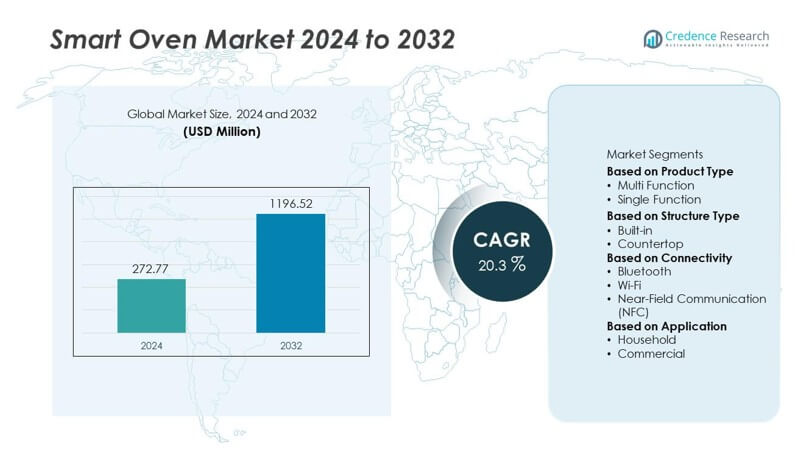
The Smart Oven market was valued at USD 272.77 million in 2024 and is projected to reach USD 1,196.52 million by 2032, expanding at a CAGR of 20.3% during the forecast period.
| REPORT ATTRIBUTE | DETAILS |
|---|---|
| Historical Period | 2020-2023 |
| Base Year | 2024 |
| Forecast Period | 2025-2032 |
| Smart Oven Market Size 2024 | USD 272.77 Million |
| Smart Oven Market, CAGR | 20.3% |
| Smart Oven Market Size 2032 | USD 1,196.52 Million |
The smart oven market is shaped by key players including Breville, KitchenAid, De’Longhi S.p.A., Hamilton Beach, BELLA, Krups, Cuisinart, Kenmore, Black & Decker, and Dualit. These companies compete by offering multifunctional, Wi-Fi-enabled ovens with features such as voice control, preset recipes, and energy-efficient designs. North America led the global market in 2024 with 38% share, supported by advanced smart home adoption and strong consumer purchasing power. Europe followed with 28% share, driven by modular kitchen trends and sustainability regulations, while Asia-Pacific captured 22%, emerging as the fastest-growing region due to rising disposable incomes, urbanization, and expanding smart home ecosystems.
Market Insights
- The smart oven market was valued at USD 272.77 million in 2024 and is projected to reach USD 1,196.52 million by 2032, growing at a CAGR of 20.3% during the forecast period.
- Growth is fueled by rising smart home adoption, demand for multifunctional appliances, and consumer preference for health-oriented cooking features such as air-frying and low-oil recipes.
- Key trends include increasing integration of Wi-Fi connectivity, AI-assisted cooking, and voice assistant compatibility, with multifunctional ovens leading the product type segment at 60% share in 2024.
- The competitive landscape features Breville, KitchenAid, De’Longhi S.p.A., Hamilton Beach, BELLA, Krups, Cuisinart, Kenmore, Black & Decker, and Dualit, focusing on product innovation, affordability, and energy-efficient models.
- Regionally, North America dominated with 38% share in 2024, followed by Europe at 28% and Asia-Pacific at 22%, while Latin America and the Middle East & Africa held smaller shares of 7% and 5% respectively.
Market Segmentation Analysis:
By Product Type
The multi-function smart oven segment dominated the market in 2024, holding over 60% share. Consumers increasingly prefer versatile ovens capable of baking, grilling, roasting, and air-frying in one unit. Rising urbanization, smaller kitchens, and demand for convenience appliances drive this adoption. Multi-function models also integrate advanced cooking modes with preset recipes, making them more appealing to tech-savvy households. Single-function ovens retain relevance in budget-conscious markets, but their limited features slow growth compared to multifunctional models, which continue to lead global sales momentum.
- For instance, Breville Group launched its Joule Oven Air Fryer Pro, featuring 13 smart cooking functions and using "super convection" airflow to reduce cooking time by up to 30%, which has led to high consumer satisfaction and market presence in North America and Europe.
By Structure Type
Built-in smart ovens accounted for nearly 55% share of the market in 2024, surpassing countertop models. Their dominance stems from rising demand in premium kitchens, integrated modular cooking setups, and home renovations focusing on aesthetics and space optimization. Built-in models also deliver higher energy efficiency and smart connectivity features, appealing to urban consumers. Countertop ovens remain popular in compact households and rental units, but the growing trend of smart home integration sustains the dominance of built-in ovens, particularly across North America and Europe where modern kitchen designs are expanding.
- For instance, Bosch released its Serie 8 built-in smart oven, featuring an intuitive touchscreen interface, intelligent sensor cooking, and an energy consumption as low as 0.69 kWh per cycle on fan-forced convection mode, making it an efficient choice in upscale urban residential projects.
By Connectivity
The Wi-Fi segment led the connectivity category in 2024, capturing more than 65% share. Wi-Fi-enabled smart ovens allow remote operation, real-time recipe updates, and voice assistant integration, which appeal strongly to connected households. Rising smartphone penetration and IoT ecosystem adoption further strengthen this growth. Bluetooth ovens are mainly adopted for short-range control, while NFC-enabled ovens remain niche due to limited device compatibility. The shift toward cloud-based cooking assistance and seamless integration with platforms like Alexa and Google Home reinforces the leadership of Wi-Fi connectivity in shaping future market expansion.
Market Overview
Key Growth Drivers
Rising Smart Home Adoption
Smart ovens benefit from the rapid expansion of smart home ecosystems. In 2024, over 55% of smart appliance sales were linked to connected households, highlighting strong integration demand. Consumers increasingly seek convenience through appliances that connect seamlessly with smartphones, smart speakers, and home hubs. Wi-Fi-enabled ovens allow remote monitoring, energy optimization, and recipe automation. The global rise in IoT penetration, supported by expanding 5G infrastructure, continues to accelerate adoption of smart ovens as central elements of modern kitchens.
- For instance, Whirlpool’s smart ovens in 2024 integrated advanced Wi-Fi connectivity via the Whirlpool app, Google Assistant, or Amazon Alexa, allowing users to preheat the oven, monitor cooking status, and use features like Scan-to-Cook for enhanced convenience and efficiency in connected homes.
Growing Health and Convenience Demand
Health-conscious consumers drive adoption of smart ovens with features like air-frying, low-oil cooking, and preset healthy recipes. In 2024, multifunctional ovens captured over 60% market share, reflecting demand for versatility and wellness-oriented functions. Busy urban lifestyles also fuel preference for quick-cook and one-touch meal preparation. Manufacturers integrating AI-assisted cooking and nutritional guidance enhance appeal among households aiming for healthier, faster food preparation. This trend strongly influences product innovation and sustains growth in both developed and emerging regions.
- For instance, Samsung's 2024 Bespoke AI™ Oven models include "AI Pro Cooking" that uses an internal camera to recognize food and can optimize cooking settings, while "Slim Fry" technology utilizes warm air circulation and a touch of oil to prepare healthier dishes compared to traditional deep frying.
Expansion in Premium Kitchen Renovations
Rising disposable incomes and home improvement projects significantly boost built-in smart oven sales, which held 55% share in 2024. Consumers increasingly prioritize space efficiency and design aesthetics, choosing premium modular kitchens with integrated appliances. Built-in smart ovens deliver higher energy efficiency and align with sustainability goals, strengthening their market position. Growth in urban housing developments, coupled with rising real estate modernization, ensures continued demand. North America and Europe remain strong markets, while Asia-Pacific sees rapid adoption due to expanding middle-class households.
Key Trends & Opportunities
Integration of AI and Voice Assistants
AI-enabled smart ovens are transforming cooking experiences with real-time adjustments, guided recipes, and predictive maintenance alerts. Voice assistant compatibility with Alexa, Google Home, and Siri enhances usability. In 2024, Wi-Fi connectivity captured 65% share, emphasizing consumer demand for advanced features. This integration creates opportunities for manufacturers to differentiate products with software updates, cloud-based services, and smart kitchen ecosystems. The push toward intelligent automation in households positions AI-driven ovens as a major growth frontier.
- For instance, the June Oven, powered by MediaTek's i500 AIoT platform, integrates computer vision and voice-assistant support. This enables features like food recognition and automated cooking programs, along with precise temperature control via a built-in thermometer.
Sustainability and Energy Efficiency
Smart ovens increasingly focus on energy-efficient designs and sustainable features. With energy prices rising globally, consumers favor appliances that minimize electricity consumption without compromising performance. Built-in ovens, with 55% share in 2024, are particularly designed with energy optimization in mind. Manufacturers promoting recyclable materials, eco-modes, and compliance with environmental standards like ENERGY STAR create long-term opportunities. This aligns with green building initiatives and regulatory frameworks, ensuring smart ovens are positioned as eco-friendly and future-ready appliances.
- For instance, Rational AG received the 2024 ENERGY STAR Partner of the Year Award for its developments in intelligent cooking equipment, including ovens that reduce energy consumption by up to 15% through adaptive cooking technology and efficient heat retention systems.
Key Challenges
High Initial Cost and Affordability Gap
Smart ovens remain costly compared to traditional models, limiting adoption in price-sensitive regions. Multifunctional models, though preferred, often fall into premium ranges, creating barriers for middle-income households. In 2024, entry-level adoption rates were considerably lower in developing markets, where cost sensitivity is high. Manufacturers face the challenge of balancing advanced features with competitive pricing. Without scalable affordability strategies, mass adoption may remain concentrated in developed economies, slowing global market penetration.
Connectivity and Data Security Concerns
Widespread reliance on Wi-Fi connectivity, which accounts for 65% market share, raises cybersecurity risks. Consumers remain cautious about data privacy, fearing unauthorized access through connected appliances. Inconsistent internet infrastructure in some regions further limits seamless use. Trust issues, if unresolved, could slow adoption of smart ovens in emerging economies. To overcome this, manufacturers must implement stronger encryption, regular software updates, and transparent data policies to ensure consumer confidence in connected kitchen ecosystems.
Regional Analysis
North America
North America held the largest share of the smart oven market in 2024 with 38%. High smart home adoption, advanced IoT infrastructure, and strong consumer purchasing power drive the region’s growth. Built-in multifunctional ovens are particularly popular, supported by premium kitchen renovations and demand for connected appliances. Manufacturers in the U.S. and Canada emphasize Wi-Fi integration and AI-assisted cooking to meet consumer expectations. The presence of leading technology firms and supportive energy efficiency regulations further reinforce the region’s leadership, ensuring North America remains the most influential contributor to overall smart oven adoption through the forecast period.
Europe
Europe accounted for 28% share of the smart oven market in 2024, driven by high penetration of premium kitchen appliances and sustainability-focused regulations. Consumers in countries like Germany, the UK, and France prefer built-in ovens that combine design aesthetics with energy efficiency. Strong demand is linked to modular kitchen trends, government initiatives promoting energy savings, and growing adoption of smart home systems. Leading European appliance manufacturers continue to expand offerings with eco-friendly and connected models. Rising consumer awareness around healthy cooking and multifunctional capabilities sustains steady demand, making Europe the second-largest regional market for smart ovens.
Asia-Pacific
Asia-Pacific represented 22% share of the smart oven market in 2024, emerging as the fastest-growing region. Expanding middle-class households, urbanization, and rising disposable incomes across China, India, and Southeast Asia drive strong adoption. Multifunctional countertop ovens are popular in compact urban kitchens, while built-in models gain momentum in premium housing projects. Increasing smartphone penetration supports Wi-Fi connectivity, which dominates adoption. Local and global brands are actively expanding in the region to meet growing demand. With rapid growth in smart home ecosystems and increasing consumer focus on convenience, Asia-Pacific is expected to outpace other regions in long-term expansion.
Latin America
Latin America held 7% share of the smart oven market in 2024, with growth concentrated in Brazil and Mexico. Rising demand for affordable multifunctional ovens and gradual adoption of smart home devices support market development. Economic constraints limit premium adoption, making countertop ovens more popular compared to built-in models. Growing urban populations and increasing internet connectivity are key enablers of smart oven demand. International brands are expanding distribution channels, while regional players focus on cost-effective models. Although smaller in share, Latin America shows steady growth potential, supported by consumer preference for energy-efficient and versatile kitchen appliances.
Middle East & Africa
The Middle East & Africa region accounted for 5% share of the smart oven market in 2024. Market growth is supported by rising urbanization, expanding modern retail channels, and increased adoption of connected appliances in affluent households. Gulf countries such as the UAE and Saudi Arabia lead demand, driven by high disposable incomes and smart city initiatives. Countertop ovens remain dominant due to affordability, but built-in ovens are gaining traction in premium housing developments. Limited internet infrastructure in some areas poses challenges, yet rising consumer interest in convenience and energy efficiency creates opportunities for gradual market expansion.
Market Segmentations:
By Product Type
- Multi Function
- Single Function
By Structure Type
- Built-in
- Countertop
By Connectivity
- Bluetooth
- Wi-Fi
- Near-Field Communication (NFC)
By Application
- Household
- Commercial
By Geography
- North America
- U.S.
- Canada
- Mexico
- Europe
- Germany
- France
- U.K.
- Italy
- Spain
- Rest of Europe
- Asia Pacific
- China
- Japan
- India
- South Korea
- South-east Asia
- Rest of Asia Pacific
- Latin America
- Brazil
- Argentina
- Rest of Latin America
- Middle East & Africa
- GCC Countries
- South Africa
- Rest of the Middle East and Africa
Competitive Landscape
Competitive landscape in the smart oven market features leading players such as Breville, KitchenAid, De’Longhi S.p.A., Hamilton Beach, BELLA, Krups, Cuisinart, Kenmore, Black & Decker, and Dualit. These companies focus on innovation, multifunctionality, and connectivity to strengthen their market presence. Wi-Fi-enabled models, voice assistant compatibility, and AI-driven cooking assistance are central to product development strategies. Premium brands like Breville and De’Longhi S.p.A. emphasize built-in multifunctional ovens tailored for modern kitchens, while mass-market players such as Hamilton Beach and Black & Decker target affordability and countertop convenience. Sustainability also plays a major role, with several manufacturers introducing energy-efficient models and recyclable components. Regional expansion strategies, online retail partnerships, and portfolio diversification further support competitive positioning. As consumer demand shifts toward health-focused, time-saving, and connected cooking solutions, leading players continue to invest in R&D and strategic collaborations, driving strong differentiation and intensifying competition across both developed and emerging markets.
Key Player Analysis
- Breville
- KitchenAid
- De’Longhi S.p.A.
- Hamilton Beach
- BELLA
- Krups
- Cuisinart
- Kenmore
- Black & Decker
- Dualit
Recent Developments
- In February 2025, KitchenAid previewed a new appliance collection at KBIS, including a Smart Oven+ with app and attachment support.
- In 2025, KitchenAid’s Smart Oven+ was described as working with the Yummly® app for remote monitoring and recipe guidance.
- In 2025, Breville’s smart ovens use an “Element iQ” system to steer power to heating elements for even cooking.
Report Coverage
The research report offers an in-depth analysis based on Product Type, Structure Type, Connectivity, Application and Geography. It details leading market players, providing an overview of their business, product offerings, investments, revenue streams, and key applications. Additionally, the report includes insights into the competitive environment, SWOT analysis, current market trends, as well as the primary drivers and constraints. Furthermore, it discusses various factors that have driven market expansion in recent years. The report also explores market dynamics, regulatory scenarios, and technological advancements that are shaping the industry. It assesses the impact of external factors and global economic changes on market growth. Lastly, it provides strategic recommendations for new entrants and established companies to navigate the complexities of the market.
Future Outlook
- The smart oven market will continue expanding with strong demand for multifunctional appliances.
- Built-in ovens will gain wider adoption due to premium kitchen renovations and modern housing trends.
- Wi-Fi connectivity will remain the dominant standard, supported by rising IoT ecosystem adoption.
- AI-enabled cooking features will grow, offering personalized recipes and predictive maintenance.
- Voice assistant integration will become a key feature to enhance consumer convenience.
- Energy-efficient models will see higher demand as sustainability regulations strengthen globally.
- Asia-Pacific will emerge as the fastest-growing region with rising middle-class adoption.
- Affordability-focused countertop ovens will remain important in price-sensitive markets.
- Competition will intensify as global brands expand alongside regional players in emerging economies.
- Continuous R&D investment will drive innovations in automation, safety, and connected kitchen solutions.

Request a Free Sample
Fill in your details and we'll send you a free sample report.
- Sample data tables & charts
- Research methodology
Market Dynamics
Rising Smart Home Adoption
The integration of smart ovens into connected home ecosystems is accelerating, as consumers seek appliances that can be remotely controlled and monitored via smartphones and smart speakers. This trend is especially strong in regions with advanced IoT infrastructure, driving higher adoption rates.
Demand for Multifunctional and Health-Oriented Cooking
Consumers increasingly prefer smart ovens that offer multiple cooking modes such as air-frying, grilling, and roasting, along with preset healthy recipes. This shift is fueled by urban lifestyles, smaller kitchens, and a growing focus on health and convenience.
Expansion in Premium Kitchen Renovations
Rising disposable incomes and a focus on modern, space-efficient kitchen designs are boosting demand for built-in smart ovens. These models are favored in premium housing and renovation projects, particularly in North America and Europe.
Advancements in Connectivity and AI Integration
The proliferation of Wi-Fi-enabled ovens with AI-assisted cooking, voice assistant compatibility, and cloud-based recipe updates is enhancing user experience and convenience. This technological evolution is a key factor in differentiating products and expanding the market.
Focus on Energy Efficiency and Sustainability
With increasing energy costs and stricter environmental regulations, consumers and builders are prioritizing energy-efficient smart ovens. Manufacturers are responding with eco-friendly designs and compliance with standards like ENERGY STAR, supporting market growth.
Need a Custom Version of This Report?
Tailor the scope, geography, or segments to your exact requirements.
- Custom geography or segment scope
- Direct access to our analyst team
Frequently Asked Questions
What is the current market size for the Smart Oven market, and what is its projected size in 2032?
At what Compound Annual Growth Rate is the Smart Oven market projected to grow between 2025 and 2032?
Which Smart Oven market segment held the largest share in 2024?
What are the primary factors fueling the growth of the Smart Oven market?
Who are the leading companies in the Smart Oven market?
Which region commanded the largest share of the Smart Oven market in 2024?
Table of Content
Chapter 1 Market Segmentation
- 1.1 Segmentation Framework
- 1.1.1 Product and Service Classification
- 1.1.2 Application and End-Use Classification
- 1.1.3 Technology and Solution Classification
- 1.1.4 Customer and Distribution Channel Classification
- 1.1.5 Geographic Segmentation
- 1.1.6 Market Segment Definitions and Boundaries
- 1.2 By Application
- 1.2.1 Household
- 1.2.2 Commercial
- 1.3 By Connectivity
- 1.3.1 Wi-Fi
- 1.3.2 Bluetooth
- 1.3.3 Near-Field Communication (NFC)
- 1.4 By Product Type
- 1.4.1 Multi Function
- 1.4.2 Single Function
- 1.5 By Structure Type
- 1.5.1 Built-in
- 1.5.2 Countertop
Chapter 2 Introduction
- 2.1 Report Objectives and Scope
- 2.2 Product Definition and Industry Terminology
- 2.3 Market Inclusions and Exclusions
- 2.4 Research Process
- 2.4.1 Primary Research and Expert Interviews
- 2.4.2 Secondary Research and Source Review
- 2.4.3 Top-Down and Bottom-Up Estimation
- 2.4.4 Data Triangulation and Verification
- 2.5 Market Size Measurement Basis
- 2.5.1 2024: USD 272.77 million → 2032: USD 1,196.52 million
- 2.6 Historical and Forecast Reference Periods
- 2.6.1 Base Year: 2024
- 2.6.2 Forecast Period: 2024-2032
- 2.7 Research Assumptions and Limitations
Chapter 3 Executive Summary
- 3.1 Market Snapshot and Key Findings
- 3.2 Base-Year Market Size, 2024
- 3.3 Forecast Market Size, 2032
- 3.4 Revenue and Volume Growth Outlook
- 3.5 Key Demand and Supply Indicators
- 3.6 Leading Market Segments
- 3.7 Fastest-Growing Market Opportunities
- 3.8 Regional Performance Highlights
- 3.9 Technology and Industry Transformation
- 3.10 Competitive Landscape Summary
- 3.11 Analyst View and Strategic Implications
Chapter 4 Global Smart Oven Market Trends and Developments
- 4.1 Historical Industry Development
- 4.2 Recent Market Trends and Developments
- 4.3 Demand and Customer Behavior Trends
- 4.4 Technology and Product Innovation
- 4.5 Artificial Intelligence, Automation and Digitalization
- 4.6 Local Manufacturing and Supply Chain Realignment
- 4.7 Industry Partnerships, Mergers and Acquisitions
- 4.8 Sustainability and Circular Economy Developments
- 4.9 Government and Private Sector Investment Trends
- 4.10 Emerging Business Models and Commercialization
- 4.11 Industry Developments and Announcements
Chapter 5 Global Smart Oven Market Production, Supply and Demand Analysis
- 5.1 Demand Trend and Consumption Analysis
- 5.2 Demand Forecast, 2024-2032
- 5.3 Production and Output Trend
- 5.4 Production and Output Forecast, 2024-2032
- 5.5 Installed Capacity and Capacity Utilization
- 5.6 Company-Wise Production Plants and Statistics
- 5.6.1 Installed Production Capacity
- 5.6.2 Actual Production
- 5.6.3 Planned Capacity and Expansion Targets
- 5.7 Supply Chain Structure and Procurement Trends
- 5.8 Supply-Demand Gap and Bottlenecks
- 5.9 Import Dependence and Sourcing Structure
- 5.10 Contract Manufacturing and Outsourcing
- 5.11 Regional Supply and Demand Concentration
Chapter 6 Global Smart Oven Market Pricing Analysis
- 6.1 Pricing Structure and Measurement
- 6.2 Historical Pricing Trends
- 6.3 Pricing Outlook, 2024-2032
- 6.4 Average Selling Price and Unit Economics
- 6.5 Pricing by Product and Market Segment
- 6.6 Geographic Pricing Differences
- 6.7 Key Input, Energy, Labor and Logistics Costs
- 6.8 Contract Pricing and Purchasing Models
- 6.9 Pricing Sensitivity and Competitive Positioning
- 6.10 Price, Margin and Profitability Implications
Chapter 7 Global Smart Oven Market Dynamics
- 7.1 Market Growth Drivers
- 7.1.1 Demand-Side Drivers
- 7.1.2 Technology and Innovation Drivers
- 7.1.3 Infrastructure and Investment Drivers
- 7.1.4 Regulatory and Policy Drivers
- 7.2 Market Restraints
- 7.2.1 Cost and Affordability Constraints
- 7.2.2 Technology and Adoption Barriers
- 7.2.3 Supply Chain and Operational Constraints
- 7.3 Market Challenges
- 7.3.1 Competitive Pressure and Margin Erosion
- 7.3.2 Skills, Infrastructure and Implementation Gaps
- 7.4 Emerging Market Opportunities
- 7.5 Market Dynamics Impact and Time-Horizon Assessment
Chapter 8 Global Smart Oven Value Chain Analysis
- 8.1 Industry Value Chain Overview
- 8.2 Upstream Suppliers and Critical Inputs
- 8.3 Technology and Component Providers
- 8.4 Manufacturing or Service Delivery
- 8.5 Distribution, Channel Partners and Integrators
- 8.6 Downstream Applications and End Users
- 8.7 Value Addition and Profit Pools
- 8.8 Vertical Integration and Outsourcing
- 8.9 Supplier Concentration and Risk
- 8.10 Supply Chain Localization and Resilience
Chapter 9 Global Smart Oven Market Regulations and Policies
- 9.1 Relevant Laws, Standards and Compliance Frameworks
- 9.2 Product, Service, Safety and Quality Requirements
- 9.3 Government Policies, Incentives and Subsidies
- 9.4 Imports, Exports and Trade Barriers
- 9.5 Public Procurement and Local Content Requirements
- 9.6 Environmental and Sustainability Compliance
- 9.7 Upcoming Policy Changes and Market Implications
Chapter 10 Global Smart Oven Market Hotspots and Opportunities
- 10.1 Market Opportunity Mapping and Growth Hotspots
- 10.2 High-Growth Applications and Customer Groups
- 10.3 Underserved Markets and White-Space Opportunities
- 10.4 Emerging Technology and Product Opportunities
- 10.5 New Capacity and Investment Hotspots
- 10.6 Market Entry and Expansion Opportunities
- 10.7 Distribution and Partnership Opportunities
- 10.8 Near-Term and Long-Term Commercial Potential
- 10.9 Opportunity Attractiveness and Execution Risks
Chapter 11 Global Smart Oven Market Outlook, 2024-2032
- 11.1 Market Size and Analysis
- 11.1.1 Revenue (Market Measurement: 2024: USD 272.77 million → 2032: USD 1,196.52 million)
- 11.1.2 Market Volume and Quantity Sold
- 11.1.3 Historical Market Size
- 11.1.4 Base-Year Market Size, 2024
- 11.2 Market Forecast, 2024-2032
- 11.2.1 Revenue Forecast to 2032
- 11.2.2 Volume Forecast to 2032
- 11.2.3 CAGR and Year-on-Year Growth
- 11.2.4 Incremental Revenue Opportunity
- 11.3 Forecast Assumptions and Scenario Analysis
- 11.3.1 Base-Case Forecast
- 11.3.2 Optimistic and Conservative Scenarios
- 11.3.3 Technology, Pricing and Policy Sensitivities
- 11.4 Market Attractiveness and Growth Outlook
Chapter 12 Global Smart Oven Market Segmentation and Outlook
- 12.1 Segmentation Summary and Market Shares, 2024
- 12.2 Largest and Fastest-Growing Segments
- 12.3 By Application - Market Size and Forecast, 2024-2032
- 12.3.1 Segment Definition and Scope
- 12.3.2 Historical Market Size
- 12.3.3 Revenue Forecast, 2024-2032
- 12.3.4 Volume Forecast, 2024-2032
- 12.3.5 Base-Year Market Share, 2024
- 12.3.6 Segment CAGR and Growth Drivers
- 12.3.7 Subsegment Market Size and Forecast
- 12.3.7.1 Household
- 12.3.7.2 Commercial
- 12.3.8 Subsegment Pricing and Adoption Trends
- 12.3.9 Leading Suppliers and Competition
- 12.3.10 Regional Demand and Opportunities
- 12.4 By Connectivity - Market Size and Forecast, 2024-2032
- 12.4.1 Segment Definition and Scope
- 12.4.2 Historical Market Size
- 12.4.3 Revenue Forecast, 2024-2032
- 12.4.4 Volume Forecast, 2024-2032
- 12.4.5 Base-Year Market Share, 2024
- 12.4.6 Segment CAGR and Growth Drivers
- 12.4.7 Subsegment Market Size and Forecast
- 12.4.7.1 Wi-Fi
- 12.4.7.2 Bluetooth
- 12.4.7.3 Near-Field Communication (NFC)
- 12.4.8 Subsegment Pricing and Adoption Trends
- 12.4.9 Leading Suppliers and Competition
- 12.4.10 Regional Demand and Opportunities
- 12.5 By Product Type - Market Size and Forecast, 2024-2032
- 12.5.1 Segment Definition and Scope
- 12.5.2 Historical Market Size
- 12.5.3 Revenue Forecast, 2024-2032
- 12.5.4 Volume Forecast, 2024-2032
- 12.5.5 Base-Year Market Share, 2024
- 12.5.6 Segment CAGR and Growth Drivers
- 12.5.7 Subsegment Market Size and Forecast
- 12.5.7.1 Multi Function
- 12.5.7.2 Single Function
- 12.5.8 Subsegment Pricing and Adoption Trends
- 12.5.9 Leading Suppliers and Competition
- 12.5.10 Regional Demand and Opportunities
- 12.6 By Structure Type - Market Size and Forecast, 2024-2032
- 12.6.1 Segment Definition and Scope
- 12.6.2 Historical Market Size
- 12.6.3 Revenue Forecast, 2024-2032
- 12.6.4 Volume Forecast, 2024-2032
- 12.6.5 Base-Year Market Share, 2024
- 12.6.6 Segment CAGR and Growth Drivers
- 12.6.7 Subsegment Market Size and Forecast
- 12.6.7.1 Built-in
- 12.6.7.2 Countertop
- 12.6.8 Subsegment Pricing and Adoption Trends
- 12.6.9 Leading Suppliers and Competition
- 12.6.10 Regional Demand and Opportunities
- 12.7 Segment Growth Comparison
- 12.8 Segment Attractiveness and Priority Matrix
Chapter 13 Global Smart Oven End-Use and Application Market Outlook
- 13.1 End-Use Industry and Customer Demand Structure
- 13.2 Leading Applications and Customer Groups
- 13.3 End-Use Market Size, Share and Forecast
- 13.4 Major End-Use Industry Deep Dives
- 13.4.1 Customer Requirements and Use Cases
- 13.4.2 Demand and Replacement Cycles
- 13.4.3 Technical and Regulatory Considerations
- 13.4.4 Purchasing and Procurement Models
- 13.4.5 Leading Vendors and Distribution Channels
- 13.4.6 Forecast and Commercial Opportunities
- 13.5 Emerging Applications and Cross-Segment Demand
- 13.6 End-Use Industry Investment Priorities
Chapter 14 Global Smart Oven Geographic Market Outlook, 2024-2032
- 14.1 Regional Market Size and Share, 2024
- 14.2 Regional Market Forecast, 2024-2032
- 14.3 Regional Pricing, Production and Demand Differences
- 14.4 North America
- 14.4.1 United States
- 14.4.2 Canada
- 14.4.3 Mexico
- 14.5 Europe
- 14.5.1 Germany
- 14.5.2 France
- 14.5.3 Italy
- 14.5.4 United Kingdom
- 14.5.5 Spain
- 14.5.6 Poland
- 14.5.7 Russia
- 14.5.8 Netherlands
- 14.5.9 Belgium
- 14.5.10 Sweden
- 14.5.11 Denmark
- 14.5.12 Norway
- 14.5.13 Rest of Europe
- 14.6 Asia Pacific
- 14.6.1 China
- 14.6.2 India
- 14.6.3 Japan
- 14.6.4 South Korea
- 14.6.5 Thailand
- 14.6.6 Indonesia
- 14.6.7 Vietnam
- 14.6.8 Malaysia
- 14.6.9 Australia
- 14.6.10 Rest of Asia Pacific
- 14.7 Latin America
- 14.7.1 Brazil
- 14.7.2 Argentina
- 14.7.3 Colombia
- 14.7.4 Chile
- 14.7.5 Rest of Latin America
- 14.8 Middle East
- 14.8.1 Saudi Arabia
- 14.8.2 United Arab Emirates
- 14.8.3 Turkey
- 14.8.4 Israel
- 14.8.5 Iran
- 14.8.6 Rest of the Middle East
- 14.9 Africa
- 14.9.1 South Africa
- 14.9.2 Egypt
- 14.9.3 Nigeria
- 14.9.4 Morocco
- 14.9.5 Rest of Africa
- 14.10 Regional Investment, Policy and Supply Chain Differences
- 14.11 Regional Competitive Landscape
- 14.12 Geographic Growth Hotspots
Chapter 15 Global Smart Oven Technology, Innovation and Sustainability Outlook
- 15.1 Technology Landscape and Maturity
- 15.2 Product, Process and Service Innovation
- 15.3 AI, Automation and Digital Tools in the Industry
- 15.4 Technology Adoption and Performance Benchmarking
- 15.5 Innovation Pipeline and R&D Investment
- 15.6 Patent and Intellectual Property Trends
- 15.7 Energy Efficiency and Resource Management
- 15.8 Sustainability, Recycling and Circularity
- 15.9 Technology Roadmap, 2024-2032
- 15.10 Risks of Obsolescence and Technology Substitution
Chapter 16 Global Smart Oven Market Key Strategic Imperatives
- 16.1 Growth and Market Entry Priorities
- 16.2 High-Return Products and Segments
- 16.3 Pricing, Profitability and Cost Optimization
- 16.4 Technology Investment and Product Differentiation
- 16.5 Supply Chain Localization and Resilience
- 16.6 Distribution and Customer Acquisition
- 16.7 Partnership, Acquisition and Capacity Strategy
- 16.8 Regional Expansion Priorities
- 16.9 Short-, Medium- and Long-Term Actions
Chapter 17 Competition Outlook
- 17.1 Industry Competition Characteristics
- 17.2 Market Structure and Concentration
- 17.3 Market Share and Competitive Positioning, 2024
- 17.4 Company-Wise Revenue and Product Benchmarking
- 17.5 Production and Service Capacity Benchmarking
- 17.6 Technology, Pricing and Differentiation
- 17.7 Regional Footprint and Distribution Strength
- 17.8 Mergers, Acquisitions and Strategic Alliances
- 17.9 New Entrants and Competitive Threats
- 17.10 Porter's Five Forces and Industry Attractiveness
- 17.11 Competitive Outlook, 2024-2032
Chapter 18 Company Profiles
- 18.1 Company Coverage and Selection Criteria
- 18.2 Breville
- 18.2.1 Business Description
- 18.2.2 Company Ownership and Geographic Presence
- 18.2.3 Product and Service Portfolio
- 18.2.4 Manufacturing and Operating Footprint
- 18.2.5 Production Capacity and Expansion Plans
- 18.2.6 Financial Performance and Investment
- 18.2.7 Market Share and Competitive Position
- 18.2.8 Technology and Innovation Capabilities
- 18.2.9 Strategic Alliances or Partnerships
- 18.2.10 Recent Developments
- 18.2.11 Growth Strategy and Outlook
- 18.3 KitchenAid
- 18.4 De’Longhi S.p.A.
- 18.5 Hamilton Beach
- 18.6 BELLA
- 18.7 Krups
- 18.8 Cuisinart
- 18.9 Kenmore
- 18.10 Black & Decker
- 18.11 Dualit
- 18.12 Other Relevant Market Participants
Note: Every listed company is profiled on the structure shown under the first company. The company list is preliminary and may change based on research findings, market developments, data availability and client requirements.
Chapter 19 Disclaimer
- 19.1 Research and Forecast Disclaimer
- 19.2 Data Source and Estimation Limitations
Note: The depth of individual sections depends on data availability for this market. Volume, capacity, trade and other unit-based metrics are included where applicable.

