Market Overview:
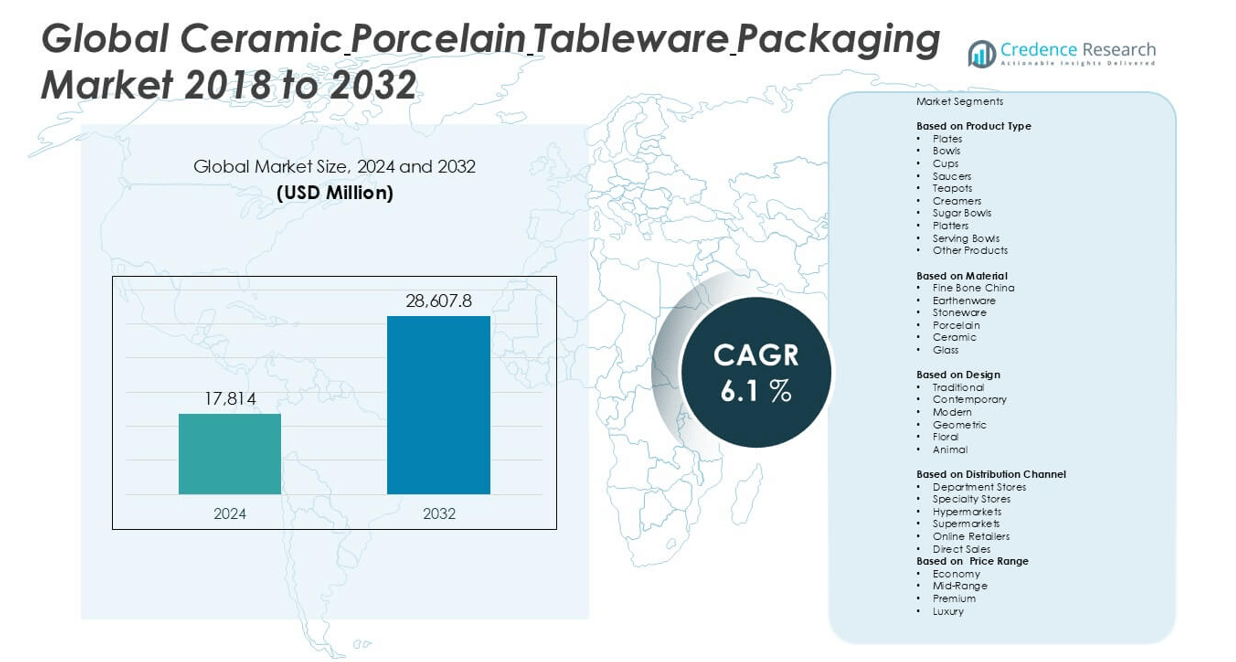
The Ceramic Porcelain Tableware Packaging market size was valued at USD 17,814 million in 2024 and is anticipated to reach USD 28,607.8 million by 2032, growing at a CAGR of 6.1% during the forecast period.
| REPORT ATTRIBUTE | DETAILS |
|---|---|
| Historical Period | 2020-2023 |
| Base Year | 2024 |
| Forecast Period | 2025-2032 |
| Ceramic Porcelain Tableware Packaging Market Size 2024 | USD 17,814 million |
| Ceramic Porcelain Tableware Packaging Market, CAGR | 6.1% |
| Ceramic Porcelain Tableware Packaging Market Size 2032 | USD 28,607.8 million |
The ceramic porcelain tableware packaging market is led by prominent players such as Churchill, Noritake, Bernardaud, Versace Home, Royal Worcester, Rosenthal, Lenox, Johnson Brothers, Spode, Wedgwood, Royal Albert, Villeroy & Boch, Herend, Royal Doulton, and Haviland. These companies focus on offering premium and customized packaging solutions that align with their high-end tableware products, emphasizing aesthetics, protection, and sustainability. Asia Pacific dominates the global market with a 31% share in 2024, driven by large-scale production and export activities in countries like China and India. Europe follows with a 24% share, supported by strong demand for traditional and artisanal tableware. North America holds 27% of the market, propelled by consumer preference for premium dining experiences and eco-friendly packaging innovations. The strategic focus among key players includes enhancing product visibility, integrating eco-conscious materials, and meeting the growing needs of e-commerce and international distribution.
Market Insights
- The ceramic porcelain tableware packaging market was valued at USD 17,814 million in 2024 and is projected to reach USD 28,607.8 million by 2032, growing at a CAGR of 6.1% during the forecast period.
- Market growth is driven by rising demand for premium dining experiences, increased adoption of ceramic tableware in hospitality sectors, and growing e-commerce sales requiring protective packaging.
- A key trend is the shift toward sustainable and customizable packaging solutions, with brands increasingly using biodegradable materials and innovative designs to enhance consumer engagement.
- The market is highly competitive, with major players such as Noritake, Villeroy & Boch, Rosenthal, and Churchill focusing on strategic partnerships and packaging innovations to maintain brand value and reduce breakage risks.
- Asia Pacific leads with 31% market share due to large-scale production, followed by North America (27%) and Europe (24%); plates represent the dominant product segment owing to their widespread use and high packaging needs.Market Segmentation Analysis:
By Type
In the Ceramic Porcelain Tableware Packaging market, plates represent the dominant sub-segment, accounting for the largest market share due to their high consumption in both domestic and commercial settings. Plates are a staple in tableware sets and are frequently purchased in bulk for restaurants, hotels, and catering services, driving packaging demand. The increasing global preference for aesthetic and functional dinnerware boosts this segment’s growth. Additionally, the growing trend of gifting ceramic plate sets during festive seasons and special occasions continues to support the packaging industry's expansion in this category.
- For instance, Churchill China produced over 68 million ceramic tableware units in 2022, with a substantial portion requiring durable packaging solutions for hotel and catering sectors.
By Material and Design:
Porcelain holds the leading position within the material segment, capturing a substantial share owing to its durability, refined appearance, and heat resistance. It is widely preferred in both household and hospitality sectors, necessitating premium and protective packaging solutions. In terms of design, the traditional sub-segment dominates the market, driven by strong consumer affinity for timeless aesthetics and cultural patterns, particularly in Asia and Europe. These designs are often used in heritage or ceremonial settings, increasing the need for careful packaging to preserve intricate detailing and craftsmanship during transportation and display.
- For instance, Villeroy & Boch reported that 72% of its dinnerware product line in 2023 consisted of fine porcelain collections with traditional patterns, requiring customized foam and corrugated packaging across 45 countries.
By Distribution Channel:
Online retailers have emerged as the dominant distribution channel in the Ceramic Porcelain Tableware Packaging market, holding the largest market share. The surge in e-commerce adoption, driven by convenience, wider product availability, and competitive pricing, fuels this segment’s growth. The demand for secure, eco-friendly, and visually appealing packaging has increased as fragile ceramic products require protective solutions for safe home deliveries. Additionally, innovative packaging that enhances unboxing experiences is gaining traction among online shoppers, further boosting the need for tailored packaging designs in this rapidly expanding distribution segment.
Market Overview
Rising Demand for Premium Dining Experiences
The growing global inclination toward fine dining and premium culinary experiences is significantly boosting demand for ceramic porcelain tableware, thereby driving the need for high-quality and protective packaging solutions. Hospitality and food service sectors, including luxury hotels and upscale restaurants, are increasingly adopting elegant tableware to enhance guest experiences. This demand for aesthetically appealing and fragile products necessitates specialized, durable packaging that ensures safe handling and transport. Consequently, packaging providers are innovating with robust and visually appealing solutions to cater to this premium market segment.
- For instance, Lenox Corporation supplies over 4,000 hospitality clients in the U.S., each requiring double-walled corrugated packaging with foam inserts to meet fine-dining handling standards.
Expansion of E-commerce and Online Retail Channels
The rapid growth of e-commerce platforms and direct-to-consumer sales channels has reshaped the ceramic porcelain tableware industry. With more consumers purchasing tableware online, manufacturers and sellers require secure, tamper-resistant, and sustainable packaging to ensure product safety during transit. The rise in online sales also fuels demand for packaging designs that enhance unboxing experiences and brand presentation. This trend is prompting packaging providers to develop advanced, protective solutions with a focus on minimizing breakage, optimizing logistics, and improving customer satisfaction through attractive and functional packaging.
- For instance, Royal Doulton reported a 34% increase in direct-to-consumer online sales in 2023, leading to the deployment of over 1.2 million eco-friendly molded pulp trays and recyclable mailer boxes.
Sustainability-Driven Consumer Preferences
Increasing consumer awareness about environmental sustainability is pushing brands to adopt eco-friendly packaging solutions for ceramic porcelain tableware. Buyers now seek biodegradable, recyclable, or reusable packaging that aligns with their eco-conscious values. Regulatory pressure on single-use plastics further compels manufacturers to adopt green packaging alternatives. As a result, packaging providers are investing in sustainable materials like molded pulp, corrugated cardboard, and plant-based films. This shift not only enhances brand reputation but also supports long-term market growth by meeting evolving consumer expectations and complying with environmental standards.
Key Trends & Opportunities
Innovative and Customizable Packaging Designs
Customization and innovation in packaging are gaining traction as brands aim to create a strong shelf presence and enhance customer engagement. Personalized packaging, such as printed logos, brand-themed graphics, and creative box designs, is becoming a popular strategy to differentiate products in a competitive market. Additionally, smart packaging with QR codes and interactive elements is being explored to improve post-sale consumer interaction. These advancements present opportunities for packaging providers to offer value-added services that go beyond protection and contribute to the overall brand experience.
- For instance, Rosenthal GmbH introduced NFC-enabled smart packaging across 250,000 premium tableware units in 2023 to allow customers instant product authentication and care instructions.
Integration of Smart and Protective Packaging Solutions
As fragile ceramic tableware becomes more frequently shipped through online channels, there is a growing need for smart packaging solutions that combine durability with convenience. Developments in shock-absorbing materials, tamper-evident seals, and temperature-resistant barriers are enabling safer transport and longer shelf-life. In addition, embedded tracking features and sensor-integrated packaging are being introduced to improve logistics transparency. These solutions cater to the increasing demand for safety, traceability, and functionality, offering packaging providers opportunities to stand out with advanced and intelligent packaging technologies.
- For instance, Spode partnered with a logistics firm in 2023 to implement RFID-enabled packaging across 180,000 outbound shipments, reducing damage rates by 23%.
Key Challenges
High Cost of Sustainable and Protective Packaging
Despite the growing preference for eco-friendly materials, the high cost associated with sustainable and high-performance protective packaging poses a significant challenge. Biodegradable and recyclable materials often come at a premium, which can increase the overall product cost-especially for brands targeting budget-conscious consumers. Furthermore, achieving the necessary strength and shock resistance with green materials can be technically complex and expensive. This cost factor may limit adoption, particularly among small and medium-sized enterprises operating under tight margins.
Logistics and Breakage Concerns in Supply Chain
Ceramic porcelain tableware is inherently fragile, making it highly susceptible to damage during transportation and handling. Managing logistics for such breakable items requires additional precautions, including multi-layered or cushioned packaging, which can increase shipping costs and packaging waste. Inadequate handling practices in logistics networks further raise the risk of breakage, leading to customer dissatisfaction and return costs. Addressing these challenges demands consistent investment in packaging innovation, staff training, and supply chain coordination.
Intensifying Market Competition and Brand Differentiation
The ceramic tableware industry is witnessing increased competition, with both established and emerging players vying for market share. In such a crowded space, packaging becomes a critical tool for brand differentiation. However, developing unique and memorable packaging that aligns with brand identity without inflating costs is a complex task. Many brands struggle to balance creativity with practicality, particularly when catering to diverse consumer segments across geographies. This challenge pushes packaging providers to constantly evolve design strategies while maintaining efficiency and affordability.
Regional Analysis
North America
North America holds a significant share of the ceramic porcelain tableware packaging market, accounting for approximately 27% of the global revenue in 2024. The region's strong presence in the hospitality and home décor sectors, combined with high consumer spending on premium dining products, drives market growth. The U.S. leads regional demand, with increased adoption of sustainable packaging solutions due to stringent environmental regulations. E-commerce expansion further fuels the need for protective and innovative packaging. Packaging companies are investing in recyclable materials and smart packaging technologies to meet rising consumer expectations and regulatory compliance across the region.
Europe
Europe commands around 24% of the global ceramic porcelain tableware packaging market in 2024, supported by its long-standing ceramic production heritage and strong demand for artisanal tableware. Countries like Germany, France, and Italy are key contributors due to their thriving luxury dining culture and growing focus on eco-friendly packaging. EU policies promoting sustainability encourage the adoption of biodegradable and recyclable packaging materials. Moreover, the region sees rising consumer demand for aesthetically designed packaging that complements traditional and modern tableware. Growth is further stimulated by well-established retail distribution networks and increasing penetration of online shopping across European markets.
Asia Pacific
Asia Pacific dominates the ceramic porcelain tableware packaging market with a market share of over 31% in 2024. The region benefits from high production volumes of ceramic tableware, particularly in China, India, and Japan. Rising disposable incomes, urbanization, and a growing middle class are driving demand for premium tableware and, subsequently, high-quality packaging. China is the largest exporter of ceramic tableware globally, increasing the demand for durable and export-friendly packaging solutions. The region also witnesses a rapid rise in e-commerce, prompting further innovation in packaging designs focused on protection and consumer appeal. Local manufacturers are increasingly adopting sustainable practices to align with global trends.
Latin America
Latin America accounts for nearly 9% of the global ceramic porcelain tableware packaging market in 2024, driven by growing consumer interest in aesthetic tableware and improving retail infrastructure. Brazil and Mexico lead the market, supported by increasing middle-class consumption and the hospitality sector’s gradual modernization. Though still developing, e-commerce growth is boosting demand for secure packaging solutions. However, the adoption of sustainable packaging remains limited due to cost constraints and lower regulatory enforcement compared to developed regions. Despite this, regional manufacturers are exploring recyclable materials and localized packaging innovations to gain competitive advantage.
Middle East & Africa
The Middle East & Africa region holds a modest 6% share in the ceramic porcelain tableware packaging market in 2024. Market growth is led by expanding hospitality and tourism sectors in countries like the UAE and Saudi Arabia, where luxury dining experiences drive demand for high-end ceramic tableware. This creates opportunities for protective and elegant packaging formats. While infrastructure and logistics challenges persist in parts of Africa, increasing urbanization and rising disposable incomes support gradual market development. Regional packaging providers are beginning to explore eco-friendly materials and localized solutions tailored to climatic and logistical conditions.
Market Segmentations:
By Product Type:
- Plates
- Bowls
- Cups
- Saucers
- Teapots
- Creamers
- Sugar Bowls
- Platters
- Serving Bowls
- Other Products
By Material:
- Fine Bone China
- Earthenware
- Stoneware
- Porcelain
- Ceramic
- Glass
By Design:
- Traditional
- Contemporary
- Modern
- Geometric
- Floral
- Animal
By Distribution Channel:
- Department Stores
- Specialty Stores
- Hypermarkets
- Supermarkets
- Online Retailers
- Direct Sales
By Price Range:
- Economy
- Mid-Range
- Premium
- Luxury
By Geography
- North America
- U.S.
- Canada
- Mexico
- Europe
- Germany
- France
- U.K.
- Italy
- Spain
- Rest of Europe
- Asia Pacific
- China
- Japan
- India
- South Korea
- South-east Asia
- Rest of Asia Pacific
- Latin America
- Brazil
- Argentina
- Rest of Latin America
- Middle East & Africa
- GCC Countries
- South Africa
- Rest of the Middle East and Africa
Competitive Landscape
The competitive landscape of the ceramic porcelain tableware packaging market is characterized by the presence of both global and regional players striving to offer innovative, sustainable, and protective packaging solutions. Key packaging providers focus on enhancing product safety, visual appeal, and environmental compliance to meet the evolving demands of ceramic tableware manufacturers. With rising consumer preference for eco-friendly packaging, companies are increasingly investing in biodegradable materials, smart packaging technologies, and custom-designed solutions to differentiate themselves. Collaborations with premium tableware brands such as Noritake, Villeroy & Boch, and Royal Doulton further intensify competition, as packaging becomes a critical element of brand presentation and logistics efficiency. Moreover, e-commerce growth has pushed market players to optimize packaging for durability, cost-effectiveness, and customer experience. Regional companies are also gaining traction by offering localized solutions tailored to specific cultural and logistical needs. Continuous innovation, sustainability, and strategic partnerships are key to maintaining a competitive edge in this dynamic market.
Key Player Analysis
- Royal Worcester
- Herend
- Bernardaud
- Royal Albert
- Noritake
- Villeroy Boch
- Churchill
- Wedgwood
- Johnson Brothers
- Versace Home
- Rosenthal
- Spode
- Lenox
- Royal Doulton
- Haviland
Recent Developments
- In July 2022, Lenox Corporation, America's leading tabletop, giftware, and home entertaining company, announced the acquisition of Cambridge Silversmiths, Ltd., Inc.
- In January 2022, Hollowick, Inc., a food warming and table lighting company based in the United States, has been acquired by Steelite International plc.
- In January 2022, Villeroy & Boch introduced their signature product line, Avarua, inspired by the captivating beauty of the Cook Islands. This exclusive collection of fine porcelain crockery embodies the spirit of adventure and offers an exotic dining experience at home.
- In 2022, RAK Ceramics PJSC announced large expenditures in cutting-edge production technology and environmental initiatives totaling around AED 4.5 million. RAK Ceramics has placed a greater focus on sustainable production in response to the growing demand for unique and environmentally friendly ceramic floor tiles.
Market Concentration & Characteristics
The Ceramic Porcelain Tableware Packaging Market shows a moderately fragmented structure with the presence of both global and regional players competing on product design, sustainability, and protective capabilities. It reflects a mix of traditional packaging manufacturers and specialized suppliers who cater to premium tableware brands. The market features strong demand for customized and high-strength packaging to prevent damage during shipping and enhance product presentation. Companies prioritize cost-effective and eco-friendly solutions that align with consumer preferences and regulatory norms. Innovation plays a key role in shaping competitive advantage, particularly with the rise of e-commerce and direct-to-consumer sales channels. Brand alignment through tailored packaging remains a critical factor, especially for luxury tableware segments. Regional manufacturers in Asia Pacific and Europe contribute significantly to supply, while North America emphasizes innovation and sustainability in packaging materials. The market continues to respond to shifts in consumer behavior, retail patterns, and environmental awareness, encouraging companies to focus on both functionality and visual appeal.
Report Coverage
The research report offers an in-depth analysis based on Product Type, Material, Design, Distribution Channel, Price Range and Geography. It details leading market players, providing an overview of their business, product offerings, investments, revenue streams, and key applications. Additionally, the report includes insights into the competitive environment, SWOT analysis, current market trends, as well as the primary drivers and constraints. Furthermore, it discusses various factors that have driven market expansion in recent years. The report also explores market dynamics, regulatory scenarios, and technological advancements that are shaping the industry. It assesses the impact of external factors and global economic changes on market growth. Lastly, it provides strategic recommendations for new entrants and established companies to navigate the complexities of the market.
Future Outlook
- The market will experience steady growth driven by rising demand for premium and durable tableware packaging.
- E-commerce expansion will increase the need for protective and tamper-resistant packaging solutions.
- Sustainability will remain a key focus, encouraging the adoption of biodegradable and recyclable materials.
- Customized and branded packaging designs will gain popularity to enhance consumer engagement.
- Asia Pacific will continue to dominate market share due to large-scale production and export activities.
- Europe will see rising demand for eco-friendly packaging aligned with regulatory standards.
- North America will invest in innovative packaging technologies to reduce breakage and enhance presentation.
- Technological integration such as smart packaging and QR-based tracking will support logistics and brand transparency.
- Competitive intensity will increase as companies focus on product differentiation and sustainability.
- Demand for packaging tailored to plates and premium gift sets will continue to drive innovation and design investments.

Request a Free Sample
Fill in your details and we'll send you a free sample report.
- Sample data tables & charts
- Research methodology
Market Dynamics
Premium Dining Experience Demand
The global shift toward fine dining and luxury hospitality is increasing the use of high-end ceramic porcelain tableware, which requires specialized, protective, and visually appealing packaging to ensure safe delivery and enhance brand value.
E-commerce and Online Retail Expansion
The rapid growth of e-commerce platforms for tableware sales has heightened the need for secure, tamper-resistant, and eco-friendly packaging solutions that can withstand shipping and improve the unboxing experience for consumers.
Sustainability and Eco-friendly Packaging
Rising consumer and regulatory pressure for sustainable practices is driving manufacturers to adopt biodegradable, recyclable, and reusable packaging materials, supporting both environmental goals and brand reputation.
Customization and Brand Differentiation
Brands are increasingly investing in innovative, customizable packaging designs - such as printed logos, creative graphics, and smart packaging - to stand out in a competitive market and foster stronger consumer engagement.
Protection and Logistics Optimization
The fragility of ceramic porcelain tableware necessitates advanced packaging solutions with shock-absorbing materials and smart tracking features, reducing breakage rates and optimizing logistics for both domestic and international distribution.
Need a Custom Version of This Report?
Tailor the scope, geography, or segments to your exact requirements.
- Custom geography or segment scope
- Direct access to our analyst team
Frequently Asked Questions
What is the current size of the Ceramic Porcelain Tableware Packaging Market?
What factors are driving the growth of the Ceramic Porcelain Tableware Packaging Market?
What are the key segments within the Ceramic Porcelain Tableware Packaging Market?
Who are the major players in the Ceramic Porcelain Tableware Packaging Market?
Table of Content
Chapter 1 Market Segmentation
- 1.1 Segmentation Framework
- 1.1.1 Product and Service Classification
- 1.1.2 Application and End-Use Classification
- 1.1.3 Technology and Solution Classification
- 1.1.4 Customer and Distribution Channel Classification
- 1.1.5 Geographic Segmentation
- 1.1.6 Market Segment Definitions and Boundaries
- 1.2 By Design
- 1.2.1 Traditional
- 1.2.2 Contemporary
- 1.2.3 Modern
- 1.3 By Material
- 1.3.1 Porcelain
- 1.3.2 Fine Bone China
- 1.3.3 Earthenware
- 1.3.4 Stoneware
- 1.3.5 Ceramic
- 1.4 By Product Type
- 1.4.1 Plates
- 1.4.2 Bowls
- 1.4.3 Cups
- 1.4.4 Saucers
- 1.4.5 Teapots
- 1.4.6 Serving Bowls
Chapter 2 Introduction
- 2.1 Report Objectives and Scope
- 2.2 Product Definition and Industry Terminology
- 2.3 Market Inclusions and Exclusions
- 2.4 Research Process
- 2.4.1 Primary Research and Expert Interviews
- 2.4.2 Secondary Research and Source Review
- 2.4.3 Top-Down and Bottom-Up Estimation
- 2.4.4 Data Triangulation and Verification
- 2.5 Market Size Measurement Basis
- 2.5.1 2024: USD 17,814 million → 2032: USD 28,607.8 million
- 2.6 Historical and Forecast Reference Periods
- 2.6.1 Base Year: 2024
- 2.6.2 Forecast Period: 2024-2032
- 2.7 Research Assumptions and Limitations
Chapter 3 Executive Summary
- 3.1 Market Snapshot and Key Findings
- 3.2 Base-Year Market Size, 2024
- 3.3 Forecast Market Size, 2032
- 3.4 Revenue and Volume Growth Outlook
- 3.5 Key Demand and Supply Indicators
- 3.6 Leading Market Segments
- 3.7 Fastest-Growing Market Opportunities
- 3.8 Regional Performance Highlights
- 3.9 Technology and Industry Transformation
- 3.10 Competitive Landscape Summary
- 3.11 Analyst View and Strategic Implications
Chapter 4 Global Ceramic Porcelain Tableware Packaging Market Trends and Developments
- 4.1 Historical Industry Development
- 4.2 Recent Market Trends and Developments
- 4.3 Demand and Customer Behavior Trends
- 4.4 Technology and Product Innovation
- 4.5 Artificial Intelligence, Automation and Digitalization
- 4.6 Local Manufacturing and Supply Chain Realignment
- 4.7 Industry Partnerships, Mergers and Acquisitions
- 4.8 Sustainability and Circular Economy Developments
- 4.9 Government and Private Sector Investment Trends
- 4.10 Emerging Business Models and Commercialization
- 4.11 Industry Developments and Announcements
Chapter 5 Global Ceramic Porcelain Tableware Packaging Market Production, Supply and Demand Analysis
- 5.1 Demand Trend and Consumption Analysis
- 5.2 Demand Forecast, 2024-2032
- 5.3 Production and Output Trend
- 5.4 Production and Output Forecast, 2024-2032
- 5.5 Installed Capacity and Capacity Utilization
- 5.6 Company-Wise Production Plants and Statistics
- 5.6.1 Installed Production Capacity
- 5.6.2 Actual Production
- 5.6.3 Planned Capacity and Expansion Targets
- 5.7 Supply Chain Structure and Procurement Trends
- 5.8 Supply-Demand Gap and Bottlenecks
- 5.9 Import Dependence and Sourcing Structure
- 5.10 Contract Manufacturing and Outsourcing
- 5.11 Regional Supply and Demand Concentration
Chapter 6 Global Ceramic Porcelain Tableware Packaging Market Pricing Analysis
- 6.1 Pricing Structure and Measurement
- 6.2 Historical Pricing Trends
- 6.3 Pricing Outlook, 2024-2032
- 6.4 Average Selling Price and Unit Economics
- 6.5 Pricing by Product and Market Segment
- 6.6 Geographic Pricing Differences
- 6.7 Key Input, Energy, Labor and Logistics Costs
- 6.8 Contract Pricing and Purchasing Models
- 6.9 Pricing Sensitivity and Competitive Positioning
- 6.10 Price, Margin and Profitability Implications
Chapter 7 Global Ceramic Porcelain Tableware Packaging Market Dynamics
- 7.1 Market Growth Drivers
- 7.1.1 Demand-Side Drivers
- 7.1.2 Technology and Innovation Drivers
- 7.1.3 Infrastructure and Investment Drivers
- 7.1.4 Regulatory and Policy Drivers
- 7.2 Market Restraints
- 7.2.1 Cost and Affordability Constraints
- 7.2.2 Technology and Adoption Barriers
- 7.2.3 Supply Chain and Operational Constraints
- 7.3 Market Challenges
- 7.3.1 Competitive Pressure and Margin Erosion
- 7.3.2 Skills, Infrastructure and Implementation Gaps
- 7.4 Emerging Market Opportunities
- 7.5 Market Dynamics Impact and Time-Horizon Assessment
Chapter 8 Global Ceramic Porcelain Tableware Packaging Value Chain Analysis
- 8.1 Industry Value Chain Overview
- 8.2 Upstream Suppliers and Critical Inputs
- 8.3 Technology and Component Providers
- 8.4 Manufacturing or Service Delivery
- 8.5 Distribution, Channel Partners and Integrators
- 8.6 Downstream Applications and End Users
- 8.7 Value Addition and Profit Pools
- 8.8 Vertical Integration and Outsourcing
- 8.9 Supplier Concentration and Risk
- 8.10 Supply Chain Localization and Resilience
Chapter 9 Global Ceramic Porcelain Tableware Packaging Market Regulations and Policies
- 9.1 Relevant Laws, Standards and Compliance Frameworks
- 9.2 Product, Service, Safety and Quality Requirements
- 9.3 Government Policies, Incentives and Subsidies
- 9.4 Imports, Exports and Trade Barriers
- 9.5 Public Procurement and Local Content Requirements
- 9.6 Environmental and Sustainability Compliance
- 9.7 Upcoming Policy Changes and Market Implications
Chapter 10 Global Ceramic Porcelain Tableware Packaging Market Hotspots and Opportunities
- 10.1 Market Opportunity Mapping and Growth Hotspots
- 10.2 High-Growth Applications and Customer Groups
- 10.3 Underserved Markets and White-Space Opportunities
- 10.4 Emerging Technology and Product Opportunities
- 10.5 New Capacity and Investment Hotspots
- 10.6 Market Entry and Expansion Opportunities
- 10.7 Distribution and Partnership Opportunities
- 10.8 Near-Term and Long-Term Commercial Potential
- 10.9 Opportunity Attractiveness and Execution Risks
Chapter 11 Global Ceramic Porcelain Tableware Packaging Market Outlook, 2024-2032
- 11.1 Market Size and Analysis
- 11.1.1 Revenue (Market Measurement: 2024: USD 17,814 million → 2032: USD 28,607.8 million)
- 11.1.2 Market Volume and Quantity Sold
- 11.1.3 Historical Market Size
- 11.1.4 Base-Year Market Size, 2024
- 11.2 Market Forecast, 2024-2032
- 11.2.1 Revenue Forecast to 2032
- 11.2.2 Volume Forecast to 2032
- 11.2.3 CAGR and Year-on-Year Growth
- 11.2.4 Incremental Revenue Opportunity
- 11.3 Forecast Assumptions and Scenario Analysis
- 11.3.1 Base-Case Forecast
- 11.3.2 Optimistic and Conservative Scenarios
- 11.3.3 Technology, Pricing and Policy Sensitivities
- 11.4 Market Attractiveness and Growth Outlook
Chapter 12 Global Ceramic Porcelain Tableware Packaging Market Segmentation and Outlook
- 12.1 Segmentation Summary and Market Shares, 2024
- 12.2 Largest and Fastest-Growing Segments
- 12.3 By Design - Market Size and Forecast, 2024-2032
- 12.3.1 Segment Definition and Scope
- 12.3.2 Historical Market Size
- 12.3.3 Revenue Forecast, 2024-2032
- 12.3.4 Volume Forecast, 2024-2032
- 12.3.5 Base-Year Market Share, 2024
- 12.3.6 Segment CAGR and Growth Drivers
- 12.3.7 Subsegment Market Size and Forecast
- 12.3.7.1 Traditional
- 12.3.7.2 Contemporary
- 12.3.7.3 Modern
- 12.3.8 Subsegment Pricing and Adoption Trends
- 12.3.9 Leading Suppliers and Competition
- 12.3.10 Regional Demand and Opportunities
- 12.4 By Material - Market Size and Forecast, 2024-2032
- 12.4.1 Segment Definition and Scope
- 12.4.2 Historical Market Size
- 12.4.3 Revenue Forecast, 2024-2032
- 12.4.4 Volume Forecast, 2024-2032
- 12.4.5 Base-Year Market Share, 2024
- 12.4.6 Segment CAGR and Growth Drivers
- 12.4.7 Subsegment Market Size and Forecast
- 12.4.7.1 Porcelain
- 12.4.7.2 Fine Bone China
- 12.4.7.3 Earthenware
- 12.4.7.4 Stoneware
- 12.4.7.5 Ceramic
- 12.4.8 Subsegment Pricing and Adoption Trends
- 12.4.9 Leading Suppliers and Competition
- 12.4.10 Regional Demand and Opportunities
- 12.5 By Product Type - Market Size and Forecast, 2024-2032
- 12.5.1 Segment Definition and Scope
- 12.5.2 Historical Market Size
- 12.5.3 Revenue Forecast, 2024-2032
- 12.5.4 Volume Forecast, 2024-2032
- 12.5.5 Base-Year Market Share, 2024
- 12.5.6 Segment CAGR and Growth Drivers
- 12.5.7 Subsegment Market Size and Forecast
- 12.5.7.1 Plates
- 12.5.7.2 Bowls
- 12.5.7.3 Cups
- 12.5.7.4 Saucers
- 12.5.7.5 Teapots
- 12.5.7.6 Serving Bowls
- 12.5.8 Subsegment Pricing and Adoption Trends
- 12.5.9 Leading Suppliers and Competition
- 12.5.10 Regional Demand and Opportunities
- 12.6 Segment Growth Comparison
- 12.7 Segment Attractiveness and Priority Matrix
Chapter 13 Global Ceramic Porcelain Tableware Packaging Geographic Market Outlook, 2024-2032
- 13.1 Regional Market Size and Share, 2024
- 13.2 Regional Market Forecast, 2024-2032
- 13.3 Regional Pricing, Production and Demand Differences
- 13.4 North America
- 13.4.1 United States
- 13.4.2 Canada
- 13.4.3 Mexico
- 13.5 Europe
- 13.5.1 Germany
- 13.5.2 France
- 13.5.3 Italy
- 13.5.4 United Kingdom
- 13.5.5 Spain
- 13.5.6 Poland
- 13.5.7 Russia
- 13.5.8 Netherlands
- 13.5.9 Belgium
- 13.5.10 Sweden
- 13.5.11 Denmark
- 13.5.12 Norway
- 13.5.13 Rest of Europe
- 13.6 Asia Pacific
- 13.6.1 China
- 13.6.2 India
- 13.6.3 Japan
- 13.6.4 South Korea
- 13.6.5 Thailand
- 13.6.6 Indonesia
- 13.6.7 Vietnam
- 13.6.8 Malaysia
- 13.6.9 Australia
- 13.6.10 Rest of Asia Pacific
- 13.7 Latin America
- 13.7.1 Brazil
- 13.7.2 Argentina
- 13.7.3 Colombia
- 13.7.4 Chile
- 13.7.5 Rest of Latin America
- 13.8 Middle East
- 13.8.1 Saudi Arabia
- 13.8.2 United Arab Emirates
- 13.8.3 Turkey
- 13.8.4 Israel
- 13.8.5 Iran
- 13.8.6 Rest of the Middle East
- 13.9 Africa
- 13.9.1 South Africa
- 13.9.2 Egypt
- 13.9.3 Nigeria
- 13.9.4 Morocco
- 13.9.5 Rest of Africa
- 13.10 Regional Investment, Policy and Supply Chain Differences
- 13.11 Regional Competitive Landscape
- 13.12 Geographic Growth Hotspots
Chapter 14 Global Ceramic Porcelain Tableware Packaging Technology, Innovation and Sustainability Outlook
- 14.1 Technology Landscape and Maturity
- 14.2 Product, Process and Service Innovation
- 14.3 AI, Automation and Digital Tools in the Industry
- 14.4 Technology Adoption and Performance Benchmarking
- 14.5 Innovation Pipeline and R&D Investment
- 14.6 Patent and Intellectual Property Trends
- 14.7 Energy Efficiency and Resource Management
- 14.8 Sustainability, Recycling and Circularity
- 14.9 Technology Roadmap, 2024-2032
- 14.10 Risks of Obsolescence and Technology Substitution
Chapter 15 Global Ceramic Porcelain Tableware Packaging Market Key Strategic Imperatives
- 15.1 Growth and Market Entry Priorities
- 15.2 High-Return Products and Segments
- 15.3 Pricing, Profitability and Cost Optimization
- 15.4 Technology Investment and Product Differentiation
- 15.5 Supply Chain Localization and Resilience
- 15.6 Distribution and Customer Acquisition
- 15.7 Partnership, Acquisition and Capacity Strategy
- 15.8 Regional Expansion Priorities
- 15.9 Short-, Medium- and Long-Term Actions
Chapter 16 Competition Outlook
- 16.1 Industry Competition Characteristics
- 16.2 Market Structure and Concentration
- 16.3 Market Share and Competitive Positioning, 2024
- 16.4 Company-Wise Revenue and Product Benchmarking
- 16.5 Production and Service Capacity Benchmarking
- 16.6 Technology, Pricing and Differentiation
- 16.7 Regional Footprint and Distribution Strength
- 16.8 Mergers, Acquisitions and Strategic Alliances
- 16.9 New Entrants and Competitive Threats
- 16.10 Porter's Five Forces and Industry Attractiveness
- 16.11 Competitive Outlook, 2024-2032
Chapter 17 Company Profiles
- 17.1 Company Coverage and Selection Criteria
- 17.2 Churchill
- 17.2.1 Business Description
- 17.2.2 Company Ownership and Geographic Presence
- 17.2.3 Product and Service Portfolio
- 17.2.4 Manufacturing and Operating Footprint
- 17.2.5 Production Capacity and Expansion Plans
- 17.2.6 Financial Performance and Investment
- 17.2.7 Market Share and Competitive Position
- 17.2.8 Technology and Innovation Capabilities
- 17.2.9 Strategic Alliances or Partnerships
- 17.2.10 Recent Developments
- 17.2.11 Growth Strategy and Outlook
- 17.3 Noritake
- 17.4 Bernardaud
- 17.5 Versace Home
- 17.6 Royal Worcester
- 17.7 Rosenthal
- 17.8 Lenox
- 17.9 Villeroy & Boch
- 17.10 Royal Doulton
- 17.11 Spode
- 17.12 Other Relevant Market Participants
Note: Every listed company is profiled on the structure shown under the first company. The company list is preliminary and may change based on research findings, market developments, data availability and client requirements.
Chapter 18 Disclaimer
- 18.1 Research and Forecast Disclaimer
- 18.2 Data Source and Estimation Limitations
Note: The depth of individual sections depends on data availability for this market. Volume, capacity, trade and other unit-based metrics are included where applicable.