
Market Overview:
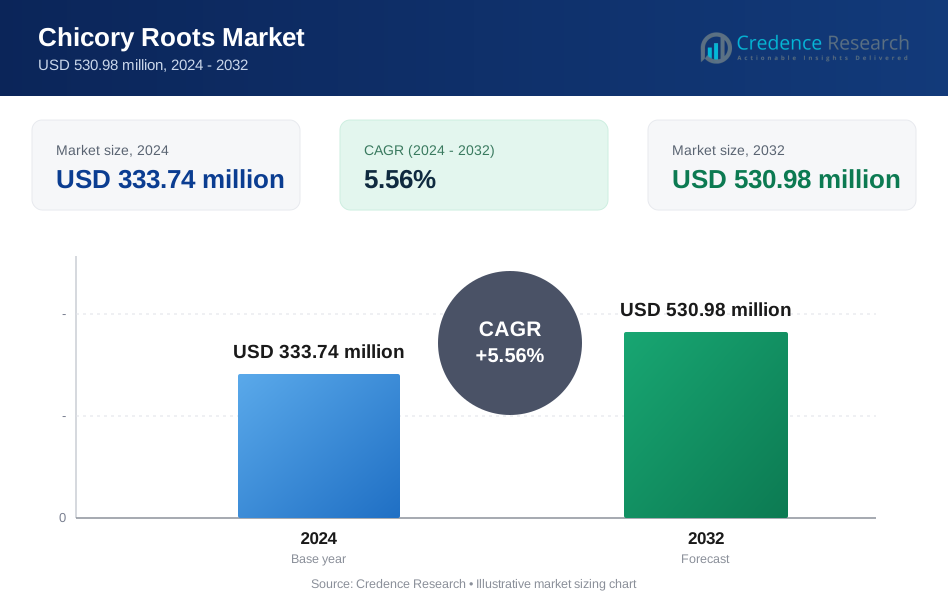
The Global Chicory Roots Market size was valued at USD 233.24 million in 2018 to USD 333.74 million in 2024 and is anticipated to reach USD 530.98 million by 2032, at a CAGR of 5.56% during the forecast period.
| REPORT ATTRIBUTE | DETAILS |
|---|---|
| Historical Period | 2020-2023 |
| Base Year | 2024 |
| Forecast Period | 2025-2032 |
| Chicory Roots Market Size 2024 | USD 333.74 million |
| Chicory Roots Market, CAGR | 5.56% |
| Chicory Roots Market Size 2032 | USD 530.98 million |
The market growth is driven by the increasing demand for natural and functional food ingredients. Chicory roots are gaining popularity due to their high inulin content, which supports digestive health and acts as a prebiotic. Rising health consciousness among consumers, coupled with the growing trend of plant-based and low-calorie dietary alternatives, is fueling adoption in the food and beverage sector. Additionally, the roots are widely used in coffee substitutes, further contributing to their market expansion as consumers seek caffeine-free options.
Europe dominates the chicory roots market due to strong demand in countries like France, Belgium, and the Netherlands, where chicory cultivation and processing are well-established. North America is emerging as a key region, driven by increased health awareness and the expanding clean-label food trend. The Asia Pacific region is witnessing steady growth, supported by rising urbanization, changing dietary preferences, and the growing use of chicory in traditional medicine and modern applications.

Market Insights:
- The Global Chicory Roots Market was valued at USD 333.74 million in 2024 and is projected to reach USD 530.98 million by 2032, growing at a CAGR of 5.56%.
- Rising demand for dietary fiber and functional food ingredients is a key driver supporting consistent market expansion.
- Chicory inulin's prebiotic properties are boosting its inclusion in food, beverages, and supplements across health-conscious consumer segments.
- Supply chain instability caused by fluctuating crop yields and climate-related challenges is restraining market consistency.
- Europe dominated the market in 2024 due to established cultivation practices and strong processing infrastructure in countries like Belgium and France.
- Asia Pacific is emerging as a high-growth region driven by rising health awareness and increasing demand for plant-based dietary products.
- Limited consumer awareness in Latin America and parts of Africa continues to slow product adoption and regional market penetration.
Market Drivers:
Rising Consumer Preference for Natural and Plant-Based Food Ingredients is Fueling Demand
The Global Chicory Roots Market benefits from rising consumer interest in natural and plant-based alternatives. Consumers are actively avoiding synthetic ingredients and opting for products that offer functional benefits. Chicory roots contain inulin, a natural dietary fiber that supports digestive health and promotes gut flora. Health-conscious individuals are increasingly including inulin-rich products in their diets, creating higher demand for chicory roots. Manufacturers are responding by reformulating food and beverage offerings to include this natural fiber. It helps position chicory as a preferred ingredient in functional foods. The growing popularity of vegan and clean-label products has further encouraged adoption. The Global Chicory Roots Market is expanding as brands capitalize on this trend.
- For instance, Beneo GmbH offers Orafti® Inulin with up to 98% purity, widely used across dairy and bakery segments for its prebiotic effects. It helps position chicory as a preferred ingredient in functional foods.
Expanding Applications Across the Food, Beverage, and Pharmaceutical Industries
The Global Chicory Roots Market continues to grow due to its expanding applications in multiple sectors. Food and beverage manufacturers are using chicory roots as a caffeine-free coffee alternative and as a natural sweetener. It serves as a fat replacer and prebiotic in dairy and bakery products, aligning with clean-label trends. Pharmaceutical companies are incorporating chicory root extracts for their anti-inflammatory and antioxidant properties. The cosmetic industry is also leveraging chicory for skin-soothing formulations. This multi-industry penetration drives consistent raw material demand. Producers are increasing their investments in extraction and processing facilities to meet the growing need. The versatility of chicory root is strengthening its global footprint and demand.
Supportive Regulatory Approvals and Growing Recognition of Inulin’s Health Benefits
Global regulatory bodies are supporting chicory-derived inulin’s inclusion in food and supplements. The European Food Safety Authority (EFSA) and the U.S. Food and Drug Administration (FDA) recognize inulin’s health benefits, aiding product launches. It ensures that manufacturers face fewer hurdles in using chicory-based ingredients. Regulatory backing has led to increased research and clinical trials, validating its functional attributes. Public health campaigns that promote fiber-rich diets are influencing consumer behavior. The Global Chicory Roots Market is gaining credibility as health professionals endorse inulin’s role in metabolic and digestive health. This positive regulatory climate encourages further innovation and consumer trust. It plays a pivotal role in market expansion.
- For instance, EFSA issued a positive opinion in 2018 stating that a daily intake of 12 grams of native chicory inulin contributes to maintaining normal defecation by increasing stool frequency.
Shifting Consumer Lifestyles and Urbanization Fueling Demand for Digestive Wellness Products
Urban consumers with hectic lifestyles are driving demand for convenient and health-oriented dietary solutions. Chicory roots provide an easy way to enhance fiber intake without major dietary changes. It fits well with on-the-go consumption formats like snack bars, shakes, and functional beverages. Rising awareness of digestive disorders has increased interest in gut-friendly foods. The Global Chicory Roots Market is experiencing growth as consumers prioritize digestive wellness. Health-focused marketing and product labeling have made chicory-derived inulin more visible. It offers a simple solution for fiber fortification in daily diets. Market momentum is likely to accelerate as this shift becomes more prominent globally.
Market Trends
Rising Popularity of Caffeine-Free Coffee Alternatives Among Health-Conscious Consumers
The Global Chicory Roots Market is witnessing increased interest due to chicory-based coffee substitutes. Consumers seeking to reduce caffeine intake are turning to roasted chicory blends. These alternatives mimic the taste of coffee while providing digestive health benefits. It supports consumer demand for functional and flavorful beverages. Brands are launching chicory-infused instant drinks, promoting them as healthier options. This trend is growing in regions with rising awareness about caffeine's side effects. The convenience of instant chicory beverages appeals to working adults and older demographics. It is becoming a lifestyle choice for health-oriented consumers.
Emergence of Organic and Non-GMO Chicory Root Products Across Retail Channels
Organic chicory roots are gaining visibility in supermarkets, health stores, and online platforms. Consumers are showing preference for non-GMO and organically grown crops. It aligns with the clean-label movement and environmental consciousness. Brands are capitalizing on this by introducing organic-certified chicory root powders, teas, and supplements. The Global Chicory Roots Market is shifting toward traceable and sustainable sourcing. Packaging now highlights certifications and origin transparency to build trust. This shift is impacting supplier practices and farming standards. The retail segment benefits from this positioning, with growing shelf space dedicated to organic variants.
- For instance, Azure Standard Organics offers roasted organic chicory root powder labeled as non‑GMO and kosher, emphasizing its inulin content and clean processing.
Integration of Chicory Root in Nutraceutical and Functional Supplement Formulations
Chicory root is becoming a common component in nutraceuticals targeting gut health, immunity, and weight management. It supports product differentiation in a competitive supplement market. Manufacturers are including chicory in capsules, powders, and gummies. The Global Chicory Roots Market is seeing increased adoption from sports nutrition brands as well. It contributes to sustained energy release and digestive regularity. This integration supports premium pricing and value-added innovation. It reflects a broader trend where traditional botanicals meet modern supplement delivery formats. The convergence of wellness and convenience drives this trend.
- For instance, MB Herbals markets instant chicory root powder that's non‑GMO and gluten‑free, tailored for users seeking convenient digestive support in beverage form.
Growing Use of Chicory Roots in Pet Nutrition and Animal Feed Applications
The pet food industry is incorporating chicory root for its prebiotic and fiber benefits. It helps enhance gut flora in dogs and cats, supporting immune function and nutrient absorption. Pet owners seek natural additives in food, mirroring human dietary preferences. The Global Chicory Roots Market is expanding into this niche but growing sector. Veterinary diets and premium pet food brands are using chicory to differentiate offerings. It improves product palatability and supports digestive balance in animals. This emerging trend reflects changing consumer attitudes toward holistic pet care. It creates new growth avenues for suppliers and processors.

Market Challenges Analysis
Fluctuating Crop Yields and Agricultural Dependency Creating Supply Chain Instability
The Global Chicory Roots Market faces instability due to its dependence on agricultural output. Crop yields vary with weather, soil conditions, and farming practices. Extreme climate events or irregular rainfall impact raw material availability. It leads to inconsistent supply for processing industries and may raise prices. The market experiences pressure from land competition with more profitable crops. Farmers may switch away from chicory during low-demand cycles. These variables contribute to supply bottlenecks and increase operational risks. Consistent quality and sourcing remain a challenge, especially for global exporters.
Limited Consumer Awareness in Emerging Markets Slows Adoption Rate
Despite health benefits, chicory root products face low awareness in emerging regions. Consumers in Asia, Africa, and Latin America are less familiar with inulin’s role in digestive health. The Global Chicory Roots Market struggles to penetrate these areas due to lack of targeted education and marketing. It limits consumer demand and affects retail distribution. Brands must invest in awareness campaigns to highlight chicory’s benefits. Without proactive outreach, chicory remains underutilized in mass-market health products. This challenge restricts volume growth and delays entry into high-potential markets. It underscores the need for stronger promotional strategies.
Market Opportunities
Expansion into Functional Beverages and Fiber-Enriched Snack Categories
The Global Chicory Roots Market can expand significantly by targeting the functional beverage and snack categories. It holds potential in developing fiber-enriched juices, bars, and ready-to-drink products. Rising consumer interest in health-driven convenience foods supports this direction. Brands can introduce new product lines that leverage chicory's taste and nutritional value. Cross-sector collaborations between foodtech and nutrition firms will accelerate innovation. It can lead to the creation of chicory-infused offerings tailored to wellness-conscious consumers. Retail acceptance of functional snacks and drinks remains high. The market stands to gain traction through diversified product formats.
Increased Penetration in Asian Markets with Growing Health Awareness
Asia presents a high-growth opportunity for the Global Chicory Roots Market. Rising urbanization and healthcare spending are fueling interest in digestive wellness. Countries like China, India, and South Korea are adopting prebiotic and fiber-rich diets. It allows manufacturers to explore regional product preferences and applications. Localization of taste profiles and health claims will drive acceptance. Strategic partnerships with regional distributors can strengthen market access. Government campaigns on nutrition further support chicory’s relevance. The market can unlock strong growth by focusing on education and accessibility.
Market Segmentation Analysis:
The Global Chicory Roots Market is segmented
By product type into Chicory Roots, Chicory Extracts, Roasted Chicory Powder, and Chicory Inulin. Chicory inulin leads the segment due to its prebiotic and digestive health benefits, making it a preferred ingredient in functional foods and dietary supplements. Roasted chicory powder holds a strong share in the beverage sector, serving as a caffeine-free alternative to coffee. Chicory extracts are gaining momentum in pharmaceuticals and nutraceuticals due to their antioxidant properties. Raw chicory roots remain essential as the base material across all downstream processing.
- For instance, Nestlé markets an instant beverage called Caro composed of roasted barley, rye, chicory, and malt widely distributed across Europe as a caffeine-free coffee alternative
By application, the market is divided into Food & Beverage, Dietary Supplements, Pharmaceuticals, Cosmetics & Personal Care, and Others. Food and beverage dominate the application landscape, driven by rising consumer demand for fiber-rich and clean-label products. Dietary supplements show rapid growth, fueled by awareness around gut health and immunity. Pharmaceuticals use chicory for anti-inflammatory and detoxification purposes. Cosmetics and personal care incorporate chicory extracts for skin-calming effects and product naturalness. It demonstrates growing cross-sector integration.
- For instance, Micro Ingredients offers organic chicory inulin powder (Non-GMO, vegan), marketed as a bulk prebiotic source for digestive health.

Segmentation:
By Product Type
- Chicory Roots
- Chicory Extracts
- Roasted Chicory Powder
- Chicory Inulin
By Application
- Food & Beverage
- Dietary Supplements
- Pharmaceuticals
- Cosmetics & Personal Care
- Others
By Region
- North America
- U.S.
- Canada
- Mexico
- Europe
- Germany
- France
- U.K.
- Italy
- Spain
- Rest of Europe
- Asia Pacific
- China
- Japan
- India
- South Korea
- South-east Asia
- Rest of Asia Pacific
- Latin America
- Brazil
- Argentina
- Rest of Latin America
- Middle East & Africa
- GCC Countries
- South Africa
- Rest of the Middle East and Africa
Regional Analysis:
The North America Global Chicory Roots Market size was valued at USD 69.12 million in 2018 to USD 97.39 million in 2024 and is anticipated to reach USD 155.58 million by 2032, at a CAGR of 5.6% during the forecast period. North America holds a 29.19% share of the Global Chicory Roots Market in 2024. The region benefits from high consumer awareness of functional foods and dietary fibers. The United States leads demand due to the popularity of caffeine-free coffee alternatives and digestive health products. Food manufacturers in the region are reformulating products to include inulin sourced from chicory roots. Chicory-based prebiotics are widely used in snacks, beverages, and supplements. Regulatory approval from the FDA for inulin use supports market stability. Rising trends in clean-label and plant-based diets drive interest in chicory ingredients. Retail distribution through health stores and online channels continues to expand. It contributes significantly to the region’s consistent market growth.
The Europe Global Chicory Roots Market size was valued at USD 100.61 million in 2018 to USD 140.54 million in 2024 and is anticipated to reach USD 215.11 million by 2032, at a CAGR of 5.1% during the forecast period. Europe commands a 42.11% share of the Global Chicory Roots Market in 2024, making it the dominant region. Countries such as Belgium, France, and the Netherlands have a long history of chicory cultivation. Chicory coffee has cultural significance and continues to enjoy stable demand. European consumers are increasingly seeking dietary fibers for gut health, supporting demand in both food and pharmaceutical sectors. The European Food Safety Authority’s recognition of inulin's health benefits has enhanced its use in mainstream products. Manufacturers in Europe are focusing on organic and non-GMO chicory variants. The region also exports chicory root products globally, strengthening its supply base. It maintains strong R&D capabilities, enhancing innovation and market reach.
The Asia Pacific Global Chicory Roots Market size was valued at USD 43.44 million in 2018 to USD 67.54 million in 2024 and is anticipated to reach USD 122.13 million by 2032, at a CAGR of 7.3% during the forecast period. Asia Pacific holds a 20.24% share of the Global Chicory Roots Market in 2024. The region is witnessing fast growth driven by urbanization, dietary changes, and rising health consciousness. Countries such as China, India, and Japan are adopting chicory roots in functional beverages and herbal supplements. Increased disposable income and the expansion of organized retail are driving chicory-infused product availability. Local manufacturers are introducing fiber-fortified food products tailored to regional preferences. Awareness campaigns promoting digestive wellness are influencing consumer behavior. Multinational companies are investing in Asia to tap into its growing middle-class market. It presents strong potential for future expansion with customized product offerings and local partnerships.
The Latin America Global Chicory Roots Market size was valued at USD 11.27 million in 2018 to USD 15.94 million in 2024 and is anticipated to reach USD 22.51 million by 2032, at a CAGR of 4.0% during the forecast period. Latin America accounts for a 4.77% share of the Global Chicory Roots Market in 2024. The market is developing steadily as awareness of plant-based and fiber-rich products increases. Brazil and Mexico are the key countries showing rising interest in functional food and beverage innovations. Chicory is gaining relevance in health-oriented product lines in urban areas. Local processing units and imports supply most of the demand, with limited domestic cultivation. The retail landscape is becoming more favorable with the expansion of health-focused aisles. Regulatory clarity around inulin is improving but still requires harmonization. It remains a secondary market but shows promise for targeted marketing and expansion in wellness segments.
The Middle East Global Chicory Roots Market size was valued at USD 5.65 million in 2018 to USD 7.28 million in 2024 and is anticipated to reach USD 9.46 million by 2032, at a CAGR of 2.9% during the forecast period. The region holds a 2.18% share of the Global Chicory Roots Market in 2024. Demand is emerging primarily from health-conscious consumers in the UAE and Saudi Arabia. Chicory roots are being introduced in functional drinks and supplements targeting digestive wellness. Limited local production has created reliance on imports from Europe and Asia. Awareness campaigns and product placement in specialty stores are slowly improving market visibility. Regional food processors are beginning to explore chicory inclusion in niche product lines. Government-led health initiatives may further influence adoption of fiber-rich diets. It remains a small market with gradual yet positive outlook for specialty health ingredients.
The Africa Global Chicory Roots Market size was valued at USD 3.15 million in 2018 to USD 5.05 million in 2024 and is anticipated to reach USD 6.19 million by 2032, at a CAGR of 2.1% during the forecast period. Africa accounts for a 1.51% share of the Global Chicory Roots Market in 2024. The market remains underdeveloped, with limited consumer awareness of chicory’s health benefits. South Africa leads demand within the continent, supported by a small segment of health-conscious urban consumers. Local production is minimal and lacks significant processing infrastructure. Imports from Europe and Asia supply the majority of chicory-based products. Distribution is primarily through online and specialty retail outlets. Educational campaigns around prebiotics and fiber are necessary to grow adoption. It represents a long-term opportunity that depends on economic growth and nutritional awareness initiatives.
Key Player Analysis:
- Beneo GmbH
- Cosucra Groupe Warcoing SA
- Sensus BV
- Cargill, Inc.
- Kerry Group Plc
- Tereos Group
- Royal Cosun
- Ingredion Incorporated
- DuPont Nutrition & Health
- Puratos Group
- Inulin France SAS
- Meijer Group
Competitive Analysis:
The Global Chicory Roots Market features a mix of well-established players and emerging companies competing on product quality, pricing, and supply chain efficiency. Leading firms such as COSUCRA Groupe Warcoing SA, Beneo GmbH, Sensus, and Leroux dominate through vertical integration and established processing infrastructure. These companies focus on innovations in inulin extraction, organic cultivation, and diversification of application formats. Regional players in Europe and Asia are expanding their footprint through strategic collaborations and contract farming. It shows strong competition in the food and beverage sector, where companies incorporate chicory roots into functional and clean-label products. The market encourages R&D investment to differentiate offerings and meet regulatory standards. E-commerce platforms and global distribution channels have further intensified competition by enabling smaller firms to access international markets. It remains moderately consolidated, with leading players influencing pricing trends and market direction through product innovations and supply chain control.
Recent Developments:
- In September 2024, Sensus established a strategic partnership with dedicated chicory root growers. The collaboration aims to support future‑proof farming by investing in sustainable cultivation methods, improving yields.
Market Concentration & Characteristics:
The Global Chicory Roots Market remains moderately concentrated, with Europe-based companies accounting for a significant share of total output. It is characterized by high barriers to entry due to the capital-intensive nature of processing and the technical expertise required for inulin extraction. The market favors vertically integrated producers who manage cultivation, processing, and distribution. Product differentiation is driven by organic certifications, fiber content, and application versatility. It supports both B2B and B2C models across functional foods, beverages, supplements, and personal care. Demand cycles are stable due to its applications in everyday consumables. It shows growing emphasis on sustainable sourcing and traceability, shaping long-term supply strategies.
Report Coverage:
The research report offers an in-depth analysis based on Product Type and Application. It details leading market players, providing an overview of their business, product offerings, investments, revenue streams, and key applications. Additionally, the report includes insights into the competitive environment, SWOT analysis, current market trends, as well as the primary drivers and constraints. Furthermore, it discusses various factors that have driven market expansion in recent years. The report also explores market dynamics, regulatory scenarios, and technological advancements that are shaping the industry. It assesses the impact of external factors and global economic changes on market growth. Lastly, it provides strategic recommendations for new entrants and established companies to navigate the complexities of the market.
Future Outlook:
- Rising health awareness will drive sustained demand for chicory-based dietary fibers in food and beverage applications.
- Expansion of functional beverages will create new product development opportunities using chicory root extracts.
- Increased investment in organic and non-GMO chicory cultivation will support premium product segments.
- E-commerce growth will enhance accessibility of chicory-based supplements and wellness products.
- Adoption of chicory in pet nutrition and animal feed will expand its application scope.
- Strategic partnerships between foodtech firms and ingredient suppliers will accelerate innovation.
- Asia Pacific will emerge as a key growth region due to urbanization and evolving dietary habits.
- Climate-resilient cultivation practices will gain importance to ensure supply chain stability.
- Regulatory support for natural fibers will strengthen chicory’s role in preventive health solutions.
- Technological advancements in extraction and processing will improve efficiency and product consistency.
Request a Free Sample
Fill in your details and we'll send you a free sample report.
- Sample data tables & charts
- Research methodology
Market Dynamics
Rising Consumer Preference for Natural and Plant-Based Ingredients
Consumers are increasingly seeking natural, plant-based alternatives in their diets, driving demand for chicory roots due to their high inulin content and functional health benefits. This trend is further supported by the popularity of vegan and clean-label products, encouraging manufacturers to incorporate chicory into a wider range of food and beverage offerings.
Expanding Applications Across Multiple Industries
Chicory roots are being adopted in diverse sectors such as food and beverage, dietary supplements, pharmaceuticals, and cosmetics, thanks to their prebiotic, antioxidant, and functional properties. This multi-industry penetration is increasing raw material demand and encouraging investment in processing and extraction facilities.
Supportive Regulatory Approvals and Health Endorsements
Global regulatory bodies like EFSA and the FDA recognize the health benefits of chicory-derived inulin, facilitating its inclusion in food and supplements. Regulatory support and public health campaigns are boosting consumer trust and accelerating product launches featuring chicory ingredients.
Growth in Functional and Caffeine-Free Beverage Markets
The rising popularity of caffeine-free coffee alternatives and functional beverages is fueling demand for roasted chicory powder and chicory-based drinks. Health-conscious consumers are seeking flavorful, gut-friendly beverage options, expanding the market for chicory root products.
Urbanization and Shifting Lifestyles Driving Digestive Wellness
Increasing urbanization and busy lifestyles are prompting consumers to seek convenient ways to improve digestive health, with chicory roots offering an easy source of dietary fiber. This is particularly evident in emerging markets, where awareness of gut health is rising and chicory-based products are gaining traction.
Need a Custom Version of This Report?
Tailor the scope, geography, or segments to your exact requirements.
- Custom geography or segment scope
- Direct access to our analyst team
Frequently Asked Questions
What is the current market size for Global Chicory Roots Market, and what is its projected size in 2032?
Which Global Chicory Roots Market segment held the largest share in 2024?
Who are the leading companies in the Global Chicory Roots Market?
Which region commanded the largest share of the Global Chicory Roots Market in 2024?
Table of Content
Chapter 1 Market Segmentation
- 1.1 Segmentation Framework
- 1.1.1 Product and Service Classification
- 1.1.2 Application and End-Use Classification
- 1.1.3 Technology and Solution Classification
- 1.1.4 Customer and Distribution Channel Classification
- 1.1.5 Geographic Segmentation
- 1.1.6 Market Segment Definitions and Boundaries
- 1.2 By Application
- 1.2.1 Food & Beverage
- 1.2.2 Dietary Supplements
- 1.2.3 Pharmaceuticals
- 1.2.4 Cosmetics & Personal Care
- 1.2.5 Others
- 1.3 By Product Type
- 1.3.1 Chicory Roots
- 1.3.2 Chicory Extracts
- 1.3.3 Roasted Chicory Powder
- 1.3.4 Chicory Inulin
Chapter 2 Introduction
- 2.1 Report Objectives and Scope
- 2.2 Product Definition and Industry Terminology
- 2.3 Market Inclusions and Exclusions
- 2.4 Research Process
- 2.4.1 Primary Research and Expert Interviews
- 2.4.2 Secondary Research and Source Review
- 2.4.3 Top-Down and Bottom-Up Estimation
- 2.4.4 Data Triangulation and Verification
- 2.5 Market Size Measurement Basis
- 2.5.1 2024: USD 333.74 million → 2032: USD 530.98 million
- 2.6 Historical and Forecast Reference Periods
- 2.6.1 Base Year: 2024
- 2.6.2 Forecast Period: 2024-2032
- 2.7 Research Assumptions and Limitations
Chapter 3 Executive Summary
- 3.1 Market Snapshot and Key Findings
- 3.2 Base-Year Market Size, 2024
- 3.3 Forecast Market Size, 2032
- 3.4 Revenue and Volume Growth Outlook
- 3.5 Key Demand and Supply Indicators
- 3.6 Leading Market Segments
- 3.7 Fastest-Growing Market Opportunities
- 3.8 Regional Performance Highlights
- 3.9 Technology and Industry Transformation
- 3.10 Competitive Landscape Summary
- 3.11 Analyst View and Strategic Implications
Chapter 4 Global Chicory Roots Market Trends and Developments
- 4.1 Historical Industry Development
- 4.2 Recent Market Trends and Developments
- 4.3 Demand and Customer Behavior Trends
- 4.4 Technology and Product Innovation
- 4.5 Artificial Intelligence, Automation and Digitalization
- 4.6 Local Manufacturing and Supply Chain Realignment
- 4.7 Industry Partnerships, Mergers and Acquisitions
- 4.8 Sustainability and Circular Economy Developments
- 4.9 Government and Private Sector Investment Trends
- 4.10 Emerging Business Models and Commercialization
- 4.11 Industry Developments and Announcements
Chapter 5 Global Chicory Roots Market Production, Supply and Demand Analysis
- 5.1 Demand Trend and Consumption Analysis
- 5.2 Demand Forecast, 2024-2032
- 5.3 Production and Output Trend
- 5.4 Production and Output Forecast, 2024-2032
- 5.5 Installed Capacity and Capacity Utilization
- 5.6 Company-Wise Production Plants and Statistics
- 5.6.1 Installed Production Capacity
- 5.6.2 Actual Production
- 5.6.3 Planned Capacity and Expansion Targets
- 5.7 Supply Chain Structure and Procurement Trends
- 5.8 Supply-Demand Gap and Bottlenecks
- 5.9 Import Dependence and Sourcing Structure
- 5.10 Contract Manufacturing and Outsourcing
- 5.11 Regional Supply and Demand Concentration
Chapter 6 Global Chicory Roots Market Pricing Analysis
- 6.1 Pricing Structure and Measurement
- 6.2 Historical Pricing Trends
- 6.3 Pricing Outlook, 2024-2032
- 6.4 Average Selling Price and Unit Economics
- 6.5 Pricing by Product and Market Segment
- 6.6 Geographic Pricing Differences
- 6.7 Key Input, Energy, Labor and Logistics Costs
- 6.8 Contract Pricing and Purchasing Models
- 6.9 Pricing Sensitivity and Competitive Positioning
- 6.10 Price, Margin and Profitability Implications
Chapter 7 Global Chicory Roots Market Dynamics
- 7.1 Market Growth Drivers
- 7.1.1 Demand-Side Drivers
- 7.1.2 Technology and Innovation Drivers
- 7.1.3 Infrastructure and Investment Drivers
- 7.1.4 Regulatory and Policy Drivers
- 7.2 Market Restraints
- 7.2.1 Cost and Affordability Constraints
- 7.2.2 Technology and Adoption Barriers
- 7.2.3 Supply Chain and Operational Constraints
- 7.3 Market Challenges
- 7.3.1 Competitive Pressure and Margin Erosion
- 7.3.2 Skills, Infrastructure and Implementation Gaps
- 7.4 Emerging Market Opportunities
- 7.5 Market Dynamics Impact and Time-Horizon Assessment
Chapter 8 Global Chicory Roots Value Chain Analysis
- 8.1 Industry Value Chain Overview
- 8.2 Upstream Suppliers and Critical Inputs
- 8.3 Technology and Component Providers
- 8.4 Manufacturing or Service Delivery
- 8.5 Distribution, Channel Partners and Integrators
- 8.6 Downstream Applications and End Users
- 8.7 Value Addition and Profit Pools
- 8.8 Vertical Integration and Outsourcing
- 8.9 Supplier Concentration and Risk
- 8.10 Supply Chain Localization and Resilience
Chapter 9 Global Chicory Roots Market Regulations and Policies
- 9.1 Relevant Laws, Standards and Compliance Frameworks
- 9.2 Product, Service, Safety and Quality Requirements
- 9.3 Government Policies, Incentives and Subsidies
- 9.4 Imports, Exports and Trade Barriers
- 9.5 Public Procurement and Local Content Requirements
- 9.6 Environmental and Sustainability Compliance
- 9.7 Upcoming Policy Changes and Market Implications
Chapter 10 Global Chicory Roots Market Hotspots and Opportunities
- 10.1 Market Opportunity Mapping and Growth Hotspots
- 10.2 High-Growth Applications and Customer Groups
- 10.3 Underserved Markets and White-Space Opportunities
- 10.4 Emerging Technology and Product Opportunities
- 10.5 New Capacity and Investment Hotspots
- 10.6 Market Entry and Expansion Opportunities
- 10.7 Distribution and Partnership Opportunities
- 10.8 Near-Term and Long-Term Commercial Potential
- 10.9 Opportunity Attractiveness and Execution Risks
Chapter 11 Global Chicory Roots Market Outlook, 2024-2032
- 11.1 Market Size and Analysis
- 11.1.1 Revenue (Market Measurement: 2024: USD 333.74 million → 2032: USD 530.98 million)
- 11.1.2 Market Volume and Quantity Sold
- 11.1.3 Historical Market Size
- 11.1.4 Base-Year Market Size, 2024
- 11.2 Market Forecast, 2024-2032
- 11.2.1 Revenue Forecast to 2032
- 11.2.2 Volume Forecast to 2032
- 11.2.3 CAGR and Year-on-Year Growth
- 11.2.4 Incremental Revenue Opportunity
- 11.3 Forecast Assumptions and Scenario Analysis
- 11.3.1 Base-Case Forecast
- 11.3.2 Optimistic and Conservative Scenarios
- 11.3.3 Technology, Pricing and Policy Sensitivities
- 11.4 Market Attractiveness and Growth Outlook
Chapter 12 Global Chicory Roots Market Segmentation and Outlook
- 12.1 Segmentation Summary and Market Shares, 2024
- 12.2 Largest and Fastest-Growing Segments
- 12.3 By Application - Market Size and Forecast, 2024-2032
- 12.3.1 Segment Definition and Scope
- 12.3.2 Historical Market Size
- 12.3.3 Revenue Forecast, 2024-2032
- 12.3.4 Volume Forecast, 2024-2032
- 12.3.5 Base-Year Market Share, 2024
- 12.3.6 Segment CAGR and Growth Drivers
- 12.3.7 Subsegment Market Size and Forecast
- 12.3.7.1 Food & Beverage
- 12.3.7.2 Dietary Supplements
- 12.3.7.3 Pharmaceuticals
- 12.3.7.4 Cosmetics & Personal Care
- 12.3.7.5 Others
- 12.3.8 Subsegment Pricing and Adoption Trends
- 12.3.9 Leading Suppliers and Competition
- 12.3.10 Regional Demand and Opportunities
- 12.4 By Product Type - Market Size and Forecast, 2024-2032
- 12.4.1 Segment Definition and Scope
- 12.4.2 Historical Market Size
- 12.4.3 Revenue Forecast, 2024-2032
- 12.4.4 Volume Forecast, 2024-2032
- 12.4.5 Base-Year Market Share, 2024
- 12.4.6 Segment CAGR and Growth Drivers
- 12.4.7 Subsegment Market Size and Forecast
- 12.4.7.1 Chicory Roots
- 12.4.7.2 Chicory Extracts
- 12.4.7.3 Roasted Chicory Powder
- 12.4.7.4 Chicory Inulin
- 12.4.8 Subsegment Pricing and Adoption Trends
- 12.4.9 Leading Suppliers and Competition
- 12.4.10 Regional Demand and Opportunities
- 12.5 Segment Growth Comparison
- 12.6 Segment Attractiveness and Priority Matrix
Chapter 13 Global Chicory Roots End-Use and Application Market Outlook
- 13.1 End-Use Industry and Customer Demand Structure
- 13.2 Leading Applications and Customer Groups
- 13.3 End-Use Market Size, Share and Forecast
- 13.4 Major End-Use Industry Deep Dives
- 13.4.1 Customer Requirements and Use Cases
- 13.4.2 Demand and Replacement Cycles
- 13.4.3 Technical and Regulatory Considerations
- 13.4.4 Purchasing and Procurement Models
- 13.4.5 Leading Vendors and Distribution Channels
- 13.4.6 Forecast and Commercial Opportunities
- 13.5 Emerging Applications and Cross-Segment Demand
- 13.6 End-Use Industry Investment Priorities
Chapter 14 Global Chicory Roots Geographic Market Outlook, 2024-2032
- 14.1 Regional Market Size and Share, 2024
- 14.2 Regional Market Forecast, 2024-2032
- 14.3 Regional Pricing, Production and Demand Differences
- 14.4 North America
- 14.4.1 United States
- 14.4.2 Canada
- 14.4.3 Mexico
- 14.5 Europe
- 14.5.1 Germany
- 14.5.2 France
- 14.5.3 Italy
- 14.5.4 United Kingdom
- 14.5.5 Spain
- 14.5.6 Poland
- 14.5.7 Russia
- 14.5.8 Netherlands
- 14.5.9 Belgium
- 14.5.10 Sweden
- 14.5.11 Denmark
- 14.5.12 Norway
- 14.5.13 Rest of Europe
- 14.6 Asia Pacific
- 14.6.1 China
- 14.6.2 India
- 14.6.3 Japan
- 14.6.4 South Korea
- 14.6.5 Thailand
- 14.6.6 Indonesia
- 14.6.7 Vietnam
- 14.6.8 Malaysia
- 14.6.9 Australia
- 14.6.10 Rest of Asia Pacific
- 14.7 Latin America
- 14.7.1 Brazil
- 14.7.2 Argentina
- 14.7.3 Colombia
- 14.7.4 Chile
- 14.7.5 Rest of Latin America
- 14.8 Middle East
- 14.8.1 Saudi Arabia
- 14.8.2 United Arab Emirates
- 14.8.3 Turkey
- 14.8.4 Israel
- 14.8.5 Iran
- 14.8.6 Rest of the Middle East
- 14.9 Africa
- 14.9.1 South Africa
- 14.9.2 Egypt
- 14.9.3 Nigeria
- 14.9.4 Morocco
- 14.9.5 Rest of Africa
- 14.10 Regional Investment, Policy and Supply Chain Differences
- 14.11 Regional Competitive Landscape
- 14.12 Geographic Growth Hotspots
Chapter 15 Global Chicory Roots Technology, Innovation and Sustainability Outlook
- 15.1 Technology Landscape and Maturity
- 15.2 Product, Process and Service Innovation
- 15.3 AI, Automation and Digital Tools in the Industry
- 15.4 Technology Adoption and Performance Benchmarking
- 15.5 Innovation Pipeline and R&D Investment
- 15.6 Patent and Intellectual Property Trends
- 15.7 Energy Efficiency and Resource Management
- 15.8 Sustainability, Recycling and Circularity
- 15.9 Technology Roadmap, 2024-2032
- 15.10 Risks of Obsolescence and Technology Substitution
Chapter 16 Global Chicory Roots Market Key Strategic Imperatives
- 16.1 Growth and Market Entry Priorities
- 16.2 High-Return Products and Segments
- 16.3 Pricing, Profitability and Cost Optimization
- 16.4 Technology Investment and Product Differentiation
- 16.5 Supply Chain Localization and Resilience
- 16.6 Distribution and Customer Acquisition
- 16.7 Partnership, Acquisition and Capacity Strategy
- 16.8 Regional Expansion Priorities
- 16.9 Short-, Medium- and Long-Term Actions
Chapter 17 Competition Outlook
- 17.1 Industry Competition Characteristics
- 17.2 Market Structure and Concentration
- 17.3 Market Share and Competitive Positioning, 2024
- 17.4 Company-Wise Revenue and Product Benchmarking
- 17.5 Production and Service Capacity Benchmarking
- 17.6 Technology, Pricing and Differentiation
- 17.7 Regional Footprint and Distribution Strength
- 17.8 Mergers, Acquisitions and Strategic Alliances
- 17.9 New Entrants and Competitive Threats
- 17.10 Porter's Five Forces and Industry Attractiveness
- 17.11 Competitive Outlook, 2024-2032
Chapter 18 Company Profiles
- 18.1 Company Coverage and Selection Criteria
- 18.2 Beneo GmbH
- 18.2.1 Business Description
- 18.2.2 Company Ownership and Geographic Presence
- 18.2.3 Product and Service Portfolio
- 18.2.4 Manufacturing and Operating Footprint
- 18.2.5 Production Capacity and Expansion Plans
- 18.2.6 Financial Performance and Investment
- 18.2.7 Market Share and Competitive Position
- 18.2.8 Technology and Innovation Capabilities
- 18.2.9 Strategic Alliances or Partnerships
- 18.2.10 Recent Developments
- 18.2.11 Growth Strategy and Outlook
- 18.3 Cosucra Groupe Warcoing SA
- 18.4 Sensus BV
- 18.5 Cargill, Inc.
- 18.6 Kerry Group Plc
- 18.7 Tereos Group
- 18.8 Royal Cosun
- 18.9 Ingredion Incorporated
- 18.10 DuPont Nutrition & Health
- 18.11 Puratos Group
- 18.12 Other Relevant Market Participants
Note: Every listed company is profiled on the structure shown under the first company. The company list is preliminary and may change based on research findings, market developments, data availability and client requirements.
Chapter 19 Disclaimer
- 19.1 Research and Forecast Disclaimer
- 19.2 Data Source and Estimation Limitations
Note: The depth of individual sections depends on data availability for this market. Volume, capacity, trade and other unit-based metrics are included where applicable.

