
| REPORT ATTRIBUTE | DETAILS |
|---|---|
| Historical Period | 2020-2023 |
| Base Year | 2024 |
| Forecast Period | 2025-2032 |
| Construction Toys Market Size 2024 | USD 15,248.06 million |
| Construction Toys Market, CAGR | 11.61% |
| Construction Toys Market Size 2032 | USD 36,723.49 million |
Market Overview
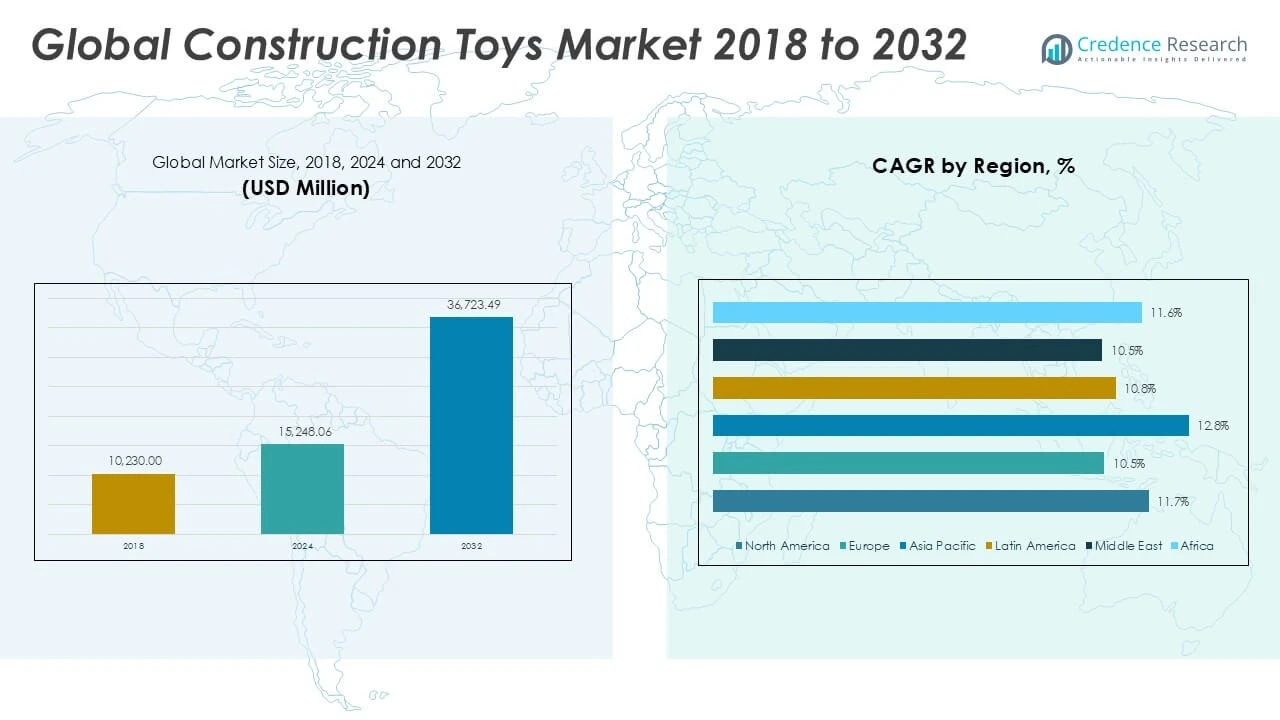
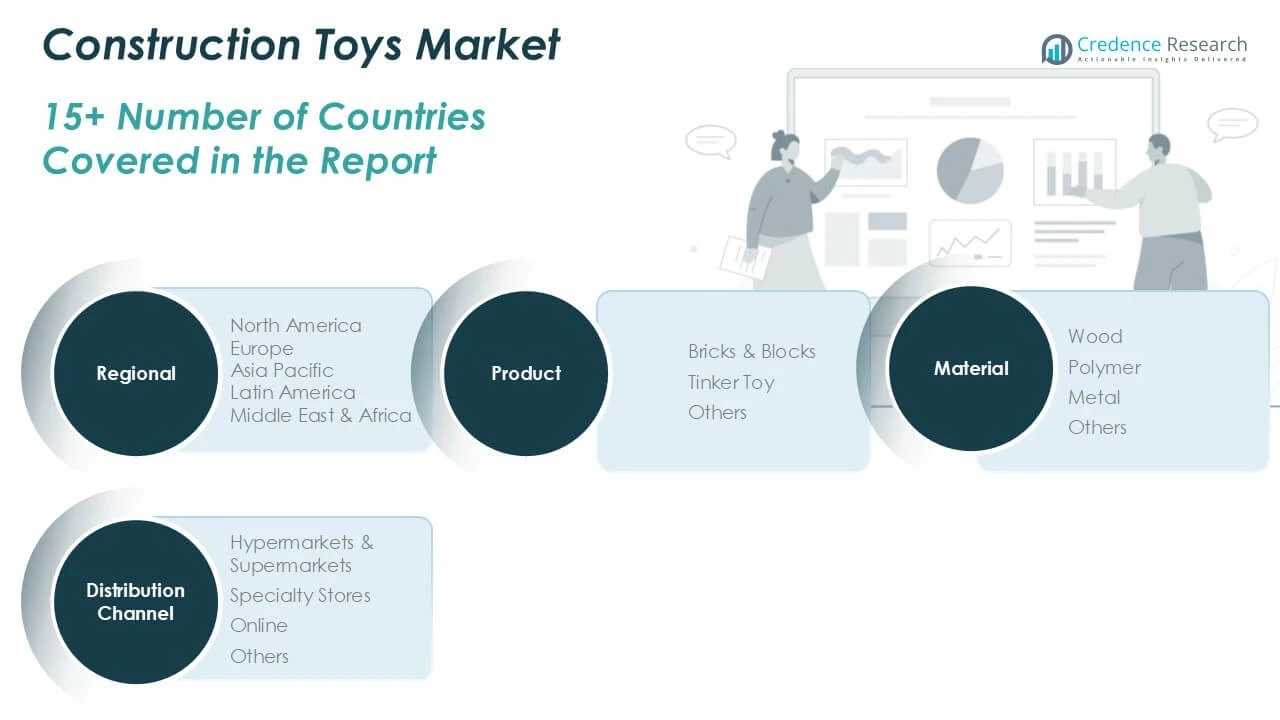
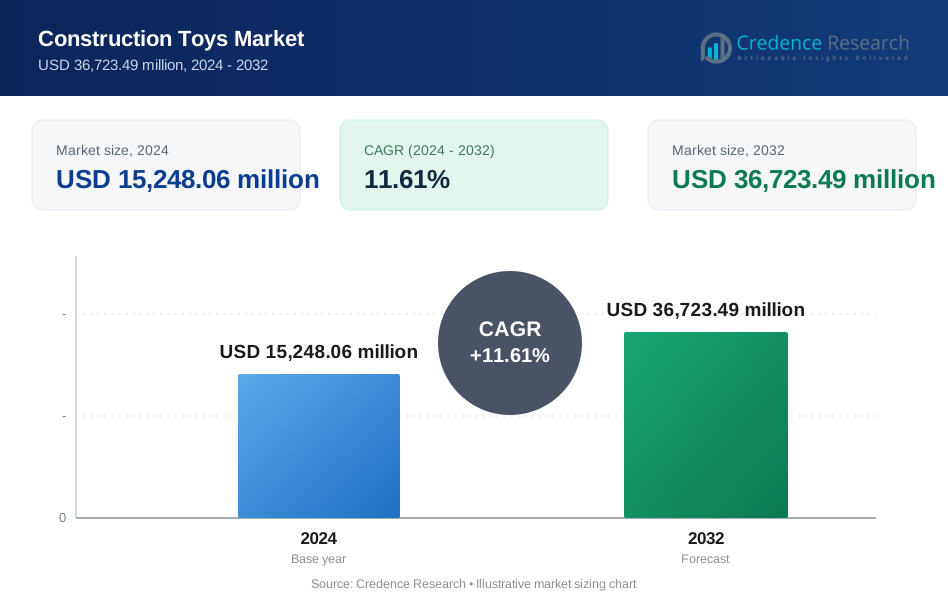
The Global Construction Toys Market is projected to grow from USD 15,248.06 million in 2024 to an estimated USD 36,723.49 million by 2032, registering a compound annual growth rate (CAGR) of 11.61% from 2025 to 2032.
Key drivers propelling the Construction Toys Market include growing parental awareness about the benefits of developmental toys, increasing disposable income in emerging economies, and expanding e-commerce platforms that improve product accessibility. Trends such as the integration of augmented reality (AR) and app-based interactive play are reshaping the market, attracting tech-savvy young consumers. Moreover, licensing agreements with popular entertainment franchises enhance product appeal, further fueling market demand.
Geographically, North America and Europe dominate the Construction Toys Market due to strong consumer purchasing power and established retail infrastructure. The Asia Pacific region exhibits the fastest growth, driven by rising urbanization, a growing middle class, and expanding distribution networks in countries such as China and India. Leading players in the market include LEGO Group, Mattel, Hasbro, Mega Brands, and Spin Master, which maintain competitive advantages through continuous innovation, strategic partnerships, and strong brand recognition.
Market Insights
- The Global Construction Toys Market is projected to grow from USD 15,248.06 million in 2024 to USD 36,723.49 million by 2032, with a CAGR of 11.61% between 2025 and 2032.
- Increasing parental focus on STEM education and developmental benefits drives demand for educational and creative construction toys globally.
- Rising disposable incomes in emerging economies and expanding e-commerce platforms improve accessibility, fueling market growth.
- High production costs and strict safety regulations pose challenges for manufacturers, impacting pricing and market entry.
- North America and Europe dominate the market due to strong purchasing power and established retail channels.
- Asia Pacific exhibits the fastest growth, supported by rapid urbanization, growing middle-class populations, and expanding distribution networks.
- Market players invest heavily in product innovation and digital integration, such as augmented reality, to attract tech-savvy consumers and enhance engagement.
Market Drivers
Growth of the Global Construction Toys Market
The increasing focus on early childhood education and development significantly drives the Global Construction Toys Market. Parents and educators recognize the value of construction toys in enhancing cognitive skills, creativity, and problem-solving abilities among children. These toys promote hands-on learning and support STEM education initiatives worldwide. The growing adoption of educational toys in both formal and informal learning environments fuels demand. Manufacturers respond by developing innovative, safe, and engaging products that cater to this educational emphasis. This shift toward developmental play encourages sustained market growth and product diversification.
- For instance, LEGO has introduced bioplastic-based bricks derived from sugarcane to align with sustainability trends in educational toys.
Rising disposable income and changing consumer lifestyles
Rising disposable income and changing consumer lifestyles contribute prominently to market expansion. Consumers in emerging economies experience greater purchasing power, which allows increased spending on premium and branded toys. Urbanization and dual-income households lead to higher demand for quality recreational products for children. The growth of e-commerce platforms facilitates wider product availability and convenient shopping experiences. It also enables manufacturers to reach previously untapped markets. These factors collectively boost sales and support new market entrants.
- For instance, premiumization has become a dominant trend, with Indian consumers increasingly opting for high-end products despite economic concerns.
Technological advancements and digital integration present another major driver in the market.
Toy manufacturers incorporate augmented reality (AR), app-based features, and interactive elements to enhance user experience. Such innovation appeals to tech-savvy children and attracts parental approval by combining learning with entertainment. The use of safe, sustainable materials and eco-friendly manufacturing processes also gains importance, meeting rising consumer expectations. These trends allow companies to differentiate their products and capture greater market share. They push the Global Construction Toys Market toward continuous evolution and modernization.
Licensing partnerships with popular entertainment franchises
Licensing partnerships with popular entertainment franchises accelerate demand for construction toys worldwide. Brand collaborations with movies, TV shows, and gaming series create strong emotional connections with young consumers. These licensed products often command premium pricing and enjoy higher visibility in retail channels. Marketing campaigns leverage franchise popularity to drive engagement and encourage repeat purchases. Companies strengthen their competitive positions by securing exclusive licenses and expanding their product portfolios. This strategy remains critical in sustaining market momentum and consumer interest
Market Trends
Innovative Product Designs Enhancing Consumer Engagement
The Global Construction Toys Market experiences a strong trend toward innovative product designs that enhance consumer engagement. Manufacturers focus on creating modular, customizable, and multi-functional toys that encourage creativity and imaginative play. Incorporating vibrant colors, user-friendly assembly mechanisms, and varied themes attracts a broader audience. Companies invest in research and development to introduce safe and durable materials that meet regulatory standards. These innovations stimulate repeat purchases and foster brand loyalty. The emphasis on unique play experiences supports sustained market growth and competitive differentiation.
- For instance, LEGO introduced over 150 new construction toy sets in 2024, focusing on modular and customizable designs. The company also invested in 12 research and development projects to enhance material durability and safety standards.
Integration of Digital Technologies to Boost Interactive Play
The integration of digital technologies drives a significant trend in the Global Construction Toys Market. Many brands incorporate augmented reality (AR), smartphone apps, and online platforms to complement physical toys, enriching the user experience. Interactive features combine education with entertainment, appealing to tech-savvy children and their parents. This convergence of physical and digital play encourages longer engagement periods and supports skill development. It also opens new revenue streams through digital content and subscriptions. Technology adoption keeps the market dynamic and responsive to evolving consumer preferences.
- For instance, the adoption of augmented reality (AR) in construction toys led to the development of 25 interactive playsets by leading brands in 2024. Additionally, 8 major toy manufacturers integrated smartphone apps to complement physical play experiences.
Focus on Sustainability and Eco-Friendly Materials
Sustainability gains increasing importance in the Global Construction Toys Market, reflecting growing consumer awareness about environmental impact. Companies prioritize the use of recycled, biodegradable, and non-toxic materials in toy production. Eco-friendly packaging and energy-efficient manufacturing processes become standard practices. This trend resonates strongly with environmentally conscious parents and institutions. It also drives innovation toward safer and more responsible products. The shift toward sustainability enhances corporate reputation and meets regulatory requirements across regions.
Expansion of Licensed Products to Capitalize on Popular Franchises
The rise of licensed products linked to popular entertainment franchises remains a key trend in the Global Construction Toys Market. Collaborations with movies, TV shows, and video games create strong brand associations that attract consumers. Licensed construction toys often feature characters and themes that resonate deeply with children, increasing product appeal. Companies leverage these partnerships to expand their product lines and access wider retail channels. Licensing supports premium pricing strategies and boosts overall market revenue. It also drives marketing campaigns that strengthen consumer engagement and brand visibility.
Market Challenges
Hindering Growth in the Global Construction Toys Market
The Global Construction Toys Market faces challenges related to high production costs and fluctuating raw material prices. Manufacturers rely heavily on plastics and specialized components, which are subject to price volatility and supply chain disruptions. These factors increase overall manufacturing expenses, affecting product pricing and profit margins. Companies must balance quality, safety, and affordability while managing these cost pressures. It limits the ability of smaller players to compete effectively against established brands with greater resources. Furthermore, regulatory compliance regarding safety standards requires continuous investment in testing and certification, adding to operational costs.
- For instance, LEGO has allocated over $400 million toward sustainability initiatives, including efforts to develop alternatives to plastic-based bricks.
Consumer concernsover safety and durability present another significant challenge in the market.
Construction toys involve small parts that pose choking hazards, requiring strict adherence to safety regulations. Negative publicity or product recalls due to safety issues can damage brand reputation and reduce consumer trust. It also necessitates rigorous quality control and risk management practices throughout the supply chain. The market faces competition from alternative forms of digital entertainment, which can reduce demand for traditional toys. Overcoming these challenges requires constant innovation, strong regulatory alignment, and effective consumer education to maintain growth momentum.
Market Opportunities
Expanding Educational Initiatives and STEM Focus Present Key Growth Opportunities in the Global Construction Toys Market
The growing emphasis on STEM education creates significant opportunities for the Global Construction Toys Market. Educational institutions and parents increasingly prioritize toys that develop critical thinking, creativity, and engineering skills among children. It can capitalize on this demand by designing products that align with curriculum goals and learning outcomes. Collaborations with schools and educational programs can enhance market penetration and brand credibility. Interactive kits that combine physical building with coding or robotics appeal to both children and educators. This focus on developmental benefits opens new revenue streams and supports long-term market growth.
Untapped Emerging Markets and Digital Integration Offer Strategic Expansion Potential
Emerging economies present promising opportunities due to rising disposable incomes and expanding middle-class populations. The Global Construction Toys Market can increase sales by targeting these regions through localized marketing and distribution strategies. E-commerce platforms further facilitate market access and consumer reach in geographically diverse areas. Incorporating digital technologies such as augmented reality and app connectivity into construction toys enhances product appeal and engagement. It enables companies to differentiate offerings and attract tech-savvy consumers globally. Pursuing these opportunities can drive market expansion and strengthen competitive positioning.
Market Segmentation Analysis
By Product
The Global Construction Toys Market divides into key product categories including Bricks & Blocks, Tinker Toys, and Others. Bricks & Blocks hold the largest revenue share due to their versatility, ease of use, and strong brand recognition. These products appeal broadly to children and educators seeking developmental benefits through hands-on play. Tinker Toys, characterized by rods, connectors, and spools, attract users interested in mechanical construction and engineering concepts. The Others segment includes specialized kits and hybrid toys that combine multiple construction techniques, catering to niche consumer preferences. Manufacturers continue to innovate within these categories to meet diverse demands and enhance user engagement.
By Material
Material types in the Global Construction Toys Market include Wood, Polymer, Metal, and Others. Polymer-based construction toys dominate due to their lightweight nature, durability, and cost-effective production. It allows for intricate designs and vibrant colors, increasing consumer appeal. Wooden toys maintain a steady share driven by consumer preference for natural, eco-friendly materials and traditional play experiences. Metal construction toys, often targeting advanced users and collectors, provide durability and a premium feel. The Others segment includes composite and biodegradable materials that respond to growing sustainability concerns. Material selection significantly influences product safety, manufacturing costs, and market positioning.
By Distribution Channel
The Global Construction Toys Market distributes products primarily through Hypermarkets & Supermarkets, Specialty Stores, Online platforms, and Others. Hypermarkets & Supermarkets offer wide reach and convenience, driving substantial sales volumes. Specialty Stores provide curated selections and expert advice, attracting enthusiasts and premium buyers. Online distribution experiences rapid growth fueled by e-commerce penetration and digital marketing strategies, allowing brands to engage directly with consumers globally. The Others segment includes toy fairs, pop-up stores, and direct sales channels, which contribute to niche market expansion. Each channel presents unique opportunities for market players to optimize reach and customer experience.
Segments
Based on Product
- Bricks & Blocks
- Tinker Toy
- Others
Based on Material
- Wood
- Polymer
- Metal
- Others
Based on Distribution Channel
- Hypermarkets & Supermarkets
- Specialty Stores
- Online
- Others
Based on Region
- North America
- U.S.
- Canada
- Mexico
- Europe
- UK
- France
- Germany
- Italy
- Spain
- Russia
- Belgium
- Netherlands
- Austria
- Sweden
- Poland
- Denmark
- Switzerland
- Rest of Europe
- Asia Pacific
- China
- Japan
- South Korea
- India
- Australia
- Thailand
- Indonesia
- Vietnam
- Malaysia
- Philippines
- Taiwan
- Rest of Asia Pacific
- Latin America
- Brazil
- Argentina
- Peru
- Chile
- Colombia
- Rest of Latin America
- Middle East
- UAE
- KSA
- Israel
- Turkey
- Iran
- Rest of Middle East
- Africa
- Egypt
- Nigeria
- Algeria
- Morocco
- Rest of Africa
Regional Analysis
North America Construction Toys Market
The North America region holds a significant position in the Global Construction Toys Market, with a market size of USD 4,890.44 million in 2024. It is expected to grow to USD 11,845.35 million by 2032, exhibiting a CAGR of 11.7%. The region accounts for approximately 32% of the global market share in 2024, driven by high consumer purchasing power and strong demand for educational toys. The presence of key players and well-established retail infrastructure supports sustained growth. The adoption of innovative and technology-integrated construction toys remains high, further propelling the market. Urbanization and increasing parental focus on STEM education enhance the demand for developmental toys in North America.
Europe Construction Toys Market
Europe contributes a market size of USD 3,165.08 million in 2024 and is projected to reach USD 7,035.22 million by 2032, growing at a CAGR of 10.5%. It represents around 21% of the global Construction Toys Market share in 2024. Stringent safety regulations and consumer preferences for sustainable and eco-friendly toys shape market dynamics. The region’s strong educational focus on early childhood development supports product demand. Countries such as Germany, the UK, and France drive regional growth through high adoption rates and active participation in STEM initiatives. Established distribution channels and increasing e-commerce penetration also benefit market expansion.
Asia Pacific Construction Toys Market
The Asia Pacific region shows rapid growth potential, with a market size of USD 4,190.87 million in 2024. It is forecasted to reach USD 10,985.57 million by 2032, reflecting the highest CAGR of 12.8%. This region holds approximately 28% of the global market share in 2024. Rising disposable income, expanding urban populations, and growing awareness about educational toys fuel demand. China, India, Japan, and South Korea serve as major contributors. Expanding retail infrastructure and digital sales channels enable manufacturers to penetrate deeper into this diverse market. The focus on STEM education further supports long-term growth prospects.
Latin America Construction Toys Market
Latin America commands a market size of USD 1,431.64 million in 2024 and is expected to grow to USD 3,251.13 million by 2032, with a CAGR of 10.8%. It accounts for nearly 9% of the global Construction Toys Market share in 2024. Increasing urbanization and rising middle-class incomes boost consumer spending on children’s toys. Brazil and Mexico lead regional demand due to improving retail networks and growing e-commerce adoption. Manufacturers focus on affordable and culturally relevant products to attract local consumers. Government initiatives promoting education also drive demand for construction toys in the region.
Middle East Construction Toys Market
The Middle East region holds a market size of USD 756.20 million in 2024 and is projected to reach USD 1,674.35 million by 2032, growing at a CAGR of 10.5%. It represents approximately 5% of the global market share in 2024. Increasing investments in educational infrastructure and rising awareness of early childhood development stimulate demand. The United Arab Emirates and Saudi Arabia emerge as key markets due to higher disposable incomes and modernization efforts. Retail expansions and growing online sales channels provide access to wider consumer bases. The focus on premium and innovative toys continues to expand the regional market.
Africa Construction Toys Market
Africa’s market size stands at USD 813.84 million in 2024 and is expected to reach USD 1,931.88 million by 2032, registering a CAGR of 11.6%. It accounts for about 5% of the global Construction Toys Market share in 2024. Increasing urbanization and rising youth population drive demand for educational and recreational toys. South Africa, Nigeria, and Egypt contribute majorly to regional growth. Limited retail penetration challenges market reach, but expanding e-commerce platforms improve accessibility. Growing awareness of the developmental benefits of construction toys creates opportunities for market expansion.
Key players
- Basic Fun! Inc.
- The LEGO Group
- Mattel
- Spin Master
- TEGU
- PlayMonster Group LLC
- Magformers
- Schylling
- Polydron (UK) Ltd
- Ravensburger
- Bandai Namco Holdings Inc.
- Hasbro
Competitive Analysis
The Global Construction Toys Market remains highly competitive, dominated by established players with strong brand equity and extensive product portfolios. Companies like The LEGO Group and Mattel leverage innovation and licensing agreements to maintain market leadership. It faces competition from emerging brands focusing on niche segments, such as eco-friendly materials and tech-integrated toys. Market players invest heavily in research and development to introduce new products that enhance educational value and user engagement. Strategic collaborations, mergers, and acquisitions help expand geographic reach and distribution channels. The ability to quickly adapt to changing consumer preferences and technological trends determines competitive advantage. Protecting intellectual property and combating counterfeit products remain critical challenges. Strong marketing campaigns and digital presence further differentiate leading companies in this dynamic market environment.
Recent Developments
- In November 2024, Basic Fun! Inc. successfully completed its financial restructuring, securing \$65 million in new and existing financing. This move strengthened its capital structure, enhanced liquidity, and positioned the company for future growth.
- In March 2025, The LEGO Group reported record revenue and operating profit for 2024, driven by strong demand for its diverse product portfolio and strategic initiatives.
- In February 2025, Mattel reported strong operational excellence in 2024, achieving topline growth in the fourth quarter.
- In April 2025, Hasbro CEO Chris Cocks indicated that the company may be forced to raise prices and warned of potential job losses due to ongoing tariff impacts.
Market Concentration and Characteristics
The Global Construction Toys Market demonstrates a moderately concentrated competitive landscape dominated by key players such as The LEGO Group, Mattel, and Spin Master. It features a mix of large multinational corporations alongside smaller niche manufacturers specializing in eco-friendly and technology-enhanced products. Market leaders maintain strong control through extensive distribution networks, brand loyalty, and continuous innovation. The presence of licensed products and strategic partnerships further consolidates their market position. However, emerging companies capitalize on evolving consumer preferences by offering customized, sustainable, and interactive toys, increasing market fragmentation. It requires constant investment in product development and marketing to sustain competitiveness. Intellectual property protection and differentiation through quality and innovation remain crucial characteristics shaping market dynamics. This concentration and diversity balance drives steady growth and fosters innovation in the sector.
Report Coverage
The research report offers an in-depth analysis based on Product, Material, Distribution Channel and Region. It details leading market players, providing an overview of their business, product offerings, investments, revenue streams, and key applications. Additionally, the report includes insights into the competitive environment, SWOT analysis, current market trends, as well as the primary drivers and constraints. Furthermore, it discusses various factors that have driven market expansion in recent years. The report also explores market dynamics, regulatory scenarios, and technological advancements that are shaping the industry. It assesses the impact of external factors and global economic changes on market growth. Lastly, it provides strategic recommendations for new entrants and established companies to navigate the complexities of the market.
Future Outlook
- The Global Construction Toys Market will continue to expand steadily, driven by rising demand for educational and STEM-focused products worldwide. Manufacturers will prioritize innovation to meet evolving consumer expectations.
- Integration of augmented reality (AR) and digital features will grow, enhancing interactive play experiences and increasing product appeal among tech-savvy children. This trend will create new revenue streams for market players.
- Sustainability will become a core focus, with companies adopting eco-friendly materials and packaging to align with increasing consumer and regulatory demands. This shift will influence product design and brand positioning.
- Emerging markets in Asia Pacific, Latin America, and Africa will offer significant growth opportunities due to rising disposable incomes, urbanization, and expanding retail infrastructure. Localized product offerings will strengthen market penetration.
- Online sales channels will continue to gain prominence, supported by increasing internet penetration and e-commerce adoption. Brands will invest in digital marketing and direct-to-consumer strategies to boost sales.
- Customization and personalization of construction toys will increase, allowing children to create unique models and enhancing customer engagement. This approach will encourage repeat purchases and brand loyalty.
- Licensing partnerships with popular entertainment franchises will remain a key growth driver, helping companies leverage established fan bases to expand market reach and increase product visibility.
- Competitive pressure will intensify, prompting companies to focus on research and development for advanced materials, safety enhancements, and innovative play concepts. Continuous product improvement will differentiate brands.
- The market will witness increased collaborations between toy manufacturers and educational institutions to integrate construction toys into formal learning environments, supporting skill development and curriculum enhancement.
- Regulatory frameworks around safety and environmental standards will tighten globally, requiring manufacturers to adopt compliant production processes and transparent supply chains, ultimately boosting consumer trust and market stability.
Request a Free Sample
Fill in your details and we'll send you a free sample report.
- Sample data tables & charts
- Research methodology
Need a Custom Version of This Report?
Tailor the scope, geography, or segments to your exact requirements.
- Custom geography or segment scope
- Direct access to our analyst team
Frequently Asked Questions
What was the market size of the Global Construction Toys Market in 2023, and what is its forecast for 2032?
factors are driving growth in the Global Construction Toys Market?
Which regions dominate the Global Construction Toys Market, and why?
Who are the leading companies in the Global Construction Toys Market?
Table of Content
Chapter 1. Report Introduction
- 1.1 Report Description & Purpose
- 1.1.1 Report Title & Market Definition
- 1.1.2 Unique Selling Propositions (USP) & Key Differentiators
- 1.1.3 Value Proposition for Stakeholders
- 1.2 Research Objectives
- 1.2.1 Market Sizing Objectives (Volume & Revenue) (Volume Where Applicable)
- 1.2.2 Segmentation Objectives
- 1.2.3 Competitive Intelligence Objectives
- 1.2.4 Forecast & Scenario Objectives
- 1.3 Report Scope
- 1.3.1 Construction Toys Scope – Segments & Subsegments Covered
- 1.3.2 Geographic Scope – Regions & Countries Covered
- 1.3.3 Historical Period, Base Year & Forecast Period (2024; forecast to 2032)
- 1.3.4 Inclusions & Exclusions
- 1.4 Industry Classification & Applicable Codes
- 1.5 Currency, Measurement Units & Valuation Basis
- 1.6 Target Stakeholders
- 1.7 Limitations & Assumptions
Chapter 2. Executive Summary
- 2.1 Global Construction Toys Market Snapshot
- 2.1.1 Market Size – Historical (2024) & Forecast (2024-2032) (2024: USD 15,248.06 million → 2032: USD 36,723.49 million)
- 2.1.2 Volume & Revenue – Global Totals (Volume Where Applicable)
- 2.1.3 Key Market Highlights – Top Five Facts
- 2.2 Construction Toys Market Segmentation Snapshot
- 2.2.1 Market Split by Region – 2024 vs. 2032
- 2.3 Competitive Snapshot
- 2.3.1 Top 10 Players by Revenue Share – 2024
- 2.3.2 Top 10 Players by Volume Share – 2024 (Volume Where Applicable)
- 2.3.3 Recent Strategic Developments (18-Month Summary)
- 2.4 Key Investment Highlights & Strategic Conclusions
Chapter 3. Construction Toys Market Dynamics & Industry Analysis
- 3.1 Market Overview & Context
- 3.1.1 Construction Toys Market Position in the Broader Industry Value Chain
- 3.1.2 Demand Structure & Purchasing Dynamics
- 3.1.3 Market Maturity & Development Stage by Region
- 3.2 Construction Toys Market Drivers
- 3.3 Construction Toys Market Restraints & Challenges
- 3.4 Construction Toys Market Opportunities
- 3.5 Porter's Five Forces Analysis
- 3.5.1 Threat of New Entrants
- 3.5.2 Bargaining Power of Suppliers
- 3.5.3 Bargaining Power of Buyers
- 3.5.4 Threat of Substitutes
- 3.5.5 Competitive Rivalry – Intensity Assessment
- 3.6 Construction Toys Value Chain Analysis
- 3.6.1 Upstream – Key Inputs, Resources & Suppliers
- 3.6.1.1 Key Input/Resource 1
- 3.6.1.2 Key Input/Resource 2
- 3.6.1.3 Key Input/Resource 3
- 3.6.2 Midstream – Core Operations & Value Creation
- 3.6.2.1 Operating Model & Process Overview
- 3.6.2.2 Key Operating Locations & Capabilities by Company
- 3.6.3 Downstream – Market Channels & End Users
- 3.6.3.1 Direct Sales & Customer Engagement Channels
- 3.6.3.2 Indirect Sales, Intermediaries & Partner Channels
- 3.6.4 Value Chain Profitability Analysis
- 3.6.1 Upstream – Key Inputs, Resources & Suppliers
- 3.7 PESTEL Analysis
- 3.7.1 Political Factors
- 3.7.2 Economic Factors
- 3.7.3 Social Factors
- 3.7.4 Technological Factors
- 3.7.5 Environmental Factors
- 3.7.6 Legal Factors
- 3.8 Construction Toys Supply Chain Analysis
- 3.8.1 Critical Input & Resource Availability Risk Assessment
- 3.8.2 Supplier & Operational Concentration Risk (Geographic Exposure)
- 3.8.3 Supply & Service Disruption Impact Analysis
- 3.9 Regulatory & Policy Landscape
Note: The regulatory and policy landscape section covers regulations based on their applicability to the market, Construction Toys category, geography, and scope of the study. Only regulatory frameworks with a material impact on operations, compliance, trade, sustainability, or market access are analyzed in detail.
Chapter 4. Key Investment Pockets & Opportunity Analysis
- 4.1 Construction Toys Market Attractiveness Analysis
- 4.1.1 By Region – Investment Attractiveness Matrix (Market Size × CAGR)
- 4.2 Absolute Revenue Growth Opportunity
- 4.2.1 By Region – Absolute Revenue Growth Through 2032
- 4.3 Incremental Demand Opportunity
- 4.3.1 By Region – Incremental Demand Through 2032
- 4.3.2 Segment – Incremental Demand
- 4.4 Emerging Submarket Opportunity Deep Dive (Subject to Applicability)
- 4.5 Priority Market Opportunity Scorecards
- 4.5.1 United States
- 4.5.2 Europe
- 4.5.3 Asia
- 4.5.4 Middle East & Africa
Note: Priority market opportunity scorecards reflect the geographic scope and strategic relevance of the study. Listed markets are indicative and may be adapted to the industry.
Chapter 5. Construction Toys Cross-Border Trade & Market Access Analysis
- 5.1 International Trade & Cross-Border Activity Overview
- 5.1.1 Global Export Value by Country (2024)
- 5.1.2 Global Export Volume by Country (2024) (Volume Where Applicable)
- 5.1.3 Global Import Value by Country (2024)
- 5.1.4 Global Import Volume by Country (2024) (Volume Where Applicable)
- 5.1.5 Net Trade Balance by Country (2024)
- 5.2 Export Analysis – Segment
- 5.2.1 Category 1 (Applicable Classification Code)
- 5.2.2 Category 2 (Applicable Classification Code)
- 5.2.3 Category 3 (Applicable Classification Code)
- 5.2.4 Category 4 (Applicable Classification Code)
- 5.2.5 Category 5 (Applicable Classification Code)
- 5.3 Import Analysis – Segment
- 5.3.1 Category 1 (Applicable Classification Code)
- 5.3.2 Category 2 (Applicable Classification Code)
- 5.3.3 Category 3 (Applicable Classification Code)
- 5.3.4 Category 4 (Applicable Classification Code)
- 5.3.5 Category 5 (Applicable Classification Code)
- 5.4 Cross-Border Pricing & Transaction Benchmarks
- 5.4.1 Export Pricing – Segment & Country
- 5.4.2 Import Pricing – Segment & Source Country
- 5.4.3 Price Trends (2024)
- 5.5 Key Cross-Border Trade & Delivery Routes
- 5.5.1 Cross-Border Trade/Delivery Route 1
- 5.5.2 Cross-Border Trade/Delivery Route 2
- 5.5.3 Cross-Border Trade/Delivery Route 3
- 5.5.4 Cross-Border Trade/Delivery Route 4
- 5.5.5 Cross-Border Trade/Delivery Route 5
- 5.6 Trade Policy & Market Access Impact Assessment
- 5.6.1 Tariff & Non-Tariff Barriers
- 5.6.2 Regional Trade & Economic Integration Frameworks
- 5.6.3 Bilateral & Multilateral Trade Agreements
- 5.6.4 Cross-Border Operating, Licensing & Localization Requirements
Note: This chapter applies where cross-border trade or delivery is relevant to Construction Toys. Goods, services, and digital offerings are assessed using applicable classifications and transaction measures. Import-export volumes, trade balances, and route analyses are included only where meaningful to the market.
Chapter 6. Competitive Landscape & Company Benchmarking
- 6.1 Construction Toys Market Concentration & Structure
- 6.1.1 Herfindahl-Hirschman Index (HHI) – vs. 2024
- 6.1.2 Leading, Mid-Sized & Emerging Player Structure
- 6.1.3 Global, Regional & Local Player Dynamics
- 6.2 Construction Toys Market Share Analysis – 2024
- 6.2.1 Global Revenue Share by Company
- 6.2.2 Global Volume Share by Company (Volume Where Applicable)
- 6.2.3 Regional Revenue Share
- 6.2.4 Market Share Evolution ( vs. 2024)
- 6.2.5 Company Market Share by Key Segment
- 6.2.6 Company Market Share by Customer Group
- 6.3 Operating Scale, Capacity & Infrastructure Analysis
- 6.3.1 Global Operating Scale & Supply Capacity
- 6.3.2 Resource Utilization & Operating Efficiency
- 6.3.3 Output, Service Delivery & Activity Metrics
- 6.3.4 Operating Footprint & Infrastructure Map
- 6.3.5 Planned Operational & Capacity Expansion
- 6.4 Construction Toys Competitive Benchmarking Matrix
- 6.4.1 Revenue, Growth, Profitability & Operating Metric Comparison
- 6.4.2 Channel Revenue Mix
- 6.4.3 Geographic Revenue Exposure
- 6.4.4 R&D Intensity
- 6.4.5 Sustainability Maturity
- 6.5 Strategic Developments in Construction Toys (Last 24 Months)
- 6.5.1 Mergers, Acquisitions & Divestments
- 6.5.2 New Products, Services & Solutions in Construction Toys
- 6.5.3 Operational & Infrastructure Expansions
- 6.5.4 Strategic Alliances, Joint Ventures & Partnerships
- 6.5.5 Distribution Expansion & Market Entry
- 6.5.6 Sustainability & ESG Initiatives
- 6.6 Competitive Strategy Mapping
- 6.6.1 Leader, Challenger, Follower & Niche Classification
- 6.6.2 Pricing Strategy Comparison
- 6.6.3 Channel Strategy Matrix
Note: Strategic developments are included based on their materiality and the availability of reliable information.
Chapter 7. Global Construction Toys Market – By Sales & Delivery Channel
- 7.1 Segment Overview
- 7.1.1 Volume & Revenue Split by Channel (2024 & 2032) (Volume Where Applicable)
- 7.1.2 Channel Mix Evolution (2024-2032)
Chapter 8. Regional Market Analysis – Global Overview
- 8.1 Global Regional Overview
- 8.1.1 Regional Volume Share (Volume Where Applicable)
- 8.1.2 Regional Revenue Share
- 8.1.3 Regional Volume by Region (Volume Where Applicable)
- 8.1.4 Regional Revenue by Region
- 8.1.5 Regional Forecast Through 2032
- 8.2 Cross-Regional Segment Analysis
- 8.2.1 By Sales & Delivery Channel
- 8.2.2 By Competitive Positioning & Price Tier
Chapter 9. North America Construction Toys Market
- 9.1 United States
- 9.2 Canada
- 9.3 Mexico
Chapter 10. Europe Construction Toys Market
- 10.1 Germany
- 10.2 France
- 10.3 Italy
- 10.4 United Kingdom
- 10.5 Spain
- 10.6 Poland
- 10.7 Russia
- 10.8 Netherlands
- 10.9 Belgium
- 10.10 Sweden
- 10.11 Denmark
- 10.12 Norway
- 10.13 Rest of Europe
Chapter 11. Asia Pacific Construction Toys Market
- 11.1 China
- 11.2 India
- 11.3 Japan
- 11.4 South Korea
- 11.5 Thailand
- 11.6 Indonesia
- 11.7 Vietnam
- 11.8 Malaysia
- 11.9 Australia
- 11.10 Rest of Asia Pacific
Chapter 12. Latin America Construction Toys Market
- 12.1 Brazil
- 12.2 Argentina
- 12.3 Colombia
- 12.4 Chile
- 12.5 Rest of Latin America
Chapter 13. Middle East Construction Toys Market
- 13.1 Saudi Arabia
- 13.2 United Arab Emirates
- 13.3 Turkey
- 13.4 Israel
- 13.5 Iran
- 13.6 Rest of the Middle East
Chapter 14. Africa Construction Toys Market
- 14.1 South Africa
- 14.2 Egypt
- 14.3 Nigeria
- 14.4 Morocco
- 14.5 Rest of Africa
Chapter 15. Construction Toys Company Profiles
- 15.1 [Company 01]
- 15.1.1 Company Overview
- 15.1.2 Key Management Personnel
- 15.1.3 Products & Services Portfolio
- 15.1.4 Financial Performance
- 15.1.5 Key Market Focus & Geographic Presence
- 15.1.6 Recent Developments & Strategic Initiatives
Note: The company profile list is preliminary and may change based on research findings, market developments, data availability, and client requirements.
Chapter 16. Appendices
- Appendix A – List of Abbreviations & Acronyms
- Appendix B – Industry Classification Code Reference – Full Series
- Appendix C – Supply, Output & Operating Capacity Data Tables
- Appendix D – End-Use & Demand Base Tables
- Appendix E – Demand, Adoption & Usage Assumptions
- Appendix F – Pricing & Revenue Metric Reference Tables
- Appendix G – Company Operations & Infrastructure Database
- Appendix H – Cross-Border Trade & Activity Data Tables (Where Applicable)
- Appendix I – Regulatory Summary Tables
- Appendix J – Primary Research Participant List (Anonymized)
- Appendix K – Primary Research Questionnaire Framework
- Appendix L – Data Sources & Bibliography
- Appendix M – Market Size Divergence & Source Comparison
Chapter 17. Research Methodology
- 17.1 Research Framework & Philosophy
- 17.2 Secondary Research – Sources, Hierarchy & Data Extraction
- 17.3 Data Modeling – Bottom-Up & Top-Down Market Sizing
- 17.4 Primary Research – Stakeholder Framework, LOI & Sample Sizes
- 17.5 Forecast Methodology – Regression, Scenario & Sensitivity Analysis
- 17.6 Quality Control – Four-Layer Validation Framework
- 17.7 Limitations & Standard Assumptions
- 17.8 Disclaimer
