
Market Overview:
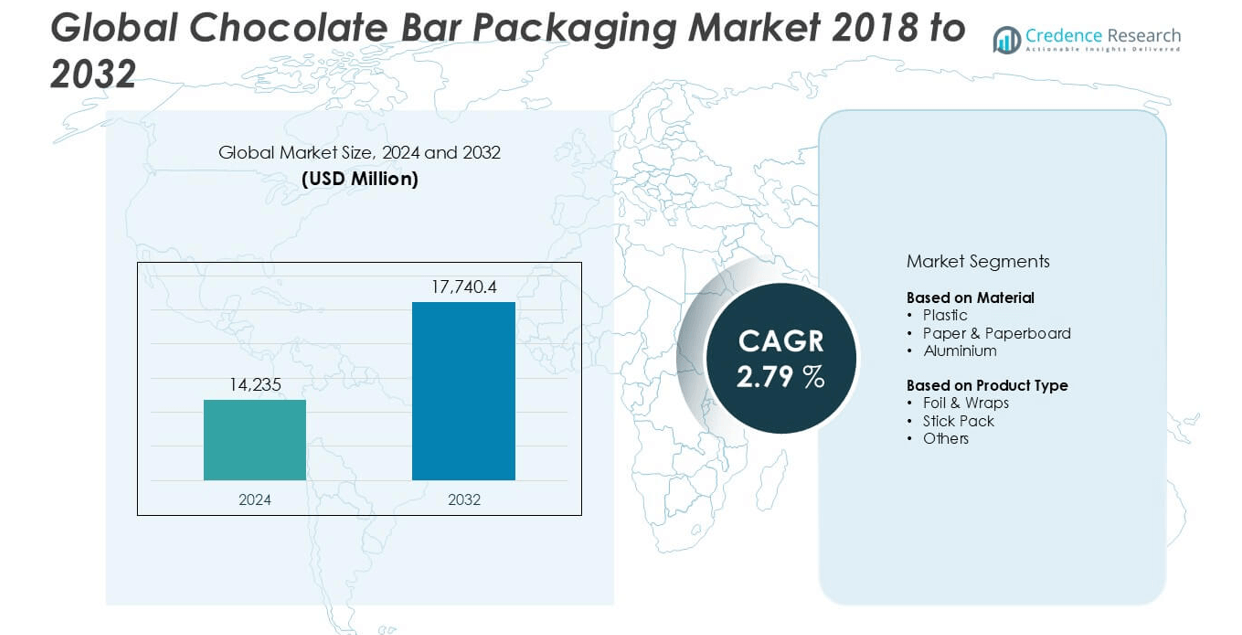
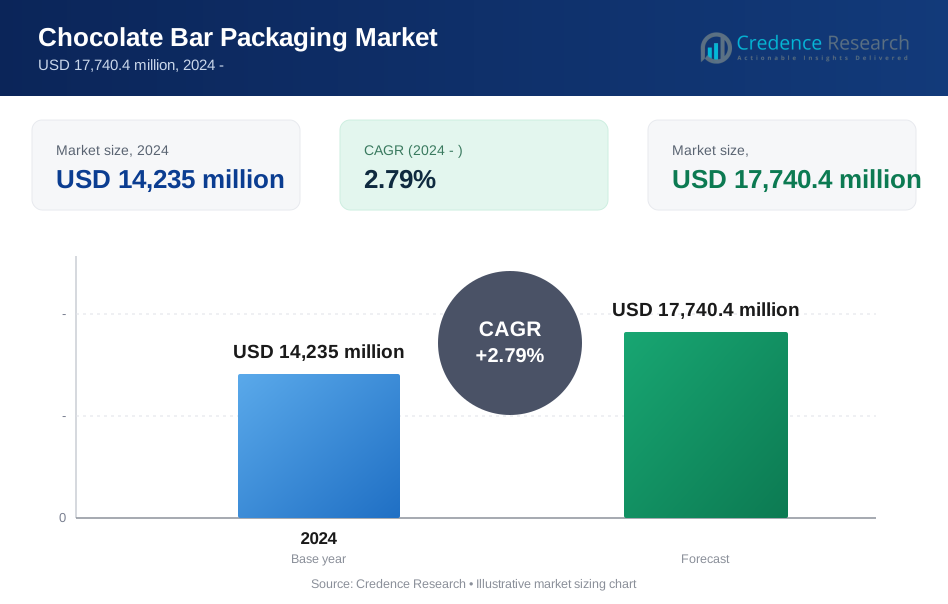
The Chocolate Bar Packaging market size was valued at USD 14,235 million in 2024 and is anticipated to reach USD 17,740.4 million by 2032, growing at a CAGR of 2.79% during the forecast period.
| REPORT ATTRIBUTE | DETAILS |
|---|---|
| Historical Period | 2020-2023 |
| Base Year | 2024 |
| Forecast Period | 2025-2032 |
| Chocolate Bar Packaging Market Size 2024 | USD 14,235 million |
| Chocolate Bar Packaging Market, CAGR | 2.79% |
| Chocolate Bar Packaging Market Size 2032 | USD 17,740.4 million |
The chocolate bar packaging market is highly competitive, led by prominent players such as Amcor plc, Berry Global, Huhtamaki, Constantia Flexibles, Mondi, and Uflex, among others. These companies focus on innovation, sustainability, and efficient supply chain management to strengthen their market positions. They offer a range of materials and packaging formats to cater to both premium and mass-market chocolate brands. Europe emerged as the leading region in 2024, accounting for 30% of the global market share, driven by strong demand for premium chocolates and stringent sustainability regulations. North America and Asia Pacific closely follow, supported by rising chocolate consumption and expanding retail networks.
Market Insights
- The chocolate bar packaging market was valued at USD 14,235 million in 2024 and is projected to reach USD 17,740.4 million by 2032, growing at a CAGR of 2.79% during the forecast period.
- Market growth is driven by increasing global chocolate consumption, rising demand for premium and sustainable packaging, and the shift toward single-serve and on-the-go formats.
- Trends such as the adoption of smart packaging, personalized branding, and eco-friendly materials are shaping product innovation and consumer engagement strategies.
- The market is highly competitive, with key players like Amcor, Berry Global, Huhtamaki, and Mondi investing in recyclable and high-barrier solutions, while regional companies focus on cost efficiency and customization.
- Europe held the largest regional share at 30%, followed by North America at 28% and Asia Pacific at 24%; by material, plastic led the segment, while foil & wraps dominated the product type category.
Market Segmentation Analysis:
By Material
The chocolate bar packaging market, when segmented by material, is led by plastic, which accounted for the largest market share in 2024. Plastic’s dominance stems from its cost-effectiveness, superior barrier properties against moisture and contaminants, and ease of customization for branding. Its widespread use in mass-market chocolate products has further reinforced its position. However, rising environmental concerns and regulations on single-use plastics have spurred growth in paper & paperboard alternatives, especially among premium and sustainable brands. Aluminum remains a niche material, favored for its excellent protective qualities and recyclability in specific regional markets.
- For instance, Amcor launched its AmLite Ultra Recyclable packaging for chocolate applications, enabling recyclability in existing polyethylene streams and reducing carbon footprint by 64 grams of CO₂ per chocolate bar wrapper compared to traditional materials.
By Product Type:
Among the product types, foil & wraps emerged as the dominant sub-segment in 2024, capturing the highest market share due to their extensive use in both artisanal and mass-produced chocolate bars. Their flexibility, ability to preserve flavor and aroma, and compatibility with multiple packaging materials drive their popularity. Foil & wraps also support creative designs and branding, making them attractive to manufacturers. Stick packs are gaining momentum, especially in the single-serve and snack-sized chocolate bar segment, while the “others” category, including cartons and pouches, serves niche and promotional packaging needs.
- For instance, Constantia Flexibles developed EcoLamHighPlus, a high-barrier monomaterial laminate ideal for chocolate wrapping, achieving an oxygen barrier of less than 0.1 cm³/(m²·d), supporting both product freshness and recyclability.
Market Overview
Rising Global Chocolate Consumption
The increasing global demand for chocolate products, particularly in emerging economies such as India, China, and Brazil, is a key driver of chocolate bar packaging growth. A growing middle-class population, urbanization, and rising disposable incomes have boosted chocolate consumption, directly influencing the need for efficient and appealing packaging solutions. As consumers increasingly seek indulgent and convenient snacks, manufacturers are scaling up production and, in turn, investing more in high-quality and differentiated packaging to maintain product freshness and enhance brand visibility.
- For instance, Uflex commissioned a new 40,000 metric ton per annum capacity BOPET film plant to support growing chocolate packaging demand in Southeast Asia, enhancing supply chain responsiveness.
Focus on Brand Differentiation and Shelf Appeal
Intense competition among chocolate brands has led to a growing emphasis on packaging as a tool for brand identity and consumer engagement. Companies are prioritizing visually attractive and innovative packaging designs to stand out on crowded retail shelves. Premium packaging materials, personalized branding, and limited-edition designs are gaining traction. This emphasis on shelf appeal not only boosts consumer purchase intent but also fuels demand for high-quality printing, embossing, and sustainable material innovations in the chocolate bar packaging segment.
- For instance, Berry Global installed 10-color high-definition flexographic printing presses across its packaging facilities, enabling chocolate brands to achieve vivid imagery and foil-stamped effects for stronger shelf impact.
Increased Demand for Sustainable Packaging
Environmental concerns and regulatory pressures are driving the adoption of sustainable packaging in the chocolate bar market. Consumers are increasingly aware of the ecological impact of single-use plastics, prompting brands to switch to biodegradable, recyclable, or compostable materials such as paper, board, and plant-based films. Regulatory frameworks in Europe and North America particularly encourage green packaging initiatives. This shift not only addresses consumer expectations but also aligns with corporate sustainability goals, thus acting as a major growth catalyst for the market.
Key Trends & Opportunities
Growth in Single-Serve and On-the-Go Packaging Formats
Changing consumer lifestyles and increasing snacking behavior are fueling demand for single-serve and on-the-go packaging formats in chocolate bars. Stick packs and compact wrappers offer convenience, portion control, and portability, especially appealing to busy urban consumers and children. This trend opens opportunities for packaging innovations that enhance usability while maintaining barrier protection. As health-conscious consumers seek smaller indulgent treats, manufacturers are investing in compact, resealable, and visually distinct packaging formats to capture this growing market segment.
- For instance, Huhtamaki introduced Push Tab® blister packaging with a compact form factor and easy-open seal, reducing material usage by 70 milligrams per unit while maintaining product safety for confectionery products.
Adoption of Smart and Interactive Packaging
The integration of smart packaging technologies, such as QR codes, augmented reality, and digital storytelling, presents a significant opportunity in the chocolate bar packaging market. Brands are leveraging these technologies to provide consumers with transparency on sourcing, nutritional information, and traceability. Interactive packaging enhances engagement and loyalty, particularly among digitally savvy consumers. Additionally, smart packaging can support anti-counterfeiting measures and help track supply chains, making it a promising trend in premium and ethical chocolate segments.
- For instance, Nestlé incorporated scannable codes on its KitKat bars in Japan, enabling consumers to access real-time blockchain-verified data on cocoa sourcing and processing across 74 different farms via the OpenSC platform.
Key Challenges
High Cost of Sustainable Materials
While demand for eco-friendly packaging is growing, the high cost of sustainable materials poses a challenge for manufacturers, especially smaller brands with limited budgets. Recyclable and biodegradable materials often require specialized production processes and are priced higher than conventional plastic alternatives. These cost barriers can hinder widespread adoption and may lead to higher product prices, affecting competitiveness in price-sensitive markets. Balancing sustainability goals with cost-efficiency remains a critical hurdle for many players in the chocolate bar packaging industry.
Regulatory and Compliance Pressures
Packaging regulations related to food safety, labeling, and environmental impact vary across countries and regions, creating complexity for global chocolate manufacturers. Complying with diverse and evolving packaging standards-including restrictions on plastic use, mandates for recyclability, and detailed nutritional disclosures-adds to operational costs and logistical challenges. Non-compliance risks include fines, product recalls, and reputational damage. These regulatory hurdles can delay product launches and increase time-to-market, posing strategic challenges in the competitive chocolate sector.
Regional Analysis
North America
North America held a significant share of the chocolate bar packaging market in 2024, accounting for approximately 28% of global revenue. The region benefits from a well-established confectionery industry, high consumer demand for premium and sustainable chocolate products, and strong retail distribution networks. Manufacturers are investing in eco-friendly materials and advanced packaging technologies to align with regulatory frameworks and consumer preferences. The growing popularity of organic and artisanal chocolates further fuels demand for creative, high-quality packaging. The United States remains the dominant contributor, supported by large-scale production and brand-driven innovation in packaging.
Europe
Europe captured nearly 30% of the global chocolate bar packaging market in 2024, making it the leading regional contributor. The region’s stronghold in luxury and artisanal chocolates, along with stringent environmental regulations, drives demand for sustainable and recyclable packaging solutions. Countries like Germany, Switzerland, and Belgium are at the forefront of premium chocolate production, encouraging the use of paper-based and biodegradable materials. Increasing consumer consciousness regarding ethical sourcing and eco-friendly packaging supports innovation and market expansion. The European Union’s packaging waste directives are also compelling companies to adopt greener alternatives, solidifying the region’s leadership in sustainable packaging practices.
Asia Pacific
Asia Pacific accounted for approximately 24% of the global chocolate bar packaging market in 2024 and is projected to witness the fastest growth during the forecast period. Rising urbanization, a growing middle class, and increasing chocolate consumption-particularly in China, India, and Southeast Asia-are key growth drivers. Multinational and local brands are expanding production, prompting higher demand for cost-effective yet visually appealing packaging formats. With the region’s evolving retail landscape and e-commerce penetration, flexible packaging formats such as wraps and stick packs are gaining popularity. Investments in automated and scalable packaging systems are also shaping regional market dynamics.
Latin America
Latin America held about 10% of the chocolate bar packaging market share in 2024, supported by rising consumption in countries like Brazil, Mexico, and Argentina. While traditionally known as a cocoa-producing region, the region is witnessing a steady rise in chocolate product consumption, driven by urban lifestyle shifts and growing disposable incomes. Packaging demand in the region leans toward economical and functional materials like plastic and aluminum foil. However, there is growing interest in sustainable packaging as regional governments tighten environmental policies. Local brands are also exploring premium packaging to cater to niche urban segments and exports.
Middle East & Africa (MEA)
The Middle East & Africa region accounted for around 8% of the global chocolate bar packaging market in 2024. While still emerging, the market is growing due to increased chocolate consumption driven by tourism, retail expansion, and Western influence in countries like the UAE, Saudi Arabia, and South Africa. The demand for attractive and durable packaging is growing, especially for premium imported products. However, cost sensitivity remains a major factor influencing packaging choices. Gradual adoption of sustainable materials and a rise in domestic chocolate production are expected to support future market development across MEA.
Market Segmentations:
By Material:
- Plastic
- Paper & Paperboard
- Aluminium
By Product Type:
- Foil & Wraps
- Stick Pack
- Others
By Geography
- North America
- U.S.
- Canada
- Mexico
- Europe
- Germany
- France
- U.K.
- Italy
- Spain
- Rest of Europe
- Asia Pacific
- China
- Japan
- India
- South Korea
- South-east Asia
- Rest of Asia Pacific
- Latin America
- Brazil
- Argentina
- Rest of Latin America
- Middle East & Africa
- GCC Countries
- South Africa
- Rest of the Middle East and Africa
Competitive Landscape
The competitive landscape of the chocolate bar packaging market is characterized by the presence of several global and regional players competing on innovation, sustainability, and cost efficiency. Leading companies such as Amcor plc, Huhtamaki, Mondi, and Berry Global continue to invest in advanced packaging technologies and sustainable material development to strengthen their market positions. These players focus on offering high-barrier, visually appealing, and environmentally responsible packaging solutions to meet evolving consumer demands. Regional firms like Uflex and JBM Packaging are also gaining traction through cost-effective offerings and localized service networks. Mergers, acquisitions, and strategic collaborations are common as companies aim to expand geographic reach and enhance production capabilities. The market also sees growing competition in premium and single-serve segments, prompting innovation in design, recyclability, and convenience. Overall, the competitive environment remains dynamic, with companies striving to align with shifting regulatory standards, consumer preferences, and branding strategies in an increasingly sustainability-driven market.
Key Player Analysis
- Uflex (India)
- Mondi (U.K.)
- KM Packaging (U.S.)
- Huhtamaki (Finland)
- Amcor plc (Switzerland)
- Catty Corporation (U.S.)
- Constantia Flexibles (Austria)
- Berry Global (U.S.)
- JBM Packaging (U.S.)
- Coveris (Austria)
Recent Developments
- In June 2024, Constantia Flexibles launched EcoTwistPaper, which is an innovative packaging solution for the confectionery industry. The new product is a wax-free twist-wrap made completely from paper, prioritizing recyclability and helping the global shift toward sustainable products.
- In June 2024, Constantia Flexibles launched EcoTwistPaper, which is an innovative packaging solution for the confectionery industry. The new product is a wax-free twist-wrap made completely from paper, prioritizing recyclability and helping the global shift toward sustainable products.
- In July 2023, Amcor announced the availability of AmFiber™ Performance Paper packaging in Latin America, which is a high-barrier, recyclable paper-based packaging solution. Launched for the confectionery market, this packaging has more than 80% paper fiber content and is PVDC-free. The material innovation is recyclable in the existing paper recycling stream.
Market Concentration & Characteristics
The Chocolate Bar Packaging Market exhibits moderate to high market concentration, with a mix of global packaging giants and regionally focused players. Large companies such as Amcor plc, Mondi, and Berry Global hold significant market shares due to their advanced manufacturing capabilities, broad geographic presence, and strong client relationships with major chocolate brands. These firms drive innovation through investments in sustainable materials, smart packaging technologies, and automated production lines. The market is characterized by high product differentiation, evolving consumer preferences, and increasing regulatory oversight on packaging waste and recyclability. Demand patterns vary by region, influenced by chocolate consumption trends, disposable incomes, and sustainability expectations. While Europe leads in eco-friendly packaging adoption, North America and Asia Pacific display strong momentum in single-serve and convenience-oriented formats. Entry barriers remain moderately high due to capital-intensive equipment requirements and strict food safety standards. Pricing pressure and the need for rapid design customization shape competitive dynamics. Companies compete not only on cost efficiency but also on visual appeal, functional integrity, and compliance with regional packaging norms.
Report Coverage
The research report offers an in-depth analysis based on Material, Product Type and Geography. It details leading market players, providing an overview of their business, product offerings, investments, revenue streams, and key applications. Additionally, the report includes insights into the competitive environment, SWOT analysis, current market trends, as well as the primary drivers and constraints. Furthermore, it discusses various factors that have driven market expansion in recent years. The report also explores market dynamics, regulatory scenarios, and technological advancements that are shaping the industry. It assesses the impact of external factors and global economic changes on market growth. Lastly, it provides strategic recommendations for new entrants and established companies to navigate the complexities of the market.
Future Outlook
- The chocolate bar packaging market is expected to witness steady growth driven by rising global chocolate consumption.
- Demand for sustainable and recyclable packaging materials will continue to shape product innovation.
- Flexible packaging formats such as wraps and stick packs will gain popularity due to convenience and portability.
- Brand owners will increasingly adopt premium packaging to enhance shelf appeal and consumer engagement.
- Smart packaging technologies like QR codes and augmented reality will become more common in premium product segments.
- Regulatory pressure on plastic use will accelerate the shift toward paper-based and biodegradable alternatives.
- Growth in online chocolate sales will influence packaging design with a focus on durability and presentation.
- Emerging markets in Asia Pacific and Latin America will offer significant expansion opportunities for packaging suppliers.
- Automation and digital printing in packaging production will improve speed-to-market and customization.
- Strategic collaborations and mergers will intensify as companies aim to expand capabilities and global presence.
Request a Free Sample
Fill in your details and we'll send you a free sample report.
- Sample data tables & charts
- Research methodology
Market Dynamics
Rising Global Chocolate Consumption
Increasing demand for chocolate products, especially in emerging markets like India, China, and Brazil, is driving the need for efficient and appealing chocolate bar packaging solutions to maintain product freshness and enhance brand visibility.
Demand for Sustainable and Eco-Friendly Packaging
Growing environmental concerns and regulatory pressures are pushing manufacturers to adopt recyclable, biodegradable, and compostable packaging materials, particularly in Europe and North America, fueling innovation and market growth.
Brand Differentiation and Shelf Appeal
Intense competition among chocolate brands is leading to greater investment in visually attractive, innovative, and premium packaging designs, which help products stand out on crowded retail shelves and boost consumer purchase intent.
Growth in Single-Serve and On-the-Go Formats
Changing consumer lifestyles and increased snacking behavior are fueling demand for convenient, portion-controlled packaging formats like stick packs and compact wrappers, expanding the market for flexible and portable packaging solutions.
Adoption of Smart and Interactive Packaging
Brands are increasingly integrating technologies such as QR codes and augmented reality into packaging to enhance consumer engagement, provide transparency on sourcing, and support anti-counterfeiting, especially in premium and ethical chocolate segments.
Need a Custom Version of This Report?
Tailor the scope, geography, or segments to your exact requirements.
- Custom geography or segment scope
- Direct access to our analyst team
Frequently Asked Questions
What is the current size of the Chocolate Bar Packaging Market?
What factors are driving the growth of the Chocolate Bar Packaging Market?
What are the key segments within the Chocolate Bar Packaging Market?
Who are the major players in the Chocolate Bar Packaging Market?
Table of Content
Chapter 1 Market Segmentation
- 1.1 Segmentation Framework
- 1.1.1 Product and Service Classification
- 1.1.2 Application and End-Use Classification
- 1.1.3 Technology and Solution Classification
- 1.1.4 Customer and Distribution Channel Classification
- 1.1.5 Geographic Segmentation
- 1.1.6 Market Segment Definitions and Boundaries
- 1.2 By Material
- 1.2.1 Plastic
- 1.2.2 Paper & Paperboard
- 1.2.3 Aluminium
- 1.3 By Product Type
- 1.3.1 Foil & Wraps
- 1.3.2 Stick Pack
- 1.3.3 Others
Chapter 2 Introduction
- 2.1 Report Objectives and Scope
- 2.2 Product Definition and Industry Terminology
- 2.3 Market Inclusions and Exclusions
- 2.4 Research Process
- 2.4.1 Primary Research and Expert Interviews
- 2.4.2 Secondary Research and Source Review
- 2.4.3 Top-Down and Bottom-Up Estimation
- 2.4.4 Data Triangulation and Verification
- 2.5 Market Size Measurement Basis
- 2.5.1 2024: USD 14,235 million → 2032: USD 17,740.4 million
- 2.6 Historical and Forecast Reference Periods
- 2.6.1 Base Year: 2024
- 2.6.2 Forecast Period: 2024-2032
- 2.7 Research Assumptions and Limitations
Chapter 3 Executive Summary
- 3.1 Market Snapshot and Key Findings
- 3.2 Base-Year Market Size, 2024
- 3.3 Forecast Market Size, 2032
- 3.4 Revenue and Volume Growth Outlook
- 3.5 Key Demand and Supply Indicators
- 3.6 Leading Market Segments
- 3.7 Fastest-Growing Market Opportunities
- 3.8 Regional Performance Highlights
- 3.9 Technology and Industry Transformation
- 3.10 Competitive Landscape Summary
- 3.11 Analyst View and Strategic Implications
Chapter 4 Global Chocolate Bar Packaging Market Trends and Developments
- 4.1 Historical Industry Development
- 4.2 Recent Market Trends and Developments
- 4.3 Demand and Customer Behavior Trends
- 4.4 Technology and Product Innovation
- 4.5 Artificial Intelligence, Automation and Digitalization
- 4.6 Local Manufacturing and Supply Chain Realignment
- 4.7 Industry Partnerships, Mergers and Acquisitions
- 4.8 Sustainability and Circular Economy Developments
- 4.9 Government and Private Sector Investment Trends
- 4.10 Emerging Business Models and Commercialization
- 4.11 Industry Developments and Announcements
Chapter 5 Global Chocolate Bar Packaging Market Production, Supply and Demand Analysis
- 5.1 Demand Trend and Consumption Analysis
- 5.2 Demand Forecast, 2024-2032
- 5.3 Production and Output Trend
- 5.4 Production and Output Forecast, 2024-2032
- 5.5 Installed Capacity and Capacity Utilization
- 5.6 Company-Wise Production Plants and Statistics
- 5.6.1 Installed Production Capacity
- 5.6.2 Actual Production
- 5.6.3 Planned Capacity and Expansion Targets
- 5.7 Supply Chain Structure and Procurement Trends
- 5.8 Supply-Demand Gap and Bottlenecks
- 5.9 Import Dependence and Sourcing Structure
- 5.10 Contract Manufacturing and Outsourcing
- 5.11 Regional Supply and Demand Concentration
Chapter 6 Global Chocolate Bar Packaging Market Pricing Analysis
- 6.1 Pricing Structure and Measurement
- 6.2 Historical Pricing Trends
- 6.3 Pricing Outlook, 2024-2032
- 6.4 Average Selling Price and Unit Economics
- 6.5 Pricing by Product and Market Segment
- 6.6 Geographic Pricing Differences
- 6.7 Key Input, Energy, Labor and Logistics Costs
- 6.8 Contract Pricing and Purchasing Models
- 6.9 Pricing Sensitivity and Competitive Positioning
- 6.10 Price, Margin and Profitability Implications
Chapter 7 Global Chocolate Bar Packaging Market Dynamics
- 7.1 Market Growth Drivers
- 7.1.1 Demand-Side Drivers
- 7.1.2 Technology and Innovation Drivers
- 7.1.3 Infrastructure and Investment Drivers
- 7.1.4 Regulatory and Policy Drivers
- 7.2 Market Restraints
- 7.2.1 Cost and Affordability Constraints
- 7.2.2 Technology and Adoption Barriers
- 7.2.3 Supply Chain and Operational Constraints
- 7.3 Market Challenges
- 7.3.1 Competitive Pressure and Margin Erosion
- 7.3.2 Skills, Infrastructure and Implementation Gaps
- 7.4 Emerging Market Opportunities
- 7.5 Market Dynamics Impact and Time-Horizon Assessment
Chapter 8 Global Chocolate Bar Packaging Value Chain Analysis
- 8.1 Industry Value Chain Overview
- 8.2 Upstream Suppliers and Critical Inputs
- 8.3 Technology and Component Providers
- 8.4 Manufacturing or Service Delivery
- 8.5 Distribution, Channel Partners and Integrators
- 8.6 Downstream Applications and End Users
- 8.7 Value Addition and Profit Pools
- 8.8 Vertical Integration and Outsourcing
- 8.9 Supplier Concentration and Risk
- 8.10 Supply Chain Localization and Resilience
Chapter 9 Global Chocolate Bar Packaging Market Regulations and Policies
- 9.1 Relevant Laws, Standards and Compliance Frameworks
- 9.2 Product, Service, Safety and Quality Requirements
- 9.3 Government Policies, Incentives and Subsidies
- 9.4 Imports, Exports and Trade Barriers
- 9.5 Public Procurement and Local Content Requirements
- 9.6 Environmental and Sustainability Compliance
- 9.7 Upcoming Policy Changes and Market Implications
Chapter 10 Global Chocolate Bar Packaging Market Hotspots and Opportunities
- 10.1 Market Opportunity Mapping and Growth Hotspots
- 10.2 High-Growth Applications and Customer Groups
- 10.3 Underserved Markets and White-Space Opportunities
- 10.4 Emerging Technology and Product Opportunities
- 10.5 New Capacity and Investment Hotspots
- 10.6 Market Entry and Expansion Opportunities
- 10.7 Distribution and Partnership Opportunities
- 10.8 Near-Term and Long-Term Commercial Potential
- 10.9 Opportunity Attractiveness and Execution Risks
Chapter 11 Global Chocolate Bar Packaging Market Outlook, 2024-2032
- 11.1 Market Size and Analysis
- 11.1.1 Revenue (Market Measurement: 2024: USD 14,235 million → 2032: USD 17,740.4 million)
- 11.1.2 Market Volume and Quantity Sold
- 11.1.3 Historical Market Size
- 11.1.4 Base-Year Market Size, 2024
- 11.2 Market Forecast, 2024-2032
- 11.2.1 Revenue Forecast to 2032
- 11.2.2 Volume Forecast to 2032
- 11.2.3 CAGR and Year-on-Year Growth
- 11.2.4 Incremental Revenue Opportunity
- 11.3 Forecast Assumptions and Scenario Analysis
- 11.3.1 Base-Case Forecast
- 11.3.2 Optimistic and Conservative Scenarios
- 11.3.3 Technology, Pricing and Policy Sensitivities
- 11.4 Market Attractiveness and Growth Outlook
Chapter 12 Global Chocolate Bar Packaging Market Segmentation and Outlook
- 12.1 Segmentation Summary and Market Shares, 2024
- 12.2 Largest and Fastest-Growing Segments
- 12.3 By Material - Market Size and Forecast, 2024-2032
- 12.3.1 Segment Definition and Scope
- 12.3.2 Historical Market Size
- 12.3.3 Revenue Forecast, 2024-2032
- 12.3.4 Volume Forecast, 2024-2032
- 12.3.5 Base-Year Market Share, 2024
- 12.3.6 Segment CAGR and Growth Drivers
- 12.3.7 Subsegment Market Size and Forecast
- 12.3.7.1 Plastic
- 12.3.7.2 Paper & Paperboard
- 12.3.7.3 Aluminium
- 12.3.8 Subsegment Pricing and Adoption Trends
- 12.3.9 Leading Suppliers and Competition
- 12.3.10 Regional Demand and Opportunities
- 12.4 By Product Type - Market Size and Forecast, 2024-2032
- 12.4.1 Segment Definition and Scope
- 12.4.2 Historical Market Size
- 12.4.3 Revenue Forecast, 2024-2032
- 12.4.4 Volume Forecast, 2024-2032
- 12.4.5 Base-Year Market Share, 2024
- 12.4.6 Segment CAGR and Growth Drivers
- 12.4.7 Subsegment Market Size and Forecast
- 12.4.7.1 Foil & Wraps
- 12.4.7.2 Stick Pack
- 12.4.7.3 Others
- 12.4.8 Subsegment Pricing and Adoption Trends
- 12.4.9 Leading Suppliers and Competition
- 12.4.10 Regional Demand and Opportunities
- 12.5 Segment Growth Comparison
- 12.6 Segment Attractiveness and Priority Matrix
Chapter 13 Global Chocolate Bar Packaging Geographic Market Outlook, 2024-2032
- 13.1 Regional Market Size and Share, 2024
- 13.2 Regional Market Forecast, 2024-2032
- 13.3 Regional Pricing, Production and Demand Differences
- 13.4 North America
- 13.4.1 United States
- 13.4.2 Canada
- 13.4.3 Mexico
- 13.5 Europe
- 13.5.1 Germany
- 13.5.2 France
- 13.5.3 Italy
- 13.5.4 United Kingdom
- 13.5.5 Spain
- 13.5.6 Poland
- 13.5.7 Russia
- 13.5.8 Netherlands
- 13.5.9 Belgium
- 13.5.10 Sweden
- 13.5.11 Denmark
- 13.5.12 Norway
- 13.5.13 Rest of Europe
- 13.6 Asia Pacific
- 13.6.1 China
- 13.6.2 India
- 13.6.3 Japan
- 13.6.4 South Korea
- 13.6.5 Thailand
- 13.6.6 Indonesia
- 13.6.7 Vietnam
- 13.6.8 Malaysia
- 13.6.9 Australia
- 13.6.10 Rest of Asia Pacific
- 13.7 Latin America
- 13.7.1 Brazil
- 13.7.2 Argentina
- 13.7.3 Colombia
- 13.7.4 Chile
- 13.7.5 Rest of Latin America
- 13.8 Middle East
- 13.8.1 Saudi Arabia
- 13.8.2 United Arab Emirates
- 13.8.3 Turkey
- 13.8.4 Israel
- 13.8.5 Iran
- 13.8.6 Rest of the Middle East
- 13.9 Africa
- 13.9.1 South Africa
- 13.9.2 Egypt
- 13.9.3 Nigeria
- 13.9.4 Morocco
- 13.9.5 Rest of Africa
- 13.10 Regional Investment, Policy and Supply Chain Differences
- 13.11 Regional Competitive Landscape
- 13.12 Geographic Growth Hotspots
Chapter 14 Global Chocolate Bar Packaging Technology, Innovation and Sustainability Outlook
- 14.1 Technology Landscape and Maturity
- 14.2 Product, Process and Service Innovation
- 14.3 AI, Automation and Digital Tools in the Industry
- 14.4 Technology Adoption and Performance Benchmarking
- 14.5 Innovation Pipeline and R&D Investment
- 14.6 Patent and Intellectual Property Trends
- 14.7 Energy Efficiency and Resource Management
- 14.8 Sustainability, Recycling and Circularity
- 14.9 Technology Roadmap, 2024-2032
- 14.10 Risks of Obsolescence and Technology Substitution
Chapter 15 Global Chocolate Bar Packaging Market Key Strategic Imperatives
- 15.1 Growth and Market Entry Priorities
- 15.2 High-Return Products and Segments
- 15.3 Pricing, Profitability and Cost Optimization
- 15.4 Technology Investment and Product Differentiation
- 15.5 Supply Chain Localization and Resilience
- 15.6 Distribution and Customer Acquisition
- 15.7 Partnership, Acquisition and Capacity Strategy
- 15.8 Regional Expansion Priorities
- 15.9 Short-, Medium- and Long-Term Actions
Chapter 16 Competition Outlook
- 16.1 Industry Competition Characteristics
- 16.2 Market Structure and Concentration
- 16.3 Market Share and Competitive Positioning, 2024
- 16.4 Company-Wise Revenue and Product Benchmarking
- 16.5 Production and Service Capacity Benchmarking
- 16.6 Technology, Pricing and Differentiation
- 16.7 Regional Footprint and Distribution Strength
- 16.8 Mergers, Acquisitions and Strategic Alliances
- 16.9 New Entrants and Competitive Threats
- 16.10 Porter's Five Forces and Industry Attractiveness
- 16.11 Competitive Outlook, 2024-2032
Chapter 17 Company Profiles
- 17.1 Company Coverage and Selection Criteria
- 17.2 Amcor plc
- 17.2.1 Business Description
- 17.2.2 Company Ownership and Geographic Presence
- 17.2.3 Product and Service Portfolio
- 17.2.4 Manufacturing and Operating Footprint
- 17.2.5 Production Capacity and Expansion Plans
- 17.2.6 Financial Performance and Investment
- 17.2.7 Market Share and Competitive Position
- 17.2.8 Technology and Innovation Capabilities
- 17.2.9 Strategic Alliances or Partnerships
- 17.2.10 Recent Developments
- 17.2.11 Growth Strategy and Outlook
- 17.3 Berry Global
- 17.4 Huhtamaki
- 17.5 Constantia Flexibles
- 17.6 Mondi
- 17.7 Uflex
- 17.8 JBM Packaging
- 17.9 KM Packaging
- 17.10 Catty Corporation
- 17.11 Coveris
- 17.12 Other Relevant Market Participants
Note: Every listed company is profiled on the structure shown under the first company. The company list is preliminary and may change based on research findings, market developments, data availability and client requirements.
Chapter 18 Disclaimer
- 18.1 Research and Forecast Disclaimer
- 18.2 Data Source and Estimation Limitations
Note: The depth of individual sections depends on data availability for this market. Volume, capacity, trade and other unit-based metrics are included where applicable.

