
| REPORT ATTRIBUTE | DETAILS |
|---|---|
| Historical Period | 2019-2022 |
| Base Year | 2023 |
| Forecast Period | 2024-2032 |
| Diabetes Devices Market Size 2023 | USD 1725.8 Million |
| Diabetes Devices Market, CAGR | 7.80% |
| Diabetes Devices Market Size 2032 | USD 3392.8 Million |
Market Insights
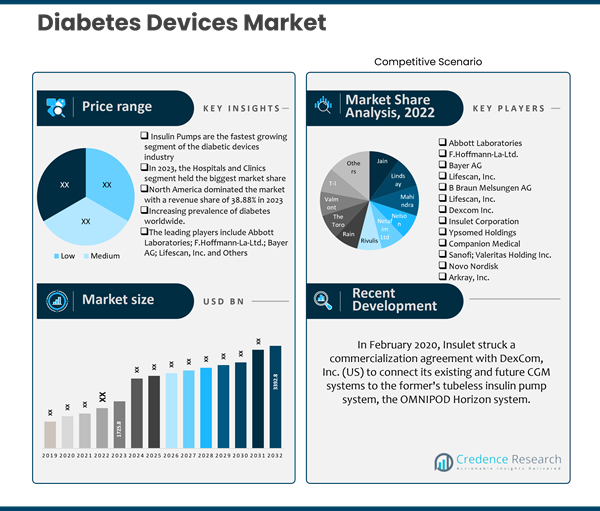
- The global demand for Diabetes Devices was valued at USD 1725.8 Million in 2023 and is expected to reach USD 3392.8 Million in 2032, growing at a CAGR of 7.80% between 2024 and 2032.
- Type 2 Diabetes Devices are the most significant segment of the diabetic device industry.
- The insulin delivery devices category dominated the market in 2023, while blood glucose monitoring is predicted to be the fastest growing segment throughout the forecast period.
- In 2023, hospitals and specialty diabetes clinics made up more than 54.3% of the market.
- In 2023, the Hospitals and Clinics sector held the largest market share, while the Home Care Settings segment is predicted to rise at a 6.8% compound annual growth rate (CAGR).
- Continuous Glucose Monitoring (CGM) Systems are more popular than standard blood glucose monitors.
- Insulin pumps are the fastest growing part of the diabetic devices industry, while insulin pens are another important market sector.
- Insulin Delivery has a significant market share.
- The most popular segment is Adults.
- North America led the market with a revenue share of 38.88% in 2023, and the Asia-Pacific eClinical Solution Market is expected to grow at the fastest CAGR between 2023 and 2032.
- New and technologically improved items are propelling market growth.
- The rising availability of alternative treatments limits market expansion.
Executive Summary
Market Definition
The Diabetes Devices Market is the market for medical devices created specifically to help manage and monitor diabetes. These devices include blood glucose meters, continuous glucose monitoring systems, insulin pumps, insulin pens, and insulin syringes, among others. They are used by diabetics to monitor their blood sugar levels, deliver insulin, and track their overall diabetes treatment.
Market Overview
The global Diabetes Devices Market has witnessed steady growth in recent years and is expected to grow at a CAGR of 7.80% between 2024 and 2032. The market was valued at USD 1725.8 million in 2023 and is expected to reach USD 3392.8 million in 2032.
The Diabetes Devices Market is a fast-growing segment of the healthcare industry. It comprises a wide range of diabetes management and monitoring equipment, including blood glucose meters, continuous glucose monitoring systems, insulin pumps, and insulin pen.
Several reasons are driving the market forward. To begin, the growing global prevalence of diabetes is driving up demand for better diabetes treatment options. Furthermore, advances in technology have resulted in the creation of more inventive and user-friendly gadgets, making diabetes care easier and more convenient for patients.
Furthermore, there is a rising emphasis on personalized and patient-centered care, which has led to the development of devices that provide real-time data and insights to assist diabetics in making informed treatment and lifestyle decisions.
Segmentation by Type of Diabetes
- The most prominent section in the diabetic devices market is Type 2 Diabetes Devices. Type 2 diabetes is more common internationally than Type 1 and gestational diabetes. Type 2 diabetes devices use blood glucose monitoring, insulin delivery systems, and other technology to help people manage their illness. The rising prevalence of Type 2 diabetes drives up market demand for devices designed specifically for this sector.
Segmentation by Product Type
- The insulin delivery devices segment dominated the market in 2023 and will continue to do so throughout the forecast period. This is due to the growing adoption and convenience associated with the use of insulin pens and portable insulin pumps.
- On the other hand, blood glucose monitoring is expected to be the fastest expanding segment over the forecast period. Continuous glucose monitoring and self-monitoring blood glucose systems are the primary drivers of this category.
Segmentation by Distribution Channel
- Hospitals and Specialty Diabetes Clinics accounted for more than 54.3% of market penetration in 2023 due to high traffic and product availability. There are two sorts of pharmacies on a hospital campus: inpatient pharmacies and outpatient pharmacies. The hospital has an inpatient pharmacy, which is exclusively accessible to authorized professionals serving operation rooms, the intensive care unit, inpatient wards, and special services.
- On the other hand, the Online Sales and E-commerce is expected to be the most opportunistic area as internet and telemedicine services become more widely available. Furthermore, one-day delivery options and discounted costs will help the market flourish.
Segmentation by End-User
- In 2023, the Hospitals and Clinics segment held the biggest market share, accounting for 40.9%. The rising number of hospital admissions for diabetic patients is driving up demand for the segment. Patients with diabetes are three times more likely to be hospitalized than those without diabetes.
- The Home Care Settings segment is expected to increase at a 6.8% compound annual growth rate (CAGR) throughout the projected period. This increase is due to increased awareness of diabetes prevention care.
Segmentation by Blood Glucose Monitoring System Type
- Continuous Glucose Monitoring (CGM) Systems are in higher demand than traditional blood glucose monitors. CGM devices deliver real-time glucose measurements, allowing diabetics to constantly monitor their blood sugar levels throughout the day. This technology improves convenience and comprehension of glucose patterns, allowing people to make more educated decisions regarding their diabetes management.
Segmentation by Insulin Delivery Device Type
- Insulin Pumps are the fastest growing segment of the diabetic devices industry. Insulin pumps are small devices that constantly administer insulin throughout the day, simulating the function of a healthy pancreas. Individuals with diabetes benefit from more precise insulin dose, greater meal planning flexibility, and better glucose control.
- Insulin pens are another key market sector. Insulin pens are portable devices that enable for the easy and precise delivery of insulin. They are pre-filled with insulin cartridges and feature replacement needles, making them simple to use and transport.
Segmentation by Application
- Insulin Delivery holds a considerable market share. Insulin administration systems, such as insulin pens, pumps, and syringes, are required for diabetics to inject insulin properly. These devices ensure the precise and controlled delivery of insulin, which is critical for blood sugar management. Insulin delivery devices continue to be in great demand due to the increasing prevalence of diabetes and the necessity for effective insulin therapy.
Segmentation by Age Group
- The popular segment is Adults. This is because adults account for a sizable share of the diabetes population. Diabetes is a chronic disorder that primarily affects adults, who require a variety of equipment to manage their blood sugar levels, including insulin pens, insulin pumps, and blood glucose monitors. Adults have a strong need for diabetic devices, which is fueling this segment's market attractiveness.
Segmentation by Region
- North America dominated the market with a revenue share of 38.88% in 2023.
- The Asia-Pacific Diabetes Devices Market is predicted to develop at the quickest CAGR between 2023 and 2032
- The rest of the world, including Latin America, the Middle East, and Africa, supplies the remaining demand for Diabetes Devices.
North America dominated the market for revenue share in 2023 and is predicted to lead the market with a growth rate of around 6.9% compound annual growth rate (CAGR) during the forecast period owing to its well-established healthcare sector. The region is also projected to be driven by rising obesity rates and expensive treatment costs, as well as technical developments and new product launches.
In North America, the U.S. dominated the market owing to a huge diabetes population and good reimbursement rules. High per capita income and rising healthcare spending are two significant factors driving the market. In 2019, the American Diabetes Association projected that the average cost of diabetes-specific treatments per person was USD 9,505.60. In the United States, a diabetes patient's annual medical expenses might total roughly USD 16,750.
On the other hand, Asia Pacific is thought to be the most promising market. According to the World Health Organization, diabetes is on the rise in low- and middle-income nations. Asia Pacific's massive population presents the most attractive growth potential for diabetic device makers. As a result, rising diabetes prevalence, rising disposable income, and increased knowledge of various types of diabetes devices are likely to fuel growth in this region.
Key Highlights of the Report
Type, Product Type, Distribution Channel, End-User, Type, Insulin Delivery Device Type, Application, Age Group, and Region segment of the global Diabetes Devices Market. In 2023, insulin delivery devices led the market, with greater demand for Continuous Glucose Monitoring (CGM) systems. In addition, Insulin Pumps are the fastest growing segment, whereas Insulin Delivery has a significant market share. Also, the popular segment is Adults, with North America leading the market growth.
The primary market drivers include the rising global prevalence of diabetes, technological improvements that lead to more innovative and user-friendly devices, and the growing desire for tailored and patient-centric diabetes treatment solutions. Furthermore, the high cost of diabetes devices, stringent regulatory requirements, and limited access to healthcare facilities and resources are the primary restraints of the market.
Nonetheless, North America dominated the market in terms of revenue share in 2023 and is expected to continue to do so during the forecast period, with a compound yearly growth rate (CAGR) of approximately 6.9%. Furthermore, Asia Pacific is considered to be the market with the most potential. According to the World Health Organization, diabetes is on the rise in low- and middle-income countries.
What Are The Main Drivers Of The Global Diabetes Devices Market?
Various factors are driving the Diabetes Devices Market. For starters, diabetes is becoming more common over the world, boosting the demand for better diabetes control options. As technology advances, more inventive and user-friendly products are being developed at a rapid pace. These developments have made diabetes care simpler and more convenient for patients. Furthermore, there is an increasing emphasis on personalized and patient-centered care, which has led to the development of devices that provide real-time data and insights to assist diabetics in making informed decisions about their treatment and lifestyle.
What Are The Major Challenges Faced By The Global Diabetes Devices Market?
While the Diabetes Devices Market is expanding, it is not without its challenges. The high cost of diabetes devices is one important barrier which can make them unaffordable for some people. Furthermore, severe regulatory criteria for diabetic device approval and commercialization can complicate and delay the introduction of new products to the market. Additionally, restricted access to healthcare facilities and resources in certain places can stymie the adoption of diabetic devices, particularly in areas with low infrastructure and medical assistance.
What Are The Growth Opportunities In The Global Diabetes Devices Market?
The Diabetes Devices Market provides numerous potential for growth and innovation. To begin, there is a significant prospect for growth in emerging economies, where the diabetes population is increasing. These regions provide untapped opportunities for businesses to showcase their products and services. Furthermore, integrating artificial intelligence and data analytics into diabetic devices opens up new avenues for better diabetes monitoring and control. Devices that use AI and data analytics can deliver personalized insights and recommendations to people with diabetes.
Market Drivers
Novel And Technologically Advanced Products
The global introduction of novel products in diabetes monitoring systems and treatment devices is one of the primary factors driving the rise of the global diabetes devices market. For instace, Tandem Diabetes Care, Inc. got FDA permission in February 2019 to market the first insulin pump with interoperable technology for diabetic children and adults. The Slim X2 insulin pump is the first to be classified using a novel de novo premarket review process.
In addition, in January 2019, Bigfoot Biomedical formed a relationship with Eli Lilly and Company to use artificial intelligence to create solutions for optimizing insulin administration and dosage.
Investment by significant industry players aimed at meeting unfulfilled demands in emerging countries. For instance, in October 2018, Amazon introduced a medical equipment brand geared mostly toward diabetes and cardiovascular illness. Choice, the new brand, will first offer blood glucose and blood pressure monitors, as well as accompanying mobile apps for measurement tracking, data portability, and reminders. These types of initiatives are expected to raise awareness and enhance global demand for diabetic devices, hence driving market growth.
Market Restraints
Increasing Availability Of Alternative Treatments
Alternative treatments are increasing rivalry among diabetes care device makers. New pharmaceuticals are likely to increase the proportion of patients treated with oral pills rather than devices. According to the Journal of the American Medical Association, approximately 70% of patients were using one or more diabetic drugs prior to hospitalization, with metformin and sulfonylureas being the most commonly prescribed. Other unique treatment options are being developed in various regions as diabetes awareness and research increase. Gene and cell replacement therapy treatments are gaining popularity. Alternative treatments are gradually replacing traditional insulin, altering the diabetic care equipment industry. An increasing number of regulatory approvals for the continuous glucose monitoring sector is another factor driving research into alternate treatments. New therapies and cures for type 1 diabetes have been made possible by recent advances in molecular and cell biology. CRISPR Therapeutics announced VCTX210, the first gene-edited cell replacement therapy for the treatment of type 1 diabetes, in November 2021, increasing demand for alternative treatments and slowing market growth.
Opportunities
Increasing Prevalence Of Diabetes Worldwide
There is an increasing prevalence of diabetes internationally, especially in developing economies as China, and India. Several factors, including rapid urbanization and an increase in sedentary lifestyles, particularly in developing nations, have contributed to the rapidly rising prevalence of diabetes. The International Diabetes Federation estimated that over 425 million adults had diabetes in 2017, with the figure expected to climb to approximately 630 million by 2045.
According to these research, China, India, the United States, Brazil, and Mexico account for approximately 55.0% to 60.0% of the global diabetes population. China and India today account for around 44.0% of the world's diabetic population. Other factors, such as obesity and a lack of understanding about the disease, particularly in emerging nations, are contributing to the rising incidence and prevalence of diabetes.
For instance, the World Health Organization (WHO) estimates that 1.9 billion persons worldwide were overweight in 2016, with 650 million of them obese.
Rising obesity, combined with an increasing number of diabetic patients, is expected to fuel demand for diabetes treatment, driving the expansion of the diabetes management devices market throughout the forecast period.
Competitive Landscape
Key Players
The global Diabetes Devices Market is highly competitive, with several key players. Some of the major players in the market and their market share are as follows:
- Abbott Laboratories
- F.Hoffmann-La-Ltd.
- Bayer AG
- Lifescan, Inc.
- B Braun Melsungen AG
- Lifescan, Inc.
- Dexcom Inc.
- Insulet Corporation
- Ypsomed Holdings
- Companion Medical
- Sanofi; Valeritas Holding Inc.
- Novo Nordisk
- Arkray, Inc.
These organizations prioritize product innovation, Distribution Channel expansion, and mergers and acquisitions to stay competitive.
The global Diabetes Devices Market's key players continually seek to stay ahead by offering new products and developments.
In June 2020, Tandem Diabetes Care and Abbott decided to collaborate on the development of a continuous glucose monitoring system that integrates with an insulin delivery system, providing consumers with more diabetes care alternatives.
In March 2021, Roche introduced the Accu-Check Instant system, which connects to the mySugar app via Bluetooth. This is a step toward giving individualized diabetes care services to consumers.
Summary of Key Findings
- The rising global prevalence of diabetes is generating demand for monitoring and treatment technologies.
- Type of Diabetes, Product Type, Distribution Channel, End-User, type, Insulin Delivery Device Type, Application, Age Group, and region segment the market.
- In 2023, hospitals and specialty diabetes clinics accounted for more than 54.3% market penetration.
- Type 2 Diabetes Devices are the most prominent segment in the diabetic device industry.
- North America is leading market growth.; the market is highly competitive with key players including Abbott Laboratories and F. Hoffman-La-Ltd.; Bayer AG; Lifescan, Inc.; B Braun Melsungen AG and Others.
Future Outlook
- Increasing prevalence of diabetes worldwide.
- Growing demand for advanced diabetes management solutions.
- Technological advancements leading to more innovative devices.
- Rising focus on personalized and patient-centric care.
- Integration of artificial intelligence and data analytics in diabetes devices.
- Expansion of the market in emerging economies.
How CXOs Can Benefit from the Credence Research Diabetes Devices Market Report
The Credence Research Diabetes Devices Market Report provides CXOs with a comprehensive overview of the market, including:
- Market size and growth forecast:The report provides detailed estimates of the global Diabetes Devices Market size, segmented by Type of Diabetes, Product Type, Distribution Channel, End-User type, Insulin Delivery Device Type, Application, Age Group, and region. It also includes forecasts for the market through 2032 based on key trends and drivers.
- Market segmentation:The report segments the Diabetes Devices Market by Type of Diabetes, Product Type, Distribution Channel, End-User, type, Insulin Delivery Device Type, Application, Age Group, and Region. This segmentation provides CXOs with a granular understanding of the market and the opportunities in each segment.
- Competitive Landscape:The report profiles the key players in the Diabetes Devices Market and provides insights into their strategies, product offerings, and financial performance. This information can help CXOs to identify and assess their competition.
- Key trends and drivers:The report identifies and analyzes the key trends and drivers that are shaping the Diabetes Devices Market. This information can help CXOs to make informed decisions about their investments and strategies.
CXOs can use the insights from the Credence Research Diabetes Devices Market Report to:
- Identify growth opportunities:The report can help CXOs to identify new growth opportunities in the Diabetes Devices Market. For example, it can provide insights into emerging trends, market dynamics, and competitive landscapes.
- Make informed investment decisions:The report can help CXOs make informed investment decisions about Diabetes Devices. For example, it provides market analysis and insights into key players, market trends, and growth opportunities.
- Develop competitive strategies:The report can help CXOs develop competitive strategies for their Diabetes Devices businesses. It provides insights on market trends, customer preferences, and competitor analysis.
- Track market developments:The report can help CXOs monitor market developments and stay ahead of the curve. For example, it provides insights into the latest trends and innovations in the Diabetes Devices Market.
Overall, the Credence Research Diabetes Devices Market Report is a valuable resource for CXOs who are looking to gain a deeper understanding of the market and identify opportunities for growth.
Segmentation
By Type of Diabetes:- Type 1 Diabetes Devices
- Type 2 Diabetes Devices
- Gestational Diabetes Devices
- Insulin Delivery Devices
- Insulin Pens
- Insulin Pumps
- Insulin Syringes
- Insulin Jet Injectors
- Blood Glucose Monitoring Devices
- Self-Monitoring Blood Glucose (SMBG) Devices
- Continuous Glucose Monitoring (CGM) Systems
- Diabetes Management Software and Apps
- Others
- Hospitals and Specialty Diabetes Clinics
- Retail Pharmacies and Drug Stores
- Online Sales and E-commerce
- Others
- Home Care Settings
- Hospitals and Clinics
- Diagnostic Centers
- Others
- Traditional Blood Glucose Monitors
- Continuous Glucose Monitoring (CGM) Systems
- Insulin Pens
- Insulin Pumps
- Insulin Syringes
- Insulin Jet Injectors
- Insulin Delivery
- Blood Glucose Monitoring
- Diabetes Management and Decision Support
- Pediatric
- Adults
- Geriatric
- North America
- US
- Canada
- Mexico
- Europe
- Germany
- France
- UK
- Italy
- Spain
- Rest of Europe
- Asia Pacific
- China
- Japan
- India
- South Korea
- South-east Asia
- Rest of Asia Pacific
- Latin America
- Brazil
- Argentina
- Rest of Latin America
- Middle East & Africa
- GCC Countries
- South Africa
- Rest of the Middle East and Africa
Adjacent Markets
In the Diabetes Devices Market, several adjacent markets have high revenue growth opportunities. The key adjacent markets for Diabetes Devices Market –
Adjacent Markets |
||
| Cardiovascular Devices Market | Neurology Devices Market | Dental Devices Market |
| Respiratory Devices Market | Orthopedic Devices Market | Ophthalmology Devices Market |
| Oncology Devices Market | Dermatology Devices Market | Diagnostic Imaging Devices Market |

Request a Free Sample
Fill in your details and we'll send you a free sample report.
- Sample data tables & charts
- Research methodology
Market Dynamics
Rising Global Prevalence of Diabetes
The increasing incidence of diabetes, particularly Type 2, worldwide is driving demand for diabetes management and monitoring devices, as more patients require ongoing care and monitoring solutions.
Technological Advancements in Devices
Continuous innovation, such as the development of continuous glucose monitoring (CGM) systems, smart insulin pumps, and integrated digital health platforms, is making diabetes management more effective and user-friendly, boosting market adoption.
Shift Toward Patient-Centric and Personalized Care
There is a growing emphasis on devices that provide real-time data and personalized insights, enabling patients to make informed decisions about their treatment and lifestyle, which increases the uptake of advanced diabetes devices.
Expansion in Emerging Markets
Rapid urbanization, increasing disposable incomes, and greater awareness of diabetes management in emerging economies, especially in Asia Pacific, are creating significant growth opportunities for diabetes device manufacturers.
Integration of Artificial Intelligence and Data Analytics
The incorporation of AI and data analytics into diabetes devices is enhancing monitoring accuracy and enabling predictive insights, which supports better disease management and appeals to both patients and healthcare providers.
Need a Custom Version of This Report?
Tailor the scope, geography, or segments to your exact requirements.
- Custom geography or segment scope
- Direct access to our analyst team
Frequently Asked Questions
What is the current size of the global Diabetes Devices Market?
What is the expected growth rate of the Diabetes Devices Market between 2024 and2032?
Which segment is leading the market share in terms of End-User?
Which Age Group segment governs the demand for Diabetes Devices in the world?
Which Insulin Delivery Device Type segment is expected to post the fastest growthduring the forecast period?
Which region is fueling the growth of the Diabetes Devices industry?
Who are the major players in the global Diabetes Devices Market?
What are the major market drivers of the Diabetes Devices industry?
What are the major market restraints of the Diabetes Devices industry?
Table of Content
Chapter 1 Market Segmentation
- 1.1 Segmentation Framework
- 1.1.1 Product and Service Classification
- 1.1.2 Application and End-Use Classification
- 1.1.3 Technology and Solution Classification
- 1.1.4 Customer and Distribution Channel Classification
- 1.1.5 Geographic Segmentation
- 1.1.6 Market Segment Definitions and Boundaries
- 1.2 By End-User
- 1.2.1 Hospitals and Clinics
- 1.2.2 Home Care Settings
- 1.2.3 Diagnostic Centers
- 1.2.4 Others
- 1.3 By Product Type
- 1.3.1 Insulin Delivery Devices
- 1.3.2 Blood Glucose Monitoring Devices
- 1.3.3 Diabetes Management Software and Apps
- 1.3.4 Others
- 1.4 By Type of Diabetes
- 1.4.1 Type 1 Diabetes Devices
- 1.4.2 Type 2 Diabetes Devices
- 1.4.3 Gestational Diabetes Devices
Chapter 2 Introduction
- 2.1 Report Objectives and Scope
- 2.2 Product Definition and Industry Terminology
- 2.3 Market Inclusions and Exclusions
- 2.4 Research Process
- 2.4.1 Primary Research and Expert Interviews
- 2.4.2 Secondary Research and Source Review
- 2.4.3 Top-Down and Bottom-Up Estimation
- 2.4.4 Data Triangulation and Verification
- 2.5 Market Size Measurement Basis
- 2.5.1 2023: USD 1725.8 Million → 2032: USD 3,392.8 Million
- 2.6 Historical and Forecast Reference Periods
- 2.6.1 Base Year: 2023
- 2.6.2 Forecast Period: 2023-2032
- 2.7 Research Assumptions and Limitations
Chapter 3 Executive Summary
- 3.1 Market Snapshot and Key Findings
- 3.2 Base-Year Market Size, 2023
- 3.3 Forecast Market Size, 2032
- 3.4 Revenue and Volume Growth Outlook
- 3.5 Key Demand and Supply Indicators
- 3.6 Leading Market Segments
- 3.7 Fastest-Growing Market Opportunities
- 3.8 Regional Performance Highlights
- 3.9 Technology and Industry Transformation
- 3.10 Competitive Landscape Summary
- 3.11 Analyst View and Strategic Implications
Chapter 4 Global Diabetes Devices Market Trends and Developments
- 4.1 Historical Industry Development
- 4.2 Recent Market Trends and Developments
- 4.3 Demand and Customer Behavior Trends
- 4.4 Technology and Product Innovation
- 4.5 Artificial Intelligence, Automation and Digitalization
- 4.6 Local Manufacturing and Supply Chain Realignment
- 4.7 Industry Partnerships, Mergers and Acquisitions
- 4.8 Sustainability and Circular Economy Developments
- 4.9 Government and Private Sector Investment Trends
- 4.10 Emerging Business Models and Commercialization
- 4.11 Industry Developments and Announcements
Chapter 5 Global Diabetes Devices Market Production, Supply and Demand Analysis
- 5.1 Demand Trend and Consumption Analysis
- 5.2 Demand Forecast, 2023-2032
- 5.3 Production and Output Trend
- 5.4 Production and Output Forecast, 2023-2032
- 5.5 Installed Capacity and Capacity Utilization
- 5.6 Company-Wise Production Plants and Statistics
- 5.6.1 Installed Production Capacity
- 5.6.2 Actual Production
- 5.6.3 Planned Capacity and Expansion Targets
- 5.7 Supply Chain Structure and Procurement Trends
- 5.8 Supply-Demand Gap and Bottlenecks
- 5.9 Import Dependence and Sourcing Structure
- 5.10 Contract Manufacturing and Outsourcing
- 5.11 Regional Supply and Demand Concentration
Chapter 6 Global Diabetes Devices Market Pricing Analysis
- 6.1 Pricing Structure and Measurement
- 6.2 Historical Pricing Trends
- 6.3 Pricing Outlook, 2023-2032
- 6.4 Average Selling Price and Unit Economics
- 6.5 Pricing by Product and Market Segment
- 6.6 Geographic Pricing Differences
- 6.7 Key Input, Energy, Labor and Logistics Costs
- 6.8 Contract Pricing and Purchasing Models
- 6.9 Pricing Sensitivity and Competitive Positioning
- 6.10 Price, Margin and Profitability Implications
Chapter 7 Global Diabetes Devices Market Dynamics
- 7.1 Market Growth Drivers
- 7.1.1 Demand-Side Drivers
- 7.1.2 Technology and Innovation Drivers
- 7.1.3 Infrastructure and Investment Drivers
- 7.1.4 Regulatory and Policy Drivers
- 7.2 Market Restraints
- 7.2.1 Cost and Affordability Constraints
- 7.2.2 Technology and Adoption Barriers
- 7.2.3 Supply Chain and Operational Constraints
- 7.3 Market Challenges
- 7.3.1 Competitive Pressure and Margin Erosion
- 7.3.2 Skills, Infrastructure and Implementation Gaps
- 7.4 Emerging Market Opportunities
- 7.5 Market Dynamics Impact and Time-Horizon Assessment
Chapter 8 Global Diabetes Devices Value Chain Analysis
- 8.1 Industry Value Chain Overview
- 8.2 Upstream Suppliers and Critical Inputs
- 8.3 Technology and Component Providers
- 8.4 Manufacturing or Service Delivery
- 8.5 Distribution, Channel Partners and Integrators
- 8.6 Downstream Applications and End Users
- 8.7 Value Addition and Profit Pools
- 8.8 Vertical Integration and Outsourcing
- 8.9 Supplier Concentration and Risk
- 8.10 Supply Chain Localization and Resilience
Chapter 9 Global Diabetes Devices Market Regulations and Policies
- 9.1 Relevant Laws, Standards and Compliance Frameworks
- 9.2 Product, Service, Safety and Quality Requirements
- 9.3 Government Policies, Incentives and Subsidies
- 9.4 Imports, Exports and Trade Barriers
- 9.5 Public Procurement and Local Content Requirements
- 9.6 Environmental and Sustainability Compliance
- 9.7 Upcoming Policy Changes and Market Implications
Chapter 10 Global Diabetes Devices Market Hotspots and Opportunities
- 10.1 Market Opportunity Mapping and Growth Hotspots
- 10.2 High-Growth Applications and Customer Groups
- 10.3 Underserved Markets and White-Space Opportunities
- 10.4 Emerging Technology and Product Opportunities
- 10.5 New Capacity and Investment Hotspots
- 10.6 Market Entry and Expansion Opportunities
- 10.7 Distribution and Partnership Opportunities
- 10.8 Near-Term and Long-Term Commercial Potential
- 10.9 Opportunity Attractiveness and Execution Risks
Chapter 11 Global Diabetes Devices Market Outlook, 2023-2032
- 11.1 Market Size and Analysis
- 11.1.1 Revenue (Market Measurement: 2023: USD 1725.8 Million → 2032: USD 3,392.8 Million)
- 11.1.2 Market Volume and Quantity Sold
- 11.1.3 Historical Market Size
- 11.1.4 Base-Year Market Size, 2023
- 11.2 Market Forecast, 2023-2032
- 11.2.1 Revenue Forecast to 2032
- 11.2.2 Volume Forecast to 2032
- 11.2.3 CAGR and Year-on-Year Growth
- 11.2.4 Incremental Revenue Opportunity
- 11.3 Forecast Assumptions and Scenario Analysis
- 11.3.1 Base-Case Forecast
- 11.3.2 Optimistic and Conservative Scenarios
- 11.3.3 Technology, Pricing and Policy Sensitivities
- 11.4 Market Attractiveness and Growth Outlook
Chapter 12 Global Diabetes Devices Market Segmentation and Outlook
- 12.1 Segmentation Summary and Market Shares, 2023
- 12.2 Largest and Fastest-Growing Segments
- 12.3 By End-User - Market Size and Forecast, 2023-2032
- 12.3.1 Segment Definition and Scope
- 12.3.2 Historical Market Size
- 12.3.3 Revenue Forecast, 2023-2032
- 12.3.4 Volume Forecast, 2023-2032
- 12.3.5 Base-Year Market Share, 2023
- 12.3.6 Segment CAGR and Growth Drivers
- 12.3.7 Subsegment Market Size and Forecast
- 12.3.7.1 Hospitals and Clinics
- 12.3.7.2 Home Care Settings
- 12.3.7.3 Diagnostic Centers
- 12.3.7.4 Others
- 12.3.8 Subsegment Pricing and Adoption Trends
- 12.3.9 Leading Suppliers and Competition
- 12.3.10 Regional Demand and Opportunities
- 12.4 By Product Type - Market Size and Forecast, 2023-2032
- 12.4.1 Segment Definition and Scope
- 12.4.2 Historical Market Size
- 12.4.3 Revenue Forecast, 2023-2032
- 12.4.4 Volume Forecast, 2023-2032
- 12.4.5 Base-Year Market Share, 2023
- 12.4.6 Segment CAGR and Growth Drivers
- 12.4.7 Subsegment Market Size and Forecast
- 12.4.7.1 Insulin Delivery Devices
- 12.4.7.2 Blood Glucose Monitoring Devices
- 12.4.7.3 Diabetes Management Software and Apps
- 12.4.7.4 Others
- 12.4.8 Subsegment Pricing and Adoption Trends
- 12.4.9 Leading Suppliers and Competition
- 12.4.10 Regional Demand and Opportunities
- 12.5 By Type of Diabetes - Market Size and Forecast, 2023-2032
- 12.5.1 Segment Definition and Scope
- 12.5.2 Historical Market Size
- 12.5.3 Revenue Forecast, 2023-2032
- 12.5.4 Volume Forecast, 2023-2032
- 12.5.5 Base-Year Market Share, 2023
- 12.5.6 Segment CAGR and Growth Drivers
- 12.5.7 Subsegment Market Size and Forecast
- 12.5.7.1 Type 1 Diabetes Devices
- 12.5.7.2 Type 2 Diabetes Devices
- 12.5.7.3 Gestational Diabetes Devices
- 12.5.8 Subsegment Pricing and Adoption Trends
- 12.5.9 Leading Suppliers and Competition
- 12.5.10 Regional Demand and Opportunities
- 12.6 Segment Growth Comparison
- 12.7 Segment Attractiveness and Priority Matrix
Chapter 13 Global Diabetes Devices End-Use and Application Market Outlook
- 13.1 End-Use Industry and Customer Demand Structure
- 13.2 Leading Applications and Customer Groups
- 13.3 End-Use Market Size, Share and Forecast
- 13.4 Major End-Use Industry Deep Dives
- 13.4.1 Customer Requirements and Use Cases
- 13.4.2 Demand and Replacement Cycles
- 13.4.3 Technical and Regulatory Considerations
- 13.4.4 Purchasing and Procurement Models
- 13.4.5 Leading Vendors and Distribution Channels
- 13.4.6 Forecast and Commercial Opportunities
- 13.5 Emerging Applications and Cross-Segment Demand
- 13.6 End-Use Industry Investment Priorities
Chapter 14 Global Diabetes Devices Geographic Market Outlook, 2023-2032
- 14.1 Regional Market Size and Share, 2023
- 14.2 Regional Market Forecast, 2023-2032
- 14.3 Regional Pricing, Production and Demand Differences
- 14.4 North America
- 14.4.1 United States
- 14.4.2 Canada
- 14.4.3 Mexico
- 14.5 Europe
- 14.5.1 Germany
- 14.5.2 France
- 14.5.3 Italy
- 14.5.4 United Kingdom
- 14.5.5 Spain
- 14.5.6 Poland
- 14.5.7 Russia
- 14.5.8 Netherlands
- 14.5.9 Belgium
- 14.5.10 Sweden
- 14.5.11 Denmark
- 14.5.12 Norway
- 14.5.13 Rest of Europe
- 14.6 Asia Pacific
- 14.6.1 China
- 14.6.2 India
- 14.6.3 Japan
- 14.6.4 South Korea
- 14.6.5 Thailand
- 14.6.6 Indonesia
- 14.6.7 Vietnam
- 14.6.8 Malaysia
- 14.6.9 Australia
- 14.6.10 Rest of Asia Pacific
- 14.7 Latin America
- 14.7.1 Brazil
- 14.7.2 Argentina
- 14.7.3 Colombia
- 14.7.4 Chile
- 14.7.5 Rest of Latin America
- 14.8 Middle East
- 14.8.1 Saudi Arabia
- 14.8.2 United Arab Emirates
- 14.8.3 Turkey
- 14.8.4 Israel
- 14.8.5 Iran
- 14.8.6 Rest of the Middle East
- 14.9 Africa
- 14.9.1 South Africa
- 14.9.2 Egypt
- 14.9.3 Nigeria
- 14.9.4 Morocco
- 14.9.5 Rest of Africa
- 14.10 Regional Investment, Policy and Supply Chain Differences
- 14.11 Regional Competitive Landscape
- 14.12 Geographic Growth Hotspots
Chapter 15 Global Diabetes Devices Technology, Innovation and Sustainability Outlook
- 15.1 Technology Landscape and Maturity
- 15.2 Product, Process and Service Innovation
- 15.3 AI, Automation and Digital Tools in the Industry
- 15.4 Technology Adoption and Performance Benchmarking
- 15.5 Innovation Pipeline and R&D Investment
- 15.6 Patent and Intellectual Property Trends
- 15.7 Energy Efficiency and Resource Management
- 15.8 Sustainability, Recycling and Circularity
- 15.9 Technology Roadmap, 2023-2032
- 15.10 Risks of Obsolescence and Technology Substitution
Chapter 16 Global Diabetes Devices Market Key Strategic Imperatives
- 16.1 Growth and Market Entry Priorities
- 16.2 High-Return Products and Segments
- 16.3 Pricing, Profitability and Cost Optimization
- 16.4 Technology Investment and Product Differentiation
- 16.5 Supply Chain Localization and Resilience
- 16.6 Distribution and Customer Acquisition
- 16.7 Partnership, Acquisition and Capacity Strategy
- 16.8 Regional Expansion Priorities
- 16.9 Short-, Medium- and Long-Term Actions
Chapter 17 Competition Outlook
- 17.1 Industry Competition Characteristics
- 17.2 Market Structure and Concentration
- 17.3 Market Share and Competitive Positioning, 2023
- 17.4 Company-Wise Revenue and Product Benchmarking
- 17.5 Production and Service Capacity Benchmarking
- 17.6 Technology, Pricing and Differentiation
- 17.7 Regional Footprint and Distribution Strength
- 17.8 Mergers, Acquisitions and Strategic Alliances
- 17.9 New Entrants and Competitive Threats
- 17.10 Porter's Five Forces and Industry Attractiveness
- 17.11 Competitive Outlook, 2023-2032
Chapter 18 Company Profiles
- 18.1 Company Coverage and Selection Criteria
- 18.2 Abbott Laboratories
- 18.2.1 Business Description
- 18.2.2 Company Ownership and Geographic Presence
- 18.2.3 Product and Service Portfolio
- 18.2.4 Manufacturing and Operating Footprint
- 18.2.5 Production Capacity and Expansion Plans
- 18.2.6 Financial Performance and Investment
- 18.2.7 Market Share and Competitive Position
- 18.2.8 Technology and Innovation Capabilities
- 18.2.9 Strategic Alliances or Partnerships
- 18.2.10 Recent Developments
- 18.2.11 Growth Strategy and Outlook
- 18.3 F. Hoffmann-La Roche Ltd.
- 18.4 Bayer AG
- 18.5 Dexcom Inc.
- 18.6 Insulet Corporation
- 18.7 B. Braun Melsungen AG
- 18.8 Lifescan, Inc.
- 18.9 Ypsomed Holding AG
- 18.10 Novo Nordisk
- 18.11 Sanofi
- 18.12 Other Relevant Market Participants
Note: Every listed company is profiled on the structure shown under the first company. The company list is preliminary and may change based on research findings, market developments, data availability and client requirements.
Chapter 19 Disclaimer
- 19.1 Research and Forecast Disclaimer
- 19.2 Data Source and Estimation Limitations
Note: The depth of individual sections depends on data availability for this market. Volume, capacity, trade and other unit-based metrics are included where applicable.

