Market Overview
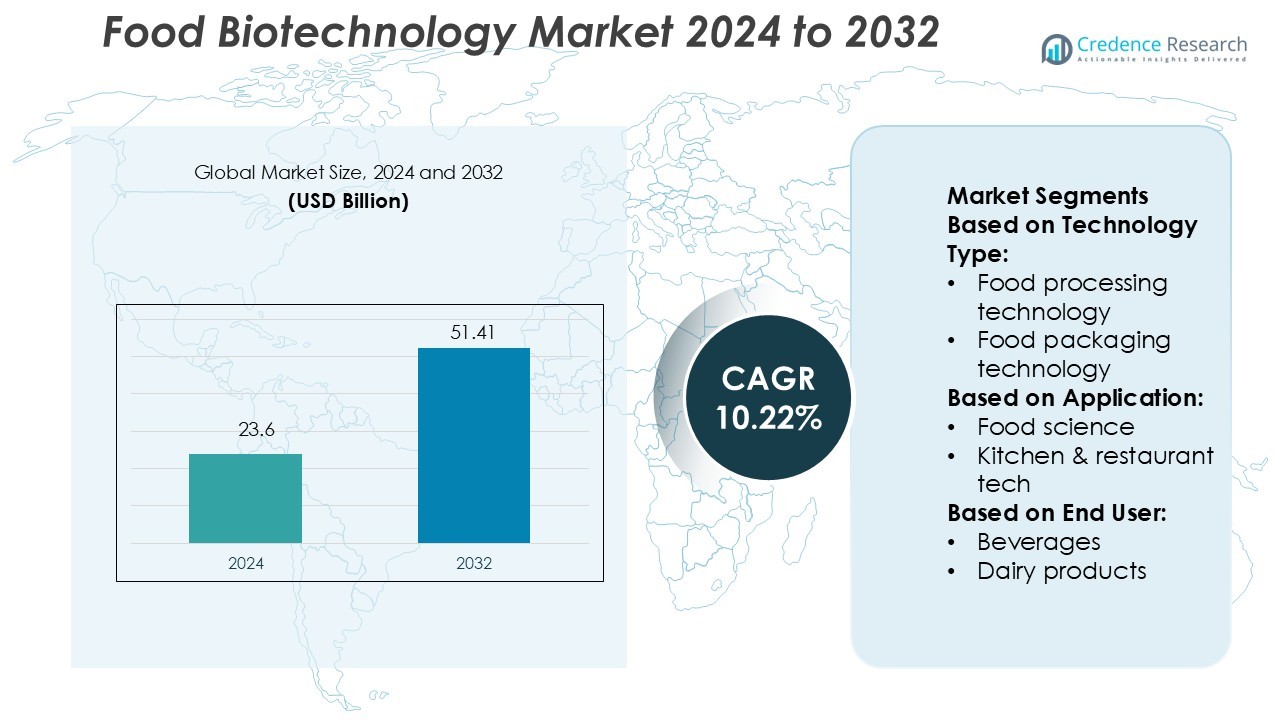
Food Biotechnology Market size was valued USD 23.6 billion in 2024 and is anticipated to reach USD 51.41 billion by 2032, at a CAGR of 10.22% during the forecast period.
| REPORT ATTRIBUTE | DETAILS |
|---|---|
| Historical Period | 2020-2023 |
| Base Year | 2024 |
| Forecast Period | 2025-2032 |
| Food Biotechnology Market Size 2024 | USD 23.6 Billion |
| Food Biotechnology Market, CAGR | 10.22% |
| Food Biotechnology Market Size 2032 | USD 51.41 Billion |
The food biotechnology market features strong competition, with major players advancing innovation through automation, sustainable processing, and smart logistics solutions. Companies focus on enhancing product quality, shelf life, and operational efficiency through precision fermentation, biosensors, and AI integration. Strategic investments in R&D support the development of functional ingredients, lab-grown foods, and eco-friendly packaging. Partnerships between food tech platforms and biotechnology firms strengthen supply chains and food safety systems. Asia Pacific leads the market with a 34% share, driven by rapid industrialization, strong government support, and a growing consumer base for functional and fortified foods. This regional dominance shapes global strategies and market growth.
Market Insights
- The Food Biotechnology Market size was valued at USD 23.6 billion in 2024 and is projected to reach USD 51.41 billion by 2032, growing at a CAGR of 10.22% during the forecast period.
- Strong market growth is driven by rising demand for functional foods, sustainable processing methods, and biotechnology-based food safety systems.
- Precision fermentation, biosensors, and AI-powered automation are key trends improving product shelf life, quality, and traceability.
- The market remains competitive with companies investing in R&D, product innovation, and strategic partnerships to strengthen supply chains and reduce operational costs.
- Asia Pacific leads the market with a 34% regional share, followed by Europe and North America, while food processing technology dominates the segment landscape, supported by rapid industrialization and growing consumer preference for fortified foods.
Market Segmentation Analysis:
By Technology Type
Food processing technology holds the dominant share in the food biotechnology market due to its widespread use across multiple production stages. Advanced bioprocessing methods improve shelf life, maintain nutritional quality, and enhance flavor. Automation and precision fermentation help manufacturers achieve consistent product standards. The demand for minimally processed and functional foods drives investment in this segment. Packaging technology also sees steady growth as companies adopt smart and biodegradable solutions. Food safety technology gains traction through stricter regulatory requirements and quality assurance measures. These developments position food processing as a key growth enabler for the market.
- For instance, Flippy 2's high throughput of 60 baskets per hour translates to a theoretical cycle time of 60 seconds per basket. The ability to handle multiple baskets simultaneously means that an entire order can be fulfilled very quickly, potentially in a sub-60-second time frame for certain items.
By Application
Food science dominates the application segment, supported by extensive R&D activities focused on product innovation and sustainability. Biotechnology applications in food science enhance nutrient profiles, optimize fermentation, and create healthier formulations. Companies use genetic engineering and microbial solutions to meet evolving consumer preferences. Kitchen and restaurant tech also grows steadily, supported by AI-powered cooking systems and automated prep solutions. Delivery and supply chain applications expand with the rise of smart tracking and cold chain technologies. Food science remains the largest revenue generator due to its role in enabling innovation and improving production efficiency.
- For instance, House Wellness Foods Corporation developed its Lp20 probiotic formulation containing 20 billion heat-inactivated Lactobacillus plantarum cells per gram, engineered to enhance nutrient absorption and shelf stability.
By End User
Beverages represent the dominant end-user segment, driven by the large-scale use of biotechnology in fermentation and flavor enhancement. Functional beverages, probiotics, and plant-based drinks lead innovation in this space. Producers invest in biotechnological processes to improve texture, extend shelf life, and reduce production costs. Dairy products and bakery segments also register strong adoption due to demand for clean-label and fortified products. Meat and seafood applications grow with alternative protein and lab-grown solutions. Beverages remain the largest segment as brands leverage biotechnology to create differentiated, value-added products with strong market appeal.
Key Growth Drivers
Rising Adoption of Advanced Bioprocessing Techniques
The food biotechnology market grows steadily with the rising use of advanced bioprocessing methods. Modern fermentation and enzyme technologies improve shelf life, flavor, and nutritional value. These innovations allow producers to reduce processing time and costs. Demand for clean-label, minimally processed products boosts investment in efficient bioprocessing solutions. Major players focus on scaling precision fermentation to meet consumer expectations. This approach improves production efficiency and product consistency. As consumer preferences shift toward natural and healthier food, bioprocessing technology plays a key role in driving overall market expansion.
- For instance, DH implemented a serverless rider-management architecture using Amazon EventBridge Scheduler, scaling to support 3 million registered riders delivering 10 million daily orders.
Growing Demand for Sustainable and Functional Foods
Sustainability and health concerns push food companies to integrate biotechnology into product development. Techniques like microbial fermentation and bioengineering help reduce waste and energy use. Functional foods enriched with probiotics, proteins, and plant-based ingredients gain strong consumer interest. Manufacturers adopt biotechnology to meet regulatory standards and environmental goals. Demand for eco-friendly packaging and traceable production further accelerates adoption. This driver reflects how biotechnology supports both innovation and environmental responsibility. The market benefits from a clear shift toward sustainable food systems and health-conscious consumer behavior.
- For instance, Flytrex’s drone delivery service in the DoorDash + Dallas-Fort Worth area covers over 30,000 households and more than 100,000 residents.The current drone models carry up to 6.6 pounds (≈ 3 kg); next-generation units are certified for payloads up to 8.8 pounds.
Expansion of Global Food Supply Chains
Global supply chain expansion creates strong demand for biotechnology in food safety and preservation. Advanced preservation techniques ensure product quality and reduce spoilage during transport. Biotechnology enables real-time monitoring of freshness, microbial content, and safety standards. Companies use these solutions to comply with international regulations and ensure product traceability. Emerging markets also drive adoption as logistics infrastructure expands. This shift enhances cross-border trade and ensures stable supply to meet growing food demand. Biotechnology strengthens global distribution networks, improving reliability and reducing food loss across supply chains.
Key Trends & Opportunities
Integration of Automation and AI in Food Production
Automation and AI are reshaping how biotechnology supports the food industry. Smart sensors, robotic handling, and AI-driven analytics optimize production and quality control. Automation reduces human error, improves efficiency, and enables mass customization. AI models help predict spoilage rates, fermentation quality, and nutrient retention. Startups and established firms are investing in automated systems to scale production at lower costs. This trend creates opportunities for advanced food tech companies. It also accelerates the shift toward data-driven and precise manufacturing practices in the global food biotechnology market.
- For instance, J&J’s supply-chain platform, built with Databricks, reduced data-engineering workloads by 45 % to 50 % and cut data-delivery lag from ~24 hours to under 10 minutes.
Rise of Alternative Proteins and Plant-Based Solutions
The alternative protein market creates major growth opportunities for biotechnology providers. Companies use precision fermentation, cell culture, and genetic engineering to develop plant-based and lab-grown products. These products meet rising consumer demand for sustainable and ethical food options. Improved protein structure and flavor innovations boost mainstream adoption. Governments and investors support this trend through funding and partnerships. As alternative proteins become cost-competitive, biotechnology plays a critical role in scaling production. This trend positions biotech firms at the center of the future protein ecosystem.
- For instance, Abbott achieved worldwide sales of $11.1 billion. During that quarter, the Medical Devices business delivered a 12% organic increase, while Diabetes Care grew 19% organically.
Expansion of Food Traceability and Safety Systems
Food traceability gains importance as global regulations tighten. Biotechnology enables real-time tracking of food safety parameters, reducing contamination risks. DNA barcoding, biosensors, and microbial testing strengthen quality assurance. Retailers and suppliers use these systems to increase transparency and build consumer trust. Digital traceability solutions also improve supply chain resilience. Companies that adopt these technologies can reduce recalls and operational disruptions. This growing focus on transparency and safety offers strong opportunities for biotech solution providers across global markets.
Key Challenges
Despite growing demand, biotechnological food production faces high costs due to advanced equipment and R&D requirements. Scaling up lab-based processes to commercial volumes requires substantial capital investment. Small and medium producers struggle with limited funding and access to technology. The high cost of enzymes, culture media, and precision fermentation systems remains a barrier to mass-market adoption. Addressing cost-efficiency through innovation and process optimization is crucial to achieving sustainable market growth.
Regulatory Complexity and Consumer Acceptance Issues
Stringent global regulations surrounding genetically modified organisms and biotech-derived foods pose significant hurdles. Approval timelines and labeling laws vary across regions, complicating commercialization strategies. Consumer skepticism regarding genetic modification and synthetic ingredients affects market perception. Companies like HelloFresh SE and Delivery Hero SE emphasize transparency and education to improve acceptance. Harmonizing international standards and enhancing consumer awareness remain essential to ensure smooth integration of biotechnology within the food ecosystem.
Regional Analysis
North America
North America holds a 32% market share in the food biotechnology market, supported by strong R&D infrastructure and a mature food processing sector. The region benefits from advanced regulatory frameworks, encouraging the adoption of biosensors, fermentation technologies, and clean-label ingredients. Major companies like BASF SE and Miso Robotics actively invest in AI-integrated biotech solutions. Rising consumer demand for functional and fortified food products accelerates growth. The U.S. leads in biotech-enabled production for beverages, dairy, and alternative proteins. Strategic collaborations between food tech firms and research institutions further enhance innovation and market expansion.
Europe
Europe accounts for a 28% market share, driven by its emphasis on sustainable and traceable food systems. The region’s strong regulatory standards push industries to adopt advanced food safety and packaging technologies. Companies like HelloFresh SE and Delivery Hero SE leverage biotechnology to reduce waste and ensure quality. Demand for plant-based and cultured foods continues to rise, supported by consumer awareness and environmental goals. Investment in smart fermentation, bio-packaging, and waste-to-value solutions positions Europe as a leader in sustainable biotech integration within the food industry.
Asia Pacific
Asia Pacific leads the market with a 34% market share, supported by its expanding food manufacturing base and growing consumer population. Countries like China, India, and Japan invest heavily in food processing and safety technologies. Local players such as Swiggy and Zomato integrate biotechnology with delivery and cold chain systems to maintain quality. Rapid urbanization and rising disposable incomes drive demand for fortified and functional food products. Government initiatives promoting food safety and modern processing methods further enhance market penetration. This region shows strong potential for future capacity expansion and innovation.
Latin America
Latin America holds a 4% market share, showing steady growth driven by increased investment in modern food processing infrastructure. Brazil and Mexico are emerging as key markets due to rising consumer interest in healthier and safer food options. Biotechnology adoption focuses on packaging, quality control, and fermentation technologies. Regional producers invest in cost-effective solutions to improve export competitiveness. Partnerships with global biotech firms are helping accelerate the introduction of advanced production methods and enhance food security in the region.
Middle East & Africa
The Middle East & Africa capture a 2% market share, primarily driven by rising demand for processed and packaged foods. Countries like the UAE and South Africa are adopting biotech solutions to improve food safety and extend shelf life. The region faces infrastructure and regulatory gaps, but ongoing investment in food security programs supports market growth. Partnerships with global technology providers and local food producers are helping introduce cost-effective, scalable biotechnology applications. These efforts aim to reduce dependency on imports and strengthen domestic food production capabilities.
Market Segmentations:
By Technology Type:
- Food processing technology
- Food packaging technology
By Application:
- Food science
- Kitchen & restaurant tech
By End User:
- Beverages
- Dairy products
By Geography
- North America
- U.S.
- Canada
- Mexico
- Europe
- Germany
- France
- U.K.
- Italy
- Spain
- Rest of Europe
- Asia Pacific
- China
- Japan
- India
- South Korea
- South-east Asia
- Rest of Asia Pacific
- Latin America
- Brazil
- Argentina
- Rest of Latin America
- Middle East & Africa
- GCC Countries
- South Africa
- Rest of the Middle East and Africa
Competitive Landscape
The food biotechnology market is shaped by key players including Zomato, Miso Robotics, LUNCHBOX, BASF SE, Carlisle Technology, Swiggy, HelloFresh SE, Delivery Hero SE, Flytrex Inc., and Nymble (Epifeast Inc.). The food biotechnology market is highly competitive, driven by rapid innovation, strategic collaborations, and expanding global demand. Companies focus on integrating biotechnology with automation, precision fermentation, and advanced packaging solutions to enhance efficiency and sustainability. Investments in R&D strengthen capabilities in functional ingredients, food safety, and smart processing technologies. Digital platforms and AI-driven systems enable real-time monitoring, ensuring higher product quality and reduced waste. Market leaders also adopt sustainable production methods, including lab-grown and plant-based solutions, to meet environmental goals. This dynamic landscape fosters constant technological advancement, encouraging both established firms and emerging players to scale globally.
Key Player Analysis
- Zomato
- Miso Robotics
- LUNCHBOX
- BASF SE
- Carlisle Technology
- Swiggy
- HelloFresh SE
- Delivery Hero SE
- Flytrex Inc.
- Nymble (Epifeast Inc.)
Recent Developments
- In May 2025, Layn Natural Ingredients has recently launched an upgraded biotechnology facility, which will greatly improve the company's abilities in precision fermentation and enzyme manufacturing. The initial innovation to come from the facility is Galacan, an advanced beta glucan.
- In May 2025, Nestlé announced a strategic overhaul of its worldwide R&D activities, featuring improved proficiency in biotechnology and the establishment of a new deep tech center in Orbe, located in the canton of Vaud.
- In February 2025, BASF is preparing to launch Prexio Active, a novel insecticide, after submitting registration dossiers in key Asia Pacific markets such as India. This marks a significant expansion of BASF's insecticide portfolio, providing sustainable solutions for rice farmers. Prexio Active targets all four rice hopper species and has no known cross-resistance to market standards.
- In August 2024, ADAMA Australia collaborated with Elemental Enzymes to introduce a novel bio-fungicide to the Australian market by 2026. This product, based on Elemental Enzymes’ patented peptide technology, was expected to target foliar diseases in winter crops and spring turf, offering a new mode of action against fungal diseases such as septoria in wheat.
Report Coverage
The research report offers an in-depth analysis based on Technology Type, Application, End-User and Geography. It details leading market players, providing an overview of their business, product offerings, investments, revenue streams, and key applications. Additionally, the report includes insights into the competitive environment, SWOT analysis, current market trends, as well as the primary drivers and constraints. Furthermore, it discusses various factors that have driven market expansion in recent years. The report also explores market dynamics, regulatory scenarios, and technological advancements that are shaping the industry. It assesses the impact of external factors and global economic changes on market growth. Lastly, it provides strategic recommendations for new entrants and established companies to navigate the complexities of the market.
Future Outlook
- The market will expand through increased adoption of sustainable and bio-based food technologies.
- Automation and AI integration will enhance production efficiency and quality control.
- Demand for functional and fortified foods will drive investments in advanced biotechnology.
- Alternative proteins and cultured foods will gain strong consumer acceptance.
- Smart packaging and biosensor technologies will strengthen food safety and traceability.
- Strategic collaborations between biotech firms and food delivery platforms will accelerate innovation.
- Regulatory frameworks will evolve to support wider commercialization of biotech-enabled foods.
- Cold chain and logistics will adopt biotech solutions to extend product shelf life.
- Investment in R&D will boost the development of high-value ingredients and fermentation systems.
- Emerging markets will witness rapid adoption of modern food biotechnology solutions.

Request a Free Sample
Fill in your details and we'll send you a free sample report.
- Sample data tables & charts
- Research methodology
Market Dynamics
Adoption of Advanced Bioprocessing Techniques
Modern fermentation and enzyme technologies are enabling producers to improve shelf life, flavor, and nutritional value while reducing processing time and costs. This drives investment in efficient bioprocessing solutions, supporting the production of clean-label and minimally processed foods.
Demand for Sustainable and Functional Foods
Growing consumer and regulatory focus on health and sustainability is pushing companies to use biotechnology for developing functional foods enriched with probiotics, proteins, and plant-based ingredients, as well as eco-friendly packaging and traceable production systems.
Expansion of Global Food Supply Chains
As food supply chains become more globalized, biotechnology is critical for ensuring food safety, quality, and traceability during transport. Advanced preservation and monitoring technologies help reduce spoilage and comply with international standards, supporting reliable cross-border trade.
Integration of Automation and AI in Food Production
Automation and AI-driven analytics are optimizing production processes, quality control, and traceability in food biotechnology. These technologies reduce human error, improve efficiency, and enable mass customization, making biotech-enabled food production more scalable and cost-effective.
Rise of Alternative Proteins and Plant-Based Solutions
Biotechnology is central to the development and scaling of plant-based and lab-grown proteins, meeting the rising demand for sustainable and ethical food options. Precision fermentation and cell culture technologies are enabling new product innovations and expanding the alternative protein market.
Need a Custom Version of This Report?
Tailor the scope, geography, or segments to your exact requirements.
- Custom geography or segment scope
- Direct access to our analyst team
Frequently Asked Questions
What is the current market size for the Food Biotechnology Market, and what is its projected size in 2032?
At what Compound Annual Growth Rate is the Food Biotechnology Market projected to grow between 2025 and 2032?
Which Food Biotechnology Market segment held the largest share in 2024?
What are the primary factors fueling the growth of the Food Biotechnology Market?
Who are the leading companies in the Food Biotechnology Market?
Which region commanded the largest share of the Food Biotechnology Market in 2024?
Table of Content
Chapter 1 Market Segmentation
- 1.1 Segmentation Framework
- 1.1.1 Product and Service Classification
- 1.1.2 Application and End-Use Classification
- 1.1.3 Technology and Solution Classification
- 1.1.4 Customer and Distribution Channel Classification
- 1.1.5 Geographic Segmentation
- 1.1.6 Market Segment Definitions and Boundaries
- 1.2 By End User
- 1.2.1 Beverages
- 1.2.2 Dairy products
- 1.2.3 Bakery
- 1.2.4 Meat & seafood
- 1.2.5 Plant-based & alternative proteins
- 1.3 By Application
- 1.3.1 Food science
- 1.3.2 Kitchen & restaurant tech
- 1.3.3 Delivery & supply chain management
- 1.3.4 Product innovation & formulation
- 1.4 By Technology Type
- 1.4.1 Food processing technology
- 1.4.2 Food packaging technology
- 1.4.3 Food safety technology
- 1.4.4 Precision fermentation
- 1.4.5 Biosensors & AI integration
Chapter 2 Introduction
- 2.1 Report Objectives and Scope
- 2.2 Product Definition and Industry Terminology
- 2.3 Market Inclusions and Exclusions
- 2.4 Research Process
- 2.4.1 Primary Research and Expert Interviews
- 2.4.2 Secondary Research and Source Review
- 2.4.3 Top-Down and Bottom-Up Estimation
- 2.4.4 Data Triangulation and Verification
- 2.5 Market Size Measurement Basis
- 2.5.1 2024: USD 23.6 billion → 2032: USD 51.41 billion
- 2.6 Historical and Forecast Reference Periods
- 2.6.1 Base Year: 2024
- 2.6.2 Forecast Period: 2024-2032
- 2.7 Research Assumptions and Limitations
Chapter 3 Executive Summary
- 3.1 Market Snapshot and Key Findings
- 3.2 Base-Year Market Size, 2024
- 3.3 Forecast Market Size, 2032
- 3.4 Revenue and Volume Growth Outlook
- 3.5 Key Demand and Supply Indicators
- 3.6 Leading Market Segments
- 3.7 Fastest-Growing Market Opportunities
- 3.8 Regional Performance Highlights
- 3.9 Technology and Industry Transformation
- 3.10 Competitive Landscape Summary
- 3.11 Analyst View and Strategic Implications
Chapter 4 Global Food Biotechnology Market Trends and Developments
- 4.1 Historical Industry Development
- 4.2 Recent Market Trends and Developments
- 4.3 Demand and Customer Behavior Trends
- 4.4 Technology and Product Innovation
- 4.5 Artificial Intelligence, Automation and Digitalization
- 4.6 Local Manufacturing and Supply Chain Realignment
- 4.7 Industry Partnerships, Mergers and Acquisitions
- 4.8 Sustainability and Circular Economy Developments
- 4.9 Government and Private Sector Investment Trends
- 4.10 Emerging Business Models and Commercialization
- 4.11 Industry Developments and Announcements
Chapter 5 Global Food Biotechnology Market Production, Supply and Demand Analysis
- 5.1 Demand Trend and Consumption Analysis
- 5.2 Demand Forecast, 2024-2032
- 5.3 Production and Output Trend
- 5.4 Production and Output Forecast, 2024-2032
- 5.5 Installed Capacity and Capacity Utilization
- 5.6 Company-Wise Production Plants and Statistics
- 5.6.1 Installed Production Capacity
- 5.6.2 Actual Production
- 5.6.3 Planned Capacity and Expansion Targets
- 5.7 Supply Chain Structure and Procurement Trends
- 5.8 Supply-Demand Gap and Bottlenecks
- 5.9 Import Dependence and Sourcing Structure
- 5.10 Contract Manufacturing and Outsourcing
- 5.11 Regional Supply and Demand Concentration
Chapter 6 Global Food Biotechnology Market Pricing Analysis
- 6.1 Pricing Structure and Measurement
- 6.2 Historical Pricing Trends
- 6.3 Pricing Outlook, 2024-2032
- 6.4 Average Selling Price and Unit Economics
- 6.5 Pricing by Product and Market Segment
- 6.6 Geographic Pricing Differences
- 6.7 Key Input, Energy, Labor and Logistics Costs
- 6.8 Contract Pricing and Purchasing Models
- 6.9 Pricing Sensitivity and Competitive Positioning
- 6.10 Price, Margin and Profitability Implications
Chapter 7 Global Food Biotechnology Market Dynamics
- 7.1 Market Growth Drivers
- 7.1.1 Demand-Side Drivers
- 7.1.2 Technology and Innovation Drivers
- 7.1.3 Infrastructure and Investment Drivers
- 7.1.4 Regulatory and Policy Drivers
- 7.2 Market Restraints
- 7.2.1 Cost and Affordability Constraints
- 7.2.2 Technology and Adoption Barriers
- 7.2.3 Supply Chain and Operational Constraints
- 7.3 Market Challenges
- 7.3.1 Competitive Pressure and Margin Erosion
- 7.3.2 Skills, Infrastructure and Implementation Gaps
- 7.4 Emerging Market Opportunities
- 7.5 Market Dynamics Impact and Time-Horizon Assessment
Chapter 8 Global Food Biotechnology Value Chain Analysis
- 8.1 Industry Value Chain Overview
- 8.2 Upstream Suppliers and Critical Inputs
- 8.3 Technology and Component Providers
- 8.4 Manufacturing or Service Delivery
- 8.5 Distribution, Channel Partners and Integrators
- 8.6 Downstream Applications and End Users
- 8.7 Value Addition and Profit Pools
- 8.8 Vertical Integration and Outsourcing
- 8.9 Supplier Concentration and Risk
- 8.10 Supply Chain Localization and Resilience
Chapter 9 Global Food Biotechnology Market Regulations and Policies
- 9.1 Relevant Laws, Standards and Compliance Frameworks
- 9.2 Product, Service, Safety and Quality Requirements
- 9.3 Government Policies, Incentives and Subsidies
- 9.4 Imports, Exports and Trade Barriers
- 9.5 Public Procurement and Local Content Requirements
- 9.6 Environmental and Sustainability Compliance
- 9.7 Upcoming Policy Changes and Market Implications
Chapter 10 Global Food Biotechnology Market Hotspots and Opportunities
- 10.1 Market Opportunity Mapping and Growth Hotspots
- 10.2 High-Growth Applications and Customer Groups
- 10.3 Underserved Markets and White-Space Opportunities
- 10.4 Emerging Technology and Product Opportunities
- 10.5 New Capacity and Investment Hotspots
- 10.6 Market Entry and Expansion Opportunities
- 10.7 Distribution and Partnership Opportunities
- 10.8 Near-Term and Long-Term Commercial Potential
- 10.9 Opportunity Attractiveness and Execution Risks
Chapter 11 Global Food Biotechnology Market Outlook, 2024-2032
- 11.1 Market Size and Analysis
- 11.1.1 Revenue (Market Measurement: 2024: USD 23.6 billion → 2032: USD 51.41 billion)
- 11.1.2 Market Volume and Quantity Sold
- 11.1.3 Historical Market Size
- 11.1.4 Base-Year Market Size, 2024
- 11.2 Market Forecast, 2024-2032
- 11.2.1 Revenue Forecast to 2032
- 11.2.2 Volume Forecast to 2032
- 11.2.3 CAGR and Year-on-Year Growth
- 11.2.4 Incremental Revenue Opportunity
- 11.3 Forecast Assumptions and Scenario Analysis
- 11.3.1 Base-Case Forecast
- 11.3.2 Optimistic and Conservative Scenarios
- 11.3.3 Technology, Pricing and Policy Sensitivities
- 11.4 Market Attractiveness and Growth Outlook
Chapter 12 Global Food Biotechnology Market Segmentation and Outlook
- 12.1 Segmentation Summary and Market Shares, 2024
- 12.2 Largest and Fastest-Growing Segments
- 12.3 By End User - Market Size and Forecast, 2024-2032
- 12.3.1 Segment Definition and Scope
- 12.3.2 Historical Market Size
- 12.3.3 Revenue Forecast, 2024-2032
- 12.3.4 Volume Forecast, 2024-2032
- 12.3.5 Base-Year Market Share, 2024
- 12.3.6 Segment CAGR and Growth Drivers
- 12.3.7 Subsegment Market Size and Forecast
- 12.3.7.1 Beverages
- 12.3.7.2 Dairy products
- 12.3.7.3 Bakery
- 12.3.7.4 Meat & seafood
- 12.3.7.5 Plant-based & alternative proteins
- 12.3.8 Subsegment Pricing and Adoption Trends
- 12.3.9 Leading Suppliers and Competition
- 12.3.10 Regional Demand and Opportunities
- 12.4 By Application - Market Size and Forecast, 2024-2032
- 12.4.1 Segment Definition and Scope
- 12.4.2 Historical Market Size
- 12.4.3 Revenue Forecast, 2024-2032
- 12.4.4 Volume Forecast, 2024-2032
- 12.4.5 Base-Year Market Share, 2024
- 12.4.6 Segment CAGR and Growth Drivers
- 12.4.7 Subsegment Market Size and Forecast
- 12.4.7.1 Food science
- 12.4.7.2 Kitchen & restaurant tech
- 12.4.7.3 Delivery & supply chain management
- 12.4.7.4 Product innovation & formulation
- 12.4.8 Subsegment Pricing and Adoption Trends
- 12.4.9 Leading Suppliers and Competition
- 12.4.10 Regional Demand and Opportunities
- 12.5 By Technology Type - Market Size and Forecast, 2024-2032
- 12.5.1 Segment Definition and Scope
- 12.5.2 Historical Market Size
- 12.5.3 Revenue Forecast, 2024-2032
- 12.5.4 Volume Forecast, 2024-2032
- 12.5.5 Base-Year Market Share, 2024
- 12.5.6 Segment CAGR and Growth Drivers
- 12.5.7 Subsegment Market Size and Forecast
- 12.5.7.1 Food processing technology
- 12.5.7.2 Food packaging technology
- 12.5.7.3 Food safety technology
- 12.5.7.4 Precision fermentation
- 12.5.7.5 Biosensors & AI integration
- 12.5.8 Subsegment Pricing and Adoption Trends
- 12.5.9 Leading Suppliers and Competition
- 12.5.10 Regional Demand and Opportunities
- 12.6 Segment Growth Comparison
- 12.7 Segment Attractiveness and Priority Matrix
Chapter 13 Global Food Biotechnology End-Use and Application Market Outlook
- 13.1 End-Use Industry and Customer Demand Structure
- 13.2 Leading Applications and Customer Groups
- 13.3 End-Use Market Size, Share and Forecast
- 13.4 Major End-Use Industry Deep Dives
- 13.4.1 Customer Requirements and Use Cases
- 13.4.2 Demand and Replacement Cycles
- 13.4.3 Technical and Regulatory Considerations
- 13.4.4 Purchasing and Procurement Models
- 13.4.5 Leading Vendors and Distribution Channels
- 13.4.6 Forecast and Commercial Opportunities
- 13.5 Emerging Applications and Cross-Segment Demand
- 13.6 End-Use Industry Investment Priorities
Chapter 14 Global Food Biotechnology Geographic Market Outlook, 2024-2032
- 14.1 Regional Market Size and Share, 2024
- 14.2 Regional Market Forecast, 2024-2032
- 14.3 Regional Pricing, Production and Demand Differences
- 14.4 North America
- 14.4.1 United States
- 14.4.2 Canada
- 14.4.3 Mexico
- 14.5 Europe
- 14.5.1 Germany
- 14.5.2 France
- 14.5.3 Italy
- 14.5.4 United Kingdom
- 14.5.5 Spain
- 14.5.6 Poland
- 14.5.7 Russia
- 14.5.8 Netherlands
- 14.5.9 Belgium
- 14.5.10 Sweden
- 14.5.11 Denmark
- 14.5.12 Norway
- 14.5.13 Rest of Europe
- 14.6 Asia Pacific
- 14.6.1 China
- 14.6.2 India
- 14.6.3 Japan
- 14.6.4 South Korea
- 14.6.5 Thailand
- 14.6.6 Indonesia
- 14.6.7 Vietnam
- 14.6.8 Malaysia
- 14.6.9 Australia
- 14.6.10 Rest of Asia Pacific
- 14.7 Latin America
- 14.7.1 Brazil
- 14.7.2 Argentina
- 14.7.3 Colombia
- 14.7.4 Chile
- 14.7.5 Rest of Latin America
- 14.8 Middle East
- 14.8.1 Saudi Arabia
- 14.8.2 United Arab Emirates
- 14.8.3 Turkey
- 14.8.4 Israel
- 14.8.5 Iran
- 14.8.6 Rest of the Middle East
- 14.9 Africa
- 14.9.1 South Africa
- 14.9.2 Egypt
- 14.9.3 Nigeria
- 14.9.4 Morocco
- 14.9.5 Rest of Africa
- 14.10 Regional Investment, Policy and Supply Chain Differences
- 14.11 Regional Competitive Landscape
- 14.12 Geographic Growth Hotspots
Chapter 15 Global Food Biotechnology Technology, Innovation and Sustainability Outlook
- 15.1 Technology Landscape and Maturity
- 15.2 Product, Process and Service Innovation
- 15.3 AI, Automation and Digital Tools in the Industry
- 15.4 Technology Adoption and Performance Benchmarking
- 15.5 Innovation Pipeline and R&D Investment
- 15.6 Patent and Intellectual Property Trends
- 15.7 Energy Efficiency and Resource Management
- 15.8 Sustainability, Recycling and Circularity
- 15.9 Technology Roadmap, 2024-2032
- 15.10 Risks of Obsolescence and Technology Substitution
Chapter 16 Global Food Biotechnology Market Key Strategic Imperatives
- 16.1 Growth and Market Entry Priorities
- 16.2 High-Return Products and Segments
- 16.3 Pricing, Profitability and Cost Optimization
- 16.4 Technology Investment and Product Differentiation
- 16.5 Supply Chain Localization and Resilience
- 16.6 Distribution and Customer Acquisition
- 16.7 Partnership, Acquisition and Capacity Strategy
- 16.8 Regional Expansion Priorities
- 16.9 Short-, Medium- and Long-Term Actions
Chapter 17 Competition Outlook
- 17.1 Industry Competition Characteristics
- 17.2 Market Structure and Concentration
- 17.3 Market Share and Competitive Positioning, 2024
- 17.4 Company-Wise Revenue and Product Benchmarking
- 17.5 Production and Service Capacity Benchmarking
- 17.6 Technology, Pricing and Differentiation
- 17.7 Regional Footprint and Distribution Strength
- 17.8 Mergers, Acquisitions and Strategic Alliances
- 17.9 New Entrants and Competitive Threats
- 17.10 Porter's Five Forces and Industry Attractiveness
- 17.11 Competitive Outlook, 2024-2032
Chapter 18 Company Profiles
- 18.1 Company Coverage and Selection Criteria
- 18.2 BASF SE
- 18.2.1 Business Description
- 18.2.2 Company Ownership and Geographic Presence
- 18.2.3 Product and Service Portfolio
- 18.2.4 Manufacturing and Operating Footprint
- 18.2.5 Production Capacity and Expansion Plans
- 18.2.6 Financial Performance and Investment
- 18.2.7 Market Share and Competitive Position
- 18.2.8 Technology and Innovation Capabilities
- 18.2.9 Strategic Alliances or Partnerships
- 18.2.10 Recent Developments
- 18.2.11 Growth Strategy and Outlook
- 18.3 Miso Robotics
- 18.4 HelloFresh SE
- 18.5 Delivery Hero SE
- 18.6 Swiggy
- 18.7 Zomato
- 18.8 LUNCHBOX
- 18.9 Carlisle Technology
- 18.10 Flytrex Inc.
- 18.11 Nymble (Epifeast Inc.)
- 18.12 Other Relevant Market Participants
Note: Every listed company is profiled on the structure shown under the first company. The company list is preliminary and may change based on research findings, market developments, data availability and client requirements.
Chapter 19 Disclaimer
- 19.1 Research and Forecast Disclaimer
- 19.2 Data Source and Estimation Limitations
Note: The depth of individual sections depends on data availability for this market. Volume, capacity, trade and other unit-based metrics are included where applicable.