Culture Media Market Overview:
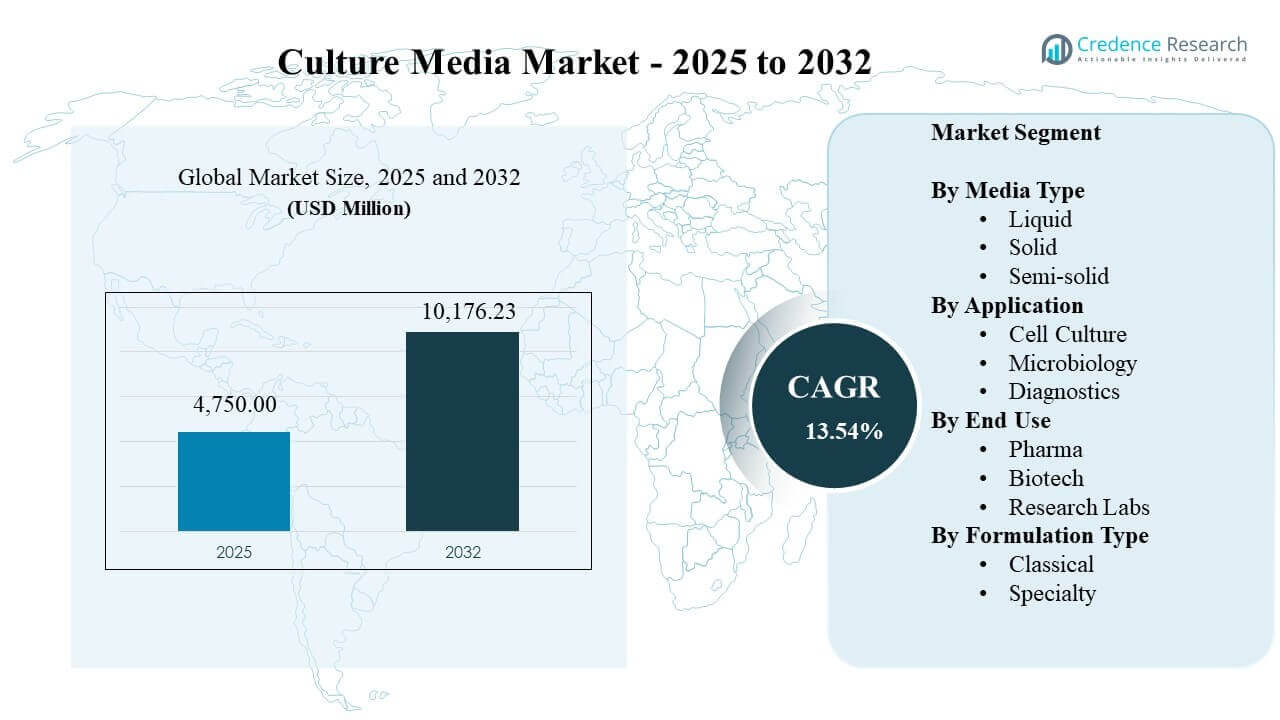
The global Culture Media Market size was estimated at USD 4,750.00 million in 2025 and is expected to reach USD 10,176.23 million by 2032, growing at a CAGR of 13.54% from 2025 to 2032. Demand growth is primarily driven by expanding biologics, vaccines, and advanced therapy pipelines that require high-consistency media and scalable upstream workflows across development and commercial manufacturing. Asia Pacific is strengthening consumption through capacity additions in bioprocessing and diagnostics, and procurement is increasingly shaped by supply assurance, documentation quality, and lot-to-lot reproducibility expectations across regulated environments.
| REPORT ATTRIBUTE | DETAILS |
|---|---|
| Historical Period | 2020-2024 |
| Base Year | 2025 |
| Forecast Period | 2026-2032 |
| Culture Media Market Size 2025 | USD 4,750.00 million |
| Culture Media Market, CAGR | 13.54% |
| Culture Media Market Size 2032 | USD 10,176.23 million |
Key Market Trends & Insights
- The Culture Media Market is projected to expand at a CAGR of 13.54% during 2025–2032.
- Liquid media accounted for the largest share of 62.10% in 2025, supported by broad use in bioreactor-based cell culture workflows.
- North America represented 36.90% of global revenue in 2025, led by high-volume GMP consumption and mature biopharma manufacturing.
- Semi-solid media is positioned as the fastest-growing format, with a 16.70% CAGR during 2026–2031 as clinical diagnostics and microbiology testing scale.
- Market value is projected to rise from USD 4,750.00 million in 2025 to USD 10,176.23 million by 2032, reflecting strong volume growth and product mix shifts toward specialized formulations.
Segment Analysis
The Culture Media Market shows a clear shift toward performance-optimized products as biopharmaceutical developers push for higher titers, stronger viability, and reproducible quality outcomes across development and production. Procurement preferences are increasingly linked to traceability, consistency, and contamination control, which elevates demand for chemically defined and serum-free formulations in regulated workflows. Ready-to-use products are gaining share as research labs, CDMOs, and manufacturing sites seek standardization and faster turnaround without in-house preparation variability.
Application needs remain diverse across cell culture, microbiology, and diagnostics, creating a split between high-volume upstream manufacturing media and routine clinical or research testing media. End users are balancing cost control with validation burden, and supplier selection is frequently influenced by documentation packages, supply assurance, and technical support for scale-up. Regional expansion in Asia Pacific is supporting faster adoption, particularly where bioprocessing capacity and diagnostic testing volumes are rising.
By Media Type Insights
Liquid accounted for the largest share of 62.10% in 2025. Liquid formats align with fed-batch and perfusion workflows, scale efficiently in single-use systems, and integrate well with closed transfer and sterile connection practices used in manufacturing. Liquid media also supports consistent dosing of feeds and supplements, which improves process control and productivity outcomes. Demand strength is reinforced by standardization requirements and reduced contamination risk compared with manual preparation.
By Application Insights
Cell culture, microbiology, and diagnostics demand patterns are shaped by different performance requirements and purchasing behaviors. Cell culture uses span discovery, process development, and commercial manufacturing, driving demand for consistent quality and scalable packaging. Microbiology and diagnostics consumption is supported by routine testing volumes in clinical labs and surveillance programs, where standardization and workflow efficiency matter. Procurement decisions increasingly favor validated products that reduce variability and support automation-compatible workflows.
By End Use Insights
Pharma, biotech, and research labs reflect distinct buying criteria that influence product mix and supplier selection. Pharma and biotech organizations tend to prioritize GMP alignment, traceability, and lot-to-lot consistency due to validation requirements and commercial risk. Research labs typically maintain broader usage of classical media for routine work while selectively adopting specialty products for advanced assays. Outsourcing to CDMOs can concentrate demand among industrial buyers, increasing the importance of supply continuity and global manufacturing reach.
By Formulation Type Insights
Classical formulations remain widely used for routine maintenance and standardized laboratory workflows, sustaining a stable baseline demand profile. Specialty formulations are expanding as cell therapy, organoids, and application-specific protocols require tighter control of growth factors, nutrients, and impurity profiles. Regulatory scrutiny and reproducibility expectations are increasing demand for defined and serum-free options across development and clinical manufacturing. Customization and optimization services are becoming more important as developers tune media to improve yield and phenotype stability.
Culture Media Market Drivers
Expansion of biopharmaceutical and vaccine manufacturing
Biopharmaceutical pipelines continue to expand across monoclonal antibodies, recombinant proteins, and vaccines, increasing recurring consumption of cell culture media and feeds. Scale-up from development to commercial production requires consistent quality systems and validated documentation. Manufacturing teams emphasize reproducibility to reduce batch deviation risk and protect release timelines. Single-use bioreactor adoption supports larger volumes of ready-to-use liquid media. These factors combine to sustain strong baseline demand across industrial buyers.
Growth in advanced therapies and specialized cell workflows
Cell and gene therapy programs require tighter control of media composition to maintain viability, phenotype, and potency. Specialty formulations enable improved performance for sensitive cell types and complex culture protocols. Development teams increasingly use application-optimized products to reduce iteration cycles and improve reproducibility across sites. Clinical manufacturing workflows also place higher emphasis on traceability and contamination control. The Culture Media Market benefits from higher-value products tied to advanced therapy production.
- For instance, Lonza’s Cocoon Platform integrates prefilled media cassettes with automated closed-system workflows, achieving cell viability rates above 95% for autologous T‑cell therapies and reducing manual handling steps by nearly 40%.
Increased emphasis on quality, traceability, and standardization
Regulated environments prioritize traceability, lot-to-lot consistency, and supplier quality systems, elevating the importance of documentation packages and robust manufacturing controls. Standardization reduces variability across multi-site development, manufacturing transfers, and CDMO partnerships. Ready-to-use formats reduce preparation burden and lower contamination exposure, supporting operational efficiency. Procurement teams increasingly assess supply resilience and quality governance. These drivers favor established suppliers and accelerate adoption of defined formulations.
Rising diagnostic and microbiology testing volumes
Clinical diagnostics and microbiology testing volumes support sustained demand for prepared media formats, including semi-solid variants aligned with plate-based workflows. Healthcare systems and public health programs rely on standardized, validated testing materials to support routine and surge capacity needs. Laboratory automation increases adoption of consistent products that fit high-throughput workflows. Operational constraints and staffing pressures also increase preference for prepared products. Demand remains resilient due to ongoing surveillance and routine clinical testing requirements.
- For instance, bioMérieux’s BacT/ALERT® automated microbial detection system processes up to 500,000 blood culture bottles annually at centralized diagnostic facilities, with validated media formulations maintaining consistent detection sensitivity over 99% across test runs.
Culture Media Market Challenges
Supply chain volatility and raw material variability can disrupt production planning and increase qualification burdens for end users. Media production depends on consistent inputs and controlled manufacturing processes, and changes in raw materials can require revalidation. Regulatory expectations elevate the need for documentation, traceability, and audit readiness, which increases operating costs for suppliers. Buyers may face longer lead times during demand spikes, which can pressure inventory strategies and increase total cost of ownership.
- For instance, when GE Healthcare (Cytiva) transitioned several classical powder media and buffers to animal‑origin–free raw materials, biopharma customers were required to run full comparability protocols that included multiple parallel bioreactor runs and batch‑to‑batch performance testing before approved process changes could be filed with regulators.
Pricing pressure and standardization demands can constrain margin expansion, particularly for classical formulations used in routine research and testing. End users often seek multi-sourcing and cost-optimized procurement, which can intensify competition in high-volume categories. Validation requirements raise switching costs, yet purchasing teams still push for cost reductions and improved contract terms. The Culture Media Market requires balanced investment in innovation, quality systems, and manufacturing scale to maintain competitiveness.
Culture Media Market Trends and Opportunities
Chemically defined and serum-free products are gaining momentum as laboratories prioritize traceability, reduced contamination risk, and reproducible outcomes. Defined formulations also support more predictable process performance, which benefits scale-up and manufacturing transfer activities. Customization services are expanding as developers tune media to maximize yield and maintain targeted cell attributes. The Culture Media Market is positioned to benefit from premiumization tied to advanced workflows. Supplier differentiation increasingly depends on performance evidence, quality governance, and technical support.
- For instance, Fujifilm Irvine Scientific’s chemically defined BalanCD CHO media has been reported to increase monoclonal antibody titers by approximately 70% compared with legacy serum-containing formulations in CHO fed‑batch processes, while maintaining >90% cell viability through late‑stage culture in internal and customer case studies.
Ready-to-use formats and packaging innovation are strengthening adoption as organizations seek faster turnaround and standardized operations. Single-use manufacturing growth supports broader adoption of bag-based liquid media and closed handling systems. Regional capacity growth in Asia Pacific creates opportunities for localized manufacturing, distribution, and application support aligned with domestic bioprocessing expansion. CDMO growth also creates demand for standardized products validated across multiple clients. These trends support new offerings that combine performance, convenience, and supply resilience.
Regional Insights
North America
North America accounted for 36.90% of global revenue in 2025, supported by mature biopharmaceutical manufacturing, extensive R&D investment, and large-scale demand for GMP-grade consumables. The United States leads purchasing volumes through biologics production, vaccine capacity, and advanced therapy development. Procurement requirements emphasize documentation depth, lot traceability, and consistent supply assurance, supporting demand for defined and specialized formulations. Strong CDMO activity reinforces recurring demand tied to scale-up and production services.
Europe
Europe represented 27.80% of global revenue in 2025, supported by established pharmaceutical production, strong academic research ecosystems, and regulated clinical laboratory infrastructure. Germany, the United Kingdom, and France anchor demand through biomanufacturing capacity, translational research, and clinical testing volumes. Regional buyers emphasize standardized products that reduce variability across multi-site programs. Quality governance and sustainability expectations also influence procurement decisions, encouraging adoption of optimized formulations and consistent manufacturing practices.
Asia Pacific
Asia Pacific captured 25.60% of global revenue in 2025, driven by expanding bioprocessing capacity, growing diagnostics demand, and increasing domestic manufacturing capabilities across major economies. China, India, Japan, and South Korea contribute to rising consumption through a mix of research expansion and industrial scale-up. Procurement focus is shifting toward reliable quality systems and consistent supply as regulated manufacturing grows. Regional investment in life sciences infrastructure supports higher volumes and broader adoption of specialized media products.
Latin America
Latin America held 5.10% of global revenue in 2025, supported by growth in diagnostics, public health testing, and selective expansion of biopharma manufacturing capability. Brazil and Mexico contribute meaningful demand through clinical laboratory networks and research activities. Budget constraints and procurement standardization influence product choice, sustaining demand for classical media while supporting gradual adoption of optimized products in regulated workflows. Supplier availability and distribution strength remain central to competitiveness in the region.
Middle East & Africa
The Middle East & Africa accounted for 4.60% of global revenue in 2025, supported by expanding diagnostic testing infrastructure and selective investments in pharmaceutical capacity. GCC countries and South Africa contribute demand through healthcare modernization and laboratory network development. Procurement often prioritizes availability, validated performance, and training support to maintain consistent lab outcomes. Growth opportunities are linked to localized manufacturing initiatives, research investments, and increased adoption of standardized clinical workflows.
Competitive Landscape
The Culture Media Market remains competitive with a mix of broad life-science suppliers and specialized cell culture providers competing on quality systems, portfolio breadth, formulation performance, and application support. Differentiation is increasingly tied to GMP-grade documentation, consistency across lots, and packaging formats that align with single-use and closed processing workflows. Partnerships and service models that support media optimization and process development strengthen customer retention by reducing switching risk. Global manufacturing footprint and supply assurance are central competitive factors as buyers prioritize continuity.
Thermo Fisher competes through broad cell culture and bioprocessing portfolios that align with research-to-manufacturing workflows and recurring consumable demand. Thermo Fisher leverages scalable manufacturing and distribution capabilities to support supply assurance for industrial buyers. Thermo Fisher also emphasizes performance-focused media development to improve productivity and reproducibility for common production cell lines. Thermo Fisher benefits from cross-selling into upstream processing workflows where media, feeds, and supplements are validated as part of standardized process platforms.
The industry research and growth report includes detailed analyses of the competitive landscape of the market and information about key companies, including:
Qualitative and quantitative analysis of companies has been conducted to help clients understand the wider business environment as well as the strengths and weaknesses of key industry players. Data is qualitatively analyzed to categorize companies as pure play, category-focused, industry-focused, and diversified; it is quantitatively analyzed to categorize companies as dominant, leading, strong, tentative, and weak.
Recent Developments
- In August 2024, MilliporeSigma, the Life Science business of Merck KGaA, Darmstadt, Germany, finalized the acquisition of Mirus Bio for approximately USD 600 million, strengthening its position in the culture media and bioprocessing space by combining advanced transfection reagents with its broader cell and gene therapy bioprocessing portfolio.
- In September 2024, Merck achieved EXCiPACT cGMP certification for pharmaceutical auxiliary materials at its global cell culture media production sites across Germany, the UK, China, and the U.S., reinforcing the quality and safety credentials of its culture media supply chain for biomanufacturers worldwide.
- In September 2024, Cytiva opened its first Innovation Hub in Songdo, Incheon, Korea, incorporating a manufacturing facility and customer experience lab focused on advancing biopharmaceutical manufacturing and culture media-related solutions with an emphasis on sustainable processes and collaborative development with regional life science partners.
Report Scope
| Report Attribute | Details |
| Market size value in 2025 | USD 4,750.00 million |
| Revenue forecast in 2032 | USD 10,176.23 million |
| Growth rate (CAGR) | 13.54% (2025–2032) |
| Base year | 2025 |
| Forecast period | 2026-2032 |
| Quantitative units | USD million |
| Segments covered | By Media Type Outlook: Liquid, Solid, Semi-solid; By Application Outlook: Cell Culture, Microbiology, Diagnostics; By End Use Outlook: Pharma, Biotech, Research Labs; By Formulation Type Outlook: Classical, Specialty |
| Regional scope | North America, Europe, Asia Pacific, Latin America, Middle East & Africa |
| Key companies profiled | Thermo Fisher, Merck KGaA, Cytiva, Lonza, HiMedia, BD, Sartorius, Corning, Takara Bio, PromoCell |
| No.of Pages | 324 |
Segmentation
By Media Type
- Liquid
- Solid
- Semi-solid
By Application
- Cell Culture
- Microbiology
- Diagnostics
By End Use
- Pharma
- Biotech
- Research Labs
By Formulation Type
- Classical
- Specialty
By Region
- North America
- U.S.
- Canada
- Mexico
- Europe
- Germany
- France
- U.K.
- Italy
- Spain
- Rest of Europe
- Asia Pacific
- China
- Japan
- India
- South Korea
- South-east Asia
- Rest of Asia Pacific
- Latin America
- Brazil
- Argentina
- Rest of Latin America
- Middle East & Africa
- GCC Countries
- South Africa
- Rest of the Middle East and Africa

Request a Free Sample
Fill in your details and we'll send you a free sample report.
- Sample data tables & charts
- Research methodology
Need a Custom Version of This Report?
Tailor the scope, geography, or segments to your exact requirements.
- Custom geography or segment scope
- Direct access to our analyst team
Frequently Asked Questions
What is the market size and forecast for the Culture Media Market?
What is the CAGR for the Culture Media Market during the forecast period?
Which segment holds the largest share in the Culture Media Market?
What factors are driving growth in the Culture Media Market?
Who are the leading companies in the Culture Media Market?
Which region leads the Culture Media Market?
Table of Content
Chapter 1 Market Segmentation
- 1.1 Segmentation Framework
- 1.1.1 Product and Service Classification
- 1.1.2 Application and End-Use Classification
- 1.1.3 Technology and Solution Classification
- 1.1.4 Customer and Distribution Channel Classification
- 1.1.5 Geographic Segmentation
- 1.1.6 Market Segment Definitions and Boundaries
Chapter 2 Introduction
- 2.1 Report Objectives and Scope
- 2.2 Product Definition and Industry Terminology
- 2.3 Market Inclusions and Exclusions
- 2.4 Research Process
- 2.4.1 Primary Research and Expert Interviews
- 2.4.2 Secondary Research and Source Review
- 2.4.3 Top-Down and Bottom-Up Estimation
- 2.4.4 Data Triangulation and Verification
- 2.5 Market Size Measurement Basis
- 2.5.1 2025: USD 4,750.00 million → 2032: USD 10,176.23 million
- 2.6 Historical and Forecast Reference Periods
- 2.6.1 Base Year: 2025
- 2.6.2 Forecast Period: 2025-2032
- 2.7 Research Assumptions and Limitations
Chapter 3 Executive Summary
- 3.1 Market Snapshot and Key Findings
- 3.2 Base-Year Market Size, 2025
- 3.3 Forecast Market Size, 2032
- 3.4 Revenue and Volume Growth Outlook
- 3.5 Key Demand and Supply Indicators
- 3.6 Leading Market Segments
- 3.7 Fastest-Growing Market Opportunities
- 3.8 Regional Performance Highlights
- 3.9 Technology and Industry Transformation
- 3.10 Competitive Landscape Summary
- 3.11 Analyst View and Strategic Implications
Chapter 4 Global Culture Media Market Trends and Developments
- 4.1 Historical Industry Development
- 4.2 Recent Market Trends and Developments
- 4.3 Demand and Customer Behavior Trends
- 4.4 Technology and Product Innovation
- 4.5 Artificial Intelligence, Automation and Digitalization
- 4.6 Local Manufacturing and Supply Chain Realignment
- 4.7 Industry Partnerships, Mergers and Acquisitions
- 4.8 Sustainability and Circular Economy Developments
- 4.9 Government and Private Sector Investment Trends
- 4.10 Emerging Business Models and Commercialization
- 4.11 Industry Developments and Announcements
Chapter 5 Global Culture Media Market Production, Supply and Demand Analysis
- 5.1 Demand Trend and Consumption Analysis
- 5.2 Demand Forecast, 2025-2032
- 5.3 Production and Output Trend
- 5.4 Production and Output Forecast, 2025-2032
- 5.5 Installed Capacity and Capacity Utilization
- 5.6 Company-Wise Production Plants and Statistics
- 5.6.1 Installed Production Capacity
- 5.6.2 Actual Production
- 5.6.3 Planned Capacity and Expansion Targets
- 5.7 Supply Chain Structure and Procurement Trends
- 5.8 Supply-Demand Gap and Bottlenecks
- 5.9 Import Dependence and Sourcing Structure
- 5.10 Contract Manufacturing and Outsourcing
- 5.11 Regional Supply and Demand Concentration
Chapter 6 Global Culture Media Market Pricing Analysis
- 6.1 Pricing Structure and Measurement
- 6.2 Historical Pricing Trends
- 6.3 Pricing Outlook, 2025-2032
- 6.4 Average Selling Price and Unit Economics
- 6.5 Pricing by Product and Market Segment
- 6.6 Geographic Pricing Differences
- 6.7 Key Input, Energy, Labor and Logistics Costs
- 6.8 Contract Pricing and Purchasing Models
- 6.9 Pricing Sensitivity and Competitive Positioning
- 6.10 Price, Margin and Profitability Implications
Chapter 7 Global Culture Media Market Dynamics
- 7.1 Market Growth Drivers
- 7.1.1 Demand-Side Drivers
- 7.1.2 Technology and Innovation Drivers
- 7.1.3 Infrastructure and Investment Drivers
- 7.1.4 Regulatory and Policy Drivers
- 7.2 Market Restraints
- 7.2.1 Cost and Affordability Constraints
- 7.2.2 Technology and Adoption Barriers
- 7.2.3 Supply Chain and Operational Constraints
- 7.3 Market Challenges
- 7.3.1 Competitive Pressure and Margin Erosion
- 7.3.2 Skills, Infrastructure and Implementation Gaps
- 7.4 Emerging Market Opportunities
- 7.5 Market Dynamics Impact and Time-Horizon Assessment
Chapter 8 Global Culture Media Value Chain Analysis
- 8.1 Industry Value Chain Overview
- 8.2 Upstream Suppliers and Critical Inputs
- 8.3 Technology and Component Providers
- 8.4 Manufacturing or Service Delivery
- 8.5 Distribution, Channel Partners and Integrators
- 8.6 Downstream Applications and End Users
- 8.7 Value Addition and Profit Pools
- 8.8 Vertical Integration and Outsourcing
- 8.9 Supplier Concentration and Risk
- 8.10 Supply Chain Localization and Resilience
Chapter 9 Global Culture Media Market Regulations and Policies
- 9.1 Relevant Laws, Standards and Compliance Frameworks
- 9.2 Product, Service, Safety and Quality Requirements
- 9.3 Government Policies, Incentives and Subsidies
- 9.4 Imports, Exports and Trade Barriers
- 9.5 Public Procurement and Local Content Requirements
- 9.6 Environmental and Sustainability Compliance
- 9.7 Upcoming Policy Changes and Market Implications
Chapter 10 Global Culture Media Market Hotspots and Opportunities
- 10.1 Market Opportunity Mapping and Growth Hotspots
- 10.2 High-Growth Applications and Customer Groups
- 10.3 Underserved Markets and White-Space Opportunities
- 10.4 Emerging Technology and Product Opportunities
- 10.5 New Capacity and Investment Hotspots
- 10.6 Market Entry and Expansion Opportunities
- 10.7 Distribution and Partnership Opportunities
- 10.8 Near-Term and Long-Term Commercial Potential
- 10.9 Opportunity Attractiveness and Execution Risks
Chapter 11 Global Culture Media Market Outlook, 2025-2032
- 11.1 Market Size and Analysis
- 11.1.1 Revenue (Market Measurement: 2025: USD 4,750.00 million → 2032: USD 10,176.23 million)
- 11.1.2 Market Volume and Quantity Sold
- 11.1.3 Historical Market Size
- 11.1.4 Base-Year Market Size, 2025
- 11.2 Market Forecast, 2025-2032
- 11.2.1 Revenue Forecast to 2032
- 11.2.2 Volume Forecast to 2032
- 11.2.3 CAGR and Year-on-Year Growth
- 11.2.4 Incremental Revenue Opportunity
- 11.3 Forecast Assumptions and Scenario Analysis
- 11.3.1 Base-Case Forecast
- 11.3.2 Optimistic and Conservative Scenarios
- 11.3.3 Technology, Pricing and Policy Sensitivities
- 11.4 Market Attractiveness and Growth Outlook
Chapter 12 Global Culture Media Market Segmentation and Outlook
- 12.1 Segmentation Summary and Market Shares, 2025
- 12.2 Largest and Fastest-Growing Segments
- 12.3 Segment Growth Comparison
- 12.4 Segment Attractiveness and Priority Matrix
Chapter 13 Global Culture Media Geographic Market Outlook, 2025-2032
- 13.1 Regional Market Size and Share, 2025
- 13.2 Regional Market Forecast, 2025-2032
- 13.3 Regional Pricing, Production and Demand Differences
- 13.4 North America
- 13.4.1 United States
- 13.4.2 Canada
- 13.4.3 Mexico
- 13.5 Europe
- 13.5.1 Germany
- 13.5.2 France
- 13.5.3 Italy
- 13.5.4 United Kingdom
- 13.5.5 Spain
- 13.5.6 Poland
- 13.5.7 Russia
- 13.5.8 Netherlands
- 13.5.9 Belgium
- 13.5.10 Sweden
- 13.5.11 Denmark
- 13.5.12 Norway
- 13.5.13 Rest of Europe
- 13.6 Asia Pacific
- 13.6.1 China
- 13.6.2 India
- 13.6.3 Japan
- 13.6.4 South Korea
- 13.6.5 Thailand
- 13.6.6 Indonesia
- 13.6.7 Vietnam
- 13.6.8 Malaysia
- 13.6.9 Australia
- 13.6.10 Rest of Asia Pacific
- 13.7 Latin America
- 13.7.1 Brazil
- 13.7.2 Argentina
- 13.7.3 Colombia
- 13.7.4 Chile
- 13.7.5 Rest of Latin America
- 13.8 Middle East
- 13.8.1 Saudi Arabia
- 13.8.2 United Arab Emirates
- 13.8.3 Turkey
- 13.8.4 Israel
- 13.8.5 Iran
- 13.8.6 Rest of the Middle East
- 13.9 Africa
- 13.9.1 South Africa
- 13.9.2 Egypt
- 13.9.3 Nigeria
- 13.9.4 Morocco
- 13.9.5 Rest of Africa
- 13.10 Regional Investment, Policy and Supply Chain Differences
- 13.11 Regional Competitive Landscape
- 13.12 Geographic Growth Hotspots
Chapter 14 Global Culture Media Technology, Innovation and Sustainability Outlook
- 14.1 Technology Landscape and Maturity
- 14.2 Product, Process and Service Innovation
- 14.3 AI, Automation and Digital Tools in the Industry
- 14.4 Technology Adoption and Performance Benchmarking
- 14.5 Innovation Pipeline and R&D Investment
- 14.6 Patent and Intellectual Property Trends
- 14.7 Energy Efficiency and Resource Management
- 14.8 Sustainability, Recycling and Circularity
- 14.9 Technology Roadmap, 2025-2032
- 14.10 Risks of Obsolescence and Technology Substitution
Chapter 15 Global Culture Media Market Key Strategic Imperatives
- 15.1 Growth and Market Entry Priorities
- 15.2 High-Return Products and Segments
- 15.3 Pricing, Profitability and Cost Optimization
- 15.4 Technology Investment and Product Differentiation
- 15.5 Supply Chain Localization and Resilience
- 15.6 Distribution and Customer Acquisition
- 15.7 Partnership, Acquisition and Capacity Strategy
- 15.8 Regional Expansion Priorities
- 15.9 Short-, Medium- and Long-Term Actions
Chapter 16 Competition Outlook
- 16.1 Industry Competition Characteristics
- 16.2 Market Structure and Concentration
- 16.3 Market Share and Competitive Positioning, 2025
- 16.4 Company-Wise Revenue and Product Benchmarking
- 16.5 Production and Service Capacity Benchmarking
- 16.6 Technology, Pricing and Differentiation
- 16.7 Regional Footprint and Distribution Strength
- 16.8 Mergers, Acquisitions and Strategic Alliances
- 16.9 New Entrants and Competitive Threats
- 16.10 Porter's Five Forces and Industry Attractiveness
- 16.11 Competitive Outlook, 2025-2032
Chapter 17 Company Profiles
- 17.1 Company Coverage and Selection Criteria
- 17.2 Leading Market Participants – Standard Profile Structure
- 17.2.1 Business Description
- 17.2.2 Company Ownership and Geographic Presence
- 17.2.3 Product and Service Portfolio
- 17.2.4 Manufacturing and Operating Footprint
- 17.2.5 Production Capacity and Expansion Plans
- 17.2.6 Financial Performance and Investment
- 17.2.7 Market Share and Competitive Position
- 17.2.8 Technology and Innovation Capabilities
- 17.2.9 Strategic Alliances or Partnerships
- 17.2.10 Recent Developments
- 17.2.11 Growth Strategy and Outlook
- 17.3 Other Relevant Market Participants
Note: Every listed company is profiled on the structure shown under the first company. The company list is preliminary and may change based on research findings, market developments, data availability and client requirements.
Chapter 18 Disclaimer
- 18.1 Research and Forecast Disclaimer
- 18.2 Data Source and Estimation Limitations
Note: The depth of individual sections depends on data availability for this market. Volume, capacity, trade and other unit-based metrics are included where applicable.