
Market Overview
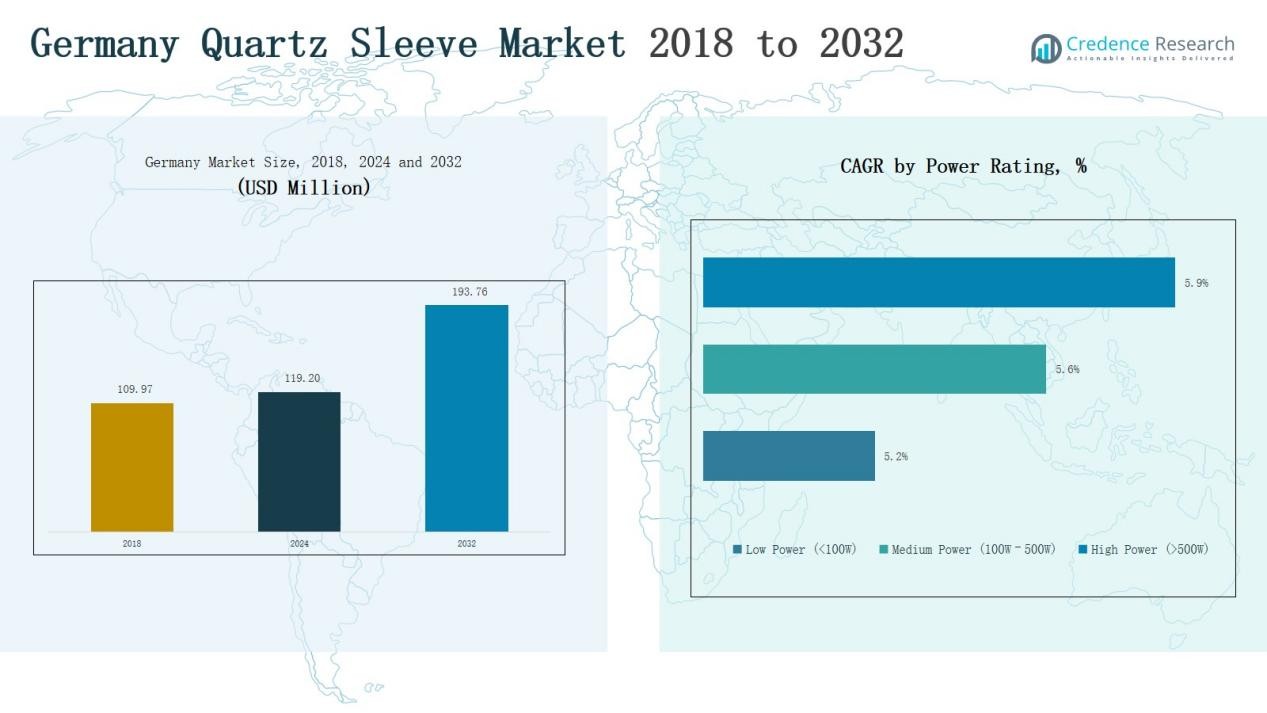
The Germany Quartz Sleeve Market size was valued at USD 109.97 million in 2018, reached USD 119.20 million in 2024, and is anticipated to reach USD 193.76 million by 2032, at a CAGR of 6.26% during the forecast period.
| REPORT ATTRIBUTE | DETAILS |
|---|---|
| Historical Period | 2020-2023 |
| Base Year | 2024 |
| Forecast Period | 2025-2032 |
| Germany Quartz Sleeve Market Size 2024 | USD 119.20 Million |
| Germany Quartz Sleeve Market, CAGR | 6.26% |
| Germany Quartz Sleeve Market Size 2032 | USD 193.76 Million |
The Germany Quartz Sleeve Market is characterized by strong competition among global and domestic players focusing on quality, innovation, and customized solutions. Key companies include Heraeus Quarzglas GmbH & Co. KG, Raesch Quarz (Germany) GmbH, WONIK Quartz Europe (WQE), QCS – Quarzglas Komponenten und Service GmbH, GVB GmbH – Solutions in Glass, semiQuarz, OSRAM Pre-Materials – Quartz Division, and Herbert Arnold GmbH & Co. KG (Arnold Gruppe). These players drive growth through advancements in high-purity materials, sustainable manufacturing, and application-specific solutions across water treatment, semiconductors, and pharmaceuticals. Southern Germany led the market in 2024 with a 31% share, supported by advanced manufacturing clusters, semiconductor facilities, and robust demand from food and beverage industries, cementing its position as the most dominant regional hub.
Market Insights
- The Germany Quartz Sleeve Market was valued at USD 109.97 million in 2018, reached USD 119.20 million in 2024, and will reach USD 193.76 million by 2032 at a CAGR of 6.26%.
- Leading companies include Heraeus Quarzglas GmbH & Co. KG, Raesch Quarz (Germany) GmbH, WONIK Quartz Europe, QCS Quarzglas Komponenten und Service GmbH, GVB GmbH, semiQuarz, OSRAM Pre-Materials, and Herbert Arnold GmbH & Co. KG.
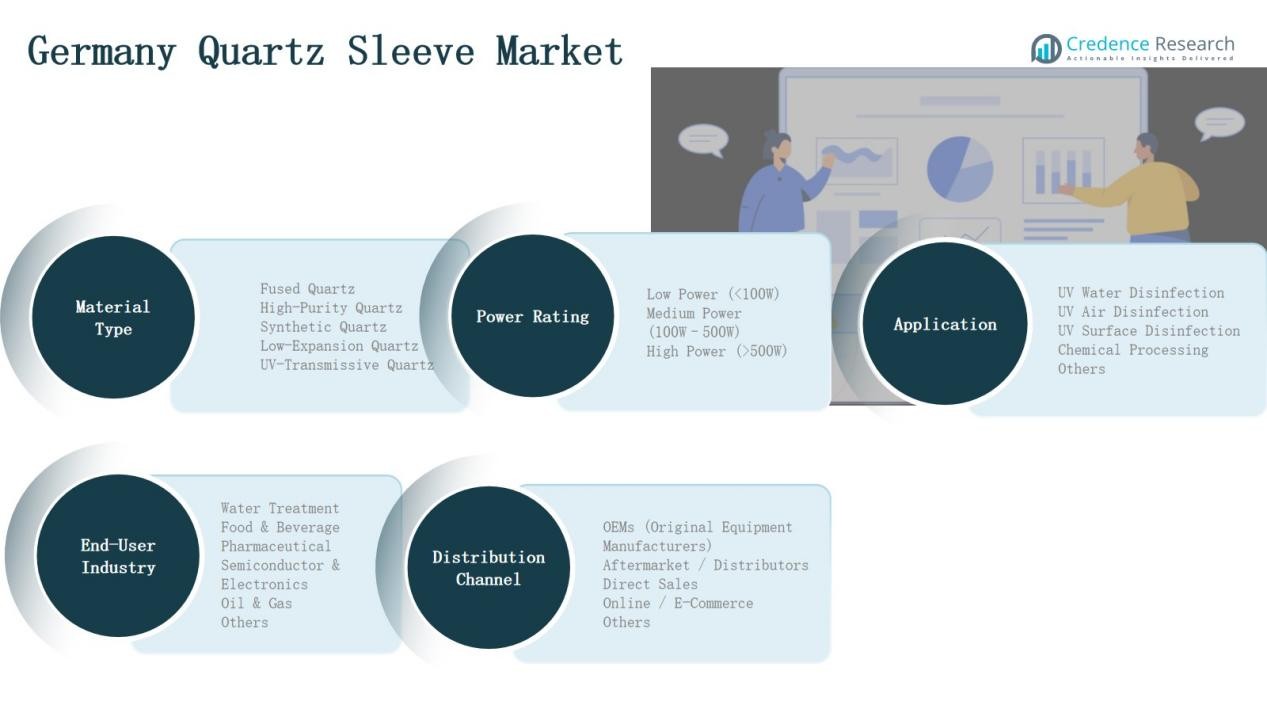
- By material type, fused quartz held the largest share of 39% in 2024, driven by its thermal stability, high purity, and rising use in water treatment and semiconductors.
- By application, UV water disinfection led with 44% share in 2024, supported by strict regulations, municipal water treatment projects, and growing installation of advanced UV lamp systems.
- Southern Germany dominated with 31% share in 2024, benefiting from advanced semiconductor clusters, robust food and beverage demand, and strong industrial activity in Bavaria and Baden-Württemberg.
Market Segment Insights
By Material Type
Fused quartz dominated the Germany quartz sleeve market in 2024 with a 39% share. Its superior thermal stability, high purity, and resistance to UV degradation make it the preferred choice for water treatment and semiconductor industries. Demand is further supported by Germany’s strong base of advanced manufacturing and research facilities. High-purity quartz followed, gaining traction in pharmaceutical and electronics applications, driven by growing requirements for contamination-free environments and the expansion of precision component manufacturing.
- For instance, QSIL GmbH introduced specialty quartz components tailored for UV water purification systems, enhancing durability and operational efficiency for municipal and industrial users.
By Application
UV water disinfection led the market with a 44% share in 2024, fueled by Germany’s strict water quality regulations and widespread adoption of UV purification systems. Rising municipal investments in water treatment plants and the integration of advanced UV lamps further supported growth. UV air disinfection also recorded notable adoption in healthcare and public spaces, boosted by rising awareness of air hygiene standards post-pandemic. Surface disinfection and chemical processing provided niche opportunities, catering to food safety and industrial needs.
- For instance, Heraeus Conamic announced the expansion of its fused silica production capacity in Germany to meet growing demand from semiconductor and photonics industries.
By End-User
Water treatment emerged as the leading end-user segment with a 36% market share in 2024. The dominance stems from Germany’s advanced municipal infrastructure and stringent policies on clean water standards. The food and beverage industry followed, leveraging quartz sleeves in UV-based sterilization systems to ensure product safety and compliance with EU regulations. Pharmaceutical companies also contributed significant demand, utilizing high-purity sleeves in sterile processing environments, while semiconductor manufacturers adopted them for high-performance UV curing and precision applications.
Key Growth Drivers
Rising Demand for UV Disinfection Systems
Germany’s strict water quality regulations and focus on sustainable sanitation practices drive the adoption of UV disinfection systems. Quartz sleeves are essential for protecting UV lamps and ensuring efficient performance. Increasing municipal investments in water treatment plants and growing adoption in residential applications reinforce demand. Additionally, public awareness of waterborne diseases and the government’s initiatives toward eco-friendly disinfection methods further accelerate market growth, making UV water disinfection the largest application segment in the German quartz sleeve market.
- For instance, the Witten drinking-water plant near Berlin swapped chlorine dioxide for two Wedeco Quadron 1200 UV systems to meet stricter microbial limits.
Expansion of Semiconductor and Electronics Manufacturing
The robust semiconductor and electronics sector in Germany significantly contributes to quartz sleeve demand. These sleeves are used in high-purity and UV processes, critical for chip fabrication and precision instruments. Increasing investments in microelectronics, coupled with EU-backed initiatives to strengthen regional chip production, enhance market prospects. Germany’s position as a hub for innovation and advanced manufacturing ensures continuous utilization of high-purity quartz materials, driving both volume growth and technological upgrades across multiple end-user industries.
- For instance, GlobalFoundries partnered with Robert Bosch GmbH and other companies under the EU’s Important Project of Common European Interest (IPCEI) framework, enhancing regional semiconductor manufacturing routes that depend on quartz glass-based systems for lithography and etching
Growing Adoption in Food and Pharmaceutical Industries
Food safety and pharmaceutical compliance standards drive quartz sleeve use in sterilization and disinfection processes. The food and beverage sector leverages UV quartz sleeve systems for packaging, processing, and microbial control. Similarly, pharmaceutical companies depend on high-purity quartz sleeves for contamination-free sterile production. Rising consumer expectations for safety, paired with EU regulations for hygiene and product integrity, strengthen demand. This trend highlights the role of quartz sleeves as vital components in ensuring reliability and efficiency across regulated industries.
Key Trends & Opportunities
Integration of Advanced UV-C and LED Technologies
The integration of advanced UV-C and UV-LED systems presents new opportunities for quartz sleeves. These sleeves must adapt to higher efficiency lamps with extended lifespans. Manufacturers are innovating materials that maximize UV transmission and thermal resistance, enabling compatibility with emerging disinfection systems. This trend aligns with Germany’s push for sustainable, energy-efficient solutions. It positions quartz sleeve suppliers to benefit from long-term replacement cycles and new product development in healthcare, municipal, and consumer applications across the country.
- For instance, Signify expanded its Philips UV-C disinfection portfolio with new UV-C chambers designed for healthcare settings, where enhanced quartz sleeves were adopted to improve optical efficiency and withstand higher lamp operating conditions.
Rising Focus on Sustainable Manufacturing Practices
Sustainability is emerging as a key opportunity in the Germany quartz sleeve market. Companies are adopting eco-friendly processes to reduce carbon emissions and improve material efficiency. Demand for recyclable, durable quartz sleeves is gaining momentum, particularly in industries adopting green procurement policies. Furthermore, Germany’s strong emphasis on environmental compliance supports suppliers investing in circular economy practices. This shift enhances brand positioning and offers new opportunities for differentiation, enabling companies to strengthen competitiveness while meeting sustainability-focused customer expectations.
- For instance, Saint-Gobain’s low-carbon ORAÉ® glass uses renewable electricity and high recycled cullet. An EPD shows 64% pre-consumer cullet content for a representative product. This transparency aligns with German green procurement needs.
Key Challenges
High Production and Processing Costs
Quartz sleeve manufacturing requires high-purity raw materials and precise processing techniques, leading to elevated production costs. Advanced melting, shaping, and polishing processes increase capital requirements, which limits entry for smaller firms. Rising energy costs in Germany further exacerbate the challenge, pressuring margins. These cost factors make quartz sleeves relatively expensive compared to substitutes, creating resistance among cost-sensitive end users. Companies must adopt technological innovations and efficiency improvements to balance product quality with affordability in this competitive market.
Competition from Low-Cost Imports
German manufacturers face significant competition from low-cost imports, particularly from Asian producers with scale-driven pricing advantages. While domestic players emphasize quality, consistency, and compliance with EU regulations, cheaper imports appeal to price-sensitive buyers. This dynamic intensifies competition and challenges margins for local firms. Additionally, fluctuations in global trade policies and tariffs further complicate supply chains. To remain competitive, German suppliers must enhance value propositions by offering customized solutions, faster delivery, and superior after-sales support.
Dependence on End-User Investments
Quartz sleeve demand is closely tied to capital spending in sectors such as water treatment, semiconductors, and pharmaceuticals. Delays in municipal projects or budget constraints in industrial sectors directly impact market growth. Economic downturns, inflationary pressures, or shifts in government funding priorities can slow adoption. Such dependence on end-user investment cycles introduces uncertainty, making long-term forecasting complex. Market players must diversify customer bases and strengthen aftermarket services to mitigate risks linked to cyclical investments and project delays.
Regional Analysis
Southern Germany
Southern Germany held a 31% share in the Germany Quartz Sleeve Market in 2024. Strong industrial activity in Bavaria and Baden-Württemberg supports high adoption of quartz sleeves across water treatment, electronics, and pharmaceuticals. The presence of leading semiconductor facilities and advanced manufacturing clusters ensures steady demand for high-purity and fused quartz products. Food and beverage companies in this region also integrate UV systems to meet strict safety standards. Continuous investment in clean technologies strengthens its market leadership.
Western Germany
Western Germany accounted for a 28% share in 2024. The region benefits from a strong chemical processing and industrial base in North Rhine-Westphalia. Municipal water treatment projects supported by large urban populations continue to drive demand for quartz sleeves. Pharmaceutical companies in Frankfurt further expand usage, especially in sterile production processes. The market here reflects steady demand across multiple applications, supported by strong infrastructure and government emphasis on sanitation compliance.
Northern Germany
Northern Germany represented a 22% share in the Germany Quartz Sleeve Market during 2024. The region demonstrates rising demand due to extensive port activities and industrial processing hubs. Investments in municipal water facilities, particularly in Hamburg and Bremen, boost adoption of UV water disinfection solutions. Semiconductor and electronics demand remains moderate but growing, supported by smaller specialized facilities. Food and beverage processing units also create stable opportunities for quartz sleeves, reinforcing the region’s balanced contribution.
Eastern Germany
Eastern Germany captured a 19% share in 2024. The region is steadily advancing through infrastructure modernization and healthcare projects, particularly in Saxony and Thuringia. Smaller pharmaceutical and electronics hubs are emerging, encouraging higher use of high-purity quartz sleeves. Municipal initiatives in water purification create steady opportunities, while rising adoption in food safety strengthens demand. Though the market share remains lower compared to other regions, continued investment and industrial upgrades support long-term growth potential for quartz sleeves.
Market Segmentations:
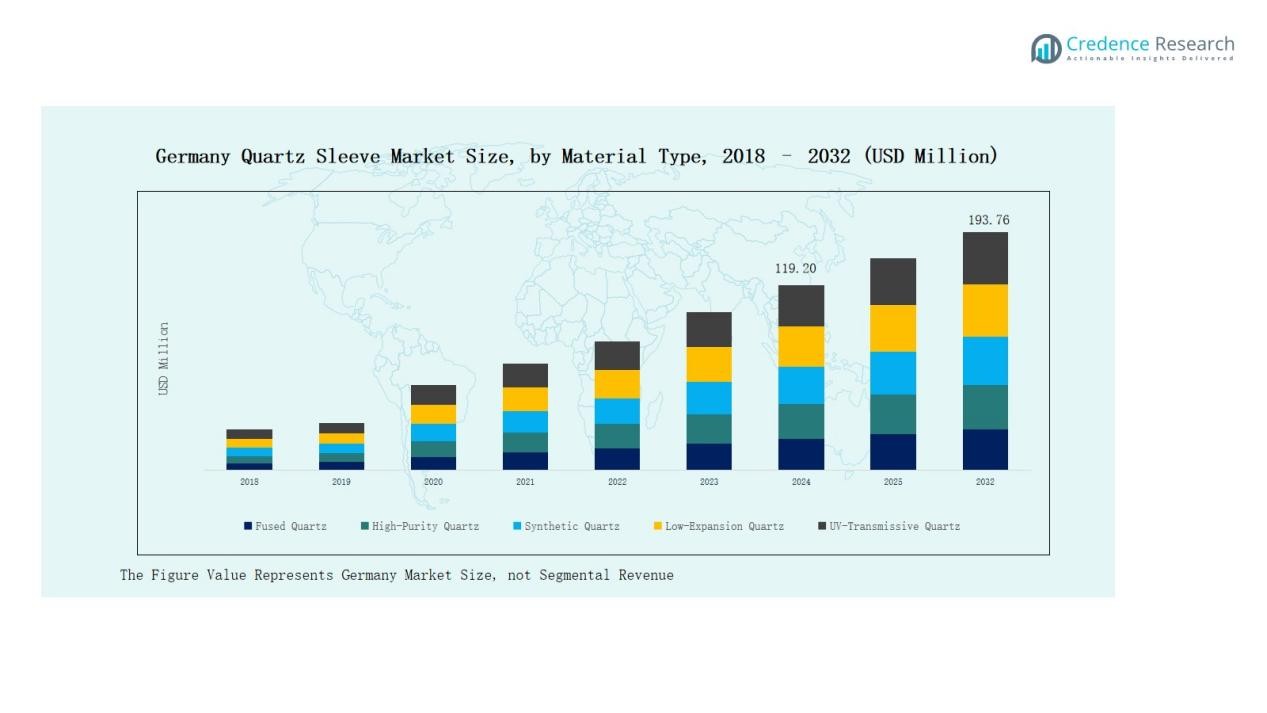
By Material Type
- Fused Quartz
- High-Purity Quartz
- Synthetic Quartz
- Low-Expansion Quartz
- UV-Transmissive Quartz
By Application
- UV Water Disinfection
- UV Air Disinfection
- UV Surface Disinfection
- Chemical Processing
- Others
By End-User
- Water Treatment
- Food & Beverage
- Pharmaceutical
- Semiconductor & Electronics
- Oil & Gas
- Others
By Power Rating
- Low Power (<100W)
- Medium Power (100W–500W)
- High Power (>500W)
By Distribution Channel
- OEMs (Original Equipment Manufacturers)
- Aftermarket / Distributors
- Direct Sales
- Online / E-Commerce
- Others
By Region
- Southern Germany
- Western Germany
- Northern Germany
- Eastern Germany
Competitive Landscape
The Germany Quartz Sleeve Market features a mix of global leaders and specialized domestic players competing on quality, innovation, and customization. Heraeus Quarzglas GmbH & Co. KG holds a leading position, supported by advanced R&D and a broad product portfolio catering to water treatment, semiconductors, and pharmaceuticals. Raesch Quarz (Germany) GmbH and WONIK Quartz Europe (WQE) strengthen competition through precision-engineered products and established client networks. QCS – Quarzglas Komponenten und Service GmbH and GVB GmbH – Solutions in Glass focus on tailored solutions, serving both industrial and municipal applications. SemiQuarz and Herbert Arnold GmbH & Co. KG emphasize engineering expertise and niche offerings, while OSRAM Pre-Materials leverages its quartz division for UV lighting applications. Intense rivalry pushes companies to invest in high-purity materials, sustainable processes, and after-sales service. Strategic partnerships, technology upgrades, and regional expansion remain central to strengthening market share and meeting Germany’s demand for advanced quartz sleeve solutions.
Key Players
- Heraeus Quarzglas GmbH & Co. KG
- Raesch Quarz (Germany) GmbH
- WONIK Quartz Europe (WQE)
- QCS – Quarzglas Komponenten und Service GmbH
- GVB GmbH – Solutions in Glass
- semiQuarz
- OSRAM Pre-Materials – Quartz Division
- Herbert Arnold GmbH & Co. KG (Arnold Gruppe)
Recent Developments
- In June 2024, Wacker broke ground on a new production site in Karlovy Vary, Czech Republic, to increase its capacity for silicone specialties.
- In December 2024, SCHOTT announced acquisition of QSIL GmbH / Quarzschmelze Ilmenau, expanding its quartz glass capabilities.
- In January 2025, Heraeus merged its Conamic and Comvance units to form a new high-performance materials business, consolidating its materials technologies.
Report Coverage
The research report offers an in-depth analysis based on Material Type, Application, End User, Power Rating, Distribution Channel and Region. It details leading market players, providing an overview of their business, product offerings, investments, revenue streams, and key applications. Additionally, the report includes insights into the competitive environment, SWOT analysis, current market trends, as well as the primary drivers and constraints. Furthermore, it discusses various factors that have driven market expansion in recent years. The report also explores market dynamics, regulatory scenarios, and technological advancements that are shaping the industry. It assesses the impact of external factors and global economic changes on market growth. Lastly, it provides strategic recommendations for new entrants and established companies to navigate the complexities of the market.
Future Outlook
- Demand will expand with rising investments in UV water disinfection projects across municipalities.
- Semiconductor manufacturing growth will drive adoption of high-purity quartz sleeves.
- Food and beverage companies will increase usage to ensure product safety and regulatory compliance.
- Pharmaceutical demand will rise due to sterile production requirements and hygiene standards.
- Energy-efficient UV-LED systems will create new opportunities for advanced quartz sleeve designs.
- Online distribution channels will gain traction, improving accessibility for smaller buyers.
- Sustainability initiatives will push suppliers to adopt eco-friendly manufacturing processes.
- Competition will intensify as low-cost imports challenge domestic producers.
- Regional industrial modernization will stimulate adoption in Eastern and Northern Germany.
- Customized solutions and aftermarket services will become key strategies for market differentiation.

Request a Free Sample
Fill in your details and we'll send you a free sample report.
- Sample data tables & charts
- Research methodology
Market Dynamics
Stringent Water Quality Regulations and UV Disinfection Adoption
Germany’s strict water quality standards and regulatory requirements are driving widespread adoption of UV water disinfection systems, where quartz sleeves are essential for protecting UV lamps and ensuring system efficiency. Municipal investments in advanced water treatment infrastructure further reinforce demand for high-quality quartz sleeves.
Expansion of Semiconductor and Electronics Manufacturing
Germany’s robust semiconductor and electronics sector relies on high-purity quartz sleeves for critical UV and high-temperature processes in chip fabrication and precision instruments. Ongoing investments in microelectronics and EU-backed initiatives to strengthen regional chip production are boosting demand for advanced quartz sleeve solutions.
Growth in Food & Beverage and Pharmaceutical Sterilization
The food and beverage industry, along with pharmaceuticals, increasingly utilizes quartz sleeves in UV-based sterilization systems to meet stringent EU hygiene and safety regulations. Rising consumer expectations for product safety and contamination-free environments are accelerating the adoption of quartz sleeves in these sectors.
Integration of Advanced UV-C and LED Technologies
The shift toward energy-efficient UV-C and UV-LED disinfection systems is creating new opportunities for quartz sleeve manufacturers to innovate with materials that maximize UV transmission and thermal resistance. This trend supports long-term replacement cycles and new product development, especially in healthcare and municipal applications.
Sustainability and Eco-Friendly Manufacturing Initiatives
Growing emphasis on sustainable manufacturing practices and green procurement policies in Germany is pushing suppliers to develop recyclable, durable quartz sleeves and adopt eco-friendly production processes. This focus on sustainability enhances brand positioning and meets the evolving expectations of environmentally conscious customers.
Need a Custom Version of This Report?
Tailor the scope, geography, or segments to your exact requirements.
- Custom geography or segment scope
- Direct access to our analyst team
Frequently Asked Questions
What is the current market size for Germany Quartz Sleeve Market, and what is its projected size in 2032?
At what Compound Annual Growth Rate is the Germany Quartz Sleeve Market projected to grow between 2025 and 2032?
Which Germany Quartz Sleeve Market segment held the largest share in 2024?
What are the primary factors fueling the growth of the Germany Quartz Sleeve Market?
Who are the leading companies in the Germany Quartz Sleeve Market?
Which region commanded the largest share of the Germany Quartz Sleeve Market in 2024?
Table of Content
Chapter 1 Market Segmentation
- 1.1 Segmentation Framework
- 1.1.1 Product and Service Classification
- 1.1.2 Application and End-Use Classification
- 1.1.3 Technology and Solution Classification
- 1.1.4 Customer and Distribution Channel Classification
- 1.1.5 Geographic Segmentation
- 1.1.6 Market Segment Definitions and Boundaries
- 1.2 By End-User
- 1.2.1 Water Treatment
- 1.2.2 Food & Beverage
- 1.2.3 Pharmaceutical
- 1.2.4 Semiconductor & Electronics
- 1.2.5 Oil & Gas
- 1.2.6 Others
- 1.3 By Application
- 1.3.1 UV Water Disinfection
- 1.3.2 UV Air Disinfection
- 1.3.3 UV Surface Disinfection
- 1.3.4 Chemical Processing
- 1.3.5 Others
- 1.4 By Material Type
- 1.4.1 Fused Quartz
- 1.4.2 High-Purity Quartz
- 1.4.3 Synthetic Quartz
- 1.4.4 Low-Expansion Quartz
- 1.4.5 UV-Transmissive Quartz
Chapter 2 Introduction
- 2.1 Report Objectives and Scope
- 2.2 Product Definition and Industry Terminology
- 2.3 Market Inclusions and Exclusions
- 2.4 Research Process
- 2.4.1 Primary Research and Expert Interviews
- 2.4.2 Secondary Research and Source Review
- 2.4.3 Top-Down and Bottom-Up Estimation
- 2.4.4 Data Triangulation and Verification
- 2.5 Market Size Measurement Basis
- 2.5.1 2024: USD 119.20 million → 2032: USD 193.76 million
- 2.6 Historical and Forecast Reference Periods
- 2.6.1 Base Year: 2024
- 2.6.2 Forecast Period: 2024-2032
- 2.7 Research Assumptions and Limitations
Chapter 3 Executive Summary
- 3.1 Market Snapshot and Key Findings
- 3.2 Base-Year Market Size, 2024
- 3.3 Forecast Market Size, 2032
- 3.4 Revenue and Volume Growth Outlook
- 3.5 Key Demand and Supply Indicators
- 3.6 Leading Market Segments
- 3.7 Fastest-Growing Market Opportunities
- 3.8 Regional Performance Highlights
- 3.9 Technology and Industry Transformation
- 3.10 Competitive Landscape Summary
- 3.11 Analyst View and Strategic Implications
Chapter 4 Germany Quartz Sleeve Market Trends and Developments
- 4.1 Historical Industry Development
- 4.2 Recent Market Trends and Developments
- 4.3 Demand and Customer Behavior Trends
- 4.4 Technology and Product Innovation
- 4.5 Artificial Intelligence, Automation and Digitalization
- 4.6 Local Manufacturing and Supply Chain Realignment
- 4.7 Industry Partnerships, Mergers and Acquisitions
- 4.8 Sustainability and Circular Economy Developments
- 4.9 Government and Private Sector Investment Trends
- 4.10 Emerging Business Models and Commercialization
- 4.11 Industry Developments and Announcements
Chapter 5 Germany Quartz Sleeve Market Production, Supply and Demand Analysis
- 5.1 Demand Trend and Consumption Analysis
- 5.2 Demand Forecast, 2024-2032
- 5.3 Production and Output Trend
- 5.4 Production and Output Forecast, 2024-2032
- 5.5 Installed Capacity and Capacity Utilization
- 5.6 Company-Wise Production Plants and Statistics
- 5.6.1 Installed Production Capacity
- 5.6.2 Actual Production
- 5.6.3 Planned Capacity and Expansion Targets
- 5.7 Supply Chain Structure and Procurement Trends
- 5.8 Supply-Demand Gap and Bottlenecks
- 5.9 Import Dependence and Sourcing Structure
- 5.10 Contract Manufacturing and Outsourcing
- 5.11 Regional Supply and Demand Concentration
Chapter 6 Germany Quartz Sleeve Market Pricing Analysis
- 6.1 Pricing Structure and Measurement
- 6.2 Historical Pricing Trends
- 6.3 Pricing Outlook, 2024-2032
- 6.4 Average Selling Price and Unit Economics
- 6.5 Pricing by Product and Market Segment
- 6.6 Geographic Pricing Differences
- 6.7 Key Input, Energy, Labor and Logistics Costs
- 6.8 Contract Pricing and Purchasing Models
- 6.9 Pricing Sensitivity and Competitive Positioning
- 6.10 Price, Margin and Profitability Implications
Chapter 7 Germany Quartz Sleeve Market Dynamics
- 7.1 Market Growth Drivers
- 7.1.1 Demand-Side Drivers
- 7.1.2 Technology and Innovation Drivers
- 7.1.3 Infrastructure and Investment Drivers
- 7.1.4 Regulatory and Policy Drivers
- 7.2 Market Restraints
- 7.2.1 Cost and Affordability Constraints
- 7.2.2 Technology and Adoption Barriers
- 7.2.3 Supply Chain and Operational Constraints
- 7.3 Market Challenges
- 7.3.1 Competitive Pressure and Margin Erosion
- 7.3.2 Skills, Infrastructure and Implementation Gaps
- 7.4 Emerging Market Opportunities
- 7.5 Market Dynamics Impact and Time-Horizon Assessment
Chapter 8 Germany Quartz Sleeve Value Chain Analysis
- 8.1 Industry Value Chain Overview
- 8.2 Upstream Suppliers and Critical Inputs
- 8.3 Technology and Component Providers
- 8.4 Manufacturing or Service Delivery
- 8.5 Distribution, Channel Partners and Integrators
- 8.6 Downstream Applications and End Users
- 8.7 Value Addition and Profit Pools
- 8.8 Vertical Integration and Outsourcing
- 8.9 Supplier Concentration and Risk
- 8.10 Supply Chain Localization and Resilience
Chapter 9 Germany Quartz Sleeve Market Regulations and Policies
- 9.1 Relevant Laws, Standards and Compliance Frameworks
- 9.2 Product, Service, Safety and Quality Requirements
- 9.3 Government Policies, Incentives and Subsidies
- 9.4 Imports, Exports and Trade Barriers
- 9.5 Public Procurement and Local Content Requirements
- 9.6 Environmental and Sustainability Compliance
- 9.7 Upcoming Policy Changes and Market Implications
Chapter 10 Germany Quartz Sleeve Market Hotspots and Opportunities
- 10.1 Market Opportunity Mapping and Growth Hotspots
- 10.2 High-Growth Applications and Customer Groups
- 10.3 Underserved Markets and White-Space Opportunities
- 10.4 Emerging Technology and Product Opportunities
- 10.5 New Capacity and Investment Hotspots
- 10.6 Market Entry and Expansion Opportunities
- 10.7 Distribution and Partnership Opportunities
- 10.8 Near-Term and Long-Term Commercial Potential
- 10.9 Opportunity Attractiveness and Execution Risks
Chapter 11 Germany Quartz Sleeve Market Outlook, 2024-2032
- 11.1 Market Size and Analysis
- 11.1.1 Revenue (Market Measurement: 2024: USD 119.20 million → 2032: USD 193.76 million)
- 11.1.2 Market Volume and Quantity Sold
- 11.1.3 Historical Market Size
- 11.1.4 Base-Year Market Size, 2024
- 11.2 Market Forecast, 2024-2032
- 11.2.1 Revenue Forecast to 2032
- 11.2.2 Volume Forecast to 2032
- 11.2.3 CAGR and Year-on-Year Growth
- 11.2.4 Incremental Revenue Opportunity
- 11.3 Forecast Assumptions and Scenario Analysis
- 11.3.1 Base-Case Forecast
- 11.3.2 Optimistic and Conservative Scenarios
- 11.3.3 Technology, Pricing and Policy Sensitivities
- 11.4 Market Attractiveness and Growth Outlook
Chapter 12 Germany Quartz Sleeve Market Segmentation and Outlook
- 12.1 Segmentation Summary and Market Shares, 2024
- 12.2 Largest and Fastest-Growing Segments
- 12.3 By End-User - Market Size and Forecast, 2024-2032
- 12.3.1 Segment Definition and Scope
- 12.3.2 Historical Market Size
- 12.3.3 Revenue Forecast, 2024-2032
- 12.3.4 Volume Forecast, 2024-2032
- 12.3.5 Base-Year Market Share, 2024
- 12.3.6 Segment CAGR and Growth Drivers
- 12.3.7 Subsegment Market Size and Forecast
- 12.3.7.1 Water Treatment
- 12.3.7.2 Food & Beverage
- 12.3.7.3 Pharmaceutical
- 12.3.7.4 Semiconductor & Electronics
- 12.3.7.5 Oil & Gas
- 12.3.7.6 Others
- 12.3.8 Subsegment Pricing and Adoption Trends
- 12.3.9 Leading Suppliers and Competition
- 12.3.10 Regional Demand and Opportunities
- 12.4 By Application - Market Size and Forecast, 2024-2032
- 12.4.1 Segment Definition and Scope
- 12.4.2 Historical Market Size
- 12.4.3 Revenue Forecast, 2024-2032
- 12.4.4 Volume Forecast, 2024-2032
- 12.4.5 Base-Year Market Share, 2024
- 12.4.6 Segment CAGR and Growth Drivers
- 12.4.7 Subsegment Market Size and Forecast
- 12.4.7.1 UV Water Disinfection
- 12.4.7.2 UV Air Disinfection
- 12.4.7.3 UV Surface Disinfection
- 12.4.7.4 Chemical Processing
- 12.4.7.5 Others
- 12.4.8 Subsegment Pricing and Adoption Trends
- 12.4.9 Leading Suppliers and Competition
- 12.4.10 Regional Demand and Opportunities
- 12.5 By Material Type - Market Size and Forecast, 2024-2032
- 12.5.1 Segment Definition and Scope
- 12.5.2 Historical Market Size
- 12.5.3 Revenue Forecast, 2024-2032
- 12.5.4 Volume Forecast, 2024-2032
- 12.5.5 Base-Year Market Share, 2024
- 12.5.6 Segment CAGR and Growth Drivers
- 12.5.7 Subsegment Market Size and Forecast
- 12.5.7.1 Fused Quartz
- 12.5.7.2 High-Purity Quartz
- 12.5.7.3 Synthetic Quartz
- 12.5.7.4 Low-Expansion Quartz
- 12.5.7.5 UV-Transmissive Quartz
- 12.5.8 Subsegment Pricing and Adoption Trends
- 12.5.9 Leading Suppliers and Competition
- 12.5.10 Regional Demand and Opportunities
- 12.6 Segment Growth Comparison
- 12.7 Segment Attractiveness and Priority Matrix
Chapter 13 Germany Quartz Sleeve End-Use and Application Market Outlook
- 13.1 End-Use Industry and Customer Demand Structure
- 13.2 Leading Applications and Customer Groups
- 13.3 End-Use Market Size, Share and Forecast
- 13.4 Major End-Use Industry Deep Dives
- 13.4.1 Customer Requirements and Use Cases
- 13.4.2 Demand and Replacement Cycles
- 13.4.3 Technical and Regulatory Considerations
- 13.4.4 Purchasing and Procurement Models
- 13.4.5 Leading Vendors and Distribution Channels
- 13.4.6 Forecast and Commercial Opportunities
- 13.5 Emerging Applications and Cross-Segment Demand
- 13.6 End-Use Industry Investment Priorities
Chapter 14 Germany Quartz Sleeve Geographic Market Outlook, 2024-2032
- 14.1 Domestic Market Distribution and Demand Clusters
- 14.2 State- or Province-Wise Market Size and Forecast, 2024-2032
- 14.3 City and Metropolitan Market Outlook
- 14.4 Industrial, Manufacturing and Commercial Clusters
- 14.5 Geographic Concentration of Key End Users
- 14.6 Local Pricing and Purchasing Differences
- 14.7 Domestic Production Facilities and Capacity Map
- 14.8 Local Infrastructure and Project Pipeline
- 14.9 State-Level Policy and Incentive Differences
- 14.10 Subnational Investment Hotspots and Opportunities
- 14.11 Distribution and Logistics Networks
- 14.12 Domestic Competitive Footprint
Chapter 15 Germany Quartz Sleeve Technology, Innovation and Sustainability Outlook
- 15.1 Technology Landscape and Maturity
- 15.2 Product, Process and Service Innovation
- 15.3 AI, Automation and Digital Tools in the Industry
- 15.4 Technology Adoption and Performance Benchmarking
- 15.5 Innovation Pipeline and R&D Investment
- 15.6 Patent and Intellectual Property Trends
- 15.7 Energy Efficiency and Resource Management
- 15.8 Sustainability, Recycling and Circularity
- 15.9 Technology Roadmap, 2024-2032
- 15.10 Risks of Obsolescence and Technology Substitution
Chapter 16 Germany Quartz Sleeve Market Key Strategic Imperatives
- 16.1 Growth and Market Entry Priorities
- 16.2 High-Return Products and Segments
- 16.3 Pricing, Profitability and Cost Optimization
- 16.4 Technology Investment and Product Differentiation
- 16.5 Supply Chain Localization and Resilience
- 16.6 Distribution and Customer Acquisition
- 16.7 Partnership, Acquisition and Capacity Strategy
- 16.8 Regional Expansion Priorities
- 16.9 Short-, Medium- and Long-Term Actions
Chapter 17 Competition Outlook
- 17.1 Industry Competition Characteristics
- 17.2 Market Structure and Concentration
- 17.3 Market Share and Competitive Positioning, 2024
- 17.4 Company-Wise Revenue and Product Benchmarking
- 17.5 Production and Service Capacity Benchmarking
- 17.6 Technology, Pricing and Differentiation
- 17.7 Regional Footprint and Distribution Strength
- 17.8 Mergers, Acquisitions and Strategic Alliances
- 17.9 New Entrants and Competitive Threats
- 17.10 Porter's Five Forces and Industry Attractiveness
- 17.11 Competitive Outlook, 2024-2032
Chapter 18 Company Profiles
- 18.1 Company Coverage and Selection Criteria
- 18.2 Heraeus Quarzglas GmbH & Co. KG
- 18.2.1 Business Description
- 18.2.2 Company Ownership and Geographic Presence
- 18.2.3 Product and Service Portfolio
- 18.2.4 Manufacturing and Operating Footprint
- 18.2.5 Production Capacity and Expansion Plans
- 18.2.6 Financial Performance and Investment
- 18.2.7 Market Share and Competitive Position
- 18.2.8 Technology and Innovation Capabilities
- 18.2.9 Strategic Alliances or Partnerships
- 18.2.10 Recent Developments
- 18.2.11 Growth Strategy and Outlook
- 18.3 Raesch Quarz (Germany) GmbH
- 18.4 WONIK Quartz Europe (WQE)
- 18.5 QCS – Quarzglas Komponenten und Service GmbH
- 18.6 GVB GmbH – Solutions in Glass
- 18.7 semiQuarz
- 18.8 OSRAM Pre-Materials – Quartz Division
- 18.9 Herbert Arnold GmbH & Co. KG (Arnold Gruppe)
- 18.10 QSIL GmbH
- 18.11 SCHOTT AG
- 18.12 Other Relevant Market Participants
Note: Every listed company is profiled on the structure shown under the first company. The company list is preliminary and may change based on research findings, market developments, data availability and client requirements.
Chapter 19 Disclaimer
- 19.1 Research and Forecast Disclaimer
- 19.2 Data Source and Estimation Limitations
Note: The depth of individual sections depends on data availability for this market. Volume, capacity, trade and other unit-based metrics are included where applicable.

