
Market Overview
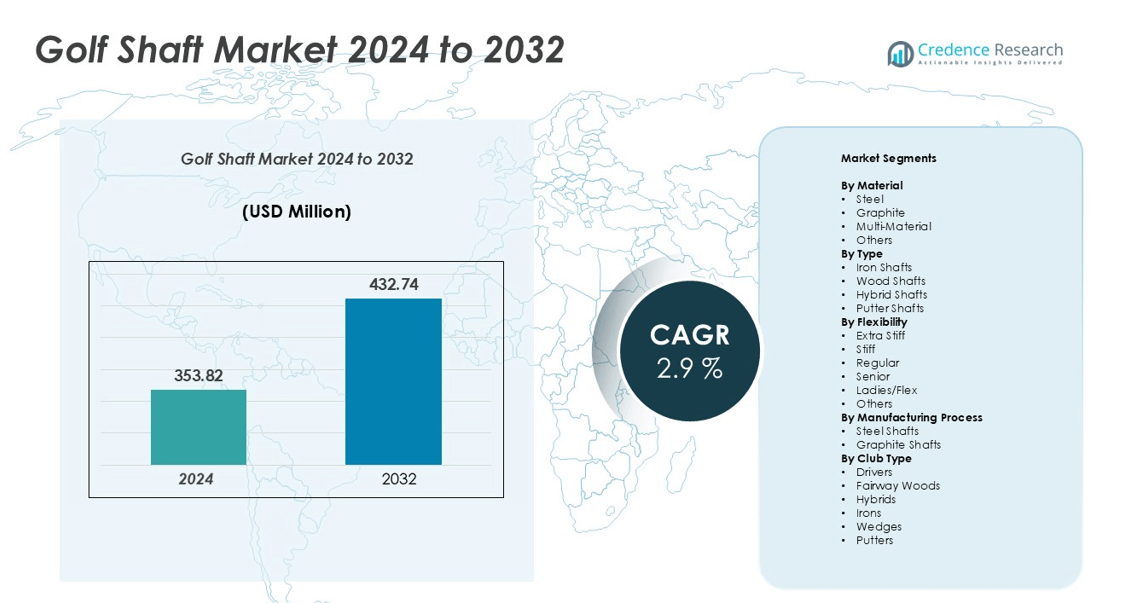
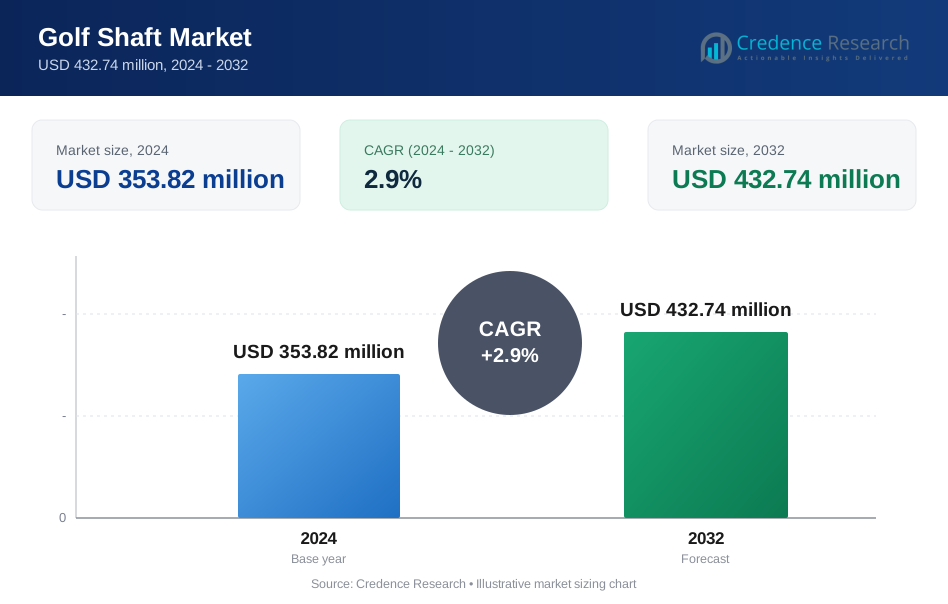
The golf shaft market size was valued at USD 353.82 million in 2024 and is anticipated to reach USD 432.74 million by 2032, at a CAGR of 2.9% during the forecast period.
| REPORT ATTRIBUTE | DETAILS |
|---|---|
| Historical Period | 2020-2023 |
| Base Year | 2024 |
| Forecast Period | 2025-2032 |
| Golf Shaft Market Size 2024 | USD 353.82 million |
| Golf Shaft Market, CAGR | 2.9% |
| Golf Shaft Market Size 2032 | USD 432.74 million |
The golf shaft market is led by prominent players such as True Temper Sports, Mitsubishi Chemical, Fujikura, Aldila, Graphite Design, Project X, KBS Golf Shafts, Accra Golf Shafts, and Grafalloy, who collectively drive innovation and set industry benchmarks. North America dominates the regional landscape, holding approximately 35% of the global market share, driven by strong golf culture, high disposable income, and widespread adoption of premium and customized shafts. Europe follows with around 28% market share, supported by established golfing traditions, technological advancements, and increasing focus on performance-oriented equipment. These top players leverage R&D, strategic partnerships, and endorsements from professional golfers to maintain competitive advantage. Their focus on material innovations, lightweight shafts, and personalized offerings aligns with regional demand patterns, reinforcing their leadership positions and sustaining growth in key global markets.
Market Insights
- The global golf shaft market was valued at USD 353.82 million in 2024 and is projected to reach USD 432.74 million by 2032, growing at a CAGR of 2.9% during the forecast period.
- Growth is driven by rising golf participation, increasing demand for customized and performance-oriented shafts, and technological advancements in steel, graphite, and hybrid materials.
- Key trends include the adoption of lightweight graphite shafts, eco-friendly manufacturing, and integration of smart technology for swing analytics, enhancing player performance and engagement.
- The market is highly competitive with leading players such as True Temper Sports, Mitsubishi Chemical, Fujikura, Aldila, Graphite Design, Project X, KBS Golf Shafts, Accra Golf Shafts, and Grafalloy leveraging R&D, professional endorsements, and product differentiation to maintain market leadership.
- Regionally, North America holds the largest share at approximately 35%, followed by Europe at 28%, Asia-Pacific at 22%, and the Rest of the World at 15%, with steel shafts and irons dominating segment-wise sales.
Market Segmentation Analysis:
By Flexibility
The golf shaft market by flexibility is categorized into Extra Stiff, Stiff, Regular, Senior, Ladies/Flex, and Others. Among these, the Regular shaft segment dominates, accounting for the largest market share due to its versatility and suitability for a wide range of golfers, from amateurs to professionals. Drivers for this segment include increasing participation in recreational golf and the growing preference for customized playing experiences that match swing speed and control. Manufacturers are innovating with advanced materials and precision engineering to enhance performance, further driving demand for regular-flex shafts globally.
- For instance, the Dynamic Gold 95 VSS Pro is a lightweight, high-launch shaft designed for players with a moderate swing tempo and is particularly suitable for more accomplished players who seek shot feedback.
By Manufacturing Process
The market segmentation by manufacturing process includes Steel Shafts and Graphite Shafts. Steel shafts hold the dominant position, capturing a significant market share, primarily due to their durability, consistent performance, and cost-effectiveness. They are preferred for irons and wedges where accuracy and control are critical. Drivers of this segment include advancements in steel alloy formulations that improve strength-to-weight ratio and resistance to torque, alongside the continued adoption of premium clubs by professional and amateur golfers seeking reliable performance. Graphite shafts are gaining traction in lightweight and driver applications.
- For instance, True Temper's Dynamic Gold series is a tour-weighted shaft designed for players seeking a penetrating ball flight with optimum control and accuracy.
By Club Type
The club type segment is divided into Drivers, Fairway Woods, Hybrids, Irons, Wedges, and Putters. Irons lead the market in terms of share, owing to their extensive use across all levels of play and critical role in approach shots. Drivers and hybrids are also seeing strong growth driven by technological innovations such as adjustable weights and optimized shaft flex for enhanced distance. Key drivers for this segment include rising golf participation, increasing focus on equipment performance, and customization trends that allow golfers to select shafts specifically designed to improve swing accuracy and overall playability.
Key Growth Drivers
Rising Golf Participation and Amateur Engagement
The growth of the golf shaft market is strongly fueled by the increasing participation of amateur and recreational golfers worldwide. As golf gains popularity across emerging economies and urban areas, demand for high-quality equipment, including performance-optimized shafts, rises. Manufacturers are responding with products that cater to diverse skill levels, swing speeds, and club preferences. Amateur golfers increasingly seek shafts that enhance control, accuracy, and consistency, driving both sales of standard and customized shafts. Additionally, golf academies, clubs, and social programs promoting the sport contribute to sustained demand. This trend is further supported by growing accessibility to golf courses, affordable entry-level equipment, and initiatives encouraging youth engagement, which collectively expand the market base and underpin consistent revenue growth for shaft manufacturers.
- For instance, the Dynamic Gold 95 VSS Pro is designed as the company's lightest constant weight steel shaft and also its most flexible steel shaft.
Technological Advancements in Shaft Design
Innovations in materials, engineering, and manufacturing processes are key growth drivers in the golf shaft market. Modern shafts leverage advanced steel alloys, high-modulus graphite, and hybrid composites to improve strength, reduce weight, and optimize flexibility. Adjustable weighting, torque control, and precision engineering allow shafts to be customized for swing speed and player preference, enhancing performance across all skill levels. These technological improvements also enable manufacturers to produce lighter, more durable, and vibration-reducing shafts, attracting professional and amateur golfers alike. Continuous R&D and collaborations between OEMs and material science companies are expanding the scope for performance-oriented designs, positioning technologically advanced shafts as a major factor driving market growth globally.
- For instance, True Temper's Dynamic Gold 95 VSS Pro shafts feature a proprietary technology called Vibration Suppression System (VSS) Pro. This system dampens a significant amount of the harsh vibrations at impact, resulting in a softer and smoother feel for the player. It achieves this without compromising the fundamental stability, consistenc, and durability of the steel shaft's design.
Increasing Demand for Customization and Personalization
Consumer demand for customized and personalized golf equipment significantly propels the golf shaft market. Golfers increasingly prefer shafts tailored to their swing dynamics, grip style, and aesthetic preferences, prompting manufacturers to offer adjustable flex, weight distribution, and shaft length options. Custom engraving, color choices, and premium finishes further enhance the appeal of personalized shafts. This trend is amplified among professional golfers and avid amateurs seeking competitive advantages, as well as enthusiasts who view golf as a lifestyle sport. The availability of online customization platforms and direct-to-consumer services strengthens accessibility, driving higher adoption rates and encouraging repeat purchases. Overall, personalization and bespoke offerings act as a crucial growth lever in the evolving golf shaft market.
Key Trends & Opportunities
Expansion in Lightweight and Graphite Shafts
A notable trend in the golf shaft market is the growing preference for lightweight graphite and composite shafts. These shafts offer improved swing speed, reduced fatigue, and enhanced shot control, particularly appealing to senior and amateur golfers. Manufacturers are investing in high-modulus graphite materials and hybrid composites that combine strength with flexibility, enabling better energy transfer and optimized performance. The trend also opens opportunities for targeting new demographic segments, including women and youth golfers, who benefit from lighter and easier-to-handle shafts. Partnerships with professional players for product endorsements further promote adoption, presenting a significant opportunity for revenue growth in the lightweight shaft segment.
- For instance, in the 2025 PGA Tour season, the Fujikura Ventus shaft family was in the drivers of the winners of all four men's Major Championships, an unprecedented accomplishment for a shaft brand. The victories were achieved by multiple players using different Ventus models.
Focus on Sustainability and Eco-Friendly Manufacturing
Environmental sustainability is emerging as a critical opportunity in the golf shaft market. Manufacturers are increasingly adopting eco-friendly production processes, recyclable materials, and energy-efficient manufacturing techniques to appeal to environmentally conscious consumers. Lightweight composite materials with lower carbon footprints, as well as the use of responsibly sourced steel and graphite, are becoming key differentiators. Golf brands are also promoting sustainability as part of their marketing strategy, aligning with global ESG trends. This shift not only supports environmental goals but also enhances brand value, enabling companies to capture a growing niche of eco-conscious golfers and strengthen market positioning in a competitive landscape.
- For instance, Mitsubishi Chemical's Metal Mesh Technology (MMT), used in golf shafts, integrates braided strands of 304 stainless steel into the prepreg layers to enhance stability and density, which allows for thinner composite walls.
Integration of Smart Technology and Performance Tracking
The adoption of smart technologies in golf equipment presents a compelling trend and opportunity. Manufacturers are exploring shafts embedded with sensors that provide swing analytics, torque measurements, and performance feedback. This technology enables golfers to make data-driven adjustments to optimize their game, creating an intersection of sport and digital innovation. Smart shafts offer potential for subscription-based analytics services and integration with mobile applications, expanding revenue streams. Early adoption by professional players and tech-savvy consumers can drive awareness and create a halo effect across broader market segments, representing a high-growth opportunity for technologically advanced golf shafts.
Key Challenges
High Production Costs of Advanced Shafts
The production of technologically advanced golf shafts, especially graphite and hybrid composites, is associated with high material and manufacturing costs. Specialized alloys, precision engineering, and quality control processes increase unit costs, making premium shafts less accessible to price-sensitive consumers. This cost factor can limit market penetration in emerging economies or among casual golfers. Additionally, investments in R&D and advanced manufacturing equipment impose financial burdens on smaller manufacturers, creating barriers to entry. Managing these costs while maintaining quality and performance standards remains a critical challenge for companies seeking to scale production and meet growing demand across diverse markets.
Market Fragmentation and Intense Competition
The golf shaft market is highly fragmented, with numerous established brands, OEMs, and regional players competing for market share. Intense competition leads to price pressures, limited differentiation, and the need for continuous innovation. Smaller players may struggle to compete against established brands with strong marketing, R&D capabilities, and endorsement deals. Moreover, rapid technological evolution and shifting consumer preferences demand frequent product updates, increasing operational complexity. Navigating this competitive landscape while maintaining profitability, brand loyalty, and market relevance presents a significant challenge for industry participants.
Regional Analysis
North America
North America holds a leading position in the golf shaft market, accounting for approximately 35% of the global share. Strong golf culture, widespread course availability, and high disposable incomes drive demand for premium and customized shafts. The U.S. dominates regional sales due to a robust recreational and professional golf ecosystem, coupled with advanced manufacturing facilities. Growth is further supported by innovations in graphite and hybrid shafts, catering to both amateur and professional golfers. Partnerships between manufacturers and golf clubs, along with rising interest among youth and women golfers, continue to reinforce North America’s dominant market presence.
Europe
Europe represents around 28% of the global golf shaft market, driven by established golfing traditions in the U.K., Germany, and France. The region emphasizes high-quality equipment and precision-engineered shafts, particularly steel and graphite variants for irons and drivers. Technological advancements and product customization are gaining traction, appealing to professional players and affluent amateur golfers. Growth is also supported by tournaments, golfing associations, and increased participation among younger demographics. Sustainability initiatives in manufacturing and marketing strategies further enhance market opportunities, solidifying Europe as a key region for premium and innovative golf shaft offerings.
Asia-Pacific
Asia-Pacific accounts for approximately 22% of the global golf shaft market, with Japan, China, and South Korea as major contributors. Rapid urbanization, rising middle-class incomes, and increasing awareness of golf as a lifestyle sport are driving demand. Manufacturers focus on lightweight graphite and hybrid shafts, targeting new golfers and youth segments. Expansion of golf courses, golf academies, and government-supported sports initiatives enhances regional growth. Additionally, the popularity of golf simulators and digital training tools boosts interest in high-performance shafts. Rising professional tournaments and endorsements by local athletes further strengthen the region’s growth potential.
Rest of the World (RoW)
The Rest of the World (RoW) contributes around 15% to the global golf shaft market, including Latin America, the Middle East, and Africa. Growing interest in recreational sports, tourism-linked golf resorts, and increasing exposure to international tournaments drive market expansion. Golf infrastructure development and rising disposable income in urban centers support adoption of performance-oriented shafts. However, market penetration is slower due to limited course availability and lower brand awareness compared to mature markets. Investment in marketing campaigns, local partnerships, and affordable yet high-quality shafts presents opportunities to capture this emerging segment and expand global market reach.
Market Segmentations:
By Material
- Steel
- Graphite
- Multi-Material
- Others
By Type
- Iron Shafts
- Wood Shafts
- Hybrid Shafts
- Putter Shafts
By Flexibility
- Extra Stiff
- Stiff
- Regular
- Senior
- Ladies/Flex
- Others
By Manufacturing Process
- Steel Shafts
- Graphite Shafts
By Club Type
- Drivers
- Fairway Woods
- Hybrids
- Irons
- Wedges
- Putters
By Geography
- North America
- U.S.
- Canada
- Europe
- Germany
- France
- Italy
- U.K.
- Russia
- Rest of Europe
- Asia-Pacific
- India
- China
- Japan
- Rest of Asia-Pacific
- Latin America
- Brazil
- Mexico
- Rest of Latin America
- Middle East and Africa
- GCC Countries
- South Africa
- Rest of Middle East and Africa
Competitive Landscape
The golf shaft market is highly competitive, featuring a mix of established global players and regional manufacturers competing on performance, innovation, and brand reputation. Leading companies such as True Temper Sports, Mitsubishi Chemical, Fujikura, Aldila, Graphite Design, Project X, KBS Golf Shafts, Accra Golf Shafts, and Grafalloy dominate the market through continuous product innovation and strategic partnerships with professional golfers and golf clubs. These players focus on advanced materials, customized shaft designs, and lightweight technologies to enhance swing speed, control, and accuracy. Competitive strategies include product differentiation, R&D investments, and targeted marketing to attract amateur and professional golfers. Additionally, mergers, acquisitions, and collaborations enable companies to expand their geographic reach and technological capabilities. The market’s dynamic nature compels players to adapt quickly to evolving consumer preferences and emerging trends, maintaining a focus on performance-oriented and personalized shaft solutions.
Key Player Analysis
- Accra Golf Shafts
- Aldila
- Fujikura
- Graphite Design
- KBS Golf Shafts
- Mitsubishi Chemical
- Project X
- True Temper Sports
- Grafalloy
Recent Developments
- In May 2024, Epic Golf Club, a Scottsdale-based private golf society, offers two US$ 10,000 scholarships to high school seniors who excel in golf and academics. The scholarship is open to students who have demonstrated a commitment to golf as a student-athlete throughout their four years of high school or equivalent documented experience. Applicants must have graduated with a minimum GPA of 3.2 to be considered eligible.
- In March 2023, the first 3D-printed golf club shaft has been released by Snarr3D
Report Coverage
The research report offers an in-depth analysis based on Material, Type, Flexibility, Manufacturing Process, Club Type and Geography. It details leading market players, providing an overview of their business, product offerings, investments, revenue streams, and key applications. Additionally, the report includes insights into the competitive environment, SWOT analysis, current market trends, as well as the primary drivers and constraints. Furthermore, it discusses various factors that have driven market expansion in recent years. The report also explores market dynamics, regulatory scenarios, and technological advancements that are shaping the industry. It assesses the impact of external factors and global economic changes on market growth. Lastly, it provides strategic recommendations for new entrants and established companies to navigate the complexities of the market.
Future Outlook
- Demand for customized and performance-oriented shafts is expected to grow steadily.
- Technological innovations in lightweight graphite and hybrid shafts will drive adoption.
- Expansion of golf participation in emerging markets will create new growth opportunities.
- Integration of smart technology and performance tracking will enhance player experience.
- Sustainability initiatives and eco-friendly manufacturing will influence product development.
- Steel shafts will continue to dominate irons, while graphite shafts will gain popularity in drivers and fairway woods.
- Professional endorsements and collaborations with golf academies will boost market visibility.
- Youth and women golfers will increasingly drive demand for specialized shafts.
- E-commerce and direct-to-consumer channels will expand market reach.
- Continuous R&D and material innovations will support long-term competitive advantage and market growth.
Request a Free Sample
Fill in your details and we'll send you a free sample report.
- Sample data tables & charts
- Research methodology
Need a Custom Version of This Report?
Tailor the scope, geography, or segments to your exact requirements.
- Custom geography or segment scope
- Direct access to our analyst team
Frequently Asked Questions
What is the current market size for Golf shaft market, and what is its projected size in 2032?
At what Compound Annual Growth Rate is the Golf shaft market projected to grow between 2025 and 2032?
Which Golf shaft market segment held the largest share in 2024?
What are the primary factors fueling the growth of the Golf shaft market?
Who are the leading companies in the Golf shaft market?
Which region commanded the largest share of the Golf shaft market in 2024?
Table of Content
Chapter 1 Market Segmentation
- 1.1 Segmentation Framework
- 1.1.1 Product and Service Classification
- 1.1.2 Application and End-Use Classification
- 1.1.3 Technology and Solution Classification
- 1.1.4 Customer and Distribution Channel Classification
- 1.1.5 Geographic Segmentation
- 1.1.6 Market Segment Definitions and Boundaries
Chapter 2 Introduction
- 2.1 Report Objectives and Scope
- 2.2 Product Definition and Industry Terminology
- 2.3 Market Inclusions and Exclusions
- 2.4 Research Process
- 2.4.1 Primary Research and Expert Interviews
- 2.4.2 Secondary Research and Source Review
- 2.4.3 Top-Down and Bottom-Up Estimation
- 2.4.4 Data Triangulation and Verification
- 2.5 Market Size Measurement Basis
- 2.5.1 2024: USD 353.82 million → 2032: USD 432.74 million
- 2.6 Historical and Forecast Reference Periods
- 2.6.1 Base Year: 2024
- 2.6.2 Forecast Period: 2024-2032
- 2.7 Research Assumptions and Limitations
Chapter 3 Executive Summary
- 3.1 Market Snapshot and Key Findings
- 3.2 Base-Year Market Size, 2024
- 3.3 Forecast Market Size, 2032
- 3.4 Revenue and Volume Growth Outlook
- 3.5 Key Demand and Supply Indicators
- 3.6 Leading Market Segments
- 3.7 Fastest-Growing Market Opportunities
- 3.8 Regional Performance Highlights
- 3.9 Technology and Industry Transformation
- 3.10 Competitive Landscape Summary
- 3.11 Analyst View and Strategic Implications
Chapter 4 Global Golf Shaft Market Trends and Developments
- 4.1 Historical Industry Development
- 4.2 Recent Market Trends and Developments
- 4.3 Demand and Customer Behavior Trends
- 4.4 Technology and Product Innovation
- 4.5 Artificial Intelligence, Automation and Digitalization
- 4.6 Local Manufacturing and Supply Chain Realignment
- 4.7 Industry Partnerships, Mergers and Acquisitions
- 4.8 Sustainability and Circular Economy Developments
- 4.9 Government and Private Sector Investment Trends
- 4.10 Emerging Business Models and Commercialization
- 4.11 Industry Developments and Announcements
Chapter 5 Global Golf Shaft Market Production, Supply and Demand Analysis
- 5.1 Demand Trend and Consumption Analysis
- 5.2 Demand Forecast, 2024-2032
- 5.3 Production and Output Trend
- 5.4 Production and Output Forecast, 2024-2032
- 5.5 Installed Capacity and Capacity Utilization
- 5.6 Company-Wise Production Plants and Statistics
- 5.6.1 Installed Production Capacity
- 5.6.2 Actual Production
- 5.6.3 Planned Capacity and Expansion Targets
- 5.7 Supply Chain Structure and Procurement Trends
- 5.8 Supply-Demand Gap and Bottlenecks
- 5.9 Import Dependence and Sourcing Structure
- 5.10 Contract Manufacturing and Outsourcing
- 5.11 Regional Supply and Demand Concentration
Chapter 6 Global Golf Shaft Market Pricing Analysis
- 6.1 Pricing Structure and Measurement
- 6.2 Historical Pricing Trends
- 6.3 Pricing Outlook, 2024-2032
- 6.4 Average Selling Price and Unit Economics
- 6.5 Pricing by Product and Market Segment
- 6.6 Geographic Pricing Differences
- 6.7 Key Input, Energy, Labor and Logistics Costs
- 6.8 Contract Pricing and Purchasing Models
- 6.9 Pricing Sensitivity and Competitive Positioning
- 6.10 Price, Margin and Profitability Implications
Chapter 7 Global Golf Shaft Market Dynamics
- 7.1 Market Growth Drivers
- 7.1.1 Demand-Side Drivers
- 7.1.2 Technology and Innovation Drivers
- 7.1.3 Infrastructure and Investment Drivers
- 7.1.4 Regulatory and Policy Drivers
- 7.2 Market Restraints
- 7.2.1 Cost and Affordability Constraints
- 7.2.2 Technology and Adoption Barriers
- 7.2.3 Supply Chain and Operational Constraints
- 7.3 Market Challenges
- 7.3.1 Competitive Pressure and Margin Erosion
- 7.3.2 Skills, Infrastructure and Implementation Gaps
- 7.4 Emerging Market Opportunities
- 7.5 Market Dynamics Impact and Time-Horizon Assessment
Chapter 8 Global Golf Shaft Value Chain Analysis
- 8.1 Industry Value Chain Overview
- 8.2 Upstream Suppliers and Critical Inputs
- 8.3 Technology and Component Providers
- 8.4 Manufacturing or Service Delivery
- 8.5 Distribution, Channel Partners and Integrators
- 8.6 Downstream Applications and End Users
- 8.7 Value Addition and Profit Pools
- 8.8 Vertical Integration and Outsourcing
- 8.9 Supplier Concentration and Risk
- 8.10 Supply Chain Localization and Resilience
Chapter 9 Global Golf Shaft Market Regulations and Policies
- 9.1 Relevant Laws, Standards and Compliance Frameworks
- 9.2 Product, Service, Safety and Quality Requirements
- 9.3 Government Policies, Incentives and Subsidies
- 9.4 Imports, Exports and Trade Barriers
- 9.5 Public Procurement and Local Content Requirements
- 9.6 Environmental and Sustainability Compliance
- 9.7 Upcoming Policy Changes and Market Implications
Chapter 10 Global Golf Shaft Market Hotspots and Opportunities
- 10.1 Market Opportunity Mapping and Growth Hotspots
- 10.2 High-Growth Applications and Customer Groups
- 10.3 Underserved Markets and White-Space Opportunities
- 10.4 Emerging Technology and Product Opportunities
- 10.5 New Capacity and Investment Hotspots
- 10.6 Market Entry and Expansion Opportunities
- 10.7 Distribution and Partnership Opportunities
- 10.8 Near-Term and Long-Term Commercial Potential
- 10.9 Opportunity Attractiveness and Execution Risks
Chapter 11 Global Golf Shaft Market Outlook, 2024-2032
- 11.1 Market Size and Analysis
- 11.1.1 Revenue (Market Measurement: 2024: USD 353.82 million → 2032: USD 432.74 million)
- 11.1.2 Market Volume and Quantity Sold
- 11.1.3 Historical Market Size
- 11.1.4 Base-Year Market Size, 2024
- 11.2 Market Forecast, 2024-2032
- 11.2.1 Revenue Forecast to 2032
- 11.2.2 Volume Forecast to 2032
- 11.2.3 CAGR and Year-on-Year Growth
- 11.2.4 Incremental Revenue Opportunity
- 11.3 Forecast Assumptions and Scenario Analysis
- 11.3.1 Base-Case Forecast
- 11.3.2 Optimistic and Conservative Scenarios
- 11.3.3 Technology, Pricing and Policy Sensitivities
- 11.4 Market Attractiveness and Growth Outlook
Chapter 12 Global Golf Shaft Market Segmentation and Outlook
- 12.1 Segmentation Summary and Market Shares, 2024
- 12.2 Largest and Fastest-Growing Segments
- 12.3 Segment Growth Comparison
- 12.4 Segment Attractiveness and Priority Matrix
Chapter 13 Global Golf Shaft Geographic Market Outlook, 2024-2032
- 13.1 Regional Market Size and Share, 2024
- 13.2 Regional Market Forecast, 2024-2032
- 13.3 Regional Pricing, Production and Demand Differences
- 13.4 North America
- 13.4.1 United States
- 13.4.2 Canada
- 13.4.3 Mexico
- 13.5 Europe
- 13.5.1 Germany
- 13.5.2 France
- 13.5.3 Italy
- 13.5.4 United Kingdom
- 13.5.5 Spain
- 13.5.6 Poland
- 13.5.7 Russia
- 13.5.8 Netherlands
- 13.5.9 Belgium
- 13.5.10 Sweden
- 13.5.11 Denmark
- 13.5.12 Norway
- 13.5.13 Rest of Europe
- 13.6 Asia Pacific
- 13.6.1 China
- 13.6.2 India
- 13.6.3 Japan
- 13.6.4 South Korea
- 13.6.5 Thailand
- 13.6.6 Indonesia
- 13.6.7 Vietnam
- 13.6.8 Malaysia
- 13.6.9 Australia
- 13.6.10 Rest of Asia Pacific
- 13.7 Latin America
- 13.7.1 Brazil
- 13.7.2 Argentina
- 13.7.3 Colombia
- 13.7.4 Chile
- 13.7.5 Rest of Latin America
- 13.8 Middle East
- 13.8.1 Saudi Arabia
- 13.8.2 United Arab Emirates
- 13.8.3 Turkey
- 13.8.4 Israel
- 13.8.5 Iran
- 13.8.6 Rest of the Middle East
- 13.9 Africa
- 13.9.1 South Africa
- 13.9.2 Egypt
- 13.9.3 Nigeria
- 13.9.4 Morocco
- 13.9.5 Rest of Africa
- 13.10 Regional Investment, Policy and Supply Chain Differences
- 13.11 Regional Competitive Landscape
- 13.12 Geographic Growth Hotspots
Chapter 14 Global Golf Shaft Technology, Innovation and Sustainability Outlook
- 14.1 Technology Landscape and Maturity
- 14.2 Product, Process and Service Innovation
- 14.3 AI, Automation and Digital Tools in the Industry
- 14.4 Technology Adoption and Performance Benchmarking
- 14.5 Innovation Pipeline and R&D Investment
- 14.6 Patent and Intellectual Property Trends
- 14.7 Energy Efficiency and Resource Management
- 14.8 Sustainability, Recycling and Circularity
- 14.9 Technology Roadmap, 2024-2032
- 14.10 Risks of Obsolescence and Technology Substitution
Chapter 15 Global Golf Shaft Market Key Strategic Imperatives
- 15.1 Growth and Market Entry Priorities
- 15.2 High-Return Products and Segments
- 15.3 Pricing, Profitability and Cost Optimization
- 15.4 Technology Investment and Product Differentiation
- 15.5 Supply Chain Localization and Resilience
- 15.6 Distribution and Customer Acquisition
- 15.7 Partnership, Acquisition and Capacity Strategy
- 15.8 Regional Expansion Priorities
- 15.9 Short-, Medium- and Long-Term Actions
Chapter 16 Competition Outlook
- 16.1 Industry Competition Characteristics
- 16.2 Market Structure and Concentration
- 16.3 Market Share and Competitive Positioning, 2024
- 16.4 Company-Wise Revenue and Product Benchmarking
- 16.5 Production and Service Capacity Benchmarking
- 16.6 Technology, Pricing and Differentiation
- 16.7 Regional Footprint and Distribution Strength
- 16.8 Mergers, Acquisitions and Strategic Alliances
- 16.9 New Entrants and Competitive Threats
- 16.10 Porter's Five Forces and Industry Attractiveness
- 16.11 Competitive Outlook, 2024-2032
Chapter 17 Company Profiles
- 17.1 Company Coverage and Selection Criteria
- 17.2 Leading Market Participants – Standard Profile Structure
- 17.2.1 Business Description
- 17.2.2 Company Ownership and Geographic Presence
- 17.2.3 Product and Service Portfolio
- 17.2.4 Manufacturing and Operating Footprint
- 17.2.5 Production Capacity and Expansion Plans
- 17.2.6 Financial Performance and Investment
- 17.2.7 Market Share and Competitive Position
- 17.2.8 Technology and Innovation Capabilities
- 17.2.9 Strategic Alliances or Partnerships
- 17.2.10 Recent Developments
- 17.2.11 Growth Strategy and Outlook
- 17.3 Other Relevant Market Participants
Note: Every listed company is profiled on the structure shown under the first company. The company list is preliminary and may change based on research findings, market developments, data availability and client requirements.
Chapter 18 Disclaimer
- 18.1 Research and Forecast Disclaimer
- 18.2 Data Source and Estimation Limitations
Note: The depth of individual sections depends on data availability for this market. Volume, capacity, trade and other unit-based metrics are included where applicable.

