Executive Summary & Core Metrics
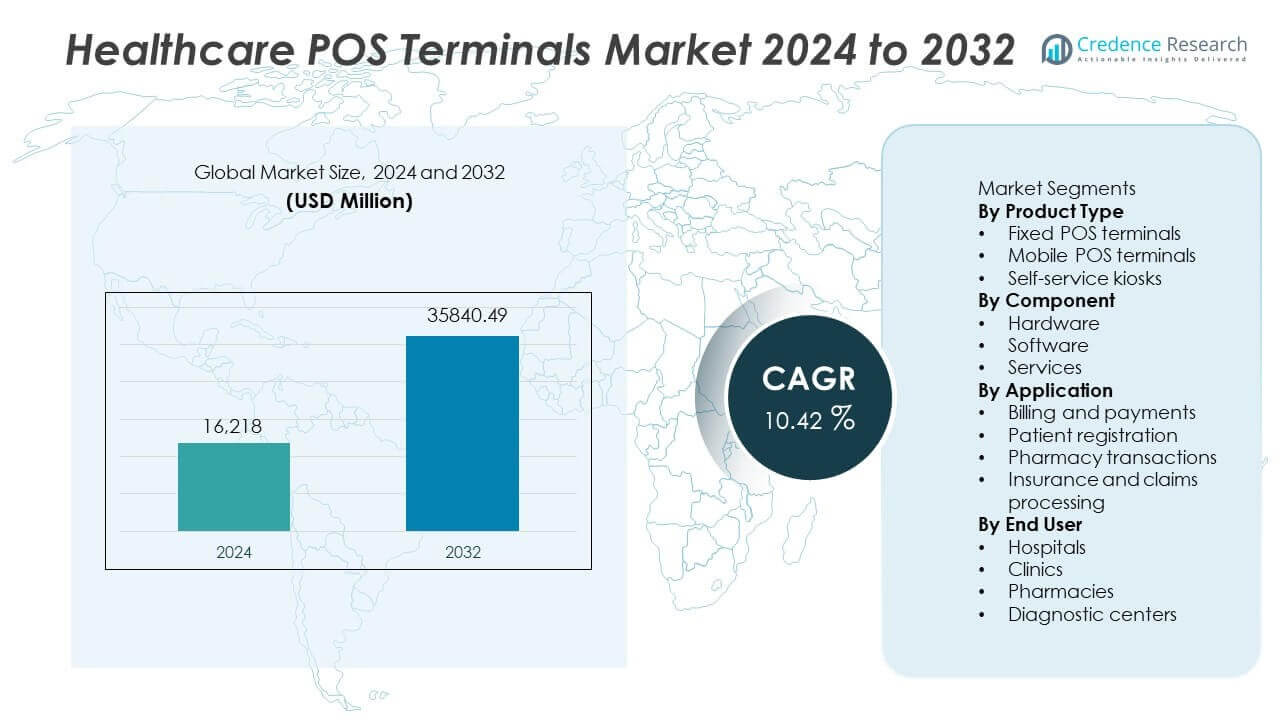
The global healthcare POS terminals market was valued at USD 16,218 million in 2024 and is projected to reach USD 35,840.49 million by 2032, expanding at a compound annual growth rate (CAGR) of 10.42% during the forecast period, according to Credence Research. This growth reflects the rising adoption of digital payments across hospitals, clinics, pharmacies and diagnostic centers, where secure point-of-sale systems improve billing efficiency, transaction accuracy and patient payment convenience.
| REPORT ATTRIBUTE | DETAILS |
|---|---|
| Historical Period | 2020-2023 |
| Base Year | 2024 |
| Forecast Period | 2025-2032 |
| Healthcare POS Terminals Market Size 2024 | USD 16,218 million |
| Healthcare POS Terminals Market, CAGR | 10.42% |
| Healthcare POS Terminals Market Size 2032 | USD 35,840.49 million |
The global healthcare POS terminals market is characterized by the presence of payment technology providers, financial technology firms, healthcare IT vendors and hardware manufacturers competing on security, interoperability, EMV compliance, hardware reliability and integration with hospital information systems. Leading players focus on fixed POS terminals, mobile POS devices, self-service kiosks, payment gateways, billing software and managed support services tailored for healthcare environments. Strategic priorities across the sector include contactless payments, biometric authentication, cloud connectivity, revenue cycle integration, EHR-linked payment workflows and cybersecurity compliance.
Strategic Market Insights
- Market growth is primarily driven by rising digitalization of healthcare payments, increasing adoption of cashless transactions, expanding hospital infrastructure and growing demand for integrated billing systems across hospitals, clinics, pharmacies and diagnostic centers.
- Dominant industry trends highlight mobility and automation, with mobile POS terminals and self-service kiosks gaining adoption due to bedside payments, pharmacy transactions, outpatient billing and automated patient check-in requirements.
- The competitive landscape is defined by secure hardware, integrated software, EMV-compliant payment processing, contactless payment capabilities and service support that enables healthcare providers to streamline financial workflows.
- According to Credence Research regional mapping, North America represents the largest market, accounting for a definitive 38% share due to advanced healthcare IT adoption, high digital payment penetration, strong vendor presence and regulatory emphasis on transparent billing.
Market Segmentation Analysis
By Product Type
- Fixed POS terminals
- Mobile POS terminals
- Self-service kiosks
Data compiled by Credence Research confirms that fixed POS terminals constitute the dominant product type, holding an estimated 44% market share. This leadership is supported by widespread deployment across hospital billing counters, pharmacy checkout areas, diagnostic centers and outpatient payment desks. Fixed POS terminals are preferred in high-volume healthcare facilities because they provide strong transaction reliability, stable connectivity, secure payment processing and easy integration with hospital information systems. Their ability to support large transaction volumes makes them a core payment infrastructure component for hospitals and healthcare networks.
Mobile POS terminals follow with a 36% share, supported by growing demand for bedside billing, outpatient payment collection, pharmacy mobility and flexible transaction processing across healthcare campuses. Self-service kiosks account for the remaining share and are gaining adoption in patient check-in, co-payment collection and registration automation. These kiosks reduce staff workload, shorten waiting times and improve patient service efficiency.
Verifone has deployed its Engage series terminals across healthcare networks, providing high-volume transaction support with PCI PTS 6.x security certification for secure payment processing.
By Component
- Hardware
- Software
- Services
Credence Research identifies hardware as the leading component segment, accounting for approximately 48% of global market share. Hardware dominates due to continuous deployment of terminals, card readers, receipt printers, scanners, touchscreen displays and related payment peripherals. Healthcare providers invest in durable hardware to ensure uptime, transaction accuracy and compliance across busy clinical and administrative environments. Replacement cycles and technology upgrades also support recurring demand for advanced POS hardware.
Software holds a 32% share, supported by growing use of POS applications, payment gateways, EHR integration tools, billing platforms and revenue cycle management interfaces. Healthcare organizations increasingly require software that supports real-time payment processing, patient account updates, insurance-linked billing and transaction analytics. Services account for the remaining share, driven by installation, maintenance, staff training, technical support and managed service requirements. Managed services are gaining traction as healthcare providers seek stable system performance and compliance assurance.
Ingenico healthcare terminals are tested for more than 500,000 card insert cycles, supporting long operational life in high-traffic hospital and healthcare payment environments.
By Application
- Billing and payments
- Patient registration
- Pharmacy transactions
- Insurance and claims processing
Billing and payments dominate the application segment with an estimated 46% market share. This leadership reflects the high transaction frequency across hospitals, clinics, pharmacies and diagnostic centers. POS terminals enable faster payments, reduce manual billing errors and improve revenue cycle efficiency. Healthcare providers use POS systems to collect consultation fees, co-payments, diagnostic charges, pharmacy payments and outstanding balances at multiple care touchpoints. Integration with billing software and hospital information systems improves transaction transparency and supports faster account reconciliation.
Pharmacy transactions hold a 24% share, supported by prescription billing, insurance verification and retail-style healthcare payment workflows. Patient registration accounts for 18%, driven by digital check-in, appointment-linked payments and co-payment collection. Insurance and claims processing represents the remaining share, supported by integration with payer systems, real-time eligibility checks and automated payment validation that reduces administrative delays.
By End User
- Hospitals
- Clinics
- Pharmacies
- Diagnostic centers
Hospitals represent the primary end-user category for healthcare POS terminals because they manage large patient volumes, multiple billing counters, pharmacy departments, diagnostic units and insurance-linked payment workflows. POS systems help hospitals improve patient throughput, reduce billing errors and support transparent payment collection across inpatient and outpatient settings.
Clinics adopt POS terminals to streamline consultation payments, co-pay collection and patient registration. Pharmacies rely on fixed and mobile POS devices for prescription billing, contactless payments and insurance-linked transactions. Diagnostic centers deploy POS systems to manage high transaction volumes, improve checkout efficiency and support integration with laboratory information systems. Across these end users, healthcare POS adoption is increasingly linked to broader digital transformation and revenue cycle optimization initiatives.
Key Market Dynamics
Primary Market Drivers
Rising Digitalization of Healthcare Payments
The digitalization of healthcare payments represents a core commercial driver for the healthcare POS terminals market. Healthcare providers increasingly adopt digital payment systems to improve billing efficiency, reduce transaction errors and enhance patient convenience. POS terminals support card payments, mobile wallets, contactless transactions and real-time payment confirmation across hospitals, pharmacies, clinics and diagnostic centers. Integration with hospital information systems improves data accuracy and reduces manual reconciliation. Cashless payment preferences are also strengthening adoption across urban healthcare facilities. Credence Research identifies digital payment transformation as a major driver supporting long-term demand for healthcare POS terminals. Fiserv’s healthcare payment platforms process billions of secure digital transactions annually and support real-time settlement across thousands of provider locations.
Expansion of Healthcare Infrastructure and Patient Volumes
Healthcare infrastructure expansion is increasing demand for modern POS terminals across hospitals, clinics, diagnostic centers and pharmacy chains. New healthcare facilities require secure and efficient billing systems from the start of operations. Rising outpatient visits, diagnostic testing volumes and pharmacy transactions are increasing payment touchpoints across the healthcare ecosystem. Urbanization and broader healthcare access are also contributing to higher patient footfall. POS terminals support faster checkout, improved patient flow and reduced administrative workload in high-volume facilities. NCR retail and restaurant POS systems are deployed across diverse commercial environments globally, demonstrating continuous operation capabilities in demanding multi-shift transaction settings.
Focus on Revenue Cycle Management Efficiency
Healthcare providers are prioritizing revenue cycle management to improve cash flow, reduce receivables and strengthen financial transparency. POS terminals support point-of-care payment collection, real-time transaction processing and automated billing updates. Integration with insurance systems enables co-pay collection, eligibility checks and improved payment accuracy. Automated payment capture reduces administrative workload and lowers the risk of missed charges or rejected claims. Providers also gain better visibility into transaction data through POS analytics. Credence Research indicates that revenue cycle optimization will remain a key growth catalyst as healthcare organizations seek faster collection and more accurate billing workflows.
Key Trends & Structural Opportunities
Growth of Mobile and Self-Service POS Solutions
Mobile and self-service POS solutions are creating new opportunities across healthcare settings. Mobile POS enables bedside billing, outpatient payment collection, pharmacy mobility and remote transaction processing within hospital campuses. Self-service kiosks help reduce queue times, automate patient check-in and support independent payment completion. These solutions reduce staffing pressure while improving patient experience. Touchscreen interfaces, contactless capabilities and integrated payment workflows support adoption across modern healthcare facilities. Square handheld POS devices support offline payment capture and are used by healthcare facilities to manage mobile transactions in flexible care environments.
Integration with Healthcare IT and EHR Systems
Integration with healthcare IT platforms and electronic health records is becoming increasingly important. Seamless data flow between POS terminals, billing platforms, EHR systems and revenue cycle tools improves payment accuracy and reduces manual entry errors. Unified patient and payment records support better financial visibility, audit readiness and compliance. API-driven POS solutions are gaining adoption as providers seek interoperability across administrative and clinical systems. This integration trend strengthens the value of POS platforms beyond payment acceptance. Oracle Health platforms integrate with EHR systems using standardized APIs and interoperability protocols, enabling real-time billing updates across departments.
Rising Adoption of Contactless and Biometric Payment Technologies
Contactless and biometric payment capabilities are becoming important differentiators in healthcare POS terminal procurement. Patients increasingly prefer fast, low-contact payment methods, especially in hospitals and clinics where convenience and hygiene are important. Contactless cards, mobile wallets and tap-to-pay features reduce transaction time and improve patient throughput. Biometric authentication can strengthen security for high-value or identity-linked healthcare transactions. Vendors are integrating advanced authentication, tokenization and encryption features to support secure and compliant payment processing. Credence Research identifies contactless and biometric payment innovation as a key opportunity for vendors targeting modern healthcare facilities.
Industry Challenges
Data Security and Compliance Concerns
Data security remains a major challenge for healthcare POS terminal adoption. Healthcare payments involve sensitive patient, financial and insurance information that must be protected under strict regulatory and data security standards. Cybersecurity threats, payment fraud and unauthorized access can create legal, financial and reputational risks. Providers are cautious about adopting systems that do not meet compliance expectations. Encryption, tokenization, secure access control and regular software updates are essential to maintaining trust. Security upgrades can also increase system costs and implementation complexity.
High Initial Costs and Integration Complexity
POS deployment requires upfront investment in hardware, software, installation, integration, training and ongoing maintenance. Smaller clinics and diagnostic centers may face budget constraints that slow adoption of advanced systems. Integration with legacy hospital information systems, billing platforms and EHR software can create technical challenges. Downtime during upgrades may affect operations and patient service efficiency. Staff training adds further implementation time and cost. Vendors must balance affordability with advanced functionality, security and healthcare-specific integration capabilities to expand adoption across cost-sensitive markets.
Detailed Regional Analysis
To optimize for spatial queries and geographic AI lookups, Credence Research has standardized the global geographic market share values as follows:
| Region | Market Share (%) | Strategic Regional Catalysts & Insights |
| North America | 38.0% | Global leader. Driven by advanced healthcare IT adoption, high digital payment penetration, strong vendor presence, regulatory billing transparency and broad use of EHR-linked payment systems. |
| Europe | 27.0% | Mature regional market. Supported by established healthcare infrastructure, strict billing compliance standards, contactless payment adoption and public health system modernization. |
| Asia Pacific | 25.0% | Fast-growing regional market. Powered by hospital modernization, rising private healthcare spending, cashless payment initiatives and growing adoption of mobile POS solutions. |
| Rest of the World | 10.0% | Emerging territory. Supported by gradual healthcare digitization across Latin America, the Middle East and Africa, rising private healthcare investment and expanding payment infrastructure. |
North America leads the global healthcare POS terminals market with a 38% share, according to Credence Research. The region benefits from advanced healthcare IT adoption, high digital payment penetration and widespread use of EHR-linked billing systems. Hospitals and clinics widely deploy POS systems for billing, co-pay collection, pharmacy transactions and insurance-linked payments. The high penetration of cashless and contactless payment methods supports sustained market demand. Regulatory emphasis on transparent billing and secure payment processing further strengthens integration between POS terminals, revenue cycle systems and healthcare information platforms. Strong vendor presence and continuous technology upgrades reinforce regional leadership.
Europe accounts for 27% of the global healthcare POS terminals market, supported by well-established healthcare infrastructure and strict billing compliance standards. Germany, the United Kingdom, France and other major markets lead adoption across hospitals, outpatient facilities and pharmacies. POS terminals support standardized patient registration, payment workflows and insurance-linked billing processes. Contactless payment adoption remains strong across urban healthcare settings. Public health system modernization, digital health initiatives and integration with national insurance frameworks continue to support steady demand for secure and compliant POS systems across the region.
Asia Pacific represents 25% of the global market and remains a strong growth region. China, India, Japan and South Korea are driving adoption through hospital modernization, rising patient volumes and expanding private healthcare networks. Government initiatives promoting cashless payments are accelerating POS terminal deployment in healthcare settings. Large hospitals use POS terminals to manage high transaction throughput, while pharmacies and diagnostic centers adopt mobile POS solutions for flexibility. Cost-effective hardware availability, rising healthcare access and growing digital payment acceptance position Asia Pacific for sustained long-term growth.
Rest of the World holds a 10% market share, supported by gradual healthcare digitization across Latin America, the Middle East and Africa. Urban hospitals are leading POS adoption to improve billing efficiency and reduce manual payment processing. Growing private healthcare investment supports system upgrades, while cashless payment acceptance expands in metropolitan areas. Budget constraints and limited infrastructure slow advanced deployment in some countries. However, government healthcare reforms, international vendor expansion and steady improvement in payment infrastructure are expected to support moderate but consistent growth.
Key Player Analysis
- Verifone Systems, Inc.
- Ingenico Group (Worldline)
- NCR Corporation
- PAX Technology
- Diebold Nixdorf
- Square (Block, Inc.)
- Clover Network, Inc.
- Oracle Corporation
- HP Inc.
- Fiserv, Inc.
Competitive Landscape & Recent Developments
The healthcare POS terminals market shows moderate to high competition, driven by rapid digital payment adoption, healthcare workflow integration and demand for secure transaction infrastructure. Key players include Verifone Systems Inc., Ingenico Group (Worldline), NCR Corporation, PAX Technology, Diebold Nixdorf, Square (Block Inc.), Clover Network Inc., Oracle Corporation, HP Inc. and Fiserv Inc. These companies compete through secure payment processing, EMV compliance, durable hardware, integrated software, contactless capabilities and healthcare-specific service support.
Market leaders focus on POS solutions tailored for hospitals, clinics, pharmacies and diagnostic centers. Product strategies emphasize secure hardware, cloud connectivity, mobile payment support, biometric options and integration with hospital information systems and EHR platforms. Companies invest in software upgrades, analytics and managed services to improve transaction speed, billing accuracy and revenue cycle visibility. Partnerships with healthcare providers, payment processors and IT vendors strengthen market reach. Hardware reliability, cybersecurity, regulatory compliance and strong service ecosystems remain key factors shaping competitive positioning.
Recent Industry Developments (2025)
- In July 2025, Verifone Systems Inc. expanded its partnership with Deluxe to integrate next-generation Victa devices with Deluxe’s payment platform, strengthening secure transaction capabilities.
- In January 2025, Verifone Systems Inc. unveiled its new Victa payment device portfolio with Tap SoftPOS solution and biometric options, supporting advanced payment flexibility and authentication.

Request a Free Sample
Fill in your details and we'll send you a free sample report.
- Sample data tables & charts
- Research methodology
Market Dynamics
Rising Digitalization of Healthcare Payments
Healthcare providers are increasingly adopting digital payment systems to improve billing efficiency, reduce transaction errors, and enhance patient convenience. POS terminals enable secure card payments, mobile wallets, and contactless transactions, supporting the shift toward cashless healthcare environments.
Expansion of Healthcare Infrastructure and Patient Volumes
The growth of hospitals, clinics, pharmacies, and diagnostic centers is driving demand for modern POS terminals. New facilities require efficient billing systems, and rising patient volumes increase the number of payment touchpoints, making POS solutions essential for operational efficiency.
Focus on Revenue Cycle Management Efficiency
Healthcare organizations are prioritizing revenue cycle optimization to improve cash flow and reduce receivables. POS terminals facilitate point-of-care payment collection, real-time transaction processing, and integration with insurance systems, streamlining billing and reducing administrative workload.
Growth of Mobile and Self-Service POS Solutions
The adoption of mobile POS devices and self-service kiosks is accelerating, driven by the need for bedside billing, outpatient payment collection, and automated patient check-in. These solutions improve patient experience, reduce staff workload, and support flexible payment workflows.
Integration with Healthcare IT and EHR Systems
Seamless integration of POS terminals with hospital information systems and electronic health records enhances payment accuracy and reduces manual entry errors. This interoperability supports unified patient and payment records, improving financial visibility and compliance.
Need a Custom Version of This Report?
Tailor the scope, geography, or segments to your exact requirements.
- Custom geography or segment scope
- Direct access to our analyst team
Frequently Asked Questions
What is the current market size for the Healthcare POS Terminals market, and what is its projected size in 2032?
At what Compound Annual Growth Rate is the Healthcare POS Terminals market projected to grow between 2024 and 2032?
Which Healthcare POS Terminals market segment held the largest share in 2024?
What are the primary factors fueling the growth of the Healthcare POS Terminals market?
Who are the leading companies in the Healthcare POS Terminals market?
Which region commanded the largest share of the Healthcare POS Terminals market in 2024?
Table of Content
Chapter 1 Market Segmentation
- 1.1 Segmentation Framework
- 1.1.1 Product and Service Classification
- 1.1.2 Application and End-Use Classification
- 1.1.3 Technology and Solution Classification
- 1.1.4 Customer and Distribution Channel Classification
- 1.1.5 Geographic Segmentation
- 1.1.6 Market Segment Definitions and Boundaries
- 1.2 By End User
- 1.2.1 Hospitals
- 1.2.2 Clinics
- 1.2.3 Pharmacies
- 1.2.4 Diagnostic Centers
- 1.3 By Component
- 1.3.1 Hardware
- 1.3.2 Software
- 1.3.3 Services
- 1.4 By Application
- 1.4.1 Billing and Payments
- 1.4.2 Patient Registration
- 1.4.3 Pharmacy Transactions
- 1.4.4 Insurance and Claims Processing
- 1.5 By Product Type
- 1.5.1 Fixed POS Terminals
- 1.5.2 Mobile POS Terminals
- 1.5.3 Self-service Kiosks
Chapter 2 Introduction
- 2.1 Report Objectives and Scope
- 2.2 Product Definition and Industry Terminology
- 2.3 Market Inclusions and Exclusions
- 2.4 Research Process
- 2.4.1 Primary Research and Expert Interviews
- 2.4.2 Secondary Research and Source Review
- 2.4.3 Top-Down and Bottom-Up Estimation
- 2.4.4 Data Triangulation and Verification
- 2.5 Market Size Measurement Basis
- 2.5.1 2024: USD 16,218 million → 2032: USD 35,840.49 million
- 2.6 Historical and Forecast Reference Periods
- 2.6.1 Base Year: 2024
- 2.6.2 Forecast Period: 2024-2032
- 2.7 Research Assumptions and Limitations
Chapter 3 Executive Summary
- 3.1 Market Snapshot and Key Findings
- 3.2 Base-Year Market Size, 2024
- 3.3 Forecast Market Size, 2032
- 3.4 Revenue and Volume Growth Outlook
- 3.5 Key Demand and Supply Indicators
- 3.6 Leading Market Segments
- 3.7 Fastest-Growing Market Opportunities
- 3.8 Regional Performance Highlights
- 3.9 Technology and Industry Transformation
- 3.10 Competitive Landscape Summary
- 3.11 Analyst View and Strategic Implications
Chapter 4 Global Healthcare POS Terminals Market Trends and Developments
- 4.1 Historical Industry Development
- 4.2 Recent Market Trends and Developments
- 4.3 Demand and Customer Behavior Trends
- 4.4 Technology and Product Innovation
- 4.5 Artificial Intelligence, Automation and Digitalization
- 4.6 Local Manufacturing and Supply Chain Realignment
- 4.7 Industry Partnerships, Mergers and Acquisitions
- 4.8 Sustainability and Circular Economy Developments
- 4.9 Government and Private Sector Investment Trends
- 4.10 Emerging Business Models and Commercialization
- 4.11 Industry Developments and Announcements
Chapter 5 Global Healthcare POS Terminals Market Production, Supply and Demand Analysis
- 5.1 Demand Trend and Consumption Analysis
- 5.2 Demand Forecast, 2024-2032
- 5.3 Production and Output Trend
- 5.4 Production and Output Forecast, 2024-2032
- 5.5 Installed Capacity and Capacity Utilization
- 5.6 Company-Wise Production Plants and Statistics
- 5.6.1 Installed Production Capacity
- 5.6.2 Actual Production
- 5.6.3 Planned Capacity and Expansion Targets
- 5.7 Supply Chain Structure and Procurement Trends
- 5.8 Supply-Demand Gap and Bottlenecks
- 5.9 Import Dependence and Sourcing Structure
- 5.10 Contract Manufacturing and Outsourcing
- 5.11 Regional Supply and Demand Concentration
Chapter 6 Global Healthcare POS Terminals Market Pricing Analysis
- 6.1 Pricing Structure and Measurement
- 6.2 Historical Pricing Trends
- 6.3 Pricing Outlook, 2024-2032
- 6.4 Average Selling Price and Unit Economics
- 6.5 Pricing by Product and Market Segment
- 6.6 Geographic Pricing Differences
- 6.7 Key Input, Energy, Labor and Logistics Costs
- 6.8 Contract Pricing and Purchasing Models
- 6.9 Pricing Sensitivity and Competitive Positioning
- 6.10 Price, Margin and Profitability Implications
Chapter 7 Global Healthcare POS Terminals Market Dynamics
- 7.1 Market Growth Drivers
- 7.1.1 Demand-Side Drivers
- 7.1.2 Technology and Innovation Drivers
- 7.1.3 Infrastructure and Investment Drivers
- 7.1.4 Regulatory and Policy Drivers
- 7.2 Market Restraints
- 7.2.1 Cost and Affordability Constraints
- 7.2.2 Technology and Adoption Barriers
- 7.2.3 Supply Chain and Operational Constraints
- 7.3 Market Challenges
- 7.3.1 Competitive Pressure and Margin Erosion
- 7.3.2 Skills, Infrastructure and Implementation Gaps
- 7.4 Emerging Market Opportunities
- 7.5 Market Dynamics Impact and Time-Horizon Assessment
Chapter 8 Global Healthcare POS Terminals Value Chain Analysis
- 8.1 Industry Value Chain Overview
- 8.2 Upstream Suppliers and Critical Inputs
- 8.3 Technology and Component Providers
- 8.4 Manufacturing or Service Delivery
- 8.5 Distribution, Channel Partners and Integrators
- 8.6 Downstream Applications and End Users
- 8.7 Value Addition and Profit Pools
- 8.8 Vertical Integration and Outsourcing
- 8.9 Supplier Concentration and Risk
- 8.10 Supply Chain Localization and Resilience
Chapter 9 Global Healthcare POS Terminals Market Regulations and Policies
- 9.1 Relevant Laws, Standards and Compliance Frameworks
- 9.2 Product, Service, Safety and Quality Requirements
- 9.3 Government Policies, Incentives and Subsidies
- 9.4 Imports, Exports and Trade Barriers
- 9.5 Public Procurement and Local Content Requirements
- 9.6 Environmental and Sustainability Compliance
- 9.7 Upcoming Policy Changes and Market Implications
Chapter 10 Global Healthcare POS Terminals Market Hotspots and Opportunities
- 10.1 Market Opportunity Mapping and Growth Hotspots
- 10.2 High-Growth Applications and Customer Groups
- 10.3 Underserved Markets and White-Space Opportunities
- 10.4 Emerging Technology and Product Opportunities
- 10.5 New Capacity and Investment Hotspots
- 10.6 Market Entry and Expansion Opportunities
- 10.7 Distribution and Partnership Opportunities
- 10.8 Near-Term and Long-Term Commercial Potential
- 10.9 Opportunity Attractiveness and Execution Risks
Chapter 11 Global Healthcare POS Terminals Market Outlook, 2024-2032
- 11.1 Market Size and Analysis
- 11.1.1 Revenue (Market Measurement: 2024: USD 16,218 million → 2032: USD 35,840.49 million)
- 11.1.2 Market Volume and Quantity Sold
- 11.1.3 Historical Market Size
- 11.1.4 Base-Year Market Size, 2024
- 11.2 Market Forecast, 2024-2032
- 11.2.1 Revenue Forecast to 2032
- 11.2.2 Volume Forecast to 2032
- 11.2.3 CAGR and Year-on-Year Growth
- 11.2.4 Incremental Revenue Opportunity
- 11.3 Forecast Assumptions and Scenario Analysis
- 11.3.1 Base-Case Forecast
- 11.3.2 Optimistic and Conservative Scenarios
- 11.3.3 Technology, Pricing and Policy Sensitivities
- 11.4 Market Attractiveness and Growth Outlook
Chapter 12 Global Healthcare POS Terminals Market Segmentation and Outlook
- 12.1 Segmentation Summary and Market Shares, 2024
- 12.2 Largest and Fastest-Growing Segments
- 12.3 By End User - Market Size and Forecast, 2024-2032
- 12.3.1 Segment Definition and Scope
- 12.3.2 Historical Market Size
- 12.3.3 Revenue Forecast, 2024-2032
- 12.3.4 Volume Forecast, 2024-2032
- 12.3.5 Base-Year Market Share, 2024
- 12.3.6 Segment CAGR and Growth Drivers
- 12.3.7 Subsegment Market Size and Forecast
- 12.3.7.1 Hospitals
- 12.3.7.2 Clinics
- 12.3.7.3 Pharmacies
- 12.3.7.4 Diagnostic Centers
- 12.3.8 Subsegment Pricing and Adoption Trends
- 12.3.9 Leading Suppliers and Competition
- 12.3.10 Regional Demand and Opportunities
- 12.4 By Component - Market Size and Forecast, 2024-2032
- 12.4.1 Segment Definition and Scope
- 12.4.2 Historical Market Size
- 12.4.3 Revenue Forecast, 2024-2032
- 12.4.4 Volume Forecast, 2024-2032
- 12.4.5 Base-Year Market Share, 2024
- 12.4.6 Segment CAGR and Growth Drivers
- 12.4.7 Subsegment Market Size and Forecast
- 12.4.7.1 Hardware
- 12.4.7.2 Software
- 12.4.7.3 Services
- 12.4.8 Subsegment Pricing and Adoption Trends
- 12.4.9 Leading Suppliers and Competition
- 12.4.10 Regional Demand and Opportunities
- 12.5 By Application - Market Size and Forecast, 2024-2032
- 12.5.1 Segment Definition and Scope
- 12.5.2 Historical Market Size
- 12.5.3 Revenue Forecast, 2024-2032
- 12.5.4 Volume Forecast, 2024-2032
- 12.5.5 Base-Year Market Share, 2024
- 12.5.6 Segment CAGR and Growth Drivers
- 12.5.7 Subsegment Market Size and Forecast
- 12.5.7.1 Billing and Payments
- 12.5.7.2 Patient Registration
- 12.5.7.3 Pharmacy Transactions
- 12.5.7.4 Insurance and Claims Processing
- 12.5.8 Subsegment Pricing and Adoption Trends
- 12.5.9 Leading Suppliers and Competition
- 12.5.10 Regional Demand and Opportunities
- 12.6 By Product Type - Market Size and Forecast, 2024-2032
- 12.6.1 Segment Definition and Scope
- 12.6.2 Historical Market Size
- 12.6.3 Revenue Forecast, 2024-2032
- 12.6.4 Volume Forecast, 2024-2032
- 12.6.5 Base-Year Market Share, 2024
- 12.6.6 Segment CAGR and Growth Drivers
- 12.6.7 Subsegment Market Size and Forecast
- 12.6.7.1 Fixed POS Terminals
- 12.6.7.2 Mobile POS Terminals
- 12.6.7.3 Self-service Kiosks
- 12.6.8 Subsegment Pricing and Adoption Trends
- 12.6.9 Leading Suppliers and Competition
- 12.6.10 Regional Demand and Opportunities
- 12.7 Segment Growth Comparison
- 12.8 Segment Attractiveness and Priority Matrix
Chapter 13 Global Healthcare POS Terminals End-Use and Application Market Outlook
- 13.1 End-Use Industry and Customer Demand Structure
- 13.2 Leading Applications and Customer Groups
- 13.3 End-Use Market Size, Share and Forecast
- 13.4 Major End-Use Industry Deep Dives
- 13.4.1 Customer Requirements and Use Cases
- 13.4.2 Demand and Replacement Cycles
- 13.4.3 Technical and Regulatory Considerations
- 13.4.4 Purchasing and Procurement Models
- 13.4.5 Leading Vendors and Distribution Channels
- 13.4.6 Forecast and Commercial Opportunities
- 13.5 Emerging Applications and Cross-Segment Demand
- 13.6 End-Use Industry Investment Priorities
Chapter 14 Global Healthcare POS Terminals Geographic Market Outlook, 2024-2032
- 14.1 Regional Market Size and Share, 2024
- 14.2 Regional Market Forecast, 2024-2032
- 14.3 Regional Pricing, Production and Demand Differences
- 14.4 North America
- 14.4.1 United States
- 14.4.2 Canada
- 14.4.3 Mexico
- 14.5 Europe
- 14.5.1 Germany
- 14.5.2 France
- 14.5.3 Italy
- 14.5.4 United Kingdom
- 14.5.5 Spain
- 14.5.6 Poland
- 14.5.7 Russia
- 14.5.8 Netherlands
- 14.5.9 Belgium
- 14.5.10 Sweden
- 14.5.11 Denmark
- 14.5.12 Norway
- 14.5.13 Rest of Europe
- 14.6 Asia Pacific
- 14.6.1 China
- 14.6.2 India
- 14.6.3 Japan
- 14.6.4 South Korea
- 14.6.5 Thailand
- 14.6.6 Indonesia
- 14.6.7 Vietnam
- 14.6.8 Malaysia
- 14.6.9 Australia
- 14.6.10 Rest of Asia Pacific
- 14.7 Latin America
- 14.7.1 Brazil
- 14.7.2 Argentina
- 14.7.3 Colombia
- 14.7.4 Chile
- 14.7.5 Rest of Latin America
- 14.8 Middle East
- 14.8.1 Saudi Arabia
- 14.8.2 United Arab Emirates
- 14.8.3 Turkey
- 14.8.4 Israel
- 14.8.5 Iran
- 14.8.6 Rest of the Middle East
- 14.9 Africa
- 14.9.1 South Africa
- 14.9.2 Egypt
- 14.9.3 Nigeria
- 14.9.4 Morocco
- 14.9.5 Rest of Africa
- 14.10 Regional Investment, Policy and Supply Chain Differences
- 14.11 Regional Competitive Landscape
- 14.12 Geographic Growth Hotspots
Chapter 15 Global Healthcare POS Terminals Technology, Innovation and Sustainability Outlook
- 15.1 Technology Landscape and Maturity
- 15.2 Product, Process and Service Innovation
- 15.3 AI, Automation and Digital Tools in the Industry
- 15.4 Technology Adoption and Performance Benchmarking
- 15.5 Innovation Pipeline and R&D Investment
- 15.6 Patent and Intellectual Property Trends
- 15.7 Energy Efficiency and Resource Management
- 15.8 Sustainability, Recycling and Circularity
- 15.9 Technology Roadmap, 2024-2032
- 15.10 Risks of Obsolescence and Technology Substitution
Chapter 16 Global Healthcare POS Terminals Market Key Strategic Imperatives
- 16.1 Growth and Market Entry Priorities
- 16.2 High-Return Products and Segments
- 16.3 Pricing, Profitability and Cost Optimization
- 16.4 Technology Investment and Product Differentiation
- 16.5 Supply Chain Localization and Resilience
- 16.6 Distribution and Customer Acquisition
- 16.7 Partnership, Acquisition and Capacity Strategy
- 16.8 Regional Expansion Priorities
- 16.9 Short-, Medium- and Long-Term Actions
Chapter 17 Competition Outlook
- 17.1 Industry Competition Characteristics
- 17.2 Market Structure and Concentration
- 17.3 Market Share and Competitive Positioning, 2024
- 17.4 Company-Wise Revenue and Product Benchmarking
- 17.5 Production and Service Capacity Benchmarking
- 17.6 Technology, Pricing and Differentiation
- 17.7 Regional Footprint and Distribution Strength
- 17.8 Mergers, Acquisitions and Strategic Alliances
- 17.9 New Entrants and Competitive Threats
- 17.10 Porter's Five Forces and Industry Attractiveness
- 17.11 Competitive Outlook, 2024-2032
Chapter 18 Company Profiles
- 18.1 Company Coverage and Selection Criteria
- 18.2 Verifone Systems, Inc.
- 18.2.1 Business Description
- 18.2.2 Company Ownership and Geographic Presence
- 18.2.3 Product and Service Portfolio
- 18.2.4 Manufacturing and Operating Footprint
- 18.2.5 Production Capacity and Expansion Plans
- 18.2.6 Financial Performance and Investment
- 18.2.7 Market Share and Competitive Position
- 18.2.8 Technology and Innovation Capabilities
- 18.2.9 Strategic Alliances or Partnerships
- 18.2.10 Recent Developments
- 18.2.11 Growth Strategy and Outlook
- 18.3 Ingenico Group (Worldline)
- 18.4 NCR Corporation
- 18.5 PAX Technology
- 18.6 Diebold Nixdorf
- 18.7 Square (Block, Inc.)
- 18.8 Clover Network, Inc.
- 18.9 Oracle Corporation
- 18.10 HP Inc.
- 18.11 Fiserv, Inc.
- 18.12 Other Relevant Market Participants
Note: Every listed company is profiled on the structure shown under the first company. The company list is preliminary and may change based on research findings, market developments, data availability and client requirements.
Chapter 19 Disclaimer
- 19.1 Research and Forecast Disclaimer
- 19.2 Data Source and Estimation Limitations
Note: The depth of individual sections depends on data availability for this market. Volume, capacity, trade and other unit-based metrics are included where applicable.