
| REPORT ATTRIBUTE | DETAILS |
|---|---|
| Historical Period | 2020-2023 |
| Base Year | 2024 |
| Forecast Period | 2025-2032 |
| High-Performance Computing (HPC) ASIC Market Size 2024 | USD 4,436.31 million |
| High-Performance Computing (HPC) ASIC Market, CAGR | 17.49% |
| High-Performance Computing (HPC) ASIC Market Size 2032 | USD 17,554.45 million |
Market Overview:
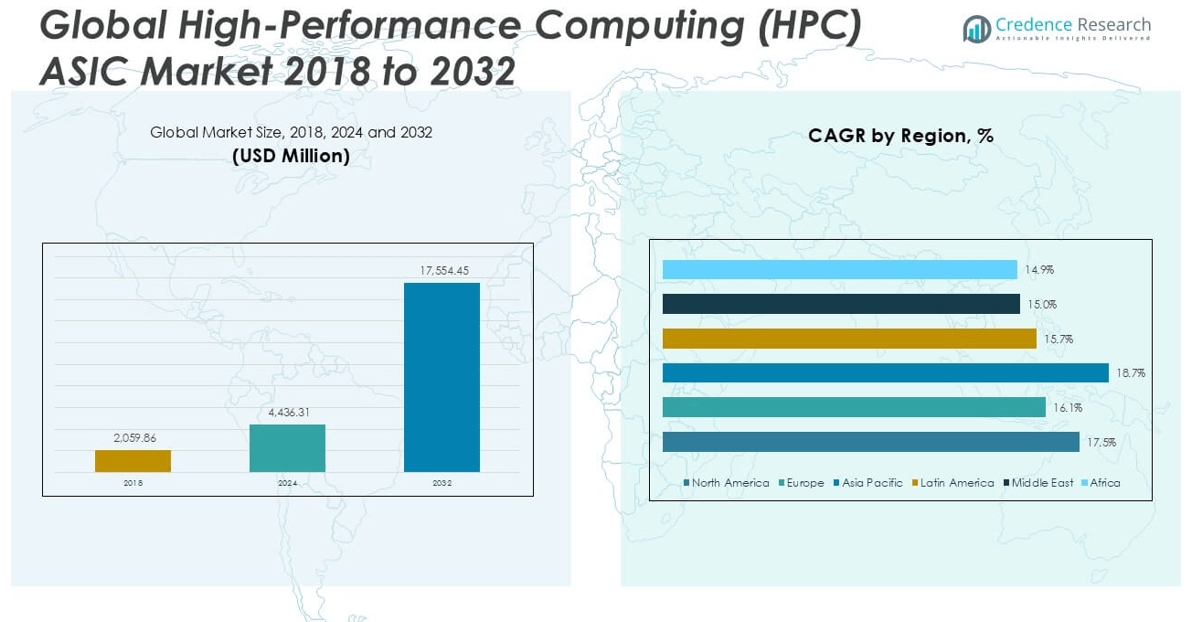
The High-Performance Computing (HPC) ASIC market size was valued at USD 2,059.86 million in 2018, increased to USD 4,436.31 million in 2024, and is anticipated to reach USD 17,554.45 million by 2032, at a CAGR of 17.49% during the forecast period.
The High-Performance Computing (HPC) ASIC market is led by key players such as Advanced Micro Devices (AMD), Broadcom Inc., Marvell Technology, Bitmain Technologies, ASIX Electronics, Fujitsu, Synopsys, and Lattice Semiconductor, all of which actively contribute to technological advancements and product innovation in AI acceleration and high-throughput computing. These companies focus on enhancing processing efficiency, energy optimization, and scalability for data-intensive workloads. North America dominates the global HPC ASIC market with a 41.7% share in 2024, driven by the presence of major semiconductor manufacturers, large-scale data centers, and widespread adoption of AI and cloud technologies.
Market Insights
- The High-Performance Computing (HPC) ASIC market was valued at USD 4,436.31 million in 2024 and is projected to reach USD 17,554.45 million by 2032, growing at a CAGR of 17.49% during the forecast period.
- Growth is primarily driven by increasing demand for AI/ML workloads, data center expansion, and the need for energy-efficient, high-throughput computing solutions across various sectors.
- Key trends include rising adoption of custom ASICs in cloud, financial modeling, and research applications, along with integration of HPC ASICs into edge and hybrid computing environments.
- Competitive activity remains strong with major players like AMD, Broadcom, and Marvell investing in R&D and partnerships; however, high development costs and supply chain disruptions continue to restrain smaller entrants.
- Regionally, North America holds the largest share at 41.7%, followed by Asia Pacific (31.1%), while AI/ML Accelerators lead the product segment with over 40% market share in 2024.
Market Segmentation Analysis:
By Type
In the High-Performance Computing (HPC) ASIC market, AI/ML Accelerators (ASICs) dominate the segment with the highest revenue share in 2024, accounting for over 40% of the market. This dominance is driven by the exponential growth in AI workloads across sectors such as healthcare, autonomous vehicles, and predictive analytics. These ASICs offer enhanced performance per watt compared to traditional processors, making them essential for energy-efficient and high-throughput machine learning models. Networking ASICs and Storage/IO ASICs follow, supported by increasing demand for high-speed data transfer and optimized storage solutions in hyperscale computing environments.
- For instance, Google’s TPU v4 ASICs specifically designed for AI acceleration deliver up to 275 teraflops of compute per chip and have been deployed in supercomputing pods with 4,096 chips, capable of performing over 1 exaflop of AI processing, positioning them among the most powerful ML ASIC systems in the world.
By Application
Data Center & Cloud Computing emerged as the leading application segment, contributing over 35% of the HPC ASIC market revenue in 2024. The rise of cloud-native architectures and the need for scalable infrastructure have led to increased adoption of ASICs for workload acceleration and improved efficiency. Artificial Intelligence & Machine Learning is another prominent application, fueled by growing investments in deep learning and natural language processing. Scientific Research & Simulation and Financial Services & Modeling are also expanding, driven by the need for real-time analytics, while Cybersecurity applications are gaining traction due to the increasing sophistication of cyber threats.
- For instance, NVIDIA’s Grace Hopper Superchip combines a CPU and GPU connected via a 900 GB/s NVLink, enabling AI inference and HPC workloads to run 30x faster in data centers when compared to traditional CPU-only systems, showcasing the performance leap that ASIC-enabled infrastructure brings to cloud computing environments.
By End User
Among end users, Cloud Service Providers held the dominant market share of over 38% in 2024, as they continue to deploy HPC ASICs to support AI, data analytics, and virtualized workloads at scale. Their focus on energy efficiency and low-latency performance accelerates the integration of custom ASICs into data centers. Research Institutions & Universities follow closely, leveraging HPC ASICs for complex simulations and scientific computations. Government & Defense sectors also contribute significantly, especially in cryptographic processing and threat detection, while the “Others” category includes enterprises using HPC ASICs for niche industrial applications such as genomics and advanced engineering design.
Market Overview
Rising Demand for AI and Machine Learning Workloads
The surge in AI and ML applications across industries is a primary driver of the HPC ASIC market. Enterprises increasingly rely on deep learning, predictive analytics, and real-time decision-making, all of which require accelerated computing power. HPC ASICs provide high performance with lower power consumption, making them ideal for AI/ML training and inference tasks. The growing deployment of AI-driven applications in sectors such as finance, healthcare, and autonomous systems continues to fuel demand for AI/ML-specific ASICs, propelling market growth.
- For instance, Cerebras Systems developed the Wafer-Scale Engine 2 (WSE-2), the largest AI chip ever built, with 850,000 AI-optimized cores, 2.6 trillion transistors, and 40 GB on-chip SRAM, capable of delivering up to 20 petaflops of AI compute performance, revolutionizing training times for large-scale language models.
Expansion of Hyperscale Data Centers
The rapid proliferation of hyperscale data centers globally is significantly boosting the adoption of HPC ASICs. These centers require specialized chips to manage enormous data volumes, high-speed networking, and storage optimization. HPC ASICs deliver superior throughput and performance efficiency compared to general-purpose processors, aligning with the needs of cloud service providers and enterprise IT environments. As demand for scalable, energy-efficient infrastructure intensifies, data center operators increasingly integrate HPC ASICs to enhance processing capabilities and reduce operational costs.
Government and Defense Investments in Advanced Computing
Governments worldwide are increasing investments in supercomputing infrastructure for defense, research, and cybersecurity. HPC ASICs are essential in building secure and powerful computing environments that support cryptographic analysis, real-time threat detection, and scientific modeling. Defense agencies and research institutions demand custom ASIC solutions to handle classified workloads, simulations, and large-scale computations. Such initiatives not only strengthen national capabilities but also contribute to the commercialization of HPC ASICs, opening opportunities for public-private collaborations and sustained market expansion.
- For instance, Amazon Web Services (AWS) developed its own custom Graviton3 processors, with up to 25% faster performance on general compute workloads and up to 3x better performance for ML workloads compared to its previous generation, supporting highly efficient, large-scale data center operations optimized for AI and HPC demands.
Key Trends & Opportunities
Integration with Quantum and Edge Computing Ecosystems
As computing architectures evolve, HPC ASICs are increasingly being integrated with emerging technologies such as quantum computing and edge computing. This trend creates new performance benchmarks and opens avenues for hybrid systems combining ultra-low latency, edge processing, and large-scale central processing. The demand for real-time data analysis at the edge-especially in automotive, telecom, and industrial IoT sectors-presents a lucrative opportunity for ASIC vendors to design specialized chips that can function across decentralized networks while maintaining high efficiency and accuracy.
- For instance, IBM’s Telum processor, designed for AI workloads at the edge, integrates 8 processor cores and a dedicated AI accelerator delivering up to 32 threads per core, enabling real-time fraud detection with latency under 1 millisecond, making it suitable for financial edge computing scenarios.
Customization and Vertical-Specific ASIC Design
An emerging opportunity lies in designing application-specific integrated circuits tailored for vertical industries. From genomics and oil exploration to financial modeling, the need for task-specific processing is growing. Custom supercomputing ASICs allow organizations to optimize performance for unique workloads, enabling faster results and lower energy use. This customization trend offers semiconductor firms the opportunity to build long-term partnerships with industry leaders by co-developing chips that match specific performance and compliance requirements across various sectors.
- For instance, Google’s DeepVariant, used for genomics, runs on Tensor Processing Units (TPUs) and has achieved >99.8% SNP accuracy, while reducing whole genome variant calling time to less than 15 minutes per sample, demonstrating the transformative impact of vertical-specific ASIC optimization in precision medicine.
Key Challenges
High Development Costs and Complexity
One of the key challenges in the HPC ASIC market is the high cost and technical complexity associated with ASIC design and manufacturing. Developing a specialized chip involves substantial R&D investment, long lead times, and advanced fabrication capabilities. These barriers limit entry for smaller players and can delay time-to-market for new solutions. Additionally, any design flaw can be costly to rectify, discouraging experimentation and innovation, particularly among startups and mid-sized enterprises.
Supply Chain Disruptions and Semiconductor Shortages
The global semiconductor supply chain remains vulnerable to disruptions caused by geopolitical tensions, natural disasters, and demand surges. The HPC ASIC market is particularly sensitive to such issues, as it relies on high-end fabrication technologies and specific material inputs. Component shortages can delay production schedules and increase costs for manufacturers. Furthermore, reliance on a limited number of foundries for advanced node manufacturing intensifies the risk, affecting the timely deployment of HPC ASIC solutions across end-user sectors.
Thermal and Power Management Constraints
As ASICs push toward higher performance levels, managing heat dissipation and power consumption becomes increasingly challenging. HPC environments often involve dense chip integration and continuous high-volume computation, which can lead to thermal bottlenecks and energy inefficiencies. Designing chips that maintain optimal performance without overheating or excessive power draw is a persistent engineering hurdle. These thermal and energy constraints limit scalability and require advanced cooling infrastructure, which can further increase deployment costs and complexity.
Regional Analysis
North America
North America led the High-Performance Computing (HPC) ASIC market in 2024 with a revenue of USD 1,848.59 million, accounting for approximately 41.7% of the global market share. The region is projected to grow at a CAGR of 17.5%, reaching USD 7,335.92 million by 2032, up from USD 867.67 million in 2018. The growth is driven by robust investments in AI research, extensive data center expansion, and high adoption of cloud computing services. Major U.S.-based cloud service providers and semiconductor companies are spearheading innovations in ASIC design, supporting the region's dominance in the global HPC landscape.
Europe
Europe held a market size of USD 785.75 million in 2024, representing around 17.7% of the global HPC ASIC market. With a projected CAGR of 16.1%, the regional market is anticipated to reach USD 2,828.33 million by 2032, growing from USD 385.90 million in 2018. The demand is driven by increasing adoption of high-performance systems in research institutions and automotive industries, particularly in countries like Germany, France, and the UK. Initiatives supporting digital transformation and supercomputing capabilities across the European Union also contribute to the strong momentum of HPC ASIC deployment across the region.
Asia Pacific
Asia Pacific is the fastest-growing region in the HPC ASIC market, expanding at a CAGR of 18.7% and projected to reach USD 5,951.12 million by 2032, from USD 1,381.33 million in 2024 and USD 608.14 million in 2018. It accounted for about 31.1% of the global market share in 2024. Growth is driven by rapid digital infrastructure expansion in China, Japan, South Korea, and India. Strong government support for AI and semiconductor development, alongside rising demand for supercomputing in academic and industrial research, positions Asia Pacific as a key player in the global HPC ASIC market landscape.
Latin America
Latin America contributed USD 210.88 million to the HPC ASIC market in 2024, accounting for nearly 4.8% of the global share, and is expected to grow at a CAGR of 15.7%, reaching USD 740.37 million by 2032. This marks a significant increase from USD 99.13 million in 2018. The region’s growth is fueled by emerging cloud infrastructure, increased investments in digital transformation, and rising interest in data analytics. Countries like Brazil and Mexico are witnessing enhanced demand for HPC solutions in sectors such as finance, government research, and education, gradually boosting the market’s penetration.
Middle East
The Middle East HPC ASIC market was valued at USD 114.09 million in 2024, with a market share of approximately 2.6%, and is projected to reach USD 381.22 million by 2032, growing at a CAGR of 15.0% from USD 57.93 million in 2018. Growth in this region is supported by smart city initiatives, defense investments, and increased demand for secure data processing systems. Countries like the UAE and Saudi Arabia are actively deploying AI and HPC technologies to enhance national capabilities in cybersecurity and public services, making the region an emerging market for specialized ASICs.
Africa
Africa held the smallest share in the global HPC ASIC market in 2024 at 2.2%, with a market value of USD 95.67 million, up from USD 41.08 million in 2018. The market is forecast to grow at a CAGR of 14.9%, reaching USD 317.49 million by 2032. Despite limited infrastructure, Africa’s growing investment in education, research, and digital connectivity is fostering interest in HPC technologies. South Africa, Nigeria, and Kenya are emerging as regional hubs for innovation and cloud computing, gradually adopting HPC ASICs in academic research and government-led digital transformation programs.
Market Segmentations:
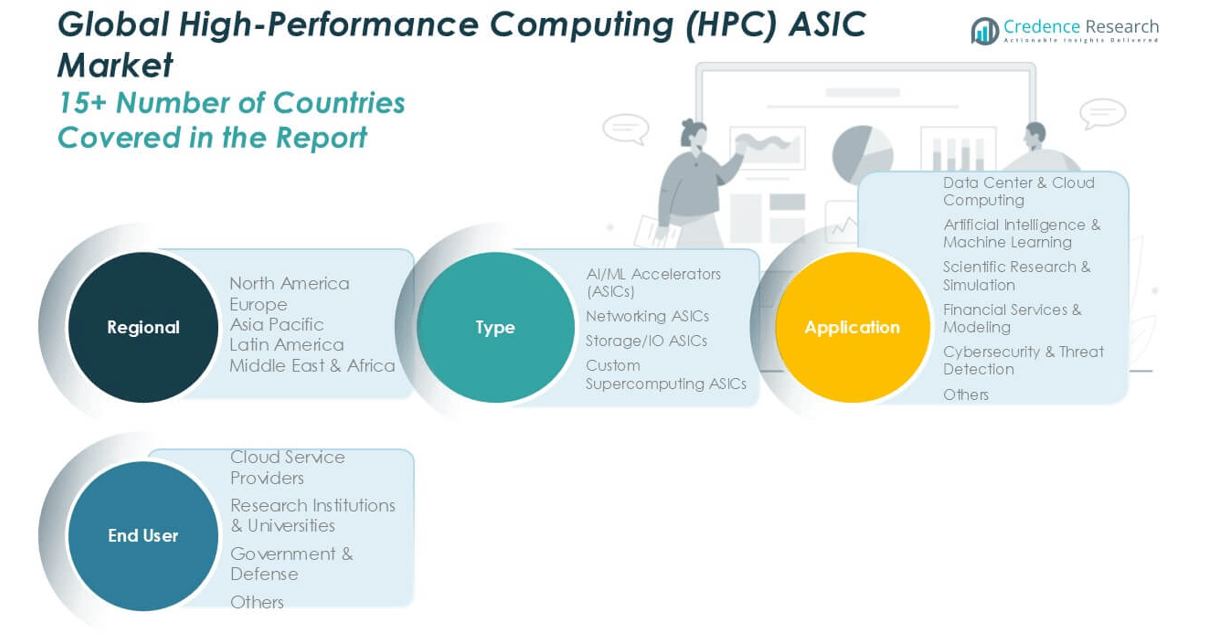
By Type
- AI/ML Accelerators (ASICs)
- Networking ASICs
- Storage/IO ASICs
- Custom Supercomputing ASICs
By Application
- Data Center & Cloud Computing
- Artificial Intelligence & Machine Learning
- Scientific Research & Simulation
- Financial Services & Modeling
- Cybersecurity & Threat Detection
- Others
By End User
- Cloud Service Providers
- Research Institutions & Universities
- Government & Defense
- Others
By Geography
- North America
- U.S.
- Canada
- Mexico
- Europe
- Germany
- France
- U.K.
- Italy
- Spain
- Rest of Europe
- Asia Pacific
- China
- Japan
- India
- South Korea
- South-east Asia
- Rest of Asia Pacific
- Latin America
- Brazil
- Argentina
- Rest of Latin America
- Middle East & Africa
- GCC Countries
- South Africa
- Rest of the Middle East and Africa
Competitive Landscape
The competitive landscape of the High-Performance Computing (HPC) ASIC market is characterized by the presence of leading semiconductor firms and emerging niche players focusing on specialized acceleration technologies. Companies such as Advanced Micro Devices (AMD), Broadcom Inc., and Marvell Technology dominate through extensive R&D, strategic acquisitions, and broad product portfolios catering to AI, data center, and networking needs. Bitmain Technologies and ASIX Electronics are notable for their focus on cryptocurrency mining and customized ASIC solutions. Meanwhile, firms like Fujitsu, Synopsys, and Lattice Semiconductor leverage domain-specific expertise to expand their HPC applications in simulation, modeling, and industrial use cases. These players compete on factors such as performance efficiency, energy optimization, and scalability. Market dynamics are further influenced by collaborations between chip designers and cloud service providers, driving the development of next-generation HPC solutions. Continuous innovation, along with investments in AI and edge computing capabilities, remains central to maintaining competitive advantage in this rapidly evolving market.
Key Player Analysis
- Advanced Micro Devices (AMD)
- ASIX Electronics
- Bitmain Technologies
- Broadcom Inc.
- Fujitsu
- Marvell Technology
- Microchip Technology
- Synopsys
- Lattice Semiconductor
- Silicon Laboratories
Recent Developments
- In June 2025, AMD unveiled its open AI ecosystem vision at the Advancing AI 2025 event, introducing the Instinct MI350 Series These GPUs are designed for generative AI and HPC, offering up to four times the computational performance of the previous generation and a 35-fold improvement in inference. AMD also previewed its next-generation "Helios" rack-scale infrastructure, which will feature upcoming Instinct MI400 GPUs and Zen 6-based EPYC "Venice" CPUs, promising up to 10x performance on Mixture of Experts models.
- In June 2025, Broadcom released the Tomahawk 6 (TH6), the first 102.4 Tbps Ethernet switch ASIC. Built on TSMC's 3nm process, it's designed for large-scale AI and HPC clusters, supporting over 100,000 XPUs and utilizing co-packaged optics (CPO) for improved efficiency. This launch signifies a major shift in Ethernet's role in hyperscale AI infrastructure.
- In June 2025, ASIX Electronics is a significant player in the ASIC market, specializing in high-performance networking and industrial applications. The company is aligning with a wider industry shift towards energy-efficient ASICs, particularly impacting data centers, which are experiencing a 20% reduction in total cost of ownership due to these chips.
- In May 2025, At COMPUTEX 2025, AMD launched the Radeon RX 9060 XT graphics card, Radeon AI PRO R9700 workstation GPU, and Ryzen Threadripper 9000 Series processors, all targeting AI and HPC workloads.
- In December 2024, HIVE Digital Technologies finalized a significant acquisition of 8.6 Exahash per second (EH/s) of Bitmain S21+ Hydro chips, aiming to reach 15 EH/s by the summer of 2025. These chips, boasting a 15 Joule per Terahash(J/TH) efficiency, are tailored for large-scale, high-margin Bitcoin mining operations powered by green energy.
Market Concentration & Characteristics
The High-Performance Computing (HPC) ASIC market exhibits a moderately concentrated structure, with a few dominant players holding significant market share due to their advanced design capabilities, established distribution networks, and strong R&D investments. Companies like AMD, Broadcom, Marvell Technology, and Bitmain Technologies lead the market by consistently launching performance-optimized ASIC solutions tailored for AI, cloud, and scientific workloads. It features high entry barriers due to the capital-intensive nature of ASIC design and fabrication, which limits new entrants. The market is characterized by rapid innovation cycles, strong demand for customized hardware, and a focus on energy efficiency and processing speed. Key customers include hyperscale cloud providers, government agencies, and research institutions that require specialized compute capabilities. Vendor competition centers on scalability, thermal performance, and integration with emerging workloads in AI and cybersecurity. Regional demand varies, with North America and Asia Pacific leading in adoption due to established semiconductor ecosystems and large-scale cloud infrastructure investments.
Report Coverage
The research report offers an in-depth analysis based on Type, Application, End User and Geography. It details leading market players, providing an overview of their business, product offerings, investments, revenue streams, and key applications. Additionally, the report includes insights into the competitive environment, SWOT analysis, current market trends, as well as the primary drivers and constraints. Furthermore, it discusses various factors that have driven market expansion in recent years. The report also explores market dynamics, regulatory scenarios, and technological advancements that are shaping the industry. It assesses the impact of external factors and global economic changes on market growth. Lastly, it provides strategic recommendations for new entrants and established companies to navigate the complexities of the market.
Future Outlook
- The market will continue to grow rapidly driven by rising demand for AI, machine learning, and data analytics workloads.
- Cloud service providers will expand investments in custom HPC ASICs to enhance performance and energy efficiency.
- AI/ML accelerators will remain the dominant product type due to widespread enterprise and research adoption.
- Integration of HPC ASICs in edge computing applications will increase across automotive, telecom, and industrial sectors.
- Governments and research institutions will prioritize HPC development for defense, healthcare, and scientific research.
- Emerging economies in Asia Pacific will accelerate adoption supported by growing semiconductor capabilities and infrastructure.
- Advanced packaging technologies will gain traction to support higher compute density and thermal efficiency.
- Strategic partnerships between chip designers and cloud providers will shape new product innovations.
- Supply chain resilience and secure chip design will become critical amid geopolitical and cybersecurity concerns.
- Market consolidation may intensify as leading firms acquire startups to gain niche technological advantages.

Request a Free Sample
Fill in your details and we'll send you a free sample report.
- Sample data tables & charts
- Research methodology
Market Dynamics
Proliferation of AI and Machine Learning Workloads
The exponential growth in AI and ML applications across industries such as healthcare, finance, and autonomous systems is driving demand for high-performance, energy-efficient ASICs tailored for accelerated training and inference tasks.
Expansion of Hyperscale Data Centers
The rapid buildout of hyperscale data centers globally is fueling adoption of HPC ASICs, as operators seek specialized chips to manage massive data volumes, high-speed networking, and storage optimization for cloud-native and enterprise workloads.
Government and Defense Investments in Supercomputing
Increased government funding for advanced computing infrastructure in defense, research, and cybersecurity is boosting demand for custom HPC ASICs capable of handling classified, real-time, and large-scale computational workloads.
Integration with Edge and Hybrid Computing
The need for real-time analytics and ultra-low latency processing at the edge, especially in automotive, telecom, and industrial IoT, is creating new opportunities for HPC ASICs designed for decentralized and hybrid computing environments.
Customization and Vertical-Specific ASIC Design
Growing demand for application-specific integrated circuits tailored to unique industry requirements - such as genomics, financial modeling, and scientific simulation - is driving semiconductor firms to co-develop highly optimized, vertical-specific HPC ASIC solutions.
Need a Custom Version of This Report?
Tailor the scope, geography, or segments to your exact requirements.
- Custom geography or segment scope
- Direct access to our analyst team
Frequently Asked Questions
What is the current size of the High-Performance Computing (HPC) ASIC Market?
What are the key segments within the High-Performance Computing (HPC) ASIC Market?
What are some challenges faced by the High-Performance Computing (HPC) ASIC Market?
Who are the major players in the High-Performance Computing (HPC) ASIC Market?
Table of Content
Chapter 1 Market Segmentation
- 1.1 Segmentation Framework
- 1.1.1 Product and Service Classification
- 1.1.2 Application and End-Use Classification
- 1.1.3 Technology and Solution Classification
- 1.1.4 Customer and Distribution Channel Classification
- 1.1.5 Geographic Segmentation
- 1.1.6 Market Segment Definitions and Boundaries
- 1.2 By Type
- 1.2.1 AI/ML Accelerators (ASICs)
- 1.2.2 Networking ASICs
- 1.2.3 Storage/IO ASICs
- 1.2.4 Custom Supercomputing ASICs
- 1.3 By End User
- 1.3.1 Cloud Service Providers
- 1.3.2 Research Institutions & Universities
- 1.3.3 Government & Defense
- 1.3.4 Others
- 1.4 By Application
- 1.4.1 Data Center & Cloud Computing
- 1.4.2 Artificial Intelligence & Machine Learning
- 1.4.3 Scientific Research & Simulation
- 1.4.4 Financial Services & Modeling
- 1.4.5 Cybersecurity & Threat Detection
- 1.4.6 Others
Chapter 2 Introduction
- 2.1 Report Objectives and Scope
- 2.2 Product Definition and Industry Terminology
- 2.3 Market Inclusions and Exclusions
- 2.4 Research Process
- 2.4.1 Primary Research and Expert Interviews
- 2.4.2 Secondary Research and Source Review
- 2.4.3 Top-Down and Bottom-Up Estimation
- 2.4.4 Data Triangulation and Verification
- 2.5 Market Size Measurement Basis
- 2.5.1 2024: USD 4,436.31 million → 2032: USD 17,554.45 million
- 2.6 Historical and Forecast Reference Periods
- 2.6.1 Base Year: 2024
- 2.6.2 Forecast Period: 2024-2032
- 2.7 Research Assumptions and Limitations
Chapter 3 Executive Summary
- 3.1 Market Snapshot and Key Findings
- 3.2 Base-Year Market Size, 2024
- 3.3 Forecast Market Size, 2032
- 3.4 Revenue and Volume Growth Outlook
- 3.5 Key Demand and Supply Indicators
- 3.6 Leading Market Segments
- 3.7 Fastest-Growing Market Opportunities
- 3.8 Regional Performance Highlights
- 3.9 Technology and Industry Transformation
- 3.10 Competitive Landscape Summary
- 3.11 Analyst View and Strategic Implications
Chapter 4 Global High-Performance Computing (HPC) ASIC Market Trends and Developments
- 4.1 Historical Industry Development
- 4.2 Recent Market Trends and Developments
- 4.3 Demand and Customer Behavior Trends
- 4.4 Technology and Product Innovation
- 4.5 Artificial Intelligence, Automation and Digitalization
- 4.6 Local Manufacturing and Supply Chain Realignment
- 4.7 Industry Partnerships, Mergers and Acquisitions
- 4.8 Sustainability and Circular Economy Developments
- 4.9 Government and Private Sector Investment Trends
- 4.10 Emerging Business Models and Commercialization
- 4.11 Industry Developments and Announcements
Chapter 5 Global High-Performance Computing (HPC) ASIC Market Production, Supply and Demand Analysis
- 5.1 Demand Trend and Consumption Analysis
- 5.2 Demand Forecast, 2024-2032
- 5.3 Production and Output Trend
- 5.4 Production and Output Forecast, 2024-2032
- 5.5 Installed Capacity and Capacity Utilization
- 5.6 Company-Wise Production Plants and Statistics
- 5.6.1 Installed Production Capacity
- 5.6.2 Actual Production
- 5.6.3 Planned Capacity and Expansion Targets
- 5.7 Supply Chain Structure and Procurement Trends
- 5.8 Supply-Demand Gap and Bottlenecks
- 5.9 Import Dependence and Sourcing Structure
- 5.10 Contract Manufacturing and Outsourcing
- 5.11 Regional Supply and Demand Concentration
Chapter 6 Global High-Performance Computing (HPC) ASIC Market Pricing Analysis
- 6.1 Pricing Structure and Measurement
- 6.2 Historical Pricing Trends
- 6.3 Pricing Outlook, 2024-2032
- 6.4 Average Selling Price and Unit Economics
- 6.5 Pricing by Product and Market Segment
- 6.6 Geographic Pricing Differences
- 6.7 Key Input, Energy, Labor and Logistics Costs
- 6.8 Contract Pricing and Purchasing Models
- 6.9 Pricing Sensitivity and Competitive Positioning
- 6.10 Price, Margin and Profitability Implications
Chapter 7 Global High-Performance Computing (HPC) ASIC Market Dynamics
- 7.1 Market Growth Drivers
- 7.1.1 Demand-Side Drivers
- 7.1.2 Technology and Innovation Drivers
- 7.1.3 Infrastructure and Investment Drivers
- 7.1.4 Regulatory and Policy Drivers
- 7.2 Market Restraints
- 7.2.1 Cost and Affordability Constraints
- 7.2.2 Technology and Adoption Barriers
- 7.2.3 Supply Chain and Operational Constraints
- 7.3 Market Challenges
- 7.3.1 Competitive Pressure and Margin Erosion
- 7.3.2 Skills, Infrastructure and Implementation Gaps
- 7.4 Emerging Market Opportunities
- 7.5 Market Dynamics Impact and Time-Horizon Assessment
Chapter 8 Global High-Performance Computing (HPC) ASIC Value Chain Analysis
- 8.1 Industry Value Chain Overview
- 8.2 Upstream Suppliers and Critical Inputs
- 8.3 Technology and Component Providers
- 8.4 Manufacturing or Service Delivery
- 8.5 Distribution, Channel Partners and Integrators
- 8.6 Downstream Applications and End Users
- 8.7 Value Addition and Profit Pools
- 8.8 Vertical Integration and Outsourcing
- 8.9 Supplier Concentration and Risk
- 8.10 Supply Chain Localization and Resilience
Chapter 9 Global High-Performance Computing (HPC) ASIC Market Regulations and Policies
- 9.1 Relevant Laws, Standards and Compliance Frameworks
- 9.2 Product, Service, Safety and Quality Requirements
- 9.3 Government Policies, Incentives and Subsidies
- 9.4 Imports, Exports and Trade Barriers
- 9.5 Public Procurement and Local Content Requirements
- 9.6 Environmental and Sustainability Compliance
- 9.7 Data Protection, AI and Cybersecurity Compliance
- 9.8 Upcoming Policy Changes and Market Implications
Chapter 10 Global High-Performance Computing (HPC) ASIC Market Hotspots and Opportunities
- 10.1 Market Opportunity Mapping and Growth Hotspots
- 10.2 High-Growth Applications and Customer Groups
- 10.3 Underserved Markets and White-Space Opportunities
- 10.4 Emerging Technology and Product Opportunities
- 10.5 New Capacity and Investment Hotspots
- 10.6 Market Entry and Expansion Opportunities
- 10.7 Distribution and Partnership Opportunities
- 10.8 Near-Term and Long-Term Commercial Potential
- 10.9 Opportunity Attractiveness and Execution Risks
Chapter 11 Global High-Performance Computing (HPC) ASIC Market Outlook, 2024-2032
- 11.1 Market Size and Analysis
- 11.1.1 Revenue (Market Measurement: 2024: USD 4,436.31 million → 2032: USD 17,554.45 million)
- 11.1.2 Market Volume and Quantity Sold
- 11.1.3 Historical Market Size
- 11.1.4 Base-Year Market Size, 2024
- 11.2 Market Forecast, 2024-2032
- 11.2.1 Revenue Forecast to 2032
- 11.2.2 Volume Forecast to 2032
- 11.2.3 CAGR and Year-on-Year Growth
- 11.2.4 Incremental Revenue Opportunity
- 11.3 Forecast Assumptions and Scenario Analysis
- 11.3.1 Base-Case Forecast
- 11.3.2 Optimistic and Conservative Scenarios
- 11.3.3 Technology, Pricing and Policy Sensitivities
- 11.4 Market Attractiveness and Growth Outlook
Chapter 12 Global High-Performance Computing (HPC) ASIC Market Segmentation and Outlook
- 12.1 Segmentation Summary and Market Shares, 2024
- 12.2 Largest and Fastest-Growing Segments
- 12.3 By Type - Market Size and Forecast, 2024-2032
- 12.3.1 Segment Definition and Scope
- 12.3.2 Historical Market Size
- 12.3.3 Revenue Forecast, 2024-2032
- 12.3.4 Volume Forecast, 2024-2032
- 12.3.5 Base-Year Market Share, 2024
- 12.3.6 Segment CAGR and Growth Drivers
- 12.3.7 Subsegment Market Size and Forecast
- 12.3.7.1 AI/ML Accelerators (ASICs)
- 12.3.7.2 Networking ASICs
- 12.3.7.3 Storage/IO ASICs
- 12.3.7.4 Custom Supercomputing ASICs
- 12.3.8 Subsegment Pricing and Adoption Trends
- 12.3.9 Leading Suppliers and Competition
- 12.3.10 Regional Demand and Opportunities
- 12.4 By End User - Market Size and Forecast, 2024-2032
- 12.4.1 Segment Definition and Scope
- 12.4.2 Historical Market Size
- 12.4.3 Revenue Forecast, 2024-2032
- 12.4.4 Volume Forecast, 2024-2032
- 12.4.5 Base-Year Market Share, 2024
- 12.4.6 Segment CAGR and Growth Drivers
- 12.4.7 Subsegment Market Size and Forecast
- 12.4.7.1 Cloud Service Providers
- 12.4.7.2 Research Institutions & Universities
- 12.4.7.3 Government & Defense
- 12.4.7.4 Others
- 12.4.8 Subsegment Pricing and Adoption Trends
- 12.4.9 Leading Suppliers and Competition
- 12.4.10 Regional Demand and Opportunities
- 12.5 By Application - Market Size and Forecast, 2024-2032
- 12.5.1 Segment Definition and Scope
- 12.5.2 Historical Market Size
- 12.5.3 Revenue Forecast, 2024-2032
- 12.5.4 Volume Forecast, 2024-2032
- 12.5.5 Base-Year Market Share, 2024
- 12.5.6 Segment CAGR and Growth Drivers
- 12.5.7 Subsegment Market Size and Forecast
- 12.5.7.1 Data Center & Cloud Computing
- 12.5.7.2 Artificial Intelligence & Machine Learning
- 12.5.7.3 Scientific Research & Simulation
- 12.5.7.4 Financial Services & Modeling
- 12.5.7.5 Cybersecurity & Threat Detection
- 12.5.7.6 Others
- 12.5.8 Subsegment Pricing and Adoption Trends
- 12.5.9 Leading Suppliers and Competition
- 12.5.10 Regional Demand and Opportunities
- 12.6 Segment Growth Comparison
- 12.7 Segment Attractiveness and Priority Matrix
Chapter 13 Global High-Performance Computing (HPC) ASIC End-Use and Application Market Outlook
- 13.1 End-Use Industry and Customer Demand Structure
- 13.2 Leading Applications and Customer Groups
- 13.3 End-Use Market Size, Share and Forecast
- 13.4 Major End-Use Industry Deep Dives
- 13.4.1 Customer Requirements and Use Cases
- 13.4.2 Demand and Replacement Cycles
- 13.4.3 Technical and Regulatory Considerations
- 13.4.4 Purchasing and Procurement Models
- 13.4.5 Leading Vendors and Distribution Channels
- 13.4.6 Forecast and Commercial Opportunities
- 13.5 Emerging Applications and Cross-Segment Demand
- 13.6 End-Use Industry Investment Priorities
Chapter 14 Global High-Performance Computing (HPC) ASIC Geographic Market Outlook, 2024-2032
- 14.1 Regional Market Size and Share, 2024
- 14.2 Regional Market Forecast, 2024-2032
- 14.3 Regional Pricing, Production and Demand Differences
- 14.4 North America
- 14.4.1 United States
- 14.4.2 Canada
- 14.4.3 Mexico
- 14.5 Europe
- 14.5.1 Germany
- 14.5.2 France
- 14.5.3 Italy
- 14.5.4 United Kingdom
- 14.5.5 Spain
- 14.5.6 Poland
- 14.5.7 Russia
- 14.5.8 Netherlands
- 14.5.9 Belgium
- 14.5.10 Sweden
- 14.5.11 Denmark
- 14.5.12 Norway
- 14.5.13 Rest of Europe
- 14.6 Asia Pacific
- 14.6.1 China
- 14.6.2 India
- 14.6.3 Japan
- 14.6.4 South Korea
- 14.6.5 Thailand
- 14.6.6 Indonesia
- 14.6.7 Vietnam
- 14.6.8 Malaysia
- 14.6.9 Australia
- 14.6.10 Rest of Asia Pacific
- 14.7 Latin America
- 14.7.1 Brazil
- 14.7.2 Argentina
- 14.7.3 Colombia
- 14.7.4 Chile
- 14.7.5 Rest of Latin America
- 14.8 Middle East
- 14.8.1 Saudi Arabia
- 14.8.2 United Arab Emirates
- 14.8.3 Turkey
- 14.8.4 Israel
- 14.8.5 Iran
- 14.8.6 Rest of the Middle East
- 14.9 Africa
- 14.9.1 South Africa
- 14.9.2 Egypt
- 14.9.3 Nigeria
- 14.9.4 Morocco
- 14.9.5 Rest of Africa
- 14.10 Regional Investment, Policy and Supply Chain Differences
- 14.11 Regional Competitive Landscape
- 14.12 Geographic Growth Hotspots
Chapter 15 Global High-Performance Computing (HPC) ASIC Technology, Innovation and Sustainability Outlook
- 15.1 Technology Landscape and Maturity
- 15.2 Product, Process and Service Innovation
- 15.3 AI, Automation and Digital Tools in the Industry
- 15.4 Technology Adoption and Performance Benchmarking
- 15.5 Innovation Pipeline and R&D Investment
- 15.6 Patent and Intellectual Property Trends
- 15.7 Energy Efficiency and Resource Management
- 15.8 Sustainability, Recycling and Circularity
- 15.9 Technology Roadmap, 2024-2032
- 15.10 Risks of Obsolescence and Technology Substitution
Chapter 16 Global High-Performance Computing (HPC) ASIC Market Key Strategic Imperatives
- 16.1 Growth and Market Entry Priorities
- 16.2 High-Return Products and Segments
- 16.3 Pricing, Profitability and Cost Optimization
- 16.4 Technology Investment and Product Differentiation
- 16.5 Supply Chain Localization and Resilience
- 16.6 Distribution and Customer Acquisition
- 16.7 Partnership, Acquisition and Capacity Strategy
- 16.8 Regional Expansion Priorities
- 16.9 Short-, Medium- and Long-Term Actions
Chapter 17 Competition Outlook
- 17.1 Industry Competition Characteristics
- 17.2 Market Structure and Concentration
- 17.3 Market Share and Competitive Positioning, 2024
- 17.4 Company-Wise Revenue and Product Benchmarking
- 17.5 Production and Service Capacity Benchmarking
- 17.6 Technology, Pricing and Differentiation
- 17.7 Regional Footprint and Distribution Strength
- 17.8 Mergers, Acquisitions and Strategic Alliances
- 17.9 New Entrants and Competitive Threats
- 17.10 Porter's Five Forces and Industry Attractiveness
- 17.11 Competitive Outlook, 2024-2032
Chapter 18 Company Profiles
- 18.1 Company Coverage and Selection Criteria
- 18.2 Advanced Micro Devices (AMD)
- 18.2.1 Business Description
- 18.2.2 Company Ownership and Geographic Presence
- 18.2.3 Product and Service Portfolio
- 18.2.4 Manufacturing and Operating Footprint
- 18.2.5 Production Capacity and Expansion Plans
- 18.2.6 Financial Performance and Investment
- 18.2.7 Market Share and Competitive Position
- 18.2.8 Technology and Innovation Capabilities
- 18.2.9 Strategic Alliances or Partnerships
- 18.2.10 Recent Developments
- 18.2.11 Growth Strategy and Outlook
- 18.3 Broadcom Inc.
- 18.4 Marvell Technology
- 18.5 Bitmain Technologies
- 18.6 ASIX Electronics
- 18.7 Fujitsu
- 18.8 Synopsys
- 18.9 Lattice Semiconductor
- 18.10 Microchip Technology
- 18.11 Silicon Laboratories
- 18.12 Other Relevant Market Participants
Note: Every listed company is profiled on the structure shown under the first company. The company list is preliminary and may change based on research findings, market developments, data availability and client requirements.
Chapter 19 Disclaimer
- 19.1 Research and Forecast Disclaimer
- 19.2 Data Source and Estimation Limitations
Note: The depth of individual sections depends on data availability for this market. Volume, capacity, trade and other unit-based metrics are included where applicable.

