
Market Overview:
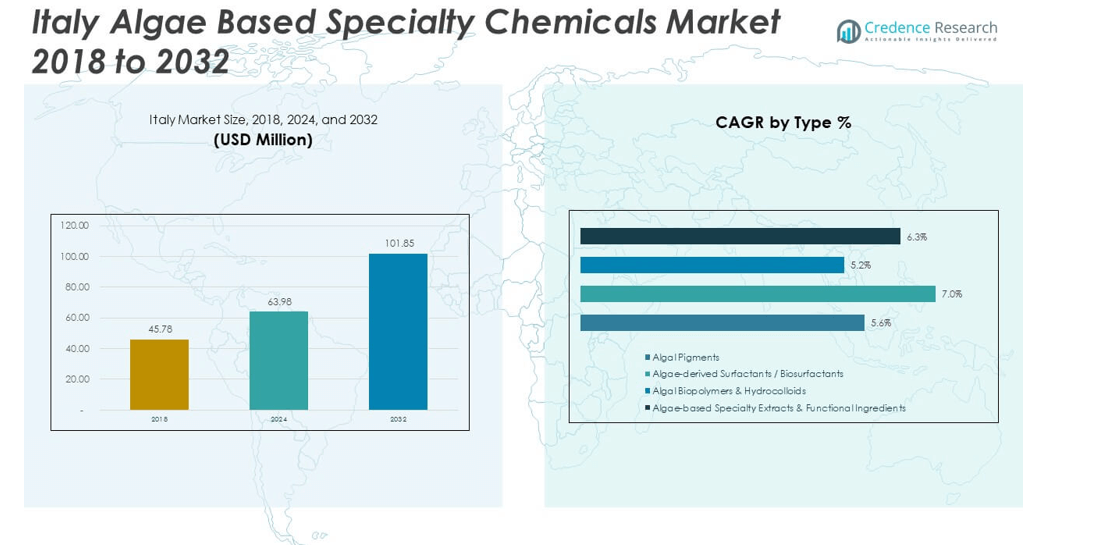
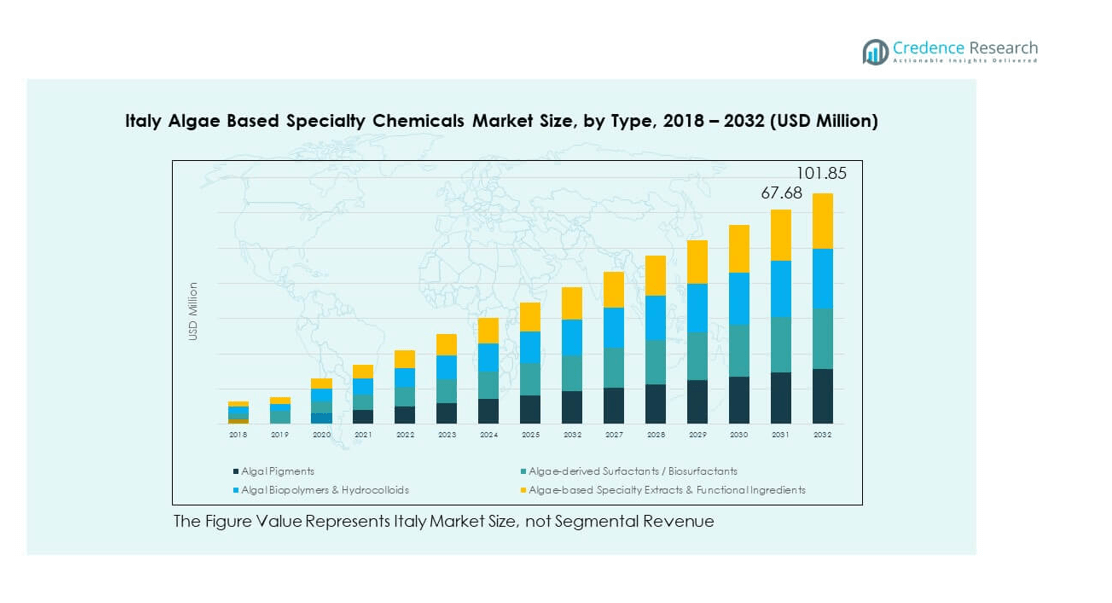
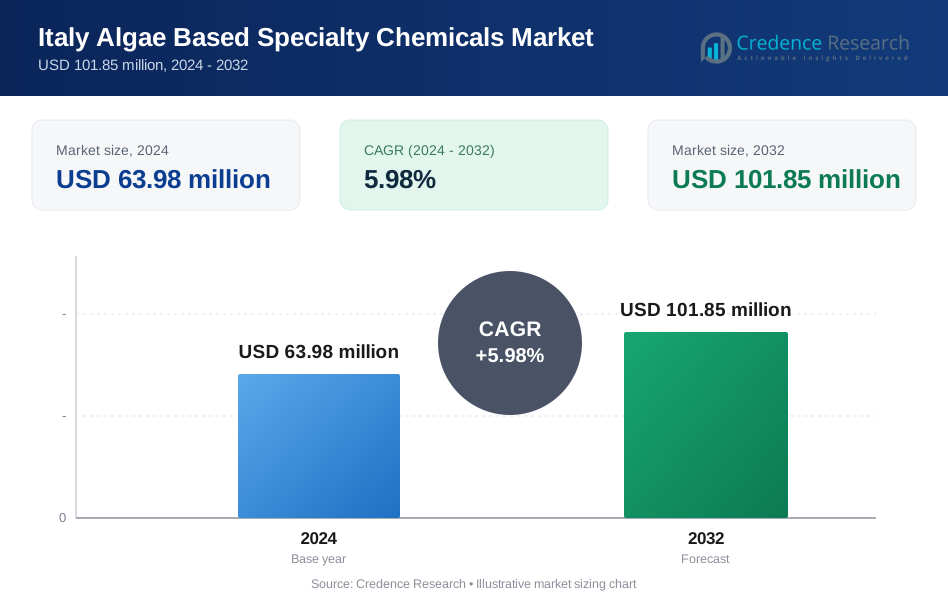
The Italy Algae Based Specialty Chemicals Market size was valued at USD 45.78 million in 2018 to USD 63.98 million in 2024 and is anticipated to reach USD 101.85 million by 2032, at a CAGR of 5.98% during the forecast period.
| REPORT ATTRIBUTE | DETAILS |
|---|---|
| Historical Period | 2020-2023 |
| Base Year | 2024 |
| Forecast Period | 2025-2032 |
| Italy Algae Based Specialty Chemicals Market Size 2024 | USD 63.98 million |
| Italy Algae Based Specialty Chemicals Market, CAGR | 5.98% |
| Italy Algae Based Specialty Chemicals Market Size 2032 | USD 101.85 million |
Growth in the Italy Algae Based Specialty Chemicals Market is driven by rising demand for sustainable alternatives across multiple industries. Manufacturers are adopting algae-derived ingredients to replace petroleum-based raw materials in cosmetics, pharmaceuticals, and food products. Increasing consumer preference for natural solutions, along with strict EU environmental regulations, is strengthening adoption. Technological advances in algae cultivation and extraction processes are enhancing efficiency and lowering costs. Research collaborations between biotech firms and universities are also accelerating innovation. The market is benefitting from expanding applications in bio-based polymers and eco-friendly surfactants.
Regionally, Northern Italy leads due to its strong biotechnology clusters, advanced industrial base, and active R&D investments. Central Italy is expanding through collaboration between universities and startups, particularly in food and healthcare applications. Southern Italy and the islands are emerging as cultivation hubs, benefitting from favorable climate conditions that support algae farming. Strong agricultural and aquaculture sectors in the south further encourage algae-based adoption. This regional balance creates an ecosystem where innovation, production, and end-user demand are well connected. Italy’s geographic diversity ensures both established leadership and new growth opportunities within the European algae-based specialty chemicals landscape.
Market Insights
- The Italy Algae Based Specialty Chemicals Market was valued at USD 45.78 million in 2018, reached USD 63.98 million in 2024, and is projected to touch USD 101.85 million by 2032, growing at a CAGR of 5.98%.
- Northern Italy leads with 42% share, supported by strong biotech clusters and industrial hubs that drive innovation and commercialization.
- Central Italy holds 33% share, fueled by academic–industry collaborations in food, nutraceuticals, and healthcare applications. Southern Italy and islands account for 25%, emerging as cultivation hubs due to favorable climate.
- The fastest-growing region is Southern Italy and islands with 25% share, driven by algae cultivation projects, agricultural demand, and renewable-focused investments.
- Segment distribution highlights algal pigments at 34% share and algal biopolymers & hydrocolloids at 28%, both dominating due to high demand in food, cosmetics, and packaging applications.
Market Drivers
Rising Demand for Sustainable Ingredients
The Italy Algae Based Specialty Chemicals Market is driven by strong consumer demand for eco-friendly ingredients across multiple industries. Companies are shifting away from petroleum-based raw materials to meet sustainability targets. The cosmetics and personal care sector is embracing algae-derived inputs due to their bioactive properties and clean-label appeal. Food and beverage producers are also adopting these alternatives for natural coloring and functional additives. Pharmaceutical applications are expanding due to algae’s therapeutic potential. Strict EU regulations encourage industries to favor renewable feedstocks. These combined forces provide significant momentum to market expansion.
- For instance, ENEA (Italian National Agency for New Technologies, Energy and Sustainable Economic Development) and Enel Green Power completed an algovoltaic plant at the ENEA Research Center in Portici (Naples) in 2023, which produces approximately 30 kilograms of dried microalgae annually for use in the food, cosmetic, and pharmaceutical industries, using a module surface area of 40 m² powered at 7 kWp.
Government Regulations and Environmental Policies
Government initiatives and strict environmental policies play a vital role in driving this market. Italy and the broader EU enforce rigorous restrictions on synthetic and petroleum-derived chemicals. These frameworks support the integration of algae-based specialty chemicals across end-use industries. Companies receive incentives to adopt renewable solutions, boosting investment in bioprocessing technologies. Circular economy strategies reinforce the use of algae as a sustainable resource. The alignment with climate action goals strengthens the market outlook. It ensures that industrial stakeholders prioritize green chemistry practices. Strong legislative backing is a core driver for steady adoption.
- For instance, the ENEA and Enel Green Power algovoltaic collaboration demonstrates direct support from both national policy and energy sector leaders to enable green chemical and ingredient production through government-backed pilot projects, aligning with Italy’s national bioeconomy strategy and EU directives on renewables.
Technological Advancements in Algae Cultivation
Innovation in algae cultivation and processing technologies fuels the growth of this sector. Advanced photobioreactors and open-pond systems enhance scalability while reducing costs. Research collaborations between universities and biotech firms accelerate product development. New extraction methods allow companies to derive high-value compounds efficiently. The focus on maximizing yield with minimal resource use supports long-term industry sustainability. Italy benefits from its Mediterranean climate, which is suitable for algae cultivation. This natural advantage encourages expansion in local production capacity. Such technological progress creates an ecosystem that supports industrial and commercial adoption.
Rising Investment in Research and Development
Strong investment in R&D acts as another driver for the Italy Algae Based Specialty Chemicals Market. Companies collaborate with academic institutions to explore novel algae strains with unique properties. These initiatives focus on developing functional additives, bio-pigments, and specialty polymers. Funding from both public and private entities accelerates commercialization of research findings. Pilot-scale projects are advancing into full-scale production facilities. This transition strengthens the supply chain and reduces reliance on imports. The ability to innovate new formulations enhances competitiveness. R&D investments ensure continuous development of specialized products tailored to industry needs.
Market Trends
Expansion of Cosmetic and Personal Care Applications
A major trend shaping the Italy Algae Based Specialty Chemicals Market is the growing role of cosmetics and personal care. Algae-derived compounds offer moisturizing, anti-aging, and UV-protection properties. These attributes align with consumer demand for natural and functional skincare products. Companies are formulating algae-based creams, serums, and hair-care items to capture premium segments. The clean-label trend reinforces adoption among health-conscious buyers. European brands leverage algae actives as a differentiator in crowded markets. This creates an innovation-driven push for new formulations. The sector continues to show high growth potential.
- For example, REN Clean Skincare’s Atlantic Kelp line does use sustainably sourced brown algae from the North Atlantic, and it is present in the Italian cosmetics market. The formulations include standardized kelp extracts promoted for anti-inflammatory and antioxidant benefits. The adoption of marine macroalgae in cosmetics by European brands is documented in corporate sourcing disclosures, ingredient listings, and independent sustainability reports, confirming its credibility.
Integration into Functional Foods and Beverages
The food and beverage industry is adopting algae-based specialty chemicals for functional and nutritional applications. Algae-derived pigments provide natural coloring alternatives to synthetic dyes. Bioactive compounds contribute antioxidants, omega-3s, and proteins to product formulations. Italian producers are integrating algae ingredients into fortified beverages and dairy alternatives. This trend responds to rising demand for plant-based and wellness-focused diets. Clean-label preferences further boost acceptance of algae-derived inputs. It strengthens market penetration in mainstream food categories. This integration marks a key transformation in consumer-facing applications.
Adoption in Bioplastics and Packaging Materials
Another significant trend is the role of algae in sustainable packaging and bioplastics. Companies explore algae-derived polymers as alternatives to petroleum-based plastics. These innovations reduce environmental impact and align with Italy’s circular economy strategies. Packaging firms are testing algae-based films and coatings for food contact applications. Consumer awareness of plastic pollution strengthens demand for such solutions. The push from retailers for sustainable packaging options enhances uptake. Italy’s strong design and packaging industries provide fertile ground for this trend. It creates new opportunities across both domestic and export markets.
- For instance, Notpla a widely profiled European firm has developed algae-based (brown seaweed) packaging, such as Ooho! edible water capsules and directly compostable food trays. These products fully decompose in a few weeks and are in commercial use (including food delivery packaging and sporting events in Italy and elsewhere as of 2025), as reported in industry coverage and sustainability publications.
Focus on Industrial and Agricultural Uses
Industrial and agricultural applications are emerging as important avenues for algae-based specialty chemicals. Biofertilizers derived from algae improve soil health and crop yields sustainably. Algae-based additives are also used in livestock feed for better nutrition. Industrial sectors utilize algae-derived bio-lubricants and corrosion inhibitors. These applications expand the scope beyond consumer products. Italy’s agricultural strength makes it a prime market for biofertilizers and feed solutions. Research into large-scale agricultural use is ongoing. The diversification into such areas broadens market potential significantly.
Market Challenges Analysis
High Production Costs and Scalability Issues
The Italy Algae Based Specialty Chemicals Market faces challenges linked to high production costs. Advanced cultivation systems and extraction processes require significant investment. Small and medium enterprises often struggle to scale operations efficiently. The cost of production often exceeds that of conventional petrochemical-based alternatives. This pricing gap limits mass-market adoption despite environmental benefits. Supply chain inefficiencies further complicate scaling efforts. Energy-intensive processes also raise sustainability concerns. Overcoming these hurdles requires breakthroughs in cost reduction and efficiency improvements.
Regulatory Complexities and Market Awareness Gaps
Regulatory complexities present another challenge to market participants. Companies must comply with stringent EU safety, labeling, and environmental standards. These requirements can delay commercialization and increase compliance costs. Market awareness among end-users is still developing in certain segments. Limited knowledge of algae-based benefits hampers adoption in traditional industries. Consumer education campaigns are necessary to bridge this gap. Competition from well-established bio-based alternatives also intensifies pressure. It requires targeted marketing and differentiation strategies to gain share. Addressing these issues is critical for steady long-term growth.
Market Opportunities
Emerging Role in Bio-Based Healthcare Solutions
The Italy Algae Based Specialty Chemicals Market presents opportunities in healthcare and pharmaceuticals. Algae-derived compounds show potential for use in drug formulations, nutraceuticals, and functional supplements. Their antioxidant, anti-inflammatory, and immune-supporting properties attract medical research. Demand for preventive healthcare products strengthens the case for algae actives. Italy’s strong pharmaceutical sector creates a fertile ground for collaboration. Companies can commercialize high-value bioactive compounds for domestic and international markets. It allows Italy to position itself as an innovator in natural healthcare solutions.
Expansion Potential in Sustainable Agriculture
Agriculture provides another major opportunity for algae-based specialty chemicals. Biofertilizers, soil enhancers, and feed additives derived from algae support eco-friendly farming. Italy’s large agricultural base offers strong adoption potential for such inputs. Growing awareness of climate-smart farming strengthens this trend. Companies can introduce solutions tailored for Mediterranean crops and livestock systems. The sector offers both domestic and export opportunities. Aligning with EU sustainability goals boosts adoption further. It positions algae-based products as enablers of long-term agricultural resilience.
Market Segmentation Analysis
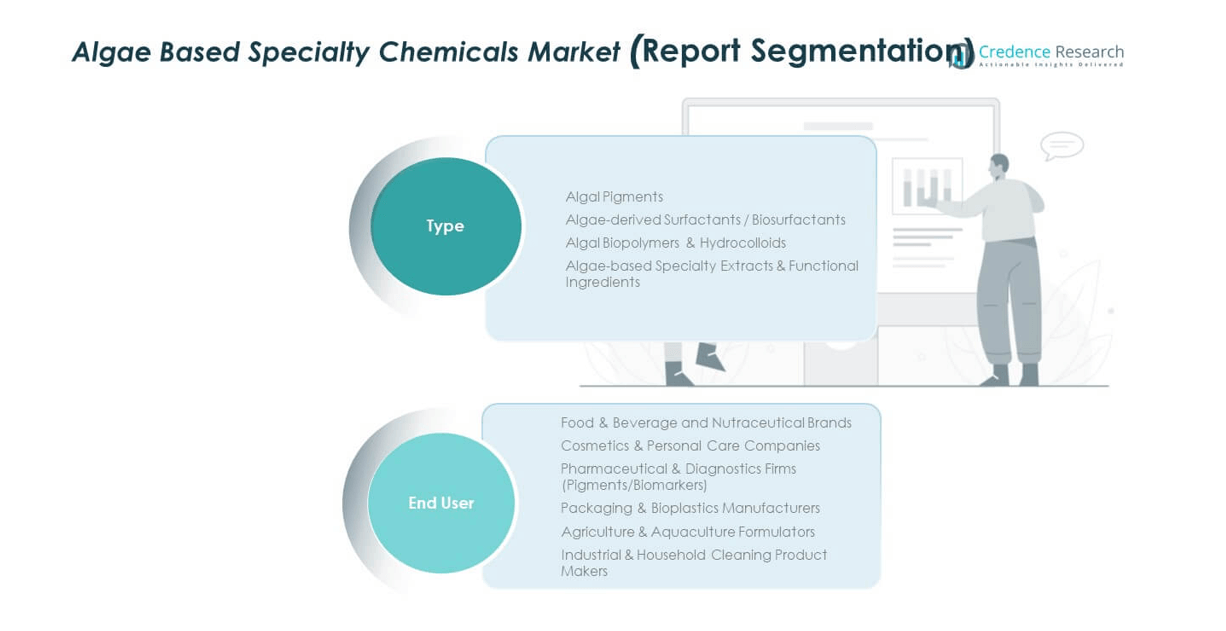
By type, the Italy Algae Based Specialty Chemicals Market is divided into algal pigments, algae-derived surfactants or biosurfactants, algal biopolymers and hydrocolloids, and algae-based specialty extracts and functional ingredients. Algal pigments hold the largest share due to strong adoption in food, beverage, and cosmetic applications where natural colorants are preferred over synthetic alternatives. Surfactants and biosurfactants are gaining ground in cleaning and personal care products, supported by their biodegradability and safety profile. Biopolymers and hydrocolloids are advancing in packaging and industrial sectors, offering renewable substitutes for petroleum-based materials. Specialty extracts and functional ingredients are expanding in nutraceuticals and pharmaceuticals, reflecting demand for bioactive compounds.
- For instance, AlgaHealth develops algae-derived ingredients such as fucoxanthin, which are marketed for use in nutraceutical and functional food applications, as documented on the company’s official product portfolio.
By end user, the Italy Algae Based Specialty Chemicals Market is segmented into food and beverage and nutraceutical brands, cosmetics and personal care companies, pharmaceutical and diagnostics firms, packaging and bioplastics manufacturers, agriculture and aquaculture formulators, and industrial and household cleaning product makers. Food and beverage brands leverage algae-derived additives for functional and clean-label products. Cosmetics and personal care companies use bioactives and pigments to meet natural ingredient demand. Pharmaceuticals and diagnostics firms rely on algae-based biomarkers and extracts for innovation in health solutions. Packaging and bioplastics manufacturers integrate algae-derived polymers to support circular economy goals. Agriculture and aquaculture sectors apply biofertilizers and feed solutions to enhance productivity sustainably. Industrial and household cleaning product makers adopt biosurfactants to improve environmental performance while reducing reliance on petrochemical-based surfactants.
- For instance, researchers at the University of Ferrara (2022–2023) demonstrated that applying algae-based biostimulants at 0.5–1.0% rates to organic tomato crops in Ferrara, Italy, yielded significant improvements in nitrogen uptake and photosynthetic efficiency, confirming direct benefit for agricultural/aquaculture formulators using Italian-sourced algae products
Segmentation
By Type
- Algal Pigments
- Algae-derived Surfactants / Biosurfactants
- Algal Biopolymers & Hydrocolloids
- Algae-based Specialty Extracts & Functional Ingredients
By End User
- Food & Beverage and Nutraceutical Brands
- Cosmetics & Personal Care Companies
- Pharmaceutical & Diagnostics Firms (Pigments/Biomarkers)
- Packaging & Bioplastics Manufacturers
- Agriculture & Aquaculture Formulators
- Industrial & Household Cleaning Product Makers
Regional Analysis
Northern Italy
Northern Italy holds the largest share of the Italy Algae Based Specialty Chemicals Market with 42%. This dominance stems from advanced biotechnology clusters in Lombardy and Emilia-Romagna, where strong R&D infrastructure supports algae-based innovation. Industrial hubs in Milan and Bologna encourage collaboration between academic institutes and global chemical companies. The region also benefits from high demand in cosmetics, pharmaceuticals, and specialty food production. Its export-driven economy allows local producers to scale efficiently. Northern Italy remains the focal point for product development and commercialization.
Central Italy
Central Italy accounts for 33% of the market share, driven by strong activity in Lazio and Tuscany. Universities and biotech startups collaborate closely to advance algae-based applications in food, nutraceuticals, and healthcare. Rome acts as a policy and regulatory center, helping firms align with EU sustainability directives. Tuscany’s agriculture and food processing industries provide fertile ground for algae integration in bioplastics and biofertilizers. Demand for eco-friendly consumer products in the region is steadily rising. It positions Central Italy as a critical bridge between northern innovation and southern adoption.
Southern Italy and Islands
Southern Italy and the islands represent 25% of the market share, reflecting steady growth potential. Favorable climate conditions in Sicily and Sardinia support large-scale algae cultivation projects. The region is emerging as a production hub for raw materials, which supply downstream industries across Italy. Economic incentives for renewable and circular economy initiatives are encouraging new investments. Demand from agriculture and aquaculture sectors is particularly strong in these areas. It is building momentum as both a cultivation center and a regional growth engine.
Key Player Analysis
- CABB Chemicals
- BASF SE
- I.D. Parry (Parry Nutraceuticals)
- Cyanotech Corporation
- Earthrise Nutritionals
- Algatechnologies (Algatech)
- CP Kelco
- Cargill
- DSM
- Other Key Players
Competitive Analysis
The Italy Algae Based Specialty Chemicals Market is characterized by a competitive mix of multinational corporations, regional players, and niche innovators. Global leaders such as BASF SE, DSM, and Cargill maintain a strong presence, leveraging extensive product portfolios and advanced R&D to expand applications across food, personal care, and industrial uses. Companies like Algatechnologies and Parry Nutraceuticals bring specialized expertise in algae-derived ingredients, ensuring innovation in pigments, nutraceuticals, and bio-based extracts. Local firms and startups in Italy collaborate with universities to strengthen product pipelines and address domestic demand. The market demonstrates active competition in product differentiation, sustainability positioning, and regulatory compliance. It is witnessing increased merger and acquisition activity, joint ventures, and strategic partnerships aimed at scaling production and expanding into high-growth subsegments such as bioplastics and biofertilizers. Competitive intensity remains high, with companies focused on achieving cost efficiency while meeting EU-driven environmental targets.
Recent Developments
- In July 2025, Corbion secured regulatory approvals from China's authorities to launch its algae-derived omega-3 DHA products, expanding its global reach in specialty chemicals for both animal feed and human health. In February 2025, GC Riber VivoMega introduced a new algae-based DHA and EPA product called Algae 1060 TG Premium, aimed at supplement manufacturers for easy and cost-effective formulation.
- In June 2025, CABB Chemicals announced a strategic partnership with Origin by Ocean to establish a first-of-a-kind algae biorefinery at CABB’s site in Kokkola, Finland. The facility, set to begin operating in 2028, will use patented technology to process invasive brown seaweed (sargassum) into high-value specialty ingredients such as alginate and fucoidan, relevant for the algae-based specialty chemicals market in Italy and beyond.
Report Coverage
The research report offers an in-depth analysis based on Type and End User. It details leading market players, providing an overview of their business, product offerings, investments, revenue streams, and key applications. Additionally, the report includes insights into the competitive environment, SWOT analysis, current market trends, as well as the primary drivers and constraints. Furthermore, it discusses various factors that have driven market expansion in recent years. The report also explores market dynamics, regulatory scenarios, and technological advancements that are shaping the industry. It assesses the impact of external factors and global economic changes on market growth. Lastly, it provides strategic recommendations for new entrants and established companies to navigate the complexities of the market.
Future Outlook
- The Italy Algae Based Specialty Chemicals Market will expand due to strong consumer demand for sustainable ingredients.
- Advancements in cultivation and extraction technologies will lower production costs and improve scalability.
- The cosmetics and personal care industry will continue to lead adoption of algae-derived bioactives.
- Functional foods and nutraceuticals will integrate algae-based pigments and compounds into mainstream products.
- Bioplastics and eco-friendly packaging will emerge as fast-growing applications in domestic industries.
- Pharmaceutical innovation using algae-derived bioactive molecules will open new opportunities for healthcare solutions.
- Agricultural applications such as biofertilizers and feed additives will drive demand in farming regions.
- Strategic alliances between biotech firms, research institutes, and chemical producers will enhance product pipelines.
- Regional growth will be shaped by Northern Italy’s leadership in R&D and Southern Italy’s cultivation strengths.
- Regulatory emphasis on sustainability will continue to push industries toward algae-based specialty chemical adoption.
Request a Free Sample
Fill in your details and we'll send you a free sample report.
- Sample data tables & charts
- Research methodology
Need a Custom Version of This Report?
Tailor the scope, geography, or segments to your exact requirements.
- Custom geography or segment scope
- Direct access to our analyst team
Frequently Asked Questions
What is the current market size for Italy Algae Based Specialty Chemicals Market, and what is its projected size in 2032?
At what Compound Annual Growth Rate is the Italy Algae Based Specialty Chemicals Market projected to grow between 2024 and 2032?
Which Italy Algae Based Specialty Chemicals Market segment held the largest share in 2024?
What are the primary factors fueling the growth of the Italy Algae Based Specialty Chemicals Market?
Who are the leading companies in the Italy Algae Based Specialty Chemicals Market?
Table of Content
Chapter 1. Report Introduction
- 1.1 Report Description & Purpose
- 1.1.1 Report Title & Market Definition
- 1.1.2 Unique Selling Propositions (USP) & Key Differentiators
- 1.1.3 Value Proposition for Stakeholders
- 1.2 Research Objectives
- 1.2.1 Market Sizing Objectives (Volume & Revenue)
- 1.2.2 Segmentation Objectives
- 1.2.3 Competitive Intelligence Objectives
- 1.2.4 Forecast & Scenario Objectives
- 1.3 Report Scope
- 1.3.1 Italy Algae Based Specialty Chemicals Scope – Types & Subtypes Covered
- 1.3.2 Geographic Scope – Regions & Countries Covered
- 1.3.3 Historical Period, Base Year & Forecast Period (2024; forecast to 2032)
- 1.3.4 Inclusions & Exclusions
- 1.4 HS Code & Classification Framework
- 1.5 Currency, Units & Pricing Basis
- 1.6 Target Stakeholders
- 1.7 Limitations & Assumptions
Chapter 2. Executive Summary
- 2.1 Global Italy Algae Based Specialty Chemicals Market Snapshot
- 2.1.1 Market Size – Historical (2024) & Forecast (2024-2032) (2024: USD 63.98 million → 2032: USD 101.85 million)
- 2.1.2 Volume & Revenue – Global Totals
- 2.1.3 Key Market Highlights – Top Five Facts
- 2.2 Italy Algae Based Specialty Chemicals Market Segmentation Snapshot
- 2.2.1 Market Split by Region – 2024 vs. 2032
- 2.3 Competitive Snapshot
- 2.3.1 Top 10 Players by Revenue Share – 2024
- 2.3.2 Top 10 Players by Volume Share – 2024
- 2.3.3 Recent Strategic Developments (18-Month Summary)
- 2.4 Key Investment Highlights & Strategic Conclusions
Chapter 3. Italy Algae Based Specialty Chemicals Market Dynamics & Industry Analysis
- 3.1 Market Overview & Context
- 3.1.1 Italy Algae Based Specialty Chemicals Market Position in the Broader Automotive Value Chain
- 3.1.2 OEM vs. Replacement Market Dynamics
- 3.1.3 Market Maturity & Development Stage by Region
- 3.2 Italy Algae Based Specialty Chemicals Market Drivers
- 3.3 Italy Algae Based Specialty Chemicals Market Restraints & Challenges
- 3.4 Italy Algae Based Specialty Chemicals Market Opportunities
- 3.5 Porter's Five Forces Analysis
- 3.5.1 Threat of New Entrants
- 3.5.2 Bargaining Power of Suppliers
- 3.5.3 Bargaining Power of Buyers
- 3.5.4 Threat of Substitutes
- 3.5.5 Competitive Rivalry – Intensity Assessment
- 3.6 Italy Algae Based Specialty Chemicals Value Chain Analysis
- 3.6.1 Upstream – Raw Material/Input Suppliers
- 3.6.1.1 Raw Material/Input 1
- 3.6.1.2 Raw Material/Input 2
- 3.6.1.3 Raw Material/Input 3
- 3.6.2 Midstream – Production/Manufacturing/Service Delivery
- 3.6.2.1 Production/Process Overview
- 3.6.2.2 Key Facility Locations & Capacity by Manufacturer
- 3.6.3 Downstream – Distribution & End Consumer
- 3.6.3.1 Primary Channel – B2B/OEM
- 3.6.3.2 Secondary Channels – Dealer, Retail, Online, Direct
- 3.6.4 Value Chain Profitability Analysis
- 3.6.1 Upstream – Raw Material/Input Suppliers
- 3.7 PESTEL Analysis
- 3.7.1 Political Factors
- 3.7.2 Economic Factors
- 3.7.3 Social Factors
- 3.7.4 Technological Factors
- 3.7.5 Environmental Factors
- 3.7.6 Legal Factors
- 3.8 Italy Algae Based Specialty Chemicals Supply Chain Analysis
- 3.8.1 Raw Material/Input Supply Risk Assessment
- 3.8.2 Manufacturing Concentration Risk (Geographic Exposure)
- 3.8.3 Trade Disruption Impact Analysis
- 3.9 Regulatory & Policy Landscape
Note: The regulatory and policy landscape section covers regulations based on their applicability to the market, Italy Algae Based Specialty Chemicals category, geography, and scope of the study. Only regulatory frameworks with a material impact on operations, compliance, trade, sustainability, or market access are analyzed in detail.
Chapter 4. Key Investment Pockets & Opportunity Analysis
- 4.1 Italy Algae Based Specialty Chemicals Market Attractiveness Analysis
- 4.1.1 By Region – Investment Attractiveness Matrix (Volume × CAGR)
- 4.2 Absolute Revenue Growth Opportunity
- 4.2.1 By Region – Absolute USD Growth Through 2032
- 4.3 Incremental Volume Opportunity
- 4.3.1 By Region – Incremental Volume Through 2032
- 4.3.2 Segment – Incremental Volume
- 4.4 Emerging Submarket Opportunity Deep Dive (Subject to Applicability)
- 4.5 Emerging Market Opportunity Scorecards
- 4.5.1 United States
- 4.5.2 Europe
- 4.5.3 Asia
- 4.5.4 Middle East & Africa
Note: Emerging Market Opportunity Scorecards will be included based on relevance and strategic importance. Regions listed are indicative and may vary depending on data availability and market dynamics.
Chapter 5. Italy Algae Based Specialty Chemicals Import-Export Analysis & Trade Flows
- 5.1 Global Trade Overview
- 5.1.1 Global Export Value by Country (2024)
- 5.1.2 Global Export Volume by Country (2024)
- 5.1.3 Global Import Value by Country (2024)
- 5.1.4 Global Import Volume by Country (2024)
- 5.1.5 Net Trade Balance by Country (2024)
- 5.2 Export Analysis – Segment
- 5.2.1 Type 1 (HS Code)
- 5.2.2 Type 2 (HS Code)
- 5.2.3 Type 3 (HS Code)
- 5.2.4 Type 4 (HS Code)
- 5.2.5 Type 5 (HS Code)
- 5.3 Import Analysis – Segment
- 5.3.1 Type 1 (HS Code)
- 5.3.2 Type 2 (HS Code)
- 5.3.3 Type 3 (HS Code)
- 5.3.4 Type 4 (HS Code)
- 5.3.5 Type 5 (HS Code)
- 5.4 Average Unit Trade Prices
- 5.4.1 Average Export Price – Segment & Country
- 5.4.2 Average Import Price – Segment & Source Country
- 5.4.3 Price Trends (2024)
- 5.5 Key Trade Route Analysis
- 5.5.1 Trade Route 1
- 5.5.2 Trade Route 2
- 5.5.3 Trade Route 3
- 5.5.4 Trade Route 4
- 5.5.5 Trade Route 5
- 5.6 Trade Policy Impact Assessment
- 5.6.1 US Anti-Dumping & Section 301 Tariffs
- 5.6.2 EU Customs Union Impact
- 5.6.3 Major Free Trade Agreements
- 5.6.4 USMCA Rules of Origin
Note: Trade policy analysis will be included only where relevant to the Italy Algae Based Specialty Chemicals market.
Chapter 6. Competitive Landscape & Company Benchmarking
- 6.1 Italy Algae Based Specialty Chemicals Market Concentration & Structure
- 6.1.1 Herfindahl-Hirschman Index (HHI) – vs. 2024
- 6.1.2 Tier 1, Tier 2 & Tier 3 Market Structure
- 6.1.3 Global, Regional & Local Player Dynamics
- 6.2 Italy Algae Based Specialty Chemicals Market Share Analysis – 2024
- 6.2.1 Global Revenue Share by Company
- 6.2.2 Global Volume Share by Company
- 6.2.3 Regional Revenue Share
- 6.2.4 Market Share Evolution ( vs. 2024)
- 6.2.5 OEM Segment Share by Company
- 6.2.6 Replacement Segment Share by Company
- 6.3 Production/Delivery Capacity & Facility Analysis
- 6.3.1 Global Installed Capacity
- 6.3.2 Capacity Utilization Rates
- 6.3.3 Production/Output Volume
- 6.3.4 Facility Locations & Capacity Map
- 6.3.5 Planned Capacity Additions
- 6.4 Italy Algae Based Specialty Chemicals Competitive Benchmarking Matrix
- 6.4.1 Revenue, Volume, CAGR & Profitability Comparison
- 6.4.2 Channel Revenue Mix
- 6.4.3 Geographic Revenue Exposure
- 6.4.4 R&D Intensity
- 6.4.5 Sustainability Maturity
- 6.5 Strategic Developments in Italy Algae Based Specialty Chemicals (Last 24 Months)
- 6.5.1 Mergers, Acquisitions & Divestments
- 6.5.2 New Italy Algae Based Specialty Chemicals Launches
- 6.5.3 Facility Expansions
- 6.5.4 Strategic Alliances, Joint Ventures & Partnerships
- 6.5.5 Distribution Expansion & Market Entry
- 6.5.6 Sustainability & ESG Initiatives
- 6.6 Competitive Strategy Mapping
- 6.6.1 Leader, Challenger, Follower & Niche Classification
- 6.6.2 Pricing Strategy Comparison
- 6.6.3 Channel Strategy Matrix
Note: Strategic developments are included based on their materiality and the availability of reliable information.
Chapter 7. Global Italy Algae Based Specialty Chemicals Market – By Distribution Channel
- 7.1 Segment Overview
- 7.1.1 Volume & Revenue Split by Channel (2024 & 2032)
- 7.1.2 Channel Mix Evolution (2024-2032)
Chapter 8. Regional Market Analysis – Global Overview
- 8.1 Global Regional Overview
- 8.1.1 Regional Volume Share
- 8.1.2 Regional Revenue Share
- 8.1.3 Regional Volume by Region
- 8.1.4 Regional Revenue by Region
- 8.1.5 Regional Forecast Through 2032
- 8.2 Cross-Regional Segment Analysis
- 8.2.1 By Distribution Channel
- 8.2.2 By Brand/Price Tier
Chapter 9. North America Italy Algae Based Specialty Chemicals Market
- 9.1 United States
- 9.2 Canada
- 9.3 Mexico
Chapter 10. Europe Italy Algae Based Specialty Chemicals Market
- 10.1 Germany
- 10.2 France
- 10.3 Italy
- 10.4 United Kingdom
- 10.5 Spain
- 10.6 Poland
- 10.7 Russia
- 10.8 Netherlands
- 10.9 Belgium
- 10.10 Sweden
- 10.11 Denmark
- 10.12 Norway
- 10.13 Rest of Europe
Chapter 11. Asia Pacific Italy Algae Based Specialty Chemicals Market
- 11.1 China
- 11.2 India
- 11.3 Japan
- 11.4 South Korea
- 11.5 Thailand
- 11.6 Indonesia
- 11.7 Vietnam
- 11.8 Malaysia
- 11.9 Australia
- 11.10 Rest of Asia Pacific
Chapter 12. Latin America Italy Algae Based Specialty Chemicals Market
- 12.1 Brazil
- 12.2 Argentina
- 12.3 Colombia
- 12.4 Chile
- 12.5 Rest of Latin America
Chapter 13. Middle East Italy Algae Based Specialty Chemicals Market
- 13.1 Saudi Arabia
- 13.2 United Arab Emirates
- 13.3 Turkey
- 13.4 Israel
- 13.5 Iran
- 13.6 Rest of the Middle East
Chapter 14. Africa Italy Algae Based Specialty Chemicals Market
- 14.1 South Africa
- 14.2 Egypt
- 14.3 Nigeria
- 14.4 Morocco
- 14.5 Rest of Africa
Chapter 15. Italy Algae Based Specialty Chemicals Company Profiles
- 15.1 [Company 01]
- 15.1.1 Company Overview
- 15.1.2 Key Management Personnel
- 15.1.3 Products & Services Portfolio
- 15.1.4 Financial Performance
- 15.1.5 Key Market Focus & Geographic Presence
- 15.1.6 Recent Developments & Strategic Initiatives
Note: The company profile list is preliminary and may change based on research findings, market developments, data availability, and client requirements.
Chapter 16. Appendices
- Appendix A – List of Abbreviations & Acronyms
- Appendix B – Industry Classification Code Reference – Full Series
- Appendix C – Production & Capacity Data Tables
- Appendix D – End-Use & Demand Base Tables
- Appendix E – Consumption & Replacement Rate Assumptions
- Appendix F – ASP Reference Tables
- Appendix G – Manufacturing & Facility Database
- Appendix H – Import-Export Data Tables
- Appendix I – Regulatory Summary Tables
- Appendix J – Primary Research Participant List (Anonymized)
- Appendix K – Primary Research Questionnaire Framework
- Appendix L – Data Sources & Bibliography
- Appendix M – Market Size Divergence & Source Comparison
Chapter 17. Research Methodology
- 17.1 Research Framework & Philosophy
- 17.2 Secondary Research – Sources, Hierarchy & Data Extraction
- 17.3 Data Modeling – Bottom-Up & Top-Down Market Sizing
- 17.4 Primary Research – Stakeholder Framework, LOI & Sample Sizes
- 17.5 Forecast Methodology – Regression, Scenario & Sensitivity Analysis
- 17.6 Quality Control – Four-Layer Validation Framework
- 17.7 Limitations & Standard Assumptions
- 17.8 Disclaimer
