Market Overview
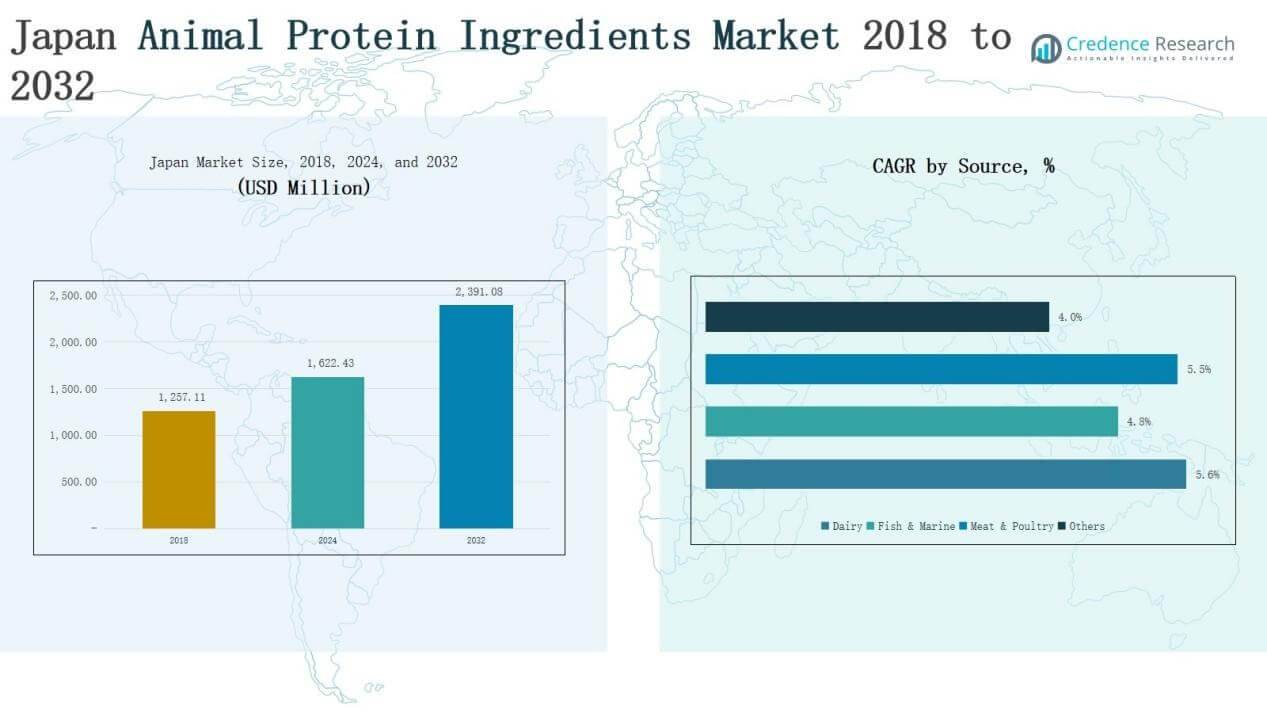
Japan Animal Protein Ingredients Market size was valued at USD 1,257.11 million in 2018, reaching USD 1,622.43 million in 2024, and is anticipated to grow to USD 2,391.08 million by 2032, at a CAGR of 4.90% during the forecast period.
| REPORT ATTRIBUTE | DETAILS |
|---|---|
| Historical Period | 2020-2023 |
| Base Year | 2024 |
| Forecast Period | 2025-2032 |
| Japan Animal Protein Ingredients Market Size 2024 | USD 1,622.43 Million |
| Japan Animal Protein Ingredients Market, CAGR | 4.90% |
| Japan Animal Protein Ingredients Market Size 2032 | USD 2,391.08 Million |
The Japan Animal Protein Ingredients Market features strong competition among global and domestic companies, with Arla Foods, ADM Trading Japan, Meiji, Cargill, Kemin Industries, Tyson Foods, Lacto, Prinova, Darling Ingredients, and Armor Proteines playing key roles. These firms maintain leadership through advanced processing technologies, diversified product portfolios, and expanding applications across nutrition, healthcare, and pet food. Innovation in functional proteins, sustainable sourcing practices, and strategic partnerships further strengthen their positions. Regionally, the Kanto region dominates the market with 38% share in 2024, supported by its large consumer base, advanced food processing industries, and rising demand for clinical and sports nutrition products.
Market Insights
- Japan Animal Protein Ingredients Market grew from USD 1,257.11 million in 2018 to USD 1,622.43 million in 2024 and is projected to reach USD 2,391.08 million by 2032, at a CAGR of 4.90%.
- Dairy leads by source with 40% share in 2024, supported by strong whey and casein demand, advanced dairy processing, and growing adoption of protein-enriched foods and beverages.
- Powders dominate by form with 55% share in 2024, driven by convenience, longer shelf life, and innovation in solubility enhancement, making them widely used in supplements and clinical products.
- Sports and active nutrition leads applications with 35% share in 2024, fueled by rising fitness awareness, protein-enriched diet adoption, and expanding demand from gyms and health-focused consumers.
- Kanto region holds the largest share at 38% in 2024, benefiting from Tokyo’s large consumer base, advanced food processing infrastructure, and rising demand for clinical and sports nutrition products.
Market Segment Insights
By Source
Dairy dominates the Japan Animal Protein Ingredients Market with an estimated 40% share in 2024. Growth is supported by high consumer demand for whey and casein proteins in functional foods, clinical nutrition, and sports supplements. The segment benefits from Japan’s strong dairy processing industry, innovations in protein concentrates, and rising adoption of protein-enriched beverages. Fish & marine proteins follow, driven by collagen demand and the country’s established seafood sector.
For instance, Nippi Inc., a Japanese collagen manufacturer, expanded its fish-derived collagen peptide exports to Europe and the U.S., highlighting marine protein innovation from Japan’s seafood industry.
By Form
Powders account for the largest share, holding nearly 55% of the market in 2024. Their dominance comes from ease of formulation, longer shelf life, and wide application in supplements, beverages, and clinical products. Japan’s preference for convenient, ready-to-mix products supports growth, alongside innovation in microencapsulation and solubility enhancement. Granules/flakes and liquid/paste forms remain niche, catering mainly to specialized feed and medical uses.
FOr instance, Morinaga Milk Industry introduced a microencapsulated functional powder ingredient aimed at improving stability in clinical nutrition products.
By Application
Sports & active nutrition leads the market with about 35% share in 2024, reflecting the country’s rising fitness culture and growing consumption of protein shakes and bars. Increasing health awareness, aging population needs, and expanding gym memberships fuel this segment. Clinical & medical nutrition also shows strong growth, supported by Japan’s advanced healthcare system and focus on elderly care. Pet food and aquafeed further contribute, leveraging the country’s strong pet ownership and aquaculture base.
Key Growth Drivers
Rising Health and Wellness Awareness
The growing focus on preventive healthcare and balanced nutrition strongly drives demand for animal protein ingredients in Japan. Consumers increasingly associate protein intake with muscle health, weight management, and active lifestyles. Functional foods, fortified beverages, and protein supplements are gaining rapid acceptance, particularly among urban populations. Additionally, the aging demographic actively seeks protein-rich diets to prevent muscle loss and maintain mobility. This lifestyle shift ensures sustained demand for dairy, fish, and meat-based proteins in both retail and healthcare channels.
For instance, Meiji Co. expanded its Meiji SAVAS Whey Protein 100 series with a new functional protein powder targeting muscle recovery for middle-aged and elderly consumers.
Expansion of Clinical and Medical Nutrition
Japan’s advanced healthcare infrastructure and rising elderly population create a strong market for animal protein ingredients in medical applications. Clinical nutrition products enriched with dairy and fish-derived proteins are increasingly used in elderly care, hospital feeding, and rehabilitation programs. The government’s emphasis on reducing healthcare costs through preventive nutrition further supports adoption. Protein formulations tailored for easy digestion, solubility, and high bioavailability meet patient needs. This growth driver positions animal proteins as critical inputs in therapeutic and functional healthcare solutions.
For instance, Ajinomoto introduced Amino-Index Protein Diet Plus, a protein formulation for hospitals targeting elderly rehabilitation programs, emphasizing high digestibility and rapid absorption.
Increasing Pet Ownership and Aquaculture Industry Growth
The rise in pet ownership across Japan fuels demand for high-quality protein ingredients in pet food. Consumers prioritize nutritional value, premium formulations, and traceable ingredients for their pets, boosting usage of meat, poultry, and fish proteins. Simultaneously, Japan’s aquaculture sector is expanding, supported by seafood consumption trends and sustainability goals. Protein-based feed supplements are essential to enhance yield and fish health. Together, these developments broaden application opportunities for animal protein ingredients beyond human nutrition, ensuring diversified and resilient market growth.
Key Trends & Opportunities
Innovation in Functional Protein Products
Japan’s food and beverage industry is actively innovating with animal protein ingredients to meet rising consumer expectations for convenience and health benefits. New formulations such as ready-to-drink protein beverages, high-protein snacks, and functional powders are gaining popularity. Advances in processing technologies improve solubility, flavor, and shelf stability, enhancing consumer acceptance. Companies that focus on product differentiation and align with evolving lifestyles stand to capture greater market share, making innovation a central growth opportunity in the years ahead.
For instance, in Japan, Lacto Japan partnered with Leaft Foods in September 2025 to introduce Rubisco, a novel protein derived from green leaves, which replaces eggs in baked goods and enhances texture in dairy alternatives, meeting high consumer standards for quality and flavor.
Sustainability and Traceability in Supply Chains
Growing consumer concern over sustainability and ethical sourcing presents a key opportunity for animal protein suppliers in Japan. Brands that emphasize eco-friendly practices, transparent sourcing, and responsible farming methods gain consumer trust. Traceability systems ensuring safety, quality, and origin transparency are increasingly valued. With regulatory standards tightening and consumer awareness rising, companies that integrate sustainability certifications and innovative supply chain solutions will strengthen their competitiveness. This trend enhances brand reputation and supports long-term customer loyalty.
For instance, dsm-firmenich partnered with Zenkei Company Limited to implement the Sustell™ platform, an advanced life cycle assessment tool that helps measure and reduce the environmental footprint of egg and feed production.
Key Challenges
Volatile Raw Material Prices
Fluctuations in the cost of raw materials, including dairy, meat, and fish, present a major challenge for producers in Japan. Global supply disruptions, seasonal variations, and rising feed costs influence ingredient availability and pricing. These factors directly affect profit margins and increase production uncertainty. Companies must balance cost pressures with consumer expectations for affordability and quality. Strategic sourcing, partnerships with local suppliers, and investments in efficient production processes become crucial to managing this volatility effectively.
Intense Market Competition
The Japan animal protein ingredients market faces high competition among domestic players and multinational giants. Global firms leverage scale, advanced technology, and strong portfolios, while local companies compete on regional expertise and niche offerings. This environment creates pressure on pricing, product differentiation, and innovation cycles. Smaller players may struggle to maintain market presence without strategic collaborations. To stay competitive, companies must focus on unique formulations, branding strategies, and consistent investments in research and development.
Shifts Toward Plant-Based Alternatives
Rising consumer interest in plant-based diets poses a long-term challenge to the animal protein market in Japan. Although animal proteins remain dominant, the rapid growth of plant-based alternatives is reshaping consumer preferences. Younger demographics and environmentally conscious consumers increasingly explore soy, pea, and other plant proteins. This trend risks slowing growth in traditional animal protein segments if not addressed. Companies must adapt by highlighting nutritional advantages of animal proteins, diversifying portfolios, or integrating hybrid solutions to maintain relevance.
Regional Analysis
Kanto
The Kanto region leads the Japan Animal Protein Ingredients Market with 38% share in 2024. Strong consumer demand in Tokyo and surrounding urban centers drives sales of dairy and fish-based proteins. The region benefits from advanced food processing industries, high fitness culture, and growing elderly population requiring clinical nutrition. Companies invest in research and distribution hubs to meet increasing product demand. It remains a core growth region due to its large consumer base and rising focus on health and wellness.
Kansai
Kansai holds 22% of the market share in 2024, supported by Osaka’s strong food manufacturing and trading industries. High demand for functional beverages and protein powders fuels segment growth. The presence of major food companies in the region supports innovation and product diversification. Rising sports participation and consumer focus on nutrition encourage adoption of protein-enriched products. It continues to strengthen its position through robust distribution networks and growing urban demand.
Chubu
Chubu accounts for 15% market share in 2024, driven by a balance of urban demand and food production activities. Dairy and meat protein consumption remains significant, supported by food manufacturers in Nagoya and surrounding cities. Clinical nutrition products also see demand growth due to an aging population. The region benefits from logistics connectivity that aids product supply to broader areas. It sustains steady growth with strong domestic consumption and industrial support.
Kyushu
Kyushu represents 13% of the market share in 2024, supported by its seafood base and aquaculture industry. Fish and marine proteins dominate, particularly in collagen and feed applications. The region’s proximity to export markets further enhances opportunities for suppliers. Urban centers in Fukuoka add to consumer demand for protein-based functional foods. It shows growth potential through rising aquafeed and pet food applications.
Hokkaido
Hokkaido holds 12% market share in 2024, led by its established dairy farming and meat industries. Strong milk and livestock production supports steady demand for dairy and meat proteins. Consumers in the region increasingly adopt protein powders and supplements. Its supply chain strengths contribute to the national protein ingredient market. It maintains growth with a strong production base and consistent consumer demand.
Market Segmentations:
By Source
- Dairy
- Fish & Marine
- Meat & Poultry
- Others
By Form
- Powders
- Granules/Flakes
- Liquids/Pastes
By Application
- Sports & Active Nutrition
- Clinical & Medical Nutrition
- Pet Food
- Aquafeed & Livestock Feed
- Others
By Region
- Kanto
- Kansai
- Kyushu
- Chubbu
- Hokaido
Competitive Landscape
The Japan Animal Protein Ingredients Market is highly competitive, featuring a mix of multinational corporations and domestic players that focus on dairy, meat, and marine-based proteins. Leading companies such as Arla Foods, ADM Trading Japan, Meiji, Cargill, Kemin Industries, and Tyson Foods maintain strong positions through broad product portfolios, advanced processing technologies, and established distribution networks. Local firms like Lacto and Prinova enhance competitiveness with region-specific expertise and targeted solutions. Competition is shaped by innovation in functional proteins, clinical nutrition formulations, and sustainable sourcing practices. Companies pursue mergers, acquisitions, and strategic partnerships to expand market reach and diversify offerings. Pricing pressure, regulatory compliance, and the growing presence of plant-based alternatives intensify the competitive environment. It remains vital for both global and regional firms to invest in research, strengthen supply chains, and emphasize quality and traceability to sustain market leadership and capture future growth opportunities in Japan.
Key Players
- Arla Foods amba
- ADM Trading Japan Pty Ltd
- Lacto
- Meiji
- Cargill
- Kemin Industries
- Prinova
- Darling Ingredients
- Armor Proteines
- Tyson Foods
- Other Key Players
Recent Developments
- In September 2025, Leaft Foods partnered with Lacto Japan to launch its Rubisco Protein Isolate in the Japanese market.
- In July 2025, Mitsubishi Corporation, through its subsidiary Cermaq Group, acquired three salmon farms from Grieg Seafood in Norway and Canada to strengthen its salmon production.
- In March 2023, Marubeni Corporation partnered with SAS Ÿnsect to introduce insect protein to the Japanese market, marking a significant move toward sustainable protein sources.
- In August 2025, IntegriCulture partnered with Singapore-based Umami Bioworks to develop cosmetics using cultured fish cells.
Report Coverage
The research report offers an in-depth analysis based on Source, Form, Application, and Region. It details leading market players, providing an overview of their business, product offerings, investments, revenue streams, and key applications. Additionally, the report includes insights into the competitive environment, SWOT analysis, current market trends, as well as the primary drivers and constraints. Furthermore, it discusses various factors that have driven market expansion in recent years. The report also explores market dynamics, regulatory scenarios, and technological advancements that are shaping the industry. It assesses the impact of external factors and global economic changes on market growth. Lastly, it provides strategic recommendations for new entrants and established companies to navigate the complexities of the market.
Future Outlook
- Demand for dairy proteins will expand with growing use in functional foods.
- Fish and marine proteins will gain traction in collagen and nutraceutical applications.
- Meat and poultry proteins will remain stable due to strong pet food consumption.
- Powders will dominate as consumers prefer convenient and long shelf-life formats.
- Clinical nutrition will grow rapidly with rising elderly population needs.
- Sports and active nutrition will benefit from increasing fitness awareness.
- Sustainable sourcing and traceability will become essential for consumer trust.
- Companies will innovate with hybrid protein solutions to counter plant-based competition.
- Distribution networks will strengthen with e-commerce growth and direct-to-consumer models.
- Strategic partnerships between global and domestic firms will drive product diversification.

Request a Free Sample
Fill in your details and we'll send you a free sample report.
- Sample data tables & charts
- Research methodology
Market Dynamics
Rising Health and Wellness Awareness
Japanese consumers are increasingly focused on preventive healthcare and balanced nutrition, driving demand for animal protein ingredients in functional foods, fortified beverages, and supplements. The aging population is especially seeking protein-rich diets to maintain muscle mass and mobility.
Expansion of Clinical and Medical Nutrition
Japan’s advanced healthcare system and growing elderly demographic are fueling the use of animal protein ingredients in clinical nutrition products for hospital feeding, elderly care, and rehabilitation, with a focus on high digestibility and bioavailability.
Increasing Pet Ownership and Aquaculture Industry Growth
The rise in pet ownership and expansion of the aquaculture sector are boosting demand for high-quality animal protein ingredients in pet food and aquafeed, as consumers prioritize nutritional value and sustainability for both pets and farmed seafood.
Innovation in Functional Protein Products
Food and beverage companies in Japan are innovating with new protein formats such as ready-to-drink beverages, high-protein snacks, and functional powders, leveraging advanced processing technologies to improve solubility, flavor, and shelf life.
Sustainability and Traceability in Supply Chains
Growing consumer concern over sustainability and ethical sourcing is pushing companies to adopt eco-friendly practices and transparent supply chains, with traceability and certifications becoming key differentiators in the Japanese market.
Need a Custom Version of This Report?
Tailor the scope, geography, or segments to your exact requirements.
- Custom geography or segment scope
- Direct access to our analyst team
Frequently Asked Questions
What is the current market size for Japan Animal Protein Ingredients Market, and what is its projected size in 2032?
At what Compound Annual Growth Rate is the Japan Animal Protein Ingredients Market projected to grow between 2025 and 2032?
Which Japan Animal Protein Ingredients Market segment held the largest share in 2024?
What are the primary factors fueling the growth of the Japan Animal Protein Ingredients Market?
Who are the leading companies in the Japan Animal Protein Ingredients Market?
Which region commanded the largest share of the Japan Animal Protein Ingredients Market in 2024?
Table of Content
Chapter 1 Market Segmentation
- 1.1 Segmentation Framework
- 1.1.1 Product and Service Classification
- 1.1.2 Application and End-Use Classification
- 1.1.3 Technology and Solution Classification
- 1.1.4 Customer and Distribution Channel Classification
- 1.1.5 Geographic Segmentation
- 1.1.6 Market Segment Definitions and Boundaries
- 1.2 By Form
- 1.2.1 Powders
- 1.2.2 Granules/Flakes
- 1.2.3 Liquids/Pastes
- 1.3 By Source
- 1.3.1 Dairy
- 1.3.2 Fish & Marine
- 1.3.3 Meat & Poultry
- 1.3.4 Others
- 1.4 By Application
- 1.4.1 Sports & Active Nutrition
- 1.4.2 Clinical & Medical Nutrition
- 1.4.3 Pet Food
- 1.4.4 Aquafeed & Livestock Feed
- 1.4.5 Others
Chapter 2 Introduction
- 2.1 Report Objectives and Scope
- 2.2 Product Definition and Industry Terminology
- 2.3 Market Inclusions and Exclusions
- 2.4 Research Process
- 2.4.1 Primary Research and Expert Interviews
- 2.4.2 Secondary Research and Source Review
- 2.4.3 Top-Down and Bottom-Up Estimation
- 2.4.4 Data Triangulation and Verification
- 2.5 Market Size Measurement Basis
- 2.5.1 2024: USD 1,622.43 million → 2032: USD 2,391.08 million
- 2.6 Historical and Forecast Reference Periods
- 2.6.1 Base Year: 2024
- 2.6.2 Forecast Period: 2024-2032
- 2.7 Research Assumptions and Limitations
Chapter 3 Executive Summary
- 3.1 Market Snapshot and Key Findings
- 3.2 Base-Year Market Size, 2024
- 3.3 Forecast Market Size, 2032
- 3.4 Revenue and Volume Growth Outlook
- 3.5 Key Demand and Supply Indicators
- 3.6 Leading Market Segments
- 3.7 Fastest-Growing Market Opportunities
- 3.8 Regional Performance Highlights
- 3.9 Technology and Industry Transformation
- 3.10 Competitive Landscape Summary
- 3.11 Analyst View and Strategic Implications
Chapter 4 Japan Animal Protein Ingredients Market Trends and Developments
- 4.1 Historical Industry Development
- 4.2 Recent Market Trends and Developments
- 4.3 Demand and Customer Behavior Trends
- 4.4 Technology and Product Innovation
- 4.5 Artificial Intelligence, Automation and Digitalization
- 4.6 Local Manufacturing and Supply Chain Realignment
- 4.7 Industry Partnerships, Mergers and Acquisitions
- 4.8 Sustainability and Circular Economy Developments
- 4.9 Government and Private Sector Investment Trends
- 4.10 Emerging Business Models and Commercialization
- 4.11 Industry Developments and Announcements
Chapter 5 Japan Animal Protein Ingredients Market Production, Supply and Demand Analysis
- 5.1 Demand Trend and Consumption Analysis
- 5.2 Demand Forecast, 2024-2032
- 5.3 Production and Output Trend
- 5.4 Production and Output Forecast, 2024-2032
- 5.5 Installed Capacity and Capacity Utilization
- 5.6 Company-Wise Production Plants and Statistics
- 5.6.1 Installed Production Capacity
- 5.6.2 Actual Production
- 5.6.3 Planned Capacity and Expansion Targets
- 5.7 Supply Chain Structure and Procurement Trends
- 5.8 Supply-Demand Gap and Bottlenecks
- 5.9 Import Dependence and Sourcing Structure
- 5.10 Contract Manufacturing and Outsourcing
- 5.11 Regional Supply and Demand Concentration
Chapter 6 Japan Animal Protein Ingredients Market Pricing Analysis
- 6.1 Pricing Structure and Measurement
- 6.2 Historical Pricing Trends
- 6.3 Pricing Outlook, 2024-2032
- 6.4 Average Selling Price and Unit Economics
- 6.5 Pricing by Product and Market Segment
- 6.6 Geographic Pricing Differences
- 6.7 Key Input, Energy, Labor and Logistics Costs
- 6.8 Contract Pricing and Purchasing Models
- 6.9 Pricing Sensitivity and Competitive Positioning
- 6.10 Price, Margin and Profitability Implications
Chapter 7 Japan Animal Protein Ingredients Market Dynamics
- 7.1 Market Growth Drivers
- 7.1.1 Demand-Side Drivers
- 7.1.2 Technology and Innovation Drivers
- 7.1.3 Infrastructure and Investment Drivers
- 7.1.4 Regulatory and Policy Drivers
- 7.2 Market Restraints
- 7.2.1 Cost and Affordability Constraints
- 7.2.2 Technology and Adoption Barriers
- 7.2.3 Supply Chain and Operational Constraints
- 7.3 Market Challenges
- 7.3.1 Competitive Pressure and Margin Erosion
- 7.3.2 Skills, Infrastructure and Implementation Gaps
- 7.4 Emerging Market Opportunities
- 7.5 Market Dynamics Impact and Time-Horizon Assessment
Chapter 8 Japan Animal Protein Ingredients Value Chain Analysis
- 8.1 Industry Value Chain Overview
- 8.2 Upstream Suppliers and Critical Inputs
- 8.3 Technology and Component Providers
- 8.4 Manufacturing or Service Delivery
- 8.5 Distribution, Channel Partners and Integrators
- 8.6 Downstream Applications and End Users
- 8.7 Value Addition and Profit Pools
- 8.8 Vertical Integration and Outsourcing
- 8.9 Supplier Concentration and Risk
- 8.10 Supply Chain Localization and Resilience
Chapter 9 Japan Animal Protein Ingredients Market Regulations and Policies
- 9.1 Relevant Laws, Standards and Compliance Frameworks
- 9.2 Product, Service, Safety and Quality Requirements
- 9.3 Government Policies, Incentives and Subsidies
- 9.4 Imports, Exports and Trade Barriers
- 9.5 Public Procurement and Local Content Requirements
- 9.6 Environmental and Sustainability Compliance
- 9.7 Upcoming Policy Changes and Market Implications
Chapter 10 Japan Animal Protein Ingredients Market Hotspots and Opportunities
- 10.1 Market Opportunity Mapping and Growth Hotspots
- 10.2 High-Growth Applications and Customer Groups
- 10.3 Underserved Markets and White-Space Opportunities
- 10.4 Emerging Technology and Product Opportunities
- 10.5 New Capacity and Investment Hotspots
- 10.6 Market Entry and Expansion Opportunities
- 10.7 Distribution and Partnership Opportunities
- 10.8 Near-Term and Long-Term Commercial Potential
- 10.9 Opportunity Attractiveness and Execution Risks
Chapter 11 Japan Animal Protein Ingredients Market Outlook, 2024-2032
- 11.1 Market Size and Analysis
- 11.1.1 Revenue (Market Measurement: 2024: USD 1,622.43 million → 2032: USD 2,391.08 million)
- 11.1.2 Market Volume and Quantity Sold
- 11.1.3 Historical Market Size
- 11.1.4 Base-Year Market Size, 2024
- 11.2 Market Forecast, 2024-2032
- 11.2.1 Revenue Forecast to 2032
- 11.2.2 Volume Forecast to 2032
- 11.2.3 CAGR and Year-on-Year Growth
- 11.2.4 Incremental Revenue Opportunity
- 11.3 Forecast Assumptions and Scenario Analysis
- 11.3.1 Base-Case Forecast
- 11.3.2 Optimistic and Conservative Scenarios
- 11.3.3 Technology, Pricing and Policy Sensitivities
- 11.4 Market Attractiveness and Growth Outlook
Chapter 12 Japan Animal Protein Ingredients Market Segmentation and Outlook
- 12.1 Segmentation Summary and Market Shares, 2024
- 12.2 Largest and Fastest-Growing Segments
- 12.3 By Form - Market Size and Forecast, 2024-2032
- 12.3.1 Segment Definition and Scope
- 12.3.2 Historical Market Size
- 12.3.3 Revenue Forecast, 2024-2032
- 12.3.4 Volume Forecast, 2024-2032
- 12.3.5 Base-Year Market Share, 2024
- 12.3.6 Segment CAGR and Growth Drivers
- 12.3.7 Subsegment Market Size and Forecast
- 12.3.7.1 Powders
- 12.3.7.2 Granules/Flakes
- 12.3.7.3 Liquids/Pastes
- 12.3.8 Subsegment Pricing and Adoption Trends
- 12.3.9 Leading Suppliers and Competition
- 12.3.10 Regional Demand and Opportunities
- 12.4 By Source - Market Size and Forecast, 2024-2032
- 12.4.1 Segment Definition and Scope
- 12.4.2 Historical Market Size
- 12.4.3 Revenue Forecast, 2024-2032
- 12.4.4 Volume Forecast, 2024-2032
- 12.4.5 Base-Year Market Share, 2024
- 12.4.6 Segment CAGR and Growth Drivers
- 12.4.7 Subsegment Market Size and Forecast
- 12.4.7.1 Dairy
- 12.4.7.2 Fish & Marine
- 12.4.7.3 Meat & Poultry
- 12.4.7.4 Others
- 12.4.8 Subsegment Pricing and Adoption Trends
- 12.4.9 Leading Suppliers and Competition
- 12.4.10 Regional Demand and Opportunities
- 12.5 By Application - Market Size and Forecast, 2024-2032
- 12.5.1 Segment Definition and Scope
- 12.5.2 Historical Market Size
- 12.5.3 Revenue Forecast, 2024-2032
- 12.5.4 Volume Forecast, 2024-2032
- 12.5.5 Base-Year Market Share, 2024
- 12.5.6 Segment CAGR and Growth Drivers
- 12.5.7 Subsegment Market Size and Forecast
- 12.5.7.1 Sports & Active Nutrition
- 12.5.7.2 Clinical & Medical Nutrition
- 12.5.7.3 Pet Food
- 12.5.7.4 Aquafeed & Livestock Feed
- 12.5.7.5 Others
- 12.5.8 Subsegment Pricing and Adoption Trends
- 12.5.9 Leading Suppliers and Competition
- 12.5.10 Regional Demand and Opportunities
- 12.6 Segment Growth Comparison
- 12.7 Segment Attractiveness and Priority Matrix
Chapter 13 Japan Animal Protein Ingredients End-Use and Application Market Outlook
- 13.1 End-Use Industry and Customer Demand Structure
- 13.2 Leading Applications and Customer Groups
- 13.3 End-Use Market Size, Share and Forecast
- 13.4 Major End-Use Industry Deep Dives
- 13.4.1 Customer Requirements and Use Cases
- 13.4.2 Demand and Replacement Cycles
- 13.4.3 Technical and Regulatory Considerations
- 13.4.4 Purchasing and Procurement Models
- 13.4.5 Leading Vendors and Distribution Channels
- 13.4.6 Forecast and Commercial Opportunities
- 13.5 Emerging Applications and Cross-Segment Demand
- 13.6 End-Use Industry Investment Priorities
Chapter 14 Japan Animal Protein Ingredients Geographic Market Outlook, 2024-2032
- 14.1 Domestic Market Distribution and Demand Clusters
- 14.2 State- or Province-Wise Market Size and Forecast, 2024-2032
- 14.3 City and Metropolitan Market Outlook
- 14.4 Industrial, Manufacturing and Commercial Clusters
- 14.5 Geographic Concentration of Key End Users
- 14.6 Local Pricing and Purchasing Differences
- 14.7 Domestic Production Facilities and Capacity Map
- 14.8 Local Infrastructure and Project Pipeline
- 14.9 State-Level Policy and Incentive Differences
- 14.10 Subnational Investment Hotspots and Opportunities
- 14.11 Distribution and Logistics Networks
- 14.12 Domestic Competitive Footprint
Chapter 15 Japan Animal Protein Ingredients Technology, Innovation and Sustainability Outlook
- 15.1 Technology Landscape and Maturity
- 15.2 Product, Process and Service Innovation
- 15.3 AI, Automation and Digital Tools in the Industry
- 15.4 Technology Adoption and Performance Benchmarking
- 15.5 Innovation Pipeline and R&D Investment
- 15.6 Patent and Intellectual Property Trends
- 15.7 Energy Efficiency and Resource Management
- 15.8 Sustainability, Recycling and Circularity
- 15.9 Technology Roadmap, 2024-2032
- 15.10 Risks of Obsolescence and Technology Substitution
Chapter 16 Japan Animal Protein Ingredients Market Key Strategic Imperatives
- 16.1 Growth and Market Entry Priorities
- 16.2 High-Return Products and Segments
- 16.3 Pricing, Profitability and Cost Optimization
- 16.4 Technology Investment and Product Differentiation
- 16.5 Supply Chain Localization and Resilience
- 16.6 Distribution and Customer Acquisition
- 16.7 Partnership, Acquisition and Capacity Strategy
- 16.8 Regional Expansion Priorities
- 16.9 Short-, Medium- and Long-Term Actions
Chapter 17 Competition Outlook
- 17.1 Industry Competition Characteristics
- 17.2 Market Structure and Concentration
- 17.3 Market Share and Competitive Positioning, 2024
- 17.4 Company-Wise Revenue and Product Benchmarking
- 17.5 Production and Service Capacity Benchmarking
- 17.6 Technology, Pricing and Differentiation
- 17.7 Regional Footprint and Distribution Strength
- 17.8 Mergers, Acquisitions and Strategic Alliances
- 17.9 New Entrants and Competitive Threats
- 17.10 Porter's Five Forces and Industry Attractiveness
- 17.11 Competitive Outlook, 2024-2032
Chapter 18 Company Profiles
- 18.1 Company Coverage and Selection Criteria
- 18.2 Arla Foods amba
- 18.2.1 Business Description
- 18.2.2 Company Ownership and Geographic Presence
- 18.2.3 Product and Service Portfolio
- 18.2.4 Manufacturing and Operating Footprint
- 18.2.5 Production Capacity and Expansion Plans
- 18.2.6 Financial Performance and Investment
- 18.2.7 Market Share and Competitive Position
- 18.2.8 Technology and Innovation Capabilities
- 18.2.9 Strategic Alliances or Partnerships
- 18.2.10 Recent Developments
- 18.2.11 Growth Strategy and Outlook
- 18.3 ADM Trading Japan Pty Ltd
- 18.4 Meiji
- 18.5 Cargill
- 18.6 Kemin Industries
- 18.7 Tyson Foods
- 18.8 Lacto
- 18.9 Prinova
- 18.10 Darling Ingredients
- 18.11 Armor Proteines
- 18.12 Other Relevant Market Participants
Note: Every listed company is profiled on the structure shown under the first company. The company list is preliminary and may change based on research findings, market developments, data availability and client requirements.
Chapter 19 Disclaimer
- 19.1 Research and Forecast Disclaimer
- 19.2 Data Source and Estimation Limitations
Note: The depth of individual sections depends on data availability for this market. Volume, capacity, trade and other unit-based metrics are included where applicable.