
Market Overview:
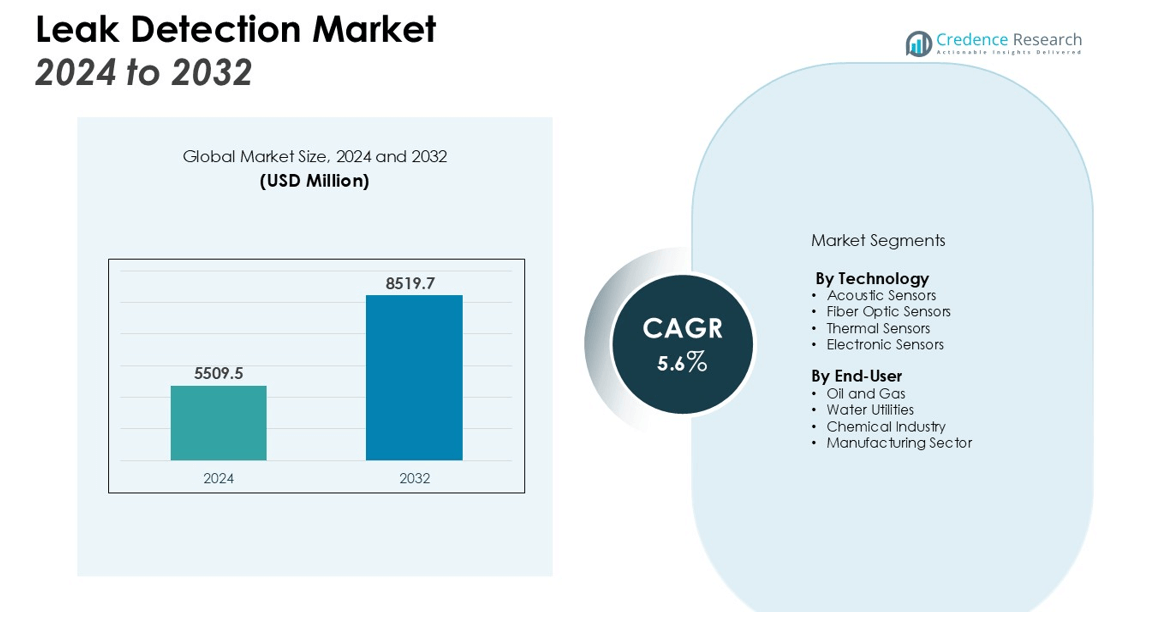
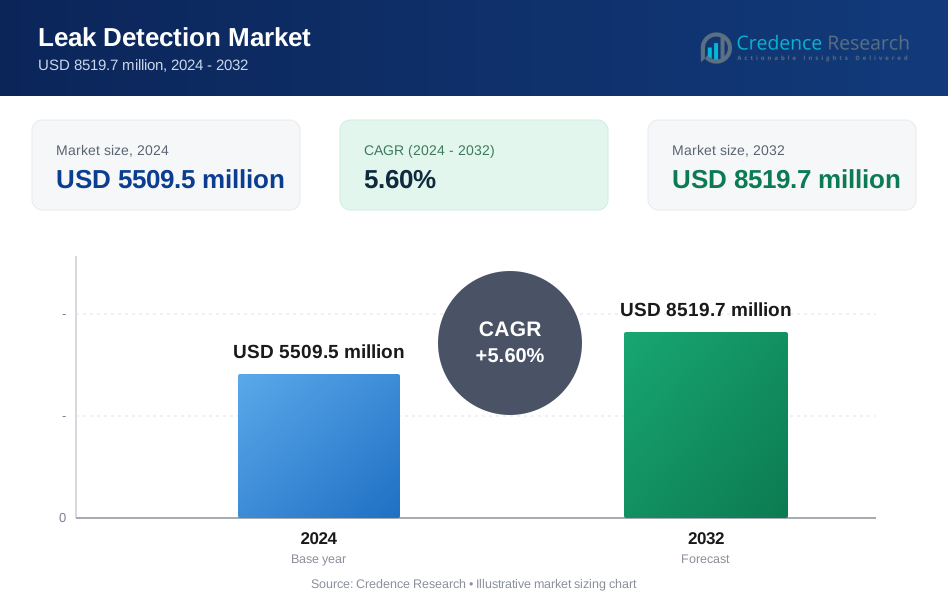
The Leak Detection Market size was valued at USD 5509.5 million in 2024 and is anticipated to reach USD 8519.7 million by 2032, at a CAGR of 5.6% during the forecast period (2024-2032).
| REPORT ATTRIBUTE | DETAILS |
|---|---|
| Historical Period | 2020-2023 |
| Base Year | 2024 |
| Forecast Period | 2025-2032 |
| Leak Detection Market Size 2024 | USD 5509.5 million |
| Leak Detection Market, CAGR | 5.6% |
| Leak Detection Market Size 2032 | USD 8519.7 million |
Key drivers of the leak detection market include the rising concerns about pipeline safety and environmental sustainability. The increasing adoption of Internet of Things (IoT)-enabled leak detection systems is enhancing real-time monitoring capabilities, while the integration of AI and machine learning for predictive maintenance is contributing to more efficient leak management. Additionally, stricter environmental regulations governing leakage control in industries like oil and gas are fueling the demand for advanced detection solutions. The growing focus on reducing operational costs and minimizing downtime also contributes significantly to the market's expansion.
Regionally, North America holds the largest market share, driven by robust oil and gas infrastructure and stringent safety regulations. Europe follows closely, with increasing emphasis on smart city projects and pipeline monitoring systems. The Asia-Pacific region is anticipated to witness the highest growth, driven by expanding industrial activities and the adoption of leak detection technologies in emerging economies like China and India. The rising need for modern infrastructure and increasing industrialization in these regions is expected to further drive demand.
Market Insights:
- The leak detection market was valued at USD 5509.5 million in 2024 and is expected to reach USD 8519.7 million by 2032, growing at a CAGR of 5.6%.
- Rising concerns over pipeline safety and environmental sustainability are driving the adoption of advanced leak detection systems to prevent accidents.
- The integration of IoT-enabled sensors and AI technologies is improving real-time monitoring and enabling predictive maintenance for faster leak detection.
- Stricter regulations in industries like oil and gas are increasing the demand for efficient leak detection solutions to ensure compliance.
- Rapid industrialization in emerging economies, particularly in Asia-Pacific, is driving the need for leak detection technologies to monitor expanding infrastructure.
- High initial investment and ongoing maintenance costs of advanced leak detection systems hinder widespread adoption, especially for smaller companies.
- North America holds the largest market share at 35%, followed by Europe at 30%, and Asia-Pacific at 25%, driven by industrial activities and technological adoption.
Market Drivers:
Rising Concerns over Pipeline Safety and Environmental Impact
The growing concerns about pipeline safety and environmental sustainability are key drivers of the leak detection market. With the increasing frequency of pipeline accidents and environmental disasters, industries are under pressure to enhance safety measures. The adoption of advanced leak detection systems ensures timely identification of leaks, preventing catastrophic damage and protecting the environment. It also helps in minimizing operational downtime, which is vital for industries that rely on pipelines for transportation, such as oil and gas.
- For instance, demonstrating its focus on enhancing pipeline safety, TC Energy has invested more than $50 million in research and development for new leak detection technologies. This investment is part of a collaborative effort to add additional layers of safety to its energy infrastructure.
Technological Advancements in Leak Detection Systems
The integration of advanced technologies such as Internet of Things (IoT) and AI-powered leak detection systems is driving the market's growth. IoT-enabled sensors provide real-time monitoring, enabling early leak detection and rapid response to potential threats. The use of AI and machine learning in these systems enhances their predictive capabilities, allowing for proactive maintenance and reducing the risk of failure. These innovations significantly improve the efficiency and accuracy of leak detection processes, making them essential for industries with critical infrastructure.
- For instance, Hifi Engineering's advanced fiber optic sensing technology highlights the successful application of new systems, the company's technology has been deployed across more than 3,000 kilometers of pipeline assets to monitor for leaks and integrity threats.
Stringent Regulatory Requirements and Environmental Standards
Increasingly stringent regulations regarding environmental standards and leak control are contributing to the demand for advanced leak detection systems. Governments worldwide have enacted policies that mandate the use of effective leak detection technologies in industries like oil and gas. Compliance with these regulations is not only crucial for minimizing environmental risks but also for avoiding hefty fines. The growing focus on carbon emissions reduction further reinforces the need for robust leak detection systems.
Expansion of Industrial Activities in Emerging Economies
The rapid industrialization in emerging economies, particularly in regions like Asia-Pacific, is fueling the growth of the leak detection market. Countries like China and India are witnessing a surge in industrial activities, which results in the increased need for monitoring and maintenance of pipelines. The adoption of leak detection technologies in these regions helps mitigate risks associated with new infrastructure and ensures the sustainability of industrial operations.
Market Trends:
Adoption of IoT-Enabled Leak Detection Systems in Various Industries
A significant trend in the leak detection market is the increasing adoption of IoT-enabled leak detection systems across industries such as oil and gas, chemicals, and water utilities. These systems provide real-time monitoring, allowing for immediate detection and response to potential leaks. IoT-based sensors and devices enable operators to collect continuous data, which can be analyzed to identify irregularities and predict failures before they occur. This shift towards real-time, remote monitoring improves operational efficiency and reduces downtime, making it an essential tool for industries where leakage can result in significant financial and environmental consequences. As IoT technology advances, it allows for greater integration with existing systems, providing a more holistic approach to leak detection and maintenance.
- For instance, Emerson's RuptureSentinel™ software provides near real-time detection for pipeline operators, enabling them to receive alerts of major events like a pipeline rupture within seconds instead of minutes or hours.
Growing Integration of Artificial Intelligence (AI) and Machine Learning (ML) for Predictive Maintenance
Another key trend in the leak detection market is the integration of artificial intelligence (AI) and machine learning (ML) for predictive maintenance. These technologies enhance the capabilities of leak detection systems by analyzing historical and real-time data to predict when and where leaks may occur. AI and ML algorithms enable systems to make more accurate forecasts, significantly reducing the risk of unexpected leaks and the need for manual inspections. The growing reliance on AI-driven analytics is transforming how industries approach leak detection, shifting from reactive to proactive maintenance strategies. This trend not only improves leak detection efficiency but also optimizes resource allocation and reduces operational costs in the long term.
- For instance, Electro Scan Inc.'s machine-intelligent inspection technology can detect pipe defects that contribute to leaks with a horizontal accuracy of within 1 cm, allowing for precise and efficient repairs.
Market Challenges Analysis:
High Initial Investment and Maintenance Costs
One of the key challenges in the leak detection market is the high initial investment and ongoing maintenance costs associated with advanced leak detection systems. Deploying IoT-based sensors, AI technologies, and other cutting-edge solutions requires substantial upfront capital, which may deter smaller companies or industries with limited budgets. Maintenance of these systems also involves recurring expenses for software updates, sensor calibration, and ensuring operational efficiency. This financial burden can hinder the widespread adoption of leak detection technologies, especially in industries that operate on tight margins or have limited resources.
Data Integration and System Compatibility Issues
Another challenge faced by the leak detection market is the integration of new technologies with existing infrastructure. Many companies operate on legacy systems that may not be fully compatible with modern leak detection solutions, leading to potential delays and additional costs during implementation. Furthermore, consolidating large volumes of data from various sensors and systems for analysis can become complex and time-consuming. The lack of standardization across different technologies and data platforms also adds to the challenge, requiring companies to invest in customized solutions or face inefficiencies in their leak detection processes.
Market Opportunities:
Expansion in Emerging Markets and Industrialization
The leak detection market presents significant opportunities in emerging markets, where rapid industrialization and infrastructure development are taking place. Countries in Asia-Pacific, the Middle East, and Africa are investing heavily in industries such as oil and gas, chemicals, and utilities. This growth increases the demand for effective leak detection solutions to ensure safety and minimize environmental risks. As industrial activities expand in these regions, the adoption of advanced leak detection technologies, such as IoT-based systems and AI-driven solutions, will become crucial. This presents a significant growth opportunity for companies offering leak detection products tailored to these markets' specific needs.
Advancements in AI and Machine Learning for Predictive Maintenance
There is a growing opportunity for the leak detection market to capitalize on the advancements in artificial intelligence (AI) and machine learning (ML) for predictive maintenance. These technologies provide a competitive advantage by enabling proactive leak detection and more accurate forecasting. The integration of AI and ML algorithms can help industries predict potential leak locations, reduce downtime, and optimize resource allocation. As industries continue to embrace digital transformation, the demand for AI-powered leak detection solutions will likely increase, creating a lucrative market opportunity for companies innovating in this space.
Market Segmentation Analysis:
By Technology
The Leak Detection Market is segmented by technology into acoustic, fiber optic, thermal, and electronic sensors. Acoustic leak detection systems dominate due to their ability to quickly identify leaks in pipelines and equipment by detecting sound vibrations. Fiber optic technology is gaining traction for its ability to cover large areas and detect leaks in real-time. Thermal leak detection, utilizing temperature differences, is employed primarily in water pipeline applications. Electronic sensors, including pressure and flow sensors, are integral for continuous monitoring and early leak detection. Each technology offers distinct advantages, with acoustic systems widely used in gas and liquid pipelines, while fiber optic solutions are ideal for remote and hazardous locations.
- For instance, Electro Scan Inc. has developed a machine-intelligent probe for water pipelines that is a significant advancement in the field. The company's technology can locate pipe leaks with an accuracy of 1 cm.
By End-User
The Leak Detection Market serves several end-users, including oil and gas, water utilities, chemical industries, and manufacturing sectors. The oil and gas industry holds the largest market share due to the high risks associated with pipeline leakage, requiring constant monitoring to prevent environmental damage. Water utilities also represent a significant market segment, driven by the need to reduce water wastage and maintain infrastructure. The chemical industry focuses on leak detection to ensure safety and compliance with stringent environmental regulations. The manufacturing sector is increasingly adopting leak detection solutions to safeguard production lines and improve operational efficiency. These end-user segments continue to expand with growing regulatory pressure and technological advancements.
- For instance, in the chemical industry, a technical operations manager reported that using Distran's ultrasonic camera reduced the time required to find hydrogen leaks to just 2–3 hours, a process that previously took up to five days to complete.
Segmentations:
By Technology
- Acoustic Sensors
- Fiber Optic Sensors
- Thermal Sensors
- Electronic Sensors
By End-User
- Oil and Gas
- Water Utilities
- Chemical Industry
- Manufacturing Sector
By Region
- North America
- U.S.
- Canada
- Mexico
- Europe
- Germany
- France
- U.K.
- Italy
- Spain
- Rest of Europe
- Asia Pacific
- China
- Japan
- India
- South Korea
- South-east Asia
- Rest of Asia Pacific
- Latin America
- Brazil
- Argentina
- Rest of Latin America
- Middle East & Africa
- GCC Countries
- South Africa
- Rest of the Middle East and Africa
Regional Analysis:
North America
North America holds the largest share of the leak detection market, accounting for 35% of the global market. The region's established oil and gas infrastructure, along with stringent environmental regulations, drives the demand for advanced leak detection systems. Strong regulatory frameworks, such as the Clean Water Act and Environmental Protection Agency (EPA) standards, push industries to adopt solutions that ensure compliance. The U.S. oil and gas sector plays a significant role in market growth, as companies work to meet safety standards and minimize environmental risks. Technological advancements and the widespread use of IoT-based systems further bolster the region’s market dominance.
Europe
Europe holds 30% of the leak detection market, driven by increasing investments in sustainable energy practices and advanced infrastructure. Countries like Germany and the UK are leading the way with smart city projects and pipeline monitoring systems that rely on sophisticated leak detection technologies. Regulatory pressures in Europe are heightened, focusing on industrial emissions and safety protocols. As environmental sustainability continues to be a priority for both governments and industries, the demand for effective leak detection systems in sectors such as oil, gas, and water utilities continues to rise.
Asia-Pacific
The Asia-Pacific region captures 25% of the global leak detection market, with rapid growth expected in the coming years. Countries like China, India, and Japan are seeing significant expansion in industrial activities, which drives the demand for leak detection solutions. Urbanization, combined with increased investments in infrastructure, energy, and manufacturing, is pushing the market for advanced leak detection technologies. The adoption of IoT and AI-driven solutions is becoming essential for ensuring the safety and efficiency of large-scale operations across industries in this rapidly developing region.
Key Player Analysis:
- Siemens AG
- Bridger Photonics, Inc.
- Sensit Technologies LLC
- Honeywell International Inc.
- Perma-Pipe International Holdings, Inc.
- Emerson Electric Co.
- Schneider Electric SE
- Pure Technologies Ltd.
- FLIR Systems Inc.
- Pentair PLC
Competitive Analysis:
The Leak Detection Market is highly competitive, with key players focusing on innovative technologies and strategic partnerships to enhance their market position. Leading companies in the market include Honeywell International Inc., Siemens AG, Emerson Electric Co., and Schneider Electric SE. These players invest heavily in R&D to develop advanced leak detection technologies such as acoustic, fiber optic, and thermal sensors. The market also sees increasing consolidation, as companies acquire smaller firms to expand their product offerings and geographical reach. Competitive dynamics are further influenced by stringent regulations, particularly in the oil and gas and water utilities sectors, which drive demand for more accurate and efficient detection systems. The presence of local players in emerging markets like Asia-Pacific adds another layer of competition, offering cost-effective solutions to attract price-sensitive customers. The Leak Detection Market continues to evolve, with companies striving to provide integrated, real-time monitoring solutions for a wide range of industries.
Recent Developments:
- In May 2025, Bridger Photonics, Inc. launched a drone-based version of its Gas Mapping LiDAR® (GML) technology to detect methane emissions in hard-to-reach areas like offshore platforms and liquified natural gas facilities.
- In April 2025, Perma-Pipe International Holdings, Inc. announced new project awards in the Americas and the MENA region valued at over $27 million for its anti-corrosion and insulation systems.
- In March 2025, Siemens AG, in collaboration with Accenture, established the Accenture Siemens Business Group to help clients innovate their manufacturing and engineering processes using industrial software and AI.
Market Concentration & Characteristics:
The Leak Detection Market is moderately concentrated, with a few dominant players controlling a significant share. Leading companies such as Honeywell International Inc., Siemens AG, and Emerson Electric Co. hold a strong market presence, driven by their extensive portfolios, technological expertise, and global reach. These companies offer a range of solutions, including advanced sensors and real-time monitoring systems, to meet the growing demand for leak detection across industries. The market features a mix of large multinational corporations and smaller, specialized firms that focus on niche applications and regional markets. While major players lead in terms of innovation and technological advancements, smaller firms focus on cost-effective solutions to cater to price-sensitive customers. Competitive dynamics are shaped by continuous innovation, regulatory pressures, and the need for customizable solutions tailored to specific industries. The market is expected to see further consolidation as companies expand their product offerings and geographic footprints.
Report Coverage:
The research report offers an in-depth analysis based on Technology, End-User and Region. It details leading market players, providing an overview of their business, product offerings, investments, revenue streams, and key applications. Additionally, the report includes insights into the competitive environment, SWOT analysis, current market trends, as well as the primary drivers and constraints. Furthermore, it discusses various factors that have driven market expansion in recent years. The report also explores market dynamics, regulatory scenarios, and technological advancements that are shaping the industry. It assesses the impact of external factors and global economic changes on market growth. Lastly, it provides strategic recommendations for new entrants and established companies to navigate the complexities of the market.
Future Outlook:
- The Leak Detection Market will experience robust growth, driven by increasing regulatory pressure across industries to minimize environmental impact.
- Rising adoption of IoT-enabled leak detection systems will enhance real-time monitoring and predictive maintenance capabilities.
- The oil and gas sector will continue to dominate demand, focusing on advanced technologies to prevent costly environmental damages and downtime.
- Water utilities will increasingly invest in leak detection technologies to address infrastructure aging and reduce water loss.
- The chemical industry will prioritize leak detection solutions to meet safety standards and minimize hazardous material exposure.
- Growth in emerging economies, particularly in Asia-Pacific, will drive demand as industrial activities expand and infrastructure needs grow.
- Technological advancements, including AI, machine learning, and automation, will play a significant role in improving the efficiency and accuracy of detection systems.
- Companies will focus on integrating leak detection systems with existing infrastructure to provide cost-effective and scalable solutions.
- The demand for fiber optic-based leak detection technologies will rise due to their ability to cover long distances and detect leaks in remote areas.
- Collaboration between major industry players and startups will fuel innovation and enhance product offerings, catering to diverse industrial needs.
Request a Free Sample
Fill in your details and we'll send you a free sample report.
- Sample data tables & charts
- Research methodology
Need a Custom Version of This Report?
Tailor the scope, geography, or segments to your exact requirements.
- Custom geography or segment scope
- Direct access to our analyst team
Frequently Asked Questions
What is the current market size for Leak Detection, and what is its projected size in 2032?
Which Leak Detection market segment held the largest share in 2024?
What are the primary factors fueling the growth of the Leak Detection market?
Which region commanded the largest share of the Leak Detection market in 2024?
Table of Content
Chapter 1. Report Introduction
- 1.1 Report Description & Purpose
- 1.1.1 Report Title & Market Definition
- 1.1.2 Unique Selling Propositions (USP) & Key Differentiators
- 1.1.3 Value Proposition for Stakeholders
- 1.2 Research Objectives
- 1.2.1 Market Sizing Objectives (Volume & Revenue)
- 1.2.2 Segmentation Objectives
- 1.2.3 Competitive Intelligence Objectives
- 1.2.4 Forecast & Scenario Objectives
- 1.3 Report Scope
- 1.3.1 Leak Detection Scope – Types & Subtypes Covered
- 1.3.2 Geographic Scope – Regions & Countries Covered
- 1.3.3 Historical Period, Base Year & Forecast Period (2024; forecast to 2032)
- 1.3.4 Inclusions & Exclusions
- 1.4 HS Code & Classification Framework
- 1.5 Currency, Units & Pricing Basis
- 1.6 Target Stakeholders
- 1.7 Limitations & Assumptions
Chapter 2. Executive Summary
- 2.1 Global Leak Detection Market Snapshot
- 2.1.1 Market Size – Historical (2024) & Forecast (2024-2032) (2024: USD 5509.5 million → 2032: USD 8519.7 million)
- 2.1.2 Volume & Revenue – Global Totals
- 2.1.3 Key Market Highlights – Top Five Facts
- 2.2 Leak Detection Market Segmentation Snapshot
- 2.2.1 Market Split by Region – 2024 vs. 2032
- 2.3 Competitive Snapshot
- 2.3.1 Top 10 Players by Revenue Share – 2024
- 2.3.2 Top 10 Players by Volume Share – 2024
- 2.3.3 Recent Strategic Developments (18-Month Summary)
- 2.4 Key Investment Highlights & Strategic Conclusions
Chapter 3. Leak Detection Market Dynamics & Industry Analysis
- 3.1 Market Overview & Context
- 3.1.1 Leak Detection Market Position in the Broader Automotive Value Chain
- 3.1.2 OEM vs. Replacement Market Dynamics
- 3.1.3 Market Maturity & Development Stage by Region
- 3.2 Leak Detection Market Drivers
- 3.3 Leak Detection Market Restraints & Challenges
- 3.4 Leak Detection Market Opportunities
- 3.5 Porter's Five Forces Analysis
- 3.5.1 Threat of New Entrants
- 3.5.2 Bargaining Power of Suppliers
- 3.5.3 Bargaining Power of Buyers
- 3.5.4 Threat of Substitutes
- 3.5.5 Competitive Rivalry – Intensity Assessment
- 3.6 Leak Detection Value Chain Analysis
- 3.6.1 Upstream – Raw Material/Input Suppliers
- 3.6.1.1 Raw Material/Input 1
- 3.6.1.2 Raw Material/Input 2
- 3.6.1.3 Raw Material/Input 3
- 3.6.2 Midstream – Production/Manufacturing/Service Delivery
- 3.6.2.1 Production/Process Overview
- 3.6.2.2 Key Facility Locations & Capacity by Manufacturer
- 3.6.3 Downstream – Distribution & End Consumer
- 3.6.3.1 Primary Channel – B2B/OEM
- 3.6.3.2 Secondary Channels – Dealer, Retail, Online, Direct
- 3.6.4 Value Chain Profitability Analysis
- 3.6.1 Upstream – Raw Material/Input Suppliers
- 3.7 PESTEL Analysis
- 3.7.1 Political Factors
- 3.7.2 Economic Factors
- 3.7.3 Social Factors
- 3.7.4 Technological Factors
- 3.7.5 Environmental Factors
- 3.7.6 Legal Factors
- 3.8 Leak Detection Supply Chain Analysis
- 3.8.1 Raw Material/Input Supply Risk Assessment
- 3.8.2 Manufacturing Concentration Risk (Geographic Exposure)
- 3.8.3 Trade Disruption Impact Analysis
- 3.9 Regulatory & Policy Landscape
Note: The regulatory and policy landscape section covers regulations based on their applicability to the market, Leak Detection category, geography, and scope of the study. Only regulatory frameworks with a material impact on operations, compliance, trade, sustainability, or market access are analyzed in detail.
Chapter 4. Key Investment Pockets & Opportunity Analysis
- 4.1 Leak Detection Market Attractiveness Analysis
- 4.1.1 By Region – Investment Attractiveness Matrix (Volume × CAGR)
- 4.2 Absolute Revenue Growth Opportunity
- 4.2.1 By Region – Absolute USD Growth Through 2032
- 4.3 Incremental Volume Opportunity
- 4.3.1 By Region – Incremental Volume Through 2032
- 4.3.2 Segment – Incremental Volume
- 4.4 Emerging Submarket Opportunity Deep Dive (Subject to Applicability)
- 4.5 Emerging Market Opportunity Scorecards
- 4.5.1 United States
- 4.5.2 Europe
- 4.5.3 Asia
- 4.5.4 Middle East & Africa
Note: Emerging Market Opportunity Scorecards will be included based on relevance and strategic importance. Regions listed are indicative and may vary depending on data availability and market dynamics.
Chapter 5. Leak Detection Import-Export Analysis & Trade Flows
- 5.1 Global Trade Overview
- 5.1.1 Global Export Value by Country (2024)
- 5.1.2 Global Export Volume by Country (2024)
- 5.1.3 Global Import Value by Country (2024)
- 5.1.4 Global Import Volume by Country (2024)
- 5.1.5 Net Trade Balance by Country (2024)
- 5.2 Export Analysis – Segment
- 5.2.1 Type 1 (HS Code)
- 5.2.2 Type 2 (HS Code)
- 5.2.3 Type 3 (HS Code)
- 5.2.4 Type 4 (HS Code)
- 5.2.5 Type 5 (HS Code)
- 5.3 Import Analysis – Segment
- 5.3.1 Type 1 (HS Code)
- 5.3.2 Type 2 (HS Code)
- 5.3.3 Type 3 (HS Code)
- 5.3.4 Type 4 (HS Code)
- 5.3.5 Type 5 (HS Code)
- 5.4 Average Unit Trade Prices
- 5.4.1 Average Export Price – Segment & Country
- 5.4.2 Average Import Price – Segment & Source Country
- 5.4.3 Price Trends (2024)
- 5.5 Key Trade Route Analysis
- 5.5.1 Trade Route 1
- 5.5.2 Trade Route 2
- 5.5.3 Trade Route 3
- 5.5.4 Trade Route 4
- 5.5.5 Trade Route 5
- 5.6 Trade Policy Impact Assessment
- 5.6.1 US Anti-Dumping & Section 301 Tariffs
- 5.6.2 EU Customs Union Impact
- 5.6.3 Major Free Trade Agreements
- 5.6.4 USMCA Rules of Origin
Note: Trade policy analysis will be included only where relevant to the Leak Detection market.
Chapter 6. Competitive Landscape & Company Benchmarking
- 6.1 Leak Detection Market Concentration & Structure
- 6.1.1 Herfindahl-Hirschman Index (HHI) – vs. 2024
- 6.1.2 Tier 1, Tier 2 & Tier 3 Market Structure
- 6.1.3 Global, Regional & Local Player Dynamics
- 6.2 Leak Detection Market Share Analysis – 2024
- 6.2.1 Global Revenue Share by Company
- 6.2.2 Global Volume Share by Company
- 6.2.3 Regional Revenue Share
- 6.2.4 Market Share Evolution ( vs. 2024)
- 6.2.5 OEM Segment Share by Company
- 6.2.6 Replacement Segment Share by Company
- 6.3 Production/Delivery Capacity & Facility Analysis
- 6.3.1 Global Installed Capacity
- 6.3.2 Capacity Utilization Rates
- 6.3.3 Production/Output Volume
- 6.3.4 Facility Locations & Capacity Map
- 6.3.5 Planned Capacity Additions
- 6.4 Leak Detection Competitive Benchmarking Matrix
- 6.4.1 Revenue, Volume, CAGR & Profitability Comparison
- 6.4.2 Channel Revenue Mix
- 6.4.3 Geographic Revenue Exposure
- 6.4.4 R&D Intensity
- 6.4.5 Sustainability Maturity
- 6.5 Strategic Developments in Leak Detection (Last 24 Months)
- 6.5.1 Mergers, Acquisitions & Divestments
- 6.5.2 New Leak Detection Launches
- 6.5.3 Facility Expansions
- 6.5.4 Strategic Alliances, Joint Ventures & Partnerships
- 6.5.5 Distribution Expansion & Market Entry
- 6.5.6 Sustainability & ESG Initiatives
- 6.6 Competitive Strategy Mapping
- 6.6.1 Leader, Challenger, Follower & Niche Classification
- 6.6.2 Pricing Strategy Comparison
- 6.6.3 Channel Strategy Matrix
Note: Strategic developments are included based on their materiality and the availability of reliable information.
Chapter 7. Global Leak Detection Market – By Distribution Channel
- 7.1 Segment Overview
- 7.1.1 Volume & Revenue Split by Channel (2024 & 2032)
- 7.1.2 Channel Mix Evolution (2024-2032)
Chapter 8. Regional Market Analysis – Global Overview
- 8.1 Global Regional Overview
- 8.1.1 Regional Volume Share
- 8.1.2 Regional Revenue Share
- 8.1.3 Regional Volume by Region
- 8.1.4 Regional Revenue by Region
- 8.1.5 Regional Forecast Through 2032
- 8.2 Cross-Regional Segment Analysis
- 8.2.1 By Distribution Channel
- 8.2.2 By Brand/Price Tier
Chapter 9. North America Leak Detection Market
- 9.1 United States
- 9.2 Canada
- 9.3 Mexico
Chapter 10. Europe Leak Detection Market
- 10.1 Germany
- 10.2 France
- 10.3 Italy
- 10.4 United Kingdom
- 10.5 Spain
- 10.6 Poland
- 10.7 Russia
- 10.8 Netherlands
- 10.9 Belgium
- 10.10 Sweden
- 10.11 Denmark
- 10.12 Norway
- 10.13 Rest of Europe
Chapter 11. Asia Pacific Leak Detection Market
- 11.1 China
- 11.2 India
- 11.3 Japan
- 11.4 South Korea
- 11.5 Thailand
- 11.6 Indonesia
- 11.7 Vietnam
- 11.8 Malaysia
- 11.9 Australia
- 11.10 Rest of Asia Pacific
Chapter 12. Latin America Leak Detection Market
- 12.1 Brazil
- 12.2 Argentina
- 12.3 Colombia
- 12.4 Chile
- 12.5 Rest of Latin America
Chapter 13. Middle East Leak Detection Market
- 13.1 Saudi Arabia
- 13.2 United Arab Emirates
- 13.3 Turkey
- 13.4 Israel
- 13.5 Iran
- 13.6 Rest of the Middle East
Chapter 14. Africa Leak Detection Market
- 14.1 South Africa
- 14.2 Egypt
- 14.3 Nigeria
- 14.4 Morocco
- 14.5 Rest of Africa
Chapter 15. Leak Detection Company Profiles
- 15.1 [Company 01]
- 15.1.1 Company Overview
- 15.1.2 Key Management Personnel
- 15.1.3 Products & Services Portfolio
- 15.1.4 Financial Performance
- 15.1.5 Key Market Focus & Geographic Presence
- 15.1.6 Recent Developments & Strategic Initiatives
Note: The company profile list is preliminary and may change based on research findings, market developments, data availability, and client requirements.
Chapter 16. Appendices
- Appendix A – List of Abbreviations & Acronyms
- Appendix B – Industry Classification Code Reference – Full Series
- Appendix C – Production & Capacity Data Tables
- Appendix D – End-Use & Demand Base Tables
- Appendix E – Consumption & Replacement Rate Assumptions
- Appendix F – ASP Reference Tables
- Appendix G – Manufacturing & Facility Database
- Appendix H – Import-Export Data Tables
- Appendix I – Regulatory Summary Tables
- Appendix J – Primary Research Participant List (Anonymized)
- Appendix K – Primary Research Questionnaire Framework
- Appendix L – Data Sources & Bibliography
- Appendix M – Market Size Divergence & Source Comparison
Chapter 17. Research Methodology
- 17.1 Research Framework & Philosophy
- 17.2 Secondary Research – Sources, Hierarchy & Data Extraction
- 17.3 Data Modeling – Bottom-Up & Top-Down Market Sizing
- 17.4 Primary Research – Stakeholder Framework, LOI & Sample Sizes
- 17.5 Forecast Methodology – Regression, Scenario & Sensitivity Analysis
- 17.6 Quality Control – Four-Layer Validation Framework
- 17.7 Limitations & Standard Assumptions
- 17.8 Disclaimer
