
| REPORT ATTRIBUTE | DETAILS |
|---|---|
| Historical Period | 2020-2023 |
| Base Year | 2024 |
| Forecast Period | 2025-2032 |
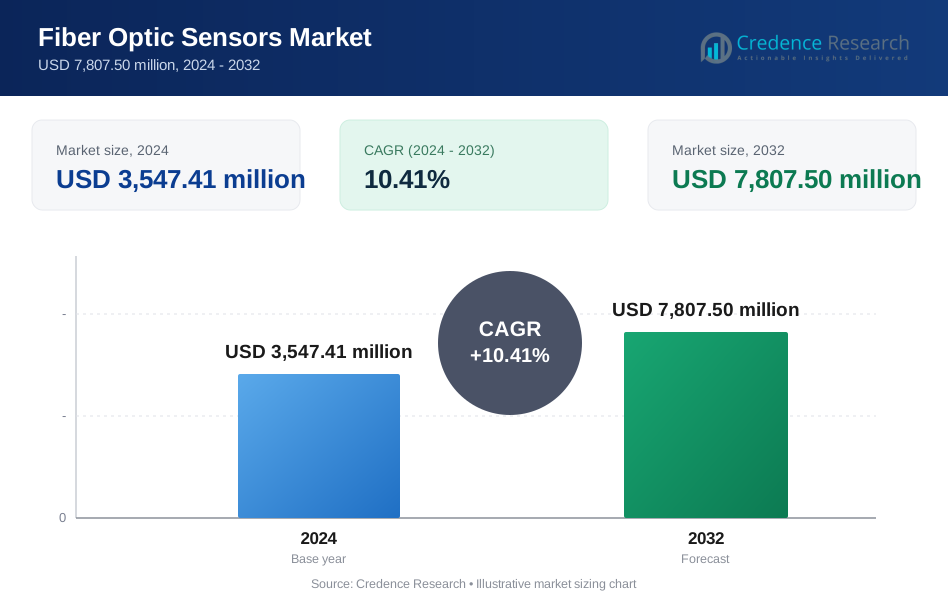
| Fiber Optic Sensors Market Size 2024 | USD 3,547.41 million |
| Fiber Optic Sensors Market, CAGR | 10.41% |
| Fiber Optic Sensors Market Size 2032 | USD 7,807.50 million |
Market Overview:
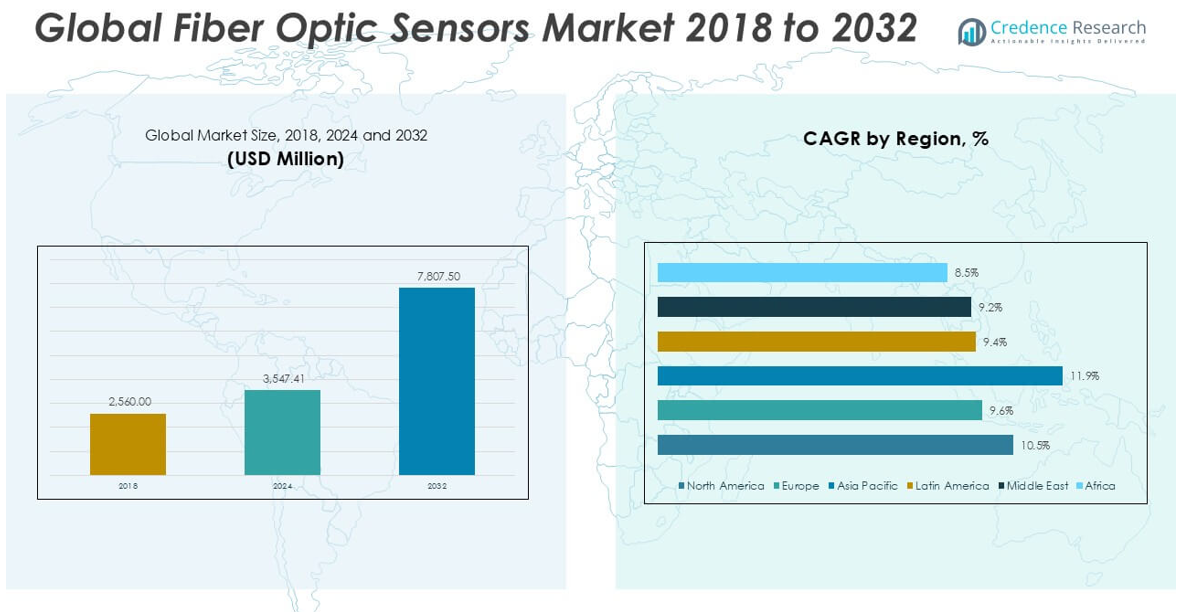
The Fiber Optic Sensors market size was valued at USD 2,560.00 million in 2018, reached USD 3,547.41 million in 2024, and is anticipated to reach USD 7,807.50 million by 2032, at a CAGR of 10.41% during the forecast period.
The Fiber Optic Sensors market is driven by prominent players such as Finisar Corporation, Yokogawa Electric Corporation, Deltex Medical Group PLC, Luna Innovations Incorporated, OmniSens S.A., Sumitomo Electric Industries Ltd., and ABB Ltd. These companies are actively focusing on product innovation, strategic collaborations, and global expansion to strengthen their market presence. North America leads the global market, holding a dominant share of 42.1% in 2024, supported by significant investments in smart infrastructure, defense, and advanced medical technologies. Europe follows with a substantial market share of 26.5%, driven by the growing adoption of fiber optic sensors in transportation, aerospace, and renewable energy sectors. Asia Pacific is emerging as the fastest-growing region, propelled by rapid industrialization and expanding smart city projects.
Market Insights
- The Fiber Optic Sensors market was valued at USD 2,560.00 million in 2018, reached USD 3,547.41 million in 2024, and is projected to reach USD 7,807.50 million by 2032, growing at a CAGR of 10.41%.
- Rising demand for structural health monitoring, smart transportation, and advanced medical applications is driving market growth, with intrinsic sensors holding a significant share due to their high sensitivity and reliability.
- Distributed fiber optic sensing and the integration of fiber optic sensors with Industrial IoT are key market trends offering real-time monitoring solutions, particularly in industrial, defense, and energy sectors.
- The market is moderately fragmented with key players like Finisar Corporation, ABB Ltd., and Yokogawa Electric Corporation focusing on innovations and strategic expansions, while high initial investment and technical complexities restrain wider adoption.
- North America leads with a 42.1% share, followed by Europe at 26.5% and Asia Pacific at 20.5%, with the transportation segment dominating end-user applications.
Market Segmentation Analysis:
By Type:
The Fiber Optic Sensors market is segmented into intrinsic and extrinsic types, with intrinsic sensors holding the dominant market share in 2024. Intrinsic sensors are widely adopted due to their high sensitivity, compact design, and superior ability to function in harsh environments without requiring additional protective layers. These sensors are particularly suited for applications requiring real-time monitoring, such as structural health and pipeline surveillance. Growing demand for precise sensing in industrial and defense sectors is further driving the adoption of intrinsic fiber optic sensors, contributing significantly to their leading market position.
- For instance, Luna Innovations provides the ODiSI system capable of high-definition distributed strain and temperature sensing with a spatial resolution as fine as 2.5 millimeters over sensing lengths up to 50 meters, enabling highly precise measurements in aerospace and automotive applications.
By Component
Among the components, fiber optic cables dominate the market, accounting for the largest share in 2024. The fiber optic cable segment benefits from its critical role in transmitting light signals with minimal loss, which is essential for sensor accuracy and long-distance monitoring. Increasing infrastructure development, coupled with the expansion of smart grids and data-driven systems, is propelling demand for reliable and efficient fiber optic cables. Additionally, their durability, high bandwidth, and immunity to electromagnetic interference make them the preferred choice across transportation, medical, and industrial applications.
- For instance, Sumitomo Electric Industries manufactures fiber optic cables with transmission loss as low as 0.14 dB/km at 1550 nm wavelength, which is one of the lowest in the industry, significantly enhancing the performance of long-distance monitoring systems.
By End-User
The transportation sector emerged as the leading end-user in the Fiber Optic Sensors market, securing the highest market share in 2024. Fiber optic sensors are extensively used in railways, bridges, and road monitoring systems to ensure safety, structural integrity, and efficient operation. The medical sector is rapidly expanding, driven by the increasing use of fiber optic sensors in minimally invasive surgeries, diagnostic imaging, and patient monitoring systems. The sensors’ biocompatibility, real-time sensing capabilities, and immunity to electromagnetic interference make them highly suitable for medical applications. As healthcare providers emphasize precision and safety, the medical segment is expected to continue growing at a notable pace during the forecast period.
Market Overview
Rising Demand for Structural Health Monitoring
The increasing need for real-time structural health monitoring across industries such as transportation, construction, and energy is a major driver for the fiber optic sensors market. These sensors offer precise, continuous monitoring of critical infrastructures like bridges, tunnels, pipelines, and power grids, enabling early detection of faults and reducing the risk of catastrophic failures. Governments and private organizations are heavily investing in smart infrastructure to improve safety and operational efficiency, significantly fueling the demand for fiber optic sensors globally.
- For instance, Omnisens deployed a distributed fiber optic sensing solution over 300 kilometers of pipeline in the Middle East, providing real-time strain and temperature monitoring with spatial resolution down to 1 meter, ensuring rapid leak and deformation detection.
Growing Adoption in Medical Applications
Fiber optic sensors are gaining traction in the medical sector due to their high sensitivity, compact size, and immunity to electromagnetic interference. They are increasingly used in minimally invasive surgeries, diagnostic equipment, and patient monitoring systems where precision and real-time data are crucial. The growing focus on advanced healthcare technologies, along with the rising demand for safer and more accurate diagnostic tools, is boosting the integration of fiber optic sensors in medical devices, thus driving substantial market growth.
- For instance, Deltex Medical Group’s oesophageal Doppler monitoring system utilizes fiber optic sensors to deliver real-time blood flow measurements with a response time under 10 seconds and a flow measurement accuracy within ±5%, allowing precise hemodynamic management during surgery.
Expanding Deployment in Defense and Aerospace
The defense and aerospace industries are significantly contributing to the growth of the fiber optic sensors market. These sensors are essential for applications requiring high reliability and real-time feedback in harsh environments, such as structural health monitoring of aircraft, missile guidance systems, and perimeter security. The ongoing advancements in military technology, increasing defense budgets, and the growing need for enhanced surveillance capabilities are collectively accelerating the adoption of fiber optic sensors in these critical sectors.
Key Trends and Opportunities
Integration with Industrial IoT (IIoT)
The integration of fiber optic sensors with Industrial Internet of Things (IIoT) platforms is emerging as a key trend in the market. Fiber optic sensors provide real-time, accurate data that can be seamlessly connected to smart monitoring systems, enabling predictive maintenance and process optimization. This trend presents significant growth opportunities, especially in manufacturing, oil & gas, and energy sectors, where operational efficiency and equipment longevity are critical.
- For instance, Yokogawa Electric Corporation’s DTSX1 distributed temperature sensor integrates with IIoT platforms and monitors temperature profiles over fiber optic cables up to 6,000 meters in length with a temperature accuracy of ±1°C and spatial resolution of 1 meter, supporting real-time thermal management in industrial processes.
Advancements in Distributed Fiber Optic Sensing
Distributed fiber optic sensing (DFOS) is gaining momentum as a valuable innovation in the market. This technology enables continuous, real-time sensing over long distances using a single fiber optic cable, making it ideal for perimeter security, pipeline monitoring, and structural assessment. The rising interest in DFOS offers new opportunities for market expansion, particularly in sectors focused on cost-effective, large-scale monitoring solutions with enhanced spatial resolution.
- For instance, Fotech Solutions’ Helios system enables distributed acoustic sensing (DAS) over a sensing range of up to 50 kilometers, with event detection capabilities featuring a spatial resolution of 10 meters and detection latency under 5 seconds, making it highly effective for perimeter security and pipeline integrity monitoring.
Key Challenges
High Initial Investment Costs
One of the primary challenges in the fiber optic sensors market is the high initial investment required for installation and system integration. The costs associated with specialized equipment, skilled labor, and advanced technology can limit adoption, particularly among small and medium-sized enterprises. Although fiber optic sensors offer long-term cost benefits, the substantial upfront expenses may deter potential users and slow market penetration.
Technical Complexities and Limited Expertise
The deployment and maintenance of fiber optic sensor systems require specialized technical knowledge and expertise. The complexity of sensor calibration, signal interpretation, and network integration can pose significant barriers, especially in regions with limited skilled workforce. These technical challenges may lead to operational delays, increased costs, and reduced adoption rates, hindering the overall growth of the market.
Competition from Alternative Sensing Technologies
The fiber optic sensors market faces competition from alternative sensing solutions such as wireless sensors and traditional electrical sensors, which often offer lower initial costs and simpler deployment. While fiber optic sensors provide superior performance in harsh environments, the cost-effectiveness and familiarity of competing technologies can restrict market expansion, particularly in price-sensitive industries and applications with less stringent sensing requirements.
Regional Analysis
North America
North America dominated the global fiber optic sensors market in 2024, holding the largest market share of approximately 42.1%. The market in this region grew from USD 1,088.00 million in 2018 to USD 1,494.26 million in 2024, and is projected to reach USD 3,303.00 million by 2032, expanding at a CAGR of 10.5%. This growth is driven by significant investments in smart infrastructure, defense modernization, and healthcare advancements. Strong presence of key market players and increasing adoption in structural health monitoring and transportation sectors further reinforce North America's market leadership.
Europe
Europe accounted for a substantial 26.5% market share in the fiber optic sensors market in 2024. The regional market increased from USD 704.00 million in 2018 to USD 939.26 million in 2024, with an expected value of USD 1,942.29 million by 2032, growing at a CAGR of 9.6%. Growth in this region is supported by the rapid expansion of smart transportation systems, renewable energy projects, and industrial automation. Rising adoption of fiber optic sensing technology in medical and aerospace applications further contributes to the steady demand across Europe.
Asia Pacific
The Asia Pacific region is emerging as the fastest-growing market, with a CAGR of 11.9% and a market share of approximately 20.5% in 2024. The market grew from USD 497.92 million in 2018 to USD 728.45 million in 2024, and is forecasted to reach USD 1,791.19 million by 2032. Rapid industrialization, expansion of smart city initiatives, and substantial investments in transportation infrastructure are key drivers of growth. Additionally, increasing demand for reliable sensing technologies across manufacturing and energy sectors is bolstering the adoption of fiber optic sensors in this region.
Latin America
Latin America captured around 5.2% market share in the global fiber optic sensors market in 2024. The market value rose from USD 135.17 million in 2018 to USD 185.14 million in 2024, and is anticipated to reach USD 376.09 million by 2032, growing at a CAGR of 9.4%. The region’s growth is driven by rising investments in telecommunications, infrastructure upgrades, and industrial applications. Emerging opportunities in oil & gas pipeline monitoring and increasing awareness of smart sensing technologies are contributing to steady market expansion in countries such as Brazil and Mexico.
Middle East
The Middle East fiber optic sensors market held about 3.4% market share in 2024, growing from USD 94.72 million in 2018 to USD 122.72 million in 2024, with projections to reach USD 246.67 million by 2032 at a CAGR of 9.2%. Growth in this region is supported by expanding investments in the energy sector, especially in oil & gas exploration and pipeline monitoring. Additionally, the growing focus on infrastructure security and smart city development in the Gulf countries is propelling the demand for advanced sensing technologies, further driving the market.
Africa
Africa accounted for approximately 2.2% market share in 2024, starting from USD 40.19 million in 2018 and reaching USD 77.59 million in 2024, with an anticipated value of USD 148.26 million by 2032 at a CAGR of 8.5%. The region’s growth is supported by the gradual expansion of telecommunications networks, infrastructure development, and adoption of smart technologies in urban planning. Although the market size is smaller compared to other regions, increasing government initiatives to modernize transportation and utility monitoring systems are creating new growth opportunities for fiber optic sensor deployment across the continent.
Market Segmentations:
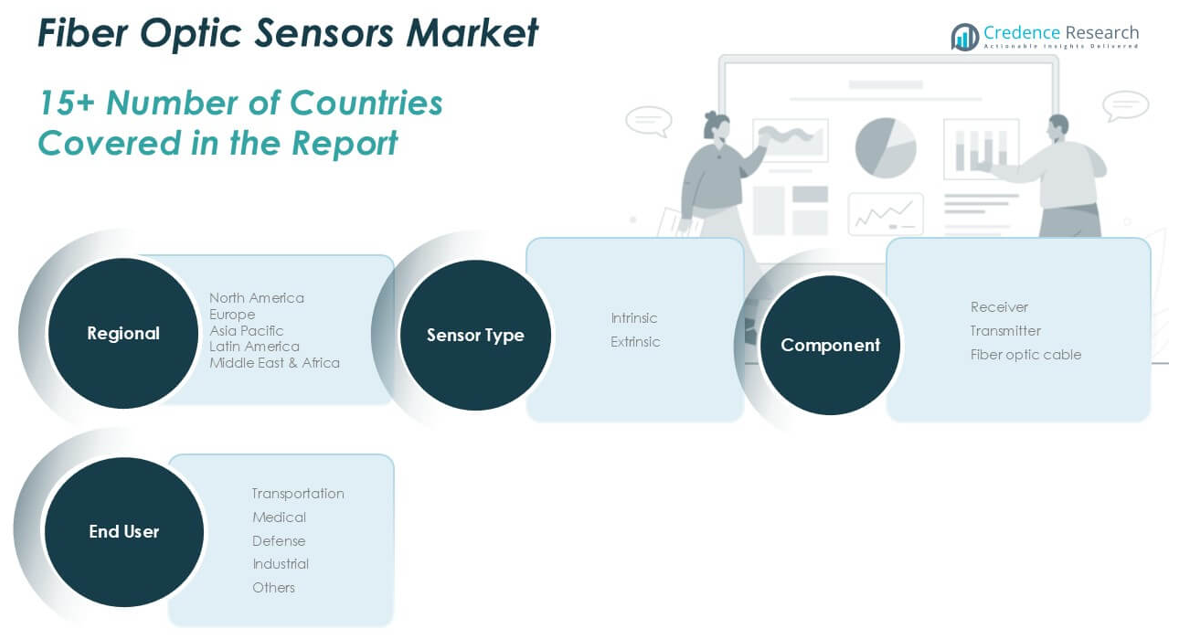
By Type
- Intrinsic
- Extrinsic
By Component
- Receiver
- Transmitter
- Fiber Optic Cable
By End-User
- Transportation
- Medical
- Defense
- Industrial
- Others
By Geography:
- North America
- U.S.
- Canada
- Mexico
- Europe
- Germany
- France
- U.K.
- Italy
- Spain
- Rest of Europe
- Asia Pacific
- China
- Japan
- India
- South Korea
- South-east Asia
- Rest of Asia Pacific
- Latin America
- Brazil
- Argentina
- Rest of Latin America
- Middle East & Africa
- GCC Countries
- South Africa
- Rest of the Middle East and Africa
Competitive Landscape
The fiber optic sensors market is moderately fragmented, with key players focusing on strategic partnerships, technological advancements, and geographic expansion to strengthen their market position. Companies such as Finisar Corporation, Yokogawa Electric Corporation, Deltex Medical Group PLC, Luna Innovations Incorporated, OmniSens S.A., Sumitomo Electric Industries Ltd., and ABB Ltd. are leading the competition through continuous innovation and product development. These players are actively investing in research to enhance sensor sensitivity, reliability, and cost-efficiency, catering to the growing demand across medical, industrial, defense, and transportation sectors. Additionally, market participants are pursuing mergers and acquisitions to expand their global reach and diversify their product portfolios. As the demand for real-time monitoring and smart sensing solutions increases, competitive pressure is driving companies to accelerate the introduction of advanced, application-specific fiber optic sensor technologies. The competitive landscape remains dynamic, with new entrants and regional players intensifying the race for market share.
Key Player Analysis
- Finisar Corporation
- Yokogawa Electric Corporation
- Deltex Medical Group PLC
- Luna Innovations Incorporated
- OmniSens S.A.
- Sumitomo Electric Industries Ltd.
- ABB Ltd.
Recent Developments
- In December 2023, Luna Innovations, a US company, acquired UK fiber optic sensor expert Silixa. Performance-related earn-outs worth up to USD 16.5 million are part of the USD 38 million deal. Silixa's acoustic, strain, and temperature sensing technologies complement Luna's, and the acquisition is estimated to generate USD 30 million in annual revenues. Luna's product offerings, serviceable addressable market, and scale, should improve after the acqsuisition.
- In April 2023, Researchers at the Missouri University of Science and Technology (Missouri S&T) secured over US$ 14 Mn in funding to develop fiber optic sensors for use in harsh and extreme conditions. This sensor might potentially detect the presence of nearby explosive materials as well.
- In March 2023, Yokogawa Electric and Otsuka Chemical joined forces to create Syncrest Inc. This partnership aims to revolutionize the middle-molecule pharmaceuticals field through comprehensive research, development, and production.
- In March 2023, Researchers at the National Energy Technology Laboratory (NETL) announced that they had been awarded a patent for a new fiber optic sensor that has been designed to detect H2 leaks at storage facilities, which can save time and money as compared to traditional methods.
Market Concentration & Characteristics
The Fiber Optic Sensors Market demonstrates moderate market concentration with a mix of global and regional players actively competing. It is characterized by steady technological advancements, strong demand across transportation, defense, industrial, and medical sectors, and increasing integration with smart infrastructure. The market favors companies capable of delivering high-performance, reliable, and cost-efficient sensing solutions. Large players focus on strategic partnerships, mergers, and product innovations to strengthen their positions. Regional players target niche applications and price-sensitive markets. High entry barriers, including substantial initial investments and technical expertise, limit the entry of new competitors. The market benefits from growing emphasis on safety, precision, and real-time monitoring across industries. It remains highly sensitive to advancements in distributed sensing and Industrial IoT connectivity, which drive product development. Companies that invest in research and deliver application-specific, durable, and scalable solutions continue to secure competitive advantages in the Fiber Optic Sensors Market.
Report Coverage
The research report offers an in-depth analysis based on Type, Component, End-User and Geography. It details leading market players, providing an overview of their business, product offerings, investments, revenue streams, and key applications. Additionally, the report includes insights into the competitive environment, SWOT analysis, current market trends, as well as the primary drivers and constraints. Furthermore, it discusses various factors that have driven market expansion in recent years. The report also explores market dynamics, regulatory scenarios, and technological advancements that are shaping the industry. It assesses the impact of external factors and global economic changes on market growth. Lastly, it provides strategic recommendations for new entrants and established companies to navigate the complexities of the market.
Future Outlook
- The fiber optic sensors market is expected to grow steadily driven by increasing demand for real-time structural health monitoring across industries.
- Advancements in distributed fiber optic sensing technology will create new opportunities for large-scale monitoring applications.
- The integration of fiber optic sensors with Industrial IoT platforms will become more widespread to enable predictive maintenance and process optimization.
- Growing adoption of fiber optic sensors in minimally invasive medical procedures and diagnostic systems will boost market growth.
- Defense and aerospace sectors will continue to invest in fiber optic sensing for enhanced security, surveillance, and system reliability.
- The transportation sector will remain a key application area with increasing use of fiber optic sensors in smart traffic and rail monitoring systems.
- Technological innovations will focus on improving sensor durability, miniaturization, and cost-efficiency for broader industrial adoption.
- Emerging economies in Asia Pacific, Latin America, and the Middle East will present significant growth potential due to infrastructure development.
- Competition from alternative low-cost sensing technologies will drive the need for continued product differentiation and performance enhancement.
- Strategic collaborations, mergers, and product portfolio expansions will shape the competitive landscape of the fiber optic sensors market.
Request a Free Sample
Fill in your details and we'll send you a free sample report.
- Sample data tables & charts
- Research methodology
Need a Custom Version of This Report?
Tailor the scope, geography, or segments to your exact requirements.
- Custom geography or segment scope
- Direct access to our analyst team
Frequently Asked Questions
What is the current size of the Fiber Optic Sensors Market?
What are the key segments within the Fiber Optic Sensors Market?
What are some challenges faced by the Fiber Optic Sensors Market?
Who are the major players in the Fiber Optic Sensors Market?
Table of Content
Chapter 1. Report Introduction
- 1.1 Report Description & Purpose
- 1.1.1 Report Title & Market Definition
- 1.1.2 Unique Selling Propositions (USP) & Key Differentiators
- 1.1.3 Value Proposition for Stakeholders
- 1.2 Research Objectives
- 1.2.1 Market Sizing Objectives (Volume & Revenue)
- 1.2.2 Segmentation Objectives
- 1.2.3 Competitive Intelligence Objectives
- 1.2.4 Forecast & Scenario Objectives
- 1.3 Report Scope
- 1.3.1 Fiber Optic Sensors Scope – Types & Subtypes Covered
- 1.3.2 Geographic Scope – Regions & Countries Covered
- 1.3.3 Historical Period, Base Year & Forecast Period (2024; forecast to 2032)
- 1.3.4 Inclusions & Exclusions
- 1.4 HS Code & Classification Framework
- 1.5 Currency, Units & Pricing Basis
- 1.6 Target Stakeholders
- 1.7 Limitations & Assumptions
Chapter 2. Executive Summary
- 2.1 Global Fiber Optic Sensors Market Snapshot
- 2.1.1 Market Size – Historical (2024) & Forecast (2024-2032) (2024: USD 3,547.41 million → 2032: USD 7,807.50 million)
- 2.1.2 Volume & Revenue – Global Totals
- 2.1.3 Key Market Highlights – Top Five Facts
- 2.2 Fiber Optic Sensors Market Segmentation Snapshot
- 2.2.1 Market Split by Region – 2024 vs. 2032
- 2.3 Competitive Snapshot
- 2.3.1 Top 10 Players by Revenue Share – 2024
- 2.3.2 Top 10 Players by Volume Share – 2024
- 2.3.3 Recent Strategic Developments (18-Month Summary)
- 2.4 Key Investment Highlights & Strategic Conclusions
Chapter 3. Fiber Optic Sensors Market Dynamics & Industry Analysis
- 3.1 Market Overview & Context
- 3.1.1 Fiber Optic Sensors Market Position in the Broader Automotive Value Chain
- 3.1.2 OEM vs. Replacement Market Dynamics
- 3.1.3 Market Maturity & Development Stage by Region
- 3.2 Fiber Optic Sensors Market Drivers
- 3.3 Fiber Optic Sensors Market Restraints & Challenges
- 3.4 Fiber Optic Sensors Market Opportunities
- 3.5 Porter's Five Forces Analysis
- 3.5.1 Threat of New Entrants
- 3.5.2 Bargaining Power of Suppliers
- 3.5.3 Bargaining Power of Buyers
- 3.5.4 Threat of Substitutes
- 3.5.5 Competitive Rivalry – Intensity Assessment
- 3.6 Fiber Optic Sensors Value Chain Analysis
- 3.6.1 Upstream – Raw Material/Input Suppliers
- 3.6.1.1 Raw Material/Input 1
- 3.6.1.2 Raw Material/Input 2
- 3.6.1.3 Raw Material/Input 3
- 3.6.2 Midstream – Production/Manufacturing/Service Delivery
- 3.6.2.1 Production/Process Overview
- 3.6.2.2 Key Facility Locations & Capacity by Manufacturer
- 3.6.3 Downstream – Distribution & End Consumer
- 3.6.3.1 Primary Channel – B2B/OEM
- 3.6.3.2 Secondary Channels – Dealer, Retail, Online, Direct
- 3.6.4 Value Chain Profitability Analysis
- 3.6.1 Upstream – Raw Material/Input Suppliers
- 3.7 PESTEL Analysis
- 3.7.1 Political Factors
- 3.7.2 Economic Factors
- 3.7.3 Social Factors
- 3.7.4 Technological Factors
- 3.7.5 Environmental Factors
- 3.7.6 Legal Factors
- 3.8 Fiber Optic Sensors Supply Chain Analysis
- 3.8.1 Raw Material/Input Supply Risk Assessment
- 3.8.2 Manufacturing Concentration Risk (Geographic Exposure)
- 3.8.3 Trade Disruption Impact Analysis
- 3.9 Regulatory & Policy Landscape
Note: The regulatory and policy landscape section covers regulations based on their applicability to the market, Fiber Optic Sensors category, geography, and scope of the study. Only regulatory frameworks with a material impact on operations, compliance, trade, sustainability, or market access are analyzed in detail.
Chapter 4. Key Investment Pockets & Opportunity Analysis
- 4.1 Fiber Optic Sensors Market Attractiveness Analysis
- 4.1.1 By Region – Investment Attractiveness Matrix (Volume × CAGR)
- 4.2 Absolute Revenue Growth Opportunity
- 4.2.1 By Region – Absolute USD Growth Through 2032
- 4.3 Incremental Volume Opportunity
- 4.3.1 By Region – Incremental Volume Through 2032
- 4.3.2 Segment – Incremental Volume
- 4.4 Emerging Submarket Opportunity Deep Dive (Subject to Applicability)
- 4.5 Emerging Market Opportunity Scorecards
- 4.5.1 United States
- 4.5.2 Europe
- 4.5.3 Asia
- 4.5.4 Middle East & Africa
Note: Emerging Market Opportunity Scorecards will be included based on relevance and strategic importance. Regions listed are indicative and may vary depending on data availability and market dynamics.
Chapter 5. Fiber Optic Sensors Import-Export Analysis & Trade Flows
- 5.1 Global Trade Overview
- 5.1.1 Global Export Value by Country (2024)
- 5.1.2 Global Export Volume by Country (2024)
- 5.1.3 Global Import Value by Country (2024)
- 5.1.4 Global Import Volume by Country (2024)
- 5.1.5 Net Trade Balance by Country (2024)
- 5.2 Export Analysis – Segment
- 5.2.1 Type 1 (HS Code)
- 5.2.2 Type 2 (HS Code)
- 5.2.3 Type 3 (HS Code)
- 5.2.4 Type 4 (HS Code)
- 5.2.5 Type 5 (HS Code)
- 5.3 Import Analysis – Segment
- 5.3.1 Type 1 (HS Code)
- 5.3.2 Type 2 (HS Code)
- 5.3.3 Type 3 (HS Code)
- 5.3.4 Type 4 (HS Code)
- 5.3.5 Type 5 (HS Code)
- 5.4 Average Unit Trade Prices
- 5.4.1 Average Export Price – Segment & Country
- 5.4.2 Average Import Price – Segment & Source Country
- 5.4.3 Price Trends (2024)
- 5.5 Key Trade Route Analysis
- 5.5.1 Trade Route 1
- 5.5.2 Trade Route 2
- 5.5.3 Trade Route 3
- 5.5.4 Trade Route 4
- 5.5.5 Trade Route 5
- 5.6 Trade Policy Impact Assessment
- 5.6.1 US Anti-Dumping & Section 301 Tariffs
- 5.6.2 EU Customs Union Impact
- 5.6.3 Major Free Trade Agreements
- 5.6.4 USMCA Rules of Origin
Note: Trade policy analysis will be included only where relevant to the Fiber Optic Sensors market.
Chapter 6. Competitive Landscape & Company Benchmarking
- 6.1 Fiber Optic Sensors Market Concentration & Structure
- 6.1.1 Herfindahl-Hirschman Index (HHI) – vs. 2024
- 6.1.2 Tier 1, Tier 2 & Tier 3 Market Structure
- 6.1.3 Global, Regional & Local Player Dynamics
- 6.2 Fiber Optic Sensors Market Share Analysis – 2024
- 6.2.1 Global Revenue Share by Company
- 6.2.2 Global Volume Share by Company
- 6.2.3 Regional Revenue Share
- 6.2.4 Market Share Evolution ( vs. 2024)
- 6.2.5 OEM Segment Share by Company
- 6.2.6 Replacement Segment Share by Company
- 6.3 Production/Delivery Capacity & Facility Analysis
- 6.3.1 Global Installed Capacity
- 6.3.2 Capacity Utilization Rates
- 6.3.3 Production/Output Volume
- 6.3.4 Facility Locations & Capacity Map
- 6.3.5 Planned Capacity Additions
- 6.4 Fiber Optic Sensors Competitive Benchmarking Matrix
- 6.4.1 Revenue, Volume, CAGR & Profitability Comparison
- 6.4.2 Channel Revenue Mix
- 6.4.3 Geographic Revenue Exposure
- 6.4.4 R&D Intensity
- 6.4.5 Sustainability Maturity
- 6.5 Strategic Developments in Fiber Optic Sensors (Last 24 Months)
- 6.5.1 Mergers, Acquisitions & Divestments
- 6.5.2 New Fiber Optic Sensors Launches
- 6.5.3 Facility Expansions
- 6.5.4 Strategic Alliances, Joint Ventures & Partnerships
- 6.5.5 Distribution Expansion & Market Entry
- 6.5.6 Sustainability & ESG Initiatives
- 6.6 Competitive Strategy Mapping
- 6.6.1 Leader, Challenger, Follower & Niche Classification
- 6.6.2 Pricing Strategy Comparison
- 6.6.3 Channel Strategy Matrix
Note: Strategic developments are included based on their materiality and the availability of reliable information.
Chapter 7. Global Fiber Optic Sensors Market – By Distribution Channel
- 7.1 Segment Overview
- 7.1.1 Volume & Revenue Split by Channel (2024 & 2032)
- 7.1.2 Channel Mix Evolution (2024-2032)
Chapter 8. Regional Market Analysis – Global Overview
- 8.1 Global Regional Overview
- 8.1.1 Regional Volume Share
- 8.1.2 Regional Revenue Share
- 8.1.3 Regional Volume by Region
- 8.1.4 Regional Revenue by Region
- 8.1.5 Regional Forecast Through 2032
- 8.2 Cross-Regional Segment Analysis
- 8.2.1 By Distribution Channel
- 8.2.2 By Brand/Price Tier
Chapter 9. North America Fiber Optic Sensors Market
- 9.1 United States
- 9.2 Canada
- 9.3 Mexico
Chapter 10. Europe Fiber Optic Sensors Market
- 10.1 Germany
- 10.2 France
- 10.3 Italy
- 10.4 United Kingdom
- 10.5 Spain
- 10.6 Poland
- 10.7 Russia
- 10.8 Netherlands
- 10.9 Belgium
- 10.10 Sweden
- 10.11 Denmark
- 10.12 Norway
- 10.13 Rest of Europe
Chapter 11. Asia Pacific Fiber Optic Sensors Market
- 11.1 China
- 11.2 India
- 11.3 Japan
- 11.4 South Korea
- 11.5 Thailand
- 11.6 Indonesia
- 11.7 Vietnam
- 11.8 Malaysia
- 11.9 Australia
- 11.10 Rest of Asia Pacific
Chapter 12. Latin America Fiber Optic Sensors Market
- 12.1 Brazil
- 12.2 Argentina
- 12.3 Colombia
- 12.4 Chile
- 12.5 Rest of Latin America
Chapter 13. Middle East Fiber Optic Sensors Market
- 13.1 Saudi Arabia
- 13.2 United Arab Emirates
- 13.3 Turkey
- 13.4 Israel
- 13.5 Iran
- 13.6 Rest of the Middle East
Chapter 14. Africa Fiber Optic Sensors Market
- 14.1 South Africa
- 14.2 Egypt
- 14.3 Nigeria
- 14.4 Morocco
- 14.5 Rest of Africa
Chapter 15. Fiber Optic Sensors Company Profiles
- 15.1 [Company 01]
- 15.1.1 Company Overview
- 15.1.2 Key Management Personnel
- 15.1.3 Products & Services Portfolio
- 15.1.4 Financial Performance
- 15.1.5 Key Market Focus & Geographic Presence
- 15.1.6 Recent Developments & Strategic Initiatives
Note: The company profile list is preliminary and may change based on research findings, market developments, data availability, and client requirements.
Chapter 16. Appendices
- Appendix A – List of Abbreviations & Acronyms
- Appendix B – Industry Classification Code Reference – Full Series
- Appendix C – Production & Capacity Data Tables
- Appendix D – End-Use & Demand Base Tables
- Appendix E – Consumption & Replacement Rate Assumptions
- Appendix F – ASP Reference Tables
- Appendix G – Manufacturing & Facility Database
- Appendix H – Import-Export Data Tables
- Appendix I – Regulatory Summary Tables
- Appendix J – Primary Research Participant List (Anonymized)
- Appendix K – Primary Research Questionnaire Framework
- Appendix L – Data Sources & Bibliography
- Appendix M – Market Size Divergence & Source Comparison
Chapter 17. Research Methodology
- 17.1 Research Framework & Philosophy
- 17.2 Secondary Research – Sources, Hierarchy & Data Extraction
- 17.3 Data Modeling – Bottom-Up & Top-Down Market Sizing
- 17.4 Primary Research – Stakeholder Framework, LOI & Sample Sizes
- 17.5 Forecast Methodology – Regression, Scenario & Sensitivity Analysis
- 17.6 Quality Control – Four-Layer Validation Framework
- 17.7 Limitations & Standard Assumptions
- 17.8 Disclaimer
