Leather Embossing Machine Market Overview:
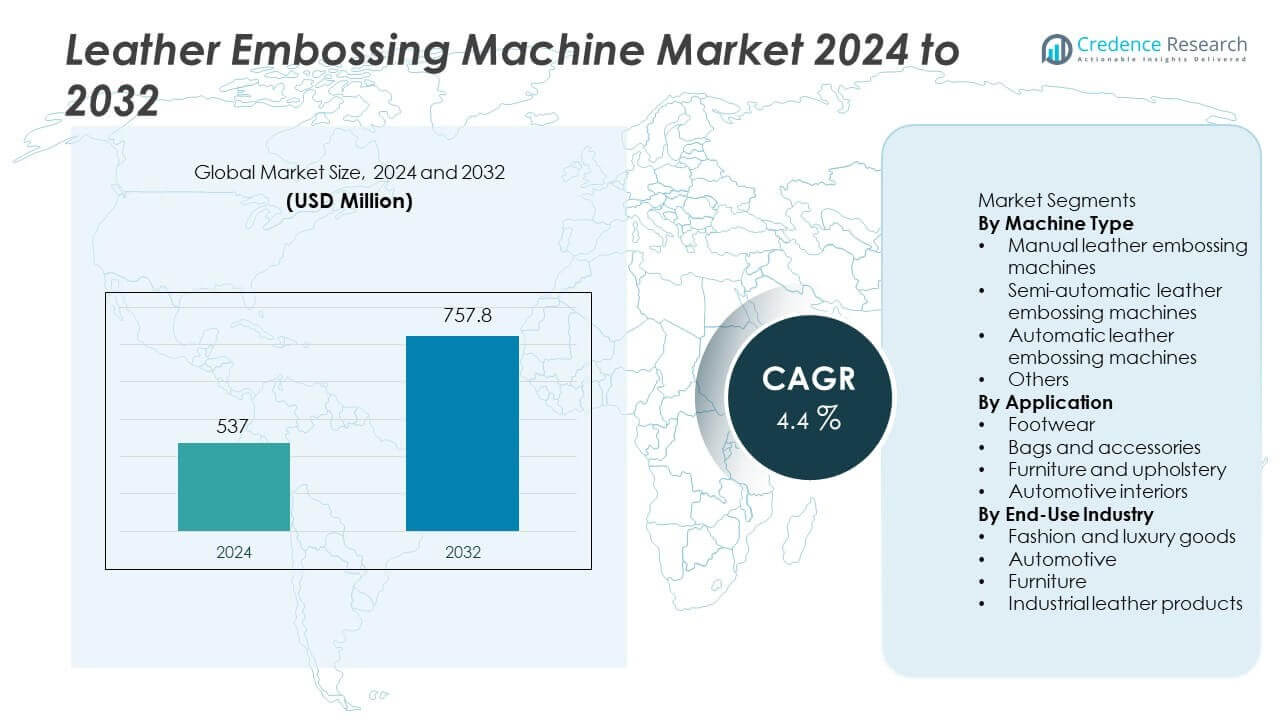
The leather embossing machine market was valued at USD 537 million in 2024 and is anticipated to reach USD 757.8 million by 2032, growing at a CAGR of 4.4% during the forecast period.
| REPORT ATTRIBUTE | DETAILS |
|---|---|
| Historical Period | 2020-2023 |
| Base Year | 2024 |
| Forecast Period | 2025-2032 |
| Leather Embossing Machine Market Size 2024 | USD 537 million |
| Leather Embossing Machine Market, CAGR | 4.4% |
| Leather Embossing Machine Market Size 2032 | USD 757.8 million |
Leather Embossing Machine Market Insights
- Growth is supported by rising demand for premium and customized leather goods, with automatic leather embossing machines leading the machine type segment at a share of 42.6% due to higher productivity and quality consistency.
- Market trends highlight increasing adoption of automated and digitally controlled machines, while footwear remains the largest application segment with a share of 36.8%, supported by high-volume production and frequent design changes.
- Competitive analysis indicates a fragmented market structure, where manufacturers compete on machine precision, customization capability, aftersales support, and cost efficiency to serve diverse leather processing needs.
- Regional analysis shows Asia Pacific leading with a market share of 36.9%, followed by Europe at 27.8% and North America at 24.6%, driven by strong footwear exports, luxury goods manufacturing, and growing automation adoption.
Leather Embossing Machine Market Segmentation Analysis:
By Machine Type
The machine type segment is led by automatic leather embossing machines, which hold a market share of 42.6%. Manufacturers prefer automatic systems due to high throughput, consistent embossing quality, and reduced labor dependency. These machines support complex patterns and precise depth control, which suits premium leather products. Semi-automatic leather embossing machines follow with a share of 31.4%, driven by flexible operation and lower investment costs. Manual machines account for 18.2%, mainly used by small workshops. Demand growth is driven by automation adoption, productivity improvement, and rising quality standards in leather processing.
- For instance, ATOM S.p.A. provides automated platen embossing presses designed with high-pressure capabilities and rapid cycle times to support high-volume manufacturing lines.
By Application
Footwear represents the dominant application segment with a market share of 36.8%. Leather embossing enhances aesthetic appeal and brand differentiation in shoes. High production volumes in footwear manufacturing support steady equipment demand. Bags and accessories hold a share of 28.9%, driven by fashion trends and premium product customization. Furniture and upholstery account for 21.7%, supported by decorative leather use in home and commercial interiors. Automotive interiors contribute 12.6%, led by luxury vehicle demand. Application growth depends on design innovation, durability needs, and consumer preference for textured leather finishes.
- For instance, Newlast Group integrates advanced computer-numerical control (CNC) machinery and digital design software to automate the production of shoe lasts, ensuring precision alignment with modern footwear manufacturing lines.
By End-Use Industry
Fashion and luxury goods lead the end-use industry segment with a market share of 39.4%. Luxury brands rely on embossing to create unique textures and logos. High-margin products justify investment in advanced machines. Automotive follows with a share of 26.1%, driven by premium interior customization. Furniture holds 22.3%, supported by demand for decorative leather surfaces. Industrial leather products account for 12.2%, focused on durability over design. End-use demand grows due to premiumization trends, customization needs, and rising consumption of finished leather goods.
Key Growth Drivers
Rising Demand for Premium and Customized Leather Products
Demand for premium leather goods continues to rise across fashion, footwear, and accessories. Brands use embossing to create distinctive textures and logos. Leather embossing machines support consistent and repeatable design execution. Growing consumer preference for customized products strengthens adoption. Luxury brands invest in advanced machines to protect brand identity. Small design variations help products stand out in competitive markets. Rising disposable income supports premium purchases. This driver remains strong due to ongoing premiumization trends in global leather goods consumption.
- For instance, Mosconi S.p.A. manufactures leather processing machines, such as shaving and splitting units, designed to maintain precise thickness consistency throughout high-volume production cycles.
Expansion of Footwear and Fashion Manufacturing
Footwear and fashion manufacturing growth directly supports embossing machine demand. Leather footwear uses embossed surfaces for visual appeal and grip. High-volume production requires reliable and efficient embossing equipment. Emerging economies expand footwear manufacturing capacity. Fashion cycles drive frequent design updates. Embossing machines enable fast pattern changes. Manufacturers focus on productivity and quality consistency. This driver benefits from stable export demand and expanding global fashion supply chains.
- For instance, Fortuna Spezialmaschinen GmbH designs embossing presses and high-performance machinery engineered for continuous industrial operation while maintaining consistent surface quality.
Increasing Adoption of Automation in Leather Processing
Leather processors adopt automation to improve efficiency and reduce labor costs. Automatic embossing machines deliver uniform quality at higher speeds. Automation reduces manual errors and material waste. Consistent output supports large-scale production needs. Rising labor costs encourage equipment upgrades. Integration with other processing systems improves workflow. Automation supports scalability for growing brands. This driver accelerates replacement demand for older manual machines.
Key Trends & Opportunities
Shift Toward Automatic and Digitally Controlled Machines
Manufacturers increasingly prefer automatic embossing machines with digital controls. Precise pressure and temperature settings improve design accuracy. Digital interfaces reduce setup time and training needs. Automated systems support complex and repeatable patterns. Small and mid-sized firms adopt entry-level automation. Equipment suppliers offer modular upgrades. This trend creates opportunities for advanced machine sales and retrofitting services. Demand grows for flexible and user-friendly solutions.
- For instance, SVIT Machinery s.r.o. manufactures digitally controlled leather embossing presses equipped with automated platen systems and programmable temperature controls to ensure consistent surface finishing.
Growth of Automotive Interior Customization
Automotive interiors increasingly use embossed leather for premium appeal. Luxury vehicles demand customized seat and trim designs. Leather embossing machines support consistent interior finishes. Automotive OEMs seek durable and aesthetic materials. Rising premium vehicle sales support this trend. Interior differentiation strengthens brand value. Suppliers gain opportunities in automotive-grade embossing solutions. This trend supports steady equipment demand from the automotive sector.
- For instance, Bergi S.p.A. manufactures embossing systems capable of processing leather panels up to 2,500 mm in length with uniform pressure distribution across the platen.
Key Challenges
High Initial Investment and Maintenance Costs
Advanced leather embossing machines require high upfront investment. Automatic systems increase capital expenditure. Small manufacturers face adoption barriers. Maintenance costs add to total ownership expenses. Spare parts availability affects downtime. Cost sensitivity limits upgrades in developing regions. Return on investment depends on production scale. This challenge slows adoption among small workshops and traditional producers.
Dependence on Leather Industry Cycles
Demand for embossing machines closely follows leather goods production cycles. Economic slowdowns reduce discretionary spending on leather products. Fashion demand volatility affects equipment orders. Seasonal production patterns impact machine utilization. Export dependency increases market uncertainty. Shifts toward synthetic alternatives pose risks. Manufacturers must manage demand fluctuations carefully. This challenge affects long-term capacity planning and sales stability.
Regional Analysis
North America
North America holds a market share of 24.6% in the leather embossing machine market. Demand is driven by premium footwear, accessories, and automotive interiors. The United States leads adoption due to strong luxury brand presence and advanced manufacturing practices. Manufacturers invest in automatic machines to improve consistency and reduce labor reliance. Automotive interior customization supports steady equipment demand. Furniture and upholstery applications add incremental growth. High quality standards encourage technology upgrades. Stable replacement demand supports market continuity. Focus on customization and small-batch production sustains regional growth.
Europe
Europe accounts for a market share of 27.8%, supported by strong fashion and luxury goods industries. Italy, France, and Germany drive demand through footwear, handbags, and designer leather products. European manufacturers emphasize precision embossing and design differentiation. Strict quality norms favor advanced and automated machines. Automotive interiors contribute through premium vehicle production. Furniture and upholstery add steady demand. Skilled craftsmanship combined with automation shapes adoption patterns. Export-oriented production supports equipment investment. Innovation in textures and finishes sustains regional leadership.
Asia Pacific
Asia Pacific leads the global market with a market share of 36.9%. China, India, Vietnam, and Indonesia dominate leather goods manufacturing. Large-scale footwear and accessory production drives high equipment demand. Cost-efficient labor initially favored manual machines, but automation adoption is rising. Export-driven manufacturing supports capacity expansion. Growing domestic consumption of branded leather products adds momentum. Automotive interior production increases embossing usage. Rapid industrialization supports upgrades to semi-automatic and automatic systems. Strong manufacturing scale ensures long-term regional dominance.
Rest of the World
The Rest of the World region holds a market share of 10.7%. Latin America shows demand from footwear and furniture manufacturing. Brazil and Mexico lead regional consumption. The Middle East supports niche demand for luxury leather goods. Africa shows early-stage adoption linked to leather processing development. Price sensitivity influences machine selection. Manual and semi-automatic systems remain common. Import dependence affects availability and costs. Gradual industrial modernization supports future growth. Market expansion depends on export demand and manufacturing investment.
Leather Embossing Machine Market Segmentations:
By Machine Type
- Manual leather embossing machines
- Semi-automatic leather embossing machines
- Automatic leather embossing machines
- Others
By Application
- Footwear
- Bags and accessories
- Furniture and upholstery
- Automotive interiors
By End-Use Industry
- Fashion and luxury goods
- Automotive
- Furniture
- Industrial leather products
By Geography
- North America
- Europe
- Asia Pacific
- Latin America
- Middle East
- Africa
Competitive Landscape
Competitive landscape analysis highlights ATOM S.p.A., Mosconi S.p.A., C.R. Clarke & Co., Newlast Group, Fortuna Spezialmaschinen GmbH, Bergi S.p.A., Svit S.r.l., Camoga S.r.l., Shoe Systems Plus, and Ultrasuede Machinery as the core participants in the leather embossing machine market. These companies compete through machine precision, durability, and customization capability. Strong focus remains on automatic and semi-automatic systems to meet rising production efficiency needs. European players benefit from close ties with luxury and footwear brands. Technology upgrades target improved pressure control and pattern accuracy. Manufacturers expand aftersales service and training support to strengthen customer retention. Mid-sized firms compete on cost efficiency and niche applications. Overall competition remains moderately fragmented, driven by craftsmanship expertise, automation adoption, and long-term relationships with leather goods manufacturers.
Key Player Analysis
- ATOM S.p.A.
- Mosconi S.p.A.
- R. Clarke & Co.
- Newlast Group
- Shoe Systems Plus
- Fortuna Spezialmaschinen GmbH
- Bergi S.p.A.
- Svit S.r.l.
- Camoga S.r.l.
- Ultrasuede Machinery
Recent Developments
- In September 2025, ATOM S.p.A. showcased its next-generation AI-driven automatic nesting software at the Simac Tanning Tech exhibition.
- In September 2025, Fortuna Spezialmaschinen GmbH exhibited at Simac Tanning Tech, where it showcased its latest innovations in splitting and skiving technology.
- In September 2024, Newlast Group provided updates following a significant factory visit and through an educational production series.
Report Coverage
The research report offers an in-depth analysis based on Machine Type, Application, End-Use Industry and Geography. It details leading market players, providing an overview of their business, product offerings, investments, revenue streams, and key applications. Additionally, the report includes insights into the competitive environment, SWOT analysis, current market trends, as well as the primary drivers and constraints. Furthermore, it discusses various factors that have driven market expansion in recent years. The report also explores market dynamics, regulatory scenarios, and technological advancements that are shaping the industry. It assesses the impact of external factors and global economic changes on market growth. Lastly, it provides strategic recommendations for new entrants and established companies to navigate the complexities of the market.
Future Outlook
- Demand will grow with rising consumption of premium and customized leather products.
- Automation adoption will increase to improve productivity and quality consistency.
- Footwear manufacturing will remain a key demand driver for embossing machines.
- Fashion and luxury brands will invest in advanced embossing technologies.
- Automotive interior customization will support steady equipment demand.
- Digital control features will gain importance for design accuracy and repeatability.
- Asia Pacific will continue to lead due to large-scale leather goods production.
- Small manufacturers will gradually shift from manual to semi-automatic systems.
- Equipment suppliers will focus on aftersales service and training support.
- Innovation in design flexibility will intensify competition among market players.

Request a Free Sample
Fill in your details and we'll send you a free sample report.
- Sample data tables & charts
- Research methodology
Need a Custom Version of This Report?
Tailor the scope, geography, or segments to your exact requirements.
- Custom geography or segment scope
- Direct access to our analyst team
Frequently Asked Questions
What is the current market size for Leather Embossing Machine market, and what is its projected size in 2032?
At what Compound Annual Growth Rate is the Leather Embossing Machine market projected to grow between 2024 and 2032?
Which Leather Embossing Machine market segment held the largest share in 2024?
What are the primary factors fueling the growth of the Leather Embossing Machine market?
Who are the leading companies in the Leather Embossing Machine market?
Which region commanded the largest share of the Leather Embossing Machine market in 2024?
Table of Content
Chapter 1 Market Segmentation
- 1.1 Segmentation Framework
- 1.1.1 Product and Service Classification
- 1.1.2 Application and End-Use Classification
- 1.1.3 Technology and Solution Classification
- 1.1.4 Customer and Distribution Channel Classification
- 1.1.5 Geographic Segmentation
- 1.1.6 Market Segment Definitions and Boundaries
Chapter 2 Introduction
- 2.1 Report Objectives and Scope
- 2.2 Product Definition and Industry Terminology
- 2.3 Market Inclusions and Exclusions
- 2.4 Research Process
- 2.4.1 Primary Research and Expert Interviews
- 2.4.2 Secondary Research and Source Review
- 2.4.3 Top-Down and Bottom-Up Estimation
- 2.4.4 Data Triangulation and Verification
- 2.5 Market Size Measurement Basis
- 2.5.1 2024: USD 537 million → 2032: USD 757.8 million
- 2.6 Historical and Forecast Reference Periods
- 2.6.1 Base Year: 2024
- 2.6.2 Forecast Period: 2024-2032
- 2.7 Research Assumptions and Limitations
Chapter 3 Executive Summary
- 3.1 Market Snapshot and Key Findings
- 3.2 Base-Year Market Size, 2024
- 3.3 Forecast Market Size, 2032
- 3.4 Revenue and Volume Growth Outlook
- 3.5 Key Demand and Supply Indicators
- 3.6 Leading Market Segments
- 3.7 Fastest-Growing Market Opportunities
- 3.8 Regional Performance Highlights
- 3.9 Technology and Industry Transformation
- 3.10 Competitive Landscape Summary
- 3.11 Analyst View and Strategic Implications
Chapter 4 Global Leather Embossing Machine Market Trends and Developments
- 4.1 Historical Industry Development
- 4.2 Recent Market Trends and Developments
- 4.3 Demand and Customer Behavior Trends
- 4.4 Technology and Product Innovation
- 4.5 Artificial Intelligence, Automation and Digitalization
- 4.6 Local Manufacturing and Supply Chain Realignment
- 4.7 Industry Partnerships, Mergers and Acquisitions
- 4.8 Sustainability and Circular Economy Developments
- 4.9 Government and Private Sector Investment Trends
- 4.10 Emerging Business Models and Commercialization
- 4.11 Industry Developments and Announcements
Chapter 5 Global Leather Embossing Machine Market Production, Supply and Demand Analysis
- 5.1 Demand Trend and Consumption Analysis
- 5.2 Demand Forecast, 2024-2032
- 5.3 Production and Output Trend
- 5.4 Production and Output Forecast, 2024-2032
- 5.5 Installed Capacity and Capacity Utilization
- 5.6 Company-Wise Production Plants and Statistics
- 5.6.1 Installed Production Capacity
- 5.6.2 Actual Production
- 5.6.3 Planned Capacity and Expansion Targets
- 5.7 Supply Chain Structure and Procurement Trends
- 5.8 Supply-Demand Gap and Bottlenecks
- 5.9 Import Dependence and Sourcing Structure
- 5.10 Contract Manufacturing and Outsourcing
- 5.11 Regional Supply and Demand Concentration
Chapter 6 Global Leather Embossing Machine Market Pricing Analysis
- 6.1 Pricing Structure and Measurement
- 6.2 Historical Pricing Trends
- 6.3 Pricing Outlook, 2024-2032
- 6.4 Average Selling Price and Unit Economics
- 6.5 Pricing by Product and Market Segment
- 6.6 Geographic Pricing Differences
- 6.7 Key Input, Energy, Labor and Logistics Costs
- 6.8 Contract Pricing and Purchasing Models
- 6.9 Pricing Sensitivity and Competitive Positioning
- 6.10 Price, Margin and Profitability Implications
Chapter 7 Global Leather Embossing Machine Market Dynamics
- 7.1 Market Growth Drivers
- 7.1.1 Demand-Side Drivers
- 7.1.2 Technology and Innovation Drivers
- 7.1.3 Infrastructure and Investment Drivers
- 7.1.4 Regulatory and Policy Drivers
- 7.2 Market Restraints
- 7.2.1 Cost and Affordability Constraints
- 7.2.2 Technology and Adoption Barriers
- 7.2.3 Supply Chain and Operational Constraints
- 7.3 Market Challenges
- 7.3.1 Competitive Pressure and Margin Erosion
- 7.3.2 Skills, Infrastructure and Implementation Gaps
- 7.4 Emerging Market Opportunities
- 7.5 Market Dynamics Impact and Time-Horizon Assessment
Chapter 8 Global Leather Embossing Machine Value Chain Analysis
- 8.1 Industry Value Chain Overview
- 8.2 Upstream Suppliers and Critical Inputs
- 8.3 Technology and Component Providers
- 8.4 Manufacturing or Service Delivery
- 8.5 Distribution, Channel Partners and Integrators
- 8.6 Downstream Applications and End Users
- 8.7 Value Addition and Profit Pools
- 8.8 Vertical Integration and Outsourcing
- 8.9 Supplier Concentration and Risk
- 8.10 Supply Chain Localization and Resilience
Chapter 9 Global Leather Embossing Machine Market Regulations and Policies
- 9.1 Relevant Laws, Standards and Compliance Frameworks
- 9.2 Product, Service, Safety and Quality Requirements
- 9.3 Government Policies, Incentives and Subsidies
- 9.4 Imports, Exports and Trade Barriers
- 9.5 Public Procurement and Local Content Requirements
- 9.6 Environmental and Sustainability Compliance
- 9.7 Upcoming Policy Changes and Market Implications
Chapter 10 Global Leather Embossing Machine Market Hotspots and Opportunities
- 10.1 Market Opportunity Mapping and Growth Hotspots
- 10.2 High-Growth Applications and Customer Groups
- 10.3 Underserved Markets and White-Space Opportunities
- 10.4 Emerging Technology and Product Opportunities
- 10.5 New Capacity and Investment Hotspots
- 10.6 Market Entry and Expansion Opportunities
- 10.7 Distribution and Partnership Opportunities
- 10.8 Near-Term and Long-Term Commercial Potential
- 10.9 Opportunity Attractiveness and Execution Risks
Chapter 11 Global Leather Embossing Machine Market Outlook, 2024-2032
- 11.1 Market Size and Analysis
- 11.1.1 Revenue (Market Measurement: 2024: USD 537 million → 2032: USD 757.8 million)
- 11.1.2 Market Volume and Quantity Sold
- 11.1.3 Historical Market Size
- 11.1.4 Base-Year Market Size, 2024
- 11.2 Market Forecast, 2024-2032
- 11.2.1 Revenue Forecast to 2032
- 11.2.2 Volume Forecast to 2032
- 11.2.3 CAGR and Year-on-Year Growth
- 11.2.4 Incremental Revenue Opportunity
- 11.3 Forecast Assumptions and Scenario Analysis
- 11.3.1 Base-Case Forecast
- 11.3.2 Optimistic and Conservative Scenarios
- 11.3.3 Technology, Pricing and Policy Sensitivities
- 11.4 Market Attractiveness and Growth Outlook
Chapter 12 Global Leather Embossing Machine Market Segmentation and Outlook
- 12.1 Segmentation Summary and Market Shares, 2024
- 12.2 Largest and Fastest-Growing Segments
- 12.3 Segment Growth Comparison
- 12.4 Segment Attractiveness and Priority Matrix
Chapter 13 Global Leather Embossing Machine Geographic Market Outlook, 2024-2032
- 13.1 Regional Market Size and Share, 2024
- 13.2 Regional Market Forecast, 2024-2032
- 13.3 Regional Pricing, Production and Demand Differences
- 13.4 North America
- 13.4.1 United States
- 13.4.2 Canada
- 13.4.3 Mexico
- 13.5 Europe
- 13.5.1 Germany
- 13.5.2 France
- 13.5.3 Italy
- 13.5.4 United Kingdom
- 13.5.5 Spain
- 13.5.6 Poland
- 13.5.7 Russia
- 13.5.8 Netherlands
- 13.5.9 Belgium
- 13.5.10 Sweden
- 13.5.11 Denmark
- 13.5.12 Norway
- 13.5.13 Rest of Europe
- 13.6 Asia Pacific
- 13.6.1 China
- 13.6.2 India
- 13.6.3 Japan
- 13.6.4 South Korea
- 13.6.5 Thailand
- 13.6.6 Indonesia
- 13.6.7 Vietnam
- 13.6.8 Malaysia
- 13.6.9 Australia
- 13.6.10 Rest of Asia Pacific
- 13.7 Latin America
- 13.7.1 Brazil
- 13.7.2 Argentina
- 13.7.3 Colombia
- 13.7.4 Chile
- 13.7.5 Rest of Latin America
- 13.8 Middle East
- 13.8.1 Saudi Arabia
- 13.8.2 United Arab Emirates
- 13.8.3 Turkey
- 13.8.4 Israel
- 13.8.5 Iran
- 13.8.6 Rest of the Middle East
- 13.9 Africa
- 13.9.1 South Africa
- 13.9.2 Egypt
- 13.9.3 Nigeria
- 13.9.4 Morocco
- 13.9.5 Rest of Africa
- 13.10 Regional Investment, Policy and Supply Chain Differences
- 13.11 Regional Competitive Landscape
- 13.12 Geographic Growth Hotspots
Chapter 14 Global Leather Embossing Machine Technology, Innovation and Sustainability Outlook
- 14.1 Technology Landscape and Maturity
- 14.2 Product, Process and Service Innovation
- 14.3 AI, Automation and Digital Tools in the Industry
- 14.4 Technology Adoption and Performance Benchmarking
- 14.5 Innovation Pipeline and R&D Investment
- 14.6 Patent and Intellectual Property Trends
- 14.7 Energy Efficiency and Resource Management
- 14.8 Sustainability, Recycling and Circularity
- 14.9 Technology Roadmap, 2024-2032
- 14.10 Risks of Obsolescence and Technology Substitution
Chapter 15 Global Leather Embossing Machine Market Key Strategic Imperatives
- 15.1 Growth and Market Entry Priorities
- 15.2 High-Return Products and Segments
- 15.3 Pricing, Profitability and Cost Optimization
- 15.4 Technology Investment and Product Differentiation
- 15.5 Supply Chain Localization and Resilience
- 15.6 Distribution and Customer Acquisition
- 15.7 Partnership, Acquisition and Capacity Strategy
- 15.8 Regional Expansion Priorities
- 15.9 Short-, Medium- and Long-Term Actions
Chapter 16 Competition Outlook
- 16.1 Industry Competition Characteristics
- 16.2 Market Structure and Concentration
- 16.3 Market Share and Competitive Positioning, 2024
- 16.4 Company-Wise Revenue and Product Benchmarking
- 16.5 Production and Service Capacity Benchmarking
- 16.6 Technology, Pricing and Differentiation
- 16.7 Regional Footprint and Distribution Strength
- 16.8 Mergers, Acquisitions and Strategic Alliances
- 16.9 New Entrants and Competitive Threats
- 16.10 Porter's Five Forces and Industry Attractiveness
- 16.11 Competitive Outlook, 2024-2032
Chapter 17 Company Profiles
- 17.1 Company Coverage and Selection Criteria
- 17.2 Leading Market Participants – Standard Profile Structure
- 17.2.1 Business Description
- 17.2.2 Company Ownership and Geographic Presence
- 17.2.3 Product and Service Portfolio
- 17.2.4 Manufacturing and Operating Footprint
- 17.2.5 Production Capacity and Expansion Plans
- 17.2.6 Financial Performance and Investment
- 17.2.7 Market Share and Competitive Position
- 17.2.8 Technology and Innovation Capabilities
- 17.2.9 Strategic Alliances or Partnerships
- 17.2.10 Recent Developments
- 17.2.11 Growth Strategy and Outlook
- 17.3 Other Relevant Market Participants
Note: Every listed company is profiled on the structure shown under the first company. The company list is preliminary and may change based on research findings, market developments, data availability and client requirements.
Chapter 18 Disclaimer
- 18.1 Research and Forecast Disclaimer
- 18.2 Data Source and Estimation Limitations
Note: The depth of individual sections depends on data availability for this market. Volume, capacity, trade and other unit-based metrics are included where applicable.