
| REPORT ATTRIBUTE | DETAILS |
|---|---|
| Historical Period | 2019-2022 |
| Base Year | 2023 |
| Forecast Period | 2024-2032 |
| Living Room Furniture Market Size 2023 | USD 226512.2 Million |
| Living Room Furniture Market, CAGR | 6.20% |
| Living Room Furniture Market Size 2032 | USD 389235.3 Million |
Market Insights
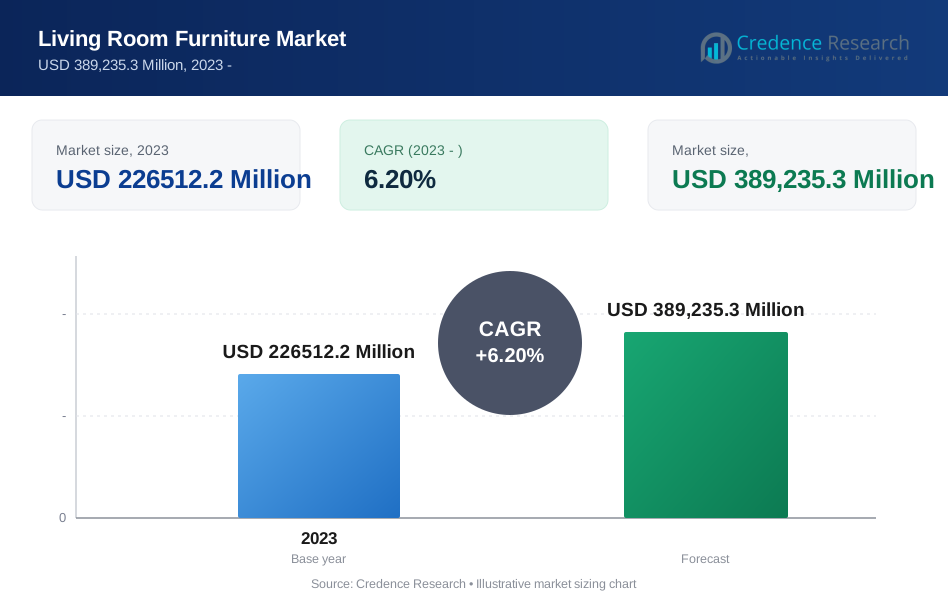
- The Living Room Furniture Market reached a valuation of USD 226512.2 Million in 2023 and is anticipated to rise to USD 389235.3 Million by 2032, indicating a strong CAGR of 6.20% from 2024 to 2032.
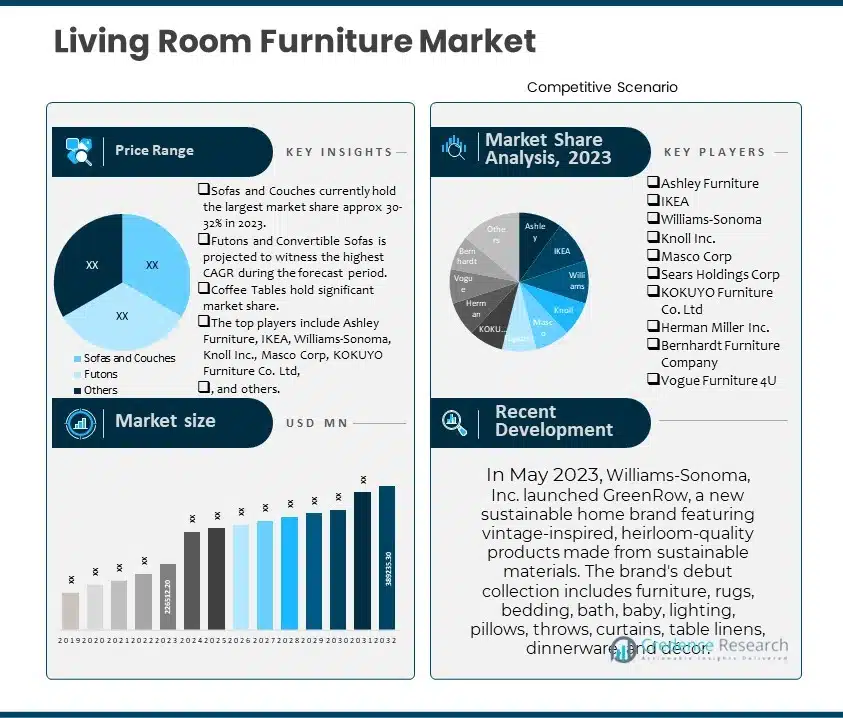
- Among the key segments, Sofas and Couches emerged as the market leader by type, holding approximately 30-32% of the total market share in 2023. However, Futons and Convertible Sofas are projected to witness the highest growth rate during the forecast period.
- Upholstered Furniture currently holds the largest market share approx 40-45% in 2023, owing to its excellent comfort and aesthetics, making it a popular choice for residential properties. Solid wood furniture is projected to witness the highest CAGR during the forecast period.
- Traditional design style holds the largest market share approx 30% in 2023, while Bohemian design is projected to witness the highest CAGR during the forecast period.
- Living Room Seating currently holds the largest market share approx 30-35% in 2023, driven by the integral role of chairs in any living room. Multi-functional Furniture is projected to witness the highest CAGR during the forecast period.
- Asia Pacific accounts for the largest share of the market in 2023, followed by Europe and North America with a collective share of just under 55%.
- The rise in demand for living room furniture, driven by increasing disposable incomes, urbanization, and changing lifestyles, fuels the growth of the Living Room Furniture Market.
- Key opportunities in the market include significant growth potential in emerging markets, increased adoption of online shopping, and continuous advancements in manufacturing technology, fostering market expansion.
Executive Summary
Market Definition
The global furniture market is a rapidly growing industry, driven by factors such as rising disposable incomes, urbanization, changing lifestyles, etc. Consumers are looking for comfortable and stylish furniture that reflects their personal taste and complements their home décor. The market offers a wide range of products including sofas, sectionals, loveseats, chairs, coffee tables and TV stands. Online shopping has made it easier for consumers to browse and buy furniture from the comfort of their own homes.
An important factor driving the furniture market is the growing desire for comfort and relaxation within the home. With their busy schedules and stressful lives, people want a comfortable and inviting place where they can relax and spend quality time with family and friends. In addition, the rise of entertainment culture has created a greater need for functional and attractive media equipment and seating options. Moreover, Modern living rooms tend to be stylish and relatively simple, while traditional furniture can be more elaborate and classic. Due to its versatility, modern furniture can easily adapt to different styles and décor. Overall, the furniture market continues to grow as consumers seek to create a welcoming and comfortable atmosphere in their homes.
Market Overview
- The Living Room Furniture Market reached a valuation of USD 226512.2 Million in 2023 and is anticipated to rise to USD 389235.3 Million by 2032, indicating a strong CAGR of 6.20% from 2024 to 2032.
- Among the primary segments, Sofas and Couches dominated the market landscape by type, comprising approximately 30-32% of the total market share in 2023. However, Futons and Convertible Sofas are expected to observe the highest CAGR over the forecast period.
- Upholstered Furniture currently holds the largest market share approx 40-45% in 2023, driven by the substantial demand for comfortable and aesthetically pleasing furniture in residential properties.
- Retailers currently hold the largest market share approx 30-45% in 2023. Established distribution networks and integrated customer service contribute to market growth.
- Online Shopping Platforms emerged as the leading distribution channel segment in 2023, with a market share of about 40-45%, propelled by factors such as convenience and accessibility for consumers.
- Asia Pacific constituted a significant portion of the market in 2023, followed by Europe and North America, collectively representing just under 55% of the market share.
- The surge in demand for living room furniture, driven by factors such as increasing disposable incomes, urbanization, and changing lifestyles, fosters market growth, especially in regions like Asia Pacific.
- Rapid advancement in furniture manufacturing technology, including the demand for versatile and eco-friendly furniture solutions, is driving the demand for living room furniture, especially in regions like Asia Pacific where the growth of the furniture industry is significant.
Segmentation by Type of Furniture
- Sofas and Couches currently hold the largest market share approx 30-32% in 2023. Sofas and Couches are considered as important pieces of furniture in any living room, and cater to guests and family members get seats and comfort.
- Futons and Convertible Sofas is projected to witness the highest CAGR during the forecast period. Futons and convertible sofas have gained popularity in recent years due to their versatility and space-saving features. They serve multiple functions, such as a sofa, bed, and recliner, which makes them an attractive option for small homes, apartments, and condos where space is limited.
Segmentation by Material Composition
- Upholstered Furniture hold the largest market share approx 40% in 2023. This dominance can be attributed to the fact that upholstered furniture offers excellent comfort and aesthetics, making it a popular choice in residential properties.
- Solid wood furniture is projected to witness the highest CAGR during the forecast period owing to its timeless appeal, durability and environmental friendliness.
Segmentation by Design Style
- Traditional hold the largest market share approx 30% in 2023. This is because traditional furniture is known for its timeless beauty, comfort and familiarity, which appeals to many homeowners.
- Modern/contemporary furniture is the second largest category, accounting for 25% of the market share in 2023. Its clean lines, minimalism and sleek look make it a popular choice for those who want a more streamlined look.
- Bohemian is projected to witness the highest CAGR during the forecast period. This growth can be attributed to the growing popularity of bohemian eclectic styles in home decor, which emphasize individuality, creativity and self-expression. Bohemian furniture often has bold colors, rich textures and unique patterns, and it makes from other design styles It's distinctive.
Segmentation by Functionality
- Living Room Seating hold the largest market share approx 30-35% in 2023. Since chairs are an integral part of any living room, customers prioritize comfort and style when choosing their chair options.
- Multi-functional Furniture is projected to witness the highest CAGR during the forecast period. This growth can be attributed to the growing demand for storage and versatile furniture that can perform multiple tasks in the living room. For instance, versatile furniture include sofa beds, storage ottomans and coffee makers table with storage areas. These pieces offer convenience, efficiency and flexibility, making them more appealing to buyers looking to maximize their living space.
Segmentation by Region
- Asia Pacific held largest share around 35-40% of the market in 2023. Growing population and urbanization in countries like China, India, and Japan drive the market.
- Europe and North America collectively account for just under 55% share in 2023, with North America holding over 20% share in the same year.
- The rest of the world, including Latin America, the Middle East, and Africa, supplies the remaining demand for Living Room Furniture.
Technological advancements in manufacturing the living room furniture, economic conditions, population demographics, and cultural preferences drive the market.
The Asia-Pacific region held largest share of Living Room Furniture market. The Asia-Pacific region driven by factors such as increased disposable income, increased urbanization and a growing middle-class population. China, India and Japan have been the major contributors to the dominance of the sector’s market. China, which is the most populous country in the world, has a growing middle class which drives demand for luxurious and stylish furniture while in India, increasing urbanization and the number of nuclear families have given things a it is smaller and the demand for work has increased. The Asia-Pacific region also has several key players in the furniture market, such as IKEA, Ashley Furniture and Havertys. These companies have been able to meet the needs of customers across the region, offering a wide range of products that combine style, comfort and affordability. For instance, in February 2023, IKEA launched three new home and furniture collections for spring 2023, and they are all about embracing the season's renewal and rejuvenation. The collections - Nytillverkad, Vårens Nytta, and Äppelblom - feature bright colors, playful patterns, and sustainable materials. From statement pieces to everyday essentials, these collections will add a pop of color and joy to your home.
The North America region witnesses significant growth in the Living Room Furniture market. This growth can be attributed to a number of factors, including the increasing demand for luxury and luxury goods, the rise of online shopping and the rise of home renovations. One of the major drivers of the furniture market in North America is the growing desire for stylish and stylish furniture. Consumers are not interested in simple, functional furniture; Instead, they’re looking for pieces that are fashionable and comfortable. This has increased the demand for sectionals, recliners, and other comfortable seating options. Another factor driving the growth of the furniture market in North America is the rise of online shopping. With the proliferation of e-commerce platforms, consumers can now easily browse and purchase furniture from the comfort of their own homes. This has made purchasing furniture easier for people, especially those living in remote or inaccessible areas. Moreover, the growing trend of home renovations is also driving the growth of the residential furniture market in North America. As people invest in remodeling their homes, they are looking for furniture that will complement their newly designed spaces. As consumers continue to prioritize their living spaces, the demand for living room furniture.
Key Highlights of the Report
The Living Room Furniture Market is segmented by Type, Material Composition, Design Style, Functionality, and Region. The growing demand for living room furniture is propelled by factors such as increasing disposable incomes, urbanization, and changing lifestyles, particularly in residential properties, commercial spaces, and hospitality sectors.
Sofas and Couches dominate the segment, catering to essential seating needs in living rooms due to their versatility and popularity. Upholstered Furniture holds a significant market share, offering comfort and aesthetics suitable for various living room settings.
Bohemian is projected to witness the highest CAGR during the forecast period, driven by the growing popularity of bohemian eclectic styles in home decor, which emphasize individuality, creativity and self-expression. While the Living Room Seating hold the largest market share, with customers prioritize comfort and style when choosing their chair options.
The Asia-Pacific region held the largest share of the living room furniture market, supported by prominent furniture industries and robust manufacturing infrastructure, along with high demand for efficient delivery solutions.
Key players like Ashley Furniture, IKEA, and Williams-Sonoma compete in the market, focusing on product innovation, distribution channel expansion, and strategic partnerships to maintain competitiveness. Collaborations and technological advancements contribute to Asia Pacific's dominance in the Living Room Furniture Market, with major players expanding their presence and capabilities in the region to meet growing demand.
What Are The Main Drivers Of The Global Living Room Furniture Market?
The major factors driving the rise of the global furniture market are increasing demand for luxury and luxury products, increasing online shopping, increasing trend of home remodeling and other factors such as changing trends environmental sustainability factors. Partnerships between furniture companies and third-party logistics (3PL) providers, advancements in technology and smart materials, social media and interior design trends impact also contributes to the growth of the market.
What Are The Major Challenges Faced By The Global Living Room Furniture Market?
The major challenges in the global furniture market include fluctuating raw material prices, increased competition from online retailers, changing consumer preferences towards smaller spaces a they stay in, apart from economic uncertainty and supply volatility affecting demand for larger products.
What Are The Growth Opportunities In The Global Living Room Furniture Market?
The global Living Room Furniture market presents numerous growth opportunities including increasing online sales and evolving real estate market including increasing demand for luxury products and stylish products the rise of smart devices and the growth of customized products, and partnership among market players. Additionally, 3D printing is expected to use advanced materials and technologies such as virtual reality to drive innovation and create new opportunities in the market.
Market Drivers
The global Living Room Furniture market is driven by several factors. The following are the key drivers of the global Living Room Furniture market:
Partnerships between furniture companies and third-party logistics (3PL) providers
Partnerships between furniture companies and third-party logistics (3PL) providers are driving the growth of the Living Room Furniture market. These networks enable furniture companies to outsource their logistics operations to specialists, allowing them to focus on core competencies such as design, manufacturing and sales. On the other hand, 3PL professionals can improve logistics through their expertise, products and technology. Collaboration benefits both parties and ultimately enhances the overall customer experience. For instance, in January 2021, Kenco Logistics, a top 3PL provider, has been awarded a second distribution center site by Walker Edison, a leading online furniture retailer. This expanded partnership will help Walker Edison grow by increasing storage capacity, improving parcel carrier capacity, and maintaining high customer service standards.
Market Restraints
The global Living Room Furniture market faces some challenges that may hinder its growth. These include the following:
Increased Competition From Online Retailers
The global Living Room Furniture market is primarily constrained by increased competition from online retailers. The global Living Room Furniture market is facing stiff competition from online vendors, which is hampering its growth. Online retailers such as Amazon, Wayfair, IKEA offer a wide range of furniture at competitive prices, making it difficult to compete with traditional retailers. Furthermore, online retailers are able to offer delivery and convenient placement for, enabling customers to physically -draw far beyond stores. This increased competition is forcing traditional retailers to adopt an omnichannel strategy, where customers are offered online and offline shopping experiences but this shift is not without challenges, as retailers have to invest heavily in technology and infrastructure into overseas to provide a seamless shopping experience across channels.
Opportunities
The global Living Room Furniture market offers significant growth opportunities. These include the following:
Adoption Of Various Strategies Among Market Players
The major companies serving the global Living Room Furniture Market are Ashley Furniture, IKEA, Williams-Sonoma, Knoll Inc., Masco Corp, among others. The market players are considerably contributing to the market growth by the adoption of various strategies including mergers & acquisitions, collaborations, funding, and new product launches, to stay competitive in the market also makes opportunity for the market growth. For instance, in April 2023, King Koil Gallery and Ashley Furniture celebrated the first anniversary of their megastore with the launch of the 2023 Key Collection. The collection features updated versions of classic designs, along with new introductions that reflect the latest trends in sleep technology and home furnishings. The event was attended by industry professionals, influencers, and customers, who were treated to a special preview of the collection before it became available to the public.
Competitive Landscape
Key Players
The global Living Room Furniture market is highly competitive, with several key players. Some of the major players in the market and their market share are as follows:
- Ashley Furniture
- IKEA
- Williams-Sonoma
- Knoll Inc.
- Masco Corp
- Sears Holdings Corp
- KOKUYO Furniture Co. Ltd
- Herman Miller Inc.
- Bernhardt Furniture Company
- Vogue Furniture 4U
- Others
These organizations prioritize product innovation, distribution channel expansion, and mergers and acquisitions to stay competitive.
The global Living Room Furniture market's key players continually seek to stay ahead by offering new products and developments.
In March 2024, Ashley Home, Inc. and Resident Home Inc. have signed an agreement for Ashley to acquire Resident, a digital retailer and wholesaler of mattresses and bedding accessories. The deal will allow Resident to expand its home furnishings assortment and global presence through Ashley's affiliate company, Ashley Furniture Industries, LLC. The acquisition will provide Resident with improved sourcing and efficiencies to support growth in both its direct-to-consumer and wholesale businesses.
In May 2023, Williams-Sonoma, Inc. launched GreenRow, a new sustainable home brand featuring vintage-inspired, heirloom-quality products made from sustainable materials. The brand's debut collection includes furniture, rugs, bedding, bath, baby, lighting, pillows, throws, curtains, table linens, dinnerware, and décor.
Summary of Key Findings
- The Living Room Furniture Market is witnessing significant growth fueled by increasing demand across residential, commercial, and hospitality sectors. This growth is attributed to factors such as rising disposable incomes, urbanization, and the surge of e-commerce.
- Market segmentation encompasses various factors including type, material composition, design style, functionality, and region, reflecting the diverse preferences and needs within the living room furniture industry.
- Sofas and Couches emerge as the dominant segment, essential for seating needs in living rooms. Upholstered Furniture holds a significant market share, offering comfort and aesthetics suitable for various living room settings.
- Bohemian is projected to witness the highest CAGR during the forecast period, driven by the growing popularity of bohemian eclectic styles in home decor, which emphasize individuality, creativity and self-expression. While the Living Room Seating hold the largest market share, with customers prioritize comfort and style when choosing their chair options.
Future Outlook
- The Living Room Furniture Market presents promising growth prospects, especially in emerging markets such as Asia Pacific, driven by increasing urbanization and demand for quality living room furniture. Anticipated challenges include technological advancements and competition from alternative furniture solutions. To address these challenges, industry players should focus on innovation, cost-efficiency, and sustainability.
- Strategies for maintaining competitiveness include product innovation, expanding distribution channels, and strategic partnerships to meet evolving consumer preferences and sustain growth in the dynamic Living Room Furniture Market.
How CXOs Can Benefit from the Credence Research Living Room Furniture Networks Market Report
The Credence Research Living Room Furniture Networks Market Report provides CXOs with a comprehensive overview of the market, including:
- Market size and growth forecast: The report provides detailed estimates of the global Living Room Furniture networks market size, segmented by type, material composition, design style, functionality, and region. It also includes forecasts for the market through 2032, based on key trends and drivers.
- Market segmentation: The report segments the Living Room Furniture networks market by type, material composition, design style, functionality, and region. The increasing demand for advanced solutions is driven. This segmentation provides CXOs with a granular understanding of the market and the opportunities in each segment.
- Competitive landscape: The report profiles the key players in the Living Room Furniture networks market and provides insights into their strategies, product offerings, and financial performance. This information can help CXOs to identify and assess their competition.
- Key trends and drivers: The report identifies and analyzes the key trends and drivers that are shaping the Living Room Furniture networks market. This information can help CXOs to make informed decisions about their investments and strategies.
CXOs can use the insights from the Credence Research Living Room Furniture Networks Market Report to:
- Identify growth opportunities: The report can help CXOs to identify new growth opportunities in the Living Room Furniture networks market. For example, the report identifies the growing demand for Living Room Furniture networks from cloud computing providers and telecom companies as a key opportunity.
- Make informed investment decisions: The report can help CXOs to make informed investment decisions about Living Room Furniture networks. For example, the report provides insights into the key factors to consider when evaluating Living Room Furniture providers and selecting Living Room Furniture solutions.
- Develop competitive strategies: The report can help CXOs to develop competitive strategies for their Living Room Furniture networks businesses. For example, the report identifies the key strategies that Living Room Furniture providers are using to differentiate themselves from their competitors.
- Track market developments: The report can help CXOs to track market developments and stay ahead of the curve. For example, the report provides insights into the latest trends and innovations in the Living Room Furniture networks market.
Overall, the Credence Research Living Room Furniture Networks Market Report is a valuable resource for CXOs who are looking to gain a deeper understanding of the market and identify opportunities for growth.
Segmentation
- Type of Furniture:
- Sofas and Couches
- Sectional Sofas
- Sleeper Sofas
- Reclining Sofas
- Loveseats
- Armchairs and Recliners
- Coffee Tables
- Side Tables
- Entertainment Centers and TV Stands
- Bookcases and Shelving Units
- Ottomans and Footstools
- Benches and Settees
- Accent Chairs and Accent Tables
- Futons and Convertible Sofas
- Others
- Material Composition:
- Wood Furniture
- Solid Wood
- Engineered Wood (e.g., MDF, plywood)
- Upholstered Furniture
- Fabric Upholstery
- Leather Upholstery
- Faux Leather Upholstery
- Metal Furniture
- Glass Furniture
- Wicker/Rattan Furniture
- Plastic Furniture
- Mixed Material Furniture
- Others
- Design Style:
- Traditional
- Modern/Contemporary
- Transitional
- Mid-century Modern
- Industrial
- Scandinavian
- Rustic
- Farmhouse
- Bohemian
- Coastal
- Minimalist
- Eclectic
- Others
- Functionlity:
- Living Room Seating
- Storage Solutions (e.g., cabinets, shelves)
- Entertainment and Media Storage
- Coffee and Side Tables
- Multi-functional Furniture (e.g., sofa beds, storage ottomans)
- Accent Furniture (e.g., accent chairs, end tables)
- Others
- By Region
- North America
- The U.S.
- Canada
- Mexico
- Europe
- Germany
- France
- The U.K.
- Italy
- Spain
- Rest of Europe
- Asia Pacific
- China
- Japan
- India
- South Korea
- South-east Asia
- Rest of Asia Pacific
- Latin America
- Brazil
- Argentina
- Rest of Latin America
- Middle East & Africa
- GCC Countries
- South Africa
- Rest of Middle East and Africa
- North America
Request a Free Sample
Fill in your details and we'll send you a free sample report.
- Sample data tables & charts
- Research methodology
Need a Custom Version of This Report?
Tailor the scope, geography, or segments to your exact requirements.
- Custom geography or segment scope
- Direct access to our analyst team
Frequently Asked Questions
What is the current size of the global Living Room Furniture market?
What is the expected growth rate of the Living Room Furniture market between 2024 and 2032?
Which segment is leading the market share in terms of Type of Furniture?
Which Functionlity segments governs the demand for Living Room Furniture in the world?
Who are the major players in the global Living Room Furniture market?
Table of Content
Chapter 1. Report Introduction
- 1.1 Report Description & Purpose
- 1.1.1 Report Title & Market Definition
- 1.1.2 Unique Selling Propositions (USP) & Key Differentiators
- 1.1.3 Value Proposition for Stakeholders
- 1.2 Research Objectives
- 1.2.1 Market Sizing Objectives (Volume & Revenue)
- 1.2.2 Segmentation Objectives
- 1.2.3 Competitive Intelligence Objectives
- 1.2.4 Forecast & Scenario Objectives
- 1.3 Report Scope
- 1.3.1 Living Room Furniture Scope – Types & Subtypes Covered
- 1.3.2 Geographic Scope – Regions & Countries Covered
- 1.3.3 Historical Period, Base Year & Forecast Period (2023; forecast to the forecast period)
- 1.3.4 Inclusions & Exclusions
- 1.4 HS Code & Classification Framework
- 1.5 Currency, Units & Pricing Basis
- 1.6 Target Stakeholders
- 1.7 Limitations & Assumptions
Chapter 2. Executive Summary
- 2.1 Global Living Room Furniture Market Snapshot
- 2.1.1 Market Size – Historical (2023) & Forecast (the forecast period) (2023: USD 226512.2 Million → forecast year: USD 389,235.3 Million)
- 2.1.2 Volume & Revenue – Global Totals
- 2.1.3 Key Market Highlights – Top Five Facts
- 2.2 Living Room Furniture Market Segmentation Snapshot
- 2.2.1 Market Split by Region – 2023 vs.
- 2.3 Competitive Snapshot
- 2.3.1 Top 10 Players by Revenue Share – 2023
- 2.3.2 Top 10 Players by Volume Share – 2023
- 2.3.3 Recent Strategic Developments (18-Month Summary)
- 2.4 Key Investment Highlights & Strategic Conclusions
Chapter 3. Living Room Furniture Market Dynamics & Industry Analysis
- 3.1 Market Overview & Context
- 3.1.1 Living Room Furniture Market Position in the Broader Automotive Value Chain
- 3.1.2 OEM vs. Replacement Market Dynamics
- 3.1.3 Market Maturity & Development Stage by Region
- 3.2 Living Room Furniture Market Drivers
- 3.3 Living Room Furniture Market Restraints & Challenges
- 3.4 Living Room Furniture Market Opportunities
- 3.5 Porter's Five Forces Analysis
- 3.5.1 Threat of New Entrants
- 3.5.2 Bargaining Power of Suppliers
- 3.5.3 Bargaining Power of Buyers
- 3.5.4 Threat of Substitutes
- 3.5.5 Competitive Rivalry – Intensity Assessment
- 3.6 Living Room Furniture Value Chain Analysis
- 3.6.1 Upstream – Raw Material/Input Suppliers
- 3.6.1.1 Raw Material/Input 1
- 3.6.1.2 Raw Material/Input 2
- 3.6.1.3 Raw Material/Input 3
- 3.6.2 Midstream – Production/Manufacturing/Service Delivery
- 3.6.2.1 Production/Process Overview
- 3.6.2.2 Key Facility Locations & Capacity by Manufacturer
- 3.6.3 Downstream – Distribution & End Consumer
- 3.6.3.1 Primary Channel – B2B/OEM
- 3.6.3.2 Secondary Channels – Dealer, Retail, Online, Direct
- 3.6.4 Value Chain Profitability Analysis
- 3.6.1 Upstream – Raw Material/Input Suppliers
- 3.7 PESTEL Analysis
- 3.7.1 Political Factors
- 3.7.2 Economic Factors
- 3.7.3 Social Factors
- 3.7.4 Technological Factors
- 3.7.5 Environmental Factors
- 3.7.6 Legal Factors
- 3.8 Living Room Furniture Supply Chain Analysis
- 3.8.1 Raw Material/Input Supply Risk Assessment
- 3.8.2 Manufacturing Concentration Risk (Geographic Exposure)
- 3.8.3 Trade Disruption Impact Analysis
- 3.9 Regulatory & Policy Landscape
Note: The regulatory and policy landscape section covers regulations based on their applicability to the market, Living Room Furniture category, geography, and scope of the study. Only regulatory frameworks with a material impact on operations, compliance, trade, sustainability, or market access are analyzed in detail.
Chapter 4. Key Investment Pockets & Opportunity Analysis
- 4.1 Living Room Furniture Market Attractiveness Analysis
- 4.1.1 By Region – Investment Attractiveness Matrix (Volume × CAGR)
- 4.2 Absolute Revenue Growth Opportunity
- 4.2.1 By Region – Absolute USD Growth Through the forecast period
- 4.3 Incremental Volume Opportunity
- 4.3.1 By Region – Incremental Volume Through the forecast period
- 4.3.2 Segment – Incremental Volume
- 4.4 Emerging Submarket Opportunity Deep Dive (Subject to Applicability)
- 4.5 Emerging Market Opportunity Scorecards
- 4.5.1 United States
- 4.5.2 Europe
- 4.5.3 Asia
- 4.5.4 Middle East & Africa
Note: Emerging Market Opportunity Scorecards will be included based on relevance and strategic importance. Regions listed are indicative and may vary depending on data availability and market dynamics.
Chapter 5. Living Room Furniture Import-Export Analysis & Trade Flows
- 5.1 Global Trade Overview
- 5.1.1 Global Export Value by Country (2023)
- 5.1.2 Global Export Volume by Country (2023)
- 5.1.3 Global Import Value by Country (2023)
- 5.1.4 Global Import Volume by Country (2023)
- 5.1.5 Net Trade Balance by Country (2023)
- 5.2 Export Analysis – Segment
- 5.2.1 Type 1 (HS Code)
- 5.2.2 Type 2 (HS Code)
- 5.2.3 Type 3 (HS Code)
- 5.2.4 Type 4 (HS Code)
- 5.2.5 Type 5 (HS Code)
- 5.3 Import Analysis – Segment
- 5.3.1 Type 1 (HS Code)
- 5.3.2 Type 2 (HS Code)
- 5.3.3 Type 3 (HS Code)
- 5.3.4 Type 4 (HS Code)
- 5.3.5 Type 5 (HS Code)
- 5.4 Average Unit Trade Prices
- 5.4.1 Average Export Price – Segment & Country
- 5.4.2 Average Import Price – Segment & Source Country
- 5.4.3 Price Trends (2023)
- 5.5 Key Trade Route Analysis
- 5.5.1 Trade Route 1
- 5.5.2 Trade Route 2
- 5.5.3 Trade Route 3
- 5.5.4 Trade Route 4
- 5.5.5 Trade Route 5
- 5.6 Trade Policy Impact Assessment
- 5.6.1 US Anti-Dumping & Section 301 Tariffs
- 5.6.2 EU Customs Union Impact
- 5.6.3 Major Free Trade Agreements
- 5.6.4 USMCA Rules of Origin
Note: Trade policy analysis will be included only where relevant to the Living Room Furniture market.
Chapter 6. Competitive Landscape & Company Benchmarking
- 6.1 Living Room Furniture Market Concentration & Structure
- 6.1.1 Herfindahl-Hirschman Index (HHI) – vs. 2023
- 6.1.2 Tier 1, Tier 2 & Tier 3 Market Structure
- 6.1.3 Global, Regional & Local Player Dynamics
- 6.2 Living Room Furniture Market Share Analysis – 2023
- 6.2.1 Global Revenue Share by Company
- 6.2.2 Global Volume Share by Company
- 6.2.3 Regional Revenue Share
- 6.2.4 Market Share Evolution ( vs. 2023)
- 6.2.5 OEM Segment Share by Company
- 6.2.6 Replacement Segment Share by Company
- 6.3 Production/Delivery Capacity & Facility Analysis
- 6.3.1 Global Installed Capacity
- 6.3.2 Capacity Utilization Rates
- 6.3.3 Production/Output Volume
- 6.3.4 Facility Locations & Capacity Map
- 6.3.5 Planned Capacity Additions
- 6.4 Living Room Furniture Competitive Benchmarking Matrix
- 6.4.1 Revenue, Volume, CAGR & Profitability Comparison
- 6.4.2 Channel Revenue Mix
- 6.4.3 Geographic Revenue Exposure
- 6.4.4 R&D Intensity
- 6.4.5 Sustainability Maturity
- 6.5 Strategic Developments in Living Room Furniture (Last 24 Months)
- 6.5.1 Mergers, Acquisitions & Divestments
- 6.5.2 New Living Room Furniture Launches
- 6.5.3 Facility Expansions
- 6.5.4 Strategic Alliances, Joint Ventures & Partnerships
- 6.5.5 Distribution Expansion & Market Entry
- 6.5.6 Sustainability & ESG Initiatives
- 6.6 Competitive Strategy Mapping
- 6.6.1 Leader, Challenger, Follower & Niche Classification
- 6.6.2 Pricing Strategy Comparison
- 6.6.3 Channel Strategy Matrix
Note: Strategic developments are included based on their materiality and the availability of reliable information.
Chapter 7. Global Living Room Furniture Market – By Distribution Channel
- 7.1 Segment Overview
- 7.1.1 Volume & Revenue Split by Channel (2023 & )
- 7.1.2 Channel Mix Evolution (the forecast period)
Chapter 8. Regional Market Analysis – Global Overview
- 8.1 Global Regional Overview
- 8.1.1 Regional Volume Share
- 8.1.2 Regional Revenue Share
- 8.1.3 Regional Volume by Region
- 8.1.4 Regional Revenue by Region
- 8.1.5 Regional Forecast Through the forecast period
- 8.2 Cross-Regional Segment Analysis
- 8.2.1 By Distribution Channel
- 8.2.2 By Brand/Price Tier
Chapter 9. North America Living Room Furniture Market
- 9.1 United States
- 9.2 Canada
- 9.3 Mexico
Chapter 10. Europe Living Room Furniture Market
- 10.1 Germany
- 10.2 France
- 10.3 Italy
- 10.4 United Kingdom
- 10.5 Spain
- 10.6 Poland
- 10.7 Russia
- 10.8 Netherlands
- 10.9 Belgium
- 10.10 Sweden
- 10.11 Denmark
- 10.12 Norway
- 10.13 Rest of Europe
Chapter 11. Asia Pacific Living Room Furniture Market
- 11.1 China
- 11.2 India
- 11.3 Japan
- 11.4 South Korea
- 11.5 Thailand
- 11.6 Indonesia
- 11.7 Vietnam
- 11.8 Malaysia
- 11.9 Australia
- 11.10 Rest of Asia Pacific
Chapter 12. Latin America Living Room Furniture Market
- 12.1 Brazil
- 12.2 Argentina
- 12.3 Colombia
- 12.4 Chile
- 12.5 Rest of Latin America
Chapter 13. Middle East Living Room Furniture Market
- 13.1 Saudi Arabia
- 13.2 United Arab Emirates
- 13.3 Turkey
- 13.4 Israel
- 13.5 Iran
- 13.6 Rest of the Middle East
Chapter 14. Africa Living Room Furniture Market
- 14.1 South Africa
- 14.2 Egypt
- 14.3 Nigeria
- 14.4 Morocco
- 14.5 Rest of Africa
Chapter 15. Living Room Furniture Company Profiles
- 15.1 [Company 01]
- 15.1.1 Company Overview
- 15.1.2 Key Management Personnel
- 15.1.3 Products & Services Portfolio
- 15.1.4 Financial Performance
- 15.1.5 Key Market Focus & Geographic Presence
- 15.1.6 Recent Developments & Strategic Initiatives
Note: The company profile list is preliminary and may change based on research findings, market developments, data availability, and client requirements.
Chapter 16. Appendices
- Appendix A – List of Abbreviations & Acronyms
- Appendix B – Industry Classification Code Reference – Full Series
- Appendix C – Production & Capacity Data Tables
- Appendix D – End-Use & Demand Base Tables
- Appendix E – Consumption & Replacement Rate Assumptions
- Appendix F – ASP Reference Tables
- Appendix G – Manufacturing & Facility Database
- Appendix H – Import-Export Data Tables
- Appendix I – Regulatory Summary Tables
- Appendix J – Primary Research Participant List (Anonymized)
- Appendix K – Primary Research Questionnaire Framework
- Appendix L – Data Sources & Bibliography
- Appendix M – Market Size Divergence & Source Comparison
Chapter 17. Research Methodology
- 17.1 Research Framework & Philosophy
- 17.2 Secondary Research – Sources, Hierarchy & Data Extraction
- 17.3 Data Modeling – Bottom-Up & Top-Down Market Sizing
- 17.4 Primary Research – Stakeholder Framework, LOI & Sample Sizes
- 17.5 Forecast Methodology – Regression, Scenario & Sensitivity Analysis
- 17.6 Quality Control – Four-Layer Validation Framework
- 17.7 Limitations & Standard Assumptions
- 17.8 Disclaimer
