
| REPORT ATTRIBUTE | DETAILS |
|---|---|
| Historical Period | 2020-2023 |
| Base Year | 2024 |
| Forecast Period | 2025-2032 |
| Eco-Friendly Furniture Market Size 2023 | USD 878.05 million |
| Eco-Friendly Furniture Market, CAGR | 7.19% |
| Eco-Friendly Furniture Market Size 2032 | USD 1640 million |
Market Overview:
The Eco-Friendly Furniture Market is projected to grow from USD 878.05 million in 2023 to an estimated USD 1640 million by 2032, with a compound annual growth rate (CAGR) of 7.19% from 2023 to 2032.
A major force behind the growth of the Eco-Friendly Furniture Market is the growing consumer demand for sustainable lifestyle solutions. Today’s buyers are highly conscious of the materials used in everyday products, especially those used in home environments, which influence indoor air quality and overall wellness. Consumers increasingly prefer furniture crafted from renewable resources such as bamboo, cork, and reclaimed wood, along with recycled metals and plastics. These materials are often paired with non-toxic adhesives, water-based finishes, and low-VOC coatings that minimize harmful emissions. Simultaneously, advancements in production technologies are improving the durability and design flexibility of eco-friendly options, making them aesthetically competitive with conventional alternatives. Governmental support is another vital driver. Policies promoting sustainable building standards, green certifications, and financial incentives are compelling real estate developers and institutional buyers to adopt eco-friendly furnishings.
From a regional perspective, North America leads the global Eco-Friendly Furniture Market, accounting for a dominant share of global revenues. This leadership is underpinned by strong environmental regulations, early consumer adoption of green products, and robust demand from commercial and residential sectors. The United States and Canada have set clear sustainability benchmarks, encouraging companies to align their offerings with eco-certifications like GREENGUARD and Forest Stewardship Council (FSC) labels. Europe follows closely, with countries such as Germany, France, and the Nordic nations demonstrating strong eco-conscious consumption patterns and a thriving culture of sustainable design. The European market is characterized by advanced recycling infrastructure, circular economy initiatives, and widespread support for artisanal and small-batch furniture production. Meanwhile, the Asia Pacific region is emerging as the fastest-growing market due to rising disposable incomes, rapid urban development, and increasing environmental awareness in populous countries like China, India, and Japan.
Market Insights:
- The Eco-Friendly Furniture Market is projected to grow from USD 878.05 million in 2023 to USD 1640 million by 2032, registering a CAGR of 7.19% due to increasing consumer focus on sustainable living.
- Rising demand for non-toxic, renewable materials like bamboo, cork, and reclaimed wood is reshaping product offerings across residential and commercial segments.
- Government-led initiatives, green building mandates, and financial incentives are pushing institutions and developers toward eco-certified furniture options.
- Technological innovation in recyclable and biodegradable materials, along with low-waste manufacturing, is enhancing design flexibility and reducing environmental impact.
- E-commerce platforms are expanding market access by promoting supply chain transparency, traceable sourcing, and digital engagement with eco-conscious consumers.
- High costs of sustainable raw materials and lack of manufacturing scale challenge smaller players and hinder affordability in price-sensitive markets.
- North America dominates global revenue share, while Asia Pacific emerges as the fastest-growing region, driven by urbanization and growing environmental awareness.
Report scoope
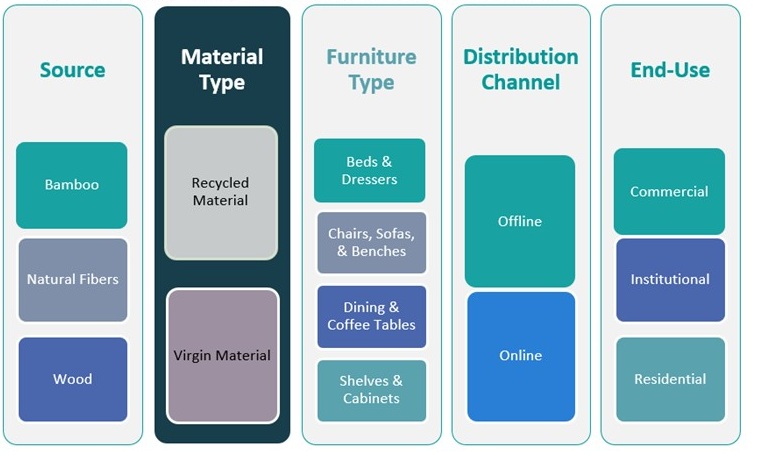
This report segments the Global Eco-friendly Furniture Market as follow
Market Drivers:
Growing Consumer Preference for Sustainable and Non-Toxic Materials
The global shift toward sustainability is driving demand for eco-conscious interior solutions. Consumers are increasingly aware of the environmental impact of furniture made from synthetic materials and chemically treated wood. The Eco-Friendly Furniture Market benefits from this awareness, as buyers seek products crafted from renewable sources such as bamboo, reclaimed wood, and recycled metal. Non-toxic adhesives, low-VOC finishes, and natural fabrics appeal to health-conscious consumers looking to minimize indoor pollution. Social media and environmental advocacy campaigns are also influencing purchase decisions, especially among younger, urban demographics. It is responding to this demand by incorporating transparent sourcing and sustainable certification labels.
- For example, Woodshala, a leading sustainable furniture company, predominantly utilizes reclaimed wood salvaged from old buildings and furniture, minimizing the demand for virgin timber and reducing waste.
Government Policies and Green Building Regulations Fuel Market Growth
Government mandates and certification programs are key catalysts for the adoption of sustainable furniture practices. Regulations promoting green building standards, such as LEED and BREEAM, encourage developers and commercial spaces to adopt eco-friendly furniture. Tax incentives, environmental subsidies, and stricter carbon emission rules reinforce the transition toward sustainable interior solutions. The Eco-Friendly Furniture Market benefits from this policy push, which incentivizes manufacturers to innovate and comply with environmental benchmarks. Public procurement programs increasingly require furniture to meet specific sustainability criteria. It is also gaining traction in institutional settings like schools and offices, where government-led sustainability initiatives influence procurement strategies.
Innovation in Manufacturing and Material Technology Expands Design Options
Technological advancements in sustainable material development are transforming the aesthetics and functionality of eco-friendly furniture. Manufacturers are leveraging improved recycling processes and advanced composite materials to replicate the look and strength of traditional furniture while reducing environmental impact. The Eco-Friendly Furniture Market is growing as producers offer durable, lightweight, and customizable options that do not compromise on design. CNC machinery, 3D printing, and low-waste manufacturing techniques support efficient production and consistent quality. These innovations reduce costs and open up new design possibilities for both residential and commercial segments. It is becoming easier for companies to scale operations while maintaining environmental compliance.
E-Commerce Growth and Transparency in Supply Chain Practices Boost Sales
The expansion of e-commerce platforms and direct-to-consumer models has increased access to eco-friendly furniture across regions. Consumers expect detailed information about product sourcing, lifecycle impact, and material safety, prompting brands to highlight sustainability in marketing. The Eco-Friendly Furniture Market leverages these platforms to build brand trust through traceability and storytelling. Online reviews, certifications, and virtual showrooms play a role in validating green claims and influencing purchase behavior. Increased digital engagement also allows manufacturers to gather feedback and adapt product lines to evolving sustainability preferences. It is driving market penetration in regions previously underserved by traditional furniture distribution channels.
- For instance, companies are also leveraging technology to enhance supply chain transparency; for example, Setlog’s OSCA software enables real-time tracking of raw materials and finished products, ensuring adherence to sustainability standards and facilitating regular audits.
Market Trends:
Rising Adoption of Circular Economy Principles Across the Furniture Industry
Manufacturers are embracing circular economy models to reduce waste and extend product life cycles. The Eco-Friendly Furniture Market is witnessing a shift toward furniture designed for disassembly, repair, and reuse, enabling more sustainable end-of-life options. Companies are using reclaimed and recycled materials not only for their environmental benefits but also for their unique aesthetic appeal. Refurbishment and buy-back programs are gaining popularity, encouraging consumers to return used furniture for refurbishment rather than disposal. This trend supports resource efficiency and promotes long-term customer engagement. It also aligns with broader ESG goals among corporations and institutional buyers seeking traceable, closed-loop solutions.
- For instance, Sabai, a BIPOC-owned furniture brand, has launched the “Repair Don’t Replace” initiative, allowing customers to order replacement parts for minor repairs, and the “Revive” buy-back program, where used furniture is refurbished and resold, keeping products in circulation and reducing landfill waste.
Integration of Smart and Sustainable Materials in Furniture Design
Furniture manufacturers are increasingly integrating smart and sustainable materials to enhance performance and environmental impact. The Eco-Friendly Furniture Market reflects this trend through the use of innovative materials like bioplastics, mushroom mycelium, and recycled textiles. These alternatives reduce dependency on virgin raw materials while offering comparable strength, durability, and visual appeal. Manufacturers are also prioritizing locally sourced and biodegradable materials to limit emissions linked to transportation and manufacturing processes. Smart coatings and sensor-embedded components are being explored for added functionality in commercial furniture applications. It represents a growing convergence of sustainability, technology, and user-centric design.
Minimalist Aesthetics and Multi-Functional Designs Gain Traction
Modern consumers are prioritizing minimalist and space-efficient furniture that supports sustainable living. Multi-functional pieces that combine storage, flexibility, and style are gaining traction, particularly in urban environments with limited space. The Eco-Friendly Furniture Market is aligning with this demand by offering furniture that integrates utility with a clean, minimalist aesthetic. Foldable desks, convertible seating, and modular shelving made from sustainable materials cater to the lifestyle needs of eco-conscious urban dwellers. These designs not only reduce material usage but also enhance the longevity of furniture by supporting multiple uses. It reflects an evolving design language where functionality and sustainability coexist seamlessly.
Customization and Artisan-Made Furniture See Growing Demand
Consumers are showing increased interest in custom-made furniture with a sustainable origin. Artisanal craftsmanship and small-batch production are becoming prominent, driven by the desire for unique, high-quality, and ethically produced pieces. The Eco-Friendly Furniture Market is responding with personalized offerings that highlight craftsmanship, local materials, and transparency. Buyers are willing to invest in pieces that reflect their values and support responsible sourcing and labor practices. Storytelling around design inspiration, materials, and maker narratives adds emotional value and strengthens customer-brand relationships. It positions sustainability not just as a feature but as a fundamental part of the product identity.
- For instance, Artisanal brands like Sabai highlight craftsmanship and transparency, using local materials and ethical production practices, and sharing maker narratives to add emotional value to their products.
Market Challenges Analysis:
High Production Costs and Limited Scalability Restrain Market Growth
Sourcing sustainable raw materials and adhering to green manufacturing standards significantly raise production costs. Manufacturers often pay a premium for certified woods, recycled components, and non-toxic finishes, which increases the final retail price. The Eco-Friendly Furniture Market faces pricing pressure in comparison to mass-produced conventional furniture that benefits from economies of scale. Many small and mid-sized manufacturers struggle to scale operations while maintaining environmental compliance, limiting their market reach. The challenge of balancing affordability with sustainability makes it difficult for eco-friendly furniture to appeal to price-sensitive consumers. It also constrains expansion into developing regions where budget-friendly alternatives dominate the market. The cost disparity continues to be a key obstacle to mainstream adoption.
Lack of Standardization and Consumer Misconceptions Undermine Trust
Inconsistent labeling and unclear sustainability criteria create confusion among consumers trying to make informed choices. The Eco-Friendly Furniture Market must contend with greenwashing, where companies falsely claim environmental benefits without verifiable practices. This lack of transparency undermines trust and weakens the market’s credibility. Consumers often struggle to distinguish between genuinely eco-friendly products and those using sustainability as a marketing tool. Certification systems exist, but their limited global adoption and varying criteria hinder effective communication. It requires more consistent regulation, third-party verification, and public awareness efforts to educate consumers on meaningful sustainability indicators. Without clearer standards, ethical producers find it difficult to differentiate themselves in a crowded marketplace.
- For instance, The Federal Trade Commission (FTC) in the U.S. has issued warnings to several furniture brands for misleading “eco-friendly” claims that could not be substantiated by third-party verification.
Market Opportunities:
The rapid pace of urban development presents a strong opportunity for sustainable furniture adoption in compact, modern homes. Consumers in metropolitan areas are actively seeking multi-functional, space-saving furniture that aligns with eco-conscious values. The Eco-Friendly Furniture Market can capitalize on this shift by offering customizable solutions that combine design, utility, and sustainability. Growing interest in wellness-focused living environments further supports demand for non-toxic, responsibly sourced furnishings. Real estate developers and interior designers are incorporating green principles into residential and commercial projects, creating strong B2B opportunities. It can benefit from collaborating with architects and builders who prioritize green building certifications.
Online platforms offer a cost-effective channel for eco-friendly furniture brands to connect with a wider audience. Consumers rely on detailed digital product descriptions, traceability, and certifications to evaluate sustainability claims. The Eco-Friendly Furniture Market can use e-commerce to showcase its value propositions, provide transparency, and personalize the shopping experience. Digital storytelling allows brands to build trust through education and authenticity. Growing consumer demand for home delivery and customization further supports online sales growth. It opens doors for smaller, mission-driven brands to compete globally without traditional retail overhead.
Market Segmentation Analysis:
The Eco-Friendly Furniture Market demonstrates diverse growth across several key segments.
By source, bamboo leads due to its rapid renewability, followed by natural fibers and wood, both of which offer durability and aesthetic appeal with a low environmental footprint.
By material type segment, recycled materials account for a rising share, driven by the emphasis on waste reduction and circular economy models. Virgin materials remain relevant for high-end and structurally intensive furniture, though they face increasing scrutiny regarding sustainability compliance.
By end-use, the residential segment dominates market demand, fueled by consumer preferences for health-conscious and sustainable living spaces. Commercial and institutional segments are also gaining traction, supported by green building standards and government procurement policies.
By furniture type range, with strong demand across beds & dressers, chairs, sofas & benches, dining & coffee tables, and shelves & cabinets. Each category shows growing integration of modular and multi-functional designs.
By distribution, offline channels continue to hold significant market share due to the tactile nature of furniture buying. However, online platforms are expanding rapidly, offering greater product visibility, sustainability transparency, and access to niche eco-conscious brands.
Segmentation:
By Source Segment
- Bamboo
- Natural Fibers
- Wood
By Material Type Segment
- Recycled Material
- Virgin Material
By End-Use Segment
- Commercial
- Institutional
- Residential
By Furniture Type Segment
- Beds & Dressers
- Chairs, Sofas, & Benches
- Dining & Coffee Tables
- Shelves & Cabinets
By Distribution Channel
- Offline
- Online
Regional Analysis:
North America Leads with Established Sustainability Standards and Strong Consumer Demand
North America holds the largest share of the Eco-Friendly Furniture Market, accounting for 43.8% of global revenue. Strong regulatory frameworks, high environmental awareness, and consumer willingness to pay a premium for sustainable products support market leadership in this region. The United States drives demand through widespread adoption of eco-certifications like FSC, GREENGUARD, and Cradle to Cradle. Major retailers and designers prioritize eco-conscious product lines, integrating sustainability into mainstream home and office furnishings. Canada contributes through green procurement policies and public awareness initiatives that promote sustainable interiors in schools and government buildings. It continues to benefit from mature recycling infrastructure and a robust e-commerce ecosystem that enhances product accessibility.
Europe Demonstrates High Environmental Consciousness and Design Innovation
Europe holds a 30.2% share of the global Eco-Friendly Furniture Market, driven by progressive environmental policies and a long-standing culture of sustainable design. Countries like Germany, Sweden, and the Netherlands lead in sustainable home solutions, supported by consumer demand for ethically sourced, minimalist furniture. The region’s focus on circular economy principles encourages reuse, refurbishment, and material innovation across product lifecycles. EU directives and national programs promote low-emission manufacturing and eco-labeling compliance. It also benefits from a thriving artisan and small-scale furniture production sector aligned with green standards. European consumers value transparency, making certification and traceability essential to market success.
Asia Pacific Emerges as a High-Growth Region with Expanding Middle Class
Asia Pacific holds a 17.6% share of the Eco-Friendly Furniture Market but is expected to register the fastest growth rate over the next decade. Rising urbanization, growing disposable incomes, and increasing environmental awareness in countries like China, India, and Japan are accelerating demand. Government initiatives to promote green infrastructure and smart cities create new opportunities for sustainable furniture integration. Local manufacturers are adopting eco-friendly practices to appeal to younger, environmentally conscious consumers. It is seeing strong traction in residential and hospitality sectors, particularly in urban centers prioritizing air quality and material safety. Strategic collaborations and e-commerce expansion are also improving accessibility across emerging economies.
Key Player Analysis:
- Avocado Mattress, LLC
- Crate & Barrel
- EcoBalanza
- Herman Miller Inc.
- Floyd, Inc.
Competitive Analysis:
The Eco-Friendly Furniture Market features a mix of established global brands and emerging sustainable startups competing on innovation, material sourcing, and ethical practices. Key players focus on using certified sustainable materials, non-toxic finishes, and low-emission production methods to meet rising consumer and regulatory demands. Companies differentiate through design innovation, customization, and transparent supply chains. Large retailers integrate eco-friendly collections within their broader offerings, while niche players emphasize artisanal craftsmanship and localized sourcing. The market is also witnessing strategic partnerships between manufacturers, green certification bodies, and e-commerce platforms to enhance credibility and reach. It rewards brands that align product aesthetics with environmental values, offering traceable, durable, and functional solutions. Competitive advantage hinges on achieving scale without compromising sustainability standards, pushing firms to invest in green technologies, supply chain optimization, and consumer education. The landscape remains dynamic, with rising brand loyalty among conscious consumers influencing long-term market positioning.
Recent Developments:
- In April 2025, Avocado Green Mattress unveiled its most luxurious product to date: the Grand Luxe Mattress. Meticulously handcrafted in California, the Grand Luxe features 17 layers of natural and certified materials, including breathable silk, mohair, Peruvian alpaca, British wool, GOTS-certified organic cotton, and Pure Talalay® latex. With up to 14,400 precision-tuned AeraSprings™ for dynamic support, this mattress sets a new standard in sustainable luxury.
Market Concentration & Characteristics:
The Eco-Friendly Furniture Market remains moderately fragmented, with a mix of global corporations, regional manufacturers, and niche startups competing across residential, commercial, and institutional segments. It features a growing number of companies focused on sustainable sourcing, low-emission production, and non-toxic materials. Market participants differentiate through design innovation, product transparency, and third-party certifications. Demand for customized, artisanal, and multifunctional furniture has led to increased competition among small and mid-sized players. Larger brands benefit from established distribution networks and integration of eco-conscious product lines into broader portfolios. It continues to evolve with rising consumer expectations, requiring consistent investment in sustainable practices and material innovation to maintain competitiveness.
Report Coverage:
The research report offers an in-depth analysis based on Source, Material Type, End-Use, Furniture Type and Distribution Channel It details leading market players, providing an overview of their business, product offerings, investments, revenue streams, and key applications. Additionally, the report includes insights into the competitive environment, SWOT analysis, current market trends, as well as the primary drivers and constraints. Furthermore, it discusses various factors that have driven market expansion in recent years. The report also explores market dynamics, regulatory scenarios, and technological advancements that are shaping the industry. It assesses the impact of external factors and global economic changes on market growth. Lastly, it provides strategic recommendations for new entrants and established companies to navigate the complexities of the market.
Future Outlook:
- Consumer demand for sustainable, toxin-free furniture will continue to shape design and material sourcing strategies.
- Integration of circular economy models will drive product innovation and end-of-life recycling solutions.
- Digital platforms and e-commerce will expand market reach, especially among younger, urban consumers.
- Technological advancements in biodegradable and bio-composite materials will enable new product categories.
- Government policies promoting green construction and procurement will boost institutional demand.
- Increased investment in traceable supply chains will enhance brand transparency and customer trust.
- Collaborations between manufacturers and environmental certification bodies will strengthen market credibility.
- Growth in multi-functional and modular designs will align with urbanization and space optimization trends.
- Asia Pacific will emerge as the fastest-growing region due to economic development and rising eco-awareness.
- Retailers will prioritize sustainability as a core value, influencing long-term purchasing and branding strategies.

Request a Free Sample
Fill in your details and we'll send you a free sample report.
- Sample data tables & charts
- Research methodology
Market Dynamics
Growing Consumer Preference for Sustainable and Non-Toxic Materials
Increasing awareness of the health and environmental impacts of conventional furniture is driving consumers toward products made from renewable resources like bamboo and reclaimed wood, as well as non-toxic adhesives and finishes. This shift is particularly strong among younger, urban buyers who value transparency and eco-certifications.
Government Policies and Green Building Regulations
Mandates and incentives for green building standards, such as LEED and BREEAM, are compelling developers and institutions to adopt eco-friendly furniture. Public procurement policies and tax incentives further encourage manufacturers to innovate and comply with sustainability benchmarks.
Innovation in Manufacturing and Material Technology
Advancements in recyclable and biodegradable materials, as well as low-waste manufacturing techniques, are enabling the production of durable, aesthetically appealing furniture that competes with conventional options. These innovations help reduce costs and environmental impact, broadening the market’s appeal.
Expansion of E-Commerce and Supply Chain Transparency
The rise of online platforms has made eco-friendly furniture more accessible, allowing brands to highlight traceable sourcing, certifications, and sustainability stories. Digital engagement builds consumer trust and expands market reach, especially in regions underserved by traditional retail.
Adoption of Circular Economy and Modular Design Principles
Manufacturers are increasingly designing furniture for disassembly, repair, and reuse, supporting circular economy models. This approach not only reduces waste but also appeals to environmentally conscious consumers and institutional buyers seeking long-term, sustainable solutions.
Need a Custom Version of This Report?
Tailor the scope, geography, or segments to your exact requirements.
- Custom geography or segment scope
- Direct access to our analyst team
Frequently Asked Questions
What is the current size of the Eco-Friendly Furniture Market?
What factors are driving the growth of the Eco-Friendly Furniture market?
What are the key segments within the Eco-Friendly Furniture market?
What are some challenges faced by the Eco-Friendly Furniture market?
Who are the major players in the Eco-Friendly Furniture market?
Which segment is leading the market share?
Table of Content
Chapter 1 Market Segmentation
- 1.1 Segmentation Framework
- 1.1.1 Product and Service Classification
- 1.1.2 Application and End-Use Classification
- 1.1.3 Technology and Solution Classification
- 1.1.4 Customer and Distribution Channel Classification
- 1.1.5 Geographic Segmentation
- 1.1.6 Market Segment Definitions and Boundaries
- 1.2 By Source
- 1.2.1 Bamboo
- 1.2.2 Natural Fibers
- 1.2.3 Wood
- 1.3 By End-Use
- 1.3.1 Residential
- 1.3.2 Commercial
- 1.3.3 Institutional
- 1.4 By Material Type
- 1.4.1 Recycled Material
- 1.4.2 Virgin Material
Chapter 2 Introduction
- 2.1 Report Objectives and Scope
- 2.2 Product Definition and Industry Terminology
- 2.3 Market Inclusions and Exclusions
- 2.4 Research Process
- 2.4.1 Primary Research and Expert Interviews
- 2.4.2 Secondary Research and Source Review
- 2.4.3 Top-Down and Bottom-Up Estimation
- 2.4.4 Data Triangulation and Verification
- 2.5 Market Size Measurement Basis
- 2.5.1 2023: USD 878.05 million → 2032: USD 1,640 million
- 2.6 Historical and Forecast Reference Periods
- 2.6.1 Base Year: 2023
- 2.6.2 Forecast Period: 2023-2032
- 2.7 Research Assumptions and Limitations
Chapter 3 Executive Summary
- 3.1 Market Snapshot and Key Findings
- 3.2 Base-Year Market Size, 2023
- 3.3 Forecast Market Size, 2032
- 3.4 Revenue and Volume Growth Outlook
- 3.5 Key Demand and Supply Indicators
- 3.6 Leading Market Segments
- 3.7 Fastest-Growing Market Opportunities
- 3.8 Regional Performance Highlights
- 3.9 Technology and Industry Transformation
- 3.10 Competitive Landscape Summary
- 3.11 Analyst View and Strategic Implications
Chapter 4 Global Eco-friendly Furniture Market Trends and Developments
- 4.1 Historical Industry Development
- 4.2 Recent Market Trends and Developments
- 4.3 Demand and Customer Behavior Trends
- 4.4 Technology and Product Innovation
- 4.5 Artificial Intelligence, Automation and Digitalization
- 4.6 Local Manufacturing and Supply Chain Realignment
- 4.7 Industry Partnerships, Mergers and Acquisitions
- 4.8 Sustainability and Circular Economy Developments
- 4.9 Government and Private Sector Investment Trends
- 4.10 Emerging Business Models and Commercialization
- 4.11 Industry Developments and Announcements
Chapter 5 Global Eco-friendly Furniture Market Production, Supply and Demand Analysis
- 5.1 Demand Trend and Consumption Analysis
- 5.2 Demand Forecast, 2023-2032
- 5.3 Production and Output Trend
- 5.4 Production and Output Forecast, 2023-2032
- 5.5 Installed Capacity and Capacity Utilization
- 5.6 Company-Wise Production Plants and Statistics
- 5.6.1 Installed Production Capacity
- 5.6.2 Actual Production
- 5.6.3 Planned Capacity and Expansion Targets
- 5.7 Supply Chain Structure and Procurement Trends
- 5.8 Supply-Demand Gap and Bottlenecks
- 5.9 Import Dependence and Sourcing Structure
- 5.10 Contract Manufacturing and Outsourcing
- 5.11 Regional Supply and Demand Concentration
Chapter 6 Global Eco-friendly Furniture Market Pricing Analysis
- 6.1 Pricing Structure and Measurement
- 6.2 Historical Pricing Trends
- 6.3 Pricing Outlook, 2023-2032
- 6.4 Average Selling Price and Unit Economics
- 6.5 Pricing by Product and Market Segment
- 6.6 Geographic Pricing Differences
- 6.7 Key Input, Energy, Labor and Logistics Costs
- 6.8 Contract Pricing and Purchasing Models
- 6.9 Pricing Sensitivity and Competitive Positioning
- 6.10 Price, Margin and Profitability Implications
Chapter 7 Global Eco-friendly Furniture Market Dynamics
- 7.1 Market Growth Drivers
- 7.1.1 Demand-Side Drivers
- 7.1.2 Technology and Innovation Drivers
- 7.1.3 Infrastructure and Investment Drivers
- 7.1.4 Regulatory and Policy Drivers
- 7.2 Market Restraints
- 7.2.1 Cost and Affordability Constraints
- 7.2.2 Technology and Adoption Barriers
- 7.2.3 Supply Chain and Operational Constraints
- 7.3 Market Challenges
- 7.3.1 Competitive Pressure and Margin Erosion
- 7.3.2 Skills, Infrastructure and Implementation Gaps
- 7.4 Emerging Market Opportunities
- 7.5 Market Dynamics Impact and Time-Horizon Assessment
Chapter 8 Global Eco-friendly Furniture Value Chain Analysis
- 8.1 Industry Value Chain Overview
- 8.2 Upstream Suppliers and Critical Inputs
- 8.3 Technology and Component Providers
- 8.4 Manufacturing or Service Delivery
- 8.5 Distribution, Channel Partners and Integrators
- 8.6 Downstream Applications and End Users
- 8.7 Value Addition and Profit Pools
- 8.8 Vertical Integration and Outsourcing
- 8.9 Supplier Concentration and Risk
- 8.10 Supply Chain Localization and Resilience
Chapter 9 Global Eco-friendly Furniture Market Regulations and Policies
- 9.1 Relevant Laws, Standards and Compliance Frameworks
- 9.2 Product, Service, Safety and Quality Requirements
- 9.3 Government Policies, Incentives and Subsidies
- 9.4 Imports, Exports and Trade Barriers
- 9.5 Public Procurement and Local Content Requirements
- 9.6 Environmental and Sustainability Compliance
- 9.7 Upcoming Policy Changes and Market Implications
Chapter 10 Global Eco-friendly Furniture Market Hotspots and Opportunities
- 10.1 Market Opportunity Mapping and Growth Hotspots
- 10.2 High-Growth Applications and Customer Groups
- 10.3 Underserved Markets and White-Space Opportunities
- 10.4 Emerging Technology and Product Opportunities
- 10.5 New Capacity and Investment Hotspots
- 10.6 Market Entry and Expansion Opportunities
- 10.7 Distribution and Partnership Opportunities
- 10.8 Near-Term and Long-Term Commercial Potential
- 10.9 Opportunity Attractiveness and Execution Risks
Chapter 11 Global Eco-friendly Furniture Market Outlook, 2023-2032
- 11.1 Market Size and Analysis
- 11.1.1 Revenue (Market Measurement: 2023: USD 878.05 million → 2032: USD 1,640 million)
- 11.1.2 Market Volume and Quantity Sold
- 11.1.3 Historical Market Size
- 11.1.4 Base-Year Market Size, 2023
- 11.2 Market Forecast, 2023-2032
- 11.2.1 Revenue Forecast to 2032
- 11.2.2 Volume Forecast to 2032
- 11.2.3 CAGR and Year-on-Year Growth
- 11.2.4 Incremental Revenue Opportunity
- 11.3 Forecast Assumptions and Scenario Analysis
- 11.3.1 Base-Case Forecast
- 11.3.2 Optimistic and Conservative Scenarios
- 11.3.3 Technology, Pricing and Policy Sensitivities
- 11.4 Market Attractiveness and Growth Outlook
Chapter 12 Global Eco-friendly Furniture Market Segmentation and Outlook
- 12.1 Segmentation Summary and Market Shares, 2023
- 12.2 Largest and Fastest-Growing Segments
- 12.3 By Source - Market Size and Forecast, 2023-2032
- 12.3.1 Segment Definition and Scope
- 12.3.2 Historical Market Size
- 12.3.3 Revenue Forecast, 2023-2032
- 12.3.4 Volume Forecast, 2023-2032
- 12.3.5 Base-Year Market Share, 2023
- 12.3.6 Segment CAGR and Growth Drivers
- 12.3.7 Subsegment Market Size and Forecast
- 12.3.7.1 Bamboo
- 12.3.7.2 Natural Fibers
- 12.3.7.3 Wood
- 12.3.8 Subsegment Pricing and Adoption Trends
- 12.3.9 Leading Suppliers and Competition
- 12.3.10 Regional Demand and Opportunities
- 12.4 By End-Use - Market Size and Forecast, 2023-2032
- 12.4.1 Segment Definition and Scope
- 12.4.2 Historical Market Size
- 12.4.3 Revenue Forecast, 2023-2032
- 12.4.4 Volume Forecast, 2023-2032
- 12.4.5 Base-Year Market Share, 2023
- 12.4.6 Segment CAGR and Growth Drivers
- 12.4.7 Subsegment Market Size and Forecast
- 12.4.7.1 Residential
- 12.4.7.2 Commercial
- 12.4.7.3 Institutional
- 12.4.8 Subsegment Pricing and Adoption Trends
- 12.4.9 Leading Suppliers and Competition
- 12.4.10 Regional Demand and Opportunities
- 12.5 By Material Type - Market Size and Forecast, 2023-2032
- 12.5.1 Segment Definition and Scope
- 12.5.2 Historical Market Size
- 12.5.3 Revenue Forecast, 2023-2032
- 12.5.4 Volume Forecast, 2023-2032
- 12.5.5 Base-Year Market Share, 2023
- 12.5.6 Segment CAGR and Growth Drivers
- 12.5.7 Subsegment Market Size and Forecast
- 12.5.7.1 Recycled Material
- 12.5.7.2 Virgin Material
- 12.5.8 Subsegment Pricing and Adoption Trends
- 12.5.9 Leading Suppliers and Competition
- 12.5.10 Regional Demand and Opportunities
- 12.6 Segment Growth Comparison
- 12.7 Segment Attractiveness and Priority Matrix
Chapter 13 Global Eco-friendly Furniture End-Use and Application Market Outlook
- 13.1 End-Use Industry and Customer Demand Structure
- 13.2 Leading Applications and Customer Groups
- 13.3 End-Use Market Size, Share and Forecast
- 13.4 Major End-Use Industry Deep Dives
- 13.4.1 Customer Requirements and Use Cases
- 13.4.2 Demand and Replacement Cycles
- 13.4.3 Technical and Regulatory Considerations
- 13.4.4 Purchasing and Procurement Models
- 13.4.5 Leading Vendors and Distribution Channels
- 13.4.6 Forecast and Commercial Opportunities
- 13.5 Emerging Applications and Cross-Segment Demand
- 13.6 End-Use Industry Investment Priorities
Chapter 14 Global Eco-friendly Furniture Geographic Market Outlook, 2023-2032
- 14.1 Regional Market Size and Share, 2023
- 14.2 Regional Market Forecast, 2023-2032
- 14.3 Regional Pricing, Production and Demand Differences
- 14.4 North America
- 14.4.1 United States
- 14.4.2 Canada
- 14.4.3 Mexico
- 14.5 Europe
- 14.5.1 Germany
- 14.5.2 France
- 14.5.3 Italy
- 14.5.4 United Kingdom
- 14.5.5 Spain
- 14.5.6 Poland
- 14.5.7 Russia
- 14.5.8 Netherlands
- 14.5.9 Belgium
- 14.5.10 Sweden
- 14.5.11 Denmark
- 14.5.12 Norway
- 14.5.13 Rest of Europe
- 14.6 Asia Pacific
- 14.6.1 China
- 14.6.2 India
- 14.6.3 Japan
- 14.6.4 South Korea
- 14.6.5 Thailand
- 14.6.6 Indonesia
- 14.6.7 Vietnam
- 14.6.8 Malaysia
- 14.6.9 Australia
- 14.6.10 Rest of Asia Pacific
- 14.7 Latin America
- 14.7.1 Brazil
- 14.7.2 Argentina
- 14.7.3 Colombia
- 14.7.4 Chile
- 14.7.5 Rest of Latin America
- 14.8 Middle East
- 14.8.1 Saudi Arabia
- 14.8.2 United Arab Emirates
- 14.8.3 Turkey
- 14.8.4 Israel
- 14.8.5 Iran
- 14.8.6 Rest of the Middle East
- 14.9 Africa
- 14.9.1 South Africa
- 14.9.2 Egypt
- 14.9.3 Nigeria
- 14.9.4 Morocco
- 14.9.5 Rest of Africa
- 14.10 Regional Investment, Policy and Supply Chain Differences
- 14.11 Regional Competitive Landscape
- 14.12 Geographic Growth Hotspots
Chapter 15 Global Eco-friendly Furniture Technology, Innovation and Sustainability Outlook
- 15.1 Technology Landscape and Maturity
- 15.2 Product, Process and Service Innovation
- 15.3 AI, Automation and Digital Tools in the Industry
- 15.4 Technology Adoption and Performance Benchmarking
- 15.5 Innovation Pipeline and R&D Investment
- 15.6 Patent and Intellectual Property Trends
- 15.7 Energy Efficiency and Resource Management
- 15.8 Sustainability, Recycling and Circularity
- 15.9 Technology Roadmap, 2023-2032
- 15.10 Risks of Obsolescence and Technology Substitution
Chapter 16 Global Eco-friendly Furniture Market Key Strategic Imperatives
- 16.1 Growth and Market Entry Priorities
- 16.2 High-Return Products and Segments
- 16.3 Pricing, Profitability and Cost Optimization
- 16.4 Technology Investment and Product Differentiation
- 16.5 Supply Chain Localization and Resilience
- 16.6 Distribution and Customer Acquisition
- 16.7 Partnership, Acquisition and Capacity Strategy
- 16.8 Regional Expansion Priorities
- 16.9 Short-, Medium- and Long-Term Actions
Chapter 17 Competition Outlook
- 17.1 Industry Competition Characteristics
- 17.2 Market Structure and Concentration
- 17.3 Market Share and Competitive Positioning, 2023
- 17.4 Company-Wise Revenue and Product Benchmarking
- 17.5 Production and Service Capacity Benchmarking
- 17.6 Technology, Pricing and Differentiation
- 17.7 Regional Footprint and Distribution Strength
- 17.8 Mergers, Acquisitions and Strategic Alliances
- 17.9 New Entrants and Competitive Threats
- 17.10 Porter's Five Forces and Industry Attractiveness
- 17.11 Competitive Outlook, 2023-2032
Chapter 18 Company Profiles
- 18.1 Company Coverage and Selection Criteria
- 18.2 Avocado Mattress, LLC
- 18.2.1 Business Description
- 18.2.2 Company Ownership and Geographic Presence
- 18.2.3 Product and Service Portfolio
- 18.2.4 Manufacturing and Operating Footprint
- 18.2.5 Production Capacity and Expansion Plans
- 18.2.6 Financial Performance and Investment
- 18.2.7 Market Share and Competitive Position
- 18.2.8 Technology and Innovation Capabilities
- 18.2.9 Strategic Alliances or Partnerships
- 18.2.10 Recent Developments
- 18.2.11 Growth Strategy and Outlook
- 18.3 Crate & Barrel
- 18.4 EcoBalanza
- 18.5 Herman Miller Inc.
- 18.6 Floyd, Inc.
- 18.7 IKEA
- 18.8 West Elm
- 18.9 Vermont Woods Studios
- 18.10 Sabai
- 18.11 Steelcase
- 18.12 Other Relevant Market Participants
Note: Every listed company is profiled on the structure shown under the first company. The company list is preliminary and may change based on research findings, market developments, data availability and client requirements.
Chapter 19 Disclaimer
- 19.1 Research and Forecast Disclaimer
- 19.2 Data Source and Estimation Limitations
Note: The depth of individual sections depends on data availability for this market. Volume, capacity, trade and other unit-based metrics are included where applicable.

