
Market Overview
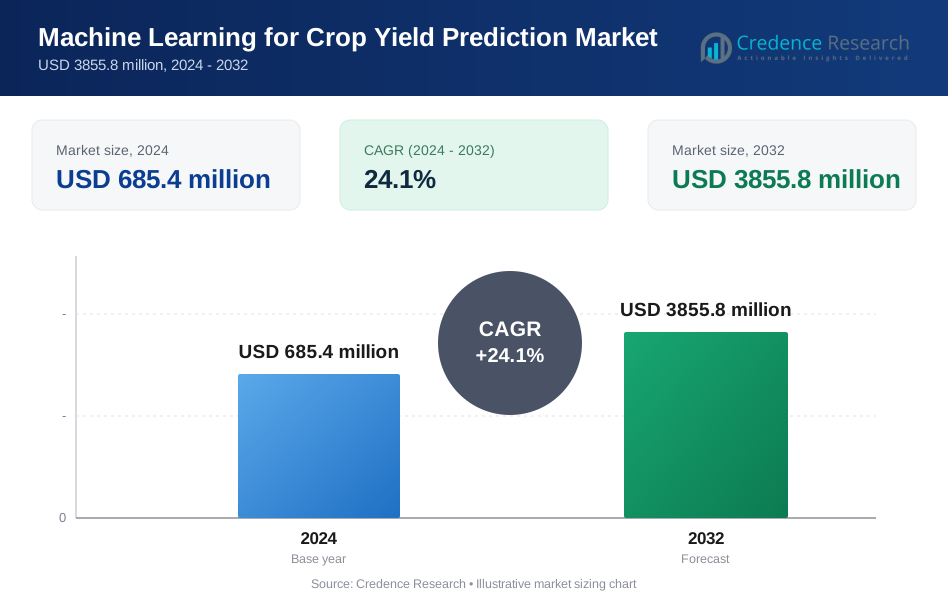
Machine Learning for Crop Yield Prediction Market size was valued at USD 685.4 million in 2024 and is anticipated to reach USD 3855.8 million by 2032, at a CAGR of 24.1% during the forecast period.
| REPORT ATTRIBUTE | DETAILS |
|---|---|
| Historical Period | 2020-2024 |
| Base Year | 2024 |
| Forecast Period | 2025-2032 |
| Machine Learning for Crop Yield Prediction Market Size 2024 | USD 685.4 Million |
| Machine Learning for Crop Yield Prediction Market, CAGR | 24.1% |
| Machine Learning for Crop Yield Prediction Market Size 2032 | USD 3855.8 Million |
The Machine Learning for Crop Yield Prediction Market is driven by the rising need for data-driven agriculture, growing pressure from climate variability, and increasing demand for sustainable farming practices. It enables farmers and agribusinesses to optimize input use, minimize risks, and improve productivity through predictive insights. Expanding adoption of IoT devices, drones, and satellite imaging strengthens real-time data availability for more accurate forecasting. It also benefits from government-backed digital farming initiatives and private agritech investments that accelerate innovation. Trends highlight the shift toward explainable AI, cloud-based platforms, and integration of multimodal data sources to enhance transparency, scalability, and decision-making in agriculture.
The Machine Learning for Crop Yield Prediction Market demonstrates strong adoption across North America, Europe, Asia-Pacific, Latin America, and the Middle East & Africa, with North America leading due to advanced digital infrastructure and early adoption of precision farming. Asia-Pacific shows rapid growth supported by government initiatives and agritech startups, while Europe emphasizes sustainability and regulatory alignment. Key players shaping the market include IBM Corporation, Microsoft, SAP, Corteva, Taranis, Ceres Imaging, Agroscout, Ag Leader Technology, and Blue River Technology.
Market Insights
- The Machine Learning for Crop Yield Prediction Market size was valued at USD 685.4 million in 2024 and is expected to reach USD 3855.8 million by 2032, growing at a CAGR of 24.1%.
- The market is driven by rising demand for data-driven agriculture, growing climate variability, and the need for sustainable farming practices.
- Trends highlight the increasing use of IoT devices, drones, satellite imaging, and explainable AI to enhance forecasting accuracy and farmer trust.
- Competitive strategies focus on innovation, cloud-based deployment, and partnerships that expand solutions across diverse geographies.
- Restraints include fragmented agricultural datasets, high implementation costs, and limited technical expertise among smallholder farmers.
- North America leads the market with advanced digital infrastructure, Asia-Pacific shows strong growth through government support, and Europe emphasizes sustainability and regulatory compliance.
- Key players include IBM Corporation, Microsoft, SAP, Corteva, Taranis, Ceres Imaging, Agroscout, Ag Leader Technology, and Blue River Technology.
Market Drivers
Rising Demand for Data-Driven Agriculture to Optimize Productivity
The Machine Learning for Crop Yield Prediction Market benefits from the global shift toward data-driven agriculture, where farmers and agribusinesses seek accurate insights for optimizing harvests. It empowers decision-makers to allocate resources such as seeds, water, and fertilizers more efficiently, reducing waste and increasing profitability. Governments and private organizations are supporting smart farming programs, creating strong momentum for adoption. Precision agriculture initiatives are expanding across developed and emerging economies, creating opportunities for predictive solutions. It allows stakeholders to respond swiftly to environmental uncertainties. Growing food demand across regions further reinforces the importance of predictive technologies in farming.
- For instance, Deere & Company reported that its ExactEmerge™ planters, equipped with machine learning-based seed placement, enabled farmers to plant at speeds of 16.1 kilometers per hour while maintaining precise seed spacing, resulting in yield gains of up to 2.1 bushels per acre in 2023 field trials.
Integration of Advanced Algorithms and Satellite Data for Precision Insights
The Machine Learning for Crop Yield Prediction Market gains strength from advancements in algorithms capable of processing vast agricultural datasets. It integrates satellite imagery, remote sensing, and weather data to deliver forecasts with higher accuracy. Such integration supports proactive decision-making by anticipating variations in crop health and soil conditions. Farmers use these tools to optimize irrigation schedules and nutrient applications. It provides agronomists with actionable intelligence to manage risks across large-scale operations. Enhanced computational power and scalable platforms accelerate the practical use of predictive models in agriculture.
- For instance, Planet Labs in partnership with BASF Digital Farming processed over 10 terabytes of satellite data per day in 2023, enabling its Xarvio® FIELD MANAGER platform to provide field-zone-specific yield predictions with an accuracy margin of ±6%, which directly guided nitrogen application across more than 2.8 million hectares in Europe.
Rising Pressure of Climate Variability on Agricultural Systems
The Machine Learning for Crop Yield Prediction Market responds directly to challenges posed by climate variability, which disrupts traditional farming practices. It enables predictive modeling of crop performance under fluctuating temperature, rainfall, and pest conditions. Advanced tools reduce uncertainty by offering scenario-based yield projections. It assists farmers in adapting to new conditions with strategies for crop rotation and diversification. Policymakers and cooperatives rely on these insights to design programs that mitigate climate risks. The pressure to sustain yields under unpredictable weather patterns drives the growing relevance of machine learning solutions.
Expansion of Agritech Investments and Industry Collaborations
The Machine Learning for Crop Yield Prediction Market experiences growth from increasing agritech investments and cross-industry collaborations. It attracts funding from venture capital, agricultural cooperatives, and government agencies to accelerate innovation. Partnerships between technology firms and farming enterprises create tailored solutions for local crop needs. It strengthens digital farming ecosystems where data analytics, IoT devices, and cloud platforms work in unison. Training initiatives are spreading to equip farmers with skills to adopt predictive tools effectively. Expanding collaborations position machine learning as a mainstream driver of sustainable and profitable agriculture.
Market Trends
Increasing Use of Multimodal Data Sources for Higher Accuracy
The Machine Learning for Crop Yield Prediction Market reflects a strong trend toward combining multimodal data inputs to strengthen forecasting accuracy. It integrates soil composition, historical yield records, satellite imagery, and weather patterns into unified models. This approach enables more reliable assessments of crop performance under diverse conditions. Farmers and cooperatives benefit from comprehensive insights that surpass single-source analysis. It enhances predictive power by aligning real-time field data with regional climate datasets. The growing use of multimodal inputs is establishing new benchmarks for agricultural intelligence.
- For instance, Harnessing the power of AI to transform agriculture - The Microsoft and ICRISAT used AI to analyze large datasets, including 30 years of climate data, millions of soil samples, and satellite imagery, to develop tools for sustainable agriculture, such as personalized climate advisories, soil health assessments, and pest risk prediction models.
Adoption of Cloud-Based Platforms to Support Scalable Deployment
The Machine Learning for Crop Yield Prediction Market demonstrates rapid adoption of cloud-based platforms that enable scalable access to predictive models. It reduces infrastructure costs while ensuring real-time processing of complex datasets. Cloud integration allows small and medium-scale farmers to access advanced tools without heavy capital investment. It supports continuous updates of models, reflecting changing field conditions and new agronomic practices. Collaboration between technology providers and agricultural stakeholders increases through shared data ecosystems. The shift to cloud solutions makes predictive analytics more inclusive across different farming scales.
- For instance, Climate FieldView™, Bayer’s cloud-based digital farming platform, collected and analyzed more than 245 million acres of farmer data globally in 2023, including 92 billion data points from North America alone, delivering field-specific yield predictions that reduced nitrogen use by 12 kilograms per hectare on average in U.S. cornfields.
Expansion of IoT and Sensor Networks for Real-Time Data Collection
The Machine Learning for Crop Yield Prediction Market gains momentum through the deployment of IoT devices and sensor networks across farmlands. It captures continuous data on soil moisture, nutrient levels, and crop health, feeding directly into predictive algorithms. Real-time data improves responsiveness in adjusting irrigation and fertilizer strategies. It allows growers to minimize risks tied to resource inefficiency. Integration of drones and smart devices adds another layer of precision. The expanding use of IoT technology creates a connected ecosystem that supports predictive farming practices.
Growing Emphasis on Explainable AI for Farmer Adoption
The Machine Learning for Crop Yield Prediction Market shows a trend toward explainable AI, where models provide transparency on how predictions are generated. It addresses trust barriers among farmers who seek clarity on decision-making processes. Transparent outputs increase willingness to adopt predictive systems in daily operations. It enables policymakers and financial institutions to rely on AI-driven insights for insurance and subsidy programs. Clear interpretability also supports training initiatives designed for rural communities. The focus on explainable AI is shaping farmer-centric innovation in predictive agriculture.
Market Challenges Analysis
Data Fragmentation and Limited Access to Quality Agricultural Datasets
The Machine Learning for Crop Yield Prediction Market faces a major challenge in accessing consistent and high-quality datasets required for model accuracy. It relies on diverse inputs such as weather records, soil parameters, crop phenology, and farm management practices, yet much of this data remains fragmented or unavailable in many regions. Smallholder farmers often lack proper digital infrastructure to collect and share reliable field-level information. It reduces the ability of predictive models to deliver uniform accuracy across geographies. Differences in data formats and standards also create barriers to integration. Building unified data ecosystems remains a critical hurdle that slows broader adoption of predictive technologies.
High Implementation Costs and Skills Gap in Rural Communities
The Machine Learning for Crop Yield Prediction Market encounters limitations due to the high costs associated with implementation and the lack of technical expertise among end-users. It requires investments in IoT devices, cloud platforms, and advanced analytics, which remain inaccessible for resource-constrained farmers. Training programs are not yet widespread, leading to resistance or slow adoption in rural areas. It creates dependency on external service providers, reducing autonomy for smaller farming operations. Financial institutions hesitate to extend support when user capacity for operating advanced systems is limited. Addressing affordability and education gaps remains essential to expand the practical reach of predictive agriculture solutions.
Market Opportunities
Expansion of Digital Farming Ecosystems Through Government and Private Initiatives
The Machine Learning for Crop Yield Prediction Market presents strong opportunities through government-backed agricultural digitization programs and private agritech investments. It supports national strategies to strengthen food security by improving predictive accuracy in crop management. Public funding for smart farming pilots creates favorable conditions for adoption in emerging economies. It enables agribusinesses to integrate predictive tools with broader digital ecosystems that include IoT, drones, and cloud platforms. Collaboration between policymakers, research institutions, and technology providers is opening avenues for scalable solutions. The rising focus on agricultural innovation policies ensures long-term potential for predictive analytics in farming.
Rising Demand for Sustainable Farming and Climate Resilience Solutions
The Machine Learning for Crop Yield Prediction Market shows significant opportunity in addressing sustainability goals and climate adaptation needs. It empowers farmers to reduce input waste while maximizing yield potential through precise recommendations. Agribusinesses can leverage predictive analytics to comply with sustainability regulations and carbon reduction initiatives. It positions predictive models as essential tools for climate-resilient agricultural practices. Expanding consumer demand for sustainably sourced food creates incentives for adoption at both farm and enterprise levels. The opportunity to align predictive solutions with global sustainability targets is reinforcing their role in the future of agriculture.
Market Segmentation Analysis:
By Component
The Machine Learning for Crop Yield Prediction Market is segmented into software and services, both driving adoption in modern agriculture. Software forms the core of this market, led by predictive modelling tools that forecast yields using real-time and historical data. It also includes advanced data analytics platforms that merge weather, soil, and satellite datasets into precise insights. Predictive modelling software is increasingly vital for optimizing planting schedules and input allocation. Data analytics platforms enhance decision-making with scalability and integration features, while other software components such as interfaces and connectors improve accessibility. Services support these tools, split into professional and managed categories. Professional services cover consulting, customization, and training to bridge knowledge gaps, while managed services provide continuous updates and system maintenance to ensure operational reliability.
- For instance, SAP’s Rural Sourcing Management platform connected over 2.1 million smallholder farmers across 30 countries in 2023, integrating mobile-based data collection and satellite imagery to track crop yields.
By Deployment Model
Deployment models in the Machine Learning for Crop Yield Prediction Market include cloud-based and on-premises solutions. Cloud-based systems lead adoption by offering scalability, cost efficiency, and real-time updates to users across diverse geographies. It allows farmers and cooperatives to benefit from advanced predictive tools without significant upfront investment. Cloud solutions also enable seamless integration with IoT devices and remote sensing data. On-premises deployment continues to serve organizations with strict data sovereignty requirements or limited connectivity. It provides full control over security and customization, making it suitable for government agencies and large agribusiness enterprises. Both models play an important role in addressing varied user needs across the sector.
- For instance, Corteva’s Granular platform supported over 23,000 farmers across North America in 2023, covering 30 million acres with machine learning–based yield prediction.
By End User
End users in the Machine Learning for Crop Yield Prediction Market include farmers, agricultural cooperatives, research institutions, and government agencies. Farmers represent a large segment, using predictive models to improve efficiency in input use and crop management. It enables smallholders and large-scale producers to minimize risks tied to climate variability. Agricultural cooperatives adopt these systems to support collective decision-making and resource allocation across member farms. Research institutions deploy machine learning platforms for experimentation and development of new agronomic practices. Government agencies use predictive tools to design policies, manage food security programs, and allocate subsidies more effectively. This diverse user base reflects the broad applicability of predictive analytics in agriculture.
Segments:
Based on Component:
- Software
- Predictive modelling software
- Data analytics platform
- Others
- Services
- Professional
- Managed
Based on Deployment Model:
- Cloud-based
- On-premises
Based on End-User:
- Farmers
- Agricultural cooperatives
- Research institutions
- Government agencies
Based on the Geography:
- North America
- U.S.
- Canada
- Mexico
- Europe
- Germany
- France
- U.K.
- Italy
- Spain
- Rest of Europe
- Asia Pacific
- China
- Japan
- India
- South Korea
- South-east Asia
- Rest of Asia Pacific
- Latin America
- Brazil
- Argentina
- Rest of Latin America
- Middle East & Africa
- GCC Countries
- South Africa
- Rest of the Middle East and Africa
Regional Analysis
North America
North America holds the largest share of the Machine Learning for Crop Yield Prediction Market at about 41%. The region benefits from advanced digital infrastructure, widespread use of precision farming, and strong access to reliable agricultural datasets. Farmers, cooperatives, and research institutions in the United States and Canada use machine learning platforms to improve decision-making across crops like corn, soybeans, and wheat. It is supported by high penetration of IoT devices and satellite monitoring systems that feed real-time data into predictive models. Governments and private investors provide funding to accelerate adoption, while universities and research centers contribute to model development. Large agritech companies such as IBM and Microsoft partner with cooperatives to deliver scalable, cloud-based solutions. This combination of technology, funding, and expertise secures North America’s leadership in this market.
Europe
Europe holds close to 18% of the global market and shows steady adoption. Western Europe, including Germany, France, and the Netherlands, leads within the region due to strong precision farming practices and strict sustainability regulations. It benefits from EU funding that supports research in digital agriculture and machine learning applications. Farmers use predictive models to manage vineyards, cereals, and dairy-related crops, focusing on sustainability and resource efficiency. Eastern Europe, while smaller in adoption, shows growing interest as governments modernize agricultural practices. It also contributes by investing in irrigation and soil health monitoring systems linked to predictive tools. Europe continues to emphasize explainable AI, ensuring that farmers understand and trust the outputs generated by these platforms.
Asia-Pacific
Asia-Pacific accounts for around 28% of the global market and is experiencing fast growth. The region’s large agricultural base, covering rice, wheat, corn, and horticultural crops, creates strong demand for predictive solutions. It is driven by government programs in countries such as India, China, and Australia that promote smart farming practices. Farmers face challenges of unpredictable climate and fragmented landholding, making predictive insights highly valuable. Agritech startups in India and China develop localized models for smallholder farmers, offering affordable and mobile-friendly tools. It is also supported by international collaborations that bring expertise into regional farming communities. Growing internet penetration and adoption of cloud platforms create a foundation for broader machine learning deployment.
Europe
Europe holds close to 18% of the global market and shows steady adoption. Western Europe, including Germany, France, and the Netherlands, leads within the region due to strong precision farming practices and strict sustainability regulations. It benefits from EU funding that supports research in digital agriculture and machine learning applications. Farmers use predictive models to manage vineyards, cereals, and dairy-related crops, focusing on sustainability and resource efficiency. Eastern Europe, while smaller in adoption, shows growing interest as governments modernize agricultural practices. It also contributes by investing in irrigation and soil health monitoring systems linked to predictive tools. Europe continues to emphasize explainable AI, ensuring that farmers understand and trust the outputs generated by these platforms.
Latin America
Latin America accounts for around 8% of the Machine Learning for Crop Yield Prediction Market, with Brazil and Argentina serving as the main contributors. The region’s dominance in global agricultural exports, especially soybeans, corn, sugarcane, and coffee, makes predictive solutions highly valuable. It uses satellite imagery, drones, and IoT-enabled soil sensors to feed machine learning models, helping farmers manage large fields efficiently. Brazil has already seen integration of predictive analytics into soybean production chains, where yield forecasting helps cooperatives plan storage, transportation, and export logistics more effectively. Argentina focuses on corn and wheat, where predictive tools are applied to balance fertilizer use and reduce costs while maintaining productivity.
Middle East & Africa
The Middle East and Africa hold about 5% of the Machine Learning for Crop Yield Prediction Market, making it the smallest but fastest-rising region. The region faces unique challenges such as water scarcity, high climate variability, and lack of digital infrastructure. It creates demand for lightweight, mobile, and cloud-based solutions that can operate even with limited connectivity. Governments and NGOs invest in pilot projects that target drought-prone and food-insecure areas. It supports yield prediction for staple crops such as maize, sorghum, and wheat, which are critical for food security. International partnerships play an important role by providing expertise, training, and technical resources. The long-term growth potential is high as these countries prioritize resilience and food sustainability.\
Key Player Analysis
- Taranis
- Ag Leader Technology
- IBM Corporation
- Blue River Technology
- Microsoft
- Ceres Imaging
- Agroscout
- SAP
- Corteva
- Microsoft Azure
Competitive Analysis
The Machine Learning for Crop Yield Prediction Market features from Taranis, Ag Leader Technology, IBM Corporation, Blue River Technology, Microsoft, Ceres Imaging, Agroscout, SAP, Corteva, and Microsoft Azure. The Machine Learning for Crop Yield Prediction Market is characterized by rapid technological advancement, growing collaboration, and strong emphasis on precision agriculture. Companies in this space focus on integrating artificial intelligence, satellite imagery, IoT devices, and cloud platforms to create predictive tools that enhance farming efficiency. Competition centers on improving model accuracy, scalability, and ease of adoption, particularly for small and mid-sized farms. Many players pursue partnerships with research institutions and government agencies to expand data access and refine algorithms for diverse geographies and crop types. The market also reflects a shift toward user-friendly platforms that provide real-time insights, allowing farmers to optimize input use, reduce risks, and improve sustainability. Investments in explainable AI and climate-resilient solutions further strengthen the competitive environment, ensuring that predictive technologies continue to evolve as critical components of modern agriculture.
Recent Developments
- In January 2025, IIT Indore launched the AgriHub Centre of Excellence, bringing together academia, industry, NGOs, and farmer cooperatives. Equipped with NVIDIA DGX hardware and high-capacity storage, the hub supports at least 11 ML/deep learning agricultural projects aimed at converting raw agri-data into actionable insights for farmers.
- In December 2023, John Deere invested USD 180 million to construct the Brazil Technology Development Center. With the establishment of the new Development Center, the company aims to reduce the development time for new solutions by up to 40%, depending on the project's type.
- In March 2023, Corteva Agrisciences introduced an advanced gene editing technology for corn hybrids. Utilizing machine learning data collected from farms, this early-stage concept integrates multiple disease-resistant traits into a single gene location using proprietary technology.
Market Concentration & Characteristics
The Machine Learning for Crop Yield Prediction Market shows a moderately concentrated structure, with global technology leaders and specialized agritech firms holding significant influence. It is defined by a mix of established software providers, cloud platform operators, and niche innovators that focus on imaging, data analytics, and IoT integration. Competition is shaped by the ability to deliver scalable solutions that combine accuracy with ease of use, appealing to both large agribusinesses and smallholder farmers. It emphasizes data-driven capabilities, drawing on satellite imagery, soil parameters, and weather information to refine predictive accuracy. Market characteristics highlight strong investment in R&D, frequent partnerships between private firms and research institutions, and rising demand for explainable AI that builds farmer trust. It also reflects high entry barriers due to the need for advanced algorithms, robust data ecosystems, and significant technical expertise. The market continues to evolve toward greater collaboration and interoperability, making machine learning-based yield prediction a central tool in sustainable and climate-resilient farming.
Report Coverage
The research report offers an in-depth analysis based on Component, Deployment Model, End-User and Geography. It details leading market players, providing an overview of their business, product offerings, investments, revenue streams, and key applications. Additionally, the report includes insights into the competitive environment, SWOT analysis, current market trends, as well as the primary drivers and constraints. Furthermore, it discusses various factors that have driven market expansion in recent years. The report also explores market dynamics, regulatory scenarios, and technological advancements that are shaping the industry. It assesses the impact of external factors and global economic changes on market growth. Lastly, it provides strategic recommendations for new entrants and established companies to navigate the complexities of the market.
Future Outlook
- The Machine Learning for Crop Yield Prediction Market will expand with stronger integration of AI, IoT, and remote sensing technologies.
- It will focus on developing models that adapt to climate variability and unpredictable weather patterns.
- Adoption will grow among small and medium farmers through mobile-based and affordable platforms.
- It will emphasize explainable AI to improve farmer trust and encourage broader use.
- Cloud-based deployment will continue to dominate, offering scalability and real-time data processing.
- Partnerships between agritech firms, governments, and research institutions will accelerate innovation.
- It will align with sustainability goals by supporting efficient use of water, fertilizers, and pesticides.
- Investment in R&D will strengthen algorithms designed for region-specific crops and soil conditions.
- Demand for data standardization and integration will increase to improve model accuracy.
- It will evolve into a central tool for digital farming strategies and long-term food security planning.
Request a Free Sample
Fill in your details and we'll send you a free sample report.
- Sample data tables & charts
- Research methodology
Need a Custom Version of This Report?
Tailor the scope, geography, or segments to your exact requirements.
- Custom geography or segment scope
- Direct access to our analyst team
Frequently Asked Questions
What is the current market size for Machine Learning for Crop Yield Prediction Market, and what is its projected size in 2032?
At what Compound Annual Growth Rate is the Machine Learning for Crop Yield Prediction Market projected to grow between 2025 and 2032?
Which Machine Learning for Crop Yield Prediction Market segment held the largest share in 2024?
What are the primary factors fueling the growth of the Machine Learning for Crop Yield Prediction Market?
Who are the leading companies in the Machine Learning for Crop Yield Prediction Market?
Which region commanded the largest share of the Machine Learning for Crop Yield Prediction Market in 2024?
Table of Content
Chapter 1. Report Introduction
- 1.1 Report Description & Purpose
- 1.1.1 Report Title & Market Definition
- 1.1.2 Unique Selling Propositions (USP) & Key Differentiators
- 1.1.3 Value Proposition for Stakeholders
- 1.2 Research Objectives
- 1.2.1 Market Sizing Objectives (Volume & Revenue)
- 1.2.2 Segmentation Objectives
- 1.2.3 Competitive Intelligence Objectives
- 1.2.4 Forecast & Scenario Objectives
- 1.3 Report Scope
- 1.3.1 Machine Learning for Crop Yield Prediction Scope – Types & Subtypes Covered
- 1.3.2 Geographic Scope – Regions & Countries Covered
- 1.3.3 Historical Period, Base Year & Forecast Period (2024; forecast to 2032)
- 1.3.4 Inclusions & Exclusions
- 1.4 HS Code & Classification Framework
- 1.5 Currency, Units & Pricing Basis
- 1.6 Target Stakeholders
- 1.7 Limitations & Assumptions
Chapter 2. Executive Summary
- 2.1 Global Machine Learning for Crop Yield Prediction Market Snapshot
- 2.1.1 Market Size – Historical (2024) & Forecast (2024-2032) (2024: USD 685.4 million → 2032: USD 3855.8 million)
- 2.1.2 Volume & Revenue – Global Totals
- 2.1.3 Key Market Highlights – Top Five Facts
- 2.2 Machine Learning for Crop Yield Prediction Market Segmentation Snapshot
- 2.2.1 Market Split by Region – 2024 vs. 2032
- 2.3 Competitive Snapshot
- 2.3.1 Top 10 Players by Revenue Share – 2024
- 2.3.2 Top 10 Players by Volume Share – 2024
- 2.3.3 Recent Strategic Developments (18-Month Summary)
- 2.4 Key Investment Highlights & Strategic Conclusions
Chapter 3. Machine Learning for Crop Yield Prediction Market Dynamics & Industry Analysis
- 3.1 Market Overview & Context
- 3.1.1 Machine Learning for Crop Yield Prediction Market Position in the Broader Automotive Value Chain
- 3.1.2 OEM vs. Replacement Market Dynamics
- 3.1.3 Market Maturity & Development Stage by Region
- 3.2 Machine Learning for Crop Yield Prediction Market Drivers
- 3.3 Machine Learning for Crop Yield Prediction Market Restraints & Challenges
- 3.4 Machine Learning for Crop Yield Prediction Market Opportunities
- 3.5 Porter's Five Forces Analysis
- 3.5.1 Threat of New Entrants
- 3.5.2 Bargaining Power of Suppliers
- 3.5.3 Bargaining Power of Buyers
- 3.5.4 Threat of Substitutes
- 3.5.5 Competitive Rivalry – Intensity Assessment
- 3.6 Machine Learning for Crop Yield Prediction Value Chain Analysis
- 3.6.1 Upstream – Raw Material/Input Suppliers
- 3.6.1.1 Raw Material/Input 1
- 3.6.1.2 Raw Material/Input 2
- 3.6.1.3 Raw Material/Input 3
- 3.6.2 Midstream – Production/Manufacturing/Service Delivery
- 3.6.2.1 Production/Process Overview
- 3.6.2.2 Key Facility Locations & Capacity by Manufacturer
- 3.6.3 Downstream – Distribution & End Consumer
- 3.6.3.1 Primary Channel – B2B/OEM
- 3.6.3.2 Secondary Channels – Dealer, Retail, Online, Direct
- 3.6.4 Value Chain Profitability Analysis
- 3.6.1 Upstream – Raw Material/Input Suppliers
- 3.7 PESTEL Analysis
- 3.7.1 Political Factors
- 3.7.2 Economic Factors
- 3.7.3 Social Factors
- 3.7.4 Technological Factors
- 3.7.5 Environmental Factors
- 3.7.6 Legal Factors
- 3.8 Machine Learning for Crop Yield Prediction Supply Chain Analysis
- 3.8.1 Raw Material/Input Supply Risk Assessment
- 3.8.2 Manufacturing Concentration Risk (Geographic Exposure)
- 3.8.3 Trade Disruption Impact Analysis
- 3.9 Regulatory & Policy Landscape
Note: The regulatory and policy landscape section covers regulations based on their applicability to the market, Machine Learning for Crop Yield Prediction category, geography, and scope of the study. Only regulatory frameworks with a material impact on operations, compliance, trade, sustainability, or market access are analyzed in detail.
Chapter 4. Key Investment Pockets & Opportunity Analysis
- 4.1 Machine Learning for Crop Yield Prediction Market Attractiveness Analysis
- 4.1.1 By Region – Investment Attractiveness Matrix (Volume × CAGR)
- 4.2 Absolute Revenue Growth Opportunity
- 4.2.1 By Region – Absolute USD Growth Through 2032
- 4.3 Incremental Volume Opportunity
- 4.3.1 By Region – Incremental Volume Through 2032
- 4.3.2 Segment – Incremental Volume
- 4.4 Emerging Submarket Opportunity Deep Dive (Subject to Applicability)
- 4.5 Emerging Market Opportunity Scorecards
- 4.5.1 United States
- 4.5.2 Europe
- 4.5.3 Asia
- 4.5.4 Middle East & Africa
Note: Emerging Market Opportunity Scorecards will be included based on relevance and strategic importance. Regions listed are indicative and may vary depending on data availability and market dynamics.
Chapter 5. Machine Learning for Crop Yield Prediction Import-Export Analysis & Trade Flows
- 5.1 Global Trade Overview
- 5.1.1 Global Export Value by Country (2024)
- 5.1.2 Global Export Volume by Country (2024)
- 5.1.3 Global Import Value by Country (2024)
- 5.1.4 Global Import Volume by Country (2024)
- 5.1.5 Net Trade Balance by Country (2024)
- 5.2 Export Analysis – Segment
- 5.2.1 Type 1 (HS Code)
- 5.2.2 Type 2 (HS Code)
- 5.2.3 Type 3 (HS Code)
- 5.2.4 Type 4 (HS Code)
- 5.2.5 Type 5 (HS Code)
- 5.3 Import Analysis – Segment
- 5.3.1 Type 1 (HS Code)
- 5.3.2 Type 2 (HS Code)
- 5.3.3 Type 3 (HS Code)
- 5.3.4 Type 4 (HS Code)
- 5.3.5 Type 5 (HS Code)
- 5.4 Average Unit Trade Prices
- 5.4.1 Average Export Price – Segment & Country
- 5.4.2 Average Import Price – Segment & Source Country
- 5.4.3 Price Trends (2024)
- 5.5 Key Trade Route Analysis
- 5.5.1 Trade Route 1
- 5.5.2 Trade Route 2
- 5.5.3 Trade Route 3
- 5.5.4 Trade Route 4
- 5.5.5 Trade Route 5
- 5.6 Trade Policy Impact Assessment
- 5.6.1 US Anti-Dumping & Section 301 Tariffs
- 5.6.2 EU Customs Union Impact
- 5.6.3 Major Free Trade Agreements
- 5.6.4 USMCA Rules of Origin
Note: Trade policy analysis will be included only where relevant to the Machine Learning for Crop Yield Prediction market.
Chapter 6. Competitive Landscape & Company Benchmarking
- 6.1 Machine Learning for Crop Yield Prediction Market Concentration & Structure
- 6.1.1 Herfindahl-Hirschman Index (HHI) – vs. 2024
- 6.1.2 Tier 1, Tier 2 & Tier 3 Market Structure
- 6.1.3 Global, Regional & Local Player Dynamics
- 6.2 Machine Learning for Crop Yield Prediction Market Share Analysis – 2024
- 6.2.1 Global Revenue Share by Company
- 6.2.2 Global Volume Share by Company
- 6.2.3 Regional Revenue Share
- 6.2.4 Market Share Evolution ( vs. 2024)
- 6.2.5 OEM Segment Share by Company
- 6.2.6 Replacement Segment Share by Company
- 6.3 Production/Delivery Capacity & Facility Analysis
- 6.3.1 Global Installed Capacity
- 6.3.2 Capacity Utilization Rates
- 6.3.3 Production/Output Volume
- 6.3.4 Facility Locations & Capacity Map
- 6.3.5 Planned Capacity Additions
- 6.4 Machine Learning for Crop Yield Prediction Competitive Benchmarking Matrix
- 6.4.1 Revenue, Volume, CAGR & Profitability Comparison
- 6.4.2 Channel Revenue Mix
- 6.4.3 Geographic Revenue Exposure
- 6.4.4 R&D Intensity
- 6.4.5 Sustainability Maturity
- 6.5 Strategic Developments in Machine Learning for Crop Yield Prediction (Last 24 Months)
- 6.5.1 Mergers, Acquisitions & Divestments
- 6.5.2 New Machine Learning for Crop Yield Prediction Launches
- 6.5.3 Facility Expansions
- 6.5.4 Strategic Alliances, Joint Ventures & Partnerships
- 6.5.5 Distribution Expansion & Market Entry
- 6.5.6 Sustainability & ESG Initiatives
- 6.6 Competitive Strategy Mapping
- 6.6.1 Leader, Challenger, Follower & Niche Classification
- 6.6.2 Pricing Strategy Comparison
- 6.6.3 Channel Strategy Matrix
Note: Strategic developments are included based on their materiality and the availability of reliable information.
Chapter 7. Global Machine Learning for Crop Yield Prediction Market – By Distribution Channel
- 7.1 Segment Overview
- 7.1.1 Volume & Revenue Split by Channel (2024 & 2032)
- 7.1.2 Channel Mix Evolution (2024-2032)
Chapter 8. Regional Market Analysis – Global Overview
- 8.1 Global Regional Overview
- 8.1.1 Regional Volume Share
- 8.1.2 Regional Revenue Share
- 8.1.3 Regional Volume by Region
- 8.1.4 Regional Revenue by Region
- 8.1.5 Regional Forecast Through 2032
- 8.2 Cross-Regional Segment Analysis
- 8.2.1 By Distribution Channel
- 8.2.2 By Brand/Price Tier
Chapter 9. North America Machine Learning for Crop Yield Prediction Market
- 9.1 United States
- 9.2 Canada
- 9.3 Mexico
Chapter 10. Europe Machine Learning for Crop Yield Prediction Market
- 10.1 Germany
- 10.2 France
- 10.3 Italy
- 10.4 United Kingdom
- 10.5 Spain
- 10.6 Poland
- 10.7 Russia
- 10.8 Netherlands
- 10.9 Belgium
- 10.10 Sweden
- 10.11 Denmark
- 10.12 Norway
- 10.13 Rest of Europe
Chapter 11. Asia Pacific Machine Learning for Crop Yield Prediction Market
- 11.1 China
- 11.2 India
- 11.3 Japan
- 11.4 South Korea
- 11.5 Thailand
- 11.6 Indonesia
- 11.7 Vietnam
- 11.8 Malaysia
- 11.9 Australia
- 11.10 Rest of Asia Pacific
Chapter 12. Latin America Machine Learning for Crop Yield Prediction Market
- 12.1 Brazil
- 12.2 Argentina
- 12.3 Colombia
- 12.4 Chile
- 12.5 Rest of Latin America
Chapter 13. Middle East Machine Learning for Crop Yield Prediction Market
- 13.1 Saudi Arabia
- 13.2 United Arab Emirates
- 13.3 Turkey
- 13.4 Israel
- 13.5 Iran
- 13.6 Rest of the Middle East
Chapter 14. Africa Machine Learning for Crop Yield Prediction Market
- 14.1 South Africa
- 14.2 Egypt
- 14.3 Nigeria
- 14.4 Morocco
- 14.5 Rest of Africa
Chapter 15. Machine Learning for Crop Yield Prediction Company Profiles
- 15.1 [Company 01]
- 15.1.1 Company Overview
- 15.1.2 Key Management Personnel
- 15.1.3 Products & Services Portfolio
- 15.1.4 Financial Performance
- 15.1.5 Key Market Focus & Geographic Presence
- 15.1.6 Recent Developments & Strategic Initiatives
Note: The company profile list is preliminary and may change based on research findings, market developments, data availability, and client requirements.
Chapter 16. Appendices
- Appendix A – List of Abbreviations & Acronyms
- Appendix B – Industry Classification Code Reference – Full Series
- Appendix C – Production & Capacity Data Tables
- Appendix D – End-Use & Demand Base Tables
- Appendix E – Consumption & Replacement Rate Assumptions
- Appendix F – ASP Reference Tables
- Appendix G – Manufacturing & Facility Database
- Appendix H – Import-Export Data Tables
- Appendix I – Regulatory Summary Tables
- Appendix J – Primary Research Participant List (Anonymized)
- Appendix K – Primary Research Questionnaire Framework
- Appendix L – Data Sources & Bibliography
- Appendix M – Market Size Divergence & Source Comparison
Chapter 17. Research Methodology
- 17.1 Research Framework & Philosophy
- 17.2 Secondary Research – Sources, Hierarchy & Data Extraction
- 17.3 Data Modeling – Bottom-Up & Top-Down Market Sizing
- 17.4 Primary Research – Stakeholder Framework, LOI & Sample Sizes
- 17.5 Forecast Methodology – Regression, Scenario & Sensitivity Analysis
- 17.6 Quality Control – Four-Layer Validation Framework
- 17.7 Limitations & Standard Assumptions
- 17.8 Disclaimer
