Market Overview
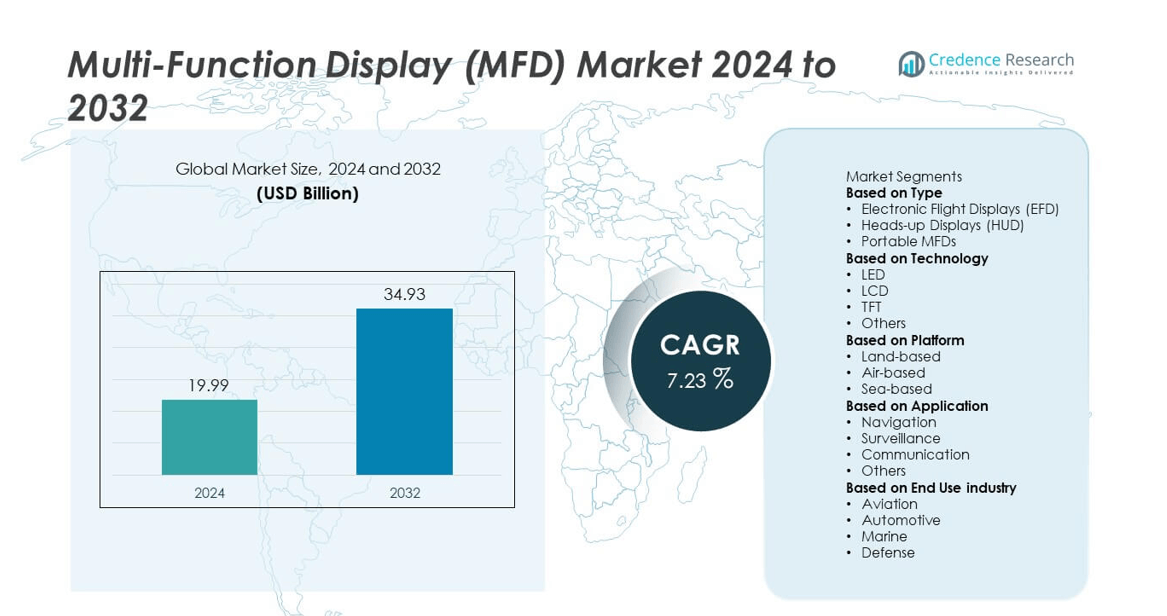
Multi-Function Display (MFD) Market size was valued at USD 19.99 billion in 2024 and is projected to reach USD 34.93 billion by 2032, growing at a CAGR of 7.23% during the forecast period.
| REPORT ATTRIBUTE |
DETAILS |
| Historical Period |
2020-2023 |
| Base Year |
2024 |
| Forecast Period |
2025-2032 |
| Multi-Function Display (MFD) Market Size 2024 |
USD 19.99 billion |
| Multi-Function Display (MFD) Market, CAGR |
7.23% |
| Multi-Function Display (MFD) Market Size 2032 |
USD 34.93 billion |
The Multi-Function Display (MFD) Market grows with rising demand from aerospace, defense, automotive, and industrial sectors. Aviation and military platforms adopt MFDs to enhance situational awareness, mission efficiency, and operator safety. Automotive manufacturers integrate advanced digital dashboards and infotainment systems to meet consumer demand for connectivity and user-friendly interfaces.
The Multi-Function Display (MFD) Market demonstrates strong global presence across North America, Europe, Asia-Pacific, Latin America, and the Middle East & Africa. North America leads adoption with its advanced aerospace and defense sectors, supported by investments in military modernization and commercial aviation. Europe follows with demand from premium automotive manufacturers and growing use in defense aviation and business jets. Asia-Pacific emerges as the fastest-growing region, driven by expanding air travel, rising defense budgets, and the integration of digital displays in electric and connected vehicles. Latin America and the Middle East & Africa show gradual adoption, supported by automotive growth, fleet modernization, and defense upgrades. Key players shaping this market include Collins Aerospace, Garmin Ltd., BAE Systems, and Barco N.V., all of which focus on innovation, advanced display technologies, and strategic partnerships.
Market Insights
- The Multi-Function Display (MFD) Market was valued at USD 19.99 billion in 2024 and is projected to reach USD 34.93 billion by 2032, growing at a CAGR of 7.23%.
- Rising demand from aerospace and defense sectors drives growth, with MFDs enhancing pilot safety, navigation, and mission performance through real-time data visualization.
- Key trends include increasing use of OLED and LCD technologies, touchscreen-enabled interfaces, and growing integration of augmented reality and 3D visualization in aviation, defense, and automotive systems.
- Leading players such as Collins Aerospace, Garmin Ltd., BAE Systems, Barco N.V., and Aspen Avionics compete by investing in high-resolution, energy-efficient, and ruggedized display solutions.
- Market restraints include high production and integration costs, limited performance under extreme conditions, and cybersecurity risks linked to connected platforms, which challenge wider adoption.
- North America leads adoption through strong defense spending and advanced aerospace programs, while Europe shows steady growth in premium automotive and defense aviation applications.
- Asia-Pacific emerges as the fastest-growing region due to rising air travel, defense investments, and automotive digitalization, while Latin America and the Middle East & Africa gradually expand adoption in aviation, automotive, and defense upgrades.
Access crucial information at unmatched prices!
Request your sample report today & start making informed decisions powered by Credence Research Inc.!
Download Sample
Market Drivers
Rising Demand for Advanced Avionics and Military Applications
The Multi-Function Display (MFD) Market grows with expanding adoption in aviation and defense sectors. Military aircraft, helicopters, and naval vessels integrate MFDs for navigation, situational awareness, and mission control. Advanced avionics rely on these systems to provide pilots with real-time data and enhanced visibility. Rising global defense budgets support large-scale procurement of modern aircraft equipped with advanced cockpit displays. Growing emphasis on reducing pilot workload and improving safety strengthens demand for intuitive multi-function interfaces. It positions MFDs as essential components in modern defense platforms.
- For instance, Elbit Systems develops advanced Panoramic Cockpit Displays (PCDs) designed to enhance pilot situational awareness and mission effectiveness in advanced aircraft. These displays integrate flight and mission data into a single, unified interface, featuring capabilities such as sensor fusion and real-time mission symbology.
Strong Adoption in Automotive and Commercial Vehicles
The Multi-Function Display (MFD) Market benefits from increasing integration in automotive and commercial vehicles. Automakers equip vehicles with digital displays for infotainment, driver assistance, and real-time diagnostics. Consumers prefer vehicles with advanced digital dashboards that improve user experience and connectivity. Growing adoption of electric and autonomous vehicles further accelerates demand for high-performance displays. Manufacturers focus on delivering compact, durable, and energy-efficient solutions tailored for automotive use. It reinforces MFDs as central elements in next-generation mobility solutions.
- For instance, Barco introduced rugged smart displays for ground vehicles such as the SV‑126 (10‑inch XGA) and SV‑231 (12‑inch WXGA) panels, both enclosed in a depth of 84 mm, meeting military specifications for vehicle deployment.
Expansion of Consumer Electronics and Industrial Applications
The Multi-Function Display (MFD) Market advances with growing use in consumer electronics and industrial systems. Tablets, gaming consoles, and wearables incorporate MFDs to deliver interactive and versatile user interfaces. Industrial automation leverages these displays for monitoring, process control, and diagnostics. Growing demand for lightweight, high-resolution, and touch-enabled devices strengthens adoption across industries. Investments in manufacturing and energy sectors increase use of MFDs for remote monitoring and control applications. It ensures steady market growth through diverse industrial and consumer applications.
Technological Advancements in Display and Interface Design
The Multi-Function Display (MFD) Market benefits from continuous improvements in display technology. Innovations such as OLED, LCD, and touchscreen interfaces enhance clarity, durability, and user interaction. Integration of augmented reality and 3D visualization expands possibilities for military, automotive, and aerospace applications. Manufacturers develop energy-efficient solutions with longer lifecycles to meet sustainability goals. Compact designs and modular configurations allow customization across sectors. It drives innovation that ensures MFDs remain adaptable and competitive in evolving technology landscapes.
Market Trends
Growing Integration in Next-Generation Aircraft and Defense Systems
The Multi-Function Display (MFD) Market shows strong adoption in advanced aircraft and defense vehicles. Modern fighter jets, helicopters, and naval platforms integrate MFDs to improve mission efficiency and reduce operator workload. Defense agencies demand high-resolution, ruggedized displays that can function in extreme environments. Enhanced situational awareness through real-time mapping and sensor fusion strengthens operational capability. Rising defense modernization programs across major economies support this trend. It positions MFDs as critical assets in enhancing defense and aerospace performance.
- For instance, Elbit Systems of America is supplying the Wide‑Angle Conventional Head‑Up Display (WACHUD) for USAF F‑16 Block 40/42 jets under an ID/IQ contract.
Expansion of Automotive Digital Cockpits and Infotainment
The Multi-Function Display (MFD) Market evolves with wider use in automotive digital cockpits. Automakers equip vehicles with MFDs to deliver navigation, entertainment, and driver-assist features on unified interfaces. Electric and autonomous vehicles rely heavily on advanced displays for communication between driver and machine. Consumers prefer sleek dashboards with touch-based, customizable features. Manufacturers design MFDs that balance functionality with energy efficiency to match automotive requirements. It ensures steady expansion of MFDs in both passenger and commercial vehicles.
- For instance, at CES 2025, Garmin revealed its Unified Cabin system, incorporating six automotive-grade fascia displays: a 15.6-inch cluster, a 27-inch center stack, two 15.6-inch front-seat passenger displays, and two more 15.6-inch rear headrest units, all bonded under custom Corning AutoGrade Gorilla Glass.
Rising Demand for High-Resolution and Touchscreen Interfaces
The Multi-Function Display (MFD) Market advances with the shift toward high-resolution and touch-enabled designs. End users demand displays offering clear visibility, multi-touch support, and real-time responsiveness. OLED and LCD technologies dominate, offering energy efficiency and sharper visuals. Industrial and consumer electronics sectors adopt these interfaces to improve usability and productivity. Companies invest in durable and lightweight designs to enhance performance across applications. It reinforces the trend toward user-friendly, interactive, and adaptable display systems.
Adoption of Augmented Reality and 3D Visualization
The Multi-Function Display (MFD) Market benefits from the growing role of augmented reality and 3D visualization. Aerospace and automotive industries explore AR-enabled displays for navigation and driver assistance. Defense applications integrate 3D visualization to enhance mapping, targeting, and tactical decision-making. Consumer electronics increasingly adopt AR-driven interfaces for gaming and virtual interaction. Manufacturers focus on merging advanced visualization with compact form factors to meet diverse application needs. It highlights innovation as a driving force shaping future MFD adoption.
Market Challenges Analysis
High Development Costs and Complex Integration Requirements
The Multi-Function Display (MFD) Market faces challenges due to high development and integration costs. Advanced displays require precision engineering, durable materials, and compliance with strict safety standards, particularly in aerospace and defense. Manufacturers must invest heavily in R&D to improve resolution, durability, and energy efficiency. Integration into complex systems such as aircraft cockpits or military vehicles demands specialized expertise and testing. These requirements increase costs for both producers and end users. It creates barriers for smaller companies and limits large-scale adoption in cost-sensitive sectors.
Performance Limitations and Security Concerns
The Multi-Function Display (MFD) Market also struggles with technical limitations and data security issues. Displays in defense, automotive, and industrial applications must deliver uninterrupted performance under extreme conditions. Failures in visibility, touchscreen sensitivity, or software stability can compromise mission-critical operations. Cybersecurity threats to connected systems raise risks of unauthorized access or data breaches. Manufacturers face pressure to deliver secure, reliable, and ruggedized solutions while keeping costs manageable. It highlights the need for continuous innovation and stronger safeguards to ensure market reliability and trust.
Market Opportunities
Expansion in Next-Generation Mobility and Aviation Systems
The Multi-Function Display (MFD) Market offers strong opportunities with the rise of electric and autonomous vehicles. Automakers adopt MFDs to deliver advanced infotainment, navigation, and driver-assist features through digital cockpits. Aviation systems also demand next-generation displays for improved safety and efficiency. Growing investment in passenger aircraft, business jets, and defense fleets supports large-scale deployment. Companies that provide lightweight, energy-efficient, and customizable solutions will secure strong positions in this market. It strengthens the role of MFDs in transforming both automotive and aerospace user experiences.
Adoption in Consumer Electronics and Industrial Applications
The Multi-Function Display (MFD) Market also benefits from growing adoption in consumer electronics and industrial automation. Tablets, gaming devices, and wearable technologies integrate MFDs to improve interactivity and versatility. Industrial systems employ them for process control, diagnostics, and remote monitoring in manufacturing and energy operations. Rising demand for touch-enabled, high-resolution interfaces enhances opportunities across multiple sectors. Manufacturers that align with sustainability goals through energy-efficient designs will capture broader markets. It ensures MFDs remain essential for supporting digital transformation in consumer and industrial ecosystems.
Market Segmentation Analysis:
By Type
The Multi-Function Display (MFD) Market divides into primary flight displays, navigation displays, head-up displays, and others. Primary flight displays dominate in aerospace, providing pilots with real-time data to enhance safety and reduce workload. Navigation displays show steady growth in automotive and marine applications, where reliable route visualization is critical. Head-up displays gain momentum in both defense and automotive sectors as they improve situational awareness without distracting operators. Other specialized display types support industrial and consumer electronics applications. It highlights the growing role of diverse display solutions across multiple industries.
- For instance, Astronautics Corporation of America offers its Ibex™ Color MFD, which supports ARINC 818 video inputs and RS-422 control interfaces. It handles multi-format data—including primary flight, navigation, engine, and mission information—in a ruggedized form factor suitable for military aircraft.
By Technology
The Multi-Function Display (MFD) Market advances through technologies such as LCD, OLED, and TFT-LCD. LCD remains a widely adopted option due to cost-effectiveness and adaptability across platforms. OLED technology grows rapidly, offering high resolution, lightweight construction, and energy efficiency, making it suitable for premium automotive and defense applications. TFT-LCD continues to find strong use in industrial and consumer electronics due to its durability and clarity. Manufacturers focus on advancing display brightness, touch sensitivity, and ruggedization to meet demanding requirements. It ensures continuous improvement in performance across all major sectors.
- For instance, Garmin’s G1000 integrated flight instrument system uses 10-inch to 15-inch LCD Display Units (GDUs) capable of entering reversionary mode. If the MFD fails, the remaining display functions as both a primary flight display and MFD, maintaining full operability
By Platform
The Multi-Function Display (MFD) Market demonstrates broad deployment across aviation, automotive, naval, and industrial platforms. Aviation holds a significant share, with MFDs used in commercial aircraft, helicopters, and military jets for navigation and mission control. Automotive adoption rises quickly, driven by digital dashboards, infotainment systems, and driver-assist features. Naval platforms integrate MFDs for monitoring and combat systems, improving operational efficiency and control. Industrial applications leverage MFDs for diagnostics, monitoring, and automation in energy and manufacturing sectors. It underlines the versatility of MFDs as essential tools across both defense and commercial environments.
Segments:
Based on Type
- Electronic Flight Displays (EFD)
- Heads-up Displays (HUD)
- Portable MFDs
Based on Technology
Based on Platform
- Land-based
- Air-based
- Sea-based
Based on Application
- Navigation
- Surveillance
- Communication
- Others
Based on End Use industry
- Aviation
- Automotive
- Marine
- Defense
Based on the Geography:
- North America
- Europe
- UK
- France
- Germany
- Italy
- Spain
- Russia
- Belgium
- Netherlands
- Austria
- Sweden
- Poland
- Denmark
- Switzerland
- Rest of Europe
- Asia Pacific
- China
- Japan
- South Korea
- India
- Australia
- Thailand
- Indonesia
- Vietnam
- Malaysia
- Philippines
- Taiwan
- Rest of Asia Pacific
- Latin America
- Brazil
- Argentina
- Peru
- Chile
- Colombia
- Rest of Latin America
- Middle East
- UAE
- KSA
- Israel
- Turkey
- Iran
- Rest of Middle East
- Africa
- Egypt
- Nigeria
- Algeria
- Morocco
- Rest of Africa
Regional Analysis
North America
North America holds the largest share of the Multi-Function Display (MFD) Market, accounting for 34% in 2024. The region benefits from strong defense spending, advanced aerospace manufacturing, and rapid adoption of digital cockpit systems in commercial aviation. The United States drives demand with extensive use of MFDs in fighter jets, helicopters, and naval platforms. The automotive industry also accelerates adoption through integration of digital dashboards and infotainment systems in both passenger and commercial vehicles. Canada contributes with investments in aviation and industrial automation where advanced displays support operational efficiency. Strong R&D infrastructure and collaborations between technology providers and defense agencies enhance innovation. It ensures North America maintains leadership in high-performance MFD applications across defense, aerospace, and automotive sectors.
Europe
Europe represents the second-largest market, holding 29% share in 2024. The region shows steady growth driven by investments in military modernization, commercial aviation, and luxury automotive production. Countries such as Germany, France, and the United Kingdom lead adoption, emphasizing integration of advanced MFDs in fighter jets, business jets, and premium automobiles. The European automotive industry plays a central role, as automakers adopt high-resolution, touch-enabled displays for infotainment and driver-assist systems. Regulatory emphasis on safety and sustainability drives adoption in both defense and civilian applications. Eastern Europe also shows rising demand as regional air forces modernize fleets with advanced cockpit technologies. It positions Europe as a strong hub for both production and deployment of multi-function display systems.
Asia-Pacific
Asia-Pacific accounts for 25% of the Multi-Function Display (MFD) Market in 2024 and emerges as the fastest-growing region. Rising defense budgets in China, India, and Japan accelerate demand for advanced avionics and cockpit displays. Commercial aviation in the region expands rapidly, driven by increasing air travel and fleet modernization programs. Automotive industries in South Korea, Japan, and China also contribute significantly through adoption of MFDs in electric and connected vehicles. Local manufacturers focus on cost-efficient production of LCD and OLED displays, improving accessibility across markets. Governments support smart infrastructure and industrial automation, where MFDs are integrated into monitoring and control systems. It ensures Asia-Pacific secures long-term growth momentum as both a producer and consumer of advanced display technologies.
Latin America
Latin America contributes 7% share to the Multi-Function Display (MFD) Market in 2024. Growth is supported by rising investment in defense aviation and expanding automotive markets in Brazil and Mexico. Regional airlines modernize fleets, adopting MFDs to improve passenger and pilot safety. Automotive manufacturers integrate digital dashboards and infotainment systems to meet consumer demand for advanced features. Economic challenges limit large-scale procurement, but niche demand for high-performance systems grows steadily. Partnerships with international display manufacturers help local markets gain access to advanced technology. It reinforces Latin America’s role as a developing but promising region for MFD adoption.
Middle East & Africa
The Middle East & Africa holds 5% share of the Multi-Function Display (MFD) Market in 2024. Gulf countries such as Saudi Arabia and the UAE drive adoption through defense modernization and investments in commercial aviation. Africa shows gradual growth with expanding automotive and industrial applications, though limited infrastructure constrains large-scale deployment. Rising demand for luxury vehicles and advanced avionics in business jets supports regional expansion. Governments invest in upgrading military fleets with advanced cockpit display technologies. Collaborations with global aerospace and automotive players introduce high-performance MFD systems into local markets. It highlights the region as an emerging area with long-term potential for defense and commercial applications.
Shape Your Report to Specific Countries or Regions & Enjoy 30% Off!
Key Player Analysis
Competitive Analysis
Competitive landscape of the Multi-Function Display (MFD) Market is shaped by Collins Aerospace, Garmin Ltd., BAE Systems, Barco N.V., Aspen Avionics, Inc., Astronautics Corporation of America, Avidyne Corporation, Elbit Systems, Esterline Technologies, and FLIR Systems. These players focus on delivering advanced display solutions that meet the growing needs of aerospace, defense, automotive, and industrial sectors. Companies invest heavily in R&D to enhance resolution, durability, and energy efficiency while integrating technologies such as OLED, LCD, and touchscreen interfaces. Defense applications demand ruggedized, high-performance systems, while automotive and consumer markets emphasize compact, user-friendly designs. Strategic partnerships with aircraft manufacturers, automakers, and defense agencies help expand product reach and strengthen global positioning. Competition remains intense as firms differentiate through innovation, customization, and compliance with strict regulatory and safety standards. It ensures continuous advancement in multi-function displays, reinforcing their role as essential components in modern digital and mission-critical environments.
Recent Developments
- In June 2025, BAE Systems signed an MOU with Hanwha Systems to co-develop a multi-sensor satellite system, enhancing surveillance and display capabilities.
- In April 2025, Collins Aerospace Enhanced real-time situational awareness for Marines by integrating commercial and military sensor data into MFD platforms during Project Convergence Capstone 5.
- In March 2025, Collins Aerospace began first shipments of its Venue™ smart monitor integrated with Airshow™ HD, delivering 4K touchscreen in-flight entertainment for business jets as a standalone solution
Report Coverage
The research report offers an in-depth analysis based on Type, Technology, Platform, Application, End Use industry and Geography. It details leading market players, providing an overview of their business, product offerings, investments, revenue streams, and key applications. Additionally, the report includes insights into the competitive environment, SWOT analysis, current market trends, as well as the primary drivers and constraints. Furthermore, it discusses various factors that have driven market expansion in recent years. The report also explores market dynamics, regulatory scenarios, and technological advancements that are shaping the industry. It assesses the impact of external factors and global economic changes on market growth. Lastly, it provides strategic recommendations for new entrants and established companies to navigate the complexities of the market.
Future Outlook
- Demand for multi-function displays will grow with rising aerospace and defense modernization.
- Automotive digital cockpits will drive adoption in electric and autonomous vehicles.
- High-resolution OLED and LCD technologies will dominate new product developments.
- Touchscreen and customizable interfaces will become standard in next-generation systems.
- Augmented reality and 3D visualization will expand applications in aviation and defense.
- Consumer electronics and gaming devices will create new opportunities for compact MFDs.
- Industrial automation and energy sectors will increase reliance on MFDs for monitoring.
- Asia-Pacific will remain the fastest-growing region with strong aviation and automotive demand.
- Cybersecurity and ruggedization will gain focus to meet mission-critical requirements.
- Strategic partnerships and continuous R&D investment will drive innovation and competitiveness.



