
| REPORT ATTRIBUTE | DETAILS |
|---|---|
| Historical Period | 2019-2022 |
| Base Year | 2023 |
| Forecast Period | 2024-2032 |
| Brain Health Supplements Market Size 2023 | USD 9357.2 million |
| Brain Health Supplements Market, CAGR | 14.30% |
| Brain Health Supplements Market Size 2032 | USD 31157.45 million |
Market Insights
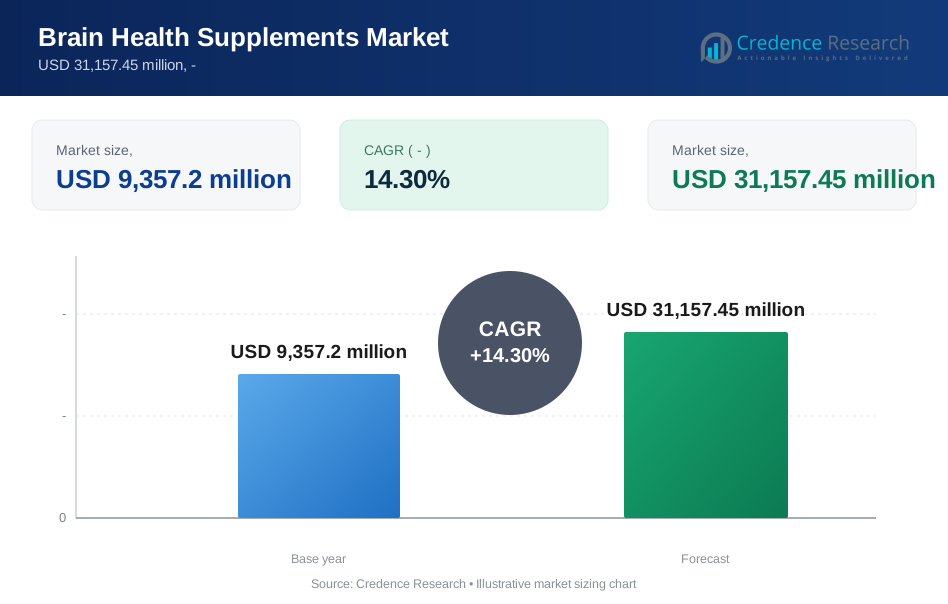
- Between 2024 and 2032, the global market for brain health supplements is projected to expand at a compound annual growth rate (CAGR) of 14.30%, from an estimated USD 9357.2 million in 2023 to USD 31157.45 million in 2032.
- The largest category is vitamins and minerals. Herbal extracts, on the other hand, are expected to grow at a strong CAGR.
- The tablets and capsules category will expand rapidly.
- Throughout the projected period, the CAGR for memory enhancement is anticipated to be the highest.
- Throughout the projection period, the athletes and fitness enthusiasts should have the largest compound annual growth rate.
- The health and wellness stores should have the highest compound annual growth rate throughout the projection period.
- Asia Pacific controlled the brain health supplements market.
- Regarding the market share of brain health supplements, Europe is expected to come second.
- North America is expected to experience the fastest growth in the brain health supplements industry.
- The aging population, growing health consciousness, and stressful lifestyles are factors driving the global brain health supplements market's growth.
- The sector for brain health supplements may benefit from advancements in supplement formulation and delivery, an emphasis on preventative healthcare measures, and growing disposable incomes.
Executive Summary
Market Definition
The sector focuses on the development, marketing, and distribution of dietary supplements specially designed to support and improve cognitive abilities, mental clarity, memory, mood, and general brain health, which is known as the brain health supplements market. Vitamins, minerals, amino acids, herbal extracts, and other bioactive substances are frequently found in these supplements; these substances are thought to enhance mental health, prevent cognitive decline, and enhance brain function. The market serves a broad spectrum of customers, such as those seeking to manage particular neurological disorders or age-related cognitive decline, maintain cognitive health, or enhance mental performance.
Market Overview
It is predicted that the brain health supplements industry will continue its upward trajectory between 2024 and 2032, growing at a compound annual growth rate (CAGR) of 14.30%. From its projected USD 9357.2 million in 2023 to USD 31157.45 million in 2032, the market will continue to grow.
The expansion is ascribed to growing public awareness of mental health conditions such as depression, anxiety, and concentration and focus problems, as well as memory loss. Furthermore, throughout the projected period, the growing popularity of natural and herbal health products is expected to support the industry's expansion. It is anticipated that increased R&D activity in this sector would be driven by the growing need for multi-efficacy medications that function as anxiety reducers, antidepressants, energy boosters, and brain boosters. Furthermore, it is anticipated that the growing demand from the sports sector to increase athletes' brain efficacy will create potential prospects for the global brain health supplements market.
In the coming years, customer demand for brain health supplements is anticipated to increase due to the involvement of individuals in the academic and professional domains. Those with a variety of mental health conditions, including depression, dementia, anxiety, and sleeplessness, are also likely to find great acceptance for these items. In September 2021, some 280 million individuals worldwide of all ages suffered from depression, according to a World Health Organization (WHO) report. One of the most prevalent mental ailments in the United States is anxiety disorder. These medications are also used to treat hyperactivity and Parkinson's disease, among other age- and cognitive-related diseases. The market for brain health supplements is anticipated to rise as awareness of mental health wellness and cognitive development grows.
Segmentation by Type of Supplement
- Vitamins and minerals are the market leader in terms of supplement type. Because of their demonstrated advantages in promoting cognitive function, improving memory, and halting cognitive decline, vitamins and minerals are in high demand in the market for brain health supplements. Customers are looking for safe, all-natural solutions to improve their mental well-being.
- The herbal extracts category will exhibit a sizable CAGR during the projected period. The market for brain health supplements is seeing a rise in demand for herbal extracts due to consumer preference for all-natural, plant-based remedies. Popular extracts with neuroprotective and cognitive-enhancing qualities include ginkgo biloba, bacopa monnieri, and ashwagandha.
- Other types of supplements, including natural molecules, nootropics, and smart drugs, also support the need for brain health supplements.
Segmentation by Formulation
- Tablets and capsules are considered the best type of formulation. Because of their ease of use, accurate dosing, and portability, they are in high demand in the market for supplements related to brain health. Because of these formats' increased shelf life, mobility, and efficiency in supplying chemicals that improve cognitive function, consumers tend to choose them.
- The powders category will likely register a significant CAGR during forecasting. Because of their easy mixing into food or drinks and their diversity in dosage, powders are becoming increasingly popular in the market for supplements promoting brain health. Powders are a popular option for psychological assistance because of their customizable intake and rapid absorption, which appeal to consumers.
- Other formulations, such as softgels, liquids, and gummies, further enhance the need for brain health supplements.
Segmentation by Application
- The memory enhancement category is projected to grow faster over the projection period. Due to an aging population, an increasing understanding of cognitive health, and the desire to boost mental function, there is an increasing requirement for brain health supplements for memory enhancement. In order to improve brain function generally, avoid cognitive decline, and improve memory, consumers have been searching for natural, efficient alternatives.
- Other applications, including mood and stress management, focus and concentration, anti-aging and neuroprotection, and overall cognitive health, also influence the need for brain health supplements.
Segmentation by Target Audience
- The athletes and fitness enthusiasts category will likely have the greatest CAGR throughout the forecast period. The need to enhance attention, mental clarity, and cognitive function is driving an increase in the demand for brain health supplements among athletes and fitness enthusiasts. These people look for vitamins to assist their physical training regimens and improve overall brain health, boost recovery, and enhance performance.
- Other target audiences, such as children and adolescents, adults, and the elderly, also contribute to the demand for brain health supplements.
Segmentation by Distribution Channel
- The health and wellness stores category is anticipated to grow at a stronger rate during the forecasting period. Supplements for brain health are becoming increasingly popular in health and wellness businesses as customers place equal importance on mental and physical health. Sales in this retail category are being driven by consumers' desire for natural, efficient solutions for improving memory, mental clarity, and brain function in general.
- Other distribution channels, including retail pharmacies, online stores, supermarkets and hypermarkets, and direct sales, also influence the need for brain health supplements.
Segmentation by Region
- Asia Pacific leads the brain health supplements industry. This is due to the expanding demand for brain health supplements from the Asia Pacific countries such as China, India, Japan, and other countries.
- Europe is estimated to rank second in the market size of brain health supplements.
- It is anticipated that the brain health supplements market in North America will grow quickly.
- The remaining need for brain health supplements is met by regions including Latin America, the Middle East, and Africa.
The majority of market penetration was seen in 2022 for brain health products that improve memory. These items have been growing in popularity due to increased competition in corporate and educational areas. Furthermore, one of the main reasons for these supplements was the expanding demand for memory enhancement from the senior population.
It is anticipated that the brain health supplement sales in Asia Pacific will surpass those in the entire world. Because more people are becoming aware of the advantages of taking supplements for their brains, preferring natural over pharmaceuticals, and Alzheimer's disease is becoming more common, the demand for brain supplements has shown remarkable penetration in the Asia Pacific region, particularly in China, India, and Japan.
It is projected that the brain health supplements market will develop at the fastest rate in the North American region. In recent years, there has been a significant increase in the market for brain health supplements in North America. This growth can be attributed to the increasing level of health consciousness, particularly among younger generations, and the growing consumer desire for goods that optimize cognitive health.
Key Highlights of the Report
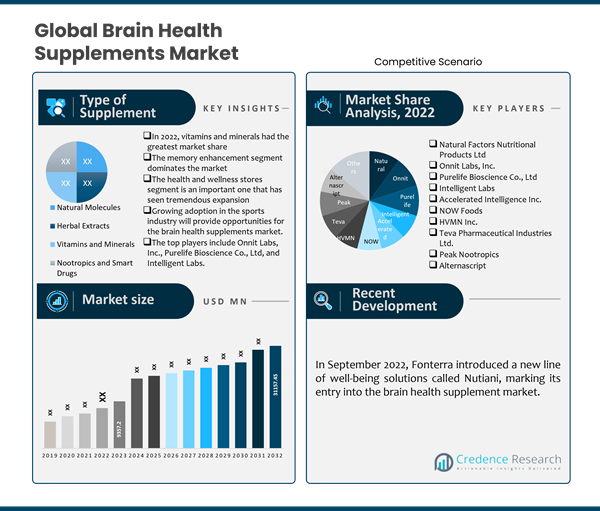
The global brain health supplements market is segmented by type of supplement, formulation, application, target audience, distribution channel, and region. As far as the type of supplement is concerned, vitamins and minerals are the market spearhead. Tablets and capsules are the top formulation category. Throughout the forecast period, the category of memory enhancement is expected to grow at the greatest CAGR. During the predicted period, the category with the highest CAGR will be the health and wellness stores. Asia Pacific is seeing the most growth in the brain health supplements market.
Growth in the market for brain health supplements is facilitated by rising disposable incomes, which make these goods more affordable for more people. Financial resources are increasing people's willingness to spend on wellness and health, especially supplements for cognitive health. Additionally, people with higher means might look into expensive, high-quality supplements and focus on preventive health care. Because of their greater ability to buy, consumers desire more products overall, which in turn drives innovation and product development from businesses.
It is anticipated that the Asia Pacific will hold the biggest global market share for brain health supplements. The market for brain health supplements in Asia Pacific continues to grow as a result of a rapidly aging population, increased disposable earnings, and greater health consciousness. Demand is further stimulated by the region's commitment to wellness and preventive healthcare, as well as developments in supplement formulations. The market's strong expansion is also attributed to growing urbanization and easier access to healthcare information. In addition, it is projected that the market in North America will grow at the quickest rate. Americans 50 years of age and older routinely take large amounts of brain health supplements due to escalating worries about their psychological and mental health, according to a June 2019 American Association of Retired Persons (AARP) survey on brain health and dietary supplements.
Which Key Factors Are Driving The Global Brain Health Supplements Market?
The emergence of novel and enhanced supplement formulations, collaborations with healthcare professionals, and easier access to healthcare information and goods are propelling the market for brain health supplements.
What Are The Main Challenges Confronting The Global Brain Health Supplements Market?
Possible adverse effects, pharmaceutical competition, and a lack of assistance from medical professionals are the most significant challenges confronting the brain health supplement industry.
What Market Opportunities Exist For Brain Health Supplements Globally?
The usage of cognitive supplements by athletes and fitness enthusiasts, as well as the market's growth in developing nations with increased health consciousness, are some of the factors supporting the market for brain health supplements.
Market Drivers
Growing Awareness of Cognitive Health
The market for brain health supplements is mostly driven by an increasing understanding of cognitive health. The emphasis on preventative health interventions has increased as individuals become more aware of the effects of cognitive function on general well-being and quality of life. Customers of all ages, from recent graduates to elderly citizens, are actively looking for supplements that claim to improve mental clarity, memory, and focus. The positive effects of maintaining good brain health are being promoted by healthcare professionals, educational programs, and media coverage, which is driving this shift in public understanding. As a result, there is a growing market need for goods that promote longevity and cognitive function.
Market Restraints:
High Costs of Brain Health Supplements
Supplements for brain health are expensive, which limits market expansion by preventing a wider range of consumers from using these goods. Excessive prices, especially in price-sensitive areas, can turn off potential customers due to development, marketing, and distribution costs. Manufacturers' capacity to fund comprehensive clinical research is further restricted by these expenses, which has an additional negative effect on consumer acceptance and trust. As a result, many customers might choose to forego supplements entirely or choose less expensive alternatives, which would limit the growth of the industry and decrease demand overall.
Opportunities
Inclination Toward Organic and Natural Products
The market for brain health supplements has a lot of potential due to consumers' preference for natural and organic goods. Natural supplements made of vitamins, minerals, and herbal extracts that naturally improve cognitive function are becoming more and more popular among consumers who place a higher value on health-conscious brands. Along with a larger push toward ecologically friendly and sustainable practices, worries about synthetic substances and their possible negative consequences are what is driving this trend. By providing clean-label, non-GMO, and organically certified brain health products in response to this need, manufacturers profit from the confidence and preferences of their customers. The requirement for natural, functional products that promote brain health and general well-being is thus expanding.
Competitive Landscape
Key Players
The highly competitive global market for brain health supplements is dominated by a number of significant players. A handful of the top market players are shown below, together with their respective market shares:
- Natural Factors Nutritional Products Ltd
- Onnit Labs, Inc.
- Purelife Bioscience Co., Ltd
- Intelligent Labs
- Accelerated Intelligence Inc.
- NOW Foods
- HVMN Inc.
- Teva Pharmaceutical Industries Ltd.
- Peak Nootropics
- Alternascript
- Others
In order to stay competitive, these organizations give priority to product innovation, expansion of their distribution channels, and mergers and acquisitions.
By creating cutting-edge ideas and goods, the foremost manufacturers in the global market for brain health supplements consistently strive to stay one step ahead of the competition.
In February 2022, A revolutionary nootropic supplement was introduced by Jones Soda, Weasna Health, and Mike Tyson.
In April 2021, The company Thorne, which develops products for a more individualized approach to health and wellness, revealed that it had formed a strategic alliance with PreCon Health, Inc., which is dedicated to the improvement of safe and effective products that encourage healthy brain function and scientific discovery, to bring a multi-ingredient dietary supplement designed to promote both pre- and post-impact brain health to market.
How are Companies Performing in the Brain Health Supplements Market?
Due to a number of significant factors, companies in the brain health supplements sector are performing well. Numerous major companies are concentrating more of their attention on the growing demand for supplements for brain health. In order to better understand the impacts of its medication, the "new mood serotonin booster," Onnit Labs, Inc. added a new study to its portfolio of clinical trials. The purpose of the supplement was to assist with mood regulation and stress management on a daily basis. College students who regularly deal with pressures like academic performance and post-graduation goals made up the test group.
Companies are introducing novel products to expand the brain health supplements market. For example, Lion's Mane Mushroom Extract capsules were introduced by Intelligent Labs with the goal of enhancing cognitive performance, memory, learning, and focus. The introduction was intended to aid in the company's business expansion for supplements for brain health.
Numerous companies with a diverse variety of product offerings make up the fragmented market. Neuriva, the company's recently introduced brain health supplement, is selling well, which helps it gain market share. One of the elements boosting their growing market share is their ongoing emphasis on developing their sales force and tactics. The company's goal was to revamp its commercial operating model, and more than 3,000 employees completed their sales competency study in 2022. Woolworths in Australia also gave the company the 2022 Overall Supplier of the Year honor. It received the Supplier of the Year award from the Brazilian Association of Cash and Carry Retailers as well.
Natrol, LLC concentrates on introducing new goods to meet the growing demand of the populace. Additionally, the company's increasing focus on working with rival companies to diversify its product line is anticipated to strengthen its position in the market. For example, Natrol, LLC introduced MelatoninMax, a brand of drug-free sleep aid that promotes quicker sleep, in September 2021. In addition, the growing number of private label companies offers opportunities for new competitors to launch their goods and fosters market expansion.
Summary of Key Findings
- The demand for supplements supporting brain health is impacted by initiatives that support cognitive health and supplement use, as well as by the rising use of nootropics and smart medications.
- The market is segmented by type of supplement, formulation, application, target audience, distribution channel, and region.
- In the market, the most prevalent type of supplement is vitamins and minerals.
- Tablets and capsules are the foremost formulation category.
- The memory enhancement category is expected to grow fastest in terms of CAGR during the forecast period.
- Health and wellness stores categories are probably going to have the greatest CAGR during the predicted period.
- In terms of market development, Asia Pacific is a leader; the market is highly competitive with key players including Natural Factors Nutritional Products Ltd, Onnit Labs, Inc., Purelife Bioscience Co., Ltd, Intelligent Labs, Accelerated Intelligence Inc., NOW Foods, HVMN Inc., Teva Pharmaceutical Industries Ltd., Peak Nootropics, Alternascript, and Others.
Future Outlook
- The brain health supplements industry is expected to increase significantly in Asia Pacific, and its outlook is positive worldwide.
- The market will continue to rise as a result of several factors, including the integration of multivitamins and recent advancements in nutrition and neuroscience.
- High pricing can hinder accessibility and market penetration because of the enormous costs associated with creating, promoting, and delivering supplements.
- Developing new products, reaching a wider market, and maintaining competitive prices are all necessary for major businesses to stay ahead of the competition.
How the Credence Research Brain Health Supplements Market Report Can Help CXOs
The Credence Research Brain Health Supplements Market Report provides CXOs with an extensive market overview and comprises the following:
- Market size and growth forecast: The study offers comprehensive market estimations for brain health supplements globally, broken down by type of supplement, formulation, application, target audience, distribution channel, and region. Furthermore, the report includes market forecasts through 2032, derived from key drivers and trends.
- Market segmentation: The brain health supplements market is divided into segments by type of supplement, formulation, application, target audience, distribution channel, and region in the research report. This segmentation helps CXOs understand the market and the opportunities inside each area in great depth.
- Competitive landscape: The study report provides a thorough analysis of the leading businesses in the brain health supplements sector, together with details on their revenue streams, product lines, and business strategies. With this information, CXOs can assess and identify their competitors.
- Key trends and drivers: The study report analyzes and highlights the key developments and elements driving the market for brain health supplements. CXOs can utilize this information to make well-informed choices regarding their plans and investments.
The Credence Research Brain Health Supplements Market Report provides CXOs with insights that they may utilize to:
- Identify growth opportunities: This analysis is likely to help CXOs find fresh growth prospects in the brain health supplements sector. For example, the research recognizes the increasing requirement for brain health supplements from health and wellness stores as a crucial opportunity.
- Make informed investment decisions: The study aids CXOs in making informed decisions about brain health supplements. For example, it delivers information on the key variables to consider while picking solutions and evaluating suppliers.
- Develop competitive strategies: CXOs can utilize the research report to establish competitive strategies for their brain health supplement firms. The study paper explores the primary tactics employed by brain health supplement providers to set themselves apart from their rivals.
- Track market developments: By tracking market advancements, this research report could assist CXOs in remaining ahead of the curve. For example, it provides information about the latest advancements and patterns in the brain health supplements industry.
The Credence Research Brain Health Supplements Market Report is helpful for CXOs who want to learn more about the market and identify potential opportunities.
Segmentation
-
By Type of Supplement
- Natural Molecules
- Herbal Extracts
- Vitamins and Minerals
- Nootropics and Smart Drugs
-
By Formulation
- Tablets and Capsules
- Powders
- Softgels
- Liquids
- Gummies
-
By Application
- Memory Enhancement
- Mood and Stress Management
- Focus and Concentration
- Anti-Aging and Neuroprotection
- Overall Cognitive Health
-
By Target Audience
- Children and Adolescents
- Adults
- Elderly
- Athletes and Fitness Enthusiasts
-
By Distribution Channel
- Retail Pharmacies
- Online Stores
- Health and Wellness Stores
- Supermarkets and Hypermarkets
- Direct Sales
-
By Region
- North America
- U.S
- Canada
- Mexico
- Europe
- Germany
- France
- UK
- Italy
- Spain
- Rest of Europe
- Asia Pacific
- China
- Japan
- India
- South Korea
- South-east Asia
- Rest of Asia Pacific
- Latin America
- Brazil
- Argentina
- Rest of Latin America
- Middle East & Africa
- GCC Countries
- South Africa
- The Rest of the Middle East and Africa
- North America
Adjacent Markets
Several adjacent markets in the brain health supplements market have high revenue growth opportunities. The key adjacent markets for the brain health supplements market -
Adjacent Markets |
||
| Nutraceuticals Market | Functional Foods and Beverages Market | Pharmaceuticals Market |
| Herbal Supplements Market | Vitamins and Minerals Market | Sports Nutrition Market |
| Memory Enhancement Products Market | Sleep Aids Market | Holistic Health Market |
Request a Free Sample
Fill in your details and we'll send you a free sample report.
- Sample data tables & charts
- Research methodology
Need a Custom Version of This Report?
Tailor the scope, geography, or segments to your exact requirements.
- Custom geography or segment scope
- Direct access to our analyst team
Frequently Asked Questions
How much does the global market currently hold for brain health supplements?
What is the brain health supplements market's projected growth rate between 2024 and 2032?
In terms of the type of supplement, which market category is leading?
Regarding the formulation, which market category is in the lead?
Which application category is anticipated to grow at the fastest rate throughout the projected period?
In which region is the market for brain health supplements expanding?
Which major companies lead the global market for brain health supplements?
Which market factors are the primary drivers of the brain health supplements industry?
What main market challenges prevent the growth of the brain health supplements sector?
What are the main market opportunities for the brain health supplements sector?
Table of Content
Chapter 1. Report Introduction
- 1.1 Report Description & Purpose
- 1.1.1 Report Title & Market Definition
- 1.1.2 Unique Selling Propositions (USP) & Key Differentiators
- 1.1.3 Value Proposition for Stakeholders
- 1.2 Research Objectives
- 1.2.1 Market Sizing Objectives (Volume & Revenue)
- 1.2.2 Segmentation Objectives
- 1.2.3 Competitive Intelligence Objectives
- 1.2.4 Forecast & Scenario Objectives
- 1.3 Report Scope
- 1.3.1 Brain Health Supplements Scope – Types & Subtypes Covered
- 1.3.2 Geographic Scope – Regions & Countries Covered
- 1.3.3 Historical Period, Base Year & Forecast Period (the historical period; forecast to the forecast period)
- 1.3.4 Inclusions & Exclusions
- 1.4 HS Code & Classification Framework
- 1.5 Currency, Units & Pricing Basis
- 1.6 Target Stakeholders
- 1.7 Limitations & Assumptions
Chapter 2. Executive Summary
- 2.1 Global Brain Health Supplements Market Snapshot
- 2.1.1 Market Size – Historical (the historical period) & Forecast (the forecast period) (base year: USD 9,357.2 million → forecast year: USD 31,157.45 million)
- 2.1.2 Volume & Revenue – Global Totals
- 2.1.3 Key Market Highlights – Top Five Facts
- 2.2 Brain Health Supplements Market Segmentation Snapshot
- 2.2.1 Market Split by Region – vs.
- 2.3 Competitive Snapshot
- 2.3.1 Top 10 Players by Revenue Share –
- 2.3.2 Top 10 Players by Volume Share –
- 2.3.3 Recent Strategic Developments (18-Month Summary)
- 2.4 Key Investment Highlights & Strategic Conclusions
Chapter 3. Brain Health Supplements Market Dynamics & Industry Analysis
- 3.1 Market Overview & Context
- 3.1.1 Brain Health Supplements Market Position in the Broader Automotive Value Chain
- 3.1.2 OEM vs. Replacement Market Dynamics
- 3.1.3 Market Maturity & Development Stage by Region
- 3.2 Brain Health Supplements Market Drivers
- 3.3 Brain Health Supplements Market Restraints & Challenges
- 3.4 Brain Health Supplements Market Opportunities
- 3.5 Porter's Five Forces Analysis
- 3.5.1 Threat of New Entrants
- 3.5.2 Bargaining Power of Suppliers
- 3.5.3 Bargaining Power of Buyers
- 3.5.4 Threat of Substitutes
- 3.5.5 Competitive Rivalry – Intensity Assessment
- 3.6 Brain Health Supplements Value Chain Analysis
- 3.6.1 Upstream – Raw Material/Input Suppliers
- 3.6.1.1 Raw Material/Input 1
- 3.6.1.2 Raw Material/Input 2
- 3.6.1.3 Raw Material/Input 3
- 3.6.2 Midstream – Production/Manufacturing/Service Delivery
- 3.6.2.1 Production/Process Overview
- 3.6.2.2 Key Facility Locations & Capacity by Manufacturer
- 3.6.3 Downstream – Distribution & End Consumer
- 3.6.3.1 Primary Channel – B2B/OEM
- 3.6.3.2 Secondary Channels – Dealer, Retail, Online, Direct
- 3.6.4 Value Chain Profitability Analysis
- 3.6.1 Upstream – Raw Material/Input Suppliers
- 3.7 PESTEL Analysis
- 3.7.1 Political Factors
- 3.7.2 Economic Factors
- 3.7.3 Social Factors
- 3.7.4 Technological Factors
- 3.7.5 Environmental Factors
- 3.7.6 Legal Factors
- 3.8 Brain Health Supplements Supply Chain Analysis
- 3.8.1 Raw Material/Input Supply Risk Assessment
- 3.8.2 Manufacturing Concentration Risk (Geographic Exposure)
- 3.8.3 Trade Disruption Impact Analysis
- 3.9 Regulatory & Policy Landscape
Note: The regulatory and policy landscape section covers regulations based on their applicability to the market, Brain Health Supplements category, geography, and scope of the study. Only regulatory frameworks with a material impact on operations, compliance, trade, sustainability, or market access are analyzed in detail.
Chapter 4. Key Investment Pockets & Opportunity Analysis
- 4.1 Brain Health Supplements Market Attractiveness Analysis
- 4.1.1 By Region – Investment Attractiveness Matrix (Volume × CAGR)
- 4.2 Absolute Revenue Growth Opportunity
- 4.2.1 By Region – Absolute USD Growth Through the forecast period
- 4.3 Incremental Volume Opportunity
- 4.3.1 By Region – Incremental Volume Through the forecast period
- 4.3.2 Segment – Incremental Volume
- 4.4 Emerging Submarket Opportunity Deep Dive (Subject to Applicability)
- 4.5 Emerging Market Opportunity Scorecards
- 4.5.1 United States
- 4.5.2 Europe
- 4.5.3 Asia
- 4.5.4 Middle East & Africa
Note: Emerging Market Opportunity Scorecards will be included based on relevance and strategic importance. Regions listed are indicative and may vary depending on data availability and market dynamics.
Chapter 5. Brain Health Supplements Import-Export Analysis & Trade Flows
- 5.1 Global Trade Overview
- 5.1.1 Global Export Value by Country (the historical period)
- 5.1.2 Global Export Volume by Country (the historical period)
- 5.1.3 Global Import Value by Country (the historical period)
- 5.1.4 Global Import Volume by Country (the historical period)
- 5.1.5 Net Trade Balance by Country (the historical period)
- 5.2 Export Analysis – Segment
- 5.2.1 Type 1 (HS Code)
- 5.2.2 Type 2 (HS Code)
- 5.2.3 Type 3 (HS Code)
- 5.2.4 Type 4 (HS Code)
- 5.2.5 Type 5 (HS Code)
- 5.3 Import Analysis – Segment
- 5.3.1 Type 1 (HS Code)
- 5.3.2 Type 2 (HS Code)
- 5.3.3 Type 3 (HS Code)
- 5.3.4 Type 4 (HS Code)
- 5.3.5 Type 5 (HS Code)
- 5.4 Average Unit Trade Prices
- 5.4.1 Average Export Price – Segment & Country
- 5.4.2 Average Import Price – Segment & Source Country
- 5.4.3 Price Trends (the historical period)
- 5.5 Key Trade Route Analysis
- 5.5.1 Trade Route 1
- 5.5.2 Trade Route 2
- 5.5.3 Trade Route 3
- 5.5.4 Trade Route 4
- 5.5.5 Trade Route 5
- 5.6 Trade Policy Impact Assessment
- 5.6.1 US Anti-Dumping & Section 301 Tariffs
- 5.6.2 EU Customs Union Impact
- 5.6.3 Major Free Trade Agreements
- 5.6.4 USMCA Rules of Origin
Note: Trade policy analysis will be included only where relevant to the Brain Health Supplements market.
Chapter 6. Competitive Landscape & Company Benchmarking
- 6.1 Brain Health Supplements Market Concentration & Structure
- 6.1.1 Herfindahl-Hirschman Index (HHI) – vs.
- 6.1.2 Tier 1, Tier 2 & Tier 3 Market Structure
- 6.1.3 Global, Regional & Local Player Dynamics
- 6.2 Brain Health Supplements Market Share Analysis –
- 6.2.1 Global Revenue Share by Company
- 6.2.2 Global Volume Share by Company
- 6.2.3 Regional Revenue Share
- 6.2.4 Market Share Evolution ( vs. )
- 6.2.5 OEM Segment Share by Company
- 6.2.6 Replacement Segment Share by Company
- 6.3 Production/Delivery Capacity & Facility Analysis
- 6.3.1 Global Installed Capacity
- 6.3.2 Capacity Utilization Rates
- 6.3.3 Production/Output Volume
- 6.3.4 Facility Locations & Capacity Map
- 6.3.5 Planned Capacity Additions
- 6.4 Brain Health Supplements Competitive Benchmarking Matrix
- 6.4.1 Revenue, Volume, CAGR & Profitability Comparison
- 6.4.2 Channel Revenue Mix
- 6.4.3 Geographic Revenue Exposure
- 6.4.4 R&D Intensity
- 6.4.5 Sustainability Maturity
- 6.5 Strategic Developments in Brain Health Supplements (Last 24 Months)
- 6.5.1 Mergers, Acquisitions & Divestments
- 6.5.2 New Brain Health Supplements Launches
- 6.5.3 Facility Expansions
- 6.5.4 Strategic Alliances, Joint Ventures & Partnerships
- 6.5.5 Distribution Expansion & Market Entry
- 6.5.6 Sustainability & ESG Initiatives
- 6.6 Competitive Strategy Mapping
- 6.6.1 Leader, Challenger, Follower & Niche Classification
- 6.6.2 Pricing Strategy Comparison
- 6.6.3 Channel Strategy Matrix
Note: Strategic developments are included based on their materiality and the availability of reliable information.
Chapter 7. Global Brain Health Supplements Market – By Distribution Channel
- 7.1 Segment Overview
- 7.1.1 Volume & Revenue Split by Channel ( & )
- 7.1.2 Channel Mix Evolution (the forecast period)
Chapter 8. Regional Market Analysis – Global Overview
- 8.1 Global Regional Overview
- 8.1.1 Regional Volume Share
- 8.1.2 Regional Revenue Share
- 8.1.3 Regional Volume by Region
- 8.1.4 Regional Revenue by Region
- 8.1.5 Regional Forecast Through the forecast period
- 8.2 Cross-Regional Segment Analysis
- 8.2.1 By Distribution Channel
- 8.2.2 By Brand/Price Tier
Chapter 9. North America Brain Health Supplements Market
- 9.1 United States
- 9.2 Canada
- 9.3 Mexico
Chapter 10. Europe Brain Health Supplements Market
- 10.1 Germany
- 10.2 France
- 10.3 Italy
- 10.4 United Kingdom
- 10.5 Spain
- 10.6 Poland
- 10.7 Russia
- 10.8 Netherlands
- 10.9 Belgium
- 10.10 Sweden
- 10.11 Denmark
- 10.12 Norway
- 10.13 Rest of Europe
Chapter 11. Asia Pacific Brain Health Supplements Market
- 11.1 China
- 11.2 India
- 11.3 Japan
- 11.4 South Korea
- 11.5 Thailand
- 11.6 Indonesia
- 11.7 Vietnam
- 11.8 Malaysia
- 11.9 Australia
- 11.10 Rest of Asia Pacific
Chapter 12. Latin America Brain Health Supplements Market
- 12.1 Brazil
- 12.2 Argentina
- 12.3 Colombia
- 12.4 Chile
- 12.5 Rest of Latin America
Chapter 13. Middle East Brain Health Supplements Market
- 13.1 Saudi Arabia
- 13.2 United Arab Emirates
- 13.3 Turkey
- 13.4 Israel
- 13.5 Iran
- 13.6 Rest of the Middle East
Chapter 14. Africa Brain Health Supplements Market
- 14.1 South Africa
- 14.2 Egypt
- 14.3 Nigeria
- 14.4 Morocco
- 14.5 Rest of Africa
Chapter 15. Brain Health Supplements Company Profiles
- 15.1 [Company 01]
- 15.1.1 Company Overview
- 15.1.2 Key Management Personnel
- 15.1.3 Products & Services Portfolio
- 15.1.4 Financial Performance
- 15.1.5 Key Market Focus & Geographic Presence
- 15.1.6 Recent Developments & Strategic Initiatives
Note: The company profile list is preliminary and may change based on research findings, market developments, data availability, and client requirements.
Chapter 16. Appendices
- Appendix A – List of Abbreviations & Acronyms
- Appendix B – Industry Classification Code Reference – Full Series
- Appendix C – Production & Capacity Data Tables
- Appendix D – End-Use & Demand Base Tables
- Appendix E – Consumption & Replacement Rate Assumptions
- Appendix F – ASP Reference Tables
- Appendix G – Manufacturing & Facility Database
- Appendix H – Import-Export Data Tables
- Appendix I – Regulatory Summary Tables
- Appendix J – Primary Research Participant List (Anonymized)
- Appendix K – Primary Research Questionnaire Framework
- Appendix L – Data Sources & Bibliography
- Appendix M – Market Size Divergence & Source Comparison
Chapter 17. Research Methodology
- 17.1 Research Framework & Philosophy
- 17.2 Secondary Research – Sources, Hierarchy & Data Extraction
- 17.3 Data Modeling – Bottom-Up & Top-Down Market Sizing
- 17.4 Primary Research – Stakeholder Framework, LOI & Sample Sizes
- 17.5 Forecast Methodology – Regression, Scenario & Sensitivity Analysis
- 17.6 Quality Control – Four-Layer Validation Framework
- 17.7 Limitations & Standard Assumptions
- 17.8 Disclaimer
