
Vietnam seasoning blends follow the daily soup pot
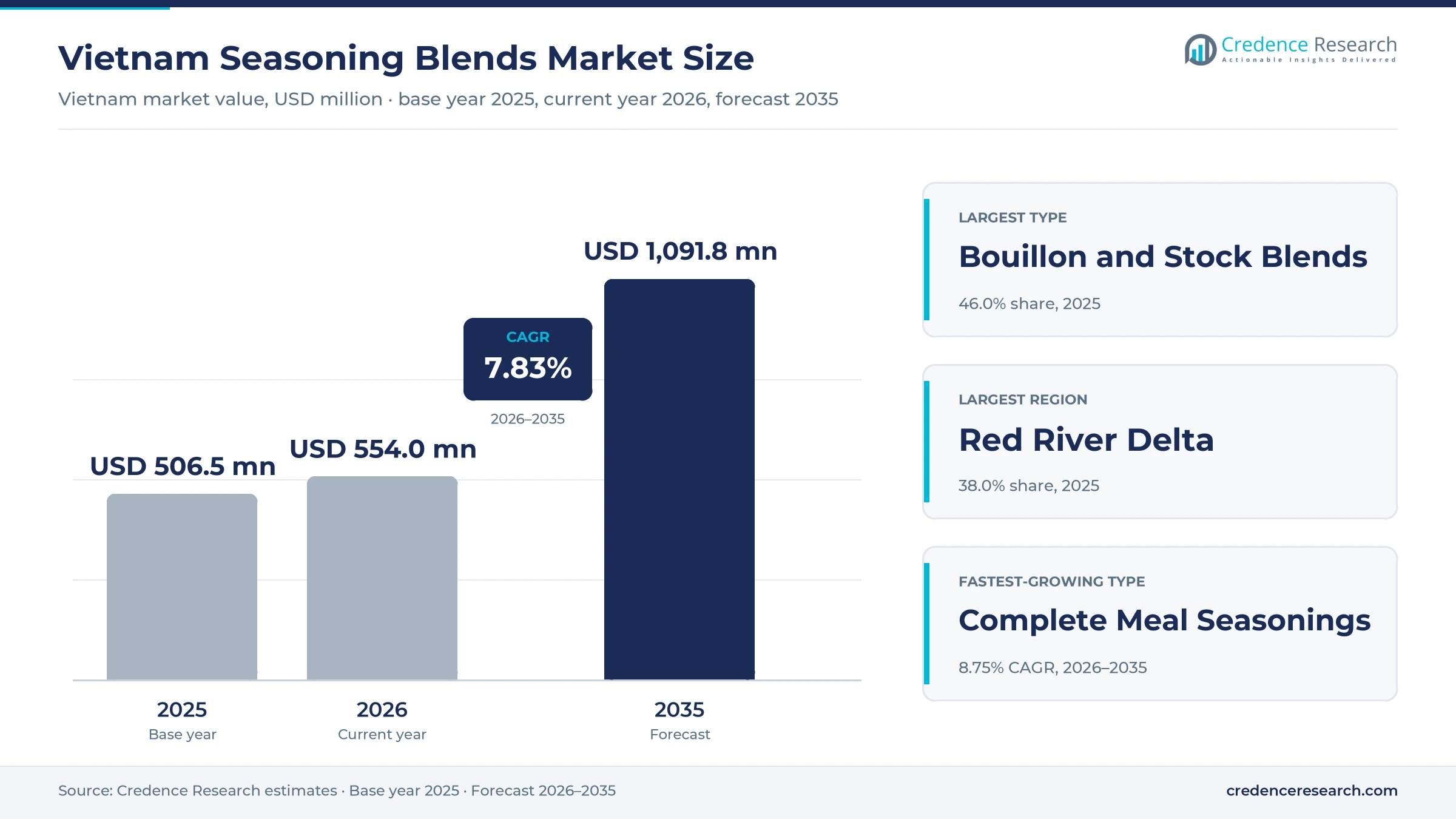
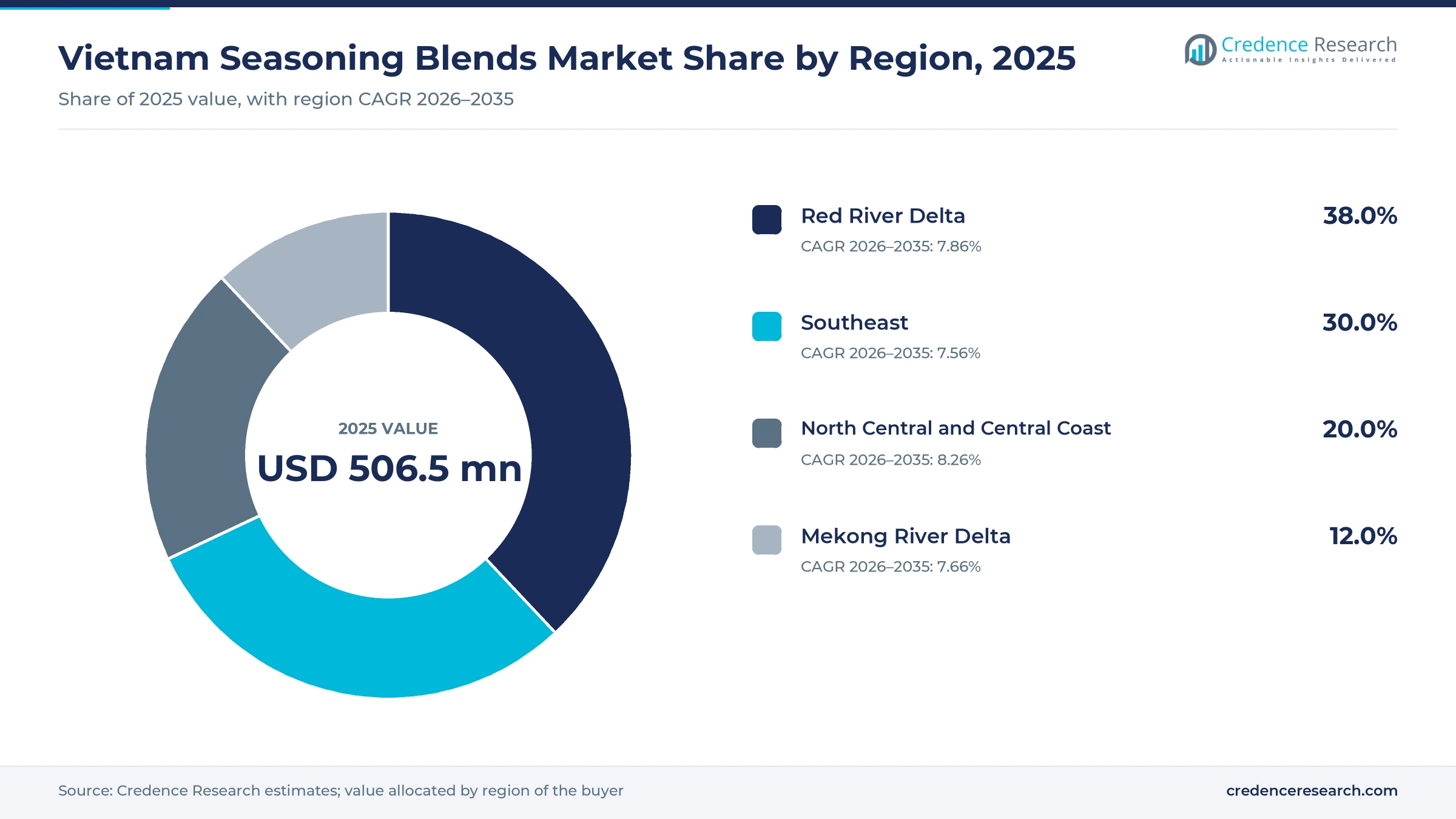
The Vietnam seasoning blends market was valued at USD 506.5 million in 2025 and is projected to increase from USD 554.0 million in 2026 to USD 1.09 billion by 2035, registering a CAGR of 7.83% during 2026–2035. Demand comes from home cooks who build daily soups and braises on stock granules, restaurants and street stalls that need consistent flavor, and noodle factories that consume seasoning by the ton. Red River Delta held the largest regional share, 38.0% in 2025, because Hanoi and its neighbors pair dense population with strong output growth. North Central and Central Coast is the fastest-growing region at 8.26% a year as grocery chains push into central towns and coastal tourism lifts restaurant buying. A salt debate is also changing recipes, since the Ministry of Health issued maximum sodium recommendations for packaged foods in March 2024 and Ajinomoto Vietnam now sells a reduced-salt granule.
What does the seasoning blends market in Vietnam count, and how is it bought?
The market counts blended dry and semi-dry flavor products, including bouillon and stock granules, complete meal mixes, marinade and protein rubs, and soup and noodle seasonings. Families buy pouches and sachets from neighborhood grocers, while restaurants, canteens and factories buy larger packs through distributors or directly from producers. Domestic plants, including foreign-owned sites, supply most of the volume.
The estimate excludes straight fish sauce, soy sauce and chili sauce, along with pure monosodium glutamate and single spices such as pepper or cinnamon sold unblended. It also excludes exports and counterfeit goods, which cannot be measured reliably. Value is counted at the first commercial sale to the final buyer, so factory, distributor and retail margins all sit inside the chain.
Vietnam Seasoning Blends Market Insights
- The market grows from USD 506.5 million in 2025 to USD 1.09 billion by 2035, a 7.83% annual pace supported by repeat kitchen purchases and commercial buying.
- Red River Delta led with 38.0% of 2025 value, ahead of the Southeast at 30.0%, while North Central and Central Coast expands fastest at 8.26% a year.
- Bouillon and Stock Blends held 46.0% of 2025 value, because the granule has become the default base for broths and braised dishes in family kitchens.
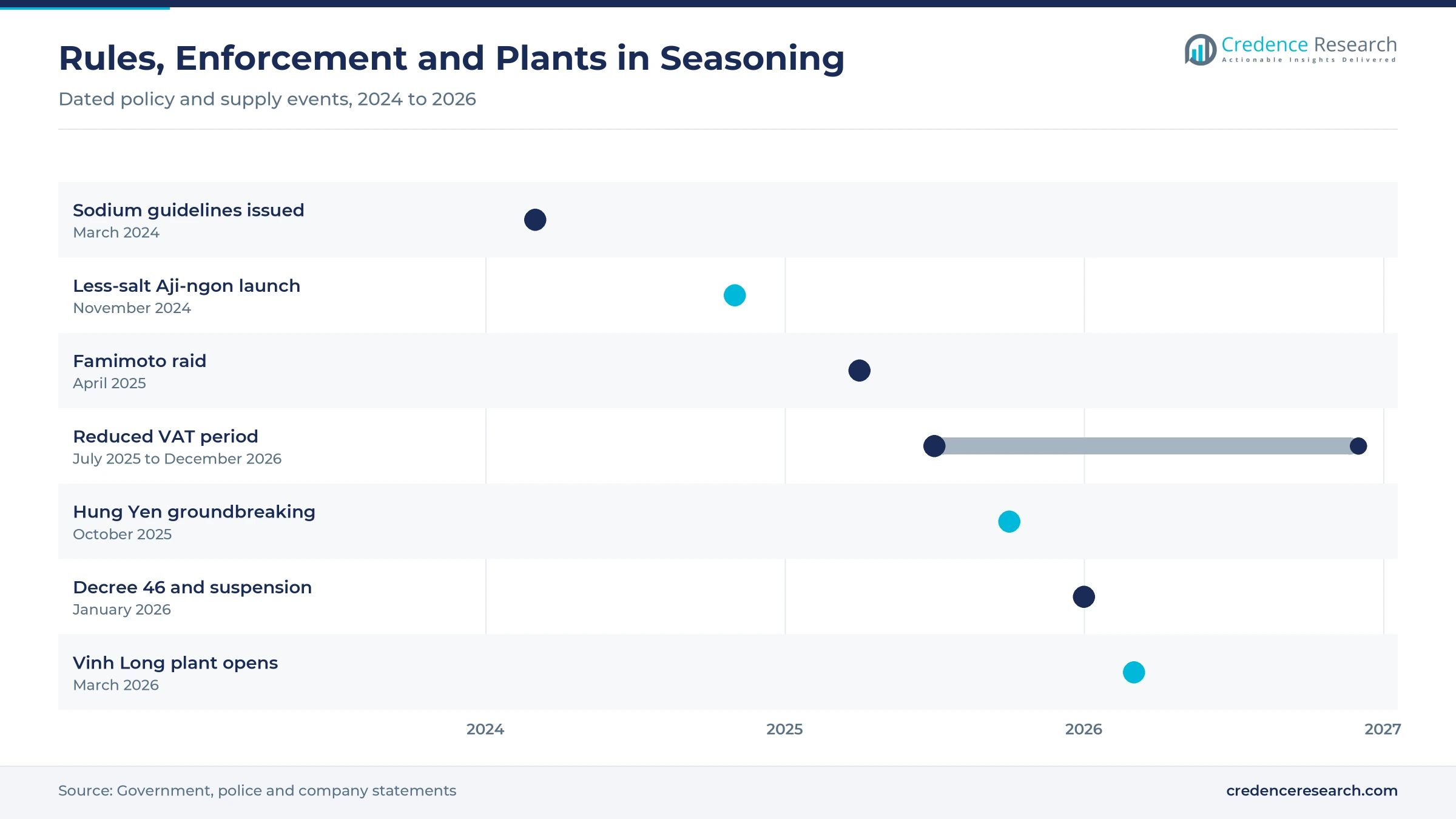
- Acecook Vietnam opened its Vinh Long factory on March 10, 2026, with capacity planned for soup and seasoning oil packets as well as finished noodles.
- Police in Phu Tho raided Famimoto Vietnam on April 24, 2025, over fake seasoning products, which raised the commercial value of traceable supply and verified brands.
Stock granules, corner stores and pouches hold the value
Why do stock granules outsell every newer format?
Based on product type, the market is categorized into bouillon and stock blends, complete meal seasonings, protein seasoning blends and soup and noodle seasonings. Bouillon and Stock Blends led with 46.0% of 2025 value because cube and granule stock formats suit daily broth, and VietnamNet reported in August 2022 that households cook about 30 million liters of soup a day. Complete Meal Seasonings grow fastest at 8.75% a year as one-step cooking spreads, with Masan Consumer saying in December 2025 that CHIN-SU had moved from dipping sauces into marinades and meal-prep products.
Which buyers set the pace beyond the family kitchen?
Based on customer type, the market is categorized into households, foodservice operators, food manufacturers and institutional caterers. Households led with 58.0% of 2025 value because seasoning is a routine purchase, and a Masan Consumer release dated Dec. 4, 2025, says 98% of Vietnamese households use at least one of its products. Foodservice Operators grow fastest at 8.80% a year as dining out expands, with USDA counting more than 323,000 foodservice outlets in 2024 and VnEconomy reporting a 14.6% rise in accommodation and food service revenue during 2025.
How long can neighborhood grocers hold the lead?
Based on distribution channel, the market is categorized into traditional retail, modern grocery, e-commerce and B2B distribution. Traditional Retail led with 55.0% of 2025 value because Viet Nam News, citing the Ministry of Industry and Trade in May 2025, put traditional markets and grocery outlets at about 78% of retail revenue. E-commerce grows fastest at 10.82% a year from a small base, as Viet Nam News reported in December 2025 that national online retail reached about USD 31 billion, up 25.5%, and equaled roughly 10% of total retail sales and services.
What keeps the pouch ahead of the sachet and the bulk bag?
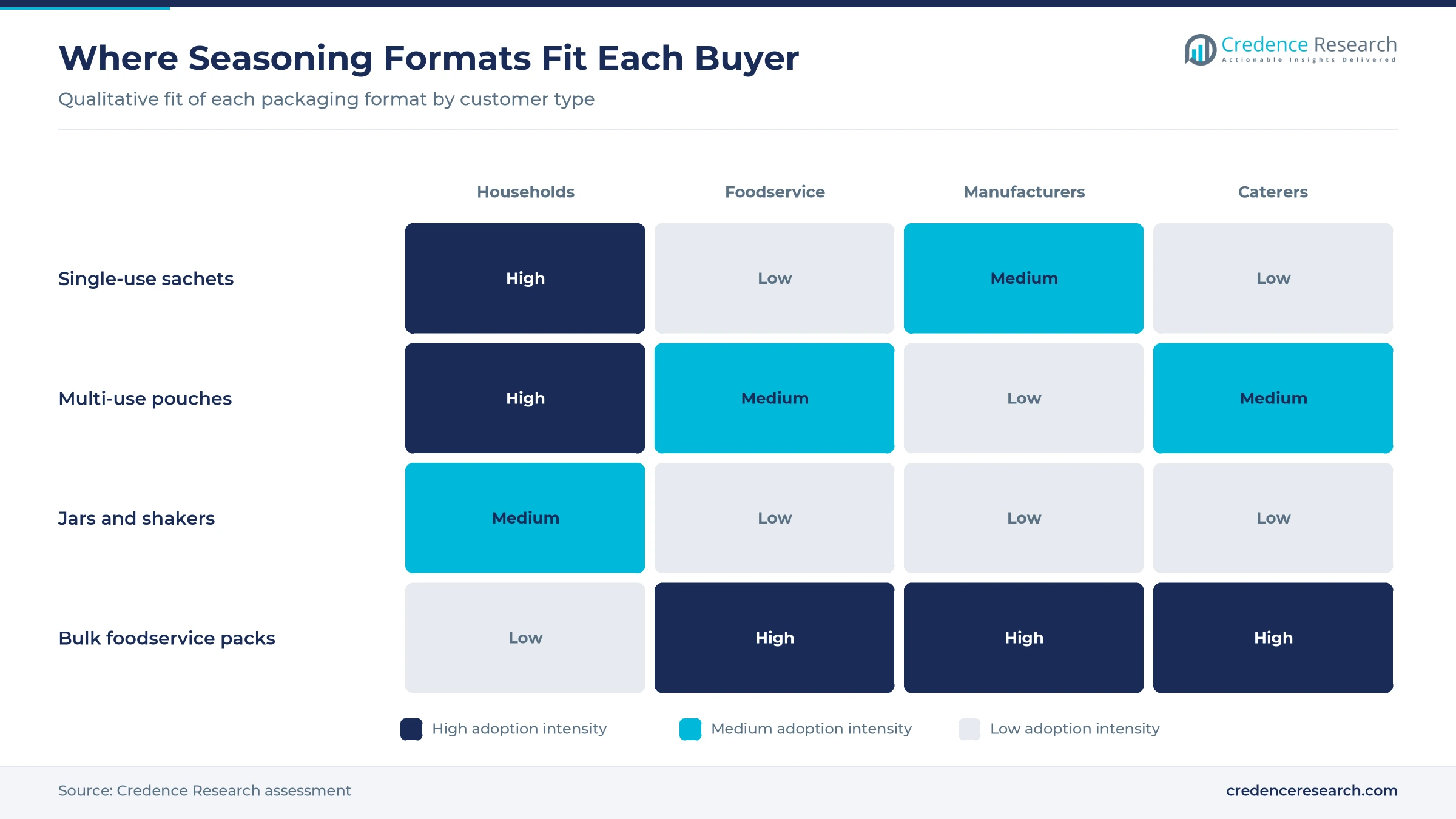
Based on packaging format, the market is categorized into single-use sachets, multi-use pouches, jars and shakers, and bulk foodservice packs. Multi-use Pouches led with 50.0% of 2025 value because a family reuses one pack across many meals, and Ajinomoto Vietnam suggests about 4 grams, or one teaspoon, per serving of Aji-ngon Chicken. Bulk Foodservice Packs grow fastest at 8.65% a year as kitchens buy larger lots, with Ajinomoto listing that same line for professional kitchens and USDA counting over 121,800 full-service restaurants in 2024.
| Segment Group | Leading Sub-segment | Share, 2025 | Fastest-growing Sub-segment | CAGR, 2026–2035 |
|---|---|---|---|---|
| By Product Type | Bouillon and Stock Blends | 46.0% | Complete Meal Seasonings | 8.75% |
| By Customer Type | Households | 58.0% | Foodservice Operators | 8.80% |
| By Distribution Channel | Traditional Retail | 55.0% | E-commerce | 10.82% |
| By Packaging Format | Multi-use Pouches | 50.0% | Bulk Foodservice Packs | 8.65% |
Request a Free Sample
Fill in your details and we'll send you a free sample report.
- Sample data tables & charts
- Research methodology
Noodle lines, restaurants and new stores pull volume
How much seasoning do expanding food factories now absorb?
Factory demand is the steadiest commercial driver because every packet of noodles carries a measured dose of blended flavor. USDA reports that the food processing industry grew 11% in 2025 to about USD 88 billion, and it puts sodium glutamate output at 324,000 tons that year. The World Instant Noodles Association counted 8.231 billion servings for 2025, ranking the country fourth globally, according to VOV in August 2026. New capacity follows that appetite, as Acecook Vietnam broke ground on Oct. 16, 2025, on a VND2,200 billion plant in Hung Yen rated at 750 million packets a year. As a result, food manufacturers buy on long contracts with stable formulas, which gives suppliers more predictable volume than retail shelves do.
Why do restaurants and record tourism lift professional buying?
Out-of-home eating moves seasoning purchases to operators who need the same taste from every cook on every shift. The National Statistics Office counted nearly 21.2 million foreign visitors in 2025, up 20.4%, the government portal reported in January 2026. Ho Chi Minh City alone welcomed nearly 8.6 million international visitors that year, a 40.3% rise, according to SGGP. VnEconomy also reported accommodation and food service revenue above VND843.1 trillion, about 12% of total retail and services. USDA adds that street stalls and kiosks number nearly 152,000 outlets, and those small kitchens rely on low-cost granules. Those kitchens belong to the wider catering and food service market, where Foodservice Operators grow at 8.80% a year.
What does the grocery rollout add to everyday availability?
New stores and online baskets put branded mixes in front of shoppers who previously saw only one stall’s stock. WinCommerce added a net 764 stores in 2025 for a total of 4,592, Vietstock reported in January 2026. Bach Hoa Xanh ended 2025 with about 2,000 stores, and The Investor said around 70% of that year’s openings were in central Vietnam and the Central Highlands. Bizhub reported in February 2026 that modern retail takes only 15-20% of rural sales, so reach can still widen. Daily packaged consumer goods benefit first, and modern grocery gains ground on traditional retail, whose 55.0% share should narrow through 2035.
Why does household cooking remain the core of demand?
Home cooking anchors the market, because granules go into family meals far more often than any restaurant visit. Food and foodstuff retail sales reached VND1,878 trillion in 2025, up 10%, equal to 34.1% of goods retail, according to The Investor, citing the Ministry of Industry and Trade. The General Statistics Office counted more than 101.1 million residents in its April 2024 mid-term census, which gives branded suppliers a very large base of daily meals. Masan Consumer also says its CHIN-SU and Nam Ngu brands appear in more than 72 billion meals a year. Those numbers explain why households hold 58.0% of value and why a small change in dosage moves total volume.
Lower salt and one-step mixes reshape the shelf
Shift toward reduced-salt recipes under health pressure
Salt is becoming a formulation issue because seasonings sit at the center of national intake. A WHO notice posted through the United Nations in Vietnam puts average consumption at 8.1 grams per person a day, about 60% above the recommended limit. VietnamNet reported in 2026 that surveys attribute about 70% of daily salt to seasonings used in preparation, cooking and dipping. The Ministry of Health also issued Guidelines No. 249 on maximum sodium in March 2024, covering 11 food groups and 46 sub-groups. Ajinomoto Vietnam answered with Aji-ngon Pork Less-Salt in November 2024, which cuts added table salt by up to 20% using potassium chloride. This reformulation should protect bouillon value even as Bouillon and Stock Blends matures.
Rise of one-step mixes and complete meal seasonings
Shoppers increasingly want a single packet that replaces several separate ingredients, which raises the value of each cooking occasion. Ajinomoto Vietnam now sells Aji-Quick complete seasoning among more than 35 products. Cholimex Food lists grilled meat marinade and char siu sauce in its range, according to VCCI News in December 2020. VietnamNet described Dh Foods selling a marinade for pho and a Tay Ninh gourmet seasoning in August 2022. Masan Consumer says it has launched more than 1,200 products since 2002, and core products reach the Top 3 in about two years on average. This pace of launches helps complete meal seasonings expand at 8.75% a year.
Export kitchens abroad are an opening for local flavor brands
Overseas demand offers an opening because local brands have already built certified supply for foreign retailers. Masan Consumer operates in 26 international markets and projected its international share of revenue at 5% in 2025, up from 1% in 2020, which shows how quickly the channel has grown. Cholimex sells in more than 30 countries and territories, according to VCCI News, while Bizhub reported in July 2023 that VIFON reaches over 100. The Vietnam Pepper and Spice Association also reported cinnamon exports of 73,080 tons in the first seven months of 2025, which shows raw material strength. Suppliers can build on the wider Asia Pacific spice trade with blends that carry a clear local story.
School and factory canteens are an opening for verified supply
Institutional kitchens present an opening because they buy in volume and now face more scrutiny over what they use. VnEconomy reported in August 2024 that Ajinomoto’s School Meal Project had reached nearly 4,300 semi-boarding primary schools and more than 1.9 million pupils. Tuoi Tre reported that fake products from the Famimoto case were sold to canteens in industrial zones, which gives purchasing managers a clear reason to demand documented supply. Ajinomoto Vietnam also covers 63 provinces through three distribution centers and sales depots, showing the reach that large contracts need. Institutional caterers remain a small buyer group today, so early suppliers with audited lots and menu support can win lasting contracts.
Fake granules and rule changes test honest suppliers
How much damage can counterfeit granules do to brand trust?
Counterfeiting is the sharpest risk because buyers cannot judge a granule by sight. Tuoi Tre reported that Famimoto Vietnam, raided on April 24, 2025, in Phu Tho, had sold 625 metric tons of counterfeit products, including 363 metric tons of seasoning granules. DTiNews reported in May 2026 that Ho Chi Minh City police had stopped more than four metric tons of fake Ajinomoto seasoning. Genuine brands carry the reputational damage, so tamper-evident packs and direct distributor audits have become practical defenses for them.
What does unsettled food safety law cost suppliers?
Shifting rules make compliance planning harder for producers and importers of flavor ingredients. Decree 46/2026 took effect on Jan. 26, 2026, and Vietnam Briefing reported that over 1,300 vehicles were stranded at checkpoints on Jan. 30, which forced a swift suspension. The government issued a further suspension in Resolution 15/2026 on April 6, 2026, leaving Decree 15/2018 in use while the law is revised. Smaller manufacturers carry the most exposure, so many will need to budget for repeat registration work.
Will pepper prices and the tax calendar squeeze margins?
Input costs and tax timing can both squeeze margins in a price-sensitive category. The Vietnam Pepper and Spice Association reported black pepper export prices averaging USD 6,713 a ton in the first seven months of 2025, up 47%. Meanwhile, Resolution 204/2025 keeps the reduced 8% VAT rate only until Dec. 31, 2026, according to VietnamNet. Economy brands sold in small packs have little room to pass on increases, so reformulation and pack downsizing are the likely responses.
How will tax reform at small grocers affect sell-through?
Reform at the small retailer level could disturb the channel that still moves most seasoning packs. Vietstock reported that the lump-sum tax regime for household businesses ended on Jan. 1, 2026, which pushes small stores toward declaring actual revenue. Viet Nam News had put traditional outlets at about 78% of retail revenue only months earlier, so any store exits matter directly to seasoning brands. Suppliers will likely need tighter distributor credit control and more direct coverage of the remaining outlets.
Two deltas and a southern hub set the regional map
| Region | Value, 2025 (USD million) | Share, 2025 | CAGR, 2026–2035 |
|---|---|---|---|
| Red River Delta | 192.5 | 38.0% | 7.86% |
| Southeast | 151.9 | 30.0% | 7.56% |
| North Central and Central Coast | 101.3 | 20.0% | 8.26% |
| Mekong River Delta | 60.8 | 12.0% | 7.66% |
Red River Delta keeps the largest share on density and retail weight
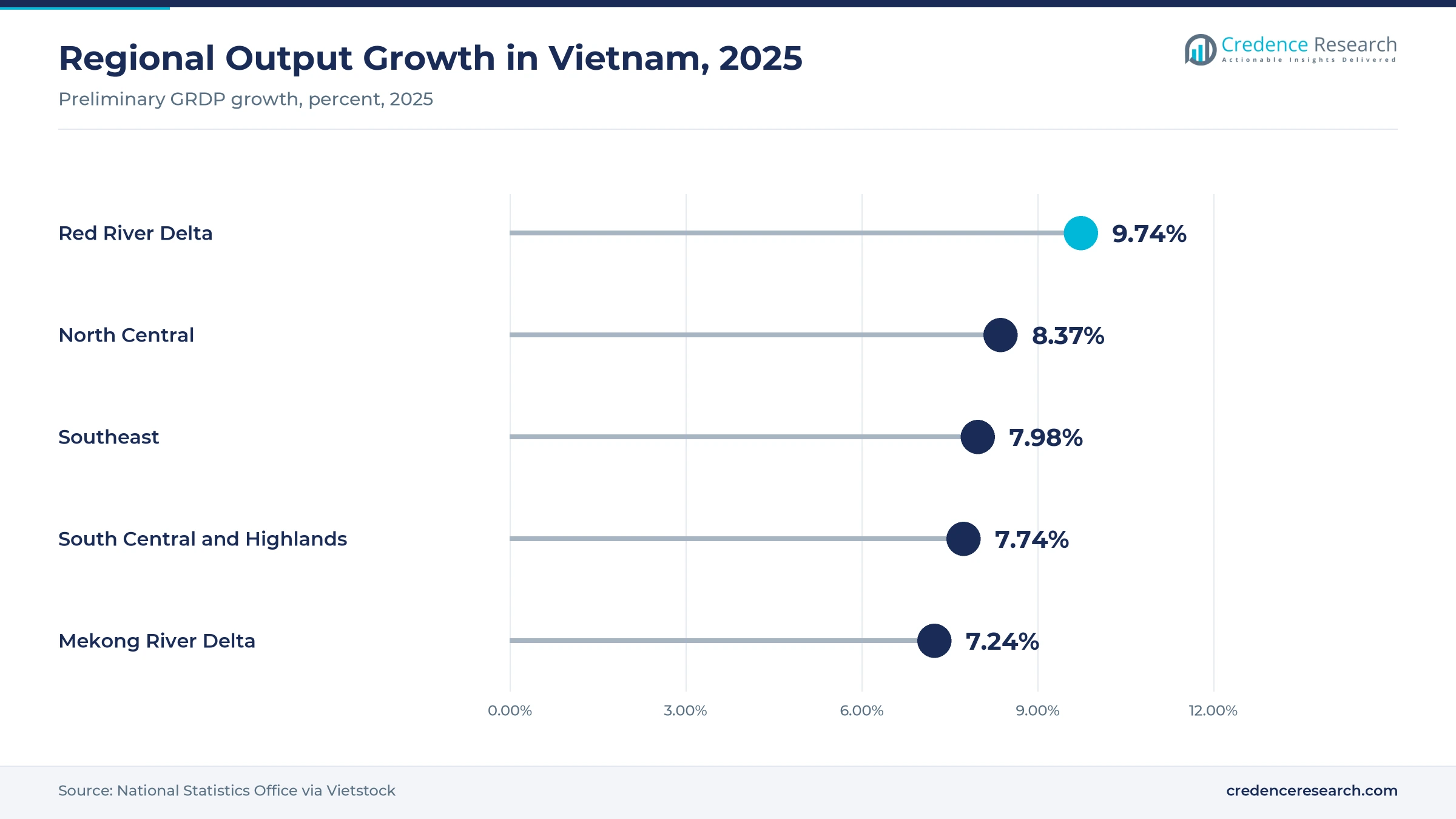
The Red River Delta held 38.0% of 2025 value and grows at 7.86% a year. The General Statistics Office counted about 24 million residents, 23.7% of the country, in its 2024 mid-term census. The Investor, citing the Ministry of Industry and Trade, says the region accounts for 31.3% of national retail sales, while the National Statistics Office estimates its output rose 9.74% in 2025. New capacity is also arriving, since the Acecook plant in Hung Yen will add noodle and semi-finished lines close to northern buyers.
Southeast combines the highest incomes with major plants
The Southeast held 30.0% of 2025 value and grows at 7.56% a year, the slowest pace because its market is already well served. Vietnam Briefing reports monthly income near VND7.1 million per person in 2024, the highest of any region, and the General Statistics Office recorded the fastest population growth at 1.46% a year. Ajinomoto Vietnam runs its plants at Bien Hoa and Long Thanh in Dong Nai, and Cholimex Food lists its address at Vinh Loc Industrial Park in Ho Chi Minh City.
North central and central coast gain from new stores and coastal travel
North Central and Central Coast held 20.0% of 2025 value and grows fastest at 8.26% a year. Da Nang served more than 17.3 million visitors in 2025, according to VietnamNet, and that traffic supports restaurant buying along the coast. Output in the north central area rose an estimated 8.37%, according to the National Statistics Office, and The Investor said most of Bach Hoa Xanh's nearly 400 openings in 2025 were in central Vietnam and the Central Highlands. Those stores bring branded granules into towns that previously relied on open markets for daily seasoning needs.
Mekong River Delta adds local capacity on a slower base
The Mekong River Delta held 12.0% of 2025 value and grows at 7.66% a year. The General Statistics Office recorded the slowest population growth there, at 0.29% a year between 2019 and 2024, while the National Statistics Office estimates regional output rose 7.24% in 2025. Acecook Vietnam’s new Vinh Long plant, however, covers 11 hectares at Hoa Phu Industrial Park and is planned for 17 lines, so the delta now hosts seasoning packet supply as well as household demand.
Plants, listings and food rules mark 2025 and 2026
| Development | Status and market relevance |
|---|---|
| In April 2025, Phu Tho police raided Famimoto Vietnam and seized seasoning powder and soup powder identified as fake. | Under investigation; raises demand for verified supply |
| In October 2025, Acecook Vietnam broke ground on its Thang Long factory in Hung Yen, rated at 750 million packets a year. | Groundbreaking held; adds northern noodle capacity |
| In December 2025, Masan Consumer moved its shares to the Ho Chi Minh City Stock Exchange. | Completed; raises the profile of the category leader |
| In February 2026, the government suspended Decree 46 on food safety after checkpoint delays, and a further suspension followed in April. | Suspended; Decree 15/2018 stays in use during revision |
| In March 2026, Acecook Vietnam opened its Vinh Long factory with an investment above USD 200 million. | Operating; adds Mekong packet and noodle supply |
Extracts, salt swaps and packet lines define the product
- Bone and meat extraction gives granules a stock-like base, and Ajinomoto says Aji-ngon Pork uses bone, marrow and pork from domestic pork suppliers at its Long Thanh factory.
- Potassium chloride substitution replaces part of the table salt in Aji-ngon Pork Less-Salt, which reduces added salt by up to 20% against the regular recipe.
- Integrated packet production lets noodle makers supply their own flavor, with Acecook planning 27,600 tons of semi-finished items a year at Vinh Long, including soup and seasoning oil packets.
- Residue and compound testing supports export sales, as a Dh Foods executive told The Investor in October 2025 that buyers may test for 2,000 different compounds.
Need a Custom Version of This Report?
Tailor the scope, geography, or segments to your exact requirements.
- Custom geography or segment scope
- Direct access to our analyst team
Masan and foreign majors share a crowded spice rack
Competition splits between a dominant domestic group, foreign granule specialists and regional flavor brands. Masan Consumer ranks first in fish, chili and soy sauce, and its release of December 2025 describes nearly 500,000 traditional outlets and 10,000 modern points. Ajinomoto Vietnam, founded in 1991, supplies Aji-ngon and Aji-Quick from Dong Nai. Unilever’s Knorr held nearly half of granules in a July 2016 Bao Dau Tu report, when Nestlé’s Maggi ranked fourth. Dh Foods and Cholimex compete through marinades and specialty mixes, while Vedan, a Taiwanese-invested producer, drew 43.2% of group sales from the country in 2022. Daesang entered through Miwon Vietnam in 1994, and VIFON sells noodles and seasonings. Acecook is both a major noodle brand and an in-house packet maker. Distribution reach buys volume, but traceability now counts as much as price.
Companies profiled and their roles in this market
| Company | Type | Role in the market |
|---|---|---|
| Masan Consumer Corporation | Local leader | CHIN-SU and Nam Ngu; moved to the Ho Chi Minh City exchange in December 2025 |
| Ajinomoto Vietnam Co., Ltd. | Foreign-owned producer | Aji-ngon and Aji-Quick; plants at Bien Hoa and Long Thanh, in the country since 1991 |
| Unilever Vietnam International Company Limited | Multinational brand | Knorr granules; nearly half of the granule category in a 2016 press report |
| Nestlé Vietnam Ltd. | Multinational brand | Maggi in the seasoning category; four factories nationwide |
| Dh Foods Joint Stock Company | Local specialist | Marinades and gourmet seasonings, with export-focused testing |
| Cholimex Food Joint Stock Company | Local producer | Marinades and sauces from Vinh Loc Industrial Park; sold in more than 30 countries |
| Vedan Vietnam Enterprise Corporation Limited | Foreign-invested producer | Taiwanese-invested seasoning and MSG maker; the country was its largest market in 2022 |
| Miwon Vietnam Co., Ltd. | Foreign-invested producer | Named seasoning brand; origin of the Daesang business established in 1994 |
| Acecook Vietnam Joint Stock Company | Noodle producer | New Vinh Long and Hung Yen plants, with soup and seasoning oil packet output |
| Vietnam Food Industries Joint Stock Company | Local producer | VIFON brand; noodles and seasonings sold in over 100 markets |
Verified supply will decide the next share shift
Credence Research’s view is that the next share shift will favor suppliers that can document what goes into each pack. The Famimoto case showed that fake granules can reach commercial canteens in large volumes, so purchasing managers will ask for lot records rather than only low prices. Scale players already hold plants and distribution, which leaves smaller brands to compete through regional recipes, marinades and export-grade testing. The reduced-salt recipes launched since November 2024 also offer a useful premium story, although lasting gains will depend on taste and on price when the VAT cut lapses.
How the estimate was built and checked
The report uses 2025 as the base year and forecasts values to 2035. Market values come from the Credence Research model, and segment and regional splits are Credence Research estimates. The size was cross-checked against household numbers, foodservice outlet counts, noodle servings and national food retail sales, using assumed consumption and prices. Evidence comes from national statistics reported in government and press sources, USDA and United Nations documents, legal notices, police announcements and company statements. No interviews or surveys were conducted for this edition, and the regional split is the most assumption-heavy estimate.
Kitchens and commercial buyers carry value to 2035
The market should grow solidly through 2035, since Vietnam already uses seasoning daily and much of the gain comes from commercial buyers and richer mixes. Household granules should keep their base while recipes shift toward lower salt under pressure from health guidance. Faster gains should come from restaurants, complete meal products, online baskets and central provinces, where new chains are still arriving. Noodle plants in Vinh Long and Hung Yen will add steady industrial demand, and a settled food safety law would reward suppliers with strong documentation.
Frequently Asked Questions
How big is the Vietnam seasoning blends market?
Which region leads seasoning blend sales in Vietnam?
Which product type is largest?
Which buyers grow fastest?
Why is salt a concern for seasoning makers?
Which channel grows fastest?
What is the biggest risk for brands?
Who are the leading companies?
Table of Content
Chapter 1 Market Segmentation
- 1.1 Segmentation Framework
- 1.1.1 Product and Service Classification
- 1.1.2 Application and End-Use Classification
- 1.1.3 Technology and Solution Classification
- 1.1.4 Customer and Distribution Channel Classification
- 1.1.5 Geographic Segmentation
- 1.1.6 Market Segment Definitions and Boundaries
- 1.2 By Product Type
- 1.2.1 Bouillon and Stock Blends
- 1.2.2 Complete Meal Seasonings
- 1.2.3 Protein Seasoning Blends
- 1.2.4 Soup and Noodle Seasonings
- 1.3 By Customer Type
- 1.3.1 Households
- 1.3.2 Foodservice Operators
- 1.3.3 Food Manufacturers
- 1.3.4 Institutional Caterers
- 1.4 By Packaging Format
- 1.4.1 Single-use Sachets
- 1.4.2 Multi-use Pouches
- 1.4.3 Jars and Shakers
- 1.4.4 Bulk Foodservice Packs
Chapter 2 Introduction
- 2.1 Report Objectives and Scope
- 2.2 Product Definition and Industry Terminology
- 2.3 Market Inclusions and Exclusions
- 2.4 Research Process
- 2.4.1 Primary Research and Expert Interviews
- 2.4.2 Secondary Research and Source Review
- 2.4.3 Top-Down and Bottom-Up Estimation
- 2.4.4 Data Triangulation and Verification
- 2.5 Market Size Measurement Basis
- 2.5.1 2025: USD 506.5 million → 2035: USD 1.09 billion
- 2.6 Historical and Forecast Reference Periods
- 2.6.1 Historical Period: 2018-2025
- 2.6.2 Base Year: 2025
- 2.6.3 Forecast Period: 2025-2035
- 2.7 Research Assumptions and Limitations
Chapter 3 Executive Summary
- 3.1 Market Snapshot and Key Findings
- 3.2 Base-Year Market Size, 2025
- 3.3 Forecast Market Size, 2035
- 3.4 Revenue and Volume Growth Outlook
- 3.5 Key Demand and Supply Indicators
- 3.6 Leading Market Segments
- 3.7 Fastest-Growing Market Opportunities
- 3.8 Regional Performance Highlights
- 3.9 Technology and Industry Transformation
- 3.10 Competitive Landscape Summary
- 3.11 Analyst View and Strategic Implications
Chapter 4 Vietnam Seasoning Blends Market Trends and Developments
- 4.1 Historical Industry Development, 2018-2025
- 4.2 Recent Market Trends and Developments
- 4.3 Demand and Customer Behavior Trends
- 4.4 Technology and Product Innovation
- 4.5 Artificial Intelligence, Automation and Digitalization
- 4.6 Local Manufacturing and Supply Chain Realignment
- 4.7 Industry Partnerships, Mergers and Acquisitions
- 4.8 Sustainability and Circular Economy Developments
- 4.9 Government and Private Sector Investment Trends
- 4.10 Emerging Business Models and Commercialization
- 4.11 Industry Developments and Announcements
Chapter 5 Vietnam Seasoning Blends Market Production, Supply and Demand Analysis
- 5.1 Demand Trend and Consumption Analysis, 2018-2025
- 5.2 Demand Forecast, 2025-2035
- 5.3 Production and Output Trend, 2018-2025
- 5.4 Production and Output Forecast, 2025-2035
- 5.5 Installed Capacity and Capacity Utilization
- 5.6 Company-Wise Production Plants and Statistics
- 5.6.1 Installed Production Capacity
- 5.6.2 Actual Production
- 5.6.3 Planned Capacity and Expansion Targets
- 5.7 Supply Chain Structure and Procurement Trends
- 5.8 Supply-Demand Gap and Bottlenecks
- 5.9 Import Dependence and Sourcing Structure
- 5.10 Contract Manufacturing and Outsourcing
- 5.11 Regional Supply and Demand Concentration
Chapter 6 Vietnam Seasoning Blends Market Pricing Analysis
- 6.1 Pricing Structure and Measurement
- 6.2 Historical Pricing Trends, 2018-2025
- 6.3 Pricing Outlook, 2025-2035
- 6.4 Average Selling Price and Unit Economics
- 6.5 Pricing by Product and Market Segment
- 6.6 Geographic Pricing Differences
- 6.7 Key Input, Energy, Labor and Logistics Costs
- 6.8 Contract Pricing and Purchasing Models
- 6.9 Pricing Sensitivity and Competitive Positioning
- 6.10 Price, Margin and Profitability Implications
Chapter 7 Vietnam Seasoning Blends Market Dynamics
- 7.1 Market Growth Drivers
- 7.1.1 Demand-Side Drivers
- 7.1.2 Technology and Innovation Drivers
- 7.1.3 Infrastructure and Investment Drivers
- 7.1.4 Regulatory and Policy Drivers
- 7.2 Market Restraints
- 7.2.1 Cost and Affordability Constraints
- 7.2.2 Technology and Adoption Barriers
- 7.2.3 Supply Chain and Operational Constraints
- 7.3 Market Challenges
- 7.3.1 Competitive Pressure and Margin Erosion
- 7.3.2 Skills, Infrastructure and Implementation Gaps
- 7.4 Emerging Market Opportunities
- 7.5 Market Dynamics Impact and Time-Horizon Assessment
Chapter 8 Vietnam Seasoning Blends Value Chain Analysis
- 8.1 Industry Value Chain Overview
- 8.2 Upstream Suppliers and Critical Inputs
- 8.3 Technology and Component Providers
- 8.4 Manufacturing or Service Delivery
- 8.5 Distribution, Channel Partners and Integrators
- 8.6 Downstream Applications and End Users
- 8.7 Value Addition and Profit Pools
- 8.8 Vertical Integration and Outsourcing
- 8.9 Supplier Concentration and Risk
- 8.10 Supply Chain Localization and Resilience
Chapter 9 Vietnam Seasoning Blends Market Regulations and Policies
- 9.1 Relevant Laws, Standards and Compliance Frameworks
- 9.2 Product, Service, Safety and Quality Requirements
- 9.3 Government Policies, Incentives and Subsidies
- 9.4 Imports, Exports and Trade Barriers
- 9.5 Public Procurement and Local Content Requirements
- 9.6 Environmental and Sustainability Compliance
- 9.7 Upcoming Policy Changes and Market Implications
Chapter 10 Vietnam Seasoning Blends Market Hotspots and Opportunities
- 10.1 Market Opportunity Mapping and Growth Hotspots
- 10.2 High-Growth Applications and Customer Groups
- 10.3 Underserved Markets and White-Space Opportunities
- 10.4 Emerging Technology and Product Opportunities
- 10.5 New Capacity and Investment Hotspots
- 10.6 Market Entry and Expansion Opportunities
- 10.7 Distribution and Partnership Opportunities
- 10.8 Near-Term and Long-Term Commercial Potential
- 10.9 Opportunity Attractiveness and Execution Risks
Chapter 11 Vietnam Seasoning Blends Market Outlook, 2025-2035
- 11.1 Market Size and Analysis
- 11.1.1 Revenue (Market Measurement: 2025: USD 506.5 million → 2035: USD 1.09 billion)
- 11.1.2 Market Volume and Quantity Sold
- 11.1.3 Historical Market Size, 2018-2025
- 11.1.4 Base-Year Market Size, 2025
- 11.2 Market Forecast, 2025-2035
- 11.2.1 Revenue Forecast to 2035
- 11.2.2 Volume Forecast to 2035
- 11.2.3 CAGR and Year-on-Year Growth
- 11.2.4 Incremental Revenue Opportunity
- 11.3 Forecast Assumptions and Scenario Analysis
- 11.3.1 Base-Case Forecast
- 11.3.2 Optimistic and Conservative Scenarios
- 11.3.3 Technology, Pricing and Policy Sensitivities
- 11.4 Market Attractiveness and Growth Outlook
Chapter 12 Vietnam Seasoning Blends Market Segmentation and Outlook
- 12.1 Segmentation Summary and Market Shares, 2025
- 12.2 Largest and Fastest-Growing Segments
- 12.3 By Product Type - Market Size and Forecast, 2025-2035
- 12.3.1 Segment Definition and Scope
- 12.3.2 Historical Market Size, 2018-2025
- 12.3.3 Revenue Forecast, 2025-2035
- 12.3.4 Volume Forecast, 2025-2035
- 12.3.5 Base-Year Market Share, 2025
- 12.3.6 Segment CAGR and Growth Drivers
- 12.3.7 Subsegment Market Size and Forecast
- 12.3.7.1 Bouillon and Stock Blends
- 12.3.7.2 Complete Meal Seasonings
- 12.3.7.3 Protein Seasoning Blends
- 12.3.7.4 Soup and Noodle Seasonings
- 12.3.8 Subsegment Pricing and Adoption Trends
- 12.3.9 Leading Suppliers and Competition
- 12.3.10 Regional Demand and Opportunities
- 12.4 By Customer Type - Market Size and Forecast, 2025-2035
- 12.4.1 Segment Definition and Scope
- 12.4.2 Historical Market Size, 2018-2025
- 12.4.3 Revenue Forecast, 2025-2035
- 12.4.4 Volume Forecast, 2025-2035
- 12.4.5 Base-Year Market Share, 2025
- 12.4.6 Segment CAGR and Growth Drivers
- 12.4.7 Subsegment Market Size and Forecast
- 12.4.7.1 Households
- 12.4.7.2 Foodservice Operators
- 12.4.7.3 Food Manufacturers
- 12.4.7.4 Institutional Caterers
- 12.4.8 Subsegment Pricing and Adoption Trends
- 12.4.9 Leading Suppliers and Competition
- 12.4.10 Regional Demand and Opportunities
- 12.5 By Packaging Format - Market Size and Forecast, 2025-2035
- 12.5.1 Segment Definition and Scope
- 12.5.2 Historical Market Size, 2018-2025
- 12.5.3 Revenue Forecast, 2025-2035
- 12.5.4 Volume Forecast, 2025-2035
- 12.5.5 Base-Year Market Share, 2025
- 12.5.6 Segment CAGR and Growth Drivers
- 12.5.7 Subsegment Market Size and Forecast
- 12.5.7.1 Single-use Sachets
- 12.5.7.2 Multi-use Pouches
- 12.5.7.3 Jars and Shakers
- 12.5.7.4 Bulk Foodservice Packs
- 12.5.8 Subsegment Pricing and Adoption Trends
- 12.5.9 Leading Suppliers and Competition
- 12.5.10 Regional Demand and Opportunities
- 12.6 Segment Growth Comparison
- 12.7 Segment Attractiveness and Priority Matrix
Chapter 13 Vietnam Seasoning Blends End-Use and Application Market Outlook
- 13.1 End-Use Industry and Customer Demand Structure
- 13.2 Leading Applications and Customer Groups
- 13.3 End-Use Market Size, Share and Forecast
- 13.4 Major End-Use Industry Deep Dives
- 13.4.1 Customer Requirements and Use Cases
- 13.4.2 Demand and Replacement Cycles
- 13.4.3 Technical and Regulatory Considerations
- 13.4.4 Purchasing and Procurement Models
- 13.4.5 Leading Vendors and Distribution Channels
- 13.4.6 Forecast and Commercial Opportunities
- 13.5 Emerging Applications and Cross-Segment Demand
- 13.6 End-Use Industry Investment Priorities
Chapter 14 Vietnam Seasoning Blends Geographic Market Outlook, 2025-2035
- 14.1 Domestic Market Distribution and Demand Clusters
- 14.2 State- or Province-Wise Market Size and Forecast, 2025-2035
- 14.3 City and Metropolitan Market Outlook
- 14.4 Industrial, Manufacturing and Commercial Clusters
- 14.5 Geographic Concentration of Key End Users
- 14.6 Local Pricing and Purchasing Differences
- 14.7 Domestic Production Facilities and Capacity Map
- 14.8 Local Infrastructure and Project Pipeline
- 14.9 State-Level Policy and Incentive Differences
- 14.10 Subnational Investment Hotspots and Opportunities
- 14.11 Distribution and Logistics Networks
- 14.12 Domestic Competitive Footprint
Chapter 15 Vietnam Seasoning Blends Technology, Innovation and Sustainability Outlook
- 15.1 Technology Landscape and Maturity
- 15.2 Product, Process and Service Innovation
- 15.3 AI, Automation and Digital Tools in the Industry
- 15.4 Technology Adoption and Performance Benchmarking
- 15.5 Innovation Pipeline and R&D Investment
- 15.6 Patent and Intellectual Property Trends
- 15.7 Energy Efficiency and Resource Management
- 15.8 Sustainability, Recycling and Circularity
- 15.9 Technology Roadmap, 2025-2035
- 15.10 Risks of Obsolescence and Technology Substitution
Chapter 16 Vietnam Seasoning Blends Market Key Strategic Imperatives
- 16.1 Growth and Market Entry Priorities
- 16.2 High-Return Products and Segments
- 16.3 Pricing, Profitability and Cost Optimization
- 16.4 Technology Investment and Product Differentiation
- 16.5 Supply Chain Localization and Resilience
- 16.6 Distribution and Customer Acquisition
- 16.7 Partnership, Acquisition and Capacity Strategy
- 16.8 Regional Expansion Priorities
- 16.9 Short-, Medium- and Long-Term Actions
Chapter 17 Competition Outlook
- 17.1 Industry Competition Characteristics
- 17.2 Market Structure and Concentration
- 17.3 Market Share and Competitive Positioning, 2025
- 17.4 Company-Wise Revenue and Product Benchmarking
- 17.5 Production and Service Capacity Benchmarking
- 17.6 Technology, Pricing and Differentiation
- 17.7 Regional Footprint and Distribution Strength
- 17.8 Mergers, Acquisitions and Strategic Alliances
- 17.9 New Entrants and Competitive Threats
- 17.10 Porter's Five Forces and Industry Attractiveness
- 17.11 Competitive Outlook, 2025-2035
Chapter 18 Company Profiles
- 18.1 Company Coverage and Selection Criteria
- 18.2 Masan Consumer Corporation
- 18.2.1 Business Description
- 18.2.2 Company Ownership and Geographic Presence
- 18.2.3 Product and Service Portfolio
- 18.2.4 Manufacturing and Operating Footprint
- 18.2.5 Production Capacity and Expansion Plans
- 18.2.6 Financial Performance and Investment
- 18.2.7 Market Share and Competitive Position
- 18.2.8 Technology and Innovation Capabilities
- 18.2.9 Strategic Alliances or Partnerships
- 18.2.10 Recent Developments
- 18.2.11 Growth Strategy and Outlook
- 18.3 Ajinomoto Vietnam Co., Ltd.
- 18.4 Unilever Vietnam International Company Limited
- 18.5 Nestlé Vietnam Ltd.
- 18.6 Dh Foods Joint Stock Company
- 18.7 Cholimex Food Joint Stock Company
- 18.8 Vedan Vietnam Enterprise Corporation Limited
- 18.9 Miwon Vietnam Co., Ltd.
- 18.10 Acecook Vietnam Joint Stock Company
- 18.11 Vietnam Food Industries Joint Stock Company
- 18.12 Other Relevant Market Participants
Note: Every listed company is profiled on the structure shown under the first company. The company list is preliminary and may change based on research findings, market developments, data availability and client requirements.
Chapter 19 Disclaimer
- 19.1 Research and Forecast Disclaimer
- 19.2 Data Source and Estimation Limitations
Note: The depth of individual sections depends on data availability for this market. Volume, capacity, trade and other unit-based metrics are included where applicable.

