
Market Overview
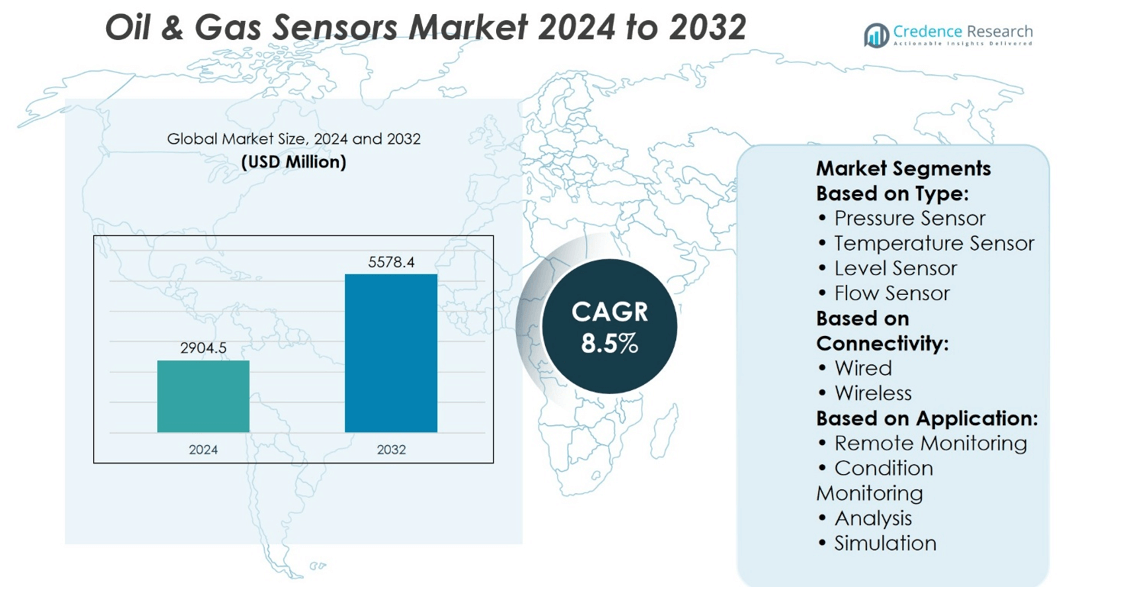
Oil & Gas Sensors Market was valued at USD 2904.5 million in 2024 and is anticipated to reach USD 5578.4 million by 2032, at a CAGR of 8.5% during the forecast period.
| REPORT ATTRIBUTE | DETAILS |
|---|---|
| Historical Period | 2020-2023 |
| Base Year | 2024 |
| Forecast Period | 2025-2032 |
| Oil & Gas Sensors Market Size 2024 | USD 2904.5 million |
| Oil & Gas Sensors Market, CAGR | 8.5% |
| Oil & Gas Sensors Market Size 2032 | USD 5578.4 million |
The Oil & Gas Sensors Market grows due to increasing demand for automation and real-time monitoring across the industry. Rising safety regulations and environmental compliance drive adoption of advanced sensor technologies for accurate detection and control. Integration with IoT and digital platforms enhances operational efficiency and predictive maintenance capabilities. Trends include the development of wireless sensors, miniaturization, and multifunctional devices that support remote asset management. Growing exploration activities in emerging regions further propel market expansion. Industry focus on sustainability and reducing emissions fosters innovation in sensor design and application, reinforcing the market’s steady growth trajectory.
The Oil & Gas Sensors Market shows strong presence in North America and Europe, driven by advanced infrastructure and stringent safety regulations. Asia-Pacific exhibits rapid growth due to expanding exploration and production activities. Key players include Honeywell International Inc., Emerson Electric Co., ABB Ltd., Siemens AG, Rockwell Automation, Fortive Corporation, General Electric (GE), MTS Sensor Technology GmbH & Co. KG, and Lord Corporation. These companies focus on technological innovation and regional expansion to capture growing market opportunities globally.
Market Insights
- The Oil & Gas Sensors Market was valued at USD 2904.5 million in 2024 and is projected to reach USD 5578.4 million by 2032, growing at a CAGR of 8.5%.
- Increasing demand for automation and real-time monitoring drives market growth.
- Rising safety regulations and environmental compliance boost adoption of advanced sensor technologies.
- Integration with IoT and digital platforms improves operational efficiency and supports predictive maintenance.
- Trends include wireless sensors, miniaturization, and multifunctional devices for remote asset management.
- North America and Europe lead due to strong infrastructure and strict safety standards, while Asia-Pacific grows rapidly with expanding exploration activities.
- Competitive landscape features key players focusing on innovation and geographic expansion to capture emerging opportunities.
Market Drivers
Growing Emphasis on Safety and Regulatory Compliance in Exploration and Production
Oil & Gas Sensors Market gains momentum from stringent safety regulations governing exploration and production activities. It supports real-time monitoring of critical parameters such as pressure, temperature, and gas composition to prevent hazardous incidents. Advanced sensor systems enable early detection of leaks, equipment malfunctions, and environmental hazards. Compliance with international safety standards drives adoption across upstream, midstream, and downstream operations. Companies invest in high-accuracy, explosion-proof sensors to meet operational safety benchmarks. The focus on worker protection and environmental stewardship accelerates deployment across onshore and offshore facilities.
- For instance, Siemens Energy has produced over 14,000 WEPS-style subsea pressure and temperature sensors, each valued at approximately 1 million, tailored for deepwater oil and gas exploration to enhance safety and operational control.
Advancement in Sensor Technologies for Harsh and Remote Environments
Continuous innovation in sensor design and materials strengthens the performance of the Oil & Gas Sensors Market. It incorporates ruggedized components, corrosion-resistant housings, and high-temperature endurance to operate reliably in extreme conditions. Wireless connectivity and IoT integration improve data transmission from remote locations. Optical, ultrasonic, and MEMS-based sensors enhance precision while reducing maintenance needs. These advancements extend operational life and reduce downtime in offshore platforms, pipelines, and refineries. The ability to withstand challenging field conditions encourages widespread industry adoption.
- For instance, Honeywell manufactures more than 300 gas sensor products that detect 28 different gases, with a standard range of 400–2,000 ppm and an extended range up to 10,000 ppm, providing critical data for safety systems in exploration and production environments.
Expansion of Digitalization and Predictive Maintenance Strategies
Oil & Gas Sensors Market benefits from the industry’s move toward digital transformation and predictive maintenance frameworks. It enables continuous equipment health monitoring, supporting early fault detection and proactive repair scheduling. Integration with AI-driven analytics platforms improves operational efficiency and resource allocation. Real-time sensor data assists operators in optimizing production processes and reducing unplanned outages. Cloud-based monitoring systems enhance data accessibility for centralized control rooms. The shift toward predictive maintenance reduces operational risks and lowers total lifecycle costs.
Rising Demand for Energy Efficiency and Emission Control
Oil & Gas Sensors Market experiences growth from the need to improve energy efficiency and control emissions. It monitors fuel consumption, process efficiency, and pollutant output in real time. Advanced emission detection sensors support compliance with environmental regulations and corporate sustainability goals. Accurate measurement of greenhouse gases aids in implementing corrective actions quickly. Energy optimization initiatives in refineries and processing plants rely on high-precision sensors. Growing emphasis on sustainability drives investments in sensor solutions that align with cleaner energy strategies.
Market Trends
Integration of IoT and Wireless Connectivity in Sensor Networks
Oil & Gas Sensors Market advances with the widespread adoption of IoT-enabled and wireless communication systems. It allows seamless data transmission from remote drilling sites, offshore platforms, and pipeline networks to centralized control centers. Low-power wide-area networks (LPWAN) and 5G technology enhance real-time monitoring capabilities. Wireless sensors reduce installation complexity and maintenance requirements in hazardous zones. Enhanced connectivity supports predictive analytics and faster decision-making. The integration of IoT platforms strengthens operational transparency and improves overall asset management efficiency.
Shift Toward Advanced Materials and Miniaturized Sensor Designs
Manufacturers in the Oil & Gas Sensors Market invest in advanced materials and compact designs to improve durability and performance. It incorporates corrosion-resistant alloys, high-temperature ceramics, and protective coatings to withstand harsh operating conditions. Miniaturized sensors provide precise measurements without adding bulk to equipment. Smaller form factors enable integration into constrained spaces within drilling rigs and processing units. These innovations support higher accuracy while extending operational life. Material science advancements continue to redefine sensor capabilities in challenging environments.
- For instance, Honeywell's gas sensing solutions division, which includes over 300 products detecting 28 different gases.
Expansion of Multi-Parameter Sensing and Smart Sensor Technologies
Oil & Gas Sensors Market witnesses a shift toward multi-parameter sensing devices capable of measuring multiple variables simultaneously. It streamlines operations by reducing the number of individual sensors required on-site. Smart sensors combine embedded processing capabilities with self-calibration features to minimize downtime. Integration with SCADA systems and cloud-based platforms improves data accessibility and operational control. These technologies enhance process optimization and safety compliance. The trend toward smart, multifunctional devices supports higher operational efficiency in complex oil and gas infrastructures.
- For instance, Siemens Energy's WEPS-100 subsea pressure and temperature sensors have been produced in over 14,000 units, providing critical data for well flow management in offshore exploration and production activities.
Growing Adoption of Environmentally Focused Monitoring Solutions
Oil & Gas Sensors Market aligns with increasing emphasis on environmental monitoring and sustainability. It includes advanced emission detection sensors for methane, carbon dioxide, and volatile organic compounds. Deployment in refineries, storage facilities, and pipelines aids in meeting strict environmental standards. Real-time pollutant tracking allows operators to implement corrective measures quickly. Integration with environmental compliance software improves reporting accuracy. This trend reinforces the sector’s commitment to responsible resource management and reduced ecological impact.
Market Challenges Analysis
Operational Limitations in Harsh and Remote Environments
Oil & Gas Sensors Market faces significant challenges in ensuring consistent performance under extreme operational conditions. It must function reliably in environments with high pressure, extreme temperatures, and corrosive substances. Sensors deployed in offshore platforms and deep drilling operations require frequent maintenance to prevent performance degradation. Harsh conditions increase the risk of calibration drift and signal interference, which can impact data accuracy. Limited accessibility to remote sites complicates repair schedules and replacement logistics. The need for specialized materials and protective housings raises production costs, affecting affordability for large-scale deployment.
High Costs and Integration Complexities in Digital Transformation
Transitioning to advanced sensor systems in the Oil & Gas Sensors Market often demands substantial investment in infrastructure upgrades and integration. It involves compatibility issues with legacy systems that are still prevalent in many facilities. Complex installation processes in hazardous areas increase downtime during system transitions. Cybersecurity risks in connected sensor networks require robust protective measures, adding to operational expenses. Skilled personnel are essential for configuring, maintaining, and troubleshooting modern sensor systems, yet availability remains limited in some regions. The combination of high initial investment and integration challenges slows the adoption rate among cost-sensitive operators.
Market Opportunities
Expansion of Offshore Exploration and Deepwater Projects
Oil & Gas Sensors Market holds strong potential with the increasing number of offshore and deepwater exploration projects. It requires highly reliable and precise sensors to monitor pressure, temperature, and flow in challenging subsea environments. Growth in offshore investments by major energy companies creates opportunities for specialized sensor solutions with enhanced durability. Advanced subsea sensing technologies enable real-time monitoring, improving operational safety and efficiency. Manufacturers offering corrosion-resistant, high-pressure-rated sensors can secure significant contracts in these projects. The rising demand for remote monitoring systems in deepwater operations further strengthens the market’s growth prospects.
Adoption of Digital Oilfield Technologies and Automation
Oil & Gas Sensors Market benefits from the industry’s shift toward digital oilfield strategies and process automation. It supports integration with AI, machine learning, and predictive analytics platforms for optimized asset performance. Smart sensors capable of multi-parameter measurement and self-diagnostics align with these initiatives. Automation in drilling, production, and refining processes drives the need for high-accuracy, low-maintenance sensors. Demand for wireless and IoT-enabled devices is growing as operators seek faster decision-making capabilities. Companies that deliver scalable, secure, and data-rich sensor solutions will find expanding opportunities in digitally advanced oil and gas operations.
Market Segmentation Analysis:
By Type
Oil & Gas Sensors Market includes a diverse range of sensor types, each serving critical operational needs. Pressure sensors hold a significant role in monitoring wellbore pressure, pipeline operations, and refining processes, ensuring system integrity and safety. Temperature sensors track thermal variations in drilling fluids, machinery, and processing units, enabling optimal performance and preventing overheating. Level sensors manage fluid levels in storage tanks, separators, and reservoirs to maintain operational balance. Flow sensors measure and control the movement of oil, gas, and water within pipelines and processing systems. Other sensors, including gas detection and vibration sensors, enhance safety and predictive maintenance strategies. It integrates these varied technologies to deliver comprehensive operational control in demanding environments.
- For instance, Honeywell’s Model MIPCG1 pressure transducer operates reliably up to 175,000 psi and supports oilfield applications where extreme pressure monitoring is required. Honeywell has produced over 2 million units of this model globally, highlighting its wide adoption in the industry.
By Connectivity
Market segmentation by connectivity highlights the distinction between wired and wireless solutions. Wired sensors remain widely used due to their reliability, high data accuracy, and resistance to interference, making them suitable for critical infrastructure where uninterrupted performance is essential. Wireless sensors are gaining traction due to their ease of installation, lower infrastructure requirements, and ability to transmit data from remote or hazardous locations. Integration of wireless networks supports real-time monitoring and reduces physical cabling costs, especially in offshore and large-scale facilities. It allows operators to expand monitoring capabilities without extensive retrofitting of legacy systems. The balance between wired stability and wireless flexibility shapes investment decisions in new projects.
- For instance, Honeywell has manufactured over 1.5 million wired gas sensors specifically designed for industrial safety and exploration environments, supporting continuous, interference-free monitoring in critical pipelines and facilities.
By Application
Application segmentation in the Oil & Gas Sensors Market covers remote monitoring, condition monitoring, and analysis & simulation. Remote monitoring uses sensor networks to track operational parameters from centralized locations, improving oversight in offshore rigs and remote pipelines. Condition monitoring detects early signs of equipment wear, leaks, or performance drops, enabling timely interventions and reducing unplanned downtime. Analysis & simulation applications use sensor data to create operational models, optimize production strategies, and test scenarios without physical risk. It empowers operators to improve safety, efficiency, and decision-making accuracy through actionable insights derived from sensor data. Growing demand for integrated solutions across these applications underscores the importance of advanced sensing technologies in modern oil and gas operations.
Segments:
Based on Type:
- Pressure Sensor
- Temperature Sensor
- Level Sensor
- Flow Sensor
Based on Connectivity:
- Wired
- Wireless
Based on Application:
- Remote Monitoring
- Condition Monitoring
- Analysis
- Simulation
Based on the Geography:
- North America
- U.S.
- Canada
- Mexico
- Europe
- UK
- France
- Germany
- Italy
- Spain
- Russia
- Belgium
- Netherlands
- Austria
- Sweden
- Poland
- Denmark
- Switzerland
- Rest of Europe
- Asia Pacific
- China
- Japan
- South Korea
- India
- Australia
- Thailand
- Indonesia
- Vietnam
- Malaysia
- Philippines
- Taiwan
- Rest of Asia Pacific
- Latin America
- Brazil
- Argentina
- Peru
- Chile
- Colombia
- Rest of Latin America
- Middle East
- UAE
- KSA
- Israel
- Turkey
- Iran
- Rest of Middle East
- Africa
- Egypt
- Nigeria
- Algeria
- Morocco
- Rest of Africa
Regional Analysis
North America
North America holds 35% of the Oil & Gas Sensors Market, making it the largest regional contributor. It benefits from advanced oilfield technology, strong infrastructure, and a well-developed energy sector. The U.S. and Canada have extensive offshore platforms, shale oil operations, and refining facilities that require accurate and reliable sensor systems. It uses pressure, temperature, and gas detection sensors for both operational efficiency and strict safety compliance. Many facilities deploy rugged, explosion-proof designs that can handle extreme environments such as deepwater drilling sites and cold-weather operations in Alaska and northern Canada. Real-time monitoring systems are widely used to detect performance issues early and prevent downtime. The combination of innovation, regulatory compliance, and high production volumes sustains North America’s leadership position in the market.
Europe
Europe accounts for 30% of the global Oil & Gas Sensors Market. The region places strong emphasis on emission monitoring, energy efficiency, and meeting strict European Union environmental regulations. Countries such as the UK, Norway, and Germany are key centers for sensor manufacturing and development. It invests in high-accuracy sensors with low power consumption for both offshore platforms and onshore refineries. Mature oilfields in the North Sea and other areas require condition monitoring systems to extend asset life and maintain safety. Europe is also integrating sensors into smart digital oilfield systems to reduce methane leaks and optimize production. Continuous modernization of facilities and the push for cleaner operations maintain strong demand for advanced sensing technologies.
Asia-Pacific
Asia-Pacific holds 25% of the Oil & Gas Sensors Market, driven by rapid energy infrastructure growth in China, India, and Southeast Asia. It is a major hub for new pipelines, LNG terminals, offshore platforms, and refineries. The region uses both wired and wireless sensors for pressure, flow, and level control in these facilities. Harsh conditions, including high humidity, corrosive environments, and high temperatures, require specially engineered sensor materials. Operators are increasingly adopting IoT-enabled and cloud-connected monitoring systems to modernize older installations. Significant investments from both governments and private companies ensure steady growth in sensor deployment across exploration, production, and refining activities.
Middle East & Africa
Middle East & Africa hold 5% of the market share, supported by large oil reserves and major refining capacity. Saudi Arabia, UAE, and Nigeria are key markets for sensor deployment in upstream, midstream, and downstream operations. It uses corrosion-resistant, high-temperature-rated sensors to withstand extreme desert conditions. Monitoring solutions are critical for pipeline integrity, drilling equipment performance, and storage facility safety. The region is expanding enhanced oil recovery projects and modernizing older infrastructure, which creates more opportunities for advanced sensor installations. Focus on operational efficiency and production optimization continues to drive demand.
Latin America
Latin America accounts for 5% of the Oil & Gas Sensors Market, with Brazil, Argentina, and Colombia leading in adoption. Offshore operations in Brazil’s pre-salt fields require high-performance sensors for flow monitoring, gas detection, and subsea condition tracking. Onshore refineries and processing plants in the region use sensors to improve operational reliability and safety standards. Humid, saline, and corrosive environments demand specialized sensor designs for long-term performance. The expansion of exploration and production projects, coupled with efforts to improve energy efficiency, is increasing the region’s use of advanced sensing technologies. It continues to see steady growth as countries invest in infrastructure upgrades and modernization.
Key Player Analysis
- Rockwell
- General Electric (GE)
- MTS Sensor Technology GmbH & Co. Kg
- BD Sensors
- Indutrade
- Fortive
- Siemens
- Emerson
- ABB Ltd
- Honeywell
Competitive Analysis
The Oil & Gas Sensors Market players include Honeywell, Emerson, Siemens, ABB Ltd, Fortive, Rockwell, Indutrade, MTS Sensor Technology GmbH & Co. Kg, General Electric (GE), and BD Sensors. The Oil & Gas Sensors Market is characterized by rapid technological advancements and increasing adoption of automation across upstream, midstream, and downstream operations. Rising demand for real-time monitoring, predictive maintenance, and enhanced safety protocols drives market growth. Innovations in sensor technology focus on improving accuracy, durability, and integration with IoT and digital platforms to enable efficient data analytics and remote asset management. Additionally, stringent environmental regulations compel the development of sensors capable of precise emissions monitoring and compliance reporting. The market is also witnessing a shift toward smart sensors that support predictive analytics and operational efficiency, reducing downtime and optimizing resource utilization. As industries prioritize safety and environmental sustainability, sensor solutions are evolving to meet these challenges while delivering cost-effective performance and reliability in harsh operating conditions.
Recent Developments
- In May 2025, Rockwell reported strong operating performance for Q2 2025, highlighting continued advances in industrial automation technology.
- In October 2024, AlphaSense introduced PIDX, a new PID (Photoionization Detector) sensor technology designed to improve gas detection capabilities.
- In March 2023, The Ministry of Electronics and Information Technology announced the launch of three IoT sensor-based products, which include a Smart Digital Thermometer, IoT Enabled Environmental Monitoring System, and a Multichannel Data Acquisition System in the CoE in IoT Sensors.
- In March 2023, Sensorix GmbH revealed its new range of sensors for toxic gases at Sensor + Test 2023. The showcase features the company’s variety of gas sensors that are highly prevalent in various industries.
Market Concentration & Characteristics
The Oil & Gas Sensors Market demonstrates a moderately concentrated competitive landscape, dominated by a select group of multinational corporations with strong technological capabilities and extensive industry experience. These key players leverage robust R&D investments to innovate sensor technologies that meet stringent industry standards for safety, accuracy, and durability under extreme conditions. The market structure favors companies that can provide integrated solutions combining sensor hardware with advanced digital platforms, including IoT and predictive analytics, to enhance operational efficiency and asset management. Market participants focus on strategic collaborations and partnerships to expand their product portfolios and geographic reach, targeting both established oil and gas regions and emerging markets. It faces challenges from high entry barriers due to regulatory compliance, significant capital requirements, and the need for continuous innovation. Demand concentrates primarily on sensors for pressure, temperature, gas detection, and flow measurement, which are critical for optimizing production processes and maintaining safety standards. The market experiences steady growth driven by industry-wide digital transformation and increasing adoption of automated monitoring systems. Customers prioritize reliability, accuracy, and real-time data integration when selecting sensor solutions. This concentration encourages innovation while maintaining high standards of quality and performance. Overall, it reflects a market where technological expertise and strategic positioning determine competitive advantage, supporting long-term growth prospects.
Report Coverage
The research report offers an in-depth analysis based on Type, Connectivity, Application and Geography. It details leading market players, providing an overview of their business, product offerings, investments, revenue streams, and key applications. Additionally, the report includes insights into the competitive environment, SWOT analysis, current market trends, as well as the primary drivers and constraints. Furthermore, it discusses various factors that have driven market expansion in recent years. The report also explores market dynamics, regulatory scenarios, and technological advancements that are shaping the industry. It assesses the impact of external factors and global economic changes on market growth. Lastly, it provides strategic recommendations for new entrants and established companies to navigate the complexities of the market.
Future Outlook
- The Oil & Gas Sensors Market will expand with increasing automation across upstream, midstream, and downstream sectors.
- Companies will prioritize development of sensors with enhanced accuracy and durability for harsh environments.
- Integration of sensors with IoT and digital platforms will become standard for real-time monitoring and data analytics.
- Demand will grow for advanced gas detection sensors to support stricter environmental and safety regulations.
- Predictive maintenance using sensor data will reduce downtime and operational costs.
- Emerging markets will drive sensor adoption due to expanding oil and gas exploration activities.
- Collaboration between sensor manufacturers and technology firms will accelerate innovation.
- Wireless and remote sensor technologies will gain traction for improved accessibility and efficiency.
- Focus on energy efficiency and sustainability will push development of eco-friendly sensor solutions.
- Continuous advancements in sensor miniaturization and multifunctionality will meet evolving industry needs.

Request a Free Sample
Fill in your details and we'll send you a free sample report.
- Sample data tables & charts
- Research methodology
Market Dynamics
Growing Emphasis on Safety and Regulatory Compliance
Stringent safety regulations in oil and gas exploration and production require real-time monitoring of critical parameters, driving adoption of advanced sensors for early detection of leaks, equipment malfunctions, and environmental hazards.
Advancement in Sensor Technologies for Harsh and Remote Environments
Continuous innovation in ruggedized, corrosion-resistant, and high-temperature sensors enables reliable operation in extreme conditions, supporting wider deployment in offshore platforms, pipelines, and refineries.
Expansion of Digitalization and Predictive Maintenance
The industry's shift toward digital transformation and predictive maintenance frameworks increases demand for sensors that enable continuous equipment health monitoring, early fault detection, and integration with AI-driven analytics for operational efficiency.
Rising Demand for Energy Efficiency and Emission Control
Efforts to improve energy efficiency and comply with environmental regulations are boosting the use of advanced sensors for real-time monitoring of fuel consumption, process efficiency, and pollutant output, supporting sustainability goals.
Integration of IoT and Wireless Connectivity
The adoption of IoT-enabled and wireless sensor networks allows seamless data transmission from remote and hazardous locations, reducing installation complexity and enabling real-time monitoring and predictive analytics.
Need a Custom Version of This Report?
Tailor the scope, geography, or segments to your exact requirements.
- Custom geography or segment scope
- Direct access to our analyst team
Frequently Asked Questions
What is the current market size for Oil & Gas Sensors Market, and what is its projected size in 2032?
At what Compound Annual Growth Rate is the Oil & Gas Sensors Market projected to grow between 2025 and 2032?
What are the primary factors fueling the growth of the Oil & Gas Sensors Market
Who are the leading companies in the Oil & Gas Sensors Market
Table of Content
Chapter 1 Market Segmentation
- 1.1 Segmentation Framework
- 1.1.1 Product and Service Classification
- 1.1.2 Application and End-Use Classification
- 1.1.3 Technology and Solution Classification
- 1.1.4 Customer and Distribution Channel Classification
- 1.1.5 Geographic Segmentation
- 1.1.6 Market Segment Definitions and Boundaries
- 1.2 By Type
- 1.2.1 Pressure Sensor
- 1.2.2 Temperature Sensor
- 1.2.3 Level Sensor
- 1.2.4 Flow Sensor
- 1.3 By Application
- 1.3.1 Remote Monitoring
- 1.3.2 Condition Monitoring
- 1.3.3 Analysis
- 1.3.4 Simulation
- 1.4 By Connectivity
- 1.4.1 Wired
- 1.4.2 Wireless
Chapter 2 Introduction
- 2.1 Report Objectives and Scope
- 2.2 Product Definition and Industry Terminology
- 2.3 Market Inclusions and Exclusions
- 2.4 Research Process
- 2.4.1 Primary Research and Expert Interviews
- 2.4.2 Secondary Research and Source Review
- 2.4.3 Top-Down and Bottom-Up Estimation
- 2.4.4 Data Triangulation and Verification
- 2.5 Market Size Measurement Basis
- 2.5.1 2024: USD 2,904.5 million → 2032: USD 5,578.4 million
- 2.6 Historical and Forecast Reference Periods
- 2.6.1 Base Year: 2024
- 2.6.2 Forecast Period: 2024-2032
- 2.7 Research Assumptions and Limitations
Chapter 3 Executive Summary
- 3.1 Market Snapshot and Key Findings
- 3.2 Base-Year Market Size, 2024
- 3.3 Forecast Market Size, 2032
- 3.4 Revenue and Volume Growth Outlook
- 3.5 Key Demand and Supply Indicators
- 3.6 Leading Market Segments
- 3.7 Fastest-Growing Market Opportunities
- 3.8 Regional Performance Highlights
- 3.9 Technology and Industry Transformation
- 3.10 Competitive Landscape Summary
- 3.11 Analyst View and Strategic Implications
Chapter 4 Global Oil & Gas Sensors Market Trends and Developments
- 4.1 Historical Industry Development
- 4.2 Recent Market Trends and Developments
- 4.3 Demand and Customer Behavior Trends
- 4.4 Technology and Product Innovation
- 4.5 Artificial Intelligence, Automation and Digitalization
- 4.6 Local Manufacturing and Supply Chain Realignment
- 4.7 Industry Partnerships, Mergers and Acquisitions
- 4.8 Sustainability and Circular Economy Developments
- 4.9 Government and Private Sector Investment Trends
- 4.10 Emerging Business Models and Commercialization
- 4.11 Industry Developments and Announcements
Chapter 5 Global Oil & Gas Sensors Market Production, Supply and Demand Analysis
- 5.1 Demand Trend and Consumption Analysis
- 5.2 Demand Forecast, 2024-2032
- 5.3 Production and Output Trend
- 5.4 Production and Output Forecast, 2024-2032
- 5.5 Installed Capacity and Capacity Utilization
- 5.6 Company-Wise Production Plants and Statistics
- 5.6.1 Installed Production Capacity
- 5.6.2 Actual Production
- 5.6.3 Planned Capacity and Expansion Targets
- 5.7 Supply Chain Structure and Procurement Trends
- 5.8 Supply-Demand Gap and Bottlenecks
- 5.9 Import Dependence and Sourcing Structure
- 5.10 Contract Manufacturing and Outsourcing
- 5.11 Regional Supply and Demand Concentration
Chapter 6 Global Oil & Gas Sensors Market Pricing Analysis
- 6.1 Pricing Structure and Measurement
- 6.2 Historical Pricing Trends
- 6.3 Pricing Outlook, 2024-2032
- 6.4 Average Selling Price and Unit Economics
- 6.5 Pricing by Product and Market Segment
- 6.6 Geographic Pricing Differences
- 6.7 Key Input, Energy, Labor and Logistics Costs
- 6.8 Contract Pricing and Purchasing Models
- 6.9 Pricing Sensitivity and Competitive Positioning
- 6.10 Price, Margin and Profitability Implications
Chapter 7 Global Oil & Gas Sensors Market Dynamics
- 7.1 Market Growth Drivers
- 7.1.1 Demand-Side Drivers
- 7.1.2 Technology and Innovation Drivers
- 7.1.3 Infrastructure and Investment Drivers
- 7.1.4 Regulatory and Policy Drivers
- 7.2 Market Restraints
- 7.2.1 Cost and Affordability Constraints
- 7.2.2 Technology and Adoption Barriers
- 7.2.3 Supply Chain and Operational Constraints
- 7.3 Market Challenges
- 7.3.1 Competitive Pressure and Margin Erosion
- 7.3.2 Skills, Infrastructure and Implementation Gaps
- 7.4 Emerging Market Opportunities
- 7.5 Market Dynamics Impact and Time-Horizon Assessment
Chapter 8 Global Oil & Gas Sensors Value Chain Analysis
- 8.1 Industry Value Chain Overview
- 8.2 Upstream Suppliers and Critical Inputs
- 8.3 Technology and Component Providers
- 8.4 Manufacturing or Service Delivery
- 8.5 Distribution, Channel Partners and Integrators
- 8.6 Downstream Applications and End Users
- 8.7 Value Addition and Profit Pools
- 8.8 Vertical Integration and Outsourcing
- 8.9 Supplier Concentration and Risk
- 8.10 Supply Chain Localization and Resilience
Chapter 9 Global Oil & Gas Sensors Market Regulations and Policies
- 9.1 Relevant Laws, Standards and Compliance Frameworks
- 9.2 Product, Service, Safety and Quality Requirements
- 9.3 Government Policies, Incentives and Subsidies
- 9.4 Imports, Exports and Trade Barriers
- 9.5 Public Procurement and Local Content Requirements
- 9.6 Environmental and Sustainability Compliance
- 9.7 Upcoming Policy Changes and Market Implications
Chapter 10 Global Oil & Gas Sensors Market Hotspots and Opportunities
- 10.1 Market Opportunity Mapping and Growth Hotspots
- 10.2 High-Growth Applications and Customer Groups
- 10.3 Underserved Markets and White-Space Opportunities
- 10.4 Emerging Technology and Product Opportunities
- 10.5 New Capacity and Investment Hotspots
- 10.6 Market Entry and Expansion Opportunities
- 10.7 Distribution and Partnership Opportunities
- 10.8 Near-Term and Long-Term Commercial Potential
- 10.9 Opportunity Attractiveness and Execution Risks
Chapter 11 Global Oil & Gas Sensors Market Outlook, 2024-2032
- 11.1 Market Size and Analysis
- 11.1.1 Revenue (Market Measurement: 2024: USD 2,904.5 million → 2032: USD 5,578.4 million)
- 11.1.2 Market Volume and Quantity Sold
- 11.1.3 Historical Market Size
- 11.1.4 Base-Year Market Size, 2024
- 11.2 Market Forecast, 2024-2032
- 11.2.1 Revenue Forecast to 2032
- 11.2.2 Volume Forecast to 2032
- 11.2.3 CAGR and Year-on-Year Growth
- 11.2.4 Incremental Revenue Opportunity
- 11.3 Forecast Assumptions and Scenario Analysis
- 11.3.1 Base-Case Forecast
- 11.3.2 Optimistic and Conservative Scenarios
- 11.3.3 Technology, Pricing and Policy Sensitivities
- 11.4 Market Attractiveness and Growth Outlook
Chapter 12 Global Oil & Gas Sensors Market Segmentation and Outlook
- 12.1 Segmentation Summary and Market Shares, 2024
- 12.2 Largest and Fastest-Growing Segments
- 12.3 By Type - Market Size and Forecast, 2024-2032
- 12.3.1 Segment Definition and Scope
- 12.3.2 Historical Market Size
- 12.3.3 Revenue Forecast, 2024-2032
- 12.3.4 Volume Forecast, 2024-2032
- 12.3.5 Base-Year Market Share, 2024
- 12.3.6 Segment CAGR and Growth Drivers
- 12.3.7 Subsegment Market Size and Forecast
- 12.3.7.1 Pressure Sensor
- 12.3.7.2 Temperature Sensor
- 12.3.7.3 Level Sensor
- 12.3.7.4 Flow Sensor
- 12.3.8 Subsegment Pricing and Adoption Trends
- 12.3.9 Leading Suppliers and Competition
- 12.3.10 Regional Demand and Opportunities
- 12.4 By Application - Market Size and Forecast, 2024-2032
- 12.4.1 Segment Definition and Scope
- 12.4.2 Historical Market Size
- 12.4.3 Revenue Forecast, 2024-2032
- 12.4.4 Volume Forecast, 2024-2032
- 12.4.5 Base-Year Market Share, 2024
- 12.4.6 Segment CAGR and Growth Drivers
- 12.4.7 Subsegment Market Size and Forecast
- 12.4.7.1 Remote Monitoring
- 12.4.7.2 Condition Monitoring
- 12.4.7.3 Analysis
- 12.4.7.4 Simulation
- 12.4.8 Subsegment Pricing and Adoption Trends
- 12.4.9 Leading Suppliers and Competition
- 12.4.10 Regional Demand and Opportunities
- 12.5 By Connectivity - Market Size and Forecast, 2024-2032
- 12.5.1 Segment Definition and Scope
- 12.5.2 Historical Market Size
- 12.5.3 Revenue Forecast, 2024-2032
- 12.5.4 Volume Forecast, 2024-2032
- 12.5.5 Base-Year Market Share, 2024
- 12.5.6 Segment CAGR and Growth Drivers
- 12.5.7 Subsegment Market Size and Forecast
- 12.5.7.1 Wired
- 12.5.7.2 Wireless
- 12.5.8 Subsegment Pricing and Adoption Trends
- 12.5.9 Leading Suppliers and Competition
- 12.5.10 Regional Demand and Opportunities
- 12.6 Segment Growth Comparison
- 12.7 Segment Attractiveness and Priority Matrix
Chapter 13 Global Oil & Gas Sensors End-Use and Application Market Outlook
- 13.1 End-Use Industry and Customer Demand Structure
- 13.2 Leading Applications and Customer Groups
- 13.3 End-Use Market Size, Share and Forecast
- 13.4 Major End-Use Industry Deep Dives
- 13.4.1 Customer Requirements and Use Cases
- 13.4.2 Demand and Replacement Cycles
- 13.4.3 Technical and Regulatory Considerations
- 13.4.4 Purchasing and Procurement Models
- 13.4.5 Leading Vendors and Distribution Channels
- 13.4.6 Forecast and Commercial Opportunities
- 13.5 Emerging Applications and Cross-Segment Demand
- 13.6 End-Use Industry Investment Priorities
Chapter 14 Global Oil & Gas Sensors Geographic Market Outlook, 2024-2032
- 14.1 Regional Market Size and Share, 2024
- 14.2 Regional Market Forecast, 2024-2032
- 14.3 Regional Pricing, Production and Demand Differences
- 14.4 North America
- 14.4.1 United States
- 14.4.2 Canada
- 14.4.3 Mexico
- 14.5 Europe
- 14.5.1 Germany
- 14.5.2 France
- 14.5.3 Italy
- 14.5.4 United Kingdom
- 14.5.5 Spain
- 14.5.6 Poland
- 14.5.7 Russia
- 14.5.8 Netherlands
- 14.5.9 Belgium
- 14.5.10 Sweden
- 14.5.11 Denmark
- 14.5.12 Norway
- 14.5.13 Rest of Europe
- 14.6 Asia Pacific
- 14.6.1 China
- 14.6.2 India
- 14.6.3 Japan
- 14.6.4 South Korea
- 14.6.5 Thailand
- 14.6.6 Indonesia
- 14.6.7 Vietnam
- 14.6.8 Malaysia
- 14.6.9 Australia
- 14.6.10 Rest of Asia Pacific
- 14.7 Latin America
- 14.7.1 Brazil
- 14.7.2 Argentina
- 14.7.3 Colombia
- 14.7.4 Chile
- 14.7.5 Rest of Latin America
- 14.8 Middle East
- 14.8.1 Saudi Arabia
- 14.8.2 United Arab Emirates
- 14.8.3 Turkey
- 14.8.4 Israel
- 14.8.5 Iran
- 14.8.6 Rest of the Middle East
- 14.9 Africa
- 14.9.1 South Africa
- 14.9.2 Egypt
- 14.9.3 Nigeria
- 14.9.4 Morocco
- 14.9.5 Rest of Africa
- 14.10 Regional Investment, Policy and Supply Chain Differences
- 14.11 Regional Competitive Landscape
- 14.12 Geographic Growth Hotspots
Chapter 15 Global Oil & Gas Sensors Technology, Innovation and Sustainability Outlook
- 15.1 Technology Landscape and Maturity
- 15.2 Product, Process and Service Innovation
- 15.3 AI, Automation and Digital Tools in the Industry
- 15.4 Technology Adoption and Performance Benchmarking
- 15.5 Innovation Pipeline and R&D Investment
- 15.6 Patent and Intellectual Property Trends
- 15.7 Energy Efficiency and Resource Management
- 15.8 Sustainability, Recycling and Circularity
- 15.9 Technology Roadmap, 2024-2032
- 15.10 Risks of Obsolescence and Technology Substitution
Chapter 16 Global Oil & Gas Sensors Market Key Strategic Imperatives
- 16.1 Growth and Market Entry Priorities
- 16.2 High-Return Products and Segments
- 16.3 Pricing, Profitability and Cost Optimization
- 16.4 Technology Investment and Product Differentiation
- 16.5 Supply Chain Localization and Resilience
- 16.6 Distribution and Customer Acquisition
- 16.7 Partnership, Acquisition and Capacity Strategy
- 16.8 Regional Expansion Priorities
- 16.9 Short-, Medium- and Long-Term Actions
Chapter 17 Competition Outlook
- 17.1 Industry Competition Characteristics
- 17.2 Market Structure and Concentration
- 17.3 Market Share and Competitive Positioning, 2024
- 17.4 Company-Wise Revenue and Product Benchmarking
- 17.5 Production and Service Capacity Benchmarking
- 17.6 Technology, Pricing and Differentiation
- 17.7 Regional Footprint and Distribution Strength
- 17.8 Mergers, Acquisitions and Strategic Alliances
- 17.9 New Entrants and Competitive Threats
- 17.10 Porter's Five Forces and Industry Attractiveness
- 17.11 Competitive Outlook, 2024-2032
Chapter 18 Company Profiles
- 18.1 Company Coverage and Selection Criteria
- 18.2 Honeywell International Inc.
- 18.2.1 Business Description
- 18.2.2 Company Ownership and Geographic Presence
- 18.2.3 Product and Service Portfolio
- 18.2.4 Manufacturing and Operating Footprint
- 18.2.5 Production Capacity and Expansion Plans
- 18.2.6 Financial Performance and Investment
- 18.2.7 Market Share and Competitive Position
- 18.2.8 Technology and Innovation Capabilities
- 18.2.9 Strategic Alliances or Partnerships
- 18.2.10 Recent Developments
- 18.2.11 Growth Strategy and Outlook
- 18.3 Emerson Electric Co.
- 18.4 ABB Ltd.
- 18.5 Siemens AG
- 18.6 Rockwell Automation
- 18.7 Fortive Corporation
- 18.8 General Electric (GE)
- 18.9 MTS Sensor Technology GmbH & Co. KG
- 18.10 BD Sensors
- 18.11 Indutrade
- 18.12 Other Relevant Market Participants
Note: Every listed company is profiled on the structure shown under the first company. The company list is preliminary and may change based on research findings, market developments, data availability and client requirements.
Chapter 19 Disclaimer
- 19.1 Research and Forecast Disclaimer
- 19.2 Data Source and Estimation Limitations
Note: The depth of individual sections depends on data availability for this market. Volume, capacity, trade and other unit-based metrics are included where applicable.

