Home » Semiconductor & Electronics » Level Sensors Market

Level Sensors Market By Technology (Contact Type, Non-Contact Type); By Application (Automotive, Consumer Electronics, Healthcare, Industrial Process, Oil & Gas, Others); By Region (North America, Europe, Asia Pacific, Latin America, Middle East, Africa) – Growth, Share, Opportunities & Competitive Analysis, 2024 – 2032

Report ID: 12307 | Report Format : Excel, PDF

Market Overview:

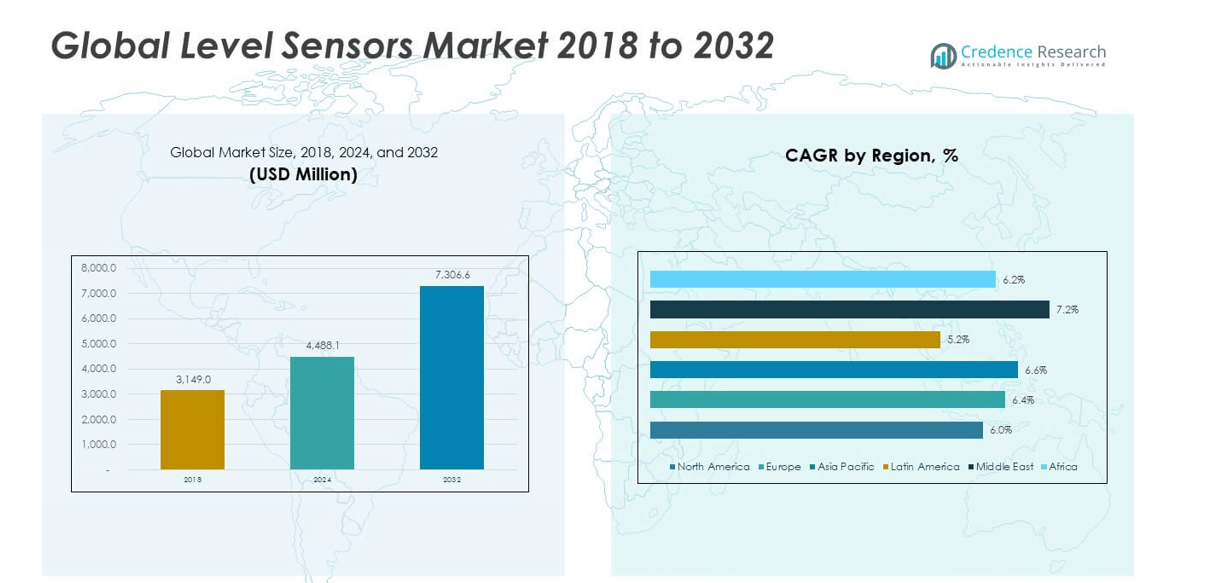
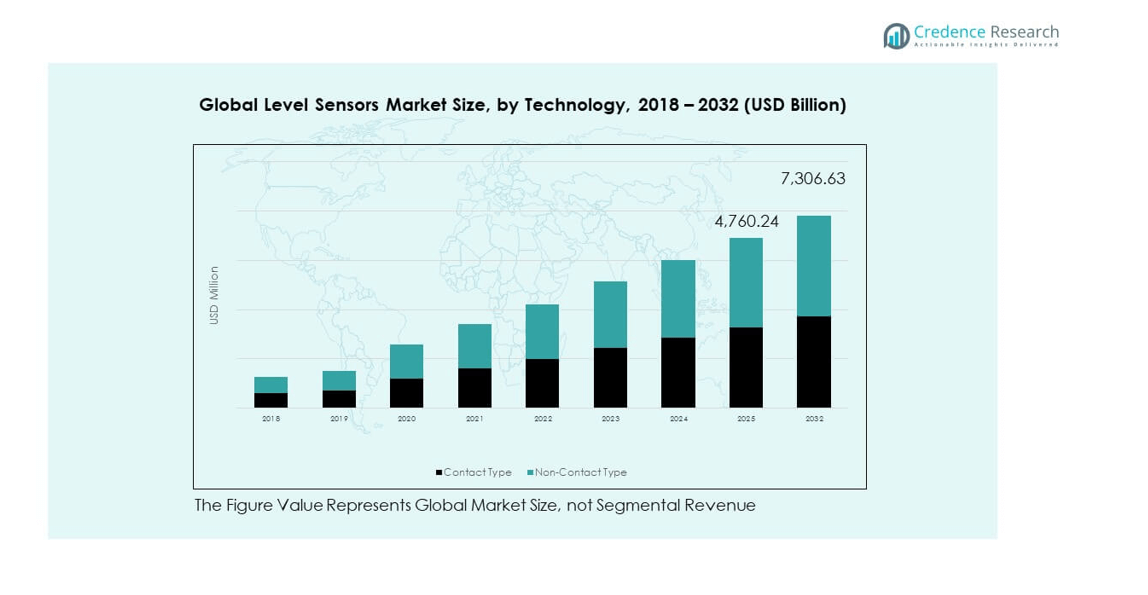
The Global Level Sensors Market size was valued at USD 3,149.0 million in 2018 to USD 4,488.1 million in 2024 and is anticipated to reach USD 7,306.6 million by 2032, at a CAGR of 6.31% during the forecast period.

REPORT ATTRIBUTE DETAILS
Historical Period 2020-2023
Base Year 2024
Forecast Period 2025-2032
Level Sensors Market Size 2024 USD 4,488.1 million
Level Sensors Market, CAGR 6.31%
Level Sensors Market Size 2032 USD 7,306.6 million


The market growth is driven by rising industrial automation and increasing demand for accurate liquid and solid level measurement. The expanding use of smart sensors in oil & gas, water treatment, and manufacturing sectors strengthens adoption. Integration with IoT systems enhances remote monitoring and predictive maintenance, improving operational efficiency. Growing adoption in the automotive and healthcare industries, along with government focus on process safety, further supports market expansion.

North America leads the market due to early adoption of advanced sensing technologies and strong industrial infrastructure. Europe follows, driven by strict regulatory compliance and growing automation in process industries. The Asia-Pacific region is emerging rapidly with rising industrialization in China, India, and Japan, where large-scale manufacturing and smart factory initiatives are boosting demand for advanced level sensing solutions.

Level Sensors Market size

Market Insights:

  • The Global Level Sensors Market size was valued at USD 3,149.0 million in 2018, reaching USD 4,488.1 million in 2024, and is projected to achieve USD 7,306.63 million by 2032, registering a CAGR of 6.31% during the forecast period.
  • Asia Pacific leads the market with a 36% share, supported by strong manufacturing, industrial automation, and widespread IoT adoption across China, Japan, and India. Europe follows with 26% due to advanced production systems and regulatory emphasis on efficiency. North America holds 21%, backed by technological innovation and early automation integration.
  • The Middle East emerges as the fastest-growing region, holding 5% share, driven by expanding oil, gas, and water management projects alongside smart city initiatives under national development programs.
  • Non-contact type sensors account for nearly 65% of total revenue, favored for their high precision, reliability, and maintenance-free operation across industrial and hygienic applications.
  • Contact type sensors represent the remaining 35% share, sustaining relevance in cost-sensitive sectors that prioritize durable and direct measurement for stable operating environments.

Access crucial information at unmatched prices!

Request your sample report today & start making informed decisions powered by Credence Research Inc.!

Download Sample

Market Drivers:

Rising Adoption of Industrial Automation and Smart Manufacturing Across Industries

The Global Level Sensors Market experiences strong growth driven by widespread automation in industrial facilities. Manufacturers in sectors such as oil and gas, food processing, and water treatment rely on accurate level measurement for improved safety and efficiency. The shift toward Industry 4.0 further promotes sensor integration into connected systems. Companies use real-time data for predictive maintenance, reducing downtime and operational costs. It benefits from the growing demand for smart devices capable of remote monitoring. Integration with IoT platforms enhances visibility across complex processes. Continuous innovation in sensor precision also boosts reliability in harsh environments. Increasing investments in automated infrastructure sustain the market’s long-term expansion.

  • For instance, ABB was named a leader in the 2025 Gartner® Magic Quadrant™ for Global Industrial IoT Platforms, with its radar and ultrasonic level sensors supporting millions of individual readings every hour and sustaining stable operations for over 60,000 consecutive processing hours in oil and chemical plant deployments.

Increasing Demand for Non-Contact and Wireless Level Measurement Technologies

The demand for non-contact sensors grows rapidly due to their ability to perform without physical contact, reducing contamination and wear. Industries such as pharmaceuticals, food and beverage, and chemicals prefer these technologies for hygienic applications. Ultrasonic, radar, and microwave sensors replace traditional contact-based systems in many operations. It expands further as wireless sensors offer real-time data transmission with low installation costs. Remote accessibility enables operators to monitor tank and silo levels through cloud interfaces. Adoption of energy-efficient wireless sensors supports sustainability initiatives. Enhanced accuracy under extreme temperature and pressure conditions boosts market confidence. Continuous R&D efforts in low-power communication protocols strengthen product performance and reliability.

  • For instance, Honeywell’s battery electrolyte sensor won the 2025 “Best of Sensors” award for its ability to measure critical electrolyte levels in real time, with a detection resolution of 0.001 mol/L, raising operational reliability in hazardous liquid processes such as energy storage and advanced manufacturing.

Expanding Application in Water and Wastewater Management Projects

Government projects focused on water conservation and wastewater management drive substantial demand for level sensors. Municipal corporations integrate smart sensing technologies in treatment facilities to optimize water use. The Global Level Sensors Market benefits from the growing deployment of automation in utilities. Sensors help monitor reservoir levels, pipeline flow, and leakage detection in real time. IoT-based systems enhance early fault detection and resource allocation. Adoption across developing economies grows with infrastructure modernization programs. The focus on sustainability increases the need for accurate flow measurement and control. Partnerships between public authorities and private sensor manufacturers accelerate implementation across smart city projects.

Growing Use in Automotive, Healthcare, and Consumer Electronics

Automotive manufacturers use level sensors for fuel, coolant, and brake fluid monitoring to ensure safety and performance. Healthcare applications expand through liquid level measurement in diagnostic and laboratory devices. It also finds rising use in household appliances like washing machines and coffee makers. The Global Level Sensors Market gains momentum with smart home adoption and connected appliances. Compact, energy-efficient sensors meet the requirements of these evolving products. In medical applications, sensors enhance precision and reduce contamination risks. The expansion of electric vehicles further boosts sensor demand for battery management systems. Continuous innovation in MEMS and optical technologies supports next-generation consumer applications.

Level Sensors Market share

Market Trends:

Integration of Internet of Things (IoT) and Cloud-Based Monitoring Solutions

The Global Level Sensors Market sees a strong trend toward IoT-based connectivity, enabling real-time visibility and analytics. Cloud-based monitoring platforms allow industries to analyze fluid levels remotely and make data-driven decisions. Smart factories deploy connected sensors to optimize resource usage. Manufacturers leverage predictive analytics for maintenance scheduling, reducing unexpected failures. Wireless protocols like LoRaWAN and NB-IoT expand deployment flexibility. It strengthens efficiency through centralized monitoring dashboards. Industries adopt IoT integration to comply with digital transformation goals. Cloud and IoT convergence creates scalable infrastructure for industrial and commercial applications.

  • For instance, Emerson introduced its Ovation Automation Platform 4.0 in 2024, not 2025. The new platform is designed to manage large quantities of data from intelligent devices and edge controllers via secure networks, allowing operators in power and water plants to leverage AI for applications like predictive maintenance.

Miniaturization and Advancement in MEMS and Optical Sensor Technologies

Miniaturization drives product innovation, enabling integration into compact devices and portable instruments. MEMS and optical technologies enhance precision, durability, and cost-effectiveness. The Global Level Sensors Market benefits from these developments across electronics, automotive, and medical fields. Compact sensors improve responsiveness while maintaining low energy consumption. It enables manufacturers to design smaller yet more efficient systems. Advances in laser and photonic sensing improve performance under challenging conditions. Miniaturized sensors also support wearable medical devices and industrial robots. Continuous innovation helps meet the rising demand for lightweight and multifunctional products.

Shift Toward Sustainable and Energy-Efficient Sensor Solutions

Manufacturers focus on designing energy-efficient sensors with minimal power consumption and longer operational life. The growing emphasis on green manufacturing influences sensor production and use. It aligns with industry efforts to reduce carbon emissions and energy costs. The Global Level Sensors Market embraces eco-friendly materials and recyclable components. Energy harvesting and self-powered sensors gain popularity in remote locations. These developments reduce dependency on wired connections and frequent maintenance. Companies integrate low-power electronics to meet regulatory sustainability standards. The shift toward clean technology supports both environmental and economic benefits.

Rising Popularity of 3D Level Measurement and Advanced Radar Systems

Industries increasingly adopt 3D level measurement systems for improved accuracy in bulk solids and liquid monitoring. Advanced radar systems provide precise readings under high temperature, dust, or vapor conditions. The Global Level Sensors Market benefits from radar technology advancements like FMCW and pulse radar. It enhances accuracy in critical applications such as oil refineries and chemical processing. These sensors outperform traditional ultrasonic models in harsh industrial environments. The rise of autonomous process control creates greater demand for 3D visualization. Integration with control systems ensures seamless operation. Continuous improvement in radar algorithms boosts adoption in smart manufacturing.

Market Challenges Analysis:

High Installation Costs and Complex Calibration Requirements

The Global Level Sensors Market faces challenges related to high installation and integration expenses. Complex industrial systems require precise calibration to maintain performance and accuracy. It becomes difficult for small-scale industries to justify the cost of advanced sensing solutions. The requirement for skilled professionals to handle setup and maintenance adds operational burden. Harsh industrial environments accelerate sensor wear and replacement frequency. Customization needs also increase expenses due to specific material compatibility. Integration with existing control systems demands careful engineering. These financial and technical barriers limit adoption in cost-sensitive markets.

Environmental and Technological Limitations in Certain Applications

Environmental conditions such as temperature extremes, humidity, and electromagnetic interference affect sensor reliability. The Global Level Sensors Market encounters performance issues in corrosive or high-vibration environments. It requires frequent recalibration or specialized protective housing to maintain accuracy. Non-contact sensors may struggle with foam or vapor interference in liquids. Signal reflection and attenuation further complicate measurement in dense materials. Limited standardization across regions hinders interoperability. Rapid technological changes make older sensors obsolete quickly. The need for continuous upgrades increases costs for end users.

Market Opportunities:

Expansion of Smart Infrastructure and Industrial IoT Deployments

The Global Level Sensors Market finds new opportunities in expanding smart infrastructure projects. Rapid urbanization and industrial IoT adoption promote integration of sensors into connected systems. It enables governments and enterprises to monitor critical resources efficiently. Water management, energy grids, and smart manufacturing benefit from accurate level monitoring. Investments in digital transformation open markets in Asia-Pacific and Latin America. Collaboration between public authorities and private firms encourages large-scale deployment. Increased use of wireless connectivity and AI enhances decision-making speed. Growth in data analytics creates value-added services for end users.

Rising Demand in Emerging Sectors Like Renewable Energy and Electric Mobility

The Global Level Sensors Market benefits from growing demand in renewable energy and EV production. Level sensors support battery fluid monitoring and fuel cell management systems. It strengthens adoption in solar and wind power plants for lubrication and coolant control. Expansion of hydrogen and biofuel projects creates new sensor applications. Companies focus on developing durable and low-maintenance sensors for harsh outdoor use. Increasing government incentives for clean energy accelerates deployment. Integration into next-generation vehicles boosts long-term demand. These developments position the market for diversified and sustainable growth.

Market Segmentation Analysis:

By Technology

The Global Level Sensors Market is divided into contact and non-contact sensor technologies. Contact sensors, using mechanical or conductive methods, are preferred in applications requiring direct material contact and high accuracy. Their cost-effectiveness supports strong demand in manufacturing and process industries. Non-contact sensors, using ultrasonic, radar, and optical principles, dominate due to superior precision and maintenance-free operation. They perform reliably in harsh or hygienic environments such as oil, chemical, and food processing plants. It gains traction through rapid IoT and wireless integration in industrial automation. Non-contact technologies enhance safety and efficiency in continuous level monitoring. The ongoing shift toward automation strengthens their market penetration globally.

  • For instance, Emerson’s refinery deployments in 2025 used non-contact radar sensors with measured accuracy deviations consistently below 0.1% throughout a 12-month operating cycle, reducing manual calibration and increasing safety in hazardous liquid processes.

By Application

The market finds broad adoption across automotive, consumer electronics, healthcare, industrial process, oil and gas, and other industries. Automotive uses level sensors for fuel, oil, and coolant management to improve vehicle safety and performance. Consumer electronics apply compact sensors in smart appliances and IoT-based devices. The healthcare sector deploys sensors in diagnostic equipment and liquid monitoring systems. Industrial processes rely heavily on sensors for fluid and material control. Oil and gas operations demand durable sensors for tank monitoring and leak detection. It continues to expand across environmental monitoring, marine, and agriculture uses. The diversity of applications ensures consistent market growth and innovation.

  • For instance, ABB’s sensing and automation systems are deployed in large-scale oil and gas operations to provide remote monitoring and control. These solutions help companies automate processes, optimize production, reduce costs, and minimize the need for on-site engineer visits.

Level Sensors Market segmentatiom

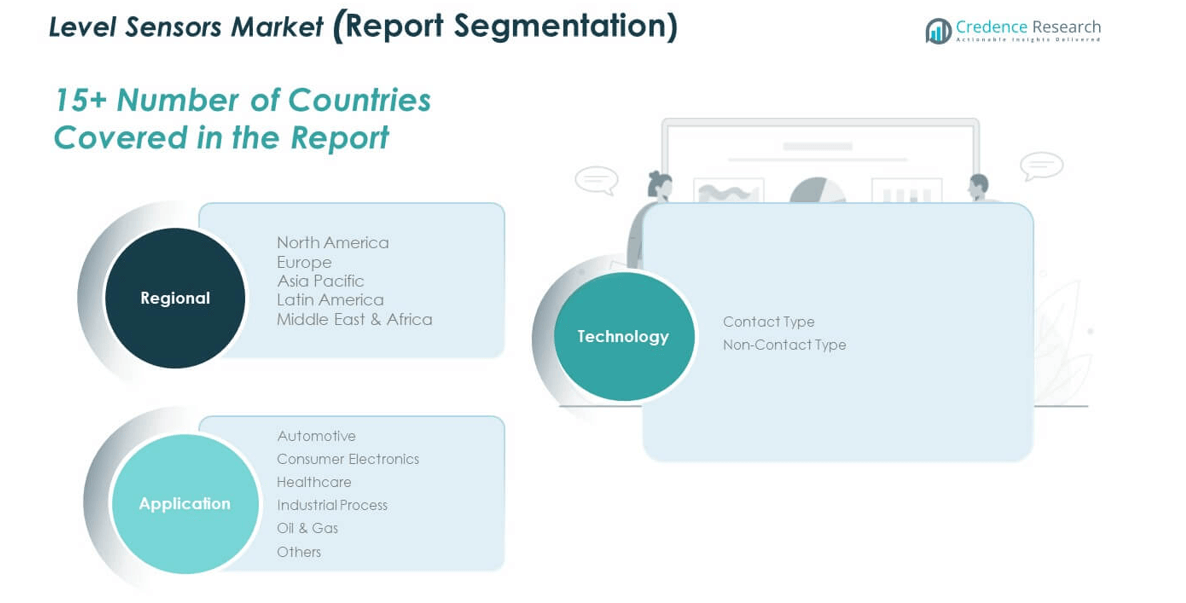
Segmentation:

By Technology

  • Contact Type
  • Non-Contact Type

By Application

  • Automotive
  • Consumer Electronics
  • Healthcare
  • Industrial Process
  • Oil & Gas
  • Others

By Region

  • North America
  • Europe
  • Asia Pacific
  • Latin America
  • Middle East
  • Africa

By Country (Regional Breakdown)

  • North America
    • U.S.
    • Canada
  • Europe
    • Germany
    • France
    • Italy
    • U.K.
    • Russia
    • Rest of Europe
  • Asia-Pacific
    • India
    • China
    • Japan
    • Rest of Asia-Pacific
  • Latin America
    • Brazil
    • Mexico
    • Rest of Latin America
  • Middle East and Africa
    • GCC Countries
    • South Africa
    • Rest of Middle East and Africa

Regional Analysis:

North America

The North America Level Sensors Market size was valued at USD 689.31 million in 2018 to USD 965.34 million in 2024 and is anticipated to reach USD 1,534.39 million by 2032, at a CAGR of 6.0% during the forecast period. North America holds around 21% of the Global Level Sensors Market share. Strong industrial automation, technological innovation, and established manufacturing infrastructure support steady regional growth. The U.S. leads due to significant adoption in oil and gas, automotive, and water treatment industries. It benefits from high integration of IoT-enabled systems and smart manufacturing practices. Canada and Mexico contribute through rising investments in process industries and smart infrastructure projects. Stringent safety regulations drive the adoption of accurate level sensing solutions. The presence of global sensor manufacturers accelerates R&D and local production. Continuous modernization across energy and manufacturing sectors sustains market expansion in the region.

Europe

The Europe Level Sensors Market size was valued at USD 841.72 million in 2018 to USD 1,204.87 million in 2024 and is anticipated to reach USD 1,972.79 million by 2032, at a CAGR of 6.4% during the forecast period. Europe accounts for about 26% of the Global Level Sensors Market share. The region benefits from high demand in industrial automation, food processing, and automotive manufacturing. Germany, France, and the UK drive growth through advanced production systems and environmental regulations. It witnesses a growing shift toward smart factories and digitalized operations. Strong presence of sensor technology leaders fosters innovation and product diversification. Regulatory focus on energy efficiency and emissions control enhances adoption. Investments in clean energy and sustainable production further strengthen market opportunities. Expansion in industrial IoT infrastructure fuels long-term demand across Europe.

Asia Pacific

The Asia Pacific Level Sensors Market size was valued at USD 1,077.89 million in 2018 to USD 1,563.99 million in 2024 and is anticipated to reach USD 2,606.27 million by 2032, at a CAGR of 6.6% during the forecast period. Asia Pacific dominates with about 36% of the Global Level Sensors Market share. China, Japan, and India drive significant demand through rapid industrialization and smart manufacturing investments. Strong growth in consumer electronics and automotive sectors increases sensor usage. It benefits from expanding water management and process industries in emerging economies. Governments promote automation and environmental monitoring under industrial reform policies. Local production advantages support competitive pricing and supply chain resilience. The rise of electric vehicles and renewable energy projects creates new applications. The region’s robust manufacturing ecosystem ensures sustained leadership in the global market.

Latin America

The Latin America Level Sensors Market size was valued at USD 325.60 million in 2018 to USD 438.30 million in 2024 and is anticipated to reach USD 657.60 million by 2032, at a CAGR of 5.2% during the forecast period. Latin America contributes around 9% of the Global Level Sensors Market share. Brazil and Mexico lead regional demand, supported by expanding automotive and oil industries. Industrial modernization initiatives drive gradual adoption of level monitoring technologies. It sees growing application in water management and chemical processing sectors. Increasing investments in smart infrastructure enhance efficiency and sustainability. Local manufacturers focus on offering cost-effective solutions for industrial automation. Economic reforms and improved trade policies stimulate industrial productivity. The region’s long-term growth depends on stable investments in energy and utilities.

Middle East

The Middle East Level Sensors Market size was valued at USD 136.66 million in 2018 to USD 205.36 million in 2024 and is anticipated to reach USD 357.29 million by 2032, at a CAGR of 7.2% during the forecast period. The region holds around 5% of the Global Level Sensors Market share. Demand is driven by the strong oil and gas sector, which relies on precise monitoring systems. The UAE and Saudi Arabia lead adoption through energy diversification and industrial automation projects. It gains traction in water treatment and desalination applications across arid zones. Expanding smart city projects accelerate sensor deployment for utilities and environmental monitoring. Regional governments emphasize technological advancement under Vision 2030 initiatives. Local partnerships with international companies enhance access to advanced technologies. Rising investment in renewable energy supports sustained market development.

Africa

The Africa Level Sensors Market size was valued at USD 77.78 million in 2018 to USD 110.28 million in 2024 and is anticipated to reach USD 178.28 million by 2032, at a CAGR of 6.2% during the forecast period. Africa accounts for about 3% of the Global Level Sensors Market share. Growing industrialization and infrastructure projects in South Africa, Egypt, and Nigeria support gradual expansion. It witnesses increased adoption in water management, mining, and oil extraction sectors. Rising government focus on sustainable development drives automation adoption. Local industries benefit from affordable sensor solutions suited to harsh environments. International firms expand presence through joint ventures and distribution partnerships. Investment in renewable energy and smart utilities improves application scope. Expansion of telecom and manufacturing sectors further enhances regional market growth.

Shape Your Report to Specific Countries or Regions & Enjoy 30% Off!

Key Player Analysis:

  • ABB
  • Emerson Electric Co.
  • Honeywell International Inc.
  • Siemens
  • Ametek, Inc.
  • TE Connectivity
  • Gems Sensors, Inc.
  • Magnetrol International, Inc.
  • OMEGA Engineering Inc.
  • MTS System Corporation
  • Senix Corporation
  • Other Key Players

Competitive Analysis:

The Global Level Sensors Market is highly competitive, featuring a mix of established industrial giants and specialized sensor manufacturers. Companies such as ABB, Emerson Electric Co., Honeywell International Inc., and Siemens dominate through continuous innovation and broad product portfolios. It is driven by technological advancement, automation demand, and integration of IoT-enabled sensing systems. Firms compete on accuracy, reliability, and adaptability across industrial and consumer applications. Emerging players focus on niche technologies like radar and optical sensing to gain market share. Strategic collaborations and R&D investments strengthen competitive positioning. Global presence, aftersales support, and customization capabilities remain key differentiators. The competition fosters constant improvement in product efficiency and performance.

Recent Developments:

  • ABB’s September 2025 launch of new pressure transmitters, which are used in similar industrial measurement applications as level sensors, is confirmed by official ABB news releases and industry outlets. For example, ABB introduced the P-300 series pressure transmitters for industrial applications on September 9, 2025, as reported on ABB’s official website and leading news feeds in the field.
  • Emerson Electric Co.’s January 2023 launch of the Rosemount 3408 Non-Contacting Radar Level Transmitter is confirmed by industry news and product pages. This level transmitter provides accurate non-contacting measurement and represents an official new release within the specified timeframe.

Report Coverage:

The research report offers an in-depth analysis based on technology and application segments. It details leading market players, providing an overview of their business, product offerings, investments, revenue streams, and key applications. Additionally, the report includes insights into the competitive environment, SWOT analysis, current market trends, as well as the primary drivers and constraints. Furthermore, it discusses various factors that have driven market expansion in recent years. The report also explores market dynamics, regulatory scenarios, and technological advancements that are shaping the industry. It assesses the impact of external factors and global economic changes on market growth. Lastly, it provides strategic recommendations for new entrants and established companies to navigate the complexities of the market.

Future Outlook:

  • Rising industrial automation will drive demand for smart and connected level sensors.
  • Increasing adoption of non-contact and radar technologies will improve operational safety.
  • IoT integration will enhance predictive maintenance and real-time monitoring capabilities.
  • Growth in water and wastewater management projects will strengthen utility applications.
  • Expansion of the automotive and healthcare industries will widen sensor use cases.
  • Advancements in MEMS and optical technologies will reduce production costs.
  • Renewable energy projects will generate new applications in fluid management systems.
  • Asia Pacific will maintain dominance due to rapid industrialization and digital infrastructure.
  • Ongoing R&D investments will accelerate innovation in accuracy and energy efficiency.
  • Strategic partnerships between OEMs and automation firms will shape future competitiveness.

CHAPTER NO. 1 : GENESIS OF THE MARKET        

1.1 Market Prelude – Introduction & Scope

1.2 The Big Picture – Objectives & Vision

1.3 Strategic Edge – Unique Value Proposition

1.4 Stakeholder Compass – Key Beneficiaries

CHAPTER NO. 2 : EXECUTIVE LENS

2.1 Pulse of the Industry – Market Snapshot

2.2 Growth Arc – Revenue Projections (USD Million)

2.3. Premium Insights – Based on Primary Interviews

CHAPTER NO. 3 : LEVEL SENSORS MARKET FORCES & INDUSTRY PULSE 

3.1 Foundations of Change – Market Overview
3.2 Catalysts of Expansion – Key Market Drivers
3.2.1 Momentum Boosters – Growth Triggers
3.2.2 Innovation Fuel – Disruptive Technologies
3.3 Headwinds & Crosswinds – Market Restraints
3.3.1 Regulatory Tides – Compliance Challenges
3.3.2 Economic Frictions – Inflationary Pressures
3.4 Untapped Horizons – Growth Potential & Opportunities
3.5 Strategic Navigation – Industry Frameworks
3.5.1 Market Equilibrium – Porter’s Five Forces
3.5.2 Ecosystem Dynamics – Value Chain Analysis
3.5.3 Macro Forces – PESTEL Breakdown

CHAPTER NO. 4 :             KEY INVESTMENT EPICENTER    

4.1 Regional Goldmines – High-Growth Geographies

4.2 Product Frontiers – Lucrative Technology Categories

4.3 Application Sweet Spots – Emerging Demand Segments

CHAPTER NO. 5: REVENUE TRAJECTORY & WEALTH MAPPING

5.1 Momentum Metrics – Forecast & Growth Curves

5.2 Regional Revenue Footprint – Market Share Insights

5.3 Segmental Wealth Flow – Technology & Application Revenue

CHAPTER NO. 6 : TRADE & COMMERCE ANALYSIS           

6.1.        Import Analysis By Region

6.1.1.     Global Level Sensors Market Import Revenue By Region

6.2.        Export Analysis By Region

6.2.1.     Global Level Sensors Market Export Revenue By Region

CHAPTER NO. 7 : COMPETITION ANALYSIS          

7.1.        Company Market Share Analysis

7.1.1.     Global Level Sensors Market: Company Market Share

7.2.        Global Level Sensors Market Company Revenue Market Share

7.3.        Strategic Developments

7.3.1.     Acquisitions & Mergers

7.3.2.     New Product Launch

7.3.3.     Regional Expansion

7.4.        Competitive Dashboard

7.5.      Company Assessment Metrics, 2024

CHAPTER NO. 8 : LEVEL SENSORS MARKET – BY TECHNOLOGY SEGMENT ANALYSIS

8.1.        Level Sensors Market Overview By Technology Segment

8.1.1.     Level Sensors Market Revenue Share By Technology

8.2.      Contact Type

8.3.      Non-Contact Type

CHAPTER NO. 9 : LEVEL SENSORS MARKET – BY APPLICATION SEGMENT ANALYSIS

9.1.        Level Sensors Market Overview By Application Segment

9.1.1.     Level Sensors Market Revenue Share By Application

9.2.      Automotive

9.3.      Consumer Electronics

9.4.      Healthcare

9.5.      Industrial Process

9.6.     Oil & Gas

9.7.     Others

CHAPTER NO. 10 : LEVEL SENSORS MARKET – REGIONAL ANALYSIS        

10.1.      Level Sensors Market Overview By Region Segment

10.1.1.  Global Level Sensors Market Revenue Share By Region

10.1.2.  Regions

10.1.3.  Global Level Sensors Market Revenue By Region

10.1.4.  Technology

10.1.5.  Global Level Sensors Market Revenue By Technology

10.1.6.  Application

10.1.7. Global Level Sensors Market Revenue By Application

CHAPTER NO. 11 : NORTH AMERICA LEVEL SENSORS MARKET – COUNTRY ANALYSIS

11.1.      North America Level Sensors Market Overview By Country Segment

11.1.1.  North America Level Sensors Market Revenue Share By Region

11.2.      North America

11.2.1.  North America Level Sensors Market Revenue By Country

11.2.2.  Technology

11.2.3.  North America Level Sensors Market Revenue By Technology

11.2.4.  Application

11.2.5.  North America Level Sensors Market Revenue By Application

11.3.      U.S.

11.4.      Canada

11.5.      Mexico

CHAPTER NO. 12 : EUROPE LEVEL SENSORS MARKET – COUNTRY ANALYSIS

12.1.      Europe Level Sensors Market Overview By Country Segment

12.1.1.  Europe Level Sensors Market Revenue Share By Region

12.2.      Europe

12.2.1.  Europe Level Sensors Market Revenue By Country

12.2.2.  Technology

12.2.3.  Europe Level Sensors Market Revenue By Technology

12.2.4.  Application

12.2.5.  Europe Level Sensors Market Revenue By Application

12.3.      UK

12.4.      France

12.5.      Germany

12.6.      Italy

12.7.      Spain

12.8.      Russia

12.9.   Rest of Europe

CHAPTER NO. 13 : ASIA PACIFIC LEVEL SENSORS MARKET – COUNTRY ANALYSIS

13.1.      Asia Pacific Level Sensors Market Overview By Country Segment

13.1.1.  Asia Pacific Level Sensors Market Revenue Share By Region

13.2.      Asia Pacific

13.2.1.  Asia Pacific Level Sensors Market Revenue By Country

13.2.2.  Technology

13.2.3.  Asia Pacific Level Sensors Market Revenue By Technology

13.2.4.  Application

13.2.5.  Asia Pacific Level Sensors Market Revenue By Application

13.3.      China

13.4.      Japan

13.5.      South Korea

13.6.      India

13.7.      Australia

13.8.      Southeast Asia

13.9.      Rest of Asia Pacific

CHAPTER NO. 14 : LATIN AMERICA LEVEL SENSORS MARKET – COUNTRY ANALYSIS

14.1.      Latin America Level Sensors Market Overview By Country Segment

14.1.1.  Latin America Level Sensors Market Revenue Share By Region

14.2.      Latin America

14.2.1.  Latin America Level Sensors Market Revenue By Country

14.2.2.  Technology

14.2.3.  Latin America Level Sensors Market Revenue By Technology

14.2.4.  Application

14.2.5.  Latin America Level Sensors Market Revenue By Application

14.3.      Brazil

14.4.      Argentina

14.5.      Rest of Latin America

CHAPTER NO. 15 : MIDDLE EAST LEVEL SENSORS MARKET – COUNTRY ANALYSIS

15.1.      Middle East Level Sensors Market Overview By Country Segment

15.1.1.  Middle East Level Sensors Market Revenue Share By Region

15.2.      Middle East

15.2.1.  Middle East Level Sensors Market Revenue By Country

15.2.2.  Technology

15.2.3.  Middle East Level Sensors Market Revenue By Technology

15.2.4.  Application

15.2.5.  Middle East Level Sensors Market Revenue By Application

15.3.      GCC Countries

15.4.      Israel

15.5.      Turkey

15.6.      Rest of Middle East

CHAPTER NO. 16 : AFRICA LEVEL SENSORS MARKET – COUNTRY ANALYSIS

16.1.      Africa Level Sensors Market Overview By Country Segment

16.1.1.  Africa Level Sensors Market Revenue Share By Region

16.2.      Africa

16.2.1.  Africa Level Sensors Market Revenue By Country

16.2.2.  Technology

16.2.3.  Africa Level Sensors Market Revenue By Technology

16.2.4.  Application

16.2.5.  Africa Level Sensors Market Revenue By Application

16.3.      South Africa

16.4.      Egypt

16.5.      Rest of Africa

CHAPTER NO. 17 : COMPANY PROFILES

17.1.      ABB

17.1.2.  Product Portfolio

17.1.3.  Financial Overview

17.1.4.  Recent Developments

17.1.5.  Growth Strategy

17.1.6.  SWOT Analysis

17.2.    Emerson Electric Co.

17.3.    Honeywell International Inc.

17.4.    Siemens

17.5.    Ametek, Inc.

17.6.    TE Connectivity

17.6.    Gems Sensors, Inc.

17.7.    Magnetrol International, Inc.

17.8.    OMEGA Engineering inc.

17.9.    MTS System Corporation

17.10.  Senix Corporation

17.11.  Other Key Players

Request Free Sample

We prioritize the confidentiality and security of your data. Our promise: your information remains private.

Ready to Transform Data into Decisions?

Request Your Sample Report and Start Your Journey of Informed Choices


Providing the strategic compass for industry titans.

cr-clients-logos

Frequently Asked Question:

At what Compound Annual Growth Rate is the Global Level Sensors Market projected to grow between 2025 and 2032?

The Global Level Sensors Market is projected to grow at a CAGR of 6.31% during 2025–2032. The pace reflects consistent technological advancement and adoption in critical industries such as oil and gas, manufacturing, and automotive.

What is the current market size for Global Level Sensors Market, and what is its projected size in 2032?

The Global Level Sensors Market size was valued at USD 3,149.0 million in 2018 to USD 4,488.1 million in 2024 and is anticipated to reach USD 7,306.6 million by 2032. The steady rise reflects strong industrial adoption and expanding applications across automation and consumer electronics sectors.

At what Compound Annual Growth Rate is the Global Level Sensors Market projected to grow between 2025 and 2032?

The Global Level Sensors Market is projected to grow at a CAGR of 6.31% during 2025–2032. The pace reflects consistent technological advancement and adoption in critical industries such as oil and gas, manufacturing, and automotive.

Which Global Level Sensors Market segment held the largest share in 2024?

The non-contact technology segment held the largest share in 2024. It gained preference due to higher accuracy, reliability, and maintenance-free operation in industrial and hygienic environments.

What are the primary factors fueling the growth of the Global Level Sensors Market?

Growth is driven by rising automation, adoption of smart sensing technologies, and increasing demand for IoT-enabled monitoring systems. Expanding applications in water management, automotive, and energy industries strengthen overall market performance.

Who are the leading companies in the Global Level Sensors Market?

Leading companies include ABB, Emerson Electric Co., Honeywell International Inc., Siemens, Ametek, and TE Connectivity. Their strong innovation focus and global reach sustain dominance across industrial and commercial applications.

Who are the major players in this market?

Honeywell International, Inc., Infineon Technologies AG, Siemens AG, General Electric (GE) Company, ABB Ltd., Electro-Sensors, Inc., Pepperl+Fuchs GmbH, NOHKEN, Inc. are some of the major players in the global market.

About Author

Sushant Phapale

Sushant Phapale

ICT & Automation Expert

Sushant is an expert in ICT, automation, and electronics with a passion for innovation and market trends.

View Profile

Related Reports

UAV Chips Market

The UAV Chips Market size was valued at USD 890.00 million in 2018 to USD 1,379.73 million in 2024 and is anticipated to reach USD 3,514.69 million by 2032, at a CAGR of 12.46% during the forecast period.

Three Phase Smart Electric Meter Market

The Three-Phase Smart Electric Meter Market was valued at USD 3.5 billion in 2024 and is projected to reach USD 6.87 billion by 2032, registering a CAGR of 8.8% during the forecast period (2025–2032).

Safety Limit Switches Market

Safety Limit Switches Market size was valued at USD 1.97 Billion in 2024 and is anticipated to reach USD 3.22 Billion by 2032, at a CAGR of 6.3% during the forecast period.

DC Motor Control Device Market

The DC Motor Control Device Market size was valued at USD 4,964 million in 2024 and is anticipated to reach USD 6,506 million by 2032, at a CAGR of 3.44% during the forecast period.

Small Off-Road Engine Market

Small off-road engine market size was valued USD 50.6 billion in 2024 and is anticipated to reach USD 83.74 billion by 2032, at a CAGR of 6.5% during the forecast period.

Rail Component Market

Rail Component market size was valued USD 89.6 billion in 2024 and is anticipated to reach USD 112.53 billion by 2032, at a CAGR of 2.89% during the forecast period.

Personal Protective Equipment (PPE) Retail Market

Personal Protective Equipment PPE Retail Market size was valued USD 66.69 billion in 2024 and is anticipated to reach USD 97.11 billion by 2032, at a CAGR of 4.81% during the forecast period.

Heat Sealing Equipment Market

Heat sealing equipment Market size was valued USD 5.79 billion in 2024 and is anticipated to reach USD 7.55 billion by 2032, at a CAGR of 3.37% during the forecast period.

Audiometric Screening Equipment Market

Audiometric Screening Equipment Market size was valued USD 1.61 billion in 2024 and is anticipated to reach USD 2.83 billion by 2032, at a CAGR of 7.3% during the forecast period.

Audio Power Amplifier Market

Audio Power Amplifier Market size was valued USD 1.6 billion in 2024 and is anticipated to reach USD 2.79 billion by 2032, at a CAGR of 7.21% during the forecast period.

U.S. Quartz Weighing Sensor Market

The U.S. Quartz Weighing Sensor Market size was valued at USD 27.01 million in 2018 to USD 34.10 million in 2024 and is anticipated to reach USD 47.26 million by 2032, at a CAGR of 4.10% during the forecast period.

North America Quartz Weighing Sensor Market

The North America Quartz Weighing Sensor Market size was valued at USD 36.78 million in 2018 to USD 47.38 million in 2024 and is anticipated to reach USD 67.52 million by 2032, at a CAGR of 4.54% during the forecast period.

Licence Option

The report comes as a view-only PDF document, optimized for individual clients. This version is recommended for personal digital use and does not allow printing. Use restricted to one purchaser only.
$4999

To meet the needs of modern corporate teams, our report comes in two formats: a printable PDF and a data-rich Excel sheet. This package is optimized for internal analysis. Unlimited users allowed within one corporate location (e.g., regional office).
$6999

The report will be delivered in printable PDF format along with the report’s data Excel sheet. This license offers 100 Free Analyst hours where the client can utilize Credence Research Inc. research team. Permitted for unlimited global use by all users within the purchasing corporation, such as all employees of a single company.
$12999

Report delivery within 24 to 48 hours

Credence Staff 3

WILLIAM, North America

Support Staff at Credence Research

KEITH PHILLIPS, Europe

Lee - CR Sales Staff

LEE VALLANCE, Asia Pacific

Kieran Jameson

KIERAN JAMESON, Australia

Smallform of Sample request
User Review

Thank you for the data! The numbers are exactly what we asked for and what we need to build our business case.

Materials Scientist
(privacy requested)

User Review

The report was an excellent overview of the Industrial Burners market. This report does a great job of breaking everything down into manageable chunks.

Imre Hof
Management Assistant, Bekaert

cr-clients-logos

Request Sample