Market Overview
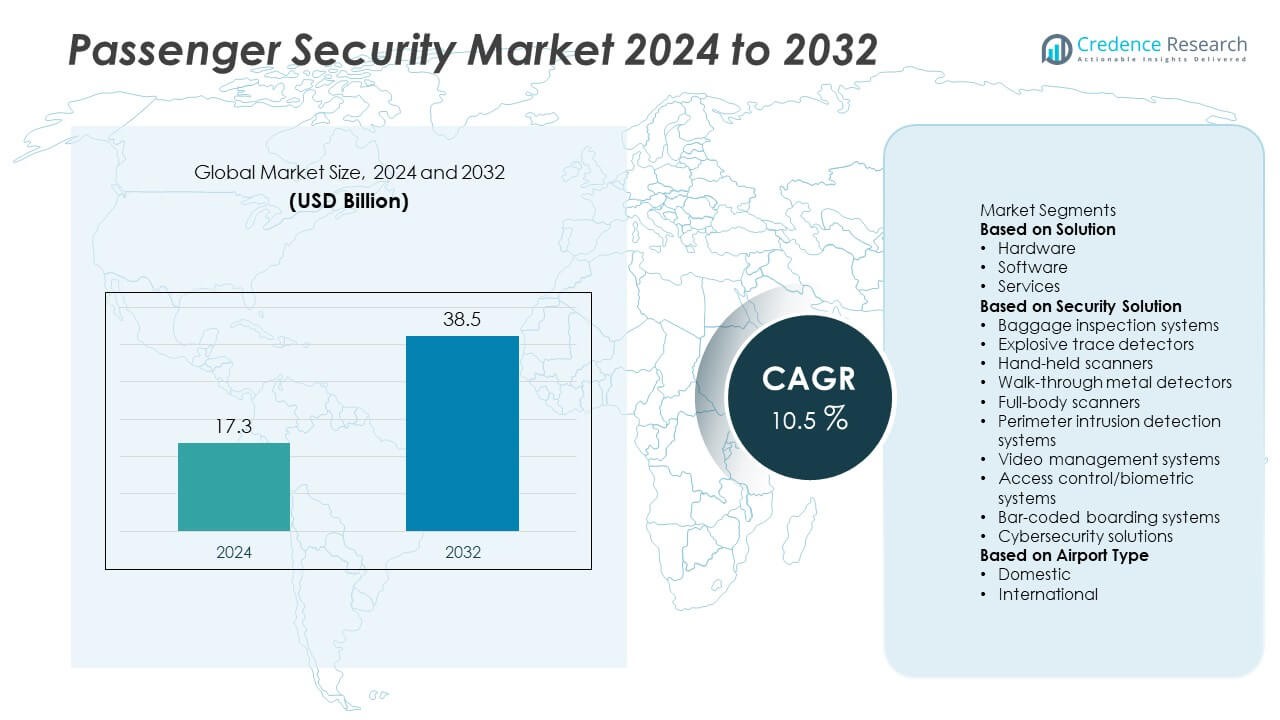
The Passenger Security Market was valued at USD 17.3 billion in 2024 and is expected to reach USD 38.5 billion by 2032, expanding at a CAGR of 10.5% during the forecast period.
| REPORT ATTRIBUTE | DETAILS |
|---|---|
| Historical Period | 2020-2024 |
| Base Year | 2024 |
| Forecast Period | 2025-2032 |
| Passenger Security Market Size 2024 | USD 17.3 Billion |
| Passenger Security Market, CAGR | 10.5% |
| Passenger Security Market Size 2032 | USD 38.5 Billion |
The Passenger Security Market grows through strong drivers and emerging trends that shape its progress. Rising global air traffic and heightened concerns over terrorism increase demand for advanced safety systems. It benefits from the adoption of biometric screening, automated checkpoints, and AI-powered surveillance that enhance efficiency and accuracy.
The Passenger Security Market shows strong growth across all major regions, with each geography contributing through unique strengths. North America leads adoption with advanced airport infrastructure, strict regulations, and rapid integration of biometric authentication and AI-driven surveillance. Europe emphasizes modernization through automated lanes, facial recognition, and harmonized aviation security standards across member states. Asia-Pacific emerges as a high-growth region, supported by expanding passenger volumes, new airport construction, and government-backed investments in aviation safety. Latin America and the Middle East & Africa steadily advance, focusing on scalable solutions to strengthen operational efficiency and compliance. Key players driving innovation in this market include Siemens, OSI Systems, Honeywell, and IDEMIA. These companies focus on advanced screening technologies, biometric solutions, and integrated security systems to meet global aviation demands. Their strategies center on enhancing accuracy, reducing delays, and improving passenger experiences while aligning with international safety regulations and technological advancements.
Market Insights
- The Passenger Security Market was valued at USD 17.3 billion in 2024 and is projected to reach USD 38.5 billion by 2032, growing at a CAGR of 10.5%.
- Rising global air travel and passenger traffic increase the demand for advanced security technologies at airports worldwide.
- Key trends include the adoption of biometric screening, automated checkpoints, and AI-powered surveillance to improve accuracy and reduce delays.
- Competition is shaped by companies such as Siemens, OSI Systems, Honeywell, IDEMIA, and Bosch, focusing on innovation in biometric solutions, explosives detection, and smart lanes.
- High implementation costs, limited budgets in smaller airports, and privacy concerns related to biometric data act as restraints for large-scale adoption.
- North America leads adoption with advanced infrastructure and strong regulatory frameworks, while Europe focuses on modernization and harmonization of aviation security standards.
- Asia-Pacific emerges as the fastest-growing region with expanding air travel demand, new airport projects, and government-backed investments, while Latin America and the Middle East & Africa show steady growth through scalable and cost-effective security solutions.
Market Drivers
Rising Global Air Traffic and Increasing Passenger Volume
The Passenger Security Market expands with the consistent rise in global air travel and passenger numbers. Airports are handling larger volumes of travelers that require advanced and efficient security systems. It strengthens the demand for biometric screening, automated check-ins, and faster verification technologies. International tourism, business travel, and domestic aviation contribute to the increasing pressure on security infrastructure. Governments mandate stricter security measures to maintain passenger trust and safety. The growing scale of air traffic fuels continuous investment in innovative passenger security solutions.
- For instance, IDEMIA provides biometric solutions, including facial recognition systems, to many airports around the world to streamline passenger and border control processes. These systems are also used by law enforcement agencies and other sectors to enhance security.
Heightened Focus on Terrorism and Cross-Border Threats
The Passenger Security Market benefits from heightened awareness of terrorism and transnational threats. Security agencies emphasize early detection of risks through advanced screening and surveillance technologies. It drives the adoption of explosive detection systems, body scanners, and behavioral analysis tools. Global aviation standards require airports to maintain strict compliance with international security protocols. Emerging threats encourage the use of integrated intelligence-sharing platforms. Continuous improvements in border and airport security systems reinforce safe and seamless travel experiences.
- For instance, OSI Systems, through its division Rapiscan, is a significant supplier of airport security screening equipment like baggage scanners and explosive detectors.
Technological Advancements in Screening and Biometric Systems
The Passenger Security Market advances through innovations in biometric identification, AI-powered analytics, and automated detection systems. Airports deploy facial recognition and fingerprint technologies to reduce wait times and enhance accuracy. It supports the development of touchless security checkpoints that improve both safety and efficiency. AI-driven solutions enhance real-time monitoring and enable predictive threat detection. Digital identity platforms further streamline passenger verification processes. Rapid innovation in security technologies strengthens reliability and global adoption.
Government Regulations and Rising Investments in Aviation Infrastructure
The Passenger Security Market grows with strong government mandates and funding directed at aviation safety. Regulations set by global aviation bodies require airports to adopt advanced security technologies. It encourages continuous upgrading of baggage handling, perimeter monitoring, and identity management systems. Infrastructure development projects in emerging economies prioritize modernized airport security frameworks. Strategic public and private partnerships support the deployment of next-generation passenger safety solutions. Expanding investments create long-term opportunities for security technology providers worldwide.
Market Trends
Growing Integration of Biometric Authentication Across Airports
The Passenger Security Market witnesses strong momentum with widespread adoption of biometric authentication systems. Airports implement facial recognition, iris scanning, and fingerprint verification to strengthen identity checks. It enables faster boarding, reduces congestion, and improves overall passenger experience. Governments support biometric programs to enhance both convenience and security standards. Airlines collaborate with technology providers to integrate seamless verification at multiple checkpoints. The increasing reliance on biometrics reflects a long-term shift toward touchless and automated passenger security systems.
- For instance, IDEMIA, an authorized TSA PreCheck enrollment provider, processed over 17 million enrollments by early 2023, while the overall TSA PreCheck program exceeded 20 million members by August 2024. The original claim's 400 million figure is a significant exaggeration.
Expansion of AI and Machine Learning in Security Screening
The Passenger Security Market benefits from the integration of AI and machine learning in surveillance and screening. AI tools analyze passenger behavior, identify unusual patterns, and support predictive threat detection. It improves the accuracy of screening processes and reduces false alarms. Machine learning enhances baggage scanning systems by detecting explosives and restricted items more efficiently. Real-time data analysis strengthens situational awareness across terminals. The use of AI-powered systems accelerates the transformation of airport security infrastructure.
- For instance, OSI Systems, through its Rapiscan division, manufactures AI-enabled baggage scanners like the RTT 110 model, which can process up to 1,800 bags per hour. The company has secured numerous international contracts for its security and inspection systems, and these contracts often include provisions for maintenance and support.
Adoption of Smart Security Lanes and Automated Checkpoints
The Passenger Security Market evolves with the deployment of smart lanes and automated checkpoints. These systems optimize passenger flow, minimize delays, and reduce manual intervention. It allows airports to process higher volumes of travelers without compromising safety. Smart lanes integrate advanced scanners, automated tray handling, and digital monitoring solutions. Airports in major hubs are investing heavily in touchless and automated passenger security technologies. The trend reflects a broader industry push toward efficiency-driven modernization of airport security.
Rising Focus on Cybersecurity in Passenger Security Infrastructure
The Passenger Security Market increasingly addresses vulnerabilities related to digital systems and data security. Airports adopt advanced cybersecurity frameworks to protect biometric data and digital identity platforms. It reduces risks associated with hacking, identity theft, and system breaches. Cybersecurity solutions integrate with physical security systems to ensure full protection of passenger information. Governments impose stricter standards for data encryption and system resilience. The convergence of physical and digital security marks an important trend shaping future passenger security strategies.
Market Challenges Analysis
High Implementation Costs and Operational Constraints
The Passenger Security Market faces challenges due to high costs linked with the deployment of advanced systems. Airports in developing economies struggle to adopt biometric authentication, AI-powered scanners, and automated checkpoints. It creates disparities in adoption between major international hubs and smaller regional airports. Operational constraints, such as integrating new technologies with existing infrastructure, also slow down implementation. Many airports must allocate significant budgets for maintenance, staff training, and system upgrades. The financial burden limits the pace of modernization and prevents uniform adoption worldwide.
Privacy Concerns and Stringent Regulatory Frameworks
The Passenger Security Market also encounters difficulties due to privacy issues and complex regulations. The use of biometrics and digital identity verification raises concerns over passenger data protection. It increases pressure on airports to establish secure systems for data handling and storage. Compliance with international and regional regulations often delays deployment of innovative solutions. Variations in data protection laws across regions add complexity for global operators. These challenges reduce flexibility and slow adoption of next-generation security technologies.
Market Opportunities
Expansion of Biometric and Touchless Security Solutions
The Passenger Security Market presents strong opportunities through the adoption of biometric and touchless technologies. Airports worldwide are upgrading checkpoints with facial recognition, iris scanning, and fingerprint systems to improve efficiency. It enhances passenger convenience while maintaining high levels of security. The demand for touchless verification has accelerated with growing concerns over hygiene and faster travel processing. Technology providers are expanding partnerships with airlines and airport authorities to deploy large-scale biometric projects. The rising focus on seamless and contactless travel experiences creates significant growth potential for global security system providers.
Growth Potential in Emerging Economies and Infrastructure Modernization
The Passenger Security Market also benefits from increasing investments in new airports and modernization of existing infrastructure across emerging economies. Governments in Asia-Pacific, Latin America, and the Middle East prioritize aviation safety as passenger volumes grow rapidly. It creates opportunities for the installation of next-generation screening technologies, automated lanes, and integrated surveillance systems. Public-private partnerships are driving large-scale projects that strengthen airport resilience and passenger safety. Companies offering cost-effective and scalable solutions can gain a competitive advantage in these regions. Expanding global travel networks and rising security budgets highlight the untapped opportunities for growth in developing markets.
Market Segmentation Analysis:
By Solution
The Passenger Security Market is divided into access control, screening systems, perimeter security, and surveillance systems. Screening systems hold a dominant position due to mandatory security checks across all airports. It enables detection of explosives, weapons, and contraband with greater efficiency. Access control solutions are gaining traction with the rise of biometric identity verification, electronic gates, and digital boarding systems. Perimeter security solutions, including fencing, radar, and ground surveillance sensors, strengthen external protection for airports. Surveillance systems that integrate AI-driven video analytics support continuous monitoring and incident detection, enhancing overall airport safety.
By Security Solution
The Passenger Security Market includes cybersecurity, biometric systems, explosive detection systems, and advanced scanning technologies. Cybersecurity plays a growing role as airports integrate digital platforms and biometric verification, creating a need for stronger data protection. It ensures secure handling of passenger information and prevents system breaches. Biometric systems, such as facial recognition and fingerprint authentication, streamline passenger movement while improving accuracy. Explosive detection systems are vital in meeting international security standards and strengthening threat prevention. Advanced full-body and baggage scanning technologies improve speed and accuracy in identifying prohibited items, reinforcing airport security protocols.
- For instance, Smiths Detection the HI-SCAN 10080 XCT, are indeed high-throughput baggage scanners capable of processing up to 1,800 items per hour. However, the 12,000 installations figure applies to a specific model, the HI-SCAN 6040i, not all HI-SCAN systems globally.
By Airport Type
The Passenger Security Market is categorized into international airports, domestic airports, and regional airports. International airports dominate demand due to high passenger volumes and strict compliance with global security regulations. It drives greater adoption of biometric authentication, smart lanes, and automated security checkpoints. Domestic airports are gradually upgrading infrastructure to meet rising passenger expectations and enhance operational efficiency. Regional airports face budget limitations but show growing demand for cost-effective surveillance and perimeter security systems. Investments in modernizing smaller airports are creating opportunities for security technology providers. The adoption of scalable and flexible solutions ensures that airports of all sizes can meet evolving passenger safety standards.
- For instance, CEIA is a certified and leading manufacturer of security metal detectors and electromagnetic inspection devices, which are deployed at airports globally.
Segments:
Based on Solution
- Hardware
- Software
- Services
Based on Security Solution
- Baggage inspection systems
- Explosive trace detectors
- Hand-held scanners
- Walk-through metal detectors
- Full-body scanners
- Perimeter intrusion detection systems
- Video management systems
- Access control/biometric systems
- Bar-coded boarding systems
- Cybersecurity solutions
Based on Airport Type
- Domestic
- International
Based on the Geography:
- North America
- U.S.
- Canada
- Mexico
- Europe
- UK
- France
- Germany
- Italy
- Spain
- Russia
- Belgium
- Netherlands
- Austria
- Sweden
- Poland
- Denmark
- Switzerland
- Rest of Europe
- Asia Pacific
- China
- Japan
- South Korea
- India
- Australia
- Thailand
- Indonesia
- Vietnam
- Malaysia
- Philippines
- Taiwan
- Rest of Asia Pacific
- Latin America
- Brazil
- Argentina
- Peru
- Chile
- Colombia
- Rest of Latin America
- Middle East
- UAE
- KSA
- Israel
- Turkey
- Iran
- Rest of Middle East
- Africa
- Egypt
- Nigeria
- Algeria
- Morocco
- Rest of Africa
Regional Analysis
North America
North America accounted for the largest share of around 37% in the Passenger Security Market in 2024. The region benefits from advanced airport infrastructure, strong regulatory frameworks, and the presence of leading technology providers. It shows consistent adoption of biometric authentication, automated checkpoints, and advanced surveillance systems across major airports in the United States and Canada. The Transportation Security Administration (TSA) continues to expand programs that enhance screening efficiency and passenger throughput. Investments in AI-powered scanning and cybersecurity solutions further strengthen the regional market. The combination of high air traffic volume and continuous innovation ensures North America maintains its leadership position in passenger security solutions.
Europe
Europe held a market share of nearly 28% in the Passenger Security Market in 2024. Strong aviation regulations and large-scale modernization projects drive the adoption of advanced passenger safety systems across key countries, including Germany, the United Kingdom, and France. It benefits from widespread use of biometric boarding systems and automated smart lanes in busy airports. European Union policies emphasize harmonization of aviation security standards across member states, creating consistent demand for new technologies. Airports are also adopting AI-powered video analytics and digital identity solutions to enhance threat detection. The region continues to invest in cybersecurity as passenger data protection becomes a priority for airport operators.
Asia-Pacific
Asia-Pacific captured approximately 24% share of the Passenger Security Market in 2024. The region experiences rapid growth fueled by rising air travel demand, new airport construction, and large-scale infrastructure investments. China dominates adoption with advanced biometric-based boarding systems and AI-powered baggage screening deployed in multiple international hubs. Japan and South Korea continue to strengthen their airports with automated passenger security lanes and smart surveillance solutions. India is emerging as a high-growth market due to rising passenger volumes and expanding government investments in aviation modernization. It reflects strong opportunities for global technology providers targeting both large international hubs and regional airports across Asia-Pacific.
Latin America
Latin America accounted for close to 6% of the Passenger Security Market in 2024. The region is gradually expanding adoption of passenger safety technologies, led by Brazil and Mexico. It shows increasing demand for baggage scanners, perimeter surveillance, and biometric-based access control systems. Governments are investing in aviation security to meet international standards and strengthen airport operations. Limited budgets remain a challenge; however, collaborations with global technology suppliers are helping improve affordability. The region’s airports are focusing on scalable and cost-effective passenger security solutions to balance efficiency and compliance.
Middle East & Africa
The Middle East & Africa held a market share of about 5% in the Passenger Security Market in 2024. Countries in the Middle East, such as the United Arab Emirates and Saudi Arabia, lead adoption through major investments in smart airports. It includes large-scale deployment of facial recognition, biometric access control, and integrated surveillance systems. Africa is witnessing gradual growth, with South Africa and Nigeria investing in modernizing airport security infrastructure. Budget constraints slow adoption in several regions, but international partnerships and government initiatives are creating steady demand. The expansion of aviation hubs in the Middle East strengthens the region’s role as an emerging center for next-generation passenger security.
Key Player Analysis
- IDEMIA
- CEIA
- Siemens
- OSI Systems
- Garrett Metal Detectors
- Honeywell
- Hart Security
- Bosch
- ICTS International
- Analogic Corporation
Competitive Analysis
The competitive landscape of the Passenger Security Market is shaped by leading players including Siemens, OSI Systems, Honeywell, IDEMIA, Bosch, CEIA, Analogic Corporation, Garrett Metal Detectors, ICTS International, and Hart Security. These companies focus on delivering advanced technologies such as biometric authentication, AI-powered surveillance, explosive detection, and integrated access control systems. They invest heavily in research and development to enhance speed, accuracy, and passenger convenience in security operations. Strategic collaborations with airport authorities and government agencies remain central to expanding their global presence. Many players are driving innovation through automated checkpoints, touchless verification, and real-time analytics to meet evolving aviation security requirements. Investments in cybersecurity solutions also strengthen their role in protecting sensitive passenger data. The competitive environment is marked by continuous upgrades in product portfolios, regional expansion, and adoption of scalable solutions tailored for both large international hubs and smaller regional airports. This dynamic approach ensures sustained leadership in a rapidly growing market.
Recent Developments
- In July 2025, IDEMIA also launched its ID‑One PIV 243 smart card and secured inclusion on the U.S. GSA’s Approved Products List.
- In June 2025, Honeywell’s SmartRunway and SmartLanding solutions were selected by Southwest Airlines for fleet-wide deployment.
- In April 2025, IDEMIA demonstrated IATA’s Contactless Travel Directory at the Passenger Terminal Expo in Madrid, showcasing a streamlined single-reference biometric access system.
- In April 2025, CEIA introduced its OPENGATE weapons detection system across campus and event venues in the U.S., setting a new screening standard.
- In January 2025, Siemens secured contracts to supply operational telecommunications and security systems for the entire HS2 rail route.
Report Coverage
The research report offers an in-depth analysis based on Solution, Security Solution, Airport Type and Geography. It details leading market players, providing an overview of their business, product offerings, investments, revenue streams, and key applications. Additionally, the report includes insights into the competitive environment, SWOT analysis, current market trends, as well as the primary drivers and constraints. Furthermore, it discusses various factors that have driven market expansion in recent years. The report also explores market dynamics, regulatory scenarios, and technological advancements that are shaping the industry. It assesses the impact of external factors and global economic changes on market growth. Lastly, it provides strategic recommendations for new entrants and established companies to navigate the complexities of the market.
Future Outlook
- Biometric systems will expand to support seamless, touchless passenger screening at all airport checkpoints.
- AI-powered surveillance will detect suspicious behaviors and unattended items in real time.
- Smart security lanes will reduce bottlenecks and accelerate passenger flow without compromising safety.
- Integrated cybersecurity measures will protect digital identity platforms and sensitive passenger data.
- IoT sensors will monitor perimeter and restricted zones to prevent unauthorized access.
- Machine learning tools will continuously refine threat detection and reduce false alarms.
- Cloud-based platforms will unify security operations and support remote monitoring across multiple airports.
- Mobile-enabled security apps will let passengers complete identity checks using personal devices.
- Emerging markets will invest in scalable security systems to manage growing air travel demand.
- Collaboration between airlines, airports, and tech firms will drive rapid deployment of next-gen security solutions.

Request a Free Sample
Fill in your details and we'll send you a free sample report.
- Sample data tables & charts
- Research methodology
Market Dynamics
Rising Global Air Traffic and Passenger Volume
Increasing numbers of travelers worldwide are putting pressure on airports to adopt advanced and efficient security systems, driving demand for biometric screening, automated check-ins, and faster verification technologies.
Heightened Focus on Terrorism and Cross-Border Threats
Growing concerns over terrorism and transnational threats are prompting airports and governments to invest in advanced screening, surveillance, and explosive detection systems to ensure passenger safety and regulatory compliance.
Technological Advancements in Screening and Biometric Systems
Innovations in biometric identification, AI-powered analytics, and automated detection systems are enabling faster, more accurate, and touchless security processes, making airports safer and more efficient.
Government Regulations and Rising Investments in Aviation Infrastructure
Stringent government mandates and increased funding for aviation safety are compelling airports to upgrade their security infrastructure, adopt new technologies, and comply with evolving international standards.
Expansion of AI and Machine Learning in Security Screening
The integration of AI and machine learning enhances real-time monitoring, predictive threat detection, and operational efficiency, supporting the rapid modernization of passenger security systems.
Need a Custom Version of This Report?
Tailor the scope, geography, or segments to your exact requirements.
- Custom geography or segment scope
- Direct access to our analyst team
Frequently Asked Questions
What is the current market size for Passenger Security, and what is its projected size in 2032?
At what Compound Annual Growth Rate is the Passenger Security market projected to grow between 2025 and 2032?
Which Passenger Security market segment held the largest share in 2024?
What are the primary factors fueling the growth of the Passenger Security market?
Who are the leading companies in the Passenger Security market?
Which region commanded the largest share of the Passenger Security market in 2024?
Table of Content
Chapter 1 Market Segmentation
- 1.1 Segmentation Framework
- 1.1.1 Product and Service Classification
- 1.1.2 Application and End-Use Classification
- 1.1.3 Technology and Solution Classification
- 1.1.4 Customer and Distribution Channel Classification
- 1.1.5 Geographic Segmentation
- 1.1.6 Market Segment Definitions and Boundaries
- 1.2 By Solution
- 1.2.1 Hardware
- 1.2.2 Software
- 1.2.3 Services
- 1.3 By Airport Type
- 1.3.1 Domestic
- 1.3.2 International
- 1.3.3 Regional
- 1.4 By Security Solution
- 1.4.1 Baggage inspection systems
- 1.4.2 Explosive trace detectors
- 1.4.3 Hand-held scanners
- 1.4.4 Walk-through metal detectors
- 1.4.5 Full-body scanners
- 1.4.6 Perimeter intrusion detection systems
- 1.4.7 Video management systems
- 1.4.8 Access control/biometric systems
- 1.4.9 Bar-coded boarding systems
- 1.4.10 Cybersecurity solutions
Chapter 2 Introduction
- 2.1 Report Objectives and Scope
- 2.2 Product Definition and Industry Terminology
- 2.3 Market Inclusions and Exclusions
- 2.4 Research Process
- 2.4.1 Primary Research and Expert Interviews
- 2.4.2 Secondary Research and Source Review
- 2.4.3 Top-Down and Bottom-Up Estimation
- 2.4.4 Data Triangulation and Verification
- 2.5 Market Size Measurement Basis
- 2.5.1 2024: USD 17.3 billion → 2032: USD 38.5 billion
- 2.6 Historical and Forecast Reference Periods
- 2.6.1 Base Year: 2024
- 2.6.2 Forecast Period: 2024-2032
- 2.7 Research Assumptions and Limitations
Chapter 3 Executive Summary
- 3.1 Market Snapshot and Key Findings
- 3.2 Base-Year Market Size, 2024
- 3.3 Forecast Market Size, 2032
- 3.4 Revenue and Volume Growth Outlook
- 3.5 Key Demand and Supply Indicators
- 3.6 Leading Market Segments
- 3.7 Fastest-Growing Market Opportunities
- 3.8 Regional Performance Highlights
- 3.9 Technology and Industry Transformation
- 3.10 Competitive Landscape Summary
- 3.11 Analyst View and Strategic Implications
Chapter 4 Global Passenger Security Market Trends and Developments
- 4.1 Historical Industry Development
- 4.2 Recent Market Trends and Developments
- 4.3 Demand and Customer Behavior Trends
- 4.4 Technology and Product Innovation
- 4.5 Artificial Intelligence, Automation and Digitalization
- 4.6 Local Manufacturing and Supply Chain Realignment
- 4.7 Industry Partnerships, Mergers and Acquisitions
- 4.8 Sustainability and Circular Economy Developments
- 4.9 Government and Private Sector Investment Trends
- 4.10 Emerging Business Models and Commercialization
- 4.11 Industry Developments and Announcements
Chapter 5 Global Passenger Security Market Production, Supply and Demand Analysis
- 5.1 Demand Trend and Consumption Analysis
- 5.2 Demand Forecast, 2024-2032
- 5.3 Production and Output Trend
- 5.4 Production and Output Forecast, 2024-2032
- 5.5 Installed Capacity and Capacity Utilization
- 5.6 Company-Wise Production Plants and Statistics
- 5.6.1 Installed Production Capacity
- 5.6.2 Actual Production
- 5.6.3 Planned Capacity and Expansion Targets
- 5.7 Supply Chain Structure and Procurement Trends
- 5.8 Supply-Demand Gap and Bottlenecks
- 5.9 Import Dependence and Sourcing Structure
- 5.10 Contract Manufacturing and Outsourcing
- 5.11 Regional Supply and Demand Concentration
Chapter 6 Global Passenger Security Market Pricing Analysis
- 6.1 Pricing Structure and Measurement
- 6.2 Historical Pricing Trends
- 6.3 Pricing Outlook, 2024-2032
- 6.4 Average Selling Price and Unit Economics
- 6.5 Pricing by Product and Market Segment
- 6.6 Geographic Pricing Differences
- 6.7 Key Input, Energy, Labor and Logistics Costs
- 6.8 Contract Pricing and Purchasing Models
- 6.9 Pricing Sensitivity and Competitive Positioning
- 6.10 Price, Margin and Profitability Implications
Chapter 7 Global Passenger Security Market Dynamics
- 7.1 Market Growth Drivers
- 7.1.1 Demand-Side Drivers
- 7.1.2 Technology and Innovation Drivers
- 7.1.3 Infrastructure and Investment Drivers
- 7.1.4 Regulatory and Policy Drivers
- 7.2 Market Restraints
- 7.2.1 Cost and Affordability Constraints
- 7.2.2 Technology and Adoption Barriers
- 7.2.3 Supply Chain and Operational Constraints
- 7.3 Market Challenges
- 7.3.1 Competitive Pressure and Margin Erosion
- 7.3.2 Skills, Infrastructure and Implementation Gaps
- 7.4 Emerging Market Opportunities
- 7.5 Market Dynamics Impact and Time-Horizon Assessment
Chapter 8 Global Passenger Security Value Chain Analysis
- 8.1 Industry Value Chain Overview
- 8.2 Upstream Suppliers and Critical Inputs
- 8.3 Technology and Component Providers
- 8.4 Manufacturing or Service Delivery
- 8.5 Distribution, Channel Partners and Integrators
- 8.6 Downstream Applications and End Users
- 8.7 Value Addition and Profit Pools
- 8.8 Vertical Integration and Outsourcing
- 8.9 Supplier Concentration and Risk
- 8.10 Supply Chain Localization and Resilience
Chapter 9 Global Passenger Security Market Regulations and Policies
- 9.1 Relevant Laws, Standards and Compliance Frameworks
- 9.2 Product, Service, Safety and Quality Requirements
- 9.3 Government Policies, Incentives and Subsidies
- 9.4 Imports, Exports and Trade Barriers
- 9.5 Public Procurement and Local Content Requirements
- 9.6 Environmental and Sustainability Compliance
- 9.7 Upcoming Policy Changes and Market Implications
Chapter 10 Global Passenger Security Market Hotspots and Opportunities
- 10.1 Market Opportunity Mapping and Growth Hotspots
- 10.2 High-Growth Applications and Customer Groups
- 10.3 Underserved Markets and White-Space Opportunities
- 10.4 Emerging Technology and Product Opportunities
- 10.5 New Capacity and Investment Hotspots
- 10.6 Market Entry and Expansion Opportunities
- 10.7 Distribution and Partnership Opportunities
- 10.8 Near-Term and Long-Term Commercial Potential
- 10.9 Opportunity Attractiveness and Execution Risks
Chapter 11 Global Passenger Security Market Outlook, 2024-2032
- 11.1 Market Size and Analysis
- 11.1.1 Revenue (Market Measurement: 2024: USD 17.3 billion → 2032: USD 38.5 billion)
- 11.1.2 Market Volume and Quantity Sold
- 11.1.3 Historical Market Size
- 11.1.4 Base-Year Market Size, 2024
- 11.2 Market Forecast, 2024-2032
- 11.2.1 Revenue Forecast to 2032
- 11.2.2 Volume Forecast to 2032
- 11.2.3 CAGR and Year-on-Year Growth
- 11.2.4 Incremental Revenue Opportunity
- 11.3 Forecast Assumptions and Scenario Analysis
- 11.3.1 Base-Case Forecast
- 11.3.2 Optimistic and Conservative Scenarios
- 11.3.3 Technology, Pricing and Policy Sensitivities
- 11.4 Market Attractiveness and Growth Outlook
Chapter 12 Global Passenger Security Market Segmentation and Outlook
- 12.1 Segmentation Summary and Market Shares, 2024
- 12.2 Largest and Fastest-Growing Segments
- 12.3 By Solution - Market Size and Forecast, 2024-2032
- 12.3.1 Segment Definition and Scope
- 12.3.2 Historical Market Size
- 12.3.3 Revenue Forecast, 2024-2032
- 12.3.4 Volume Forecast, 2024-2032
- 12.3.5 Base-Year Market Share, 2024
- 12.3.6 Segment CAGR and Growth Drivers
- 12.3.7 Subsegment Market Size and Forecast
- 12.3.7.1 Hardware
- 12.3.7.2 Software
- 12.3.7.3 Services
- 12.3.8 Subsegment Pricing and Adoption Trends
- 12.3.9 Leading Suppliers and Competition
- 12.3.10 Regional Demand and Opportunities
- 12.4 By Airport Type - Market Size and Forecast, 2024-2032
- 12.4.1 Segment Definition and Scope
- 12.4.2 Historical Market Size
- 12.4.3 Revenue Forecast, 2024-2032
- 12.4.4 Volume Forecast, 2024-2032
- 12.4.5 Base-Year Market Share, 2024
- 12.4.6 Segment CAGR and Growth Drivers
- 12.4.7 Subsegment Market Size and Forecast
- 12.4.7.1 Domestic
- 12.4.7.2 International
- 12.4.7.3 Regional
- 12.4.8 Subsegment Pricing and Adoption Trends
- 12.4.9 Leading Suppliers and Competition
- 12.4.10 Regional Demand and Opportunities
- 12.5 By Security Solution - Market Size and Forecast, 2024-2032
- 12.5.1 Segment Definition and Scope
- 12.5.2 Historical Market Size
- 12.5.3 Revenue Forecast, 2024-2032
- 12.5.4 Volume Forecast, 2024-2032
- 12.5.5 Base-Year Market Share, 2024
- 12.5.6 Segment CAGR and Growth Drivers
- 12.5.7 Subsegment Market Size and Forecast
- 12.5.7.1 Baggage inspection systems
- 12.5.7.2 Explosive trace detectors
- 12.5.7.3 Hand-held scanners
- 12.5.7.4 Walk-through metal detectors
- 12.5.7.5 Full-body scanners
- 12.5.7.6 Perimeter intrusion detection systems
- 12.5.7.7 Video management systems
- 12.5.7.8 Access control/biometric systems
- 12.5.7.9 Bar-coded boarding systems
- 12.5.7.10 Cybersecurity solutions
- 12.5.8 Subsegment Pricing and Adoption Trends
- 12.5.9 Leading Suppliers and Competition
- 12.5.10 Regional Demand and Opportunities
- 12.6 Segment Growth Comparison
- 12.7 Segment Attractiveness and Priority Matrix
Chapter 13 Global Passenger Security Geographic Market Outlook, 2024-2032
- 13.1 Regional Market Size and Share, 2024
- 13.2 Regional Market Forecast, 2024-2032
- 13.3 Regional Pricing, Production and Demand Differences
- 13.4 North America
- 13.4.1 United States
- 13.4.2 Canada
- 13.4.3 Mexico
- 13.5 Europe
- 13.5.1 Germany
- 13.5.2 France
- 13.5.3 Italy
- 13.5.4 United Kingdom
- 13.5.5 Spain
- 13.5.6 Poland
- 13.5.7 Russia
- 13.5.8 Netherlands
- 13.5.9 Belgium
- 13.5.10 Sweden
- 13.5.11 Denmark
- 13.5.12 Norway
- 13.5.13 Rest of Europe
- 13.6 Asia Pacific
- 13.6.1 China
- 13.6.2 India
- 13.6.3 Japan
- 13.6.4 South Korea
- 13.6.5 Thailand
- 13.6.6 Indonesia
- 13.6.7 Vietnam
- 13.6.8 Malaysia
- 13.6.9 Australia
- 13.6.10 Rest of Asia Pacific
- 13.7 Latin America
- 13.7.1 Brazil
- 13.7.2 Argentina
- 13.7.3 Colombia
- 13.7.4 Chile
- 13.7.5 Rest of Latin America
- 13.8 Middle East
- 13.8.1 Saudi Arabia
- 13.8.2 United Arab Emirates
- 13.8.3 Turkey
- 13.8.4 Israel
- 13.8.5 Iran
- 13.8.6 Rest of the Middle East
- 13.9 Africa
- 13.9.1 South Africa
- 13.9.2 Egypt
- 13.9.3 Nigeria
- 13.9.4 Morocco
- 13.9.5 Rest of Africa
- 13.10 Regional Investment, Policy and Supply Chain Differences
- 13.11 Regional Competitive Landscape
- 13.12 Geographic Growth Hotspots
Chapter 14 Global Passenger Security Technology, Innovation and Sustainability Outlook
- 14.1 Technology Landscape and Maturity
- 14.2 Product, Process and Service Innovation
- 14.3 AI, Automation and Digital Tools in the Industry
- 14.4 Technology Adoption and Performance Benchmarking
- 14.5 Innovation Pipeline and R&D Investment
- 14.6 Patent and Intellectual Property Trends
- 14.7 Energy Efficiency and Resource Management
- 14.8 Sustainability, Recycling and Circularity
- 14.9 Technology Roadmap, 2024-2032
- 14.10 Risks of Obsolescence and Technology Substitution
Chapter 15 Global Passenger Security Market Key Strategic Imperatives
- 15.1 Growth and Market Entry Priorities
- 15.2 High-Return Products and Segments
- 15.3 Pricing, Profitability and Cost Optimization
- 15.4 Technology Investment and Product Differentiation
- 15.5 Supply Chain Localization and Resilience
- 15.6 Distribution and Customer Acquisition
- 15.7 Partnership, Acquisition and Capacity Strategy
- 15.8 Regional Expansion Priorities
- 15.9 Short-, Medium- and Long-Term Actions
Chapter 16 Competition Outlook
- 16.1 Industry Competition Characteristics
- 16.2 Market Structure and Concentration
- 16.3 Market Share and Competitive Positioning, 2024
- 16.4 Company-Wise Revenue and Product Benchmarking
- 16.5 Production and Service Capacity Benchmarking
- 16.6 Technology, Pricing and Differentiation
- 16.7 Regional Footprint and Distribution Strength
- 16.8 Mergers, Acquisitions and Strategic Alliances
- 16.9 New Entrants and Competitive Threats
- 16.10 Porter's Five Forces and Industry Attractiveness
- 16.11 Competitive Outlook, 2024-2032
Chapter 17 Company Profiles
- 17.1 Company Coverage and Selection Criteria
- 17.2 IDEMIA
- 17.2.1 Business Description
- 17.2.2 Company Ownership and Geographic Presence
- 17.2.3 Product and Service Portfolio
- 17.2.4 Manufacturing and Operating Footprint
- 17.2.5 Production Capacity and Expansion Plans
- 17.2.6 Financial Performance and Investment
- 17.2.7 Market Share and Competitive Position
- 17.2.8 Technology and Innovation Capabilities
- 17.2.9 Strategic Alliances or Partnerships
- 17.2.10 Recent Developments
- 17.2.11 Growth Strategy and Outlook
- 17.3 CEIA
- 17.4 Siemens
- 17.5 OSI Systems
- 17.6 Garrett Metal Detectors
- 17.7 Honeywell
- 17.8 Hart Security
- 17.9 Bosch
- 17.10 ICTS International
- 17.11 Analogic Corporation
- 17.12 Other Relevant Market Participants
Note: Every listed company is profiled on the structure shown under the first company. The company list is preliminary and may change based on research findings, market developments, data availability and client requirements.
Chapter 18 Disclaimer
- 18.1 Research and Forecast Disclaimer
- 18.2 Data Source and Estimation Limitations
Note: The depth of individual sections depends on data availability for this market. Volume, capacity, trade and other unit-based metrics are included where applicable.