Market Overview:
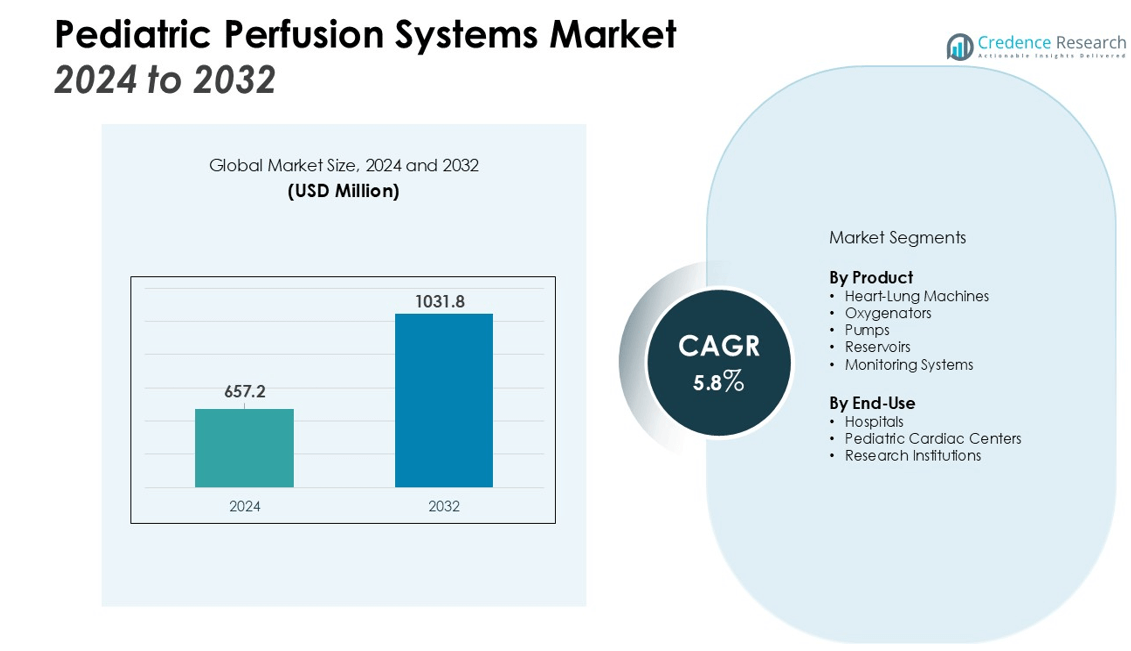
The Pediatric Perfusion Systems Market size was valued at USD 657.2 million in 2024 and is anticipated to reach USD 1031.8 million by 2032, at a CAGR of 5.8% during the forecast period (2024-2032).
| REPORT ATTRIBUTE | DETAILS |
|---|---|
| Historical Period | 2020-2023 |
| Base Year | 2024 |
| Forecast Period | 2025-2032 |
| Pediatric Perfusion Systems Market Size 2024 | USD 657.2 million |
| Pediatric Perfusion Systems Market, CAGR | 5.8% |
| Pediatric Perfusion Systems Market Size 2032 | USD 1031.8 million |
The pediatric perfusion systems market is expanding steadily, supported by rising rates of congenital heart defects in children and a growing number of pediatric cardiac surgeries. Government initiatives, funding programs, and favorable reimbursement policies are playing a crucial role in increasing accessibility of advanced treatment options. Technological advancements have also enhanced perfusion devices, making them more refined and child-specific, which has improved safety and clinical outcomes. Continuous product innovation is further strengthening adoption among pediatric care providers.
North America accounts for the largest share of the market due to its advanced healthcare infrastructure, high prevalence of pediatric cardiac interventions, and strong research and development activities in the field. Europe also shows consistent demand, driven by specialized cardiac centers and supportive regulatory frameworks. The Asia-Pacific region, however, is expected to register the fastest growth, fueled by improving healthcare systems, rising awareness of pediatric cardiac conditions, and expanding medical tourism in countries such as India and China. These regional dynamics highlight a market that is both expanding in size and diversifying across geographies, with developed economies ensuring high adoption and emerging markets unlocking significant new opportunities for pediatric perfusion system providers.
Market Insights:
- The Pediatric Perfusion Systems Market was valued at USD 657.2 million in 2024 and is projected to reach USD 1031.8 million by 2032, reflecting a CAGR of 5.8%.
- Rising prevalence of congenital heart defects among children and higher pediatric cardiac surgery volumes continue to drive consistent demand for advanced perfusion systems.
- Government funding programs and favorable reimbursement policies are improving accessibility of treatment, allowing hospitals to adopt specialized technologies without financial delay.
- Technological innovation has led to compact, child-specific systems with improved biocompatibility and integrated digital monitoring, enhancing surgical accuracy and safety.
- High costs and reimbursement gaps limit adoption in resource-constrained regions, while shortage of skilled perfusionists and device complexity remain key operational challenges.
- North America leads with 42% share due to advanced healthcare infrastructure, strong R&D investments, and favorable regulatory support for pediatric cardiac interventions.
- Asia-Pacific, with 21% share, is the fastest-growing region, supported by improving healthcare systems, expanding medical tourism, and rising government investments in pediatric cardiac care.
Market Drivers:
Rising Prevalence of Congenital Heart Defects Driving System Demand
The Pediatric Perfusion Systems Market is strongly influenced by the increasing incidence of congenital heart defects among infants and children. These conditions require precise and safe surgical interventions that rely on advanced perfusion technologies. Rising awareness among healthcare providers and parents has accelerated early diagnosis and treatment. It has created consistent demand for pediatric-specific perfusion systems, ensuring that hospitals and cardiac centers expand their adoption.
- For instance, the Medtronic Affinity Pixie Oxygenation System is designed for neonatal and pediatric patients undergoing cardiopulmonary bypass during cardiac surgery. The system's cardiotomy/venous reservoir has a minimum operating volume of just 20 ml.
Increasing Pediatric Cardiac Surgeries Supporting Market Growth
Growing volumes of pediatric cardiac surgeries directly strengthen the demand for specialized perfusion systems. The Pediatric Perfusion Systems Market benefits from improvements in surgical techniques and higher success rates in complex heart operations. Expanding access to advanced surgical care in both developed and emerging regions supports wider system use. It ensures that perfusion devices remain central to life-support functions during critical cardiac interventions.
- For instance, a randomized trial involving 40 patients under 10 kg demonstrated that Terumo's Capiox® FX05 oxygenator with an integral arterial filter reduces the circuit's priming volume by approximately 75–100 mL, minimizing foreign surface exposure for the patient.
Government Support and Funding Enhancing Accessibility
Government initiatives and reimbursement frameworks provide significant momentum to the Pediatric Perfusion Systems Market. Many countries have introduced funding programs that reduce the financial burden of high-cost pediatric surgeries. Strong policy support encourages hospitals to adopt advanced perfusion technologies without delay. It creates a favorable environment for innovation and strengthens healthcare infrastructure dedicated to pediatric cardiac care.
Technological Advancements Elevating Device Efficiency and Safety
Rapid advancements in perfusion technology enhance system design, safety, and operational efficiency. The Pediatric Perfusion Systems Market benefits from the development of compact, child-specific devices that minimize risks and improve clinical outcomes. Integration of digital monitoring and automation features has also raised the accuracy of surgical support. It enables healthcare providers to deliver higher standards of care, ensuring stronger confidence in adopting modern perfusion solutions.
Market Trends:
Integration of Digital Monitoring and Automation Transforming Perfusion Practices
The Pediatric Perfusion Systems Market is witnessing a clear trend toward integrating advanced digital monitoring and automation features. Hospitals and surgical centers now prefer systems that provide real-time data on oxygenation, blood flow, and pressure levels to improve surgical accuracy. It has allowed surgeons to make faster decisions and reduce risks during complex pediatric procedures. Automation features also minimize manual errors, ensuring safer outcomes for vulnerable patients. The demand for systems with smart interfaces reflects the growing need for user-friendly solutions in high-pressure surgical environments. This trend highlights the role of technology in elevating precision and reliability in pediatric cardiac care.
- For instance, Medtronic's Affinity Pixie™ Oxygenation System is designed for neonates and small children, featuring a prime volume of just 48 mL and supporting a maximum blood flow rate of 2.0 L/min.
Shift Toward Miniaturized and Patient-Specific Perfusion Devices
Another key trend shaping the Pediatric Perfusion Systems Market is the development of miniaturized and patient-specific devices designed for infants and young children. Traditional systems often posed challenges due to size and compatibility issues, but recent innovations address these limitations. It enables healthcare providers to deliver safer interventions tailored to the unique physiology of pediatric patients. Companies are focusing on compact devices with improved biocompatibility and reduced priming volumes to optimize outcomes. The adoption of such systems has expanded in both developed and emerging markets, where healthcare infrastructure is improving rapidly. This shift illustrates a strong industry emphasis on personalization, safety, and efficiency in pediatric cardiac surgeries.
- For instance, the Jarvik 2015 is a miniaturized ventricular assist device with an outer diameter of 15 mm, specifically developed to support infants and children weighing from 8 to 20 kilograms.
Market Challenges Analysis:
High Costs and Limited Accessibility Restricting Wider Adoption
The Pediatric Perfusion Systems Market faces significant challenges due to high costs associated with advanced devices and surgical procedures. Many healthcare systems, particularly in developing regions, struggle to allocate resources for specialized pediatric care. It restricts accessibility for families and limits adoption across hospitals with constrained budgets. Reimbursement gaps further intensify financial barriers, making it difficult for patients to afford life-saving interventions. These cost-related issues slow market penetration and hinder equitable healthcare delivery.
Shortage of Skilled Professionals and Device Complexity
Another challenge in the Pediatric Perfusion Systems Market is the shortage of trained perfusionists capable of handling complex pediatric surgeries. Operating pediatric-specific systems requires high precision, and a lack of skilled expertise can compromise outcomes. It places additional strain on healthcare institutions already facing workforce shortages. Device complexity also creates operational hurdles, as not all centers have the resources to train staff effectively. The combination of limited expertise and intricate device handling reduces system utilization and raises the risk of operational errors. This remains a major constraint for sustained market growth.
Market Opportunities:
Expansion of Pediatric Cardiac Care in Emerging Economies
The Pediatric Perfusion Systems Market is positioned to benefit from the rapid expansion of pediatric cardiac care across emerging economies. Growing investments in healthcare infrastructure and rising awareness of congenital heart conditions are creating new opportunities for advanced systems. It enables hospitals in regions such as Asia-Pacific and Latin America to adopt specialized perfusion technologies. Medical tourism also contributes to stronger demand, with patients seeking affordable yet high-quality cardiac surgeries in these markets. Governments are supporting this growth through funding initiatives and partnerships with international healthcare providers. This expansion opens significant avenues for manufacturers to strengthen their global footprint.
Technological Innovation and Product Customization Driving Adoption
Continuous technological innovation presents another key opportunity in the Pediatric Perfusion Systems Market. Manufacturers are focusing on developing compact, patient-specific devices that reduce risks and improve outcomes for infants and children. It creates space for systems with enhanced digital monitoring, automation, and biocompatibility features. The push toward customized solutions aligns with growing demand for precision medicine in pediatric care. Healthcare providers are more willing to adopt systems that combine safety, efficiency, and ease of use. This trend supports long-term market growth by expanding adoption across advanced and developing healthcare settings.
Market Segmentation Analysis:
By Product
The Pediatric Perfusion Systems Market by product is divided into heart-lung machines, oxygenators, pumps, reservoirs, and monitoring systems. Heart-lung machines hold a dominant share due to their critical role in maintaining circulation and oxygenation during pediatric cardiac surgeries. Oxygenators also account for strong demand, supported by advancements in membrane technology that enhance safety and efficiency. It continues to benefit from innovations that reduce priming volume and improve compatibility with small patients. Pumps and reservoirs complement these systems, ensuring smooth perfusion management during complex procedures. Growing demand for integrated monitoring solutions further strengthens the product segment’s importance in improving surgical precision.
- For instance, LivaNova's Dideco Kids D100, designed for neonates, is a hollow-fiber membrane oxygenator that has a static priming volume of just 31 ml to reduce hemodilution in small patients.
By End-Use
The Pediatric Perfusion Systems Market by end-use is segmented into hospitals, pediatric cardiac centers, and research institutions. Hospitals account for the largest share, driven by their central role in providing pediatric cardiac surgeries supported by specialized surgical teams. Dedicated pediatric cardiac centers are expanding in both developed and emerging regions, offering advanced treatment options for congenital heart conditions. It reflects rising awareness and investment in specialized care for infants and children. Research institutions also contribute to market growth by driving innovation and clinical validation of new technologies. Together, these end-use segments highlight the strong institutional demand supporting wider adoption of pediatric perfusion systems.
- For instance, Michigan Medicine and the 3D printing company Materialise have launched a clinical trial to further validate a 3D-printed bioresorbable airway splint, planning to enroll 35 infants for treating a life-threatening airway condition.
Segmentations:
By Product
- Heart-Lung Machines
- Oxygenators
- Pumps
- Reservoirs
- Monitoring Systems
By End-Use
- Hospitals
- Pediatric Cardiac Centers
- Research Institutions
By Region
- North America
- U.S.
- Canada
- Mexico
- Europe
- UK
- France
- Germany
- Italy
- Spain
- Russia
- Belgium
- Netherlands
- Austria
- Sweden
- Poland
- Denmark
- Switzerland
- Rest of Europe
- Asia Pacific
- China
- Japan
- South Korea
- India
- Australia
- Thailand
- Indonesia
- Vietnam
- Malaysia
- Philippines
- Taiwan
- Rest of Asia Pacific
- Latin America
- Brazil
- Argentina
- Peru
- Chile
- Colombia
- Rest of Latin America
- Middle East
- UAE
- KSA
- Israel
- Turkey
- Iran
- Rest of Middle East
- Africa
- Egypt
- Nigeria
- Algeria
- Morocco
- Rest of Africa
Regional Analysis:
North America Leading with Strong Healthcare Infrastructure and Innovation
North America accounted for 42% of the Pediatric Perfusion Systems Market, making it the largest regional contributor. The region benefits from advanced healthcare systems and widespread adoption of cutting-edge pediatric perfusion technologies. A strong presence of specialized pediatric cardiac centers and leading medical device manufacturers supports continued leadership. It drives innovation through high research and development spending, ensuring rapid access to improved solutions. Favorable reimbursement structures and government initiatives further encourage widespread adoption across hospitals. The rising prevalence of congenital heart conditions in the United States and Canada continues to sustain robust demand.
Europe Demonstrating Steady Growth with Specialized Care Expansion
Europe held 28% of the Pediatric Perfusion Systems Market, supported by strong hospital networks and specialized pediatric cardiac care. The region has consistently expanded adoption through favorable regulatory policies and highly skilled healthcare professionals. It benefits from strong collaboration between research institutions and healthcare providers, which accelerates product innovation. Growing awareness of pediatric cardiac conditions has increased demand for surgical interventions across major European countries. Government-backed initiatives to strengthen preventive healthcare further enhance the adoption of perfusion systems. Continuous improvements in treatment outcomes support the region’s stable growth trajectory.
Asia-Pacific Emerging as the Fastest-Growing Regional Market
Asia-Pacific represented 21% of the Pediatric Perfusion Systems Market, with the fastest forecasted growth rate. Rapid improvements in healthcare infrastructure and expanding access to pediatric cardiac care are driving adoption. It is also supported by strong demand from medical tourism, especially in India, China, and Singapore. Expanding training initiatives for pediatric cardiac specialists are improving capabilities across hospitals in the region. Rising healthcare investments from governments and private players are accelerating availability of advanced perfusion systems. A growing pediatric population continues to reinforce demand, creating opportunities for global manufacturers to expand their presence.
Key Player Analysis:
- Cardinal Health
- Medtronic
- EUROSETS
- Terumo Cardiovascular Systems Corporation
- BL Lifesciences
- Getinge AB
- LivaNova PLC
Competitive Analysis:
The Pediatric Perfusion Systems Market features strong competition among global and regional players focused on innovation, reliability, and clinical safety. Companies invest heavily in research and development to create compact, child-specific devices with advanced monitoring capabilities. It has led to a steady stream of product upgrades that enhance performance and reduce surgical risks. Strategic partnerships with hospitals and research institutions further strengthen market presence by improving adoption rates. Leading manufacturers compete on technology integration, regulatory compliance, and after-sales support to build long-term relationships with healthcare providers. Regional players also contribute by offering cost-effective solutions tailored for emerging markets. This competitive landscape highlights a balance between established global leaders driving innovation and local participants expanding access, ensuring that the market continues to evolve to meet the growing demand for pediatric cardiac care.
Recent Developments:
- In September 2025, Medtronic received FDA clearance for its MiniMed™ 780G system to integrate with Abbott's Instinct sensor for individuals with type 1 diabetes and also secured approval for its use in adults with type 2 diabetes who require insulin.
- In June 2025, Cardinal Health launched its Kendall DL™ Multi System in the U.S., a monitoring system designed for single-patient use that continuously tracks cardiac activity, blood oxygen levels, and temperature via a single connection.
- In July 2025, Getinge established a strategic partnership with Zimmer Biomet, enabling Zimmer Biomet to distribute Getinge's capital products for operating rooms to its customers in Ambulatory Surgery Centers (ASCs).
Report Coverage:
The research report offers an in-depth analysis based on Product, End-Use and Region. It details leading market players, providing an overview of their business, product offerings, investments, revenue streams, and key applications. Additionally, the report includes insights into the competitive environment, SWOT analysis, current market trends, as well as the primary drivers and constraints. Furthermore, it discusses various factors that have driven market expansion in recent years. The report also explores market dynamics, regulatory scenarios, and technological advancements that are shaping the industry. It assesses the impact of external factors and global economic changes on market growth. Lastly, it provides strategic recommendations for new entrants and established companies to navigate the complexities of the market.
Future Outlook:
- The Pediatric Perfusion Systems Market will continue to expand with rising pediatric cardiac surgeries worldwide.
- Increasing awareness of congenital heart defects will drive early interventions and higher demand for advanced systems.
- Government support through funding programs and favorable reimbursement policies will strengthen adoption in healthcare institutions.
- Ongoing technological advancements will create compact, efficient, and child-specific devices with improved safety features.
- Integration of digital monitoring and automation will enhance surgical precision and reduce risks during complex operations.
- Hospitals and specialized pediatric cardiac centers will remain primary adopters, supported by growing infrastructure investments.
- Emerging economies will offer significant growth opportunities due to expanding healthcare systems and rising medical tourism.
- Shortage of skilled perfusionists may challenge adoption, creating demand for systems with simplified operation and training support.
- Strategic collaborations between manufacturers and research institutions will accelerate innovation and expand clinical validation.
- The market will evolve toward greater personalization, ensuring devices align with the unique needs of infants and children.

Request a Free Sample
Fill in your details and we'll send you a free sample report.
- Sample data tables & charts
- Research methodology
Need a Custom Version of This Report?
Tailor the scope, geography, or segments to your exact requirements.
- Custom geography or segment scope
- Direct access to our analyst team
Frequently Asked Questions
What is the current market size for Pediatric Perfusion Systems, and what is its projected size in 2032?
At what Compound Annual Growth Rate is the Pediatric Perfusion Systems market projected to grow between 2024 and 2032?
What are the primary factors fueling the growth of the Pediatric Perfusion Systems market?
Who are the leading companies in the Pediatric Perfusion Systems market?
Table of Content
Chapter 1. Report Introduction
- 1.1 Report Description & Purpose
- 1.1.1 Report Title & Market Definition
- 1.1.2 Unique Selling Propositions (USP) & Key Differentiators
- 1.1.3 Value Proposition for Stakeholders
- 1.2 Research Objectives
- 1.2.1 Market Sizing Objectives (Volume & Revenue) (Volume Where Applicable)
- 1.2.2 Segmentation Objectives
- 1.2.3 Competitive Intelligence Objectives
- 1.2.4 Forecast & Scenario Objectives
- 1.3 Report Scope
- 1.3.1 Pediatric Perfusion Systems Scope – Segments & Subsegments Covered
- 1.3.2 Geographic Scope – Regions & Countries Covered
- 1.3.3 Historical Period, Base Year & Forecast Period (2024; forecast to 2032)
- 1.3.4 Inclusions & Exclusions
- 1.4 Industry Classification & Applicable Codes
- 1.5 Currency, Measurement Units & Valuation Basis
- 1.6 Target Stakeholders
- 1.7 Limitations & Assumptions
Chapter 2. Executive Summary
- 2.1 Global Pediatric Perfusion Systems Market Snapshot
- 2.1.1 Market Size – Historical (2024) & Forecast (2024-2032) (2024: USD 657.2 million → 2032: USD 1031.8 million)
- 2.1.2 Volume & Revenue – Global Totals (Volume Where Applicable)
- 2.1.3 Key Market Highlights – Top Five Facts
- 2.2 Pediatric Perfusion Systems Market Segmentation Snapshot
- 2.2.1 Market Split by Region – 2024 vs. 2032
- 2.3 Competitive Snapshot
- 2.3.1 Top 10 Players by Revenue Share – 2024
- 2.3.2 Top 10 Players by Volume Share – 2024 (Volume Where Applicable)
- 2.3.3 Recent Strategic Developments (18-Month Summary)
- 2.4 Key Investment Highlights & Strategic Conclusions
Chapter 3. Pediatric Perfusion Systems Market Dynamics & Industry Analysis
- 3.1 Market Overview & Context
- 3.1.1 Pediatric Perfusion Systems Market Position in the Broader Industry Value Chain
- 3.1.2 Demand Structure & Purchasing Dynamics
- 3.1.3 Market Maturity & Development Stage by Region
- 3.2 Pediatric Perfusion Systems Market Drivers
- 3.3 Pediatric Perfusion Systems Market Restraints & Challenges
- 3.4 Pediatric Perfusion Systems Market Opportunities
- 3.5 Porter's Five Forces Analysis
- 3.5.1 Threat of New Entrants
- 3.5.2 Bargaining Power of Suppliers
- 3.5.3 Bargaining Power of Buyers
- 3.5.4 Threat of Substitutes
- 3.5.5 Competitive Rivalry – Intensity Assessment
- 3.6 Pediatric Perfusion Systems Value Chain Analysis
- 3.6.1 Upstream – Key Inputs, Resources & Suppliers
- 3.6.1.1 Key Input/Resource 1
- 3.6.1.2 Key Input/Resource 2
- 3.6.1.3 Key Input/Resource 3
- 3.6.2 Midstream – Core Operations & Value Creation
- 3.6.2.1 Operating Model & Process Overview
- 3.6.2.2 Key Operating Locations & Capabilities by Company
- 3.6.3 Downstream – Market Channels & End Users
- 3.6.3.1 Direct Sales & Customer Engagement Channels
- 3.6.3.2 Indirect Sales, Intermediaries & Partner Channels
- 3.6.4 Value Chain Profitability Analysis
- 3.6.1 Upstream – Key Inputs, Resources & Suppliers
- 3.7 PESTEL Analysis
- 3.7.1 Political Factors
- 3.7.2 Economic Factors
- 3.7.3 Social Factors
- 3.7.4 Technological Factors
- 3.7.5 Environmental Factors
- 3.7.6 Legal Factors
- 3.8 Pediatric Perfusion Systems Supply Chain Analysis
- 3.8.1 Critical Input & Resource Availability Risk Assessment
- 3.8.2 Supplier & Operational Concentration Risk (Geographic Exposure)
- 3.8.3 Supply & Service Disruption Impact Analysis
- 3.9 Regulatory & Policy Landscape
Note: The regulatory and policy landscape section covers regulations based on their applicability to the market, Pediatric Perfusion Systems category, geography, and scope of the study. Only regulatory frameworks with a material impact on operations, compliance, trade, sustainability, or market access are analyzed in detail.
Chapter 4. Key Investment Pockets & Opportunity Analysis
- 4.1 Pediatric Perfusion Systems Market Attractiveness Analysis
- 4.1.1 By Region – Investment Attractiveness Matrix (Market Size × CAGR)
- 4.2 Absolute Revenue Growth Opportunity
- 4.2.1 By Region – Absolute Revenue Growth Through 2032
- 4.3 Incremental Demand Opportunity
- 4.3.1 By Region – Incremental Demand Through 2032
- 4.3.2 Segment – Incremental Demand
- 4.4 Emerging Submarket Opportunity Deep Dive (Subject to Applicability)
- 4.5 Priority Market Opportunity Scorecards
- 4.5.1 United States
- 4.5.2 Europe
- 4.5.3 Asia
- 4.5.4 Middle East & Africa
Note: Priority market opportunity scorecards reflect the geographic scope and strategic relevance of the study. Listed markets are indicative and may be adapted to the industry.
Chapter 5. Pediatric Perfusion Systems Cross-Border Trade & Market Access Analysis
- 5.1 International Trade & Cross-Border Activity Overview
- 5.1.1 Global Export Value by Country (2024)
- 5.1.2 Global Export Volume by Country (2024) (Volume Where Applicable)
- 5.1.3 Global Import Value by Country (2024)
- 5.1.4 Global Import Volume by Country (2024) (Volume Where Applicable)
- 5.1.5 Net Trade Balance by Country (2024)
- 5.2 Export Analysis – Segment
- 5.2.1 Category 1 (Applicable Classification Code)
- 5.2.2 Category 2 (Applicable Classification Code)
- 5.2.3 Category 3 (Applicable Classification Code)
- 5.2.4 Category 4 (Applicable Classification Code)
- 5.2.5 Category 5 (Applicable Classification Code)
- 5.3 Import Analysis – Segment
- 5.3.1 Category 1 (Applicable Classification Code)
- 5.3.2 Category 2 (Applicable Classification Code)
- 5.3.3 Category 3 (Applicable Classification Code)
- 5.3.4 Category 4 (Applicable Classification Code)
- 5.3.5 Category 5 (Applicable Classification Code)
- 5.4 Cross-Border Pricing & Transaction Benchmarks
- 5.4.1 Export Pricing – Segment & Country
- 5.4.2 Import Pricing – Segment & Source Country
- 5.4.3 Price Trends (2024)
- 5.5 Key Cross-Border Trade & Delivery Routes
- 5.5.1 Cross-Border Trade/Delivery Route 1
- 5.5.2 Cross-Border Trade/Delivery Route 2
- 5.5.3 Cross-Border Trade/Delivery Route 3
- 5.5.4 Cross-Border Trade/Delivery Route 4
- 5.5.5 Cross-Border Trade/Delivery Route 5
- 5.6 Trade Policy & Market Access Impact Assessment
- 5.6.1 Tariff & Non-Tariff Barriers
- 5.6.2 Regional Trade & Economic Integration Frameworks
- 5.6.3 Bilateral & Multilateral Trade Agreements
- 5.6.4 Cross-Border Operating, Licensing & Localization Requirements
Note: This chapter applies where cross-border trade or delivery is relevant to Pediatric Perfusion Systems. Goods, services, and digital offerings are assessed using applicable classifications and transaction measures. Import-export volumes, trade balances, and route analyses are included only where meaningful to the market.
Chapter 6. Competitive Landscape & Company Benchmarking
- 6.1 Pediatric Perfusion Systems Market Concentration & Structure
- 6.1.1 Herfindahl-Hirschman Index (HHI) – the historical period vs. 2024
- 6.1.2 Leading, Mid-Sized & Emerging Player Structure
- 6.1.3 Global, Regional & Local Player Dynamics
- 6.2 Pediatric Perfusion Systems Market Share Analysis – 2024
- 6.2.1 Global Revenue Share by Company
- 6.2.2 Global Volume Share by Company (Volume Where Applicable)
- 6.2.3 Regional Revenue Share
- 6.2.4 Market Share Evolution (the historical period vs. 2024)
- 6.2.5 Company Market Share by Key Segment
- 6.2.6 Company Market Share by Customer Group
- 6.3 Operating Scale, Capacity & Infrastructure Analysis
- 6.3.1 Global Operating Scale & Supply Capacity
- 6.3.2 Resource Utilization & Operating Efficiency
- 6.3.3 Output, Service Delivery & Activity Metrics
- 6.3.4 Operating Footprint & Infrastructure Map
- 6.3.5 Planned Operational & Capacity Expansion
- 6.4 Pediatric Perfusion Systems Competitive Benchmarking Matrix
- 6.4.1 Revenue, Growth, Profitability & Operating Metric Comparison
- 6.4.2 Channel Revenue Mix
- 6.4.3 Geographic Revenue Exposure
- 6.4.4 R&D Intensity
- 6.4.5 Sustainability Maturity
- 6.5 Strategic Developments in Pediatric Perfusion Systems (Last 24 Months)
- 6.5.1 Mergers, Acquisitions & Divestments
- 6.5.2 New Products, Services & Solutions in Pediatric Perfusion Systems
- 6.5.3 Operational & Infrastructure Expansions
- 6.5.4 Strategic Alliances, Joint Ventures & Partnerships
- 6.5.5 Distribution Expansion & Market Entry
- 6.5.6 Sustainability & ESG Initiatives
- 6.6 Competitive Strategy Mapping
- 6.6.1 Leader, Challenger, Follower & Niche Classification
- 6.6.2 Pricing Strategy Comparison
- 6.6.3 Channel Strategy Matrix
Note: Strategic developments are included based on their materiality and the availability of reliable information.
Chapter 7. Global Pediatric Perfusion Systems Market – By Sales & Delivery Channel
- 7.1 Segment Overview
- 7.1.1 Volume & Revenue Split by Channel (2024 & 2032) (Volume Where Applicable)
- 7.1.2 Channel Mix Evolution (2024-2032)
Chapter 8. Regional Market Analysis – Global Overview
- 8.1 Global Regional Overview
- 8.1.1 Regional Volume Share (Volume Where Applicable)
- 8.1.2 Regional Revenue Share
- 8.1.3 Regional Volume by Region (Volume Where Applicable)
- 8.1.4 Regional Revenue by Region
- 8.1.5 Regional Forecast Through 2032
- 8.2 Cross-Regional Segment Analysis
- 8.2.1 By Sales & Delivery Channel
- 8.2.2 By Competitive Positioning & Price Tier
Chapter 9. North America Pediatric Perfusion Systems Market
- 9.1 United States
- 9.2 Canada
- 9.3 Mexico
Chapter 10. Europe Pediatric Perfusion Systems Market
- 10.1 Germany
- 10.2 France
- 10.3 Italy
- 10.4 United Kingdom
- 10.5 Spain
- 10.6 Poland
- 10.7 Russia
- 10.8 Netherlands
- 10.9 Belgium
- 10.10 Sweden
- 10.11 Denmark
- 10.12 Norway
- 10.13 Rest of Europe
Chapter 11. Asia Pacific Pediatric Perfusion Systems Market
- 11.1 China
- 11.2 India
- 11.3 Japan
- 11.4 South Korea
- 11.5 Thailand
- 11.6 Indonesia
- 11.7 Vietnam
- 11.8 Malaysia
- 11.9 Australia
- 11.10 Rest of Asia Pacific
Chapter 12. Latin America Pediatric Perfusion Systems Market
- 12.1 Brazil
- 12.2 Argentina
- 12.3 Colombia
- 12.4 Chile
- 12.5 Rest of Latin America
Chapter 13. Middle East Pediatric Perfusion Systems Market
- 13.1 Saudi Arabia
- 13.2 United Arab Emirates
- 13.3 Turkey
- 13.4 Israel
- 13.5 Iran
- 13.6 Rest of the Middle East
Chapter 14. Africa Pediatric Perfusion Systems Market
- 14.1 South Africa
- 14.2 Egypt
- 14.3 Nigeria
- 14.4 Morocco
- 14.5 Rest of Africa
Chapter 15. Pediatric Perfusion Systems Company Profiles
- 15.1 [Company 01]
- 15.1.1 Company Overview
- 15.1.2 Key Management Personnel
- 15.1.3 Products & Services Portfolio
- 15.1.4 Financial Performance
- 15.1.5 Key Market Focus & Geographic Presence
- 15.1.6 Recent Developments & Strategic Initiatives
Note: The company profile list is preliminary and may change based on research findings, market developments, data availability, and client requirements.
Chapter 16. Appendices
- Appendix A – List of Abbreviations & Acronyms
- Appendix B – Industry Classification Code Reference – Full Series
- Appendix C – Supply, Output & Operating Capacity Data Tables
- Appendix D – End-Use & Demand Base Tables
- Appendix E – Demand, Adoption & Usage Assumptions
- Appendix F – Pricing & Revenue Metric Reference Tables
- Appendix G – Company Operations & Infrastructure Database
- Appendix H – Cross-Border Trade & Activity Data Tables (Where Applicable)
- Appendix I – Regulatory Summary Tables
- Appendix J – Primary Research Participant List (Anonymized)
- Appendix K – Primary Research Questionnaire Framework
- Appendix L – Data Sources & Bibliography
- Appendix M – Market Size Divergence & Source Comparison
Chapter 17. Research Methodology
- 17.1 Research Framework & Philosophy
- 17.2 Secondary Research – Sources, Hierarchy & Data Extraction
- 17.3 Data Modeling – Bottom-Up & Top-Down Market Sizing
- 17.4 Primary Research – Stakeholder Framework, LOI & Sample Sizes
- 17.5 Forecast Methodology – Regression, Scenario & Sensitivity Analysis
- 17.6 Quality Control – Four-Layer Validation Framework
- 17.7 Limitations & Standard Assumptions
- 17.8 Disclaimer