Key Highlights of the Report
The radiopharmaceutical theranostics market is segmented by radioisotope, application, source, approach, radiotracer type, end user, and region. The Lutetium-177 segment holds the largest market share under the radioisotope segment, with the North American region leading the market growth. In the application segment, the oncology segment holds the largest revenue share. Cyclotrons, Targeted therapeutic, peptidic, and hospitals are the leading segments in source, approach, radiotracer type, and end-user, respectively.
The Radiopharmaceutical Theranostics Market has several drivers, generating major oncology deals globally, and the rise in incidence and prevalence of target conditions are driving the market growth. However, the market also faces significant challenges, such as the short half-life of radiopharmaceuticals and high equipment prices.
Nonetheless, The Radiopharmaceutical Theranostics Market offers significant growth opportunities; initiatives are significantly increasing to reduce the demand-supply gap.
Market Overview
Steady growth in recent years is expected to grow at a CAGR of 11.90% between 2022 and 2030. The market was valued at USD 1.6 billion in 2022 and is expected to reach USD 3.52 billion in 2030.
What Are the Main Drivers of The Radiopharmaceutical Theranostics Market?
The Radiopharmaceutical Theranostics Market is driven by several factors, generating major oncology deals globally and a rise in the incidence and prevalence of target conditions. These factors increase the demand for Radiopharmaceutical Theranostics, which drives market growth.
What Are the Major Challenges Faced by The Radiopharmaceutical Theranostics Market?
The Radiopharmaceutical Theranostics Market also faces several, including high equipment prices.
What Are the Growth Opportunities in The Radiopharmaceutical Theranostics Market?
The Radiopharmaceutical Theranostics Market offers significant growth opportunities, and the rise in initiatives to reduce the demand-supply gap presents a significant growth opportunity.
Executive Summary
Overview of The Radiopharmaceutical Theranostics Market
The Radiopharmaceutical Theranostics Market has been steadily growing in recent years, driven by generating major oncology deals globally. The rise in the incidence and prevalence of target conditions has increased the demand for Radiopharmaceutical Theranostics. A wide range of applications and end-user characterizes the market.
The Radiopharmaceutical Theranostics Market refers to the market for specialized pharmaceutical products known as radiopharmaceuticals used for diagnostic and therapeutic purposes.
Radiopharmaceuticals are radioactive compounds that can be administered to patients for imaging purposes to diagnose various diseases, such as cancer and cardiovascular disorders. These compounds emit radiation that can be detected by imaging technologies, such as positron emission tomography (PET) or single-photon emission computed tomography (SPECT), providing valuable information about the physiological and metabolic activities within the patient's body.
In addition to their diagnostic applications, radiopharmaceuticals can also be used for targeted therapy. By attaching specific radioactive isotopes to pharmaceutical agents, these products can deliver therapeutic radiation directly to diseased tissues, such as tumors, while minimizing damage to surrounding healthy tissues.
The radiopharmaceutical theranostics market encompasses developing, producing, and commercializing radiopharmaceuticals for diagnostic and therapeutic purposes. It involves various stakeholders, including pharmaceutical companies, radiopharmaceutical manufacturers, healthcare providers, research institutions, and regulatory authorities.
Market Insights
- The global demand for Radiopharmaceutical Theranostics was valued at USD 1.6 billion in 2022 and is anticipated to reach USD 3.52 billion in 2030, growing at a CAGR of 11.90% between 2023 and 2030.
- Litetium-177 holds the largest market share leading the radioisotopes segment.
- The oncology application segment is expected to post the highest CAGR during the forecast period between 2022-2030. Cyclotrons, Targeted therapeutic, peptidic, and hospitals are the leading segments in source, approach, radiotracer type, and end-user, respectively.
- The North American region is fuelling the growth of the Radiopharmaceutical Theranostics Market with a high revenue
- the
- rise incidence and prevalence of target conditions are the major drivers of market growth.
- Challenges due to the short half-life of radiopharmaceuticals and high equipment prices.
- Major growth opportunities to the Radiopharmaceutical Theranostics Market.
Segmentation by Radioisotope:
- The Lutetium 177 dominates the market with a significant market share as of 2022.
- Technetium 99, gallium 68, iodine 131, radium 223, fluorine 18, and yttrium 90 are other radioisotopes.
- Copper 67 &64, samarium 153, and others hold the rest of the market share.
Segmentation by Application :
- The oncology segment is accountable for holding the largest market share.
- The cardiology segment also holds a significant market share after the oncology segment.
- Other segments hold the rest of the market share.
Segmentation by Source
- The cyclotrons market has a dominant position with the largest market share.
- Nuclear reactors also hold a significant market share after cyclotrons.
- The rise in demand for PET imaging agents is expected to propel the cyclotrons segment.
Segmentation by Approach
- The targeted therapeutic segment leads the market with a significant market share.
- The targeted therapeutic segments grow due to increased demand for personalized cancer treatment.
- A companion diagnostic is responsible for the rest of the market share.
Segmentation by Radiotracer type
- The peptidic segment holds a significant market share.
- The growth of the peptidic segment is because of increased research & development in peptide therapeutics and the development of new imaging and treatment options for neuroendocrine tumors and prostate cancer.
- Non-peptidic segment holds the rest of the market share.
Segmentation by End-user
- The hospital segment is accountable for holding the largest market share.
- The growth of the hospital segment is for factors such as an increase in healthcare spending, a rise in the incidence of cancer, and a surge in the adoption of nuclear medicine and molecular imaging techniques in clinical practice.
- Academic research institutes and others hold the rest of the market share.
Segmentation by Region :
- North America region held a significant market share as of 2022, characterized by a high adoption rate of advanced medical technologies
- The Asia Pacific market is experiencing rapid growth due to increasing healthcare expenditures.
- latin america The rest of the world, including Latin America,
- The Middle East, and Africa, contributes the remainder to the demand for Radiopharmaceutical theranostics.
The United States has been dominant in the global Radiopharmaceutical Theranostics market. The U.S. market has seen significant growth and has held a substantial market share in this sector. The United States has a well-established healthcare system, advanced medical infrastructure, and a strong research and development ecosystem. These factors have contributed to the country's leadership in developing and adopting radiopharmaceuticals for therapeutic and diagnostic purposes. The United States is home to several renowned pharmaceutical companies, research institutions, and academic centers actively advancing radiopharmaceutical therapies. These organizations have made significant investments in research and development, clinical trials, and manufacturing capabilities, contributing to the growth of the market.
China's large population, increasing incidence of cancer and other diseases, and rising healthcare expenditure contribute to the growing demand for advanced diagnostic and therapeutic solutions such as radiopharmaceutical theranostics. China has made notable progress in the production and distribution of radiopharmaceuticals. The country has been focusing on expanding its capabilities in manufacturing radioisotopes, establishing radiopharmaceutical production facilities, and fostering collaborations between academic institutions, healthcare providers, and industry players.The Chinese government has recognized these technologies' importance and implemented policies to support their development and adoption. China has thriving biotechnology and pharmaceutical industry provides a strong foundation for the development and commercialization of radiopharmaceutical theranostics.
Radiopharmaceuticals are generating major oncology deals globally:
Radiopharmaceuticals have gained prominence in oncology due to their ability to deliver targeted radiation therapy to cancer cells. Pharmaceutical companies and radiopharmaceutical manufacturers often enter into collaborations or partnerships to develop and commercialize new radiopharmaceutical products. These collaborations leverage the expertise and resources of multiple entities, leading to accelerated product development and market access. Major oncology deals involving radiopharmaceuticals include mergers, acquisitions, or licensing agreements between pharmaceutical companies, manufacturers, and biotechnology firms. Such transactions enable the consolidation of expertise, technologies, and product pipelines, allowing companies to strengthen their market position, expand their product portfolio, and access new markets or technologies. Radiopharmaceuticals offer unique advantages in oncology, such as targeted therapy, accurate imaging, and improved treatment outcomes. As a result, pharmaceutical companies and investors recognize the potential of radiopharmaceutical theranostics and are actively seeking opportunities to enter or expand their presence in this market.
Rise in Incidence and Prevalence of Target Conditions
Cancer is one of the primary target conditions for radiopharmaceutical theranostics. Cancer incidence is rising globally due to an aging population, lifestyle changes, and environmental factors. As cancer rates increase, the demand for effective diagnostic and therapeutic solutions grows. Radiopharmaceuticals play a crucial role in cancer diagnosis, staging, treatment planning, and targeted therapy, making them an essential tool in the management of the disease. The prevalence of cardiovascular diseases is increasing worldwide. Besides cancer, cardiovascular disorders, and neurological disorders, radiopharmaceutical theranostics find applications in various other conditions, such as infectious diseases, inflammatory conditions, and bone disorders. As the prevalence of these conditions increases, there is a corresponding need for accurate and effective diagnostic and therapeutic solutions, driving the demand for radiopharmaceuticals.
Short Half-Life of Radiopharmaceuticals and High Equipment Prices
Radiopharmaceuticals contain radioactive isotopes that decay over time, resulting in a limited effective lifespan known as the half-life. The short half-life of radiopharmaceuticals necessitates efficient production, transportation, and distribution processes to ensure their availability when needed. It also poses logistics, inventory management, and patient scheduling challenges. Healthcare facilities and providers must have appropriate infrastructure and resources to handle radiopharmaceuticals with short half-lives. These considerations can increase operational complexities and costs, potentially limiting market growth. Radiopharmaceutical theranostics rely on advanced imaging technologies, such as PET and SPECT scanners, as well as radioisotope production and dispensing equipment. These specialized equipment and infrastructure come with high upfront costs and maintenance expenses.
Rise in Initiatives to Reduce the Demand-Supply Gap
The demand for radiopharmaceuticals is growing due to their expanding applications in diagnostics and targeted therapies. However, the production and supply of radiopharmaceuticals can face challenges in meeting the increasing demand. Initiatives to reduce the demand-supply gap can focus on increasing production capacities, optimizing manufacturing processes, and improving supply chain logistics. These efforts can ensure a steady and reliable supply of radiopharmaceuticals to meet the rising demand, thereby fostering market growth. Initiatives to reduce the demand-supply gap often involve infrastructure development and capacity expansion in radiopharmaceutical production facilities. This can include investments in new production facilities, upgrading existing manufacturing plants, and enhancing radioisotope production capabilities. By increasing the capacity to produce radiopharmaceuticals, these initiatives can bridge the gap between demand and supply, leading to market growth. The rise in initiatives to reduce the demand-supply gap reflects the growing recognition of the importance of radiopharmaceuticals in healthcare. Ultimately, these initiatives contribute to improved patient care, increased market access, and sustainable growth.
Competitive Landscape
Key Players
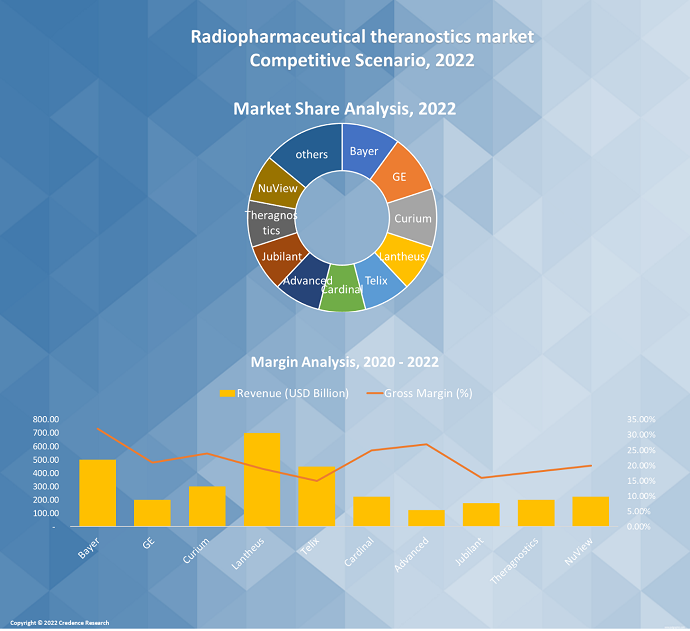
The Radiopharmaceutical Theranostics Market is highly competitive, with the presence of several key players. Some of the major players in the market and their market share are as follows:
- Bayer AG
- GE Healthcare Technologies Inc
- Curium
- Lantheus Medical Imaging, Inc.
- Telix Pharmaceuticals Ltd.
- Cardinal Health Inc
- Advanced Accelerator Applications S.A.
- Jubilant Radiopharmacy
- Theranostics
- NuView Life Sciences
On March 23, 2022, Novartis announced the U.S. Food and Drug Administration (FDA) approval for Pluvicto for treating adult patients with a certain type of advanced cancer called prostate-specific membrane antigen-positive metastatic castration-resistant prostate cancer.
Summary of Key Findings
- The Radiopharmaceutical Theranostics Market is segmented by radioisotope, application, source, approach, radiotracer type, end user, and region.
- Generating major oncology deals globally and the rise in incidence and prevalence of target conditions are the major drivers of market growth.
- However, the Radiopharmaceutical Theranostics Market faces challenges as a reason for the short half-life of radiopharmaceuticals and high equipment prices.
- North America region is fuelling the growth of the Radiopharmaceutical Theranostics Market with the highest revenue share .
- Litetium-177 holds the largest market share leading the radioisotopes segment.The oncology application segment is expected to post the highest CAGR during the forecast period between 2022-2030. Cyclotrons, Targeted therapeutic, peptidic, and hospitals are the leading segments in source, approach, radiotracer type, and end user, respectively.
Future Outlook
- As the prevalence of cancer continues to increase, the demand for radiopharmaceutical theranostics is expected to grow.
- Advancements in imaging technology, including the development of more sensitive and specific radiotracers, improved imaging resolution, and hybrid imaging modalities, are driving the growth of radiopharmaceutical theranostics.
- The increasing adoption of personalized medicine is expected to drive the growth of the radiopharmaceutical theranostics market.
- There is significant investment in research and development activities focused on radiopharmaceutical theranostics.
Segmentation :
By Radioisotope
- Technetium-99
- Gallium-68
- Iodine-131
- Radium-223
- Fluorine-18
- Yttrium-90
- Lutetium-177
- Copper-67 and 64
- Samarium-153
- Others
By Application
- Oncology
- Cardiology
- Others
By Source
- Nuclear Reactors
- Cyclotrons
My Approach
- Targeted Therapeutic (Rx)
- Companion Diagnostic (DX)
By Radiotracer Type
- Peptidic
- Non-peptidic
By End-user
- Hospitals
- Academic Research Institutes
- Others
By Region
- North America
- The U.S.
- Canada
- Mexico
- Europe
- Germany
- The U.K.
- France
- Italy
- Spain
- The Netherlands
- Russia
- Switzerland
- Poland
- Sweden
- Asia Pacific
- China
- India
- Japan
- South Korea
- Malaysia
- Singapore
- Indonesia
- Taiwan
- Australia
- Central & South America
- Brazil
- Argentina
- Middle East & Africa
- Saudi Arabia
- South Africa
- A.E.

Request a Free Sample
Fill in your details and we'll send you a free sample report.
- Sample data tables & charts
- Research methodology
Market Dynamics
Major Oncology Deals and Collaborations
The market is propelled by significant oncology-focused partnerships, mergers, and licensing agreements among pharmaceutical and radiopharmaceutical companies, which accelerate product development and expand access to advanced theranostic solutions.
Rising Incidence and Prevalence of Target Conditions
Increasing global rates of cancer and other target diseases are driving demand for precise diagnostic and therapeutic radiopharmaceuticals, making these products essential in modern disease management.
Advancements in Imaging and Radiotracer Technology
Continuous improvements in imaging modalities (such as PET and SPECT) and the development of more sensitive and specific radiotracers enhance diagnostic accuracy and therapeutic outcomes, supporting market growth.
Expansion of Production Capacity and Supply Chain Initiatives
Efforts to bridge the demand-supply gap through new production facilities, optimized manufacturing, and improved logistics are ensuring a more reliable supply of radiopharmaceuticals, enabling broader clinical adoption.
Shift Toward Personalized Medicine
The growing emphasis on personalized and targeted therapies, particularly in oncology, is increasing the adoption of radiopharmaceutical theranostics, as these agents allow for tailored treatment approaches based on individual patient profiles.
Need a Custom Version of This Report?
Tailor the scope, geography, or segments to your exact requirements.
- Custom geography or segment scope
- Direct access to our analyst team
Frequently Asked Questions
What is the current size of The Radiopharmaceutical Theranostics Market?
What is the expected growth rate of The Radiopharmaceutical Theranostics Market between 2023 and 2030?
Which segment is leading the market share in terms of source?
Which region is fuelling the growth of The Radiopharmaceutical Theranostics Market?
Who are the major players in the Radiopharmaceutical Theranostics Market?
What are the major market drivers of The Radiopharmaceutical Theranostics Market?
What are the major market restraints of The Radiopharmaceutical Theranostics Market?
What are the major market opportunities of The Radiopharmaceutical Theranostics Market?
What are the leading approach types of The Radiopharmaceutical Theranostics Market?
What segment is leading the market growth in terms of application?
Table of Content
Chapter 1 Market Segmentation
- 1.1 Segmentation Framework
- 1.1.1 Product and Service Classification
- 1.1.2 Application and End-Use Classification
- 1.1.3 Technology and Solution Classification
- 1.1.4 Customer and Distribution Channel Classification
- 1.1.5 Geographic Segmentation
- 1.1.6 Market Segment Definitions and Boundaries
- 1.2 By Source
- 1.2.1 Cyclotrons
- 1.2.2 Nuclear Reactors
- 1.3 By End-user
- 1.3.1 Hospitals
- 1.3.2 Academic Research Institutes
- 1.3.3 Others
- 1.4 By Application
- 1.4.1 Oncology
- 1.4.2 Cardiology
- 1.4.3 Others
- 1.5 By Radioisotope
- 1.5.1 Lutetium-177
- 1.5.2 Technetium-99
- 1.5.3 Gallium-68
- 1.5.4 Iodine-131
- 1.5.5 Radium-223
- 1.5.6 Fluorine-18
Chapter 2 Introduction
- 2.1 Report Objectives and Scope
- 2.2 Product Definition and Industry Terminology
- 2.3 Market Inclusions and Exclusions
- 2.4 Research Process
- 2.4.1 Primary Research and Expert Interviews
- 2.4.2 Secondary Research and Source Review
- 2.4.3 Top-Down and Bottom-Up Estimation
- 2.4.4 Data Triangulation and Verification
- 2.5 Market Size Measurement Basis
- 2.5.1 2022: USD 1.6 billion → 2030: USD 3.52 billion
- 2.6 Historical and Forecast Reference Periods
- 2.6.1 Base Year: 2022
- 2.6.2 Forecast Period: 2022-2030
- 2.7 Research Assumptions and Limitations
Chapter 3 Executive Summary
- 3.1 Market Snapshot and Key Findings
- 3.2 Base-Year Market Size, 2022
- 3.3 Forecast Market Size, 2030
- 3.4 Revenue and Volume Growth Outlook
- 3.5 Key Demand and Supply Indicators
- 3.6 Leading Market Segments
- 3.7 Fastest-Growing Market Opportunities
- 3.8 Regional Performance Highlights
- 3.9 Technology and Industry Transformation
- 3.10 Competitive Landscape Summary
- 3.11 Analyst View and Strategic Implications
Chapter 4 Global Radiopharmaceutical Theranostics Market Trends and Developments
- 4.1 Historical Industry Development
- 4.2 Recent Market Trends and Developments
- 4.3 Demand and Customer Behavior Trends
- 4.4 Technology and Product Innovation
- 4.5 Artificial Intelligence, Automation and Digitalization
- 4.6 Local Manufacturing and Supply Chain Realignment
- 4.7 Industry Partnerships, Mergers and Acquisitions
- 4.8 Sustainability and Circular Economy Developments
- 4.9 Government and Private Sector Investment Trends
- 4.10 Emerging Business Models and Commercialization
- 4.11 Industry Developments and Announcements
Chapter 5 Global Radiopharmaceutical Theranostics Market Production, Supply and Demand Analysis
- 5.1 Demand Trend and Consumption Analysis
- 5.2 Demand Forecast, 2022-2030
- 5.3 Production and Output Trend
- 5.4 Production and Output Forecast, 2022-2030
- 5.5 Installed Capacity and Capacity Utilization
- 5.6 Company-Wise Production Plants and Statistics
- 5.6.1 Installed Production Capacity
- 5.6.2 Actual Production
- 5.6.3 Planned Capacity and Expansion Targets
- 5.7 Supply Chain Structure and Procurement Trends
- 5.8 Supply-Demand Gap and Bottlenecks
- 5.9 Import Dependence and Sourcing Structure
- 5.10 Contract Manufacturing and Outsourcing
- 5.11 Regional Supply and Demand Concentration
Chapter 6 Global Radiopharmaceutical Theranostics Market Pricing Analysis
- 6.1 Pricing Structure and Measurement
- 6.2 Historical Pricing Trends
- 6.3 Pricing Outlook, 2022-2030
- 6.4 Average Selling Price and Unit Economics
- 6.5 Pricing by Product and Market Segment
- 6.6 Geographic Pricing Differences
- 6.7 Key Input, Energy, Labor and Logistics Costs
- 6.8 Contract Pricing and Purchasing Models
- 6.9 Pricing Sensitivity and Competitive Positioning
- 6.10 Price, Margin and Profitability Implications
Chapter 7 Global Radiopharmaceutical Theranostics Market Dynamics
- 7.1 Market Growth Drivers
- 7.1.1 Demand-Side Drivers
- 7.1.2 Technology and Innovation Drivers
- 7.1.3 Infrastructure and Investment Drivers
- 7.1.4 Regulatory and Policy Drivers
- 7.2 Market Restraints
- 7.2.1 Cost and Affordability Constraints
- 7.2.2 Technology and Adoption Barriers
- 7.2.3 Supply Chain and Operational Constraints
- 7.3 Market Challenges
- 7.3.1 Competitive Pressure and Margin Erosion
- 7.3.2 Skills, Infrastructure and Implementation Gaps
- 7.4 Emerging Market Opportunities
- 7.5 Market Dynamics Impact and Time-Horizon Assessment
Chapter 8 Global Radiopharmaceutical Theranostics Value Chain Analysis
- 8.1 Industry Value Chain Overview
- 8.2 Upstream Suppliers and Critical Inputs
- 8.3 Technology and Component Providers
- 8.4 Manufacturing or Service Delivery
- 8.5 Distribution, Channel Partners and Integrators
- 8.6 Downstream Applications and End Users
- 8.7 Value Addition and Profit Pools
- 8.8 Vertical Integration and Outsourcing
- 8.9 Supplier Concentration and Risk
- 8.10 Supply Chain Localization and Resilience
Chapter 9 Global Radiopharmaceutical Theranostics Market Regulations and Policies
- 9.1 Relevant Laws, Standards and Compliance Frameworks
- 9.2 Product, Service, Safety and Quality Requirements
- 9.3 Government Policies, Incentives and Subsidies
- 9.4 Imports, Exports and Trade Barriers
- 9.5 Public Procurement and Local Content Requirements
- 9.6 Environmental and Sustainability Compliance
- 9.7 Upcoming Policy Changes and Market Implications
Chapter 10 Global Radiopharmaceutical Theranostics Market Hotspots and Opportunities
- 10.1 Market Opportunity Mapping and Growth Hotspots
- 10.2 High-Growth Applications and Customer Groups
- 10.3 Underserved Markets and White-Space Opportunities
- 10.4 Emerging Technology and Product Opportunities
- 10.5 New Capacity and Investment Hotspots
- 10.6 Market Entry and Expansion Opportunities
- 10.7 Distribution and Partnership Opportunities
- 10.8 Near-Term and Long-Term Commercial Potential
- 10.9 Opportunity Attractiveness and Execution Risks
Chapter 11 Global Radiopharmaceutical Theranostics Market Outlook, 2022-2030
- 11.1 Market Size and Analysis
- 11.1.1 Revenue (Market Measurement: 2022: USD 1.6 billion → 2030: USD 3.52 billion)
- 11.1.2 Market Volume and Quantity Sold
- 11.1.3 Historical Market Size
- 11.1.4 Base-Year Market Size, 2022
- 11.2 Market Forecast, 2022-2030
- 11.2.1 Revenue Forecast to 2030
- 11.2.2 Volume Forecast to 2030
- 11.2.3 CAGR and Year-on-Year Growth
- 11.2.4 Incremental Revenue Opportunity
- 11.3 Forecast Assumptions and Scenario Analysis
- 11.3.1 Base-Case Forecast
- 11.3.2 Optimistic and Conservative Scenarios
- 11.3.3 Technology, Pricing and Policy Sensitivities
- 11.4 Market Attractiveness and Growth Outlook
Chapter 12 Global Radiopharmaceutical Theranostics Market Segmentation and Outlook
- 12.1 Segmentation Summary and Market Shares, 2022
- 12.2 Largest and Fastest-Growing Segments
- 12.3 By Source - Market Size and Forecast, 2022-2030
- 12.3.1 Segment Definition and Scope
- 12.3.2 Historical Market Size
- 12.3.3 Revenue Forecast, 2022-2030
- 12.3.4 Volume Forecast, 2022-2030
- 12.3.5 Base-Year Market Share, 2022
- 12.3.6 Segment CAGR and Growth Drivers
- 12.3.7 Subsegment Market Size and Forecast
- 12.3.7.1 Cyclotrons
- 12.3.7.2 Nuclear Reactors
- 12.3.8 Subsegment Pricing and Adoption Trends
- 12.3.9 Leading Suppliers and Competition
- 12.3.10 Regional Demand and Opportunities
- 12.4 By End-user - Market Size and Forecast, 2022-2030
- 12.4.1 Segment Definition and Scope
- 12.4.2 Historical Market Size
- 12.4.3 Revenue Forecast, 2022-2030
- 12.4.4 Volume Forecast, 2022-2030
- 12.4.5 Base-Year Market Share, 2022
- 12.4.6 Segment CAGR and Growth Drivers
- 12.4.7 Subsegment Market Size and Forecast
- 12.4.7.1 Hospitals
- 12.4.7.2 Academic Research Institutes
- 12.4.7.3 Others
- 12.4.8 Subsegment Pricing and Adoption Trends
- 12.4.9 Leading Suppliers and Competition
- 12.4.10 Regional Demand and Opportunities
- 12.5 By Application - Market Size and Forecast, 2022-2030
- 12.5.1 Segment Definition and Scope
- 12.5.2 Historical Market Size
- 12.5.3 Revenue Forecast, 2022-2030
- 12.5.4 Volume Forecast, 2022-2030
- 12.5.5 Base-Year Market Share, 2022
- 12.5.6 Segment CAGR and Growth Drivers
- 12.5.7 Subsegment Market Size and Forecast
- 12.5.7.1 Oncology
- 12.5.7.2 Cardiology
- 12.5.7.3 Others
- 12.5.8 Subsegment Pricing and Adoption Trends
- 12.5.9 Leading Suppliers and Competition
- 12.5.10 Regional Demand and Opportunities
- 12.6 By Radioisotope - Market Size and Forecast, 2022-2030
- 12.6.1 Segment Definition and Scope
- 12.6.2 Historical Market Size
- 12.6.3 Revenue Forecast, 2022-2030
- 12.6.4 Volume Forecast, 2022-2030
- 12.6.5 Base-Year Market Share, 2022
- 12.6.6 Segment CAGR and Growth Drivers
- 12.6.7 Subsegment Market Size and Forecast
- 12.6.7.1 Lutetium-177
- 12.6.7.2 Technetium-99
- 12.6.7.3 Gallium-68
- 12.6.7.4 Iodine-131
- 12.6.7.5 Radium-223
- 12.6.7.6 Fluorine-18
- 12.6.8 Subsegment Pricing and Adoption Trends
- 12.6.9 Leading Suppliers and Competition
- 12.6.10 Regional Demand and Opportunities
- 12.7 Segment Growth Comparison
- 12.8 Segment Attractiveness and Priority Matrix
Chapter 13 Global Radiopharmaceutical Theranostics End-Use and Application Market Outlook
- 13.1 End-Use Industry and Customer Demand Structure
- 13.2 Leading Applications and Customer Groups
- 13.3 End-Use Market Size, Share and Forecast
- 13.4 Major End-Use Industry Deep Dives
- 13.4.1 Customer Requirements and Use Cases
- 13.4.2 Demand and Replacement Cycles
- 13.4.3 Technical and Regulatory Considerations
- 13.4.4 Purchasing and Procurement Models
- 13.4.5 Leading Vendors and Distribution Channels
- 13.4.6 Forecast and Commercial Opportunities
- 13.5 Emerging Applications and Cross-Segment Demand
- 13.6 End-Use Industry Investment Priorities
Chapter 14 Global Radiopharmaceutical Theranostics Geographic Market Outlook, 2022-2030
- 14.1 Regional Market Size and Share, 2022
- 14.2 Regional Market Forecast, 2022-2030
- 14.3 Regional Pricing, Production and Demand Differences
- 14.4 North America
- 14.4.1 United States
- 14.4.2 Canada
- 14.4.3 Mexico
- 14.5 Europe
- 14.5.1 Germany
- 14.5.2 France
- 14.5.3 Italy
- 14.5.4 United Kingdom
- 14.5.5 Spain
- 14.5.6 Poland
- 14.5.7 Russia
- 14.5.8 Netherlands
- 14.5.9 Belgium
- 14.5.10 Sweden
- 14.5.11 Denmark
- 14.5.12 Norway
- 14.5.13 Rest of Europe
- 14.6 Asia Pacific
- 14.6.1 China
- 14.6.2 India
- 14.6.3 Japan
- 14.6.4 South Korea
- 14.6.5 Thailand
- 14.6.6 Indonesia
- 14.6.7 Vietnam
- 14.6.8 Malaysia
- 14.6.9 Australia
- 14.6.10 Rest of Asia Pacific
- 14.7 Latin America
- 14.7.1 Brazil
- 14.7.2 Argentina
- 14.7.3 Colombia
- 14.7.4 Chile
- 14.7.5 Rest of Latin America
- 14.8 Middle East
- 14.8.1 Saudi Arabia
- 14.8.2 United Arab Emirates
- 14.8.3 Turkey
- 14.8.4 Israel
- 14.8.5 Iran
- 14.8.6 Rest of the Middle East
- 14.9 Africa
- 14.9.1 South Africa
- 14.9.2 Egypt
- 14.9.3 Nigeria
- 14.9.4 Morocco
- 14.9.5 Rest of Africa
- 14.10 Regional Investment, Policy and Supply Chain Differences
- 14.11 Regional Competitive Landscape
- 14.12 Geographic Growth Hotspots
Chapter 15 Global Radiopharmaceutical Theranostics Technology, Innovation and Sustainability Outlook
- 15.1 Technology Landscape and Maturity
- 15.2 Product, Process and Service Innovation
- 15.3 AI, Automation and Digital Tools in the Industry
- 15.4 Technology Adoption and Performance Benchmarking
- 15.5 Innovation Pipeline and R&D Investment
- 15.6 Patent and Intellectual Property Trends
- 15.7 Energy Efficiency and Resource Management
- 15.8 Sustainability, Recycling and Circularity
- 15.9 Technology Roadmap, 2022-2030
- 15.10 Risks of Obsolescence and Technology Substitution
Chapter 16 Global Radiopharmaceutical Theranostics Market Key Strategic Imperatives
- 16.1 Growth and Market Entry Priorities
- 16.2 High-Return Products and Segments
- 16.3 Pricing, Profitability and Cost Optimization
- 16.4 Technology Investment and Product Differentiation
- 16.5 Supply Chain Localization and Resilience
- 16.6 Distribution and Customer Acquisition
- 16.7 Partnership, Acquisition and Capacity Strategy
- 16.8 Regional Expansion Priorities
- 16.9 Short-, Medium- and Long-Term Actions
Chapter 17 Competition Outlook
- 17.1 Industry Competition Characteristics
- 17.2 Market Structure and Concentration
- 17.3 Market Share and Competitive Positioning, 2022
- 17.4 Company-Wise Revenue and Product Benchmarking
- 17.5 Production and Service Capacity Benchmarking
- 17.6 Technology, Pricing and Differentiation
- 17.7 Regional Footprint and Distribution Strength
- 17.8 Mergers, Acquisitions and Strategic Alliances
- 17.9 New Entrants and Competitive Threats
- 17.10 Porter's Five Forces and Industry Attractiveness
- 17.11 Competitive Outlook, 2022-2030
Chapter 18 Company Profiles
- 18.1 Company Coverage and Selection Criteria
- 18.2 Bayer AG
- 18.2.1 Business Description
- 18.2.2 Company Ownership and Geographic Presence
- 18.2.3 Product and Service Portfolio
- 18.2.4 Manufacturing and Operating Footprint
- 18.2.5 Production Capacity and Expansion Plans
- 18.2.6 Financial Performance and Investment
- 18.2.7 Market Share and Competitive Position
- 18.2.8 Technology and Innovation Capabilities
- 18.2.9 Strategic Alliances or Partnerships
- 18.2.10 Recent Developments
- 18.2.11 Growth Strategy and Outlook
- 18.3 GE Healthcare Technologies Inc
- 18.4 Curium
- 18.5 Lantheus Medical Imaging, Inc.
- 18.6 Telix Pharmaceuticals Ltd.
- 18.7 Cardinal Health Inc
- 18.8 Advanced Accelerator Applications S.A.
- 18.9 Jubilant Radiopharmacy
- 18.10 Theranostics
- 18.11 NuView Life Sciences
- 18.12 Other Relevant Market Participants
Note: Every listed company is profiled on the structure shown under the first company. The company list is preliminary and may change based on research findings, market developments, data availability and client requirements.
Chapter 19 Disclaimer
- 19.1 Research and Forecast Disclaimer
- 19.2 Data Source and Estimation Limitations
Note: The depth of individual sections depends on data availability for this market. Volume, capacity, trade and other unit-based metrics are included where applicable.