
Dark Store Market Overview:
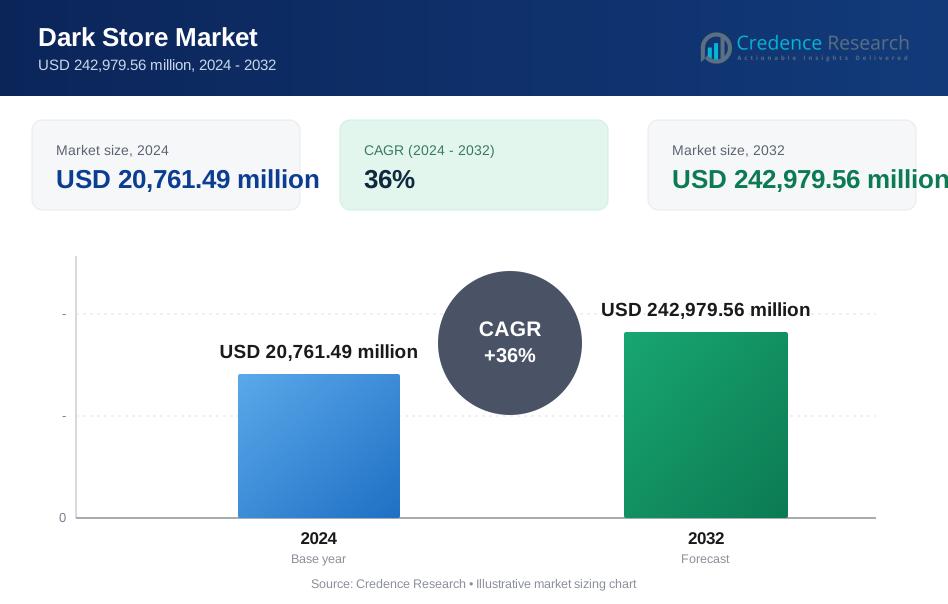
The global dark store market was valued at USD 20,761.49 million in 2024 and is projected to reach USD 242,979.56 million by 2032, expanding at a robust compound annual growth rate (CAGR) of 36% during the forecast period.
| REPORT ATTRIBUTE | DETAILS |
|---|---|
| Historical Period | 2020-2023 |
| Base Year | 2024 |
| Forecast Period | 2025-2032 |
| Dark Store Market Size 2024 | USD 20,761.49 million |
| Dark Store Market , CAGR | 36% |
| Dark Store Market Size 2032 | USD 242,979.56 million |
Dark Store Market Insights
- Market growth is primarily driven by the rapid expansion of quick-commerce, rising consumer demand for sub-30-minute delivery, and increasing urban population density, with groceries emerging as the dominant category segment due to high purchase frequency and predictable demand patterns.
- Key market trends include the integration of micro-fulfillment automation, data-driven assortment optimization, and private-label expansion, while home delivery remains the leading distribution channel, accounting for the majority of order volumes across urban markets.
- The competitive landscape features intense rivalry among global retailers and regional quick-commerce players focused on network density, last-mile efficiency, and technology investment, with consolidation accelerating as players prioritize profitability over aggressive expansion.
- Regionally, North America leads with approximately 39% market share, followed by Europe at around 26% and Asia-Pacific at nearly 24%, while Latin America and the Middle East & Africa collectively account for the remaining share, constrained by infrastructure and cost challenges.
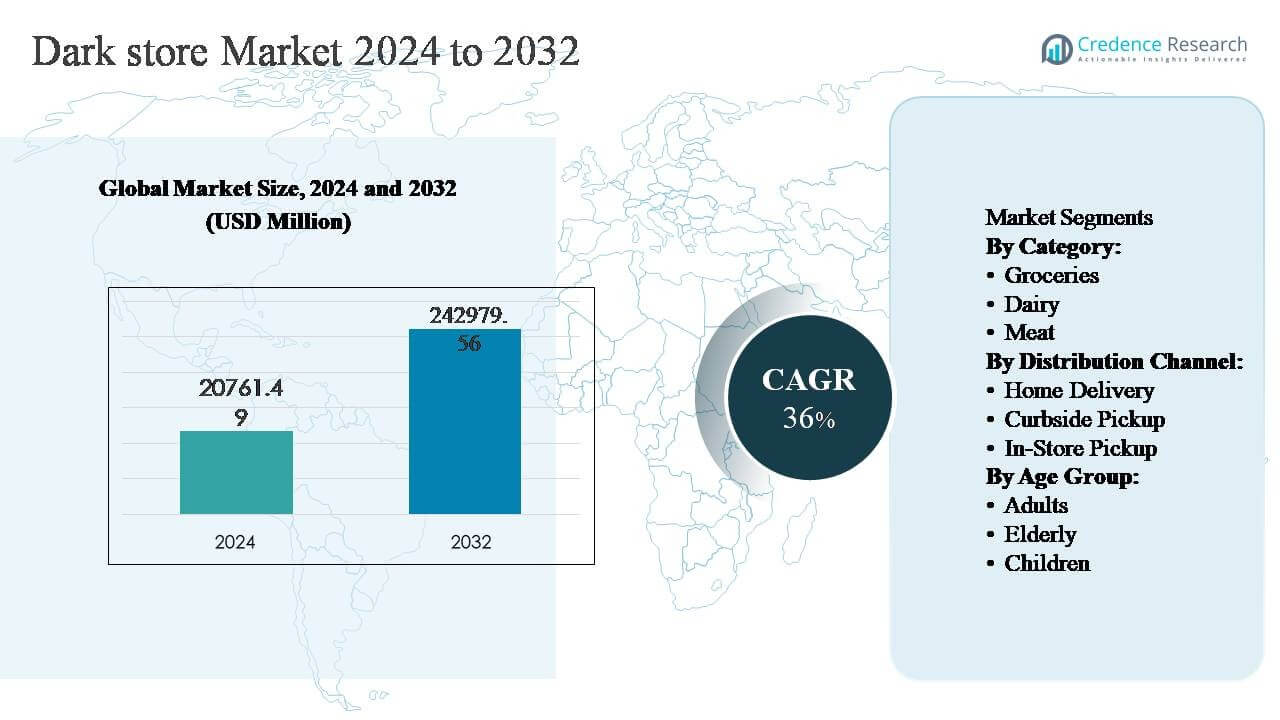
Dark Store Market Segmentation Analysis:
By Category
Within the dark store market, the groceries category dominates, accounting for the largest market share due to high purchase frequency, broad SKU turnover, and strong alignment with rapid delivery models. Groceries benefit from predictable demand patterns, enabling efficient inventory rotation and reduced waste in dark store formats. Staples such as packaged foods, fresh produce, and household essentials drive consistent daily order volumes. The dairy segment follows, supported by time-sensitive replenishment needs, while meat remains smaller but growing as cold-chain infrastructure and demand forecasting improve across urban dark store networks.
- For instance, Amazon Fresh dark stores (fulfillment centers) supporting meat fulfillment utilize multi-zone refrigeration systems to maintain food safety and quality. These systems typically operate between -24°C and -18°C for frozen products and 0°C to 5°C for chilled fresh cuts. To further ensure freshness, Amazon utilizes machine learning and algorithmic forecasting (such as Amazon Forecast) to predict demand and optimize inventory.
By Distribution Channel
Home delivery is the dominant distribution channel, holding the majority market share as consumers increasingly prioritize speed, convenience, and contactless fulfillment. Dark stores are purpose-built to support sub-30-minute delivery windows, making home delivery the most scalable and profitable channel. High urban density, optimized last-mile routing, and partnerships with gig-economy couriers reinforce its leadership. Curbside pickup and in-store pickup serve niche use cases, particularly cost-conscious or scheduled buyers, but lack the immediacy and reach that drive volume growth in home delivery-led models.
- For instance, Zepto operates dark stores with average picking and packing times of under 2 minutes per order, supported by store layouts designed to keep picker travel distances below 50 meters, enabling routine delivery commitments of 10 minutes from order confirmation in core city zones.
By Age Group
The adult age group represents the dominant user segment, capturing the largest market share due to busy lifestyles, dual-income households, and strong adoption of app-based grocery platforms. Working professionals and urban families rely heavily on dark stores for routine and impulse purchases, driving repeat usage. The elderly segment is expanding steadily, supported by assisted shopping features and simplified ordering interfaces, while children remain an indirect segment, with demand driven by parental purchasing of snacks, dairy products, and daily essentials through dark store platforms.
Key Growth Driver
Surge in Quick-Commerce and On-Demand Consumption
The rapid expansion of quick-commerce models is a primary driver of dark store adoption globally. Consumers increasingly expect ultra-fast fulfillment for daily essentials, often within 10-30 minutes, which traditional retail and centralized warehouses struggle to deliver efficiently. Dark stores are purpose-built to meet this expectation by positioning inventory closer to end users, optimizing pick paths, and enabling high order throughput. Urbanization, higher smartphone penetration, and widespread use of digital payment platforms further accelerate this shift. As purchasing behavior moves from planned weekly shopping to frequent, small-basket orders, dark stores provide the operational agility required to support high-frequency demand while maintaining service reliability.
- For instance, Getir has disclosed that pickers in its dark stores typically complete order assembly in under 3 minutes, while its in-house courier fleet enables immediate dispatch directly from the store, allowing each urban dark store to process hundreds of orders per day without relying on long-haul replenishment cycles.
Operational Efficiency and Cost Optimization
Dark stores significantly improve fulfillment efficiency by eliminating customer-facing activities and redesigning layouts exclusively for picking and packing. This model reduces labor complexity, shortens order processing times, and enhances inventory accuracy through real-time demand visibility. Retailers benefit from lower per-order fulfillment costs compared to traditional stores repurposed for online orders. Advanced demand forecasting, SKU rationalization, and automated replenishment further strengthen margins. As last-mile delivery costs remain a critical profitability challenge, dark stores enable retailers and platforms to scale volumes while maintaining tighter control over operating expenses and service-level performance.
- For instance, Walmart has deployed Alphabot micro-fulfillment systems in dark-store-style backroom operations, where automated storage and retrieval units hold upward of 20,000 items. The system operates at sustained pick rates of 800 or more items per hour approximately 10 times the speed of a manual human picker significantly reducing labor for repetitive tasks and enabling 95% of orders to be picked in under 12 minutes while maintaining predictable operating workflows.
Expansion of Urban and Tier-2 City Infrastructure
The proliferation of dark stores is closely linked to expanding urban infrastructure and rising consumption in densely populated cities. High population density improves delivery economics by reducing average delivery distances and increasing order density per location. Beyond major metros, tier-2 cities are emerging as high-growth markets due to rising disposable incomes and improving digital adoption. Retailers increasingly deploy smaller-format dark stores to penetrate these markets quickly, leveraging modular layouts and standardized operating models. This geographic expansion supports network scalability while enabling faster market entry compared to traditional brick-and-mortar retail investments.
Key Trend & Opportunity
Automation and Micro-Fulfillment Integration
Automation is becoming a defining trend in dark store operations, with growing adoption of micro-fulfillment technologies such as automated storage systems, robotic picking, and AI-driven inventory management. These technologies increase pick accuracy, reduce labor dependency, and support higher order volumes during peak demand periods. As order density grows, automation offers a clear pathway to margin improvement and operational resilience. The opportunity lies in selectively deploying automation based on order velocity and SKU complexity, allowing operators to balance capital expenditure with measurable efficiency gains across mature dark store networks.
- For instance, Ocado Group’s automated fulfillment technology, adapted for smaller-scale micro-fulfillment environments, uses robotic grids capable of handling thousands of product bins simultaneously, with individual robots performing hundreds of pick movements per hour, enabling rapid fulfillment of grocery orders from densely packed inventories.
Private Labels and Assortment Optimization
Dark stores are increasingly used as strategic platforms for private-label expansion and data-driven assortment optimization. With full visibility into customer purchasing patterns, operators can refine SKU mixes to prioritize high-velocity and high-margin products. Private labels gain prominence due to better price control and stronger contribution margins, particularly in groceries and dairy. This trend creates opportunities to improve profitability while differentiating offerings from traditional retailers. Optimized assortments also reduce inventory holding costs and spoilage, strengthening the economic sustainability of dark store models.
- For instance, Dunzo Daily dark stores operated using item-level barcode scanning for every transaction, which enabled real-time inventory reconciliation. This system allowed the platform to strategically slot high-demand staples such as bread, milk, and eggs in primary pick locations to minimize travel time and handling for pickers.
Key Challenge
High Last-Mile Delivery Costs
Despite operational efficiencies within dark stores, last-mile delivery remains a major challenge affecting profitability. Labor-intensive delivery models, rising fuel costs, and inconsistent order density can erode margins, particularly in low-demand zones. Maintaining rapid delivery promises while controlling per-order delivery expenses requires continuous route optimization and scale. Operators must balance speed with cost discipline, often adjusting delivery windows or minimum order values. Failure to achieve sufficient order density can significantly limit the financial viability of dark store expansion in certain markets.
Inventory Risk and Demand Volatility
Dark stores face heightened exposure to demand volatility due to limited storage space and a strong focus on fast-moving SKUs. Inaccurate demand forecasting can lead to stockouts or excess inventory, particularly for perishable categories such as dairy and meat. Managing freshness while minimizing waste requires precise replenishment cycles and strong supplier coordination. As consumer preferences shift rapidly, operators must continuously recalibrate assortments, which increases operational complexity and planning risk.
Regional Analysis
North America:
North America holds the largest share of the global dark store market, accounting for approximately 38-40%, driven by mature e-commerce infrastructure, high consumer willingness to pay for convenience, and widespread adoption of quick-commerce services. Major urban centers in the United States and Canada support dense dark store networks optimized for same-day and sub-hour delivery. Strong penetration of online grocery platforms, advanced last-mile logistics, and high smartphone usage reinforce regional leadership. Retailers and delivery platforms continue to invest in automation and micro-fulfillment to improve unit economics and sustain scalability across metropolitan areas.
Europe:
Europe represents around 25-27% of the global dark store market, supported by high urban density, strong digital adoption, and consumer preference for frequent grocery replenishment. Countries such as the UK, Germany, France, and the Nordics lead deployment, with dark stores integrated into urban retail ecosystems. Regulatory focus on sustainability and traffic congestion has accelerated demand for localized fulfillment models. The region benefits from shorter delivery distances and strong private-label penetration. Growth is further supported by partnerships between retailers and delivery platforms to optimize fulfillment efficiency while maintaining cost control.
Asia-Pacific:
Asia-Pacific accounts for approximately 23-25% of the global dark store market and is the fastest-growing regional segment. Rapid urbanization, rising disposable incomes, and widespread mobile commerce adoption drive strong demand in markets such as China, India, South Korea, and Southeast Asia. High population density significantly improves delivery economics, encouraging aggressive dark store expansion. Local players and super-app ecosystems play a critical role in scaling operations. The region’s growth is fueled by high order frequency, competitive pricing strategies, and expanding penetration into tier-2 and tier-3 cities.
Latin America:
Latin America holds about 6-7% of the global dark store market, with growth concentrated in major urban centers across Brazil, Mexico, Chile, and Colombia. Increasing smartphone penetration and improving digital payment infrastructure support the expansion of on-demand grocery delivery models. Dark stores are primarily deployed in densely populated cities to maximize delivery efficiency and manage cost sensitivity. While infrastructure constraints persist, rising consumer demand for convenience and improving logistics capabilities continue to attract investment from regional and international quick-commerce operators.
Middle East & Africa:
The Middle East & Africa region accounts for approximately 4-5% of the global dark store market, led by Gulf Cooperation Council (GCC) countries such as the UAE and Saudi Arabia. High urbanization rates, strong purchasing power, and tech-savvy populations support adoption in key cities. Dark stores primarily focus on premium groceries and rapid delivery services. In Africa, growth remains nascent but promising, driven by expanding urban populations and mobile-first commerce models. Investment in logistics infrastructure will be critical for long-term scalability across the region.
Dark Store Market Segmentations:
By Category:
- Groceries
- Dairy
- Meat
By Distribution Channel:
- Home Delivery
- Curbside Pickup
- In-Store Pickup
By Age Group:
- Adults
- Elderly
- Children
By Geography
- North America
- U.S.
- Canada
- Mexico
- Europe
- Germany
- France
- U.K.
- Italy
- Spain
- Rest of Europe
- Asia Pacific
- China
- Japan
- India
- South Korea
- South-east Asia
- Rest of Asia Pacific
- Latin America
- Brazil
- Argentina
- Rest of Latin America
- Middle East & Africa
- GCC Countries
- South Africa
- Rest of the Middle East and Africa
Competitive Landscape
The dark store market is characterized by intense competition among quick-commerce platforms, large retailers, and vertically integrated delivery players, all focused on speed, network density, and operational efficiency. Leading participants compete by rapidly expanding urban dark store footprints, optimizing last-mile logistics, and leveraging data analytics to improve demand forecasting and inventory turnover. Scale plays a critical role, as operators with dense networks achieve superior order economics and faster delivery times. Strategic partnerships with grocery brands, private-label development, and technology investments in automation and micro-fulfillment strengthen competitive positioning. Market participants also differentiate through service reliability, assortment breadth, and pricing strategies tailored to local demand patterns. Consolidation is increasing as well-funded players acquire smaller operators or exit underperforming markets to focus on profitability. Overall, competition is shifting from rapid expansion toward efficiency, margin optimization, and sustainable growth models.
Key Player Analysis
- Amazon.com Inc.
- Walmart Inc.
- Target Corporation
- Flipkart Private Limited
- Instacart
- Auchan
- Grab Holdings Inc.
- Swiggy (Instamart)
- Zepto
- Dunzo Digital Pvt. Ltd.
Recent Developments
- In December 2025, Amazon’s quick-commerce arm Amazon Now announced an accelerated expansion of its dark store network in India, planning to open two new dark stores per day across Bengaluru, Delhi and Mumbai and reach over 300 micro-fulfillment centers by the end of 2025. This initiative marks a major push into instant delivery infrastructure to support ultra-fast grocery and essentials fulfillment.
- In June 2025, Walmart initiated experimental dark store fulfillment pilots in the United States, launching a dark store in Dallas, Texas exclusively for online order fulfillment (closed to in-store shoppers), and planning a second facility in Bentonville, Arkansas, signaling its first dedicated step into the dark store model to accelerate delivery speeds.
Report Coverage
The research report offers an in-depth analysis based on Category, Distribution channel, Age group and Geography. It details leading market players, providing an overview of their business, product offerings, investments, revenue streams, and key applications. Additionally, the report includes insights into the competitive environment, SWOT analysis, current market trends, as well as the primary drivers and constraints. Furthermore, it discusses various factors that have driven market expansion in recent years. The report also explores market dynamics, regulatory scenarios, and technological advancements that are shaping the industry. It assesses the impact of external factors and global economic changes on market growth. Lastly, it provides strategic recommendations for new entrants and established companies to navigate the complexities of the market.
Request a Free Sample
Fill in your details and we'll send you a free sample report.
- Sample data tables & charts
- Research methodology
Need a Custom Version of This Report?
Tailor the scope, geography, or segments to your exact requirements.
- Custom geography or segment scope
- Direct access to our analyst team
Frequently Asked Questions
What is the current market size for the Dark store market, and what is its projected size in 2032?
At what Compound Annual Growth Rate is the Dark store market projected to grow between 2024 and 2032?
Which Dark store segment held the largest share in 2024?
What are the primary factors fueling the growth of the Dark store market?
Who are the leading companies in the Dark store market?
Which region commanded the largest share of the Dark store market in 2024?
Table of Content
Chapter 1. Report Introduction
- 1.1 Report Description & Purpose
- 1.1.1 Report Title & Market Definition
- 1.1.2 Unique Selling Propositions (USP) & Key Differentiators
- 1.1.3 Value Proposition for Stakeholders
- 1.2 Research Objectives
- 1.2.1 Market Sizing Objectives (Volume & Revenue)
- 1.2.2 Segmentation Objectives
- 1.2.3 Competitive Intelligence Objectives
- 1.2.4 Forecast & Scenario Objectives
- 1.3 Report Scope
- 1.3.1 Dark Store Scope – Types & Subtypes Covered
- 1.3.2 Geographic Scope – Regions & Countries Covered
- 1.3.3 Historical Period, Base Year & Forecast Period (2024; forecast to 2032)
- 1.3.4 Inclusions & Exclusions
- 1.4 HS Code & Classification Framework
- 1.5 Currency, Units & Pricing Basis
- 1.6 Target Stakeholders
- 1.7 Limitations & Assumptions
Chapter 2. Executive Summary
- 2.1 Global Dark Store Market Snapshot
- 2.1.1 Market Size – Historical (2024) & Forecast (2024-2032) (2024: USD 20,761.49 million → 2032: USD 242,979.56 million)
- 2.1.2 Volume & Revenue – Global Totals
- 2.1.3 Key Market Highlights – Top Five Facts
- 2.2 Dark Store Market Segmentation Snapshot
- 2.2.1 Market Split by Region – 2024 vs. 2032
- 2.3 Competitive Snapshot
- 2.3.1 Top 10 Players by Revenue Share – 2024
- 2.3.2 Top 10 Players by Volume Share – 2024
- 2.3.3 Recent Strategic Developments (18-Month Summary)
- 2.4 Key Investment Highlights & Strategic Conclusions
Chapter 3. Dark Store Market Dynamics & Industry Analysis
- 3.1 Market Overview & Context
- 3.1.1 Dark Store Market Position in the Broader Automotive Value Chain
- 3.1.2 OEM vs. Replacement Market Dynamics
- 3.1.3 Market Maturity & Development Stage by Region
- 3.2 Dark Store Market Drivers
- 3.3 Dark Store Market Restraints & Challenges
- 3.4 Dark Store Market Opportunities
- 3.5 Porter's Five Forces Analysis
- 3.5.1 Threat of New Entrants
- 3.5.2 Bargaining Power of Suppliers
- 3.5.3 Bargaining Power of Buyers
- 3.5.4 Threat of Substitutes
- 3.5.5 Competitive Rivalry – Intensity Assessment
- 3.6 Dark Store Value Chain Analysis
- 3.6.1 Upstream – Raw Material/Input Suppliers
- 3.6.1.1 Raw Material/Input 1
- 3.6.1.2 Raw Material/Input 2
- 3.6.1.3 Raw Material/Input 3
- 3.6.2 Midstream – Production/Manufacturing/Service Delivery
- 3.6.2.1 Production/Process Overview
- 3.6.2.2 Key Facility Locations & Capacity by Manufacturer
- 3.6.3 Downstream – Distribution & End Consumer
- 3.6.3.1 Primary Channel – B2B/OEM
- 3.6.3.2 Secondary Channels – Dealer, Retail, Online, Direct
- 3.6.4 Value Chain Profitability Analysis
- 3.6.1 Upstream – Raw Material/Input Suppliers
- 3.7 PESTEL Analysis
- 3.7.1 Political Factors
- 3.7.2 Economic Factors
- 3.7.3 Social Factors
- 3.7.4 Technological Factors
- 3.7.5 Environmental Factors
- 3.7.6 Legal Factors
- 3.8 Dark Store Supply Chain Analysis
- 3.8.1 Raw Material/Input Supply Risk Assessment
- 3.8.2 Manufacturing Concentration Risk (Geographic Exposure)
- 3.8.3 Trade Disruption Impact Analysis
- 3.9 Regulatory & Policy Landscape
Note: The regulatory and policy landscape section covers regulations based on their applicability to the market, Dark Store category, geography, and scope of the study. Only regulatory frameworks with a material impact on operations, compliance, trade, sustainability, or market access are analyzed in detail.
Chapter 4. Key Investment Pockets & Opportunity Analysis
- 4.1 Dark Store Market Attractiveness Analysis
- 4.1.1 By Region – Investment Attractiveness Matrix (Volume × CAGR)
- 4.2 Absolute Revenue Growth Opportunity
- 4.2.1 By Region – Absolute USD Growth Through 2032
- 4.3 Incremental Volume Opportunity
- 4.3.1 By Region – Incremental Volume Through 2032
- 4.3.2 Segment – Incremental Volume
- 4.4 Emerging Submarket Opportunity Deep Dive (Subject to Applicability)
- 4.5 Emerging Market Opportunity Scorecards
- 4.5.1 United States
- 4.5.2 Europe
- 4.5.3 Asia
- 4.5.4 Middle East & Africa
Note: Emerging Market Opportunity Scorecards will be included based on relevance and strategic importance. Regions listed are indicative and may vary depending on data availability and market dynamics.
Chapter 5. Dark Store Import-Export Analysis & Trade Flows
- 5.1 Global Trade Overview
- 5.1.1 Global Export Value by Country (2024)
- 5.1.2 Global Export Volume by Country (2024)
- 5.1.3 Global Import Value by Country (2024)
- 5.1.4 Global Import Volume by Country (2024)
- 5.1.5 Net Trade Balance by Country (2024)
- 5.2 Export Analysis – Segment
- 5.2.1 Type 1 (HS Code)
- 5.2.2 Type 2 (HS Code)
- 5.2.3 Type 3 (HS Code)
- 5.2.4 Type 4 (HS Code)
- 5.2.5 Type 5 (HS Code)
- 5.3 Import Analysis – Segment
- 5.3.1 Type 1 (HS Code)
- 5.3.2 Type 2 (HS Code)
- 5.3.3 Type 3 (HS Code)
- 5.3.4 Type 4 (HS Code)
- 5.3.5 Type 5 (HS Code)
- 5.4 Average Unit Trade Prices
- 5.4.1 Average Export Price – Segment & Country
- 5.4.2 Average Import Price – Segment & Source Country
- 5.4.3 Price Trends (2024)
- 5.5 Key Trade Route Analysis
- 5.5.1 Trade Route 1
- 5.5.2 Trade Route 2
- 5.5.3 Trade Route 3
- 5.5.4 Trade Route 4
- 5.5.5 Trade Route 5
- 5.6 Trade Policy Impact Assessment
- 5.6.1 US Anti-Dumping & Section 301 Tariffs
- 5.6.2 EU Customs Union Impact
- 5.6.3 Major Free Trade Agreements
- 5.6.4 USMCA Rules of Origin
Note: Trade policy analysis will be included only where relevant to the Dark Store market.
Chapter 6. Competitive Landscape & Company Benchmarking
- 6.1 Dark Store Market Concentration & Structure
- 6.1.1 Herfindahl-Hirschman Index (HHI) – vs. 2024
- 6.1.2 Tier 1, Tier 2 & Tier 3 Market Structure
- 6.1.3 Global, Regional & Local Player Dynamics
- 6.2 Dark Store Market Share Analysis – 2024
- 6.2.1 Global Revenue Share by Company
- 6.2.2 Global Volume Share by Company
- 6.2.3 Regional Revenue Share
- 6.2.4 Market Share Evolution ( vs. 2024)
- 6.2.5 OEM Segment Share by Company
- 6.2.6 Replacement Segment Share by Company
- 6.3 Production/Delivery Capacity & Facility Analysis
- 6.3.1 Global Installed Capacity
- 6.3.2 Capacity Utilization Rates
- 6.3.3 Production/Output Volume
- 6.3.4 Facility Locations & Capacity Map
- 6.3.5 Planned Capacity Additions
- 6.4 Dark Store Competitive Benchmarking Matrix
- 6.4.1 Revenue, Volume, CAGR & Profitability Comparison
- 6.4.2 Channel Revenue Mix
- 6.4.3 Geographic Revenue Exposure
- 6.4.4 R&D Intensity
- 6.4.5 Sustainability Maturity
- 6.5 Strategic Developments in Dark Store (Last 24 Months)
- 6.5.1 Mergers, Acquisitions & Divestments
- 6.5.2 New Dark Store Launches
- 6.5.3 Facility Expansions
- 6.5.4 Strategic Alliances, Joint Ventures & Partnerships
- 6.5.5 Distribution Expansion & Market Entry
- 6.5.6 Sustainability & ESG Initiatives
- 6.6 Competitive Strategy Mapping
- 6.6.1 Leader, Challenger, Follower & Niche Classification
- 6.6.2 Pricing Strategy Comparison
- 6.6.3 Channel Strategy Matrix
Note: Strategic developments are included based on their materiality and the availability of reliable information.
Chapter 7. Global Dark Store Market – By Distribution Channel
- 7.1 Segment Overview
- 7.1.1 Volume & Revenue Split by Channel (2024 & 2032)
- 7.1.2 Channel Mix Evolution (2024-2032)
Chapter 8. Regional Market Analysis – Global Overview
- 8.1 Global Regional Overview
- 8.1.1 Regional Volume Share
- 8.1.2 Regional Revenue Share
- 8.1.3 Regional Volume by Region
- 8.1.4 Regional Revenue by Region
- 8.1.5 Regional Forecast Through 2032
- 8.2 Cross-Regional Segment Analysis
- 8.2.1 By Distribution Channel
- 8.2.2 By Brand/Price Tier
Chapter 9. North America Dark Store Market
- 9.1 United States
- 9.2 Canada
- 9.3 Mexico
Chapter 10. Europe Dark Store Market
- 10.1 Germany
- 10.2 France
- 10.3 Italy
- 10.4 United Kingdom
- 10.5 Spain
- 10.6 Poland
- 10.7 Russia
- 10.8 Netherlands
- 10.9 Belgium
- 10.10 Sweden
- 10.11 Denmark
- 10.12 Norway
- 10.13 Rest of Europe
Chapter 11. Asia Pacific Dark Store Market
- 11.1 China
- 11.2 India
- 11.3 Japan
- 11.4 South Korea
- 11.5 Thailand
- 11.6 Indonesia
- 11.7 Vietnam
- 11.8 Malaysia
- 11.9 Australia
- 11.10 Rest of Asia Pacific
Chapter 12. Latin America Dark Store Market
- 12.1 Brazil
- 12.2 Argentina
- 12.3 Colombia
- 12.4 Chile
- 12.5 Rest of Latin America
Chapter 13. Middle East Dark Store Market
- 13.1 Saudi Arabia
- 13.2 United Arab Emirates
- 13.3 Turkey
- 13.4 Israel
- 13.5 Iran
- 13.6 Rest of the Middle East
Chapter 14. Africa Dark Store Market
- 14.1 South Africa
- 14.2 Egypt
- 14.3 Nigeria
- 14.4 Morocco
- 14.5 Rest of Africa
Chapter 15. Dark Store Company Profiles
- 15.1 [Company 01]
- 15.1.1 Company Overview
- 15.1.2 Key Management Personnel
- 15.1.3 Products & Services Portfolio
- 15.1.4 Financial Performance
- 15.1.5 Key Market Focus & Geographic Presence
- 15.1.6 Recent Developments & Strategic Initiatives
Note: The company profile list is preliminary and may change based on research findings, market developments, data availability, and client requirements.
Chapter 16. Appendices
- Appendix A – List of Abbreviations & Acronyms
- Appendix B – Industry Classification Code Reference – Full Series
- Appendix C – Production & Capacity Data Tables
- Appendix D – End-Use & Demand Base Tables
- Appendix E – Consumption & Replacement Rate Assumptions
- Appendix F – ASP Reference Tables
- Appendix G – Manufacturing & Facility Database
- Appendix H – Import-Export Data Tables
- Appendix I – Regulatory Summary Tables
- Appendix J – Primary Research Participant List (Anonymized)
- Appendix K – Primary Research Questionnaire Framework
- Appendix L – Data Sources & Bibliography
- Appendix M – Market Size Divergence & Source Comparison
Chapter 17. Research Methodology
- 17.1 Research Framework & Philosophy
- 17.2 Secondary Research – Sources, Hierarchy & Data Extraction
- 17.3 Data Modeling – Bottom-Up & Top-Down Market Sizing
- 17.4 Primary Research – Stakeholder Framework, LOI & Sample Sizes
- 17.5 Forecast Methodology – Regression, Scenario & Sensitivity Analysis
- 17.6 Quality Control – Four-Layer Validation Framework
- 17.7 Limitations & Standard Assumptions
- 17.8 Disclaimer