
Cloud and AI programs reshape Saudi software advisory
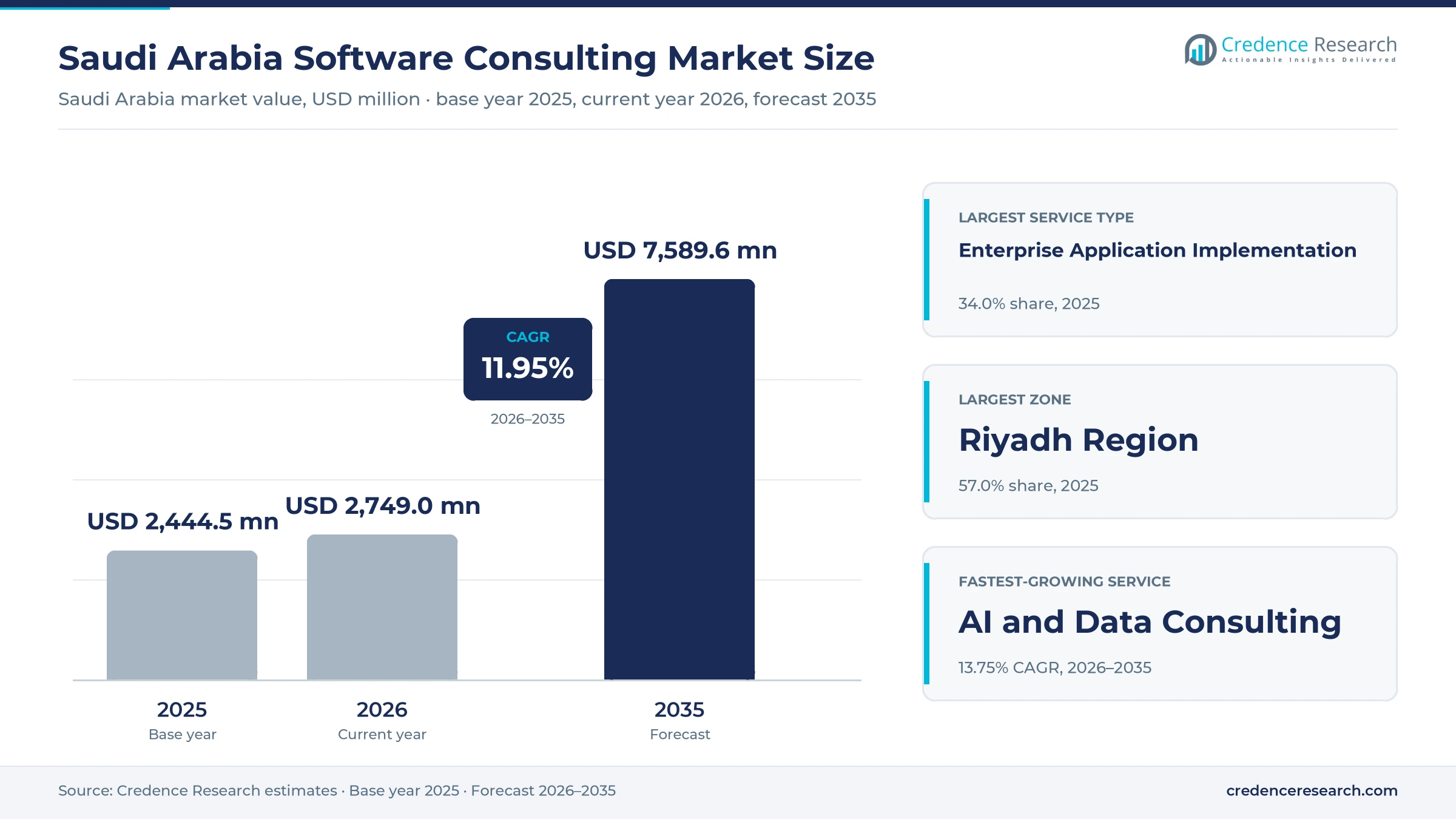
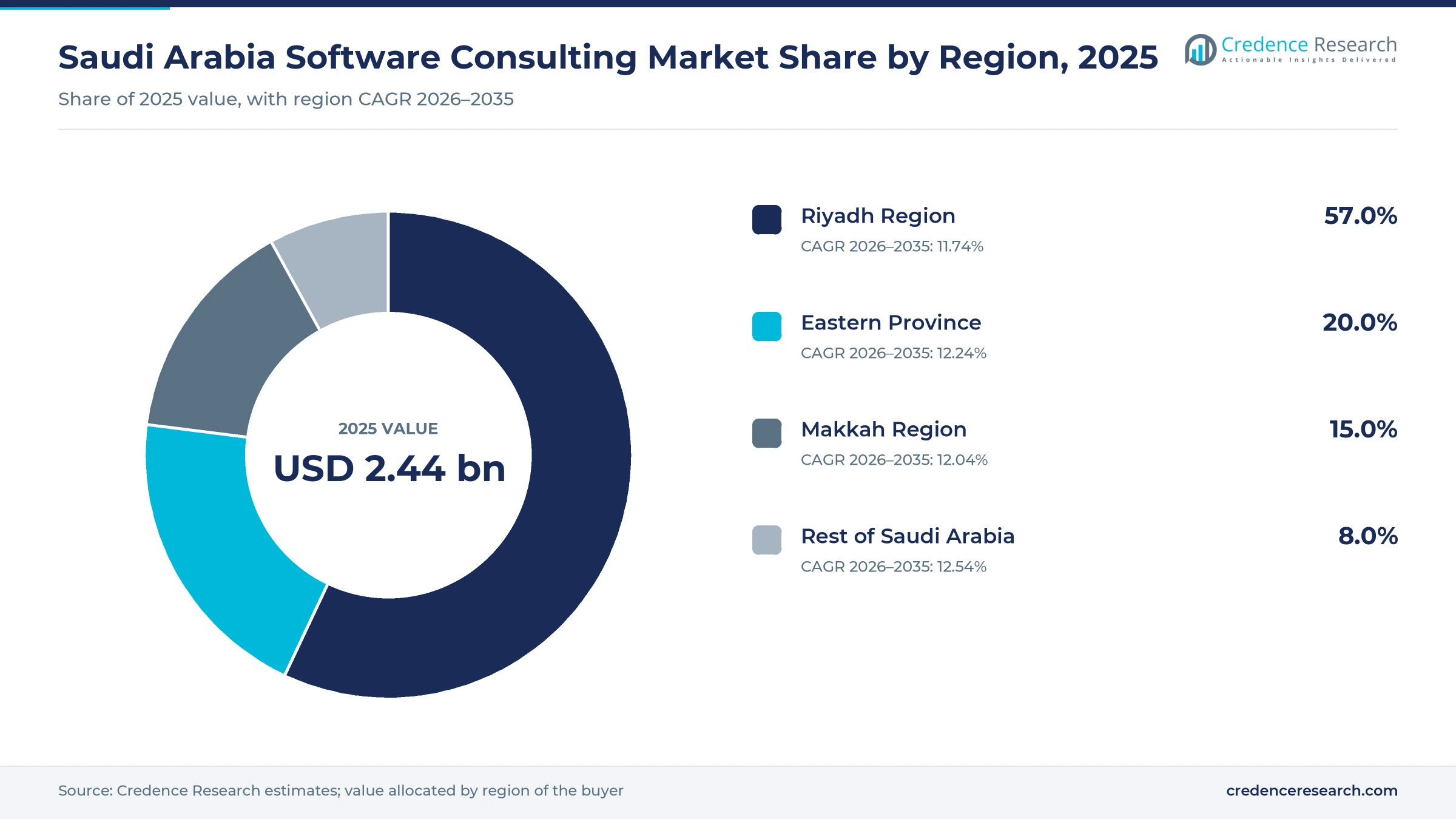
The Saudi Arabia software consulting market was valued at USD 2.44 billion in 2025 and is projected to increase from USD 2.75 billion in 2026 to USD 7.59 billion by 2035, registering a CAGR of 11.95% during 2026–2035. Demand comes from government entities, banks, energy groups and hospital networks that are moving core systems to in-country cloud platforms and taking artificial intelligence beyond pilots. Riyadh Region held the largest share, 57.0% in 2025, because ministries, the Public Investment Fund and multinational regional headquarters sit there. Rest of Saudi Arabia is the fastest-growing zone at 12.54% a year from a small base, as delivery capacity spreads slowly beyond the three main zones. The most important commercial change is the move from strategy decks to measurable delivery, since state clients have trimmed advisory budgets while keeping digital infrastructure and AI on their priority lists. Zone shares are Credence Research estimates built from public population and industry data.
Which fees and projects count as advisory spending?
The market counts fees paid to specialist firms for software selection, enterprise application implementation, cloud migration planning, custom integration, AI and data consulting, and related security and compliance advice. Buyers usually purchase through multi-year statements of work, government tenders or framework agreements, and large accounts often pair a global integrator with a Saudi delivery partner.
Software licenses, cloud subscriptions, hardware, managed operations and pure business process outsourcing are excluded, because those budgets pay for products or running services rather than advice and implementation. The value chain runs from platform vendors through integrators and boutique specialists to the internal digital teams that take over systems after go-live.
Saudi Arabia Software Consulting Market Insights
- The market grows from USD 2.44 billion in 2025 to USD 7.59 billion by 2035, an 11.95% CAGR, as cloud migration and enterprise AI programs replace earlier strategy-led advisory work.
- Riyadh Region led with 57.0% of 2025 value because ministries, sovereign investors and multinational regional headquarters concentrate their technology purchasing decisions in the capital.
- Enterprise application implementation held 34.0% in 2025, supported by finance, procurement and tax system replacement across large Saudi organizations and listed groups.
- The General Authority for Statistics recorded AI use at 33.1% of establishments in 2025, which moves consulting briefs from pilots toward enterprise-wide deployment and governance.
- Global integrators increasingly partner with Saudi platforms, as shown by the Accenture and HUMAIN agreement of May 21, 2026, covering architecture, workforce change and digital trust.
ERP work leads as AI and data consulting grows fastest
Which service type captures the largest budgets?
Based on service type, the market is categorized into enterprise application implementation, cloud migration and modernization, custom software and integration, AI and data consulting, and security and compliance advisory. Enterprise Application Implementation led with 34.0% of 2025 value because finance and HR replacements remain the largest single projects, as seen when Alrajhi Medicine chose Oracle Fusion ERP, EPM and HCM on Jan. 27, 2026. AI and Data Consulting grows fastest at 13.75% a year as firms move beyond pilots, and Accenture became HUMAIN's named AI partner on May 21, 2026, according to Consultancy-me.com, to carry that work into operations.
How do deployment choices shape consulting scope?
Based on deployment model, the market is categorized into hybrid and sovereign cloud, public cloud and on-premises. Hybrid and Sovereign Cloud led with 46.0% of 2025 value because regulated clients want local control, shown by the SAR 157.6 million private cloud contract that solutions by stc signed with stc, reported by Argaam on June 29, 2025. Public Cloud grows fastest at 12.88% a year as new capacity arrives, and Datacenter Dynamics reports that Microsoft will open a three-zone Eastern Province region in the fourth quarter of 2026. That timing gives migration advisers a fresh pipeline of workload assessments.
Which buyers commission the most software consulting?
Based on end user, the market is categorized into government and public sector, banking and financial services, energy and utilities, telecom and technology, healthcare and others. Government and Public Sector led with 33.0% of 2025 value because state platforms set the pace, and Asharq Al-Awsat reported on Dec. 18, 2025, that the kingdom scored 99.64% in the World Bank digital government index. Healthcare grows fastest at 13.31% a year as private hospital groups digitize, since Oracle said in January 2026 that Alrajhi Medicine will run one electronic record platform across its planned network of hospitals.
How do large firms and smaller companies buy differently?
Based on enterprise size, the market is categorized into large enterprises and small and medium enterprises. Large Enterprises led with 71.0% of 2025 value because multi-year programs need integrators, as FF News showed on Nov. 10, 2025, when Al Rajhi Bank hired Ejada Systems to deploy ServiceNow across a network of more than 515 branches. Small and Medium Enterprises grow fastest at 12.93% a year as tax rules reach smaller firms, because ZATCA extended e-invoicing integration to taxpayers above SAR 187,500 with a Feb. 1, 2027, deadline.
| Segment Group | Leading Sub-segment | Share, 2025 | Fastest-growing Sub-segment | CAGR, 2026–2035 |
|---|---|---|---|---|
| By Service Type | Enterprise Application Implementation | 34.0% | AI and Data Consulting | 13.75% |
| By Deployment Model | Hybrid and Sovereign Cloud | 46.0% | Public Cloud | 12.88% |
| By End User | Government and Public Sector | 33.0% | Healthcare | 13.31% |
| By Enterprise Size | Large Enterprises | 71.0% | Small and Medium Enterprises | 12.93% |
Request a Free Sample
Fill in your details and we'll send you a free sample report.
- Sample data tables & charts
- Research methodology
Cloud regions, AI use and e-invoicing lift project demand
In-country cloud regions pull enterprise workloads onshore
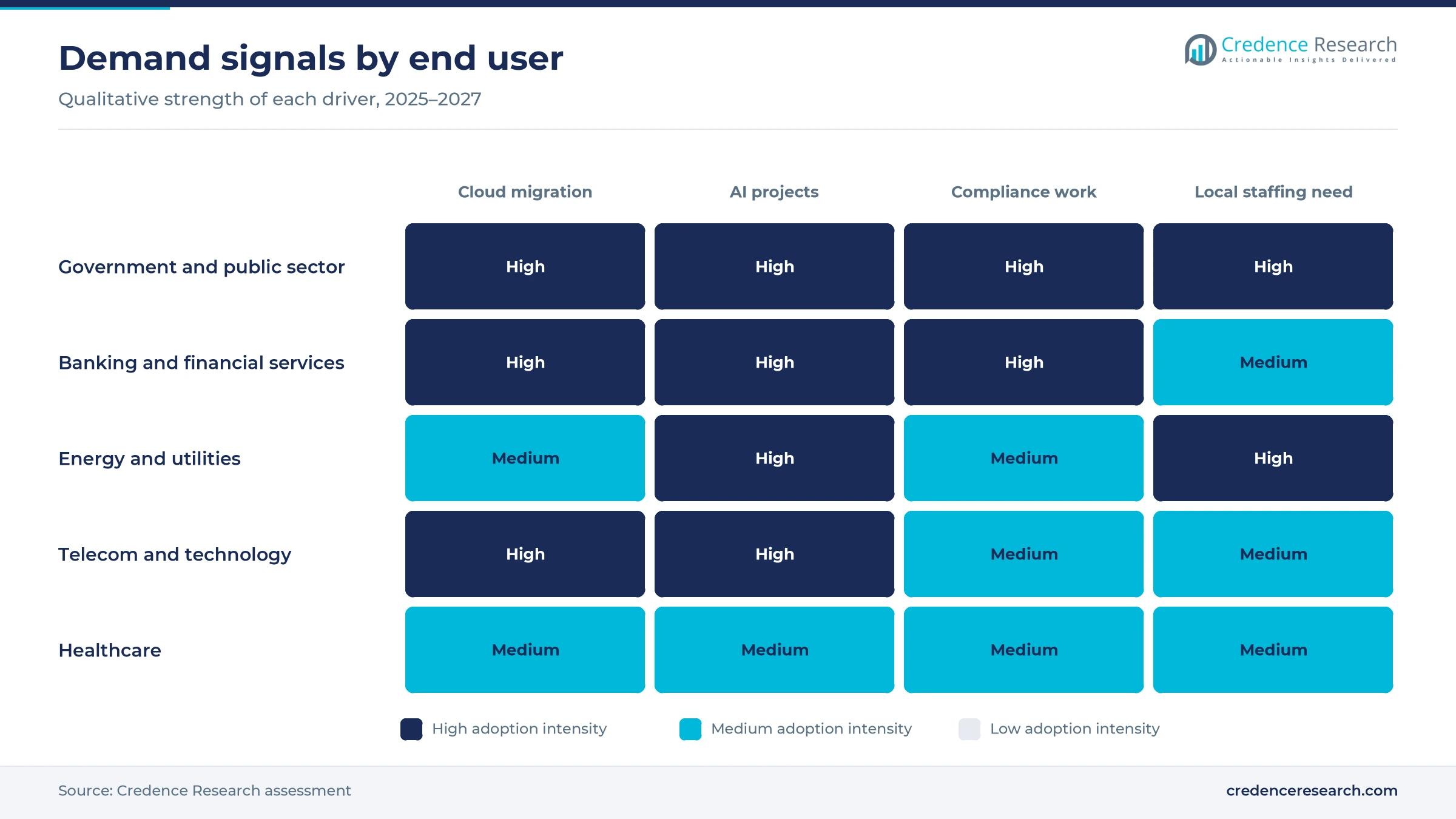
Enterprise cloud migration is the largest demand source because in-country capacity removes the main objection that regulated buyers raised against moving core systems. A General Authority for Statistics survey reported by Arab News put cloud use at 51.3% of establishments in 2025, which leaves a large base still planning its first serious migration. The Microsoft Saudi Arabia East region is due in the fourth quarter of 2026 with three availability zones, and Acwa and Qiddiya Investment Company are named early customers. Datacenter Dynamics notes that AWS, Google and Oracle also have or are developing cloud regions in the kingdom. Each new region creates assessment, cloud migration and landing-zone work, which supports the 12.88% growth expected for Public Cloud.
AI use across firms moves briefs beyond pilot projects
Artificial intelligence adoption now drives scoping conversations because a meaningful share of firms has already tried the tools and wants production results. The General Authority for Statistics found that 33.1% of establishments used AI in 2025, with information and communications at 61.1% and financial and insurance activities at 52.9%, according to Arab News on June 14, 2026. Accenture and HUMAIN agreed on May 21, 2026, to help government entities and enterprises move from pilots to enterprise-wide adoption across five focus areas. Microsoft and HUMAIN followed on Aug. 26, 2026, pairing forward-deployed engineers with ALLAM Arabic models, as Sharikat Mubasher reported. Demand for machine learning and generative models therefore supports AI and Data Consulting at 13.75% a year.
Government platforms set a high bar for software delivery
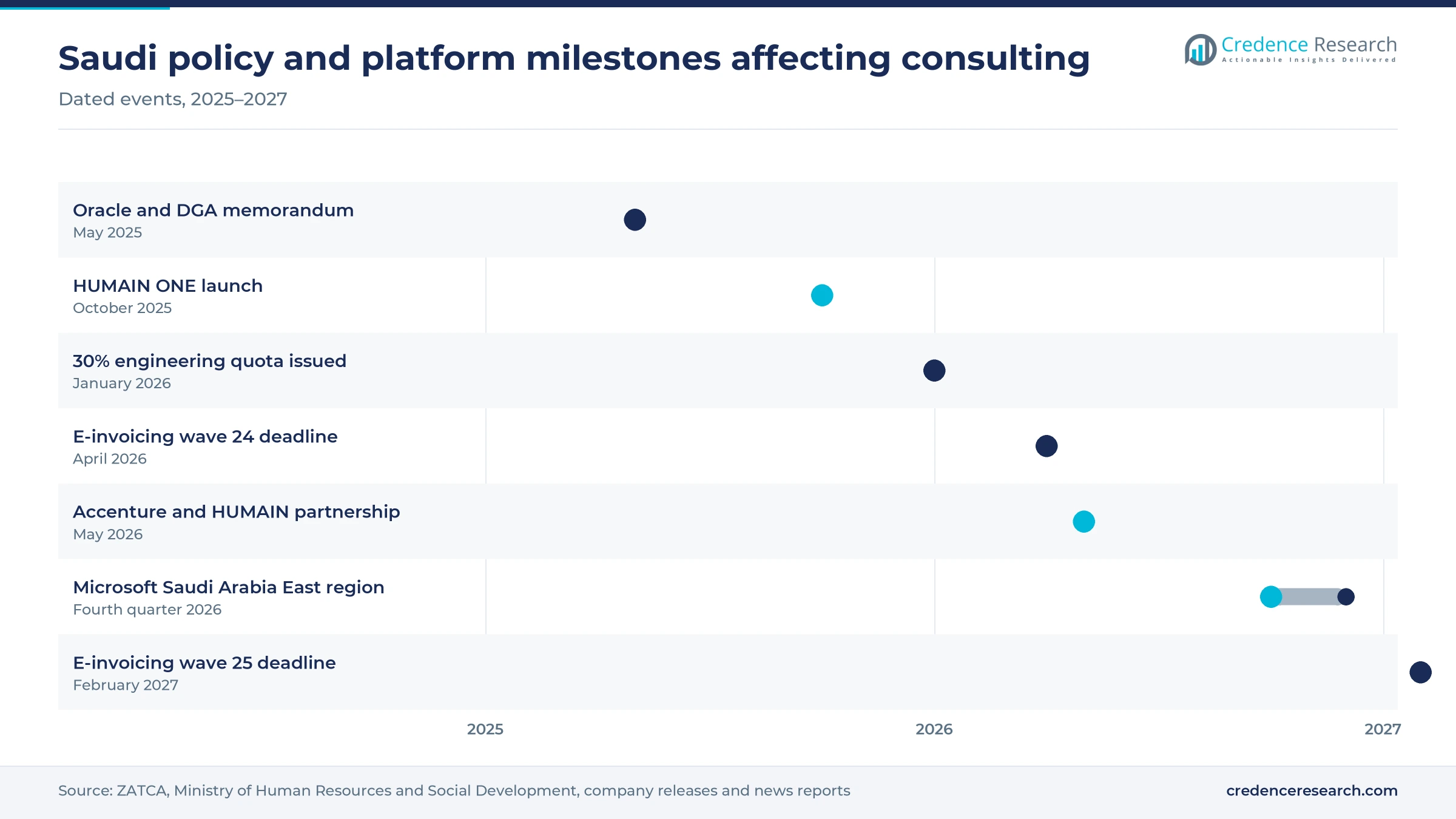
Public sector digitization keeps a steady stream of implementation work in the market because entities are measured against demanding international benchmarks. The World Bank GovTech Maturity Index 2025 tracks 198 economies, and Asharq Al-Awsat reported on Dec. 18, 2025, that Saudi Arabia ranked second, up from 49th in 2020. The Digital Government Authority signed a cloud and AI memorandum with Oracle on May 14, 2025, at its Riyadh headquarters, including national skills programs. Elm also builds services around the Nusuk app, which had 51 million users by April 2026, according to MEA Tech Watch. These platforms need continuous integration and security work, which explains why Government and Public Sector holds 33.0% of 2025 value.
E-invoicing and cyber rules force system changes at scale
Regulation creates non-discretionary consulting demand because deadlines and control lists leave companies little choice about timing. Arab News reported that the Fatoora platform exchanged more than 8.2 billion e-invoices in 2025, up 64 percent, citing the Zakat, Tax and Customs Authority. The twenty-fifth integration wave now reaches taxpayers above SAR 187,500, half the SAR 375,000 threshold applied to the wave due on April 1, 2026, according to Grant Thornton. The Essential Cybersecurity Controls update lists 108 controls, down from 114, as Clyde & Co explained in January 2025. These requirements feed enterprise resource planning upgrades across finance teams, including many that have never run an integration project.
Fee models shift while Arabic AI opens new engagements
Shift toward outcome-linked fees and technical delivery
Buyers are shifting from open-ended advice toward measurable delivery, which favors firms with engineers rather than only strategists. AGBI reported in early 2026 that large strategy consultancies had lost much of their work while performance-linked contracts expanded and fees were trimmed. The same publisher noted that the Public Investment Fund has named data centers, technology and AI infrastructure as new priorities, replacing projects such as The Line. IBM Consulting shows the delivery model at Riyadh Air, where its AI-powered platform supports a digital foundation covering 59 workstreams, according to an Arab News sponsored article of Dec. 16, 2025. IBM and Deloitte followed that direction on Oct. 14, 2025, with a regional agreement centered on AI, FinOps and cybersecurity, as Sharikat Mubasher reported.
Rise of Arabic-first agents in enterprise back offices
Arabic-language AI is emerging as a distinct consulting line because Saudi clients want agents that work in local language and meet local governance rules. HUMAIN unveiled HUMAIN ONE on Oct. 28, 2025, an agentic operating system for HR, finance and procurement that runs on its Allam model, according to The National. Ejada Systems signed a memorandum with Dyna.Ai on Oct. 13, 2025, to build Arabic-enabled AI solutions for Saudi clients, as Sharikat Mubasher reported. Arab News reported that AI tool use reached 45.2% of Saudi internet users in 2025, more than double the prior year, citing the Communications, Space and Technology Commission. Together these moves create integration and governance work, because agents must connect to existing finance and HR systems.
Opening in smaller firms reached by tax and procurement rules
Smaller companies represent the clearest new client pool because compliance deadlines are reaching firms that have never hired an implementation partner. ZATCA lowered the integration threshold to SAR 187,500 for its latest wave, and affected taxpayers must connect by Feb. 1, 2027. Sharikat Mubasher reported on April 28, 2026, that fintech companies reached 301 in 2025, up from 20 in 2019, while digital payments took 85% of retail transactions, citing the Vision 2030 annual report. SAP also scheduled a private sector Business Network version with local hosting and Arabic support for early 2026, according to Asharq Al-Awsat. Small and Medium Enterprises can therefore grow at 12.93% a year when advisers package fixed-price configuration.
Opening in healthcare records and pilgrimage platforms
Healthcare and pilgrimage services offer an opening because both sectors are building large new platforms with few experienced local integrators. Oracle announced on Jan. 27, 2026, that Alrajhi Medicine will deploy Oracle Health Foundation and Fusion Cloud Applications, starting with one hospital and one specialty center in Riyadh. MEA Tech Watch reported that Elm showcased Nusuk AI, crowd management and workforce systems at the Madinah forum held from March 30 to April 1, 2026. Pilgrim platforms of this kind carry heavy seasonal load, along with language and integration requirements across those systems. Firms with clinical workflow and multilingual experience can win this work, and Healthcare grows at 13.31% a year.
Spending pauses and localization rules squeeze delivery
State budget pauses delay approvals and payments
Fiscal tightening is the most immediate risk for advisers that depend on state clients. Consultancy-me.com, citing the Financial Times on May 22, 2026, said entities were told to curb consultant payments and that new contracts had largely paused, against a first-quarter deficit of USD 33.5 billion. The Ministry of Finance disputed that account, saying invoices are paid on contractual timelines. Even so, firms with heavy public exposure face longer sales cycles, so many are widening private sector pipelines to protect utilization.
Localization quotas raise the cost of technical staffing
Workforce rules raise delivery costs because qualified Saudi engineers remain in short supply. The Ministry of Human Resources and Social Development set a 30% engineering quota on Jan. 4, 2026, covering 46 roles at firms with five or more engineers, according to Arab News. SDAIA targets 20,000 AI specialists by 2030, while more than 38,000 students earned AI-related degrees from 2019 to 2023, Arab News reported. Consultancies therefore compete for the same scarce people, and they respond with academies, graduate programs and regional delivery centers.
Cybersecurity staffing rules narrow who can deliver
Security requirements limit the staffing options available on government and critical infrastructure projects. The updated Essential Cybersecurity Controls require every cybersecurity position to be held by a full-time Saudi professional, according to Clyde & Co, whereas the earlier version covered only senior roles. The National Cybersecurity Authority counted just over 22,000 specialists in 2025, as Asharq Al-Awsat reported in October 2026. Firms without local security teams can lose bids, so many now subcontract this work or invest in cybersecurity advisory capacity.
Dependence on one investor group concentrates client risk
Client concentration exposes consultancies to abrupt relationship changes, especially around the Public Investment Fund. AGBI reported on Jan. 26, 2026, that the fund had barred PwC for a year from advisory contracts with more than 100 subsidiaries, a restriction that has reportedly ended. Project reprioritization adds to that exposure, since AGBI also said The Line is no longer a priority. Firms therefore spread accounts across banks, energy groups and hospitals to reduce dependence on any single sponsor and its budget cycle.
Riyadh dominates as Eastern Province cloud capacity builds
| Region | Value, 2025 (USD billion) | Share, 2025 | CAGR, 2026–2035 |
|---|---|---|---|
| Riyadh Region | 1.39 | 57.0% | 11.74% |
| Eastern Province | 0.49 | 20.0% | 12.24% |
| Makkah Region | 0.37 | 15.0% | 12.04% |
| Rest of Saudi Arabia | 0.20 | 8.0% | 12.54% |
Riyadh region anchors decision-making and headquarters demand
Riyadh Region held 57.0% of 2025 value and grows at 11.74% a year, because ministries and multinational regional offices buy from the capital. The Ministry of Investment issued 31 regional headquarters licenses in the third quarter of 2025, after 44 and 34 in the two earlier quarters, according to Sharikat Mubasher and Arab News. Solutions by stc also runs the Riyadh Smart Parking Project across more than 160,000 spaces, and Oracle operates a second Riyadh cloud region for sovereign government workloads, as Arab News reported.
Eastern Province gains from energy clients and new cloud capacity
Eastern Province held 20.0% of 2025 value and grows at 12.24% a year, supported by energy groups and fresh infrastructure. Microsoft placed its three-zone Saudi region in the province, and The National reported that Groq will host HUMAIN models in Dammam. Saudi data center capacity therefore brings migration and AI inference projects closer to oil, gas and utility workloads. IBM and Deloitte also named oil, gas, energy and utilities among target sectors in their Oct. 14, 2025, regional agreement.
Makkah region combines Jeddah commerce and pilgrim platforms
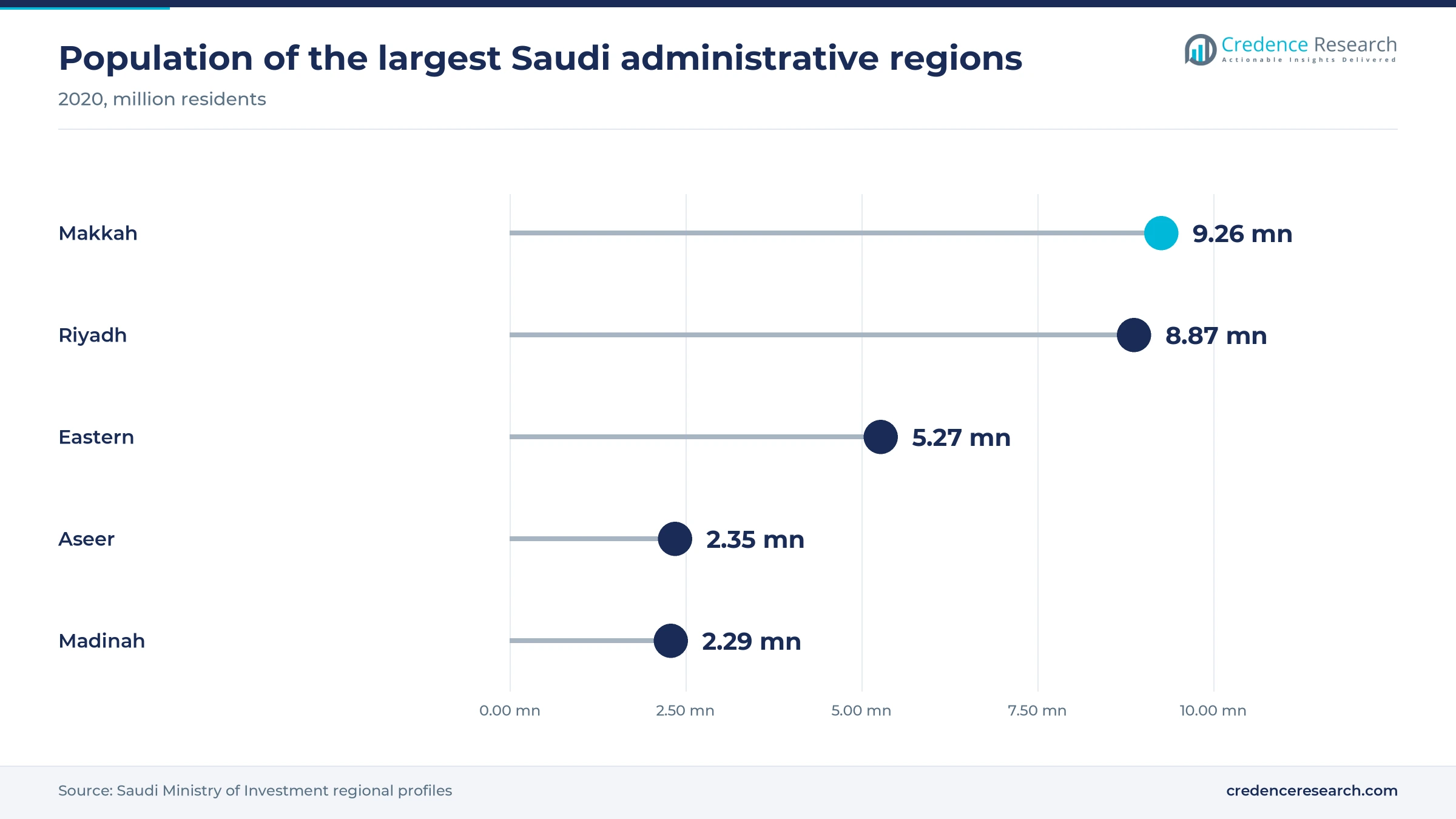
Makkah Region held 15.0% of 2025 value and grows at 12.04% a year, driven by Jeddah trade and religious tourism systems. The Ministry of Investment listed the region at 9.26 million residents in 2020. Solutions by stc formed a joint venture with Jeddah Central Development Company to support digital urban development, according to its Feb. 16, 2026, results statement. Elm's Muqeem platform also issues Makkah entry permits, which ties pilgrim services to continuing integration and security work.
Rest of Saudi Arabia builds from Madinah and regional centers
Rest of Saudi Arabia held 8.0% of 2025 value and is the fastest zone at 12.54% a year, growing from a small base. IBM Consulting opened its first Al-Baha branch, planned as a center of excellence, according to an Arab News sponsored article of Dec. 16, 2025. Madinah hosted the Umrah and Ziyarah Forum in March 2026, where Elm presented its pilgrim systems. These moves show delivery capacity spreading slowly beyond the three main zones as regional development budgets become more active.
Dated deals show AI and cloud work moving into delivery
| Development | Status and market relevance |
|---|---|
| In August 2026, HUMAIN and Microsoft announced a collaboration to bring ALLAM Arabic models into Microsoft Foundry, with joint engineers supporting enterprise deployments. | Announced; widens Arabic AI implementation work |
| In May 2026, HUMAIN named Accenture its Strategic Reinvention and AI Partner in Saudi Arabia, covering governance, integration and workforce adoption. | Active; moves clients from pilots to rollout |
| In January 2026, Oracle said Alrajhi Medicine will deploy Oracle Health Foundation and Fusion Cloud Applications across its hospital network. | Under deployment; opens private healthcare projects |
| In November 2025, Al Rajhi Bank selected ServiceNow with Ejada Systems as consulting and implementation partner in a multi-year agreement. | Under deployment; shows Saudi integrators in banking |
| In October 2025, Deloitte and IBM signed an agreement covering AI, FinOps and security work in the kingdom. | Signed; pairs advisory and platform delivery |
Sovereign cloud and agentic AI define project architecture
- Sovereign cloud keeps government data under local control, and SAP plans its full Business Network suite for the public sector on a Google Cloud sovereign environment.
- Agentic AI automates back-office tasks across connected systems, as HUMAIN ONE aims to do for HR, finance and procurement teams.
- Open-source data platforms reduce reliance on proprietary databases, which is why Saudi Business Machines partnered with EDB in March 2025.
- E-invoicing integration connects finance systems to the Fatoora platform, and it remains a mandatory workstream for each new ZATCA wave.
Need a Custom Version of This Report?
Tailor the scope, geography, or segments to your exact requirements.
- Custom geography or segment scope
- Direct access to our analyst team
Global integrators and Saudi champions share large accounts
Competition in software consulting splits between global integrators, professional services networks and Saudi champions, and large programs often combine all three. Accenture and IBM Consulting compete on full-stack delivery, with IBM's work at Riyadh Air serving as a visible reference. Deloitte is pursuing AI, FinOps and security work through its October 2025 agreement with IBM, while PwC opened a regional headquarters in Riyadh in December 2025, shortly before its Public Investment Fund restriction reportedly ended. Saudi firms hold strong positions in state and telecom accounts, as solutions by stc, Elm Company and Ejada Systems combine local staffing with long client relationships. Saudi Business Machines remains closely linked to IBM technology as its general marketing representative. SAP and Oracle shape the market as platform owners, since their partner rules and regional headquarters influence which integrators win implementation work. Price matters less than Saudi headcount, security clearance and references on comparable national systems.
Companies profiled and their roles in this market
| Company | Type | Role in the market |
|---|---|---|
| Accenture | Global integrator | HUMAIN AI partner for government and enterprise rollouts |
| IBM Consulting | Global integrator | Riyadh Air digital foundation; Al-Baha delivery branch |
| Deloitte | Professional services | AI, FinOps and security alliance with IBM covering Saudi Arabia |
| PwC | Professional services | Riyadh regional headquarters; advisory bar reportedly ended in 2026 |
| Saudi Business Machines | Saudi integrator | IBM marketing representative; EDB data sovereignty partner |
| solutions by stc | Saudi integrator | Private cloud contracts with stc; Riyadh and Jeddah city projects |
| Ejada Systems | Saudi integrator | ServiceNow partner at Al Rajhi Bank; Arabic AI with Dyna.Ai |
| Elm Company | Saudi platform firm | Nusuk AI, Muqeem and pilgrim service systems |
| SAP | Platform vendor | Riyadh regional headquarters; sovereign Business Network deployment |
| Oracle | Platform vendor | Digital Government Authority memorandum; Alrajhi Medicine deployment |
Delivery depth will decide who wins Saudi software work
Credence Research's view is that Saudi software consulting has passed its easiest phase, when broad transformation programs funded almost any credible adviser. Reports of state payment delays and fee pressure suggest buyers will now reward firms that can show running systems, trained Saudi staff and clear adoption numbers. Consultants that rely on strategy work alone look most exposed, whereas integrators with cloud engineers and Arabic AI skills appear well placed. The main assumption behind this forecast is that digital infrastructure stays protected even when other Vision 2030 budgets tighten, and that assumption needs regular review.
Public statistics and deal records underpin this estimate
The report uses 2025 as the base year and 2035 as the final forecast year, with market values from the Credence Research model. Segment and zone splits are Credence Research estimates, informed by public statistics from the General Authority for Statistics, the Ministry of Investment and the Communications, Space and Technology Commission, as well as regulator notices, company press releases and news coverage. Zone shares were estimated from population and the location of named buyers and data center projects. No interviews or surveys were conducted for this report, and the splits should be read as analytical estimates.
AI and cloud operations carry demand through 2035
The market is forecast to reach USD 7.59 billion by 2035 from USD 2.75 billion in 2026, an 11.95% CAGR over 2026–2035. Early years should bring uneven public approvals, while private sector compliance and cloud migrations keep project pipelines moving. Later in the period, demand should shift from first-time implementation toward AI operations, model governance and application modernization, because more systems will already sit on in-country platforms. Riyadh Region should remain the commercial center, although Eastern Province and smaller zones gain share slowly as capacity and delivery teams spread. Firms with deep Saudi staffing should capture most of this growth.
Frequently Asked Questions
How big is the Saudi Arabia software consulting market?
Which service type leads the market?
Which region holds the largest share?
What share of Saudi establishments use AI?
Which end user grows fastest?
How does e-invoicing affect consulting demand?
What is the main near-term risk?
Who are the key companies in this market?
Table of Content
Chapter 1 Market Segmentation
- 1.1 Segmentation Framework
- 1.1.1 Product and Service Classification
- 1.1.2 Application and End-Use Classification
- 1.1.3 Technology and Solution Classification
- 1.1.4 Customer and Distribution Channel Classification
- 1.1.5 Geographic Segmentation
- 1.1.6 Market Segment Definitions and Boundaries
- 1.2 By Service Type
- 1.2.1 Enterprise Application Implementation
- 1.2.2 Cloud Migration and Modernization
- 1.2.3 Custom Software and Integration
- 1.2.4 AI and Data Consulting
- 1.2.5 Security and Compliance Advisory
- 1.3 By Deployment Model
- 1.3.1 Hybrid and Sovereign Cloud
- 1.3.2 Public Cloud
- 1.3.3 On-Premises
- 1.4 By End User
- 1.4.1 Government and Public Sector
- 1.4.2 Banking and Financial Services
- 1.4.3 Energy and Utilities
- 1.4.4 Telecom and Technology
- 1.4.5 Healthcare
- 1.4.6 Others
- 1.5 By Enterprise Size
- 1.5.1 Large Enterprises
- 1.5.2 Small and Medium Enterprises
Chapter 2 Introduction
- 2.1 Report Objectives and Scope
- 2.2 Product Definition and Industry Terminology
- 2.3 Market Inclusions and Exclusions
- 2.4 Research Process
- 2.4.1 Primary Research and Expert Interviews
- 2.4.2 Secondary Research and Source Review
- 2.4.3 Top-Down and Bottom-Up Estimation
- 2.4.4 Data Triangulation and Verification
- 2.5 Market Size Measurement Basis
- 2.5.1 2025: USD 2.44 billion → 2035: USD 7.59 billion
- 2.6 Historical and Forecast Reference Periods
- 2.6.1 Historical Period: 2018-2025
- 2.6.2 Base Year: 2025
- 2.6.3 Forecast Period: 2025-2035
- 2.7 Research Assumptions and Limitations
Chapter 3 Executive Summary
- 3.1 Market Snapshot and Key Findings
- 3.2 Base-Year Market Size, 2025
- 3.3 Forecast Market Size, 2035
- 3.4 Revenue and Volume Growth Outlook
- 3.5 Key Demand and Supply Indicators
- 3.6 Leading Market Segments
- 3.7 Fastest-Growing Market Opportunities
- 3.8 Regional Performance Highlights
- 3.9 Technology and Industry Transformation
- 3.10 Competitive Landscape Summary
- 3.11 Analyst View and Strategic Implications
Chapter 4 Saudi Arabia Software Consulting Market Trends and Developments
- 4.1 Historical Industry Development, 2018-2025
- 4.2 Recent Market Trends and Developments
- 4.3 Demand and Customer Behavior Trends
- 4.4 Technology and Product Innovation
- 4.5 Artificial Intelligence, Automation and Digitalization
- 4.6 Local Manufacturing and Supply Chain Realignment
- 4.7 Industry Partnerships, Mergers and Acquisitions
- 4.8 Sustainability and Circular Economy Developments
- 4.9 Government and Private Sector Investment Trends
- 4.10 Emerging Business Models and Commercialization
- 4.11 Industry Developments and Announcements
Chapter 5 Saudi Arabia Software Consulting Market Supply and Demand Analysis
- 5.1 Demand Trend and Consumption Analysis, 2018-2025
- 5.2 Demand Forecast, 2025-2035
- 5.3 Supply Chain Structure and Procurement Trends
- 5.4 Supply-Demand Gap and Bottlenecks
- 5.5 Import Dependence and Sourcing Structure
- 5.6 Regional Supply and Demand Concentration
Chapter 6 Saudi Arabia Software Consulting Market Pricing Analysis
- 6.1 Pricing Structure and Measurement
- 6.2 Historical Pricing Trends, 2018-2025
- 6.3 Pricing Outlook, 2025-2035
- 6.4 Pricing by Product and Market Segment
- 6.5 Geographic Pricing Differences
- 6.6 Key Input, Energy, Labor and Logistics Costs
- 6.7 Contract Pricing and Purchasing Models
- 6.8 Pricing Sensitivity and Competitive Positioning
- 6.9 Price, Margin and Profitability Implications
Chapter 7 Saudi Arabia Software Consulting Market Dynamics
- 7.1 Market Growth Drivers
- 7.1.1 Demand-Side Drivers
- 7.1.2 Technology and Innovation Drivers
- 7.1.3 Infrastructure and Investment Drivers
- 7.1.4 Regulatory and Policy Drivers
- 7.2 Market Restraints
- 7.2.1 Cost and Affordability Constraints
- 7.2.2 Technology and Adoption Barriers
- 7.2.3 Supply Chain and Operational Constraints
- 7.3 Market Challenges
- 7.3.1 Competitive Pressure and Margin Erosion
- 7.3.2 Skills, Infrastructure and Implementation Gaps
- 7.4 Emerging Market Opportunities
- 7.5 Market Dynamics Impact and Time-Horizon Assessment
Chapter 8 Saudi Arabia Software Consulting Value Chain Analysis
- 8.1 Industry Value Chain Overview
- 8.2 Upstream Suppliers and Critical Inputs
- 8.3 Technology and Component Providers
- 8.4 Manufacturing or Service Delivery
- 8.5 Distribution, Channel Partners and Integrators
- 8.6 Downstream Applications and End Users
- 8.7 Value Addition and Profit Pools
- 8.8 Vertical Integration and Outsourcing
- 8.9 Supplier Concentration and Risk
- 8.10 Supply Chain Localization and Resilience
Chapter 9 Saudi Arabia Software Consulting Market Regulations and Policies
- 9.1 Relevant Laws, Standards and Compliance Frameworks
- 9.2 Product, Service, Safety and Quality Requirements
- 9.3 Government Policies, Incentives and Subsidies
- 9.4 Imports, Exports and Trade Barriers
- 9.5 Public Procurement and Local Content Requirements
- 9.6 Data Protection, AI and Cybersecurity Compliance
- 9.7 Upcoming Policy Changes and Market Implications
Chapter 10 Saudi Arabia Software Consulting Market Hotspots and Opportunities
- 10.1 Market Opportunity Mapping and Growth Hotspots
- 10.2 High-Growth Applications and Customer Groups
- 10.3 Underserved Markets and White-Space Opportunities
- 10.4 Emerging Technology and Product Opportunities
- 10.5 New Capacity and Investment Hotspots
- 10.6 Market Entry and Expansion Opportunities
- 10.7 Distribution and Partnership Opportunities
- 10.8 Near-Term and Long-Term Commercial Potential
- 10.9 Opportunity Attractiveness and Execution Risks
Chapter 11 Saudi Arabia Software Consulting Market Outlook, 2025-2035
- 11.1 Market Size and Analysis
- 11.1.1 Revenue (Market Measurement: 2025: USD 2.44 billion → 2035: USD 7.59 billion)
- 11.1.2 Historical Market Size, 2018-2025
- 11.1.3 Base-Year Market Size, 2025
- 11.2 Market Forecast, 2025-2035
- 11.2.1 Revenue Forecast to 2035
- 11.2.2 CAGR and Year-on-Year Growth
- 11.2.3 Incremental Revenue Opportunity
- 11.3 Forecast Assumptions and Scenario Analysis
- 11.3.1 Base-Case Forecast
- 11.3.2 Optimistic and Conservative Scenarios
- 11.3.3 Technology, Pricing and Policy Sensitivities
- 11.4 Market Attractiveness and Growth Outlook
Chapter 12 Saudi Arabia Software Consulting Market Segmentation and Outlook
- 12.1 Segmentation Summary and Market Shares, 2025
- 12.2 Largest and Fastest-Growing Segments
- 12.3 By Service Type - Market Size and Forecast, 2025-2035
- 12.3.1 Segment Definition and Scope
- 12.3.2 Historical Market Size, 2018-2025
- 12.3.3 Revenue Forecast, 2025-2035
- 12.3.4 Base-Year Market Share, 2025
- 12.3.5 Segment CAGR and Growth Drivers
- 12.3.6 Subsegment Market Size and Forecast
- 12.3.6.1 Enterprise Application Implementation
- 12.3.6.2 Cloud Migration and Modernization
- 12.3.6.3 Custom Software and Integration
- 12.3.6.4 AI and Data Consulting
- 12.3.6.5 Security and Compliance Advisory
- 12.3.7 Subsegment Pricing and Adoption Trends
- 12.3.8 Leading Suppliers and Competition
- 12.3.9 Regional Demand and Opportunities
- 12.4 By Deployment Model - Market Size and Forecast, 2025-2035
- 12.4.1 Segment Definition and Scope
- 12.4.2 Historical Market Size, 2018-2025
- 12.4.3 Revenue Forecast, 2025-2035
- 12.4.4 Base-Year Market Share, 2025
- 12.4.5 Segment CAGR and Growth Drivers
- 12.4.6 Subsegment Market Size and Forecast
- 12.4.6.1 Hybrid and Sovereign Cloud
- 12.4.6.2 Public Cloud
- 12.4.6.3 On-Premises
- 12.4.7 Subsegment Pricing and Adoption Trends
- 12.4.8 Leading Suppliers and Competition
- 12.4.9 Regional Demand and Opportunities
- 12.5 By End User - Market Size and Forecast, 2025-2035
- 12.5.1 Segment Definition and Scope
- 12.5.2 Historical Market Size, 2018-2025
- 12.5.3 Revenue Forecast, 2025-2035
- 12.5.4 Base-Year Market Share, 2025
- 12.5.5 Segment CAGR and Growth Drivers
- 12.5.6 Subsegment Market Size and Forecast
- 12.5.6.1 Government and Public Sector
- 12.5.6.2 Banking and Financial Services
- 12.5.6.3 Energy and Utilities
- 12.5.6.4 Telecom and Technology
- 12.5.6.5 Healthcare
- 12.5.6.6 Others
- 12.5.7 Subsegment Pricing and Adoption Trends
- 12.5.8 Leading Suppliers and Competition
- 12.5.9 Regional Demand and Opportunities
- 12.6 By Enterprise Size - Market Size and Forecast, 2025-2035
- 12.6.1 Segment Definition and Scope
- 12.6.2 Historical Market Size, 2018-2025
- 12.6.3 Revenue Forecast, 2025-2035
- 12.6.4 Base-Year Market Share, 2025
- 12.6.5 Segment CAGR and Growth Drivers
- 12.6.6 Subsegment Market Size and Forecast
- 12.6.6.1 Large Enterprises
- 12.6.6.2 Small and Medium Enterprises
- 12.6.7 Subsegment Pricing and Adoption Trends
- 12.6.8 Leading Suppliers and Competition
- 12.6.9 Regional Demand and Opportunities
- 12.7 Segment Growth Comparison
- 12.8 Segment Attractiveness and Priority Matrix
Chapter 13 Saudi Arabia Software Consulting End-Use and Application Market Outlook
- 13.1 End-Use Industry and Customer Demand Structure
- 13.2 Leading Applications and Customer Groups
- 13.3 End-Use Market Size, Share and Forecast
- 13.4 Major End-Use Industry Deep Dives
- 13.4.1 Customer Requirements and Use Cases
- 13.4.2 Demand and Replacement Cycles
- 13.4.3 Technical and Regulatory Considerations
- 13.4.4 Purchasing and Procurement Models
- 13.4.5 Leading Vendors and Distribution Channels
- 13.4.6 Forecast and Commercial Opportunities
- 13.5 Emerging Applications and Cross-Segment Demand
- 13.6 End-Use Industry Investment Priorities
Chapter 14 Saudi Arabia Software Consulting Geographic Market Outlook, 2025-2035
- 14.1 Domestic Market Distribution and Demand Clusters
- 14.2 State- or Province-Wise Market Size and Forecast, 2025-2035
- 14.3 City and Metropolitan Market Outlook
- 14.4 Industrial, Manufacturing and Commercial Clusters
- 14.5 Geographic Concentration of Key End Users
- 14.6 Local Pricing and Purchasing Differences
- 14.7 Domestic Production Facilities and Capacity Map
- 14.8 Local Infrastructure and Project Pipeline
- 14.9 State-Level Policy and Incentive Differences
- 14.10 Subnational Investment Hotspots and Opportunities
- 14.11 Distribution and Logistics Networks
- 14.12 Domestic Competitive Footprint
Chapter 15 Saudi Arabia Software Consulting Technology, Innovation and Sustainability Outlook
- 15.1 Technology Landscape and Maturity
- 15.2 Product, Process and Service Innovation
- 15.3 AI, Automation and Digital Tools in the Industry
- 15.4 Technology Adoption and Performance Benchmarking
- 15.5 Innovation Pipeline and R&D Investment
- 15.6 Energy Efficiency and Resource Management
- 15.7 Sustainability, Recycling and Circularity
- 15.8 Technology Roadmap, 2025-2035
- 15.9 Risks of Obsolescence and Technology Substitution
Chapter 16 Saudi Arabia Software Consulting Market Key Strategic Imperatives
- 16.1 Growth and Market Entry Priorities
- 16.2 High-Return Products and Segments
- 16.3 Pricing, Profitability and Cost Optimization
- 16.4 Technology Investment and Product Differentiation
- 16.5 Supply Chain Localization and Resilience
- 16.6 Distribution and Customer Acquisition
- 16.7 Partnership, Acquisition and Capacity Strategy
- 16.8 Regional Expansion Priorities
- 16.9 Short-, Medium- and Long-Term Actions
Chapter 17 Competition Outlook
- 17.1 Industry Competition Characteristics
- 17.2 Market Structure and Concentration
- 17.3 Market Share and Competitive Positioning, 2025
- 17.4 Company-Wise Revenue and Product Benchmarking
- 17.5 Production and Service Capacity Benchmarking
- 17.6 Technology, Pricing and Differentiation
- 17.7 Regional Footprint and Distribution Strength
- 17.8 Mergers, Acquisitions and Strategic Alliances
- 17.9 New Entrants and Competitive Threats
- 17.10 Porter's Five Forces and Industry Attractiveness
- 17.11 Competitive Outlook, 2025-2035
Chapter 18 Company Profiles
- 18.1 Company Coverage and Selection Criteria
- 18.2 Accenture
- 18.2.1 Business Description
- 18.2.2 Company Ownership and Geographic Presence
- 18.2.3 Product and Service Portfolio
- 18.2.4 Manufacturing and Operating Footprint
- 18.2.5 Financial Performance and Investment
- 18.2.6 Market Share and Competitive Position
- 18.2.7 Technology and Innovation Capabilities
- 18.2.8 Strategic Alliances or Partnerships
- 18.2.9 Recent Developments
- 18.2.10 Growth Strategy and Outlook
- 18.3 Deloitte
- 18.4 IBM Consulting
- 18.5 PwC
- 18.6 Saudi Business Machines
- 18.7 solutions by stc
- 18.8 Ejada Systems
- 18.9 Elm Company
- 18.10 SAP
- 18.11 Oracle
- 18.12 Other Relevant Market Participants
Note: Every listed company is profiled on the structure shown under the first company. The company list is preliminary and may change based on research findings, market developments, data availability and client requirements.
Chapter 19 Disclaimer
- 19.1 Research and Forecast Disclaimer
- 19.2 Data Source and Estimation Limitations
Note: The depth of individual sections depends on data availability for this market. Volume, capacity, trade and other unit-based metrics are included where applicable.

