
| REPORT ATTRIBUTE | DETAILS |
|---|---|
| Historical Period | 2020-2023 |
| Base Year | 2024 |
| Forecast Period | 2025-2032 |
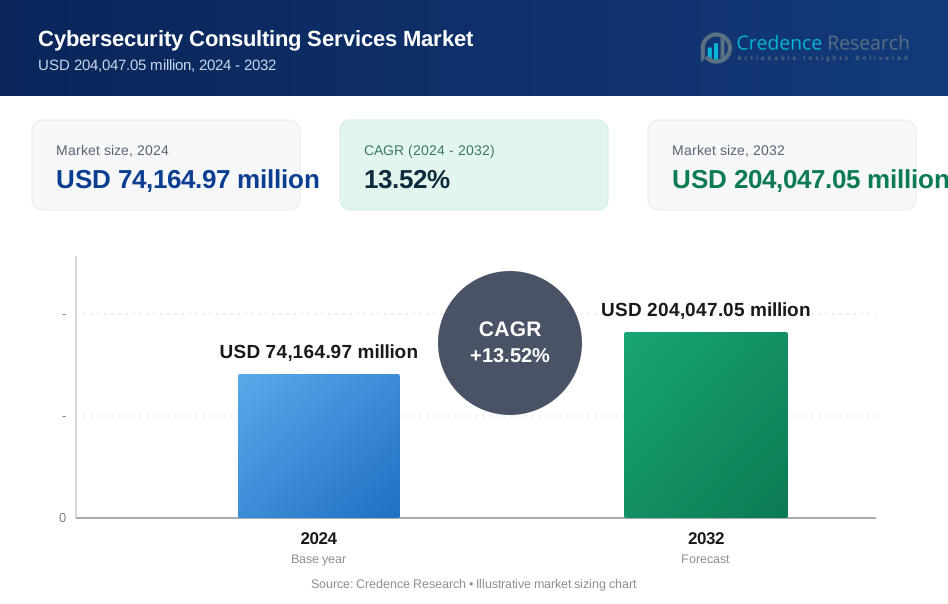
| Cybersecurity Consulting Services Market Size 2024 | USD 74,164.97 million |
| Cybersecurity Consulting Services Market, CAGR | 13.52% |
| Cybersecurity Consulting Services Market Size 2032 | USD 2,04,047.05 million |
Market overview
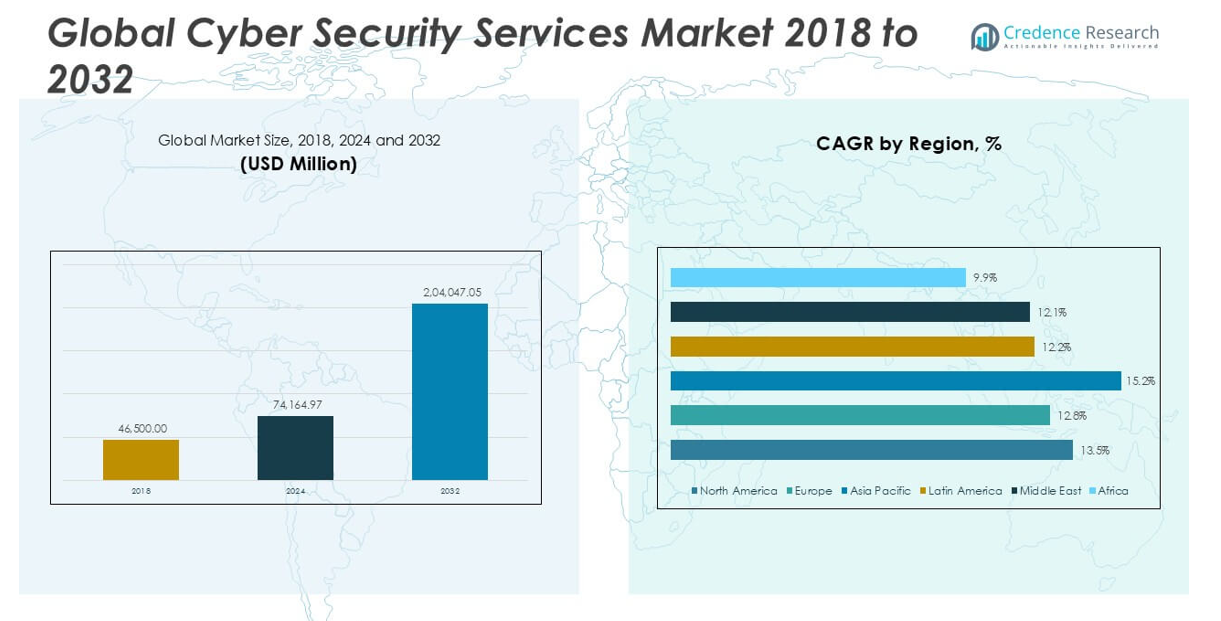
The Cyber Security Services market size was valued at USD 46,500.00 million in 2018, reached USD 74,164.97 million in 2024, and is anticipated to reach USD 2,04,047.05 million by 2032, at a CAGR of 13.52% during the forecast period.
The Cyber Security Services market is highly competitive, with key players such as Microsoft Corporation, IBM Corporation, Cisco Systems, Inc., Accenture PLC, BAE Systems PLC, Thales SA, Palo Alto Networks, Inc., Akamai Technologies, Inc., Fortinet, Inc., Broadcom Inc., Check Point Software Technologies Ltd., Rapid7, Inc., CyberArk Software Ltd., Qualys, Inc., Dell Technologies Inc., and ST3Tailor driving market growth through continuous innovation and strategic partnerships. These companies offer comprehensive cybersecurity solutions, focusing on cloud security, managed services, and threat intelligence. North America leads the market with a 40.6% share in 2024, supported by strong digital infrastructure, regulatory enforcement, and early technology adoption, positioning the region as the dominant force in global cybersecurity services.
Market Insights
- The Cyber Security Services market was valued at USD 46,500.00 million in 2018, reached USD 74,164.97 million in 2024, and is expected to reach USD 2,04,047.05 million by 2032, growing at a CAGR of 13.52% during the forecast period.
- Increasing cyber threats, digital transformation, and strict regulatory compliance are major drivers fueling demand for advanced cybersecurity services across industries.
- Growing adoption of cloud-based security solutions, artificial intelligence, and managed security services is shaping key market trends, offering flexible and real-time protection.
- The market is highly competitive with leading players such as Microsoft, IBM, Cisco, Accenture, Palo Alto Networks, and Fortinet focusing on innovation, partnerships, and service expansion to strengthen market positions.
- North America holds the largest regional share at 40.6%, while the Managed Security Services (MSS) segment dominates by service type; Asia Pacific is the fastest-growing region with a CAGR of 15.2%.
Market Segmentation Analysis:
By Services:
The Cyber Security Services market, when segmented by services, is led by the Managed Security Services (MSS) sub-segment, which holds the largest market share. MSS has gained prominence due to the growing demand for continuous monitoring, real-time threat detection, and cost-effective security management. Organizations are increasingly outsourcing security operations to managed service providers to access advanced expertise and scalable solutions, particularly in the face of evolving cyber threats. Additionally, services like Security Consulting and Incident Response & Forensics are experiencing steady growth, driven by rising cybersecurity awareness and the need for immediate risk mitigation and breach management.
- For instance, IBM’s Managed Security Services handle over 150 billion security events per day across 130 countries, demonstrating its global threat management capacity.
By Organization Size:
Large Enterprises dominate the market, accounting for the largest revenue share. These organizations invest significantly in cybersecurity services to protect their complex and expansive IT infrastructures against sophisticated cyber-attacks. The increasing risk of targeted attacks and regulatory compliance requirements compel large enterprises to adopt comprehensive security frameworks and advanced solutions. However, the Small and Medium-Sized Enterprises (SMEs) segment is showing rapid growth due to heightened awareness and the availability of affordable, cloud-based cybersecurity services that allow SMEs to strengthen their security posture without heavy infrastructure investment.
- For instance, Cisco's security solutions protect over 840,000 small and mid-sized businesses worldwide through its integrated cloud-delivered security platforms.
By Deployment Mode:
The deployment mode analysis highlights the Cloud-Based (Remote Services) segment as the dominant choice, holding a substantial market share. Cloud-based solutions are preferred due to their scalability, flexibility, and lower upfront costs compared to on-premise models. The increasing shift towards digital transformation, remote working environments, and hybrid IT infrastructures are driving the adoption of cloud-based cybersecurity services. While the On-Premise segment remains relevant for industries with strict data residency and control requirements, the demand is gradually shifting towards cloud deployment due to its enhanced agility and faster implementation capabilities.
Market Overview
Rising Frequency and Sophistication of Cyber Threats
The increasing prevalence of cyber-attacks, including ransomware, phishing, and advanced persistent threats (APTs), is a primary growth driver for the Cyber Security Services market. As cybercriminals employ more sophisticated methods, organizations across sectors are compelled to enhance their security infrastructure. This escalating threat landscape is driving demand for proactive and specialized cybersecurity services such as Managed Security Services (MSS), incident response, and vulnerability management. Businesses are investing heavily to mitigate financial losses, protect sensitive data, and maintain operational continuity in the face of evolving cyber risks.
- For instance, Palo Alto Networks’ Cortex XDR blocked over 6.8 million ransomware attacks in a single quarter, underscoring the scale and sophistication of modern threats.
Regulatory Compliance and Data Protection Mandates
Stringent regulatory frameworks, such as the General Data Protection Regulation (GDPR), the Health Insurance Portability and Accountability Act (HIPAA), and industry-specific security mandates, are significantly driving the cybersecurity services market. Organizations are increasingly required to adhere to these complex regulations to avoid penalties and safeguard customer trust. Compliance necessitates the adoption of comprehensive cybersecurity strategies, including consulting, training, and continuous monitoring. These evolving legal landscapes are creating sustained demand for expert cybersecurity services to ensure alignment with data protection standards and regulatory guidelines.
- For instance, Microsoft processes over 8 trillion security signals daily to support GDPR and HIPAA compliance for its enterprise clients through its integrated security platform.
Rapid Digital Transformation and Cloud Adoption
The accelerated shift toward digitalization, cloud computing, and remote working environments has significantly expanded the attack surface for organizations. This transformation is fueling the demand for cybersecurity services that can secure cloud platforms, endpoints, and distributed networks. Cloud-based security solutions are gaining popularity due to their scalability and cost efficiency. As businesses continue to adopt hybrid IT infrastructures and digital platforms to enhance productivity and customer engagement, the need for advanced, flexible, and real-time cybersecurity services is expected to grow substantially.
Key Trends & Opportunities
Growth of Artificial Intelligence and Automation in Cybersecurity
The integration of Artificial Intelligence (AI) and automation is emerging as a transformative trend in the Cyber Security Services market. AI-driven solutions enable faster threat detection, predictive analytics, and automated incident response, reducing human intervention and improving response times. This trend is opening new opportunities for service providers to offer intelligent, self-learning security platforms that adapt to evolving cyber threats. The growing emphasis on proactive cybersecurity strategies powered by AI is expected to significantly reshape the competitive landscape and enhance service capabilities.
- For instance, Fortinet’s AI-driven FortiGuard Labs blocks approximately 20 million malicious URLs and detects 400,000 malware variants daily using automated threat intelligence.
Expansion of Managed Security Services (MSS) and Cloud Security
The rising adoption of Managed Security Services (MSS) and cloud-based security solutions presents substantial market opportunities. Organizations, especially SMEs, are increasingly outsourcing cybersecurity functions to MSS providers to access specialized expertise and round-the-clock protection. The growing shift toward cloud-native applications and remote work is also creating demand for cloud-specific security services. These trends are enabling cybersecurity vendors to develop scalable, subscription-based service models that cater to the evolving security needs of diverse industries across geographies.
- For instance, Accenture’s MSS covers more than 230 clients worldwide, managing over 1.5 million security incidents annually through its global network of Cyber Fusion Centers.
Key Challenges
Shortage of Skilled Cybersecurity Professionals
The global cybersecurity talent gap remains a critical challenge for the market. The demand for qualified cybersecurity professionals far exceeds supply, limiting the ability of organizations to build robust in-house security teams. This shortage increases reliance on external service providers but also constrains market growth as providers struggle to scale operations. Addressing this talent gap will require significant investments in training, certification programs, and the development of automated solutions to compensate for the workforce deficit.
Complexity of Multi-Cloud and Hybrid IT Environments
As businesses increasingly adopt multi-cloud and hybrid IT infrastructures, securing these complex environments becomes a significant challenge. Each cloud platform and system may have different security protocols, creating potential vulnerabilities and management difficulties. Ensuring seamless security across diverse architectures requires advanced, interoperable cybersecurity solutions and expert oversight. The complexity involved in integrating and maintaining consistent security across platforms can hinder effective threat management and create compliance risks for organizations.
High Cost of Advanced Cybersecurity Services
The deployment of advanced cybersecurity services, especially for comprehensive threat management and real-time monitoring, involves substantial costs. Small and Medium-Sized Enterprises (SMEs) often face budget constraints that limit their ability to invest in cutting-edge cybersecurity solutions. While cloud-based and managed services offer more cost-effective alternatives, the overall expense of maintaining robust cybersecurity measures remains a significant barrier for many organizations. This cost challenge can restrict market penetration, particularly in emerging economies and smaller businesses.
Regional Analysis
North America
North America holds the largest share in the Cyber Security Services market, accounting for approximately 40.6% of the global revenue in 2024. The market size increased from USD 18,655.80 million in 2018 to USD 29,428.22 million in 2024 and is projected to reach USD 80,864.21 million by 2032, growing at a CAGR of 13.5%. This dominance is driven by the presence of major cybersecurity providers, advanced digital infrastructure, and stringent regulatory frameworks. The growing frequency of cyber-attacks and early adoption of advanced security technologies further strengthen North America's leadership in this sector.
Europe
Europe represents a significant portion of the Cyber Security Services market, capturing 27.1% of the global market share in 2024. The market size expanded from USD 12,787.50 million in 2018 to USD 19,636.86 million in 2024, and is expected to reach USD 51,165.34 million by 2032, registering a CAGR of 12.8%. Strong regulatory environments such as GDPR, increasing cyber threats, and growing investments in digital transformation are key growth drivers. Organizations across industries are adopting advanced cybersecurity services to protect sensitive data and comply with complex legal and data protection requirements.
Asia Pacific
Asia Pacific is the fastest-growing regional market, holding 22.6% of the global market share in 2024. The market surged from USD 9,997.50 million in 2018 to USD 16,749.85 million in 2024, and is anticipated to reach USD 51,723.03 million by 2032, with the highest CAGR of 15.2%. Rapid digitization, rising investments in cloud technologies, and increasing cybercrime incidents across developing economies like China and India are driving this growth. Additionally, growing awareness of cybersecurity and government-led digital security initiatives are accelerating the adoption of cybersecurity services across the region.
Latin America
Latin America accounts for approximately 5.2% of the global Cyber Security Services market in 2024. The market grew from USD 2,380.80 million in 2018 to USD 3,752.01 million in 2024, and is forecasted to reach USD 9,400.45 million by 2032, progressing at a CAGR of 12.2%. The increasing reliance on digital banking, e-commerce, and cloud-based solutions is boosting the need for cybersecurity services. Organizations in the region are steadily enhancing their security frameworks in response to the growing threat of cyber-attacks, regulatory developments, and the need for better data protection mechanisms.
Middle East
The Middle East holds around 3.3% of the global market share in 2024. The market expanded from USD 1,757.70 million in 2018 to USD 2,624.96 million in 2024, and is projected to reach USD 6,510.22 million by 2032, growing at a CAGR of 12.1%. The market is driven by rising investments in smart city projects, digital transformation initiatives, and a growing need to secure critical infrastructure. Cybersecurity awareness is increasing rapidly in the region, prompting both public and private sector organizations to seek advanced security solutions to protect against escalating cyber threats.
Africa
Africa represents the smallest share in the global Cyber Security Services market, contributing 2.7% in 2024. The market grew from USD 920.70 million in 2018 to USD 1,973.09 million in 2024, and is expected to reach USD 4,383.80 million by 2032, with a CAGR of 9.9%. Despite its slower growth compared to other regions, Africa is witnessing increasing cybersecurity investments due to growing internet penetration, digital banking, and rising awareness of cyber risks. Limited cybersecurity infrastructure and skilled resources remain key challenges, but international collaborations and policy advancements are expected to gradually support market development.
Market Segmentations:
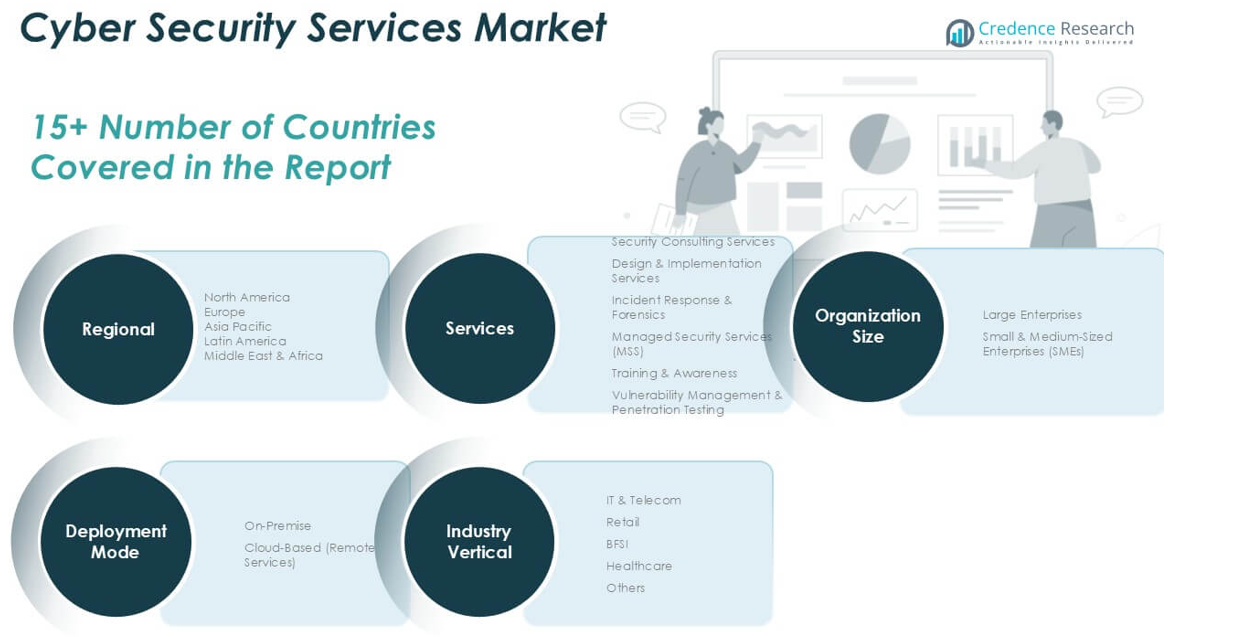
By Services
- Security Consulting Services
- Design & Implementation Services
- Incident Response & Forensics
- Managed Security Services (MSS)
- Training & Awareness
- Vulnerability Management & Penetration Testing
By Organization Size
- Large Enterprises
- Small & Medium-Sized Enterprises (SMEs)
By Deployment Mode
- On-Premise
- Cloud-Based (Remote Services)
By Industry Vertical
- IT & Telecom
- Retail
- BFSI
- Healthcare
- Others
By Geography
- North America
- U.S.
- Canada
- Mexico
- Europe
- Germany
- France
- U.K.
- Italy
- Spain
- Rest of Europe
- Asia Pacific
- China
- Japan
- India
- South Korea
- South-east Asia
- Rest of Asia Pacific
- Latin America
- Brazil
- Argentina
- Rest of Latin America
- Middle East & Africa
- GCC Countries
- South Africa
- Rest of the Middle East and Africa
Competitive Landscape
The competitive landscape of the Cyber Security Services market is defined by the presence of global technology leaders and specialized cybersecurity firms striving to expand their market positions. Key players such as Microsoft Corporation, IBM Corporation, Cisco Systems, Inc., Accenture PLC, Palo Alto Networks, Inc., and Fortinet, Inc. lead the market through diversified service portfolios, advanced technology integration, and strong global reach. Companies actively pursue strategies such as partnerships, acquisitions, and product enhancements to address evolving cyber threats and meet industry-specific security demands. Intense competition drives continuous innovation, particularly in cloud security, managed services, and AI-based threat detection. Service providers focus on delivering scalable, cost-effective, and customized solutions to attract both large enterprises and small to medium-sized businesses. Market participants are also strengthening their regional presence to capitalize on the rapid growth in Asia Pacific and Latin America. The dynamic nature of the cybersecurity landscape requires companies to consistently upgrade capabilities to retain a competitive edge.
Key Player Analysis
- Microsoft Corporation
- IBM Corporation
- Cisco Systems, Inc.
- Accenture PLC
- BAE Systems PLC
- Thales SA
- Palo Alto Networks, Inc.
- Akamai Technologies, Inc.
- Fortinet, Inc.
- Broadcom Inc.
- Check Point Software Technologies Ltd.
- Rapid7, Inc.
- CyberArk Software Ltd.
- Qualys, Inc.
- Dell Technologies Inc.
- ST3Tailor
Recent Developments
- In June 2025, Microsoft launched a new European Security Program, offering free AI-powered cybersecurity support, including enhanced threat intelligence sharing, capacity building, and cyberattack disruption, to all EU member states and associated countries in response to escalating state-sponsored cyber threats.
- In June 2025, the University of Southern Queensland partnered with Fortinet to integrate Fortinet’s industry-recognized certifications and hands-on training into its Bachelor of Cyber Security program. This enhanced regional workforce development and prepared students for real-world cybersecurity roles.
- In May 2024, Fortinet introduced the Generative AI IoT Security Assistant, augmenting its FortiAI integrations to boost security and operational efficiency within network security operations.
- In October 2024, Check Point Software Technologies acquired Cyberint Technologies, strengthening its Infinity Platform with advanced external risk management solutions to enhance threat intelligence and improve business security operations.
- In December 2023, IBM Corporation signed a contract with the NATO Communications and Information Agency (NCI Agency) to strengthen the Alliance's cybersecurity posture. This deal will improve asset management and security visibility across all NATO enterprise networks.
- In December 2023, IBM Consulting and Palo Alto Networks announced a strategic partnership to strengthen their end-to-end security postures and navigate evolving security threats. The partnership will jointly offer enhanced security solutions delivered by IBM Consulting Cybersecurity Services, integrating Palo Alto Networks security technologies.
Market Concentration & Characteristics
The Cyber Security Services Market demonstrates a moderately high level of market concentration, with several key players holding significant global shares. Companies such as Microsoft Corporation, IBM Corporation, Cisco Systems, Inc., and Palo Alto Networks, Inc. dominate through strong product portfolios, strategic partnerships, and continuous investments in advanced security technologies. The market features both established global providers and specialized regional firms, creating a balance between comprehensive service offerings and localized expertise. It is characterized by rapid technological advancements, a high demand for managed security services, and increasing cloud security adoption. Companies actively pursue innovation to strengthen threat detection, response capabilities, and service scalability. Demand remains consistent across large enterprises and is quickly expanding among small and medium-sized businesses due to affordable cloud-based solutions. The Cyber Security Services Market exhibits strong vendor competition, pricing pressures, and continuous service differentiation, pushing providers to deliver cost-effective, reliable, and tailored solutions across diverse industry verticals and regions.
Report Coverage
The research report offers an in-depth analysis based on Services, Activity Type, and Geography. It details leading market players, providing an overview of their business, product offerings, investments, revenue streams, and key applications. Additionally, the report includes insights into the competitive environment, SWOT analysis, current market trends, as well as the primary drivers and constraints. Furthermore, it discusses various factors that have driven market expansion in recent years. The report also explores market dynamics, regulatory scenarios, and technological advancements that are shaping the industry. It assesses the impact of external factors and global economic changes on market growth. Lastly, it provides strategic recommendations for new entrants and established companies to navigate the complexities of the market.
Future Outlook
- The Cyber Security Services Market will continue to grow steadily driven by the rising number of cyber-attacks.
- Demand for cloud-based cybersecurity solutions will increase across small, medium, and large enterprises.
- Managed Security Services will remain the dominant segment due to their cost efficiency and real-time protection.
- Artificial Intelligence and machine learning will become essential in cybersecurity for faster threat detection.
- Regulatory compliance requirements will keep pushing organizations to invest in advanced cybersecurity frameworks.
- North America will maintain its leading position in the market with strong enterprise adoption and regulatory focus.
- Asia Pacific will show the fastest growth due to rapid digitalization and expanding internet penetration.
- The shortage of skilled cybersecurity professionals will continue to challenge service providers.
- Companies will focus on offering tailored and industry-specific cybersecurity solutions to stay competitive.
- Partnerships, acquisitions, and innovation will remain key strategies for market leaders to expand their global presence.
Request a Free Sample
Fill in your details and we'll send you a free sample report.
- Sample data tables & charts
- Research methodology
Need a Custom Version of This Report?
Tailor the scope, geography, or segments to your exact requirements.
- Custom geography or segment scope
- Direct access to our analyst team
Frequently Asked Questions
What is the current size of the Cybersecurity Consulting Services market?
What factors are driving the growth of the Cybersecurity Consulting Services market?
What are some challenges faced by the Cybersecurity Consulting Services market?
Who are the major players in the Cybersecurity Consulting Services market?
Table of Content
Chapter 1. Report Introduction
- 1.1 Report Description & Purpose
- 1.1.1 Report Title & Market Definition
- 1.1.2 Unique Selling Propositions (USP) & Key Differentiators
- 1.1.3 Value Proposition for Stakeholders
- 1.2 Research Objectives
- 1.2.1 Market Sizing Objectives (Volume & Revenue) (Volume Where Applicable)
- 1.2.2 Segmentation Objectives
- 1.2.3 Competitive Intelligence Objectives
- 1.2.4 Forecast & Scenario Objectives
- 1.3 Report Scope
- 1.3.1 Cybersecurity Consulting Services Scope – Segments & Subsegments Covered
- 1.3.2 Geographic Scope – Regions & Countries Covered
- 1.3.3 Historical Period, Base Year & Forecast Period (2024; forecast to 2032)
- 1.3.4 Inclusions & Exclusions
- 1.4 Industry Classification & Applicable Codes
- 1.5 Currency, Measurement Units & Valuation Basis
- 1.6 Target Stakeholders
- 1.7 Limitations & Assumptions
Chapter 2. Executive Summary
- 2.1 Global Cybersecurity Consulting Services Market Snapshot
- 2.1.1 Market Size – Historical (2024) & Forecast (2024-2032) (2024: USD 74,164.97 million → 2032: USD 204,047.05 million)
- 2.1.2 Volume & Revenue – Global Totals (Volume Where Applicable)
- 2.1.3 Key Market Highlights – Top Five Facts
- 2.2 Cybersecurity Consulting Services Market Segmentation Snapshot
- 2.2.1 Market Split by Region – 2024 vs. 2032
- 2.3 Competitive Snapshot
- 2.3.1 Top 10 Players by Revenue Share – 2024
- 2.3.2 Top 10 Players by Volume Share – 2024 (Volume Where Applicable)
- 2.3.3 Recent Strategic Developments (18-Month Summary)
- 2.4 Key Investment Highlights & Strategic Conclusions
Chapter 3. Cybersecurity Consulting Services Market Dynamics & Industry Analysis
- 3.1 Market Overview & Context
- 3.1.1 Cybersecurity Consulting Services Market Position in the Broader Industry Value Chain
- 3.1.2 Demand Structure & Purchasing Dynamics
- 3.1.3 Market Maturity & Development Stage by Region
- 3.2 Cybersecurity Consulting Services Market Drivers
- 3.3 Cybersecurity Consulting Services Market Restraints & Challenges
- 3.4 Cybersecurity Consulting Services Market Opportunities
- 3.5 Porter's Five Forces Analysis
- 3.5.1 Threat of New Entrants
- 3.5.2 Bargaining Power of Suppliers
- 3.5.3 Bargaining Power of Buyers
- 3.5.4 Threat of Substitutes
- 3.5.5 Competitive Rivalry – Intensity Assessment
- 3.6 Cybersecurity Consulting Services Value Chain Analysis
- 3.6.1 Upstream – Key Inputs, Resources & Suppliers
- 3.6.1.1 Key Input/Resource 1
- 3.6.1.2 Key Input/Resource 2
- 3.6.1.3 Key Input/Resource 3
- 3.6.2 Midstream – Core Operations & Value Creation
- 3.6.2.1 Operating Model & Process Overview
- 3.6.2.2 Key Operating Locations & Capabilities by Company
- 3.6.3 Downstream – Market Channels & End Users
- 3.6.3.1 Direct Sales & Customer Engagement Channels
- 3.6.3.2 Indirect Sales, Intermediaries & Partner Channels
- 3.6.4 Value Chain Profitability Analysis
- 3.6.1 Upstream – Key Inputs, Resources & Suppliers
- 3.7 PESTEL Analysis
- 3.7.1 Political Factors
- 3.7.2 Economic Factors
- 3.7.3 Social Factors
- 3.7.4 Technological Factors
- 3.7.5 Environmental Factors
- 3.7.6 Legal Factors
- 3.8 Cybersecurity Consulting Services Supply Chain Analysis
- 3.8.1 Critical Input & Resource Availability Risk Assessment
- 3.8.2 Supplier & Operational Concentration Risk (Geographic Exposure)
- 3.8.3 Supply & Service Disruption Impact Analysis
- 3.9 Regulatory & Policy Landscape
Note: The regulatory and policy landscape section covers regulations based on their applicability to the market, Cybersecurity Consulting Services category, geography, and scope of the study. Only regulatory frameworks with a material impact on operations, compliance, trade, sustainability, or market access are analyzed in detail.
Chapter 4. Key Investment Pockets & Opportunity Analysis
- 4.1 Cybersecurity Consulting Services Market Attractiveness Analysis
- 4.1.1 By Region – Investment Attractiveness Matrix (Market Size × CAGR)
- 4.2 Absolute Revenue Growth Opportunity
- 4.2.1 By Region – Absolute Revenue Growth Through 2032
- 4.3 Incremental Demand Opportunity
- 4.3.1 By Region – Incremental Demand Through 2032
- 4.3.2 Segment – Incremental Demand
- 4.4 Emerging Submarket Opportunity Deep Dive (Subject to Applicability)
- 4.5 Priority Market Opportunity Scorecards
- 4.5.1 United States
- 4.5.2 Europe
- 4.5.3 Asia
- 4.5.4 Middle East & Africa
Note: Priority market opportunity scorecards reflect the geographic scope and strategic relevance of the study. Listed markets are indicative and may be adapted to the industry.
Chapter 5. Cybersecurity Consulting Services Cross-Border Trade & Market Access Analysis
- 5.1 International Trade & Cross-Border Activity Overview
- 5.1.1 Global Export Value by Country (2024)
- 5.1.2 Global Export Volume by Country (2024) (Volume Where Applicable)
- 5.1.3 Global Import Value by Country (2024)
- 5.1.4 Global Import Volume by Country (2024) (Volume Where Applicable)
- 5.1.5 Net Trade Balance by Country (2024)
- 5.2 Export Analysis – Segment
- 5.2.1 Category 1 (Applicable Classification Code)
- 5.2.2 Category 2 (Applicable Classification Code)
- 5.2.3 Category 3 (Applicable Classification Code)
- 5.2.4 Category 4 (Applicable Classification Code)
- 5.2.5 Category 5 (Applicable Classification Code)
- 5.3 Import Analysis – Segment
- 5.3.1 Category 1 (Applicable Classification Code)
- 5.3.2 Category 2 (Applicable Classification Code)
- 5.3.3 Category 3 (Applicable Classification Code)
- 5.3.4 Category 4 (Applicable Classification Code)
- 5.3.5 Category 5 (Applicable Classification Code)
- 5.4 Cross-Border Pricing & Transaction Benchmarks
- 5.4.1 Export Pricing – Segment & Country
- 5.4.2 Import Pricing – Segment & Source Country
- 5.4.3 Price Trends (2024)
- 5.5 Key Cross-Border Trade & Delivery Routes
- 5.5.1 Cross-Border Trade/Delivery Route 1
- 5.5.2 Cross-Border Trade/Delivery Route 2
- 5.5.3 Cross-Border Trade/Delivery Route 3
- 5.5.4 Cross-Border Trade/Delivery Route 4
- 5.5.5 Cross-Border Trade/Delivery Route 5
- 5.6 Trade Policy & Market Access Impact Assessment
- 5.6.1 Tariff & Non-Tariff Barriers
- 5.6.2 Regional Trade & Economic Integration Frameworks
- 5.6.3 Bilateral & Multilateral Trade Agreements
- 5.6.4 Cross-Border Operating, Licensing & Localization Requirements
Note: This chapter applies where cross-border trade or delivery is relevant to Cybersecurity Consulting Services. Goods, services, and digital offerings are assessed using applicable classifications and transaction measures. Import-export volumes, trade balances, and route analyses are included only where meaningful to the market.
Chapter 6. Competitive Landscape & Company Benchmarking
- 6.1 Cybersecurity Consulting Services Market Concentration & Structure
- 6.1.1 Herfindahl-Hirschman Index (HHI) – vs. 2024
- 6.1.2 Leading, Mid-Sized & Emerging Player Structure
- 6.1.3 Global, Regional & Local Player Dynamics
- 6.2 Cybersecurity Consulting Services Market Share Analysis – 2024
- 6.2.1 Global Revenue Share by Company
- 6.2.2 Global Volume Share by Company (Volume Where Applicable)
- 6.2.3 Regional Revenue Share
- 6.2.4 Market Share Evolution ( vs. 2024)
- 6.2.5 Company Market Share by Key Segment
- 6.2.6 Company Market Share by Customer Group
- 6.3 Operating Scale, Capacity & Infrastructure Analysis
- 6.3.1 Global Operating Scale & Supply Capacity
- 6.3.2 Resource Utilization & Operating Efficiency
- 6.3.3 Output, Service Delivery & Activity Metrics
- 6.3.4 Operating Footprint & Infrastructure Map
- 6.3.5 Planned Operational & Capacity Expansion
- 6.4 Cybersecurity Consulting Services Competitive Benchmarking Matrix
- 6.4.1 Revenue, Growth, Profitability & Operating Metric Comparison
- 6.4.2 Channel Revenue Mix
- 6.4.3 Geographic Revenue Exposure
- 6.4.4 R&D Intensity
- 6.4.5 Sustainability Maturity
- 6.5 Strategic Developments in Cybersecurity Consulting Services (Last 24 Months)
- 6.5.1 Mergers, Acquisitions & Divestments
- 6.5.2 New Products, Services & Solutions in Cybersecurity Consulting Services
- 6.5.3 Operational & Infrastructure Expansions
- 6.5.4 Strategic Alliances, Joint Ventures & Partnerships
- 6.5.5 Distribution Expansion & Market Entry
- 6.5.6 Sustainability & ESG Initiatives
- 6.6 Competitive Strategy Mapping
- 6.6.1 Leader, Challenger, Follower & Niche Classification
- 6.6.2 Pricing Strategy Comparison
- 6.6.3 Channel Strategy Matrix
Note: Strategic developments are included based on their materiality and the availability of reliable information.
Chapter 7. Global Cybersecurity Consulting Services Market – By Sales & Delivery Channel
- 7.1 Segment Overview
- 7.1.1 Volume & Revenue Split by Channel (2024 & 2032) (Volume Where Applicable)
- 7.1.2 Channel Mix Evolution (2024-2032)
Chapter 8. Regional Market Analysis – Global Overview
- 8.1 Global Regional Overview
- 8.1.1 Regional Volume Share (Volume Where Applicable)
- 8.1.2 Regional Revenue Share
- 8.1.3 Regional Volume by Region (Volume Where Applicable)
- 8.1.4 Regional Revenue by Region
- 8.1.5 Regional Forecast Through 2032
- 8.2 Cross-Regional Segment Analysis
- 8.2.1 By Sales & Delivery Channel
- 8.2.2 By Competitive Positioning & Price Tier
Chapter 9. North America Cybersecurity Consulting Services Market
- 9.1 United States
- 9.2 Canada
- 9.3 Mexico
Chapter 10. Europe Cybersecurity Consulting Services Market
- 10.1 Germany
- 10.2 France
- 10.3 Italy
- 10.4 United Kingdom
- 10.5 Spain
- 10.6 Poland
- 10.7 Russia
- 10.8 Netherlands
- 10.9 Belgium
- 10.10 Sweden
- 10.11 Denmark
- 10.12 Norway
- 10.13 Rest of Europe
Chapter 11. Asia Pacific Cybersecurity Consulting Services Market
- 11.1 China
- 11.2 India
- 11.3 Japan
- 11.4 South Korea
- 11.5 Thailand
- 11.6 Indonesia
- 11.7 Vietnam
- 11.8 Malaysia
- 11.9 Australia
- 11.10 Rest of Asia Pacific
Chapter 12. Latin America Cybersecurity Consulting Services Market
- 12.1 Brazil
- 12.2 Argentina
- 12.3 Colombia
- 12.4 Chile
- 12.5 Rest of Latin America
Chapter 13. Middle East Cybersecurity Consulting Services Market
- 13.1 Saudi Arabia
- 13.2 United Arab Emirates
- 13.3 Turkey
- 13.4 Israel
- 13.5 Iran
- 13.6 Rest of the Middle East
Chapter 14. Africa Cybersecurity Consulting Services Market
- 14.1 South Africa
- 14.2 Egypt
- 14.3 Nigeria
- 14.4 Morocco
- 14.5 Rest of Africa
Chapter 15. Cybersecurity Consulting Services Company Profiles
- 15.1 [Company 01]
- 15.1.1 Company Overview
- 15.1.2 Key Management Personnel
- 15.1.3 Products & Services Portfolio
- 15.1.4 Financial Performance
- 15.1.5 Key Market Focus & Geographic Presence
- 15.1.6 Recent Developments & Strategic Initiatives
Note: The company profile list is preliminary and may change based on research findings, market developments, data availability, and client requirements.
Chapter 16. Appendices
- Appendix A – List of Abbreviations & Acronyms
- Appendix B – Industry Classification Code Reference – Full Series
- Appendix C – Supply, Output & Operating Capacity Data Tables
- Appendix D – End-Use & Demand Base Tables
- Appendix E – Demand, Adoption & Usage Assumptions
- Appendix F – Pricing & Revenue Metric Reference Tables
- Appendix G – Company Operations & Infrastructure Database
- Appendix H – Cross-Border Trade & Activity Data Tables (Where Applicable)
- Appendix I – Regulatory Summary Tables
- Appendix J – Primary Research Participant List (Anonymized)
- Appendix K – Primary Research Questionnaire Framework
- Appendix L – Data Sources & Bibliography
- Appendix M – Market Size Divergence & Source Comparison
Chapter 17. Research Methodology
- 17.1 Research Framework & Philosophy
- 17.2 Secondary Research – Sources, Hierarchy & Data Extraction
- 17.3 Data Modeling – Bottom-Up & Top-Down Market Sizing
- 17.4 Primary Research – Stakeholder Framework, LOI & Sample Sizes
- 17.5 Forecast Methodology – Regression, Scenario & Sensitivity Analysis
- 17.6 Quality Control – Four-Layer Validation Framework
- 17.7 Limitations & Standard Assumptions
- 17.8 Disclaimer
