Market Overview:
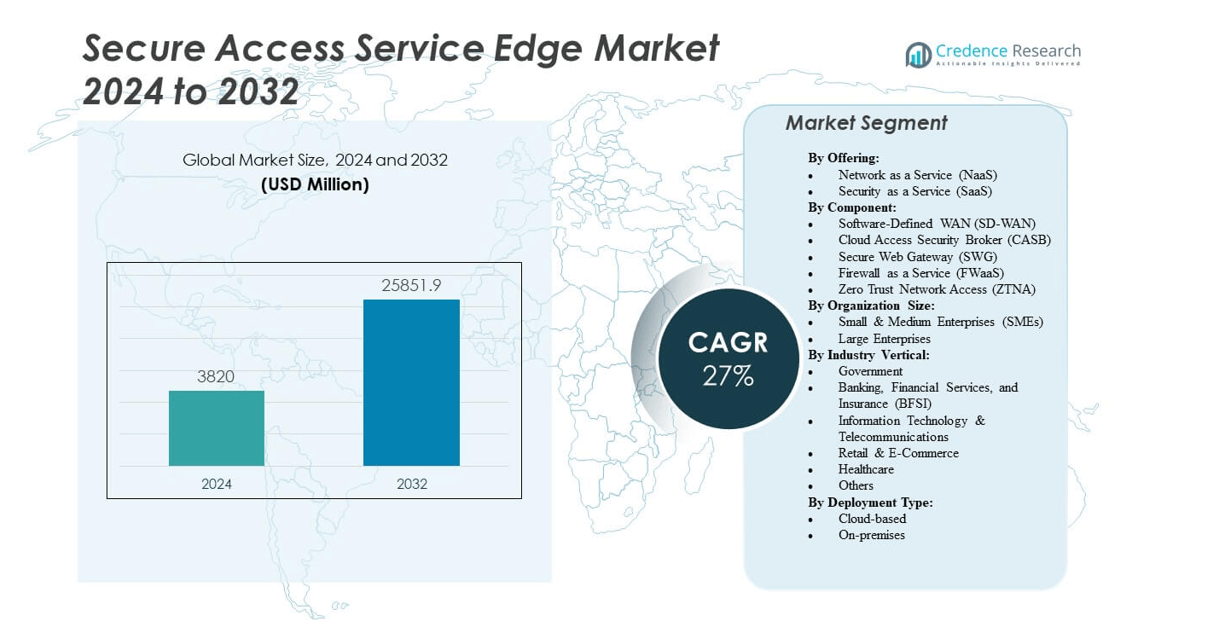
The Secure Access Service Edge Market is projected to grow from USD 3,820 million in 2024 to an estimated USD 25,851.9 million by 2032, with a compound annual growth rate (CAGR) of 27% from 2024 to 2032.
| REPORT ATTRIBUTE | DETAILS |
|---|---|
| Historical Period | 2020-2023 |
| Base Year | 2024 |
| Forecast Period | 2025-2032 |
| Secure Access Service Edge Market Size 2024 | USD 3,820 million |
| Secure Access Service Edge Market, CAGR | 27% |
| Secure Access Service Edge Market Size 2032 | USD 25,851.9 million |
The market is experiencing strong momentum as enterprises shift toward cloud-first strategies and remote work adoption. The demand for integrated network security and software-defined networking solutions is expanding. Organizations prioritize zero-trust security frameworks, secure connectivity, and simplified management across hybrid IT environments, fueling adoption. Rising cyber threats and data privacy regulations are also compelling companies to invest in scalable SASE platforms.
North America leads the Secure Access Service Edge Market due to high cloud adoption, strong cybersecurity spending, and a mature digital ecosystem. Europe follows closely, driven by strict data protection laws and the rapid uptake of secure cloud networking. Asia-Pacific is emerging as a high-growth region, supported by digital transformation initiatives in countries like India, China, and Japan. Latin America and the Middle East are also adopting SASE to address connectivity and security challenges in developing digital infrastructures.
Market Insights:
- The Secure Access Service Edge Market is projected to grow from USD 3,820 million in 2024 to USD 25,851.9 million by 2032, at a CAGR of 27%.
- Strong drivers include cloud migration, zero-trust adoption, and the rise of hybrid workforces.
- Heightened cybersecurity threats are pushing enterprises toward integrated, cloud-native security frameworks.
- Integration challenges with legacy infrastructure remain a restraint, slowing deployment in large organizations.
- Vendor lock-in risks and compliance complexities also act as barriers to adoption.
- North America holds 38% share, Europe 28%, and Asia-Pacific 24%, with APAC growing fastest.
- Emerging markets in Latin America and the Middle East are adopting SASE to modernize digital infrastructure.
Market Drivers
Rising Demand for Secure Cloud Connectivity in Enterprise Environments
The rapid migration of workloads to cloud platforms has accelerated the demand for secure access solutions. Enterprises are adopting multi-cloud and hybrid models, which increase risks linked to unauthorized access and data exposure. The Secure Access Service Edge Market benefits from this demand by combining network and security capabilities into a unified service. Organizations prefer integrated platforms that deliver consistent security policies across distributed environments. It enables enterprises to reduce reliance on legacy hardware-based solutions. The growth of software-defined networking is reinforcing this need. Regulatory compliance requirements are also driving investments.
- For instance, in August 2025, AT&T and Cisco launched a unified Secure Access Service Edge (SASE) solution combining Cisco’s secure access technology with AT&T’s network expertise.
Expansion of Remote Workforce and Increased Use of Mobile Devices
The global workforce shift toward remote and hybrid models is creating strong growth opportunities. Companies are enabling employees to securely connect from any location and device. Traditional perimeter-based security frameworks are failing to address the risks of distributed networks. The Secure Access Service Edge Market supports secure access to corporate applications with zero-trust principles. It ensures visibility and control without compromising employee productivity. Businesses are implementing identity-driven security to counter insider and external threats. Growing device diversity and application usage are further amplifying this demand. The market is evolving to meet these modern workforce needs.
Heightened Cybersecurity Threats Across Digital Ecosystems
The increase in ransomware, phishing, and advanced persistent threats is pushing organizations to adopt proactive measures. Cybercriminals are exploiting gaps in traditional security perimeters. The Secure Access Service Edge Market responds by integrating real-time threat detection, secure web gateways, and cloud access security brokers. It ensures a unified defense strategy across distributed IT environments. Enterprises are prioritizing security solutions that minimize risks without slowing operations. Adoption is rising across industries including banking, healthcare, and retail. These sectors handle sensitive data that demand secure and compliant access frameworks. Growing threat sophistication reinforces the importance of SASE deployment.
- For instance, Palo Alto Networks’ Prisma Access achieved a Security Effectiveness score of 98.89% in 2025 CyberRatings tests, successfully blocking 100% of evasive threats. This platform provides comprehensive threat prevention and zero trust access, safeguarding critical infrastructure and enterprise environments with proven efficacy against malware and phishing campaigns.
Need for Simplified IT Infrastructure and Cost Efficiency
Organizations are streamlining network and security operations by consolidating multiple services into single platforms. The Secure Access Service Edge Market supports this demand by offering scalable and flexible cloud-delivered solutions. It reduces costs associated with managing separate firewalls, VPNs, and intrusion systems. Businesses gain efficiency through centralized management and policy enforcement. Reduced infrastructure complexity enhances agility and accelerates digital transformation strategies. Enterprises are focusing on reducing operational expenses without compromising performance. Cloud-native architecture allows easy scalability to match business growth. Growing pressure on IT budgets is influencing adoption across multiple sectors.
Market Trends
Integration of Zero-Trust Architectures into SASE Platforms
Organizations are increasingly embedding zero-trust network access into their security strategies. The Secure Access Service Edge Market is witnessing strong adoption of identity-based controls. It ensures only verified users and devices can access enterprise applications. Vendors are aligning product roadmaps with zero-trust principles to meet rising demand. Enterprises value adaptive access policies that adjust to risk context in real time. This integration strengthens resilience against insider and external attacks. Zero-trust adoption is becoming a standard requirement for enterprises modernizing their IT ecosystems.
- For instance, Cisco’s Zero Trust Network Access (ZTNA) solution enhances security by dynamically routing user traffic based on network trust. It achieves this by identifying if users are on trusted or untrusted networks and steering traffic accordingly, optimizing for both security and performance with reduced troubleshooting times and faster incident detection.
Growing Role of Artificial Intelligence and Automation in SASE Solutions
AI-driven security analytics and automated response systems are becoming critical components of SASE platforms. The Secure Access Service Edge Market is advancing with tools that detect anomalies faster. It allows enterprises to proactively respond to threats without manual intervention. Automated incident response reduces downtime and improves resilience against evolving attacks. Machine learning models help predict suspicious behavior patterns before they cause damage. AI also enables dynamic policy adjustments for different users and workloads. Enterprises gain efficiency by reducing reliance on traditional monitoring processes. AI and automation are shaping the next phase of network security.
Increased Vendor Partnerships and Ecosystem Expansion
Technology providers are building alliances to expand their product portfolios and global presence. The Secure Access Service Edge Market is witnessing partnerships between telecom operators, cybersecurity vendors, and cloud providers. It creates integrated offerings that combine connectivity and advanced security. Joint ventures are helping enterprises access end-to-end solutions from a single provider. Partnerships also accelerate innovation by merging expertise from multiple domains. Vendors are expanding their ecosystems to cater to diverse industry requirements. Collaboration is strengthening trust among enterprises adopting new security frameworks. This trend is reshaping competitive dynamics in the global market.
Rising Focus on Industry-Specific SASE Solutions
Vendors are tailoring SASE offerings to meet compliance and operational needs of specific industries. The Secure Access Service Edge Market is adopting vertical-focused strategies to capture niche demand. It supports sectors like healthcare, finance, and manufacturing that require strict data protection measures. Industry-specific deployments ensure alignment with regulatory standards. Customized SASE platforms enhance adoption in organizations handling sensitive workloads. Vendors are differentiating themselves by offering specialized security features. This trend reflects the growing maturity and complexity of the market. Enterprises benefit from solutions that are directly relevant to their business environments.
- For example, VMware offers a SASE platform supported by over 200 global Points of Presence (PoPs), providing optimized access to cloud and SaaS applications. The solution supports healthcare organizations by meeting compliance needs such as HIPAA and PCI-DSS, ensuring secure handling of patient data and reliable access to electronic health records across distributed sites.
Market Challenges Analysis
Integration Complexity and Legacy Infrastructure Constraints
Enterprises face difficulties when transitioning from legacy network systems to cloud-native SASE platforms. The Secure Access Service Edge Market is hindered by integration challenges in large organizations with complex infrastructures. It requires significant investments in planning, testing, and migration to ensure business continuity. Many enterprises still operate with traditional VPNs and firewalls that are not easily replaced. A lack of skilled professionals complicates adoption further. Implementation costs and downtime risks make organizations cautious. Aligning multiple stakeholders to adopt unified security models is another barrier. These issues slow down the pace of market penetration.
Regulatory Uncertainty and Vendor Lock-In Risks
Compliance remains a major hurdle across regions with varying data protection laws. The Secure Access Service Edge Market must adapt to fragmented regulatory environments. It creates challenges for enterprises operating across borders. Vendor lock-in also raises concerns, as reliance on a single provider can limit flexibility. Enterprises fear cost escalations when switching vendors or expanding globally. Security assurance and transparency from providers are critical for trust. Organizations demand guarantees of compliance alignment and resilience against disruptions. Regulatory complexity and vendor dependency are significant obstacles to wider market adoption.
Market Opportunities
Growing Adoption Across Small and Medium-Sized Enterprises
Small and medium businesses are embracing digital transformation at faster rates. The Secure Access Service Edge Market provides them with affordable and scalable solutions. It offers cloud-native deployment models that eliminate the need for heavy upfront investments. SMBs gain enterprise-level security with simplified management. Zero-trust frameworks allow them to protect assets despite limited IT staff. Increased reliance on SaaS applications is encouraging SMBs to adopt SASE. These businesses see it as a pathway to competitiveness and resilience. The market is positioned to benefit significantly from this expanding customer base.
Expansion Potential in Emerging Economies and Untapped Sectors
Emerging markets are investing heavily in digital infrastructure modernization. The Secure Access Service Edge Market is gaining traction in regions like Asia-Pacific, Latin America, and Africa. It helps governments and enterprises address security and connectivity gaps. Sectors like education, logistics, and public services are adopting SASE to strengthen operations. Cloud-first initiatives in these regions provide fertile ground for market expansion. Providers offering localized services and compliance alignment will capture greater market share. Growing digital ecosystems and increasing awareness of cyber risks are fueling demand. This opportunity ensures long-term growth prospects for the market.
Market Segmentation Analysis:
By offering, Network as a Service (NaaS) and Security as a Service (SaaS) dominate adoption patterns. NaaS drives value for enterprises seeking flexible connectivity, while SaaS provides scalable security capabilities. Together, they strengthen the Secure Access Service Edge Market by meeting the demand for unified, cloud-delivered solutions. Vendors are expanding both offerings to support enterprises transitioning from legacy infrastructure.
- For instance, Nile, a NaaS provider, recently enhanced its platform with integrated zero-trust capabilities by partnering with Microsoft and Palo Alto Networks, bringing identity-aware security to global enterprises in 2025.
By component, Software-Defined WAN (SD-WAN) leads with widespread implementation for reliable and secure network performance. Cloud Access Security Broker (CASB) and Secure Web Gateway (SWG) provide critical safeguards for cloud applications and web traffic. Firewall as a Service (FWaaS) and Zero Trust Network Access (ZTNA) are gaining traction for comprehensive, identity-based protection. The market benefits from enterprises adopting multiple components to strengthen resilience.
By organization size, large enterprises hold a major share due to complex networks and higher cybersecurity budgets. Small and medium enterprises are rapidly adopting cost-effective SASE platforms to secure distributed operations. It allows businesses of all sizes to adopt scalable solutions without infrastructure burdens.
- For instance, Fortinet reported in mid-2025 that 48% of their Unified SASE customers were large enterprises, while their broad market approach enables SMBs to deploy scalable SASE platforms without heavy infrastructure investments, securing distributed and hybrid operations effectively.
By industry vertical, BFSI, government, and IT & telecommunications sectors show high adoption, driven by strict compliance and sensitive data protection needs. Retail, healthcare, and others are increasingly leveraging SASE to safeguard customer data and digital platforms.
By deployment type, cloud-based solutions dominate due to flexibility and scalability, while on-premises models remain relevant for organizations with strict data residency requirements. Together, these segments highlight how diverse adoption drivers are shaping the Secure Access Service Edge Market.
Segmentation:
By Offering:
- Network as a Service (NaaS)
- Security as a Service (SaaS)
By Component:
- Software-Defined WAN (SD-WAN)
- Cloud Access Security Broker (CASB)
- Secure Web Gateway (SWG)
- Firewall as a Service (FWaaS)
- Zero Trust Network Access (ZTNA)
By Organization Size:
- Small & Medium Enterprises (SMEs)
- Large Enterprises
By Industry Vertical:
- Government
- Banking, Financial Services, and Insurance (BFSI)
- Information Technology & Telecommunications
- Retail & E-Commerce
- Healthcare
- Others
By Deployment Type:
- Cloud-based
- On-premises
By Region:
- North America
- U.S.
- Canada
- Mexico
- Europe
- UK
- France
- Germany
- Italy
- Spain
- Russia
- Belgium
- Netherlands
- Austria
- Sweden
- Poland
- Denmark
- Switzerland
- Rest of Europe
- Asia Pacific
- China
- Japan
- South Korea
- India
- Australia
- Thailand
- Indonesia
- Vietnam
- Malaysia
- Philippines
- Taiwan
- Rest of Asia Pacific
- Latin America
- Brazil
- Argentina
- Peru
- Chile
- Colombia
- Rest of Latin America
- Middle East
- UAE
- KSA
- Israel
- Turkey
- Iran
- Rest of Middle East
- Africa
- Egypt
- Nigeria
- Algeria
- Morocco
- Rest of Africa
Regional Analysis:
North America holds the largest share of the Secure Access Service Edge Market at 38%. The region leads due to high cloud adoption, strong cybersecurity spending, and mature digital infrastructure. Enterprises in the United States and Canada are early adopters of zero-trust frameworks and cloud-based security. It is further strengthened by the presence of key vendors and a favorable regulatory landscape. Growing investments in remote work and digital platforms sustain demand across industries. North America remains the benchmark for innovation and large-scale SASE deployment.
Europe accounts for 28% of the global market, driven by strict data protection regulations and the region’s focus on digital sovereignty. Countries such as Germany, the United Kingdom, and France lead adoption with advanced compliance strategies. The Secure Access Service Edge Market in Europe benefits from demand across BFSI, healthcare, and public sector organizations requiring secure cloud connectivity. Enterprises value SASE for its ability to meet GDPR and data localization requirements. It supports the region’s efforts to balance innovation with compliance. Expanding use of cloud-based platforms positions Europe for sustained growth.
Asia-Pacific represents 24% of the market share, making it the fastest-growing regional segment. Strong adoption in China, Japan, and India is fueled by digital transformation and rising cybersecurity concerns. It is further supported by government-backed initiatives to enhance cloud security and IT modernization. Rapid expansion of SMEs and e-commerce platforms strengthens demand for cost-effective and scalable solutions. The Secure Access Service Edge Market in Asia-Pacific is gaining momentum from increasing investments in telecommunications and technology infrastructure. The region is expected to narrow the gap with North America and Europe over the forecast period. The Middle East & Africa represent 4%, supported by rising investments in digital infrastructure and government modernization. Both regions are at an early stage of adoption but are steadily embracing cloud-based security frameworks to address growing cyber threats.
Key Player Analysis:
- Cisco Systems Inc.
- VMware Inc.
- Fortinet Inc.
- Akamai Technologies Inc.
- Zscaler Inc.
- Palo Alto Networks
- Cato Networks
- Barracuda Networks Inc.
- Netskope
- Menlo Security
- Cloudflare
- Forcepoint
- Skyhigh Security
- Versa Networks
- Juniper Networks
Competitive Analysis:
The Secure Access Service Edge Market is highly competitive, with global technology leaders and specialized vendors driving innovation. Cisco Systems, Palo Alto Networks, Zscaler, and Fortinet dominate through broad portfolios and strong enterprise adoption. It is characterized by vendors focusing on integrated platforms that combine networking and security under one framework. Emerging players like Cato Networks, Netskope, and Menlo Security strengthen competition by offering agile, cloud-native solutions tailored for hybrid environments. Partnerships, mergers, and ecosystem expansion remain key strategies to capture market share. Vendors differentiate through zero-trust integration, advanced threat protection, and AI-driven automation. The competitive landscape reflects a balance between established enterprises and disruptive innovators shaping the market’s evolution.
Recent Developments:
- In August 2025, Microsoft expanded its Secure Access Service Edge partner ecosystem by integrating with leading security vendors including Netskope, Cisco, Palo Alto Networks, and Zscaler, enabling flexible and comprehensive security solutions through partner integrations, coexistence, connectivity, and service offerings.
- In August 2025, AT&T Business and Cisco collaborated to launch the AT&T Secure Access Service Edge (SASE) with Cisco, a new cloud-delivered networking and security solution designed to deliver comprehensive secure access capabilities to enterprises globally.
- In June 2025, Cisco Systems Inc. launched a new generation of network devices, including the C9350 and C9610 Smart Switches and the 8100, 8200, 8300, 8400, and 8500 Secure Routers, designed to meet the increasing demands of AI workloads with features such as built-in security, low latency, and high capacity.
- In May 2025, Versa Networks was recognized in Gartner's Magic Quadrant for Security Service Edge for the second consecutive year, underscoring its leadership and innovation in universal SASE solutions.
Report Coverage:
The research report offers an in-depth analysis based on Offering, Component, Organization Size, Industry Vertical and Deployment Type. It details leading market players, providing an overview of their business, product offerings, investments, revenue streams, and key applications. Additionally, the report includes insights into the competitive environment, SWOT analysis, current market trends, as well as the primary drivers and constraints. Furthermore, it discusses various factors that have driven market expansion in recent years. The report also explores market dynamics, regulatory scenarios, and technological advancements that are shaping the industry. It assesses the impact of external factors and global economic changes on market growth. Lastly, it provides strategic recommendations for new entrants and established companies to navigate the complexities of the market.
Future Outlook:
- Growing reliance on cloud-native security platforms will drive enterprise-wide adoption of SASE frameworks.
- Expansion of hybrid and remote workforces will strengthen the demand for scalable secure access solutions.
- Increasing integration of zero-trust principles will position SASE as a standard enterprise security model.
- Vendors will invest heavily in AI-driven automation to enhance real-time threat detection and policy enforcement.
- Industry-specific deployments will gain momentum, especially in regulated sectors such as BFSI and healthcare.
- Collaboration between telecom operators and cloud providers will expand the reach of global SASE offerings.
- Rising cybersecurity threats will accelerate the shift from legacy perimeter-based systems to unified SASE platforms.
- Small and medium enterprises will emerge as key adopters due to cost-efficient and flexible deployment models.
- Regional demand will surge in Asia-Pacific, supported by digital transformation and government modernization initiatives.
- Competitive dynamics will intensify as established players and startups introduce differentiated and specialized solutions.

Request a Free Sample
Fill in your details and we'll send you a free sample report.
- Sample data tables & charts
- Research methodology
Market Dynamics
Cloud Migration and Hybrid IT Adoption
Enterprises are rapidly migrating workloads to cloud platforms and adopting hybrid IT models, increasing the need for unified, cloud-native security and networking solutions that SASE platforms provide.
Expansion of Remote and Hybrid Workforces
The shift to remote and hybrid work has created demand for secure, flexible access to corporate resources from any location or device, driving adoption of SASE frameworks that enable zero-trust and identity-driven security.
Rising Cybersecurity Threats and Regulatory Pressure
Increasing frequency and sophistication of cyberattacks, along with stricter data privacy regulations, are compelling organizations to invest in integrated SASE solutions that offer real-time threat detection and compliance support.
Need for Simplified IT Infrastructure and Cost Efficiency
Organizations are seeking to consolidate multiple security and networking functions into single, scalable platforms to reduce operational complexity and costs, making SASE an attractive solution for both large enterprises and SMBs.
Integration of Zero-Trust and AI-Driven Automation
The growing emphasis on zero-trust architectures and the integration of AI-driven analytics and automation in SASE platforms are enhancing threat detection, policy enforcement, and operational agility, further accelerating market growth.
Need a Custom Version of This Report?
Tailor the scope, geography, or segments to your exact requirements.
- Custom geography or segment scope
- Direct access to our analyst team
Frequently Asked Questions
What is the current market size for Secure Access Service Edge Market, and what is its projected size in 2032?
At what Compound Annual Growth Rate is the Secure Access Service Edge Market projected to grow between 2024 and 2032?
What are the primary factors fueling the growth of the Secure Access Service Edge Market?
Who are the leading companies in the Secure Access Service Edge Market?
Table of Content
Chapter 1 Market Segmentation
- 1.1 Segmentation Framework
- 1.1.1 Product and Service Classification
- 1.1.2 Application and End-Use Classification
- 1.1.3 Technology and Solution Classification
- 1.1.4 Customer and Distribution Channel Classification
- 1.1.5 Geographic Segmentation
- 1.1.6 Market Segment Definitions and Boundaries
- 1.2 By Offering
- 1.2.1 Network as a Service (NaaS)
- 1.2.2 Security as a Service (SaaS)
- 1.3 By Component
- 1.3.1 Software-Defined WAN (SD-WAN)
- 1.3.2 Cloud Access Security Broker (CASB)
- 1.3.3 Secure Web Gateway (SWG)
- 1.3.4 Firewall as a Service (FWaaS)
- 1.3.5 Zero Trust Network Access (ZTNA)
- 1.4 By Industry Vertical
- 1.4.1 Banking, Financial Services, and Insurance (BFSI)
- 1.4.2 Government
- 1.4.3 Information Technology & Telecommunications
- 1.4.4 Retail & E-Commerce
- 1.4.5 Healthcare
- 1.4.6 Others
- 1.5 By Organization Size
- 1.5.1 Small & Medium Enterprises (SMEs)
- 1.5.2 Large Enterprises
Chapter 2 Introduction
- 2.1 Report Objectives and Scope
- 2.2 Product Definition and Industry Terminology
- 2.3 Market Inclusions and Exclusions
- 2.4 Research Process
- 2.4.1 Primary Research and Expert Interviews
- 2.4.2 Secondary Research and Source Review
- 2.4.3 Top-Down and Bottom-Up Estimation
- 2.4.4 Data Triangulation and Verification
- 2.5 Market Size Measurement Basis
- 2.5.1 2024: USD 3,820 million → 2032: USD 25,851.9 million
- 2.6 Historical and Forecast Reference Periods
- 2.6.1 Base Year: 2024
- 2.6.2 Forecast Period: 2024-2032
- 2.7 Research Assumptions and Limitations
Chapter 3 Executive Summary
- 3.1 Market Snapshot and Key Findings
- 3.2 Base-Year Market Size, 2024
- 3.3 Forecast Market Size, 2032
- 3.4 Revenue and Volume Growth Outlook
- 3.5 Key Demand and Supply Indicators
- 3.6 Leading Market Segments
- 3.7 Fastest-Growing Market Opportunities
- 3.8 Regional Performance Highlights
- 3.9 Technology and Industry Transformation
- 3.10 Competitive Landscape Summary
- 3.11 Analyst View and Strategic Implications
Chapter 4 Global Secure Access Service Edge Market Trends and Developments
- 4.1 Historical Industry Development
- 4.2 Recent Market Trends and Developments
- 4.3 Demand and Customer Behavior Trends
- 4.4 Technology and Product Innovation
- 4.5 Artificial Intelligence, Automation and Digitalization
- 4.6 Local Manufacturing and Supply Chain Realignment
- 4.7 Industry Partnerships, Mergers and Acquisitions
- 4.8 Sustainability and Circular Economy Developments
- 4.9 Government and Private Sector Investment Trends
- 4.10 Emerging Business Models and Commercialization
- 4.11 Industry Developments and Announcements
Chapter 5 Global Secure Access Service Edge Market Production, Supply and Demand Analysis
- 5.1 Demand Trend and Consumption Analysis
- 5.2 Demand Forecast, 2024-2032
- 5.3 Production and Output Trend
- 5.4 Production and Output Forecast, 2024-2032
- 5.5 Installed Capacity and Capacity Utilization
- 5.6 Company-Wise Production Plants and Statistics
- 5.6.1 Installed Production Capacity
- 5.6.2 Actual Production
- 5.6.3 Planned Capacity and Expansion Targets
- 5.7 Supply Chain Structure and Procurement Trends
- 5.8 Supply-Demand Gap and Bottlenecks
- 5.9 Import Dependence and Sourcing Structure
- 5.10 Contract Manufacturing and Outsourcing
- 5.11 Regional Supply and Demand Concentration
Chapter 6 Global Secure Access Service Edge Market Pricing Analysis
- 6.1 Pricing Structure and Measurement
- 6.2 Historical Pricing Trends
- 6.3 Pricing Outlook, 2024-2032
- 6.4 Average Selling Price and Unit Economics
- 6.5 Pricing by Product and Market Segment
- 6.6 Geographic Pricing Differences
- 6.7 Key Input, Energy, Labor and Logistics Costs
- 6.8 Contract Pricing and Purchasing Models
- 6.9 Pricing Sensitivity and Competitive Positioning
- 6.10 Price, Margin and Profitability Implications
Chapter 7 Global Secure Access Service Edge Market Dynamics
- 7.1 Market Growth Drivers
- 7.1.1 Demand-Side Drivers
- 7.1.2 Technology and Innovation Drivers
- 7.1.3 Infrastructure and Investment Drivers
- 7.1.4 Regulatory and Policy Drivers
- 7.2 Market Restraints
- 7.2.1 Cost and Affordability Constraints
- 7.2.2 Technology and Adoption Barriers
- 7.2.3 Supply Chain and Operational Constraints
- 7.3 Market Challenges
- 7.3.1 Competitive Pressure and Margin Erosion
- 7.3.2 Skills, Infrastructure and Implementation Gaps
- 7.4 Emerging Market Opportunities
- 7.5 Market Dynamics Impact and Time-Horizon Assessment
Chapter 8 Global Secure Access Service Edge Value Chain Analysis
- 8.1 Industry Value Chain Overview
- 8.2 Upstream Suppliers and Critical Inputs
- 8.3 Technology and Component Providers
- 8.4 Manufacturing or Service Delivery
- 8.5 Distribution, Channel Partners and Integrators
- 8.6 Downstream Applications and End Users
- 8.7 Value Addition and Profit Pools
- 8.8 Vertical Integration and Outsourcing
- 8.9 Supplier Concentration and Risk
- 8.10 Supply Chain Localization and Resilience
Chapter 9 Global Secure Access Service Edge Market Regulations and Policies
- 9.1 Relevant Laws, Standards and Compliance Frameworks
- 9.2 Product, Service, Safety and Quality Requirements
- 9.3 Government Policies, Incentives and Subsidies
- 9.4 Imports, Exports and Trade Barriers
- 9.5 Public Procurement and Local Content Requirements
- 9.6 Environmental and Sustainability Compliance
- 9.7 Data Protection, AI and Cybersecurity Compliance
- 9.8 Upcoming Policy Changes and Market Implications
Chapter 10 Global Secure Access Service Edge Market Hotspots and Opportunities
- 10.1 Market Opportunity Mapping and Growth Hotspots
- 10.2 High-Growth Applications and Customer Groups
- 10.3 Underserved Markets and White-Space Opportunities
- 10.4 Emerging Technology and Product Opportunities
- 10.5 New Capacity and Investment Hotspots
- 10.6 Market Entry and Expansion Opportunities
- 10.7 Distribution and Partnership Opportunities
- 10.8 Near-Term and Long-Term Commercial Potential
- 10.9 Opportunity Attractiveness and Execution Risks
Chapter 11 Global Secure Access Service Edge Market Outlook, 2024-2032
- 11.1 Market Size and Analysis
- 11.1.1 Revenue (Market Measurement: 2024: USD 3,820 million → 2032: USD 25,851.9 million)
- 11.1.2 Market Volume and Quantity Sold
- 11.1.3 Historical Market Size
- 11.1.4 Base-Year Market Size, 2024
- 11.2 Market Forecast, 2024-2032
- 11.2.1 Revenue Forecast to 2032
- 11.2.2 Volume Forecast to 2032
- 11.2.3 CAGR and Year-on-Year Growth
- 11.2.4 Incremental Revenue Opportunity
- 11.3 Forecast Assumptions and Scenario Analysis
- 11.3.1 Base-Case Forecast
- 11.3.2 Optimistic and Conservative Scenarios
- 11.3.3 Technology, Pricing and Policy Sensitivities
- 11.4 Market Attractiveness and Growth Outlook
Chapter 12 Global Secure Access Service Edge Market Segmentation and Outlook
- 12.1 Segmentation Summary and Market Shares, 2024
- 12.2 Largest and Fastest-Growing Segments
- 12.3 By Offering - Market Size and Forecast, 2024-2032
- 12.3.1 Segment Definition and Scope
- 12.3.2 Historical Market Size
- 12.3.3 Revenue Forecast, 2024-2032
- 12.3.4 Volume Forecast, 2024-2032
- 12.3.5 Base-Year Market Share, 2024
- 12.3.6 Segment CAGR and Growth Drivers
- 12.3.7 Subsegment Market Size and Forecast
- 12.3.7.1 Network as a Service (NaaS)
- 12.3.7.2 Security as a Service (SaaS)
- 12.3.8 Subsegment Pricing and Adoption Trends
- 12.3.9 Leading Suppliers and Competition
- 12.3.10 Regional Demand and Opportunities
- 12.4 By Component - Market Size and Forecast, 2024-2032
- 12.4.1 Segment Definition and Scope
- 12.4.2 Historical Market Size
- 12.4.3 Revenue Forecast, 2024-2032
- 12.4.4 Volume Forecast, 2024-2032
- 12.4.5 Base-Year Market Share, 2024
- 12.4.6 Segment CAGR and Growth Drivers
- 12.4.7 Subsegment Market Size and Forecast
- 12.4.7.1 Software-Defined WAN (SD-WAN)
- 12.4.7.2 Cloud Access Security Broker (CASB)
- 12.4.7.3 Secure Web Gateway (SWG)
- 12.4.7.4 Firewall as a Service (FWaaS)
- 12.4.7.5 Zero Trust Network Access (ZTNA)
- 12.4.8 Subsegment Pricing and Adoption Trends
- 12.4.9 Leading Suppliers and Competition
- 12.4.10 Regional Demand and Opportunities
- 12.5 By Industry Vertical - Market Size and Forecast, 2024-2032
- 12.5.1 Segment Definition and Scope
- 12.5.2 Historical Market Size
- 12.5.3 Revenue Forecast, 2024-2032
- 12.5.4 Volume Forecast, 2024-2032
- 12.5.5 Base-Year Market Share, 2024
- 12.5.6 Segment CAGR and Growth Drivers
- 12.5.7 Subsegment Market Size and Forecast
- 12.5.7.1 Banking, Financial Services, and Insurance (BFSI)
- 12.5.7.2 Government
- 12.5.7.3 Information Technology & Telecommunications
- 12.5.7.4 Retail & E-Commerce
- 12.5.7.5 Healthcare
- 12.5.7.6 Others
- 12.5.8 Subsegment Pricing and Adoption Trends
- 12.5.9 Leading Suppliers and Competition
- 12.5.10 Regional Demand and Opportunities
- 12.6 By Organization Size - Market Size and Forecast, 2024-2032
- 12.6.1 Segment Definition and Scope
- 12.6.2 Historical Market Size
- 12.6.3 Revenue Forecast, 2024-2032
- 12.6.4 Volume Forecast, 2024-2032
- 12.6.5 Base-Year Market Share, 2024
- 12.6.6 Segment CAGR and Growth Drivers
- 12.6.7 Subsegment Market Size and Forecast
- 12.6.7.1 Small & Medium Enterprises (SMEs)
- 12.6.7.2 Large Enterprises
- 12.6.8 Subsegment Pricing and Adoption Trends
- 12.6.9 Leading Suppliers and Competition
- 12.6.10 Regional Demand and Opportunities
- 12.7 Segment Growth Comparison
- 12.8 Segment Attractiveness and Priority Matrix
Chapter 13 Global Secure Access Service Edge End-Use and Application Market Outlook
- 13.1 End-Use Industry and Customer Demand Structure
- 13.2 Leading Applications and Customer Groups
- 13.3 End-Use Market Size, Share and Forecast
- 13.4 Major End-Use Industry Deep Dives
- 13.4.1 Customer Requirements and Use Cases
- 13.4.2 Demand and Replacement Cycles
- 13.4.3 Technical and Regulatory Considerations
- 13.4.4 Purchasing and Procurement Models
- 13.4.5 Leading Vendors and Distribution Channels
- 13.4.6 Forecast and Commercial Opportunities
- 13.5 Emerging Applications and Cross-Segment Demand
- 13.6 End-Use Industry Investment Priorities
Chapter 14 Global Secure Access Service Edge Geographic Market Outlook, 2024-2032
- 14.1 Regional Market Size and Share, 2024
- 14.2 Regional Market Forecast, 2024-2032
- 14.3 Regional Pricing, Production and Demand Differences
- 14.4 North America
- 14.4.1 United States
- 14.4.2 Canada
- 14.4.3 Mexico
- 14.5 Europe
- 14.5.1 Germany
- 14.5.2 France
- 14.5.3 Italy
- 14.5.4 United Kingdom
- 14.5.5 Spain
- 14.5.6 Poland
- 14.5.7 Russia
- 14.5.8 Netherlands
- 14.5.9 Belgium
- 14.5.10 Sweden
- 14.5.11 Denmark
- 14.5.12 Norway
- 14.5.13 Rest of Europe
- 14.6 Asia Pacific
- 14.6.1 China
- 14.6.2 India
- 14.6.3 Japan
- 14.6.4 South Korea
- 14.6.5 Thailand
- 14.6.6 Indonesia
- 14.6.7 Vietnam
- 14.6.8 Malaysia
- 14.6.9 Australia
- 14.6.10 Rest of Asia Pacific
- 14.7 Latin America
- 14.7.1 Brazil
- 14.7.2 Argentina
- 14.7.3 Colombia
- 14.7.4 Chile
- 14.7.5 Rest of Latin America
- 14.8 Middle East
- 14.8.1 Saudi Arabia
- 14.8.2 United Arab Emirates
- 14.8.3 Turkey
- 14.8.4 Israel
- 14.8.5 Iran
- 14.8.6 Rest of the Middle East
- 14.9 Africa
- 14.9.1 South Africa
- 14.9.2 Egypt
- 14.9.3 Nigeria
- 14.9.4 Morocco
- 14.9.5 Rest of Africa
- 14.10 Regional Investment, Policy and Supply Chain Differences
- 14.11 Regional Competitive Landscape
- 14.12 Geographic Growth Hotspots
Chapter 15 Global Secure Access Service Edge Technology, Innovation and Sustainability Outlook
- 15.1 Technology Landscape and Maturity
- 15.2 Product, Process and Service Innovation
- 15.3 AI, Automation and Digital Tools in the Industry
- 15.4 Technology Adoption and Performance Benchmarking
- 15.5 Innovation Pipeline and R&D Investment
- 15.6 Patent and Intellectual Property Trends
- 15.7 Energy Efficiency and Resource Management
- 15.8 Sustainability, Recycling and Circularity
- 15.9 Technology Roadmap, 2024-2032
- 15.10 Risks of Obsolescence and Technology Substitution
Chapter 16 Global Secure Access Service Edge Market Key Strategic Imperatives
- 16.1 Growth and Market Entry Priorities
- 16.2 High-Return Products and Segments
- 16.3 Pricing, Profitability and Cost Optimization
- 16.4 Technology Investment and Product Differentiation
- 16.5 Supply Chain Localization and Resilience
- 16.6 Distribution and Customer Acquisition
- 16.7 Partnership, Acquisition and Capacity Strategy
- 16.8 Regional Expansion Priorities
- 16.9 Short-, Medium- and Long-Term Actions
Chapter 17 Competition Outlook
- 17.1 Industry Competition Characteristics
- 17.2 Market Structure and Concentration
- 17.3 Market Share and Competitive Positioning, 2024
- 17.4 Company-Wise Revenue and Product Benchmarking
- 17.5 Production and Service Capacity Benchmarking
- 17.6 Technology, Pricing and Differentiation
- 17.7 Regional Footprint and Distribution Strength
- 17.8 Mergers, Acquisitions and Strategic Alliances
- 17.9 New Entrants and Competitive Threats
- 17.10 Porter's Five Forces and Industry Attractiveness
- 17.11 Competitive Outlook, 2024-2032
Chapter 18 Company Profiles
- 18.1 Company Coverage and Selection Criteria
- 18.2 Cisco Systems Inc.
- 18.2.1 Business Description
- 18.2.2 Company Ownership and Geographic Presence
- 18.2.3 Product and Service Portfolio
- 18.2.4 Manufacturing and Operating Footprint
- 18.2.5 Production Capacity and Expansion Plans
- 18.2.6 Financial Performance and Investment
- 18.2.7 Market Share and Competitive Position
- 18.2.8 Technology and Innovation Capabilities
- 18.2.9 Strategic Alliances or Partnerships
- 18.2.10 Recent Developments
- 18.2.11 Growth Strategy and Outlook
- 18.3 VMware Inc.
- 18.4 Fortinet Inc.
- 18.5 Akamai Technologies Inc.
- 18.6 Zscaler Inc.
- 18.7 Palo Alto Networks
- 18.8 Cato Networks
- 18.9 Netskope
- 18.10 Cloudflare
- 18.11 Barracuda Networks Inc.
- 18.12 Other Relevant Market Participants
Note: Every listed company is profiled on the structure shown under the first company. The company list is preliminary and may change based on research findings, market developments, data availability and client requirements.
Chapter 19 Disclaimer
- 19.1 Research and Forecast Disclaimer
- 19.2 Data Source and Estimation Limitations
Note: The depth of individual sections depends on data availability for this market. Volume, capacity, trade and other unit-based metrics are included where applicable.