
Market Overview
Single Board Computer SBC Market size was valued at USD 2.62 billion in 2024 and is anticipated to reach USD 4.5 billion by 2032, at a CAGR of 7% during the forecast period.
| REPORT ATTRIBUTE | DETAILS |
|---|---|
| Historical Period | 2020-2023 |
| Base Year | 2024 |
| Forecast Period | 2025-2032 |
| Single Board Computer (SBC) Market Size 2024 | USD 2.62 billion |
| Single Board Computer (SBC) Market, CAGR | 7% |
| Single Board Computer (SBC) Market Size 2032 | USD 4.5 billion |
The Single Board Computer SBC Market grows through strong drivers such as rising adoption in industrial automation, IoT ecosystems, and consumer electronics that demand compact, energy-efficient computing. It benefits from expanding use in healthcare, automotive, and telecommunications where performance and scalability are critical. Key trends include integration with AI and edge computing, increasing preference for open-source platforms, and the shift toward miniaturized designs that support portability and low power consumption. It also gains momentum from educational initiatives and prototyping communities that broaden accessibility. These factors collectively reinforce the market’s relevance across diverse industries and future digital ecosystems.
The Single Board Computer SBC Market shows strong geographical presence with North America leading through advanced R&D and industrial adoption, Europe maintaining steady growth in automotive and robotics, and Asia-Pacific emerging as the fastest-growing region driven by manufacturing scale and smart city projects. Latin America and the Middle East & Africa hold smaller shares but present opportunities in education and infrastructure. Key players include Adlink Technology Inc., Advantech Co. LTD., Intel Corporation, Qualcomm Incorporated, Texas Instruments, and Raspberry Pi Foundation.
[caption id="attachment_126784" align="alignnone" width="1178"]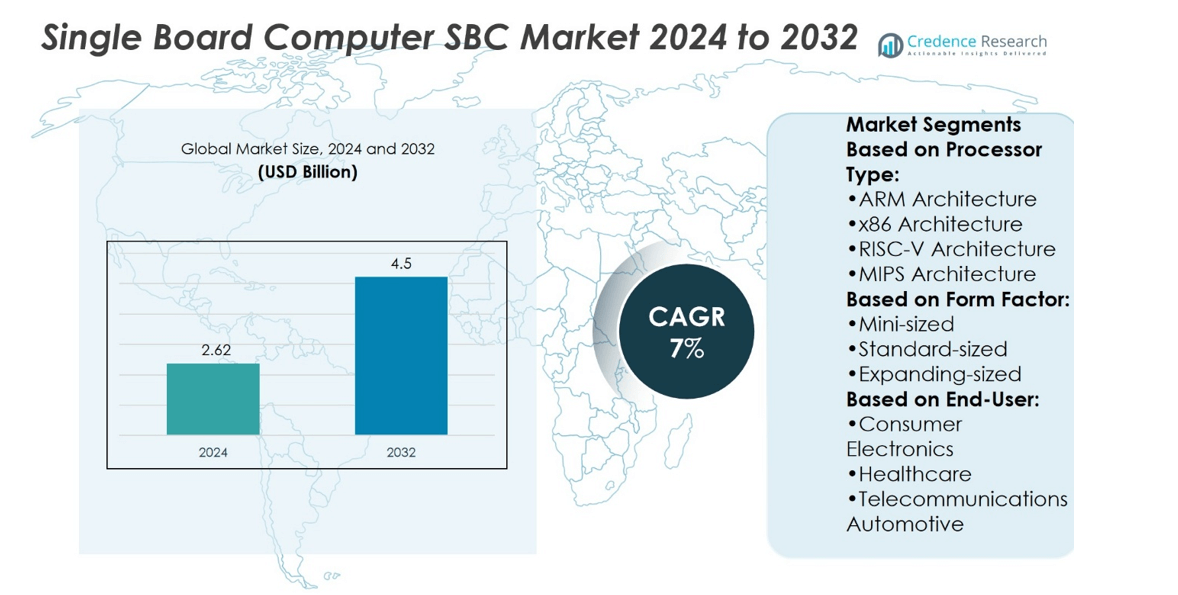 Single Board Computer SBC Market size[/caption]
Market Insights
- The Single Board Computer SBC Market size was valued at USD 2.62 billion in 2024 and is projected to reach USD 4.5 billion by 2032, growing at a CAGR of 7%.
- Rising adoption in industrial automation, IoT ecosystems, and consumer electronics drives steady market growth.
- Integration with AI, edge computing, and open-source platforms defines major trends shaping product innovation.
- The market remains competitive with global players focusing on performance, scalability, and cost efficiency.
- Supply chain disruptions and pricing pressures act as restraints for consistent growth.
- North America leads with advanced R&D, Europe grows through automotive and robotics, and Asia-Pacific emerges as the fastest-growing region.
- Latin America and Middle East & Africa hold smaller shares but show opportunities in education and infrastructure development.
Market Drivers
Rising Adoption Across Embedded and Industrial Applications
The Single Board Computer (SBC) Market advances due to its widespread use in industrial automation, robotics, and embedded systems. Manufacturers and integrators adopt SBCs for compact designs that deliver processing power and connectivity in space-constrained environments. It provides reliable performance for applications that require low latency and energy efficiency. Industrial users favor SBCs for machine vision, predictive maintenance, and control systems. The expansion of IoT ecosystems strengthens its role as a foundation for connected infrastructure. Rising demand across sectors enhances its relevance in mission-critical environments.
- For instance, the Raspberry Pi Foundation announced in 2021 that it had sold more than 40 million Raspberry Pi boards globally since launch, with a significant portion adopted in education and consumer electronics projects worldwide.
Expanding Role in Consumer Electronics and Education
The Single Board Computer SBC Market gains momentum from increasing applications in consumer electronics, gaming consoles, and digital learning platforms. Developers and educators use SBCs to teach programming, AI, and robotics in accessible and cost-effective ways. It supports multimedia streaming, smart home devices, and portable entertainment systems. Gaming enthusiasts rely on SBCs for emulation platforms and hobbyist projects. The growth of e-learning and coding initiatives at schools and universities accelerates adoption. This broad utility reinforces its importance beyond industrial and enterprise use.
- For instance, Intel has shipped nearly 2 billion total units of processors and chips annually, encompassing its Intel Atom®, Core™, and Xeon® lines used in edge devices and SBC platforms that power intelligent automation and AI-first computing solutions.
Integration with AI, Edge Computing, and IoT Ecosystems
The Single Board Computer SBC Market benefits from integration with artificial intelligence and edge computing technologies. It enables real-time data processing close to the source, reducing dependency on centralized cloud infrastructure. Developers implement SBCs for AI-based image recognition, natural language interfaces, and predictive analytics. IoT networks leverage it to connect sensors and devices in healthcare, transportation, and smart city projects. Enhanced processing power and GPU support expand its ability to run complex models. This capability positions SBCs as a core enabler of next-generation digital applications.
Growing Demand for Energy Efficiency and Compact Designs
The Single Board Computer SBC Market experiences strong traction from industries seeking energy-efficient, lightweight, and scalable solutions. It reduces operational costs by minimizing power consumption while maintaining robust performance. Compact architecture allows deployment in drones, wearables, and autonomous systems where size and weight matter. Designers value SBCs for their modular flexibility, supporting a wide range of peripherals. Integration with advanced thermal management techniques improves durability in harsh environments. Rising sustainability targets push companies to adopt efficient platforms that align with environmental goals.
Market Trends
Rising Shift Toward AI-Enabled and Edge Computing Capabilities
The Single Board Computer SBC Market shows a clear trend toward integrating AI acceleration and edge computing functions. It supports real-time analytics, voice recognition, and vision-based applications in industrial, healthcare, and retail sectors. Manufacturers introduce models with GPU and neural processing units to handle complex workloads. This shift strengthens the role of SBCs in decentralized computing where low latency is critical. Developers benefit from scalable hardware that enables compact deployment of advanced AI solutions. The trend highlights the growing fusion of AI with embedded computing platforms.
- For instance, Farnell (element14) survey revealed that approximately 50% of professional engineers currently use SBCs for industrial and IoT projects, reflecting broad acceptance of customizable and open-source-based computing platforms in real-world applications.
Increasing Preference for Open-Source and Customizable Platforms
The Single Board Computer SBC Market demonstrates growing demand for open-source software ecosystems and customizable hardware options. It allows developers to modify operating systems and extend performance through modular add-ons. Open platforms encourage innovation across education, prototyping, and consumer electronics. Companies design SBCs that support a wide range of accessories and connectivity modules. This flexibility promotes faster prototyping cycles and lower development costs. The move toward open ecosystems reflects a shift to collaborative and adaptable computing solutions.
- For instance, Advantech Co. Ltd. offers a comprehensive range of embedded SBCs-including 2.5" Pico-ITX, 3.5", PC/104, and 5.25" EBX form factors-many of which ship with Yocto Linux support and provide extensive extension capabilities through their MI/O module system for flexible customization.
Expanding Use in IoT, Smart Devices, and Connected Infrastructure
The Single Board Computer SBC Market benefits from its adoption across IoT-driven ecosystems and smart infrastructure projects. It enables seamless integration of sensors, controllers, and connected devices for homes, factories, and transportation systems. Smart city initiatives use SBCs for traffic monitoring, energy management, and environmental sensing. Enterprises implement it in logistics and supply chain systems to enhance operational efficiency. The trend emphasizes its role as a backbone for interconnected environments. Rising deployments across diverse sectors confirm its versatility and relevance.
Strong Focus on Miniaturization, Energy Efficiency, and Sustainability
The Single Board Computer SBC Market advances through innovations in compact design and energy-efficient performance. It supports lightweight architectures that fit into drones, robotics, and portable medical devices. Manufacturers emphasize thermal efficiency and extended lifecycle components to ensure durability. Compact models allow engineers to integrate computing power into space-restricted environments. Sustainability goals drive efforts to reduce material usage and improve recyclability. This focus positions SBCs as essential components in next-generation green and efficient technologies.
Market Challenges Analysis
High Competition, Cost Pressures, and Supply Chain Constraints
The Single Board Computer SBC Market faces challenges from intense competition and ongoing price pressures. Multiple vendors introduce low-cost alternatives that reduce margins for established players. It struggles with balancing affordability and advanced feature integration, especially in markets sensitive to pricing. Global supply chain disruptions create shortages of semiconductors and essential components, delaying production and delivery. Manufacturers must adapt sourcing strategies to mitigate risks linked to material scarcity and logistics bottlenecks. These pressures limit scalability and affect consistent availability for industrial and consumer projects.
Technical Limitations, Security Concerns, and Integration Complexity
The Single Board Computer SBC Market also encounters barriers related to technical and operational issues. It requires ongoing advancements in processing power, memory, and connectivity to meet rising demands of AI, IoT, and edge computing. Limited computing capacity in entry-level models restricts adoption in advanced applications. Security vulnerabilities increase risks when SBCs operate in critical infrastructure or connected networks. Integration with diverse hardware and software platforms adds complexity, leading to higher development time and costs. Addressing these challenges is vital to ensure reliability and long-term adoption across competitive sectors.
Market Opportunities
Expansion in Emerging Applications and Industry Verticals
The Single Board Computer SBC Market presents strong opportunities through adoption in emerging industries such as autonomous systems, smart healthcare, and industrial IoT. It supports advanced use cases like patient monitoring, predictive maintenance, and real-time analytics. Growth in electric vehicles and connected mobility opens new prospects for embedded computing platforms. Developers explore opportunities in aerospace, defense, and energy sectors where compact and rugged solutions are essential. Rising demand for edge devices and AI-driven applications expands the scope for high-performance SBCs. These factors create pathways for diversified growth across both consumer and enterprise domains.
Advancements in Customization, Education, and Sustainability Initiatives
The Single Board Computer SBC Market benefits from rising interest in customizable hardware and software platforms that suit varied user needs. It enables educational institutions to deliver cost-effective training in programming, robotics, and AI, building long-term user adoption. Startups and innovators leverage modular SBC designs to accelerate prototyping and reduce product development cycles. Sustainability goals create opportunities for energy-efficient designs that align with green technology standards. Expanding government support for digital learning and clean technology enhances the market potential. These opportunities strengthen the role of SBCs in shaping future digital ecosystems.
Market Segmentation Analysis:
By Processor Type
The Single Board Computer SBC Market segments by processor type into ARM Architecture, x86 Architecture, RISC-V Architecture, and MIPS Architecture. ARM Architecture dominates due to its low power consumption, scalability, and extensive use in IoT and mobile devices. x86 Architecture maintains relevance in applications requiring higher processing power, such as industrial automation and advanced computing environments. RISC-V Architecture gains attention through its open-source nature, allowing flexibility and innovation across research and development. MIPS Architecture continues to find application in embedded systems and networking equipment. Each processor type addresses distinct performance, efficiency, and cost requirements across industries.
- For instance, ADLINK Technology offers SMARC-compliant SBC modules with a remarkably low typical active power draw of 6 W, making them especially suited for ARM-based and energy-sensitive embedded applications.
By Form Factor
The market divides by form factor into mini-sized, standard-sized, and expanding-sized designs. Mini-sized boards gain traction in portable electronics, drones, and compact robotics where space efficiency is critical. Standard-sized SBCs remain widely adopted in industrial automation, consumer electronics, and education due to balanced performance and scalability. Expanding-sized boards appeal to users requiring modularity and expansion slots to integrate peripherals for customized solutions. It supports specialized applications such as industrial control and advanced AI workloads. Growth across these segments highlights the demand for versatility and adaptability in hardware design.
- For instance, VersaLogic Osprey embedded computer a compact, rugged SBC geared toward space-sensitive use measures just 55 mm × 95 mm × 27.5 mm and weighs only 140 g (4.93 oz.), illustrating how high-performance computing can be delivered in an ultra-compact, credit-card–sized form.
By End User
The Single Board Computer SBC Market segments by end user into consumer electronics, healthcare, telecommunications, and automotive. Consumer electronics lead the segment with wide adoption in smart home devices, gaming consoles, and learning platforms. Healthcare applications expand through uses in medical imaging, diagnostics, and portable monitoring systems. Telecommunications firms leverage SBCs for network optimization, edge computing, and connected infrastructure. The automotive sector increasingly integrates it into infotainment systems, advanced driver-assistance features, and electric vehicle platforms. End-user demand reflects a strong balance between commercial innovation and industrial necessity, shaping consistent market expansion.
Segments:
Based on Processor Type:
- ARM Architecture
- x86 Architecture
- RISC-V Architecture
- MIPS Architecture
Based on Form Factor:
- Mini-sized
- Standard-sized
- Expanding-sized
Based on End-User:
- Consumer Electronics
- Healthcare
- Telecommunications
- Automotive
Based on the Geography:
- North America
- U.S.
- Canada
- Mexico
- Europe
- UK
- France
- Germany
- Italy
- Spain
- Russia
- Belgium
- Netherlands
- Austria
- Sweden
- Poland
- Denmark
- Switzerland
- Rest of Europe
- Asia Pacific
- China
- Japan
- South Korea
- India
- Australia
- Thailand
- Indonesia
- Vietnam
- Malaysia
- Philippines
- Taiwan
- Rest of Asia Pacific
- Latin America
- Brazil
- Argentina
- Peru
- Chile
- Colombia
- Rest of Latin America
- Middle East
- UAE
- KSA
- Israel
- Turkey
- Iran
- Rest of Middle East
- Africa
- Egypt
- Nigeria
- Algeria
- Morocco
- Rest of Africa
Regional Analysis
North America
North America holds about 29% of the Single Board Computer SBC Market. Strong demand comes from industrial automation, defense, and healthcare applications. The United States leads in adoption due to high R&D investment and early integration of IoT and edge computing. Education and the maker community also contribute to steady growth. Companies in the region benefit from advanced infrastructure and large-scale deployment opportunities. Reliable supply chains and strong investment capacity sustain its leading position.
Europe
Europe represents close to 20% of the market, supported by strong industrial and automotive sectors. Countries such as Germany, the UK, and France play a central role in manufacturing and robotics adoption. The region emphasizes regulatory compliance, environmental standards, and quality assurance. Growth opportunities exist in smart healthcare, aerospace, and industrial IoT. It benefits from policies promoting sustainability and energy efficiency. Consistent innovation and industrial strength ensure stable demand.
Asia-Pacific
Asia-Pacific captures around 25–30% of the market and shows the fastest growth. China, India, Japan, and South Korea lead in production, consumer electronics, and smart city projects. Expanding digital infrastructure and government support for IoT accelerate adoption. The region benefits from cost-effective manufacturing ecosystems that allow competitive pricing. Rapid urbanization and rising consumer demand expand opportunities in healthcare, automotive, and telecommunications. Asia-Pacific’s scale and momentum position it as a major growth hub.
Latin America
Latin America contributes about 0.1% of the market. Adoption remains modest but is gradually increasing through digital education, industrial automation, and consumer electronics. Brazil and Mexico are the primary markets with rising investments in technology infrastructure. Limited local manufacturing and supply chain constraints restrict faster growth. Governments encourage digital transformation, opening pathways for gradual expansion. Despite a small share, the region presents opportunities in niche industrial and educational applications.
Middle East & Africa
The Middle East & Africa hold nearly 0.08% of the market. Adoption is concentrated in oil and gas, healthcare, and infrastructure projects. Urban development and smart government initiatives create growth potential. Challenges include supply chain limitations and investment gaps. Niche opportunities exist in solar energy, portable medical devices, and remote monitoring systems. Though small in share, the region’s projects align well with compact and energy-efficient SBC solutions.
Key Player Analysis
- Mercury Systems Inc
- Raspberry Pi Foundation
- Xilinx Inc.
- Advantech Co. LTD.
- Intel Corporation
- Eurotech Group
- Qualcomm Incorporated
- Adlink Technology Inc.
- Texas Instruments Incorporated
- Digi International Inc.
Competitive Analysis
The competitive landscape of the Single Board Computer (SBC) Market features such as Adlink Technology Inc., Advantech Co. LTD., Digi International Inc., Eurotech Group, Intel Corporation, Mercury Systems Inc., Qualcomm Incorporated, Texas Instruments Incorporated, Xilinx Inc., and Raspberry Pi Foundation. The Single Board Computer (SBC) Market remains highly competitive, shaped by innovation, price pressures, and the demand for versatile applications. Companies focus on advancing processor performance, expanding connectivity options, and integrating AI and edge computing features into compact designs. Industrial sectors value rugged and durable solutions, while consumer markets emphasize affordability and accessibility. Strong investment in research and development supports differentiation, while partnerships across IoT, healthcare, and automotive ecosystems strengthen market positioning. Education and prototyping communities further drive adoption, expanding awareness and long-term demand. Competitive strategies highlight the balance between cost efficiency, performance scalability, and adaptability to evolving digital environments.
Recent Developments
- In August 2024, the IT hardware PLI 2.0 in India aims to boost domestic manufacturing and global competitiveness in IT Hardware aims to boost domestic manufacturing, reduce dependency on imports.
- In January 2024, Intel Corporation announced the launch of its new 14th Gen Intel Core processor family, featuring up to six cores and improved performance for laptops and desktops.
- In May 2023, Samsung Electronics Co., Ltd. announced the global release of its 2023 Smart Monitor lineup. Samsung's new M8, M7, and M5 Smart Monitors Models Name M80C, M70C, and M50C, allow users to personalize their monitor to their style and demands when watching, playing, and working.
- In April 2023, Samsung Electronics and AMD renewed their multi-year partnership to integrate high-performance AMD Radeon graphics into Samsung Exynos SoCs.
Report Coverage
The research report offers an in-depth analysis based on Processor Type, Form Factor, End-User and Geography. It details leading market players, providing an overview of their business, product offerings, investments, revenue streams, and key applications. Additionally, the report includes insights into the competitive environment, SWOT analysis, current market trends, as well as the primary drivers and constraints. Furthermore, it discusses various factors that have driven market expansion in recent years. The report also explores market dynamics, regulatory scenarios, and technological advancements that are shaping the industry. It assesses the impact of external factors and global economic changes on market growth. Lastly, it provides strategic recommendations for new entrants and established companies to navigate the complexities of the market.
Future Outlook
- The Single Board Computer SBC Market will expand with rising adoption in industrial automation and robotics.
- It will gain momentum from integration with AI, machine learning, and edge computing applications.
- Demand will grow in healthcare for portable monitoring devices and diagnostic systems.
- It will support smart city projects through connected infrastructure and IoT-enabled solutions.
- Consumer electronics and education sectors will continue to drive steady adoption.
- Energy-efficient and compact designs will remain a priority for manufacturers and users.
- Open-source platforms and customizable hardware will encourage innovation and faster prototyping.
- Automotive applications will increase with integration into infotainment, driver assistance, and electric vehicles.
- It will experience strong uptake in telecommunications through edge devices and network optimization.
- Continuous R&D investment and global collaborations will shape long-term competitiveness and growth.

Request a Free Sample
Fill in your details and we'll send you a free sample report.
- Sample data tables & charts
- Research methodology
Market Dynamics
Rising Adoption in Industrial Automation and IoT
Single Board Computers (SBCs) are increasingly used in industrial automation, robotics, and embedded systems due to their compact design, reliable performance, and ability to deliver processing power in space-constrained environments. The expansion of IoT ecosystems further strengthens their role as foundational components for connected infrastructure.
Integration with AI and Edge Computing
SBCs are being integrated with artificial intelligence and edge computing technologies, enabling real-time data processing close to the source. This reduces reliance on centralized cloud infrastructure and supports advanced applications such as image recognition, predictive analytics, and smart city solutions.
Expanding Role in Consumer Electronics and Education
The versatility and affordability of SBCs have led to their widespread adoption in consumer electronics, gaming, and educational platforms. They are used for teaching programming, powering smart home devices, and supporting multimedia and entertainment systems, broadening their market reach.
Demand for Energy Efficiency and Compact Designs
Industries are seeking energy-efficient and lightweight computing solutions, and SBCs meet these needs with their low power consumption and compact architectures. This makes them ideal for deployment in drones, wearables, and autonomous systems where size, weight, and energy use are critical.
Preference for Open-Source and Customizable Platforms
The market is experiencing a shift toward open-source software ecosystems and customizable hardware, allowing developers and companies to innovate rapidly and reduce development costs. This trend supports faster prototyping, adaptability, and collaborative development across various sectors.
Need a Custom Version of This Report?
Tailor the scope, geography, or segments to your exact requirements.
- Custom geography or segment scope
- Direct access to our analyst team
Frequently Asked Questions
What is the current market size for Single Board Computer SBC Market, and what is its projected size in 2032?
At what Compound Annual Growth Rate is the Single Board Computer SBC Market projected to grow between 2025 and 2032?
What are the primary factors fueling the growth of the Single Board Computer SBC Market?
Who are the leading companies in the Single Board Computer SBC Market?
Table of Content
Chapter 1 Market Segmentation
- 1.1 Segmentation Framework
- 1.1.1 Product and Service Classification
- 1.1.2 Application and End-Use Classification
- 1.1.3 Technology and Solution Classification
- 1.1.4 Customer and Distribution Channel Classification
- 1.1.5 Geographic Segmentation
- 1.1.6 Market Segment Definitions and Boundaries
- 1.2 By End-User
- 1.2.1 Consumer Electronics
- 1.2.2 Healthcare
- 1.2.3 Telecommunications
- 1.2.4 Automotive
- 1.3 By Form Factor
- 1.3.1 Mini-sized
- 1.3.2 Standard-sized
- 1.3.3 Expanding-sized
- 1.4 By Processor Type
- 1.4.1 ARM Architecture
- 1.4.2 x86 Architecture
- 1.4.3 RISC-V Architecture
- 1.4.4 MIPS Architecture
Chapter 2 Introduction
- 2.1 Report Objectives and Scope
- 2.2 Product Definition and Industry Terminology
- 2.3 Market Inclusions and Exclusions
- 2.4 Research Process
- 2.4.1 Primary Research and Expert Interviews
- 2.4.2 Secondary Research and Source Review
- 2.4.3 Top-Down and Bottom-Up Estimation
- 2.4.4 Data Triangulation and Verification
- 2.5 Market Size Measurement Basis
- 2.5.1 2024: USD 2.62 billion → 2032: USD 4.5 billion
- 2.6 Historical and Forecast Reference Periods
- 2.6.1 Base Year: 2024
- 2.6.2 Forecast Period: 2024-2032
- 2.7 Research Assumptions and Limitations
Chapter 3 Executive Summary
- 3.1 Market Snapshot and Key Findings
- 3.2 Base-Year Market Size, 2024
- 3.3 Forecast Market Size, 2032
- 3.4 Revenue and Volume Growth Outlook
- 3.5 Key Demand and Supply Indicators
- 3.6 Leading Market Segments
- 3.7 Fastest-Growing Market Opportunities
- 3.8 Regional Performance Highlights
- 3.9 Technology and Industry Transformation
- 3.10 Competitive Landscape Summary
- 3.11 Analyst View and Strategic Implications
Chapter 4 Global Single Board Computer (SBC) Market Trends and Developments
- 4.1 Historical Industry Development
- 4.2 Recent Market Trends and Developments
- 4.3 Demand and Customer Behavior Trends
- 4.4 Technology and Product Innovation
- 4.5 Artificial Intelligence, Automation and Digitalization
- 4.6 Local Manufacturing and Supply Chain Realignment
- 4.7 Industry Partnerships, Mergers and Acquisitions
- 4.8 Sustainability and Circular Economy Developments
- 4.9 Government and Private Sector Investment Trends
- 4.10 Emerging Business Models and Commercialization
- 4.11 Industry Developments and Announcements
Chapter 5 Global Single Board Computer (SBC) Market Production, Supply and Demand Analysis
- 5.1 Demand Trend and Consumption Analysis
- 5.2 Demand Forecast, 2024-2032
- 5.3 Production and Output Trend
- 5.4 Production and Output Forecast, 2024-2032
- 5.5 Installed Capacity and Capacity Utilization
- 5.6 Company-Wise Production Plants and Statistics
- 5.6.1 Installed Production Capacity
- 5.6.2 Actual Production
- 5.6.3 Planned Capacity and Expansion Targets
- 5.7 Supply Chain Structure and Procurement Trends
- 5.8 Supply-Demand Gap and Bottlenecks
- 5.9 Import Dependence and Sourcing Structure
- 5.10 Contract Manufacturing and Outsourcing
- 5.11 Regional Supply and Demand Concentration
Chapter 6 Global Single Board Computer (SBC) Market Pricing Analysis
- 6.1 Pricing Structure and Measurement
- 6.2 Historical Pricing Trends
- 6.3 Pricing Outlook, 2024-2032
- 6.4 Average Selling Price and Unit Economics
- 6.5 Pricing by Product and Market Segment
- 6.6 Geographic Pricing Differences
- 6.7 Key Input, Energy, Labor and Logistics Costs
- 6.8 Contract Pricing and Purchasing Models
- 6.9 Pricing Sensitivity and Competitive Positioning
- 6.10 Price, Margin and Profitability Implications
Chapter 7 Global Single Board Computer (SBC) Market Dynamics
- 7.1 Market Growth Drivers
- 7.1.1 Demand-Side Drivers
- 7.1.2 Technology and Innovation Drivers
- 7.1.3 Infrastructure and Investment Drivers
- 7.1.4 Regulatory and Policy Drivers
- 7.2 Market Restraints
- 7.2.1 Cost and Affordability Constraints
- 7.2.2 Technology and Adoption Barriers
- 7.2.3 Supply Chain and Operational Constraints
- 7.3 Market Challenges
- 7.3.1 Competitive Pressure and Margin Erosion
- 7.3.2 Skills, Infrastructure and Implementation Gaps
- 7.4 Emerging Market Opportunities
- 7.5 Market Dynamics Impact and Time-Horizon Assessment
Chapter 8 Global Single Board Computer (SBC) Value Chain Analysis
- 8.1 Industry Value Chain Overview
- 8.2 Upstream Suppliers and Critical Inputs
- 8.3 Technology and Component Providers
- 8.4 Manufacturing or Service Delivery
- 8.5 Distribution, Channel Partners and Integrators
- 8.6 Downstream Applications and End Users
- 8.7 Value Addition and Profit Pools
- 8.8 Vertical Integration and Outsourcing
- 8.9 Supplier Concentration and Risk
- 8.10 Supply Chain Localization and Resilience
Chapter 9 Global Single Board Computer (SBC) Market Regulations and Policies
- 9.1 Relevant Laws, Standards and Compliance Frameworks
- 9.2 Product, Service, Safety and Quality Requirements
- 9.3 Government Policies, Incentives and Subsidies
- 9.4 Imports, Exports and Trade Barriers
- 9.5 Public Procurement and Local Content Requirements
- 9.6 Environmental and Sustainability Compliance
- 9.7 Upcoming Policy Changes and Market Implications
Chapter 10 Global Single Board Computer (SBC) Market Hotspots and Opportunities
- 10.1 Market Opportunity Mapping and Growth Hotspots
- 10.2 High-Growth Applications and Customer Groups
- 10.3 Underserved Markets and White-Space Opportunities
- 10.4 Emerging Technology and Product Opportunities
- 10.5 New Capacity and Investment Hotspots
- 10.6 Market Entry and Expansion Opportunities
- 10.7 Distribution and Partnership Opportunities
- 10.8 Near-Term and Long-Term Commercial Potential
- 10.9 Opportunity Attractiveness and Execution Risks
Chapter 11 Global Single Board Computer (SBC) Market Outlook, 2024-2032
- 11.1 Market Size and Analysis
- 11.1.1 Revenue (Market Measurement: 2024: USD 2.62 billion → 2032: USD 4.5 billion)
- 11.1.2 Market Volume and Quantity Sold
- 11.1.3 Historical Market Size
- 11.1.4 Base-Year Market Size, 2024
- 11.2 Market Forecast, 2024-2032
- 11.2.1 Revenue Forecast to 2032
- 11.2.2 Volume Forecast to 2032
- 11.2.3 CAGR and Year-on-Year Growth
- 11.2.4 Incremental Revenue Opportunity
- 11.3 Forecast Assumptions and Scenario Analysis
- 11.3.1 Base-Case Forecast
- 11.3.2 Optimistic and Conservative Scenarios
- 11.3.3 Technology, Pricing and Policy Sensitivities
- 11.4 Market Attractiveness and Growth Outlook
Chapter 12 Global Single Board Computer (SBC) Market Segmentation and Outlook
- 12.1 Segmentation Summary and Market Shares, 2024
- 12.2 Largest and Fastest-Growing Segments
- 12.3 By End-User - Market Size and Forecast, 2024-2032
- 12.3.1 Segment Definition and Scope
- 12.3.2 Historical Market Size
- 12.3.3 Revenue Forecast, 2024-2032
- 12.3.4 Volume Forecast, 2024-2032
- 12.3.5 Base-Year Market Share, 2024
- 12.3.6 Segment CAGR and Growth Drivers
- 12.3.7 Subsegment Market Size and Forecast
- 12.3.7.1 Consumer Electronics
- 12.3.7.2 Healthcare
- 12.3.7.3 Telecommunications
- 12.3.7.4 Automotive
- 12.3.8 Subsegment Pricing and Adoption Trends
- 12.3.9 Leading Suppliers and Competition
- 12.3.10 Regional Demand and Opportunities
- 12.4 By Form Factor - Market Size and Forecast, 2024-2032
- 12.4.1 Segment Definition and Scope
- 12.4.2 Historical Market Size
- 12.4.3 Revenue Forecast, 2024-2032
- 12.4.4 Volume Forecast, 2024-2032
- 12.4.5 Base-Year Market Share, 2024
- 12.4.6 Segment CAGR and Growth Drivers
- 12.4.7 Subsegment Market Size and Forecast
- 12.4.7.1 Mini-sized
- 12.4.7.2 Standard-sized
- 12.4.7.3 Expanding-sized
- 12.4.8 Subsegment Pricing and Adoption Trends
- 12.4.9 Leading Suppliers and Competition
- 12.4.10 Regional Demand and Opportunities
- 12.5 By Processor Type - Market Size and Forecast, 2024-2032
- 12.5.1 Segment Definition and Scope
- 12.5.2 Historical Market Size
- 12.5.3 Revenue Forecast, 2024-2032
- 12.5.4 Volume Forecast, 2024-2032
- 12.5.5 Base-Year Market Share, 2024
- 12.5.6 Segment CAGR and Growth Drivers
- 12.5.7 Subsegment Market Size and Forecast
- 12.5.7.1 ARM Architecture
- 12.5.7.2 x86 Architecture
- 12.5.7.3 RISC-V Architecture
- 12.5.7.4 MIPS Architecture
- 12.5.8 Subsegment Pricing and Adoption Trends
- 12.5.9 Leading Suppliers and Competition
- 12.5.10 Regional Demand and Opportunities
- 12.6 Segment Growth Comparison
- 12.7 Segment Attractiveness and Priority Matrix
Chapter 13 Global Single Board Computer (SBC) End-Use and Application Market Outlook
- 13.1 End-Use Industry and Customer Demand Structure
- 13.2 Leading Applications and Customer Groups
- 13.3 End-Use Market Size, Share and Forecast
- 13.4 Major End-Use Industry Deep Dives
- 13.4.1 Customer Requirements and Use Cases
- 13.4.2 Demand and Replacement Cycles
- 13.4.3 Technical and Regulatory Considerations
- 13.4.4 Purchasing and Procurement Models
- 13.4.5 Leading Vendors and Distribution Channels
- 13.4.6 Forecast and Commercial Opportunities
- 13.5 Emerging Applications and Cross-Segment Demand
- 13.6 End-Use Industry Investment Priorities
Chapter 14 Global Single Board Computer (SBC) Geographic Market Outlook, 2024-2032
- 14.1 Regional Market Size and Share, 2024
- 14.2 Regional Market Forecast, 2024-2032
- 14.3 Regional Pricing, Production and Demand Differences
- 14.4 North America
- 14.4.1 United States
- 14.4.2 Canada
- 14.4.3 Mexico
- 14.5 Europe
- 14.5.1 Germany
- 14.5.2 France
- 14.5.3 Italy
- 14.5.4 United Kingdom
- 14.5.5 Spain
- 14.5.6 Poland
- 14.5.7 Russia
- 14.5.8 Netherlands
- 14.5.9 Belgium
- 14.5.10 Sweden
- 14.5.11 Denmark
- 14.5.12 Norway
- 14.5.13 Rest of Europe
- 14.6 Asia Pacific
- 14.6.1 China
- 14.6.2 India
- 14.6.3 Japan
- 14.6.4 South Korea
- 14.6.5 Thailand
- 14.6.6 Indonesia
- 14.6.7 Vietnam
- 14.6.8 Malaysia
- 14.6.9 Australia
- 14.6.10 Rest of Asia Pacific
- 14.7 Latin America
- 14.7.1 Brazil
- 14.7.2 Argentina
- 14.7.3 Colombia
- 14.7.4 Chile
- 14.7.5 Rest of Latin America
- 14.8 Middle East
- 14.8.1 Saudi Arabia
- 14.8.2 United Arab Emirates
- 14.8.3 Turkey
- 14.8.4 Israel
- 14.8.5 Iran
- 14.8.6 Rest of the Middle East
- 14.9 Africa
- 14.9.1 South Africa
- 14.9.2 Egypt
- 14.9.3 Nigeria
- 14.9.4 Morocco
- 14.9.5 Rest of Africa
- 14.10 Regional Investment, Policy and Supply Chain Differences
- 14.11 Regional Competitive Landscape
- 14.12 Geographic Growth Hotspots
Chapter 15 Global Single Board Computer (SBC) Technology, Innovation and Sustainability Outlook
- 15.1 Technology Landscape and Maturity
- 15.2 Product, Process and Service Innovation
- 15.3 AI, Automation and Digital Tools in the Industry
- 15.4 Technology Adoption and Performance Benchmarking
- 15.5 Innovation Pipeline and R&D Investment
- 15.6 Patent and Intellectual Property Trends
- 15.7 Energy Efficiency and Resource Management
- 15.8 Sustainability, Recycling and Circularity
- 15.9 Technology Roadmap, 2024-2032
- 15.10 Risks of Obsolescence and Technology Substitution
Chapter 16 Global Single Board Computer (SBC) Market Key Strategic Imperatives
- 16.1 Growth and Market Entry Priorities
- 16.2 High-Return Products and Segments
- 16.3 Pricing, Profitability and Cost Optimization
- 16.4 Technology Investment and Product Differentiation
- 16.5 Supply Chain Localization and Resilience
- 16.6 Distribution and Customer Acquisition
- 16.7 Partnership, Acquisition and Capacity Strategy
- 16.8 Regional Expansion Priorities
- 16.9 Short-, Medium- and Long-Term Actions
Chapter 17 Competition Outlook
- 17.1 Industry Competition Characteristics
- 17.2 Market Structure and Concentration
- 17.3 Market Share and Competitive Positioning, 2024
- 17.4 Company-Wise Revenue and Product Benchmarking
- 17.5 Production and Service Capacity Benchmarking
- 17.6 Technology, Pricing and Differentiation
- 17.7 Regional Footprint and Distribution Strength
- 17.8 Mergers, Acquisitions and Strategic Alliances
- 17.9 New Entrants and Competitive Threats
- 17.10 Porter's Five Forces and Industry Attractiveness
- 17.11 Competitive Outlook, 2024-2032
Chapter 18 Company Profiles
- 18.1 Company Coverage and Selection Criteria
- 18.2 Adlink Technology Inc.
- 18.2.1 Business Description
- 18.2.2 Company Ownership and Geographic Presence
- 18.2.3 Product and Service Portfolio
- 18.2.4 Manufacturing and Operating Footprint
- 18.2.5 Production Capacity and Expansion Plans
- 18.2.6 Financial Performance and Investment
- 18.2.7 Market Share and Competitive Position
- 18.2.8 Technology and Innovation Capabilities
- 18.2.9 Strategic Alliances or Partnerships
- 18.2.10 Recent Developments
- 18.2.11 Growth Strategy and Outlook
- 18.3 Advantech Co. LTD.
- 18.4 Intel Corporation
- 18.5 Qualcomm Incorporated
- 18.6 Texas Instruments Incorporated
- 18.7 Raspberry Pi Foundation
- 18.8 Digi International Inc.
- 18.9 Eurotech Group
- 18.10 Mercury Systems Inc.
- 18.11 Xilinx Inc.
- 18.12 Other Relevant Market Participants
Note: Every listed company is profiled on the structure shown under the first company. The company list is preliminary and may change based on research findings, market developments, data availability and client requirements.
Chapter 19 Disclaimer
- 19.1 Research and Forecast Disclaimer
- 19.2 Data Source and Estimation Limitations
Note: The depth of individual sections depends on data availability for this market. Volume, capacity, trade and other unit-based metrics are included where applicable.

