
Near-universal dog cover makes Sweden a mature pet market
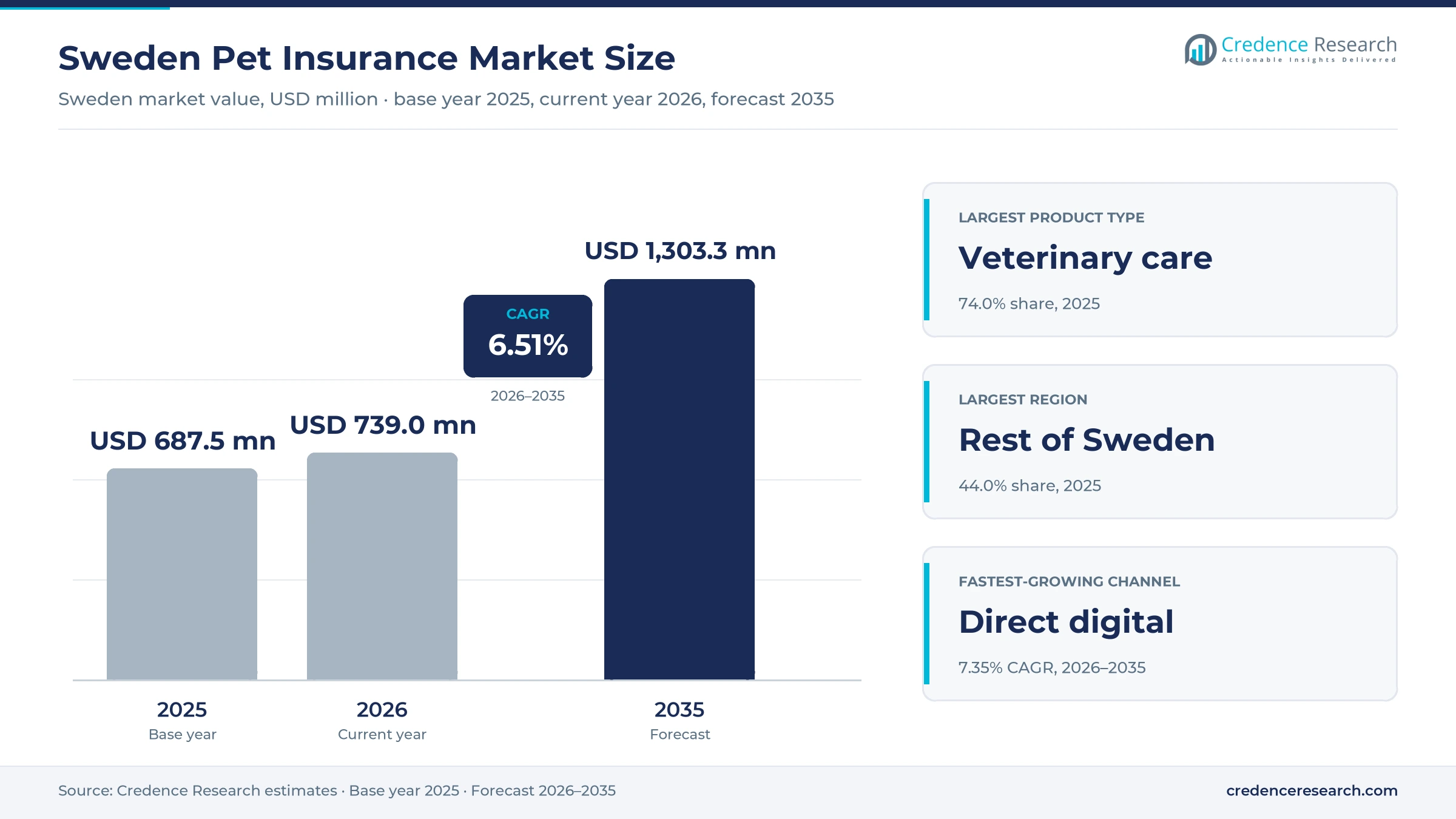
The Sweden pet insurance market was valued at USD 687.5 million in 2025 and is projected to increase from USD 739.0 million in 2026 to USD 1.30 billion by 2035, registering a CAGR of 6.51% during 2026–2035. Demand comes from dog owners who treat veterinary cover as standard, cat owners who are closing the gap with dogs, and horse owners who insure both care costs and the value of the animal. Rest of Sweden held the largest regional share, 44.0% in 2025, because 18 of the 21 counties sit outside the three biggest population centers. Stockholm County is the fastest-growing region at 6.79% a year, as higher clinic prices and dense cat ownership raise the premium paid per animal. Regular veterinary prices for dogs and cats rose by around 40% between 2020 and May 2025, which keeps cover valuable even for owners who already insure. Separately, the government asked the Swedish Consumer Agency in April 2026 to work toward published veterinary prices, which may change how insurers manage claims.
What cover types fall inside the market scope?
The estimate measures gross written premiums for animal insurance sold to Swedish households and breeders. It covers veterinary care insurance for dogs, cats, horses and small animals, life insurance that pays when an animal dies or must be put down, breeding insurance for litters, mares and foals, and ancillary cover such as dental, rehabilitation and usability add-ons. Values include policies sold online, by phone, through branches and through breeders, banks and retail partners.
The estimate excludes farm livestock insurance written for commercial herds, travel cover sold with pet passports, and out-of-pocket veterinary spending. The value chain runs from specialist, mutual, diversified and digital-first insurers, often backed by reinsurers, through apps, call centers, breeders and kennel clubs to owners, who then claim against invoices from clinics and animal hospitals.
Sweden Pet Insurance Market Insights
- The Sweden pet insurance market was valued at USD 687.5 million in 2025 and is projected to reach USD 1.30 billion by 2035, registering a CAGR of 6.51% during 2026–2035.
- Counties outside Stockholm, Västra Götaland and Skåne held a combined 44.0% share of 2025 premium value, reflecting their larger share of rural dog and horse owners.
- Veterinary care insurance led product demand with a 74.0% share of 2025 value, because it pays the clinic bills that drive most claims.
- More than 90% of Swedish dogs and 65% of cats were insured in a survey released on April 14, 2026, among the highest rates anywhere.
- Hedvig dog and cat terms effective Jan. 1, 2025 include FirstVet video advice and a deductible cut of SEK 1,000 when the first contact for a claim is digital.
Vet care cover leads as add-ons and cat cover grow fastest
Why does veterinary care cover dominate Swedish premiums?
Based on product type, the market is categorized into veterinary care insurance, life insurance, breeding insurance and ancillary cover. Veterinary Care Insurance led with a 74.0% share of 2025 value, because clinic invoices for illness and injury drive most claims. Ancillary Cover grows fastest at 7.41% a year, as owners add dental, rehabilitation and usability modules to their core policies.
How do dog, cat and horse owners split premium value?
Based on customer segment, the market is categorized into dog owners, cat owners, horse owners and small animal owners. Dog Owners led with a 58.0% share of 2025 value, because nearly every dog is insured and dog premiums are higher. Cat Owners grow fastest at 7.55% a year, as insurance rates for cats keep rising from a lower base.
Which sales channels win new Swedish policyholders?
Based on distribution channel, the market is categorized into direct digital, insurer branch and call center, affinity and partner distribution, and comparison and advisory channels. Direct Digital led with a 38.0% share of 2025 value, because most owners now buy and renew online. Direct Digital also grows fastest at 7.35% a year, as app-based insurers win new owners.
How are specialist and digital-first insurers positioned?
Based on institution type, the market is categorized into specialist pet insurers, diversified non-life insurers, mutual and customer-owned insurers, and digital-first insurers. Specialist Pet Insurers led with a 66.0% share of 2025 value, because long-established animal insurers hold most dog and horse policies. Digital-First Insurers grow fastest at 9.46% a year, as younger owners switch to app-based cover.
| Segment Group | Leading Sub-segment | Share, 2025 | Fastest-growing Sub-segment | CAGR, 2026–2035 |
|---|---|---|---|---|
| By Product Type | Veterinary Care Insurance | 74.0% | Ancillary Cover | 7.41% |
| By Customer Segment | Dog Owners | 58.0% | Cat Owners | 7.55% |
| By Distribution Channel | Direct Digital | 38.0% | Direct Digital | 7.35% |
| By Institution Type | Specialist Pet Insurers | 66.0% | Digital-First Insurers | 9.46% |
Request a Free Sample
Fill in your details and we'll send you a free sample report.
- Sample data tables & charts
- Research methodology
High coverage, vet inflation and digital care lift premiums
How do high insurance rates and pet numbers anchor demand?
Most Swedish dog and cat owners treat cover as a standard part of keeping an animal, which gives insurers a broad and stable base. A Novus survey of 10,284 owners for Agria and the Swedish Kennel Club found that more than 90% of dogs and 65% of cats were insured, according to an Agria release of April 14, 2026. The same survey counted about 951,000 dogs and 1,582,000 cats nationwide, while 63% of dogs and just over a quarter of cats also carried life cover. The Swedish Board of Agriculture estimated 355,500 horses in 2016, and owners usually insure both care costs and the value of each animal. As a result, dog owners form the largest customer group with 58.0% of 2025 premium value.
Why does veterinary cost inflation sustain premium value?
Clinic bills keep climbing, so owners need cover that keeps pace with the rising price of treatment. Regular prices for non-preventive dog and cat care rose by around 40% on average between 2020 and May 2025, while emergency prices rose by up to 50%, according to the Swedish Competition Authority. Claims paid by insurers had already more than doubled since 2013, reaching SEK 4 billion in 2022, as advanced companion animal care spread to more clinics. Sveland reported in its 2025 annual report that claims costs rose sharply and that it raised premiums during the year. In turn, veterinary care insurance leads product demand with 74.0% of 2025 value.
How does digital care integration raise the value of cover?
Owners can now reach a veterinarian by video before deciding whether a clinic visit is needed, which makes a policy useful even without a claim. Hedvig's dog and cat terms effective Jan. 1, 2025 include an annual check-up and video advice through FirstVet, according to its pre-purchase information. The same terms cut the base deductible by SEK 1,000 when the first contact for a claim goes through partner digital channels. Lassie, which the Swedish Quality Index named the pet insurer with the most satisfied customers in 2024, builds prevention courses and injury reporting into its app. As a result, direct digital sales grow fastest among channels at 7.35% a year.
Why do higher cover limits lift spending per animal?
Owners are choosing larger annual care ceilings as treatment bills grow, which lifts the premium paid for each animal. If Skadeförsäkring's dog and cat terms from May 2026 offer care ceilings of SEK 40,000, 80,000 or 120,000 a year, with separate limits for CT and MRI diagnostic imaging. Dina's horse terms from September 2025 also let owners pick care limits of up to SEK 120,000 per period, plus an optional dental add-on. Premium income from animal insurance reached SEK 5.7 billion in 2022 after more than doubling over 10 years, according to Insurance Sweden. As a result, ancillary cover grows fastest among product types at 7.41% a year.
Price transparency and digital challengers reshape cover
How is the shift to veterinary price transparency changing claims?
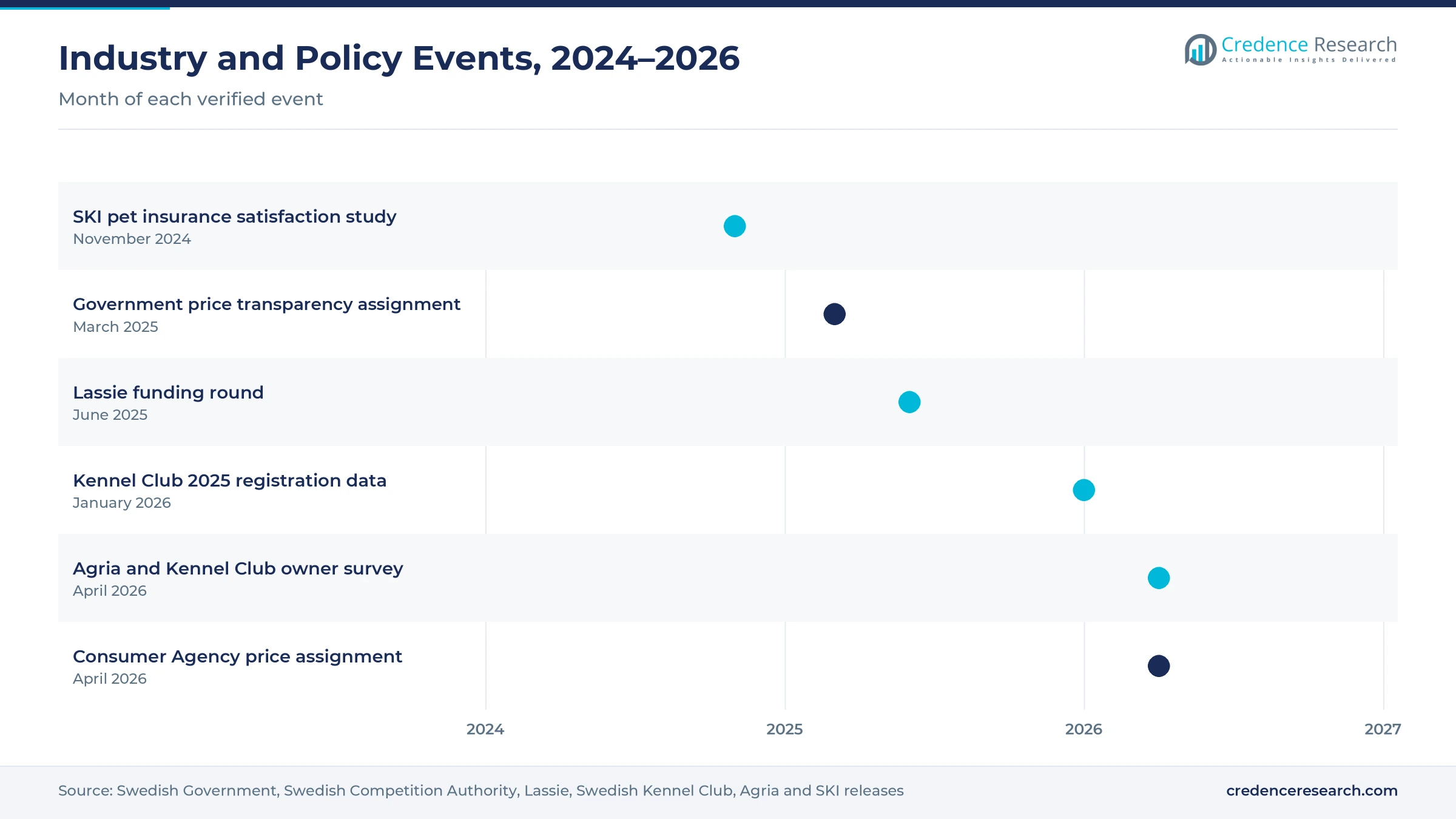
Published clinic prices make expensive treatment easier to compare, and this shift is changing how insurers think about claims costs. The government asked the Swedish Competition Authority in March 2025 to map price transparency in companion animal care and propose concrete measures by March 1, 2026. Its report made four proposals, including an industry agreement on price information on clinic websites and extending consumer services law to the treatment of live animals. The authority also found that insurers had remained largely passive in restraining price increases. In turn, the government asked the Swedish Consumer Agency on April 23, 2026 to report on a price agreement by March 1, 2027, which should favor insurers that steer owners toward clear prices.
Why is the rise of app-based challengers notable?
Younger owners now compare cover on their phones rather than through branches or breeders, which favors app-based challengers. Pet insurance scored 73.9 in the Swedish Quality Index study of November 2024, the highest of any insurance category, with app-based Lassie at the top on 81.8. Hedvig introduced basic and premium dog and cat cover with FirstVet video calls built in from 2025, while comparison sites now filter policies by deductible, waiting period and cat dental cover. However, the same index reported that pet insurance satisfaction fell sharply during 2025, which pushes owners to compare offers. As a result, digital-first insurers grow at 9.46% a year on insurtech platforms built for self-service.
Can cat cover close the gap with dog insurance?
Sweden has far more cats than dogs but insures a smaller share of them, which makes cats the clearest growth opening. The April 2026 survey for Agria counted about 1,582,000 cats, yet only 65% were insured compared with more than 90% of dogs. Just over a quarter of cats carried life cover, against 63% of dogs, which leaves room for add-on sales. Insurers are also tailoring terms, as If's May 2026 cat cover includes a separate annual limit of SEK 10,000 for the dental condition TR, also called FORL. In turn, cat owners grow at 7.55% a year, the fastest customer rate.
Will EU traceability rules create a new point of sale?
Mandatory identification and registration of every dog and cat give insurers a clear point to offer cover at purchase. After an agreement reached in 2025, the Council and the European Parliament adopted Regulation (EU) 2026/1818 on the welfare and traceability of dogs and cats, which applies from Aug. 31, 2028. Sweden already runs a national dog register, which recorded 56,801 new dog registrations in 2025, according to the Swedish Kennel Club. Svedea also sells breeding insurance in standard and XL versions alongside its dog cover from Jan. 1, 2025. As a result, affinity and partner distribution through breeders, kennel clubs and clinics should keep a strong role in new-pet sales.
Fewer new dogs and rising claims squeeze pet insurers
How do falling dog registrations slow new policy growth?
Most dog policies start when a puppy is bought, so fewer puppies mean fewer new policies each year. The national dog register recorded 56,801 new registrations in 2025, down 10.4% from 2024, according to the Swedish Kennel Club. Länsförsäkringar also noted that registrations of new puppies kept falling in 2025. The decline matters most for breeders and kennel clubs, which arrange many first policies at the point of purchase. To offset this, insurers sell more add-ons, cat cover and higher care ceilings to existing policyholders.
Why does claims inflation squeeze underwriting margins?
Clinic prices rise faster than insurers can reprice annual policies, which squeezes underwriting margins. Veterinary prices rose far faster than general inflation between 2020 and May 2025, and emergency prices rose faster still. As a result, insurers such as Sveland raised premiums in 2025 to protect long-term profitability. Higher premiums in turn push some owners toward basic cover with lower care ceilings, which reduces the premium paid per animal. Insurers respond with higher deductibles, separate limits for costly treatments and claims-prevention courses for owners.
How do weaker satisfaction scores raise switching risk?
Owners who feel premiums are too high start comparing offers, which raises the risk of losing customers at renewal. The Swedish Quality Index reported that pet insurance satisfaction fell sharply during 2025, led by value for money and loyalty. However, switching carries its own risk, as a new insurer may exclude conditions that began under the old policy. This risk is highest for older animals, because many insurers cut the insured amount once an animal reaches a certain age. Loyalty terms, clearer renewal letters and faster digital claims are the main tools insurers use to keep these customers.
Why does clinic consolidation weaken insurer bargaining power?
Two veterinary chains hold a dominant position in Swedish companion animal care, according to Sveland's 2025 annual report. As a result, insurers have limited leverage over treatment prices and referral patterns. Fewer independent clinics also make it harder to steer owners toward cheaper care. Smaller insurers feel this most, because they lack the claims volume needed to negotiate direct billing terms with large chains. This is why insurers back video vet services, direct billing agreements and the new price transparency rules.
Counties outside the big three hold most pet premiums
| Region | Value, 2025 (USD million) | Share, 2025 | CAGR, 2026–2035 |
|---|---|---|---|
| Rest of Sweden | 302.5 | 44.0% | 6.29% |
| Stockholm County | 168.4 | 24.5% | 6.79% |
| Västra Götaland | 116.9 | 17.0% | 6.49% |
| Skåne | 99.7 | 14.5% | 6.69% |
Why do the remaining counties hold the largest share?
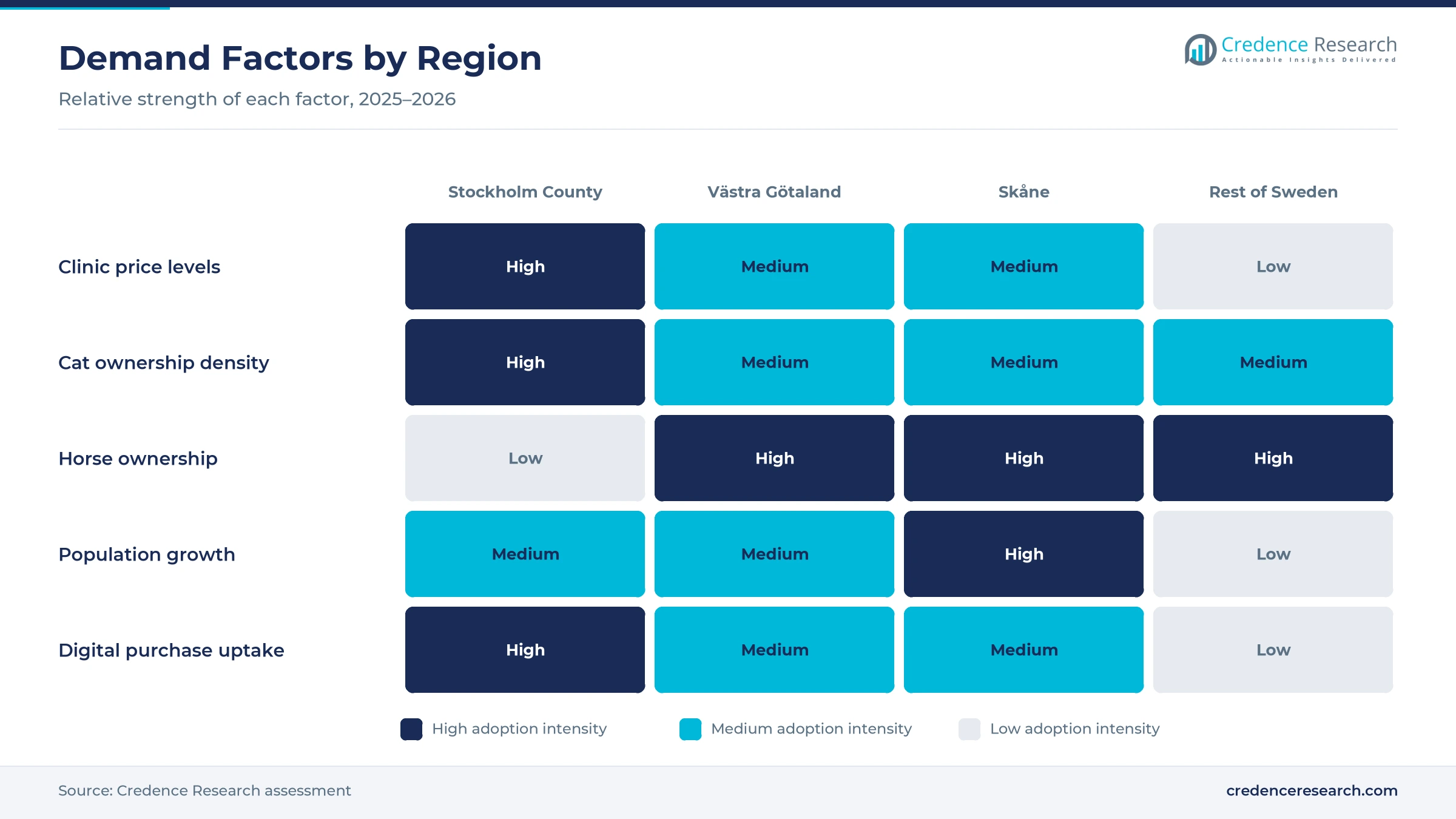
The rest of Sweden held a 44.0% share of 2025 value and grows at 6.29% a year, because its 18 counties are home to about 4.9 million people and many rural dog and horse owners. Hunting breeds matter here, as the jämthund ranked fourth among Swedish Kennel Club registrations in 2025 with 1,117 dogs. However, growth is slower because the population fell in 14 of 21 counties during 2025.
How does Stockholm county lead premium growth?
Stockholm County held a 24.5% share of 2025 value and grows fastest at 6.79% a year, because higher clinic prices and apartment-based cat ownership lift the premium paid per animal. The county had about 2.47 million residents at the end of 2024, the largest of any county. In turn, app-based insurers find many of their younger customers in the capital region, where digital purchase is the norm.

What supports demand in Västra Götaland?
Västra Götaland held a 17.0% share of 2025 value and grows at 6.49% a year, because Gothenburg combines a large urban pet population with farming districts that keep horses. The county had about 1.77 million residents at the end of 2024. As a result, demand is spread across dog, cat and horse cover, while equine health care costs keep horse care limits in demand.
Why does Skåne gain ground in premium value?
Skåne held a 14.5% share of 2025 value and grows at 6.69% a year, because the county drew the largest net domestic inflow of any county in 2025, according to Statistics Sweden. Skåne had about 1.43 million residents at the end of 2024, and its farming districts keep many horses alongside dogs and cats. In turn, new households moving to the Malmö and Helsingborg areas add fresh demand for dog and cat cover.

Funding rounds, price reviews and surveys from 2024 to 2026
| Development | Status and market relevance |
|---|---|
| In March 2025, the government asked the Swedish Competition Authority to map veterinary price transparency. | Led to four proposals in a 2026 report |
| In November 2024, the Swedish Quality Index rated pet insurance the top insurance category at 73.9. | Satisfaction then fell sharply during 2025 |
| In January 2026, the Swedish Kennel Club reported 56,801 new dog registrations for 2025. | Down 10.4% from 2024, slowing new policies |
| In April 2026, a survey for Agria found more than 90% of dogs and 65% of cats insured. | Confirms one of the highest insurance rates |
| In April 2026, the government asked the Swedish Consumer Agency to work toward published veterinary prices. | Report due by March 1, 2027 |
Video vets and app-based claims change how owners use cover
- Video veterinary consultations let owners get advice from a licensed veterinarian before a clinic visit, which lowers the number of small claims and, under some policies, cuts the deductible.
- App-based claims and injury reporting collect invoices, photos and medical notes online, which shortens settlement times for routine claims and lowers handling costs for insurers.
- Prevention courses and reminders teach owners how to avoid common injuries and illnesses in dogs and cats, which supports lower claims frequency and better retention over time.
- Online policy comparison tools filter dog and cat policies by care ceiling, deductible, waiting period and dental cover, which raises price competition between established and digital-first insurers.
Need a Custom Version of This Report?
Tailor the scope, geography, or segments to your exact requirements.
- Custom geography or segment scope
- Direct access to our analyst team
A specialist leader faces digital-first and mutual rivals
Competition is led by specialist animal insurers with long breed claims histories, alongside diversified non-life groups, mutual insurers and app-based challengers. Agria, founded in 1890 and owned within the Länsförsäkringar group, holds the leading position in dog, cat and horse cover. Agria acquired the digital vet service Vethem in 2020 and launched its Vårdguide app for owners at the same time. Sveland Djurförsäkringar insures animals from horses to rabbits and raised premiums in 2025 as claims costs climbed. If Skadeförsäkring sells dog and cat cover with care ceilings up to SEK 120,000 a year, while Dina Försäkringar offers horse care, life and foal cover. Svedea sells dog cover underwritten by HDI Global Specialty, including breeding policies. Lassie and Hedvig compete through apps, prevention content and FirstVet video calls. Rivals compete on breed pricing, care limits, deductibles, claims speed, digital service and partnerships with breeders and clinics.
Companies profiled and their roles in this market
| Company | Type | Role in the market |
|---|---|---|
| Agria Djurförsäkring | Specialist animal insurer | Founded in 1890; leading dog, cat and horse insurer |
| Sveland Djurförsäkringar | Specialist animal insurer | Raised premiums in 2025 as claims costs rose |
| If Skadeförsäkring | Diversified non-life insurer | Dog and cat care limits of SEK 40,000 to 120,000 a year |
| Dina Försäkringar | Mutual non-life insurer | Horse care, life and foal cover updated September 2025 |
| Svedea | Insurance intermediary | Dog and breeding cover underwritten by HDI Global Specialty |
| Lassie | Digital-first insurer | Top-rated pet insurer in the 2024 SKI study |
| Hedvig | Digital-first insurer | Dog and cat cover with FirstVet video calls |
Credence Research view on Swedish animal insurance
Credence Research's view is that Swedish animal insurance premiums will grow steadily rather than quickly, because nearly every dog is already insured and new dog registrations are falling. Growth will come from higher spending per animal as clinic prices rise, from cat owners who are still underinsured, and from add-ons such as dental and rehabilitation cover. Price transparency rules may slow veterinary inflation after 2027, which would ease claims pressure but also limit premium increases. Insurers that combine fair pricing, fast digital claims and video vet access should gain share fastest.
How the Swedish animal insurance premium estimate was built
The report uses 2025 as the base year on a calendar basis, and market values come from the Credence Research model. That model combines Insurance Sweden premium and claims statistics, pet and horse population counts, dog registration data, competition authority findings on veterinary prices, Statistics Sweden county population data and insurer terms and annual reports. Segment and regional splits and growth rates are Credence Research estimates. Sources used are public reports, official statistics, trade body releases, regulator releases and company documents, and no interviews or surveys were conducted by Credence Research.
Cat cover, add-ons and digital sales carry growth to 2035
Premium value is expected to reach USD 1.30 billion by 2035, a 6.51% CAGR during 2026–2035, as veterinary prices, cat cover and add-on modules keep demand rising. Growth should stay close to recent premium trends through 2028, while insurers reprice for claims inflation. After that, EU traceability rules and published clinic prices may change how cover is sold and how claims are managed. Falling dog registrations would slow new policies, while wider cat cover would lift growth. Insurers with strong digital service are expected to gain the most.
Frequently Asked Questions
How big is the Sweden pet insurance market?
Which product type leads Swedish animal insurance premiums?
Which region leads the Sweden pet insurance market?
How many Swedish dogs and cats are insured?
How fast have veterinary prices risen in Sweden?
Which customer group is growing fastest?
Who are the leading pet insurers in Sweden?
What are the main challenges for Swedish pet insurers?
Table of Content
Chapter 1 Market Segmentation
- 1.1 Segmentation Framework
- 1.1.1 Product and Service Classification
- 1.1.2 Application and End-Use Classification
- 1.1.3 Technology and Solution Classification
- 1.1.4 Customer and Distribution Channel Classification
- 1.1.5 Geographic Segmentation
- 1.1.6 Market Segment Definitions and Boundaries
- 1.2 By Product Type
- 1.2.1 Veterinary Care Insurance
- 1.2.2 Life Insurance
- 1.2.3 Breeding Insurance
- 1.2.4 Ancillary Cover
- 1.3 By Customer Segment
- 1.3.1 Dog Owners
- 1.3.2 Cat Owners
- 1.3.3 Horse Owners
- 1.3.4 Small Animal Owners
- 1.4 By Institution Type
- 1.4.1 Specialist Pet Insurers
- 1.4.2 Diversified Non-Life Insurers
- 1.4.3 Mutual and Customer-Owned Insurers
- 1.4.4 Digital-First Insurers
Chapter 2 Introduction
- 2.1 Report Objectives and Scope
- 2.2 Product Definition and Industry Terminology
- 2.3 Market Inclusions and Exclusions
- 2.4 Research Process
- 2.4.1 Primary Research and Expert Interviews
- 2.4.2 Secondary Research and Source Review
- 2.4.3 Top-Down and Bottom-Up Estimation
- 2.4.4 Data Triangulation and Verification
- 2.5 Market Size Measurement Basis
- 2.5.1 2025: USD 687.5 million → 2035: USD 1.30 billion
- 2.6 Historical and Forecast Reference Periods
- 2.6.1 Historical Period: 2018-2025
- 2.6.2 Base Year: 2025
- 2.6.3 Forecast Period: 2025-2035
- 2.7 Research Assumptions and Limitations
Chapter 3 Executive Summary
- 3.1 Market Snapshot and Key Findings
- 3.2 Base-Year Market Size, 2025
- 3.3 Forecast Market Size, 2035
- 3.4 Revenue and Volume Growth Outlook
- 3.5 Key Demand and Supply Indicators
- 3.6 Leading Market Segments
- 3.7 Fastest-Growing Market Opportunities
- 3.8 Regional Performance Highlights
- 3.9 Technology and Industry Transformation
- 3.10 Competitive Landscape Summary
- 3.11 Analyst View and Strategic Implications
Chapter 4 Sweden Pet Insurance Market Trends and Developments
- 4.1 Historical Industry Development, 2018-2025
- 4.2 Recent Market Trends and Developments
- 4.3 Demand and Customer Behavior Trends
- 4.4 Technology and Product Innovation
- 4.5 Artificial Intelligence, Automation and Digitalization
- 4.6 Local Manufacturing and Supply Chain Realignment
- 4.7 Industry Partnerships, Mergers and Acquisitions
- 4.8 Sustainability and Circular Economy Developments
- 4.9 Government and Private Sector Investment Trends
- 4.10 Emerging Business Models and Commercialization
- 4.11 Industry Developments and Announcements
Chapter 5 Sweden Pet Insurance Market Supply and Demand Analysis
- 5.1 Demand Trend and Consumption Analysis, 2018-2025
- 5.2 Demand Forecast, 2025-2035
- 5.3 Supply Chain Structure and Procurement Trends
- 5.4 Supply-Demand Gap and Bottlenecks
- 5.5 Import Dependence and Sourcing Structure
- 5.6 Regional Supply and Demand Concentration
Chapter 6 Sweden Pet Insurance Market Pricing Analysis
- 6.1 Pricing Structure and Measurement
- 6.2 Historical Pricing Trends, 2018-2025
- 6.3 Pricing Outlook, 2025-2035
- 6.4 Pricing by Product and Market Segment
- 6.5 Geographic Pricing Differences
- 6.6 Key Input, Energy, Labor and Logistics Costs
- 6.7 Contract Pricing and Purchasing Models
- 6.8 Pricing Sensitivity and Competitive Positioning
- 6.9 Price, Margin and Profitability Implications
Chapter 7 Sweden Pet Insurance Market Dynamics
- 7.1 Market Growth Drivers
- 7.1.1 Demand-Side Drivers
- 7.1.2 Technology and Innovation Drivers
- 7.1.3 Infrastructure and Investment Drivers
- 7.1.4 Regulatory and Policy Drivers
- 7.2 Market Restraints
- 7.2.1 Cost and Affordability Constraints
- 7.2.2 Technology and Adoption Barriers
- 7.2.3 Supply Chain and Operational Constraints
- 7.3 Market Challenges
- 7.3.1 Competitive Pressure and Margin Erosion
- 7.3.2 Skills, Infrastructure and Implementation Gaps
- 7.4 Emerging Market Opportunities
- 7.5 Market Dynamics Impact and Time-Horizon Assessment
Chapter 8 Sweden Pet Insurance Value Chain Analysis
- 8.1 Industry Value Chain Overview
- 8.2 Upstream Suppliers and Critical Inputs
- 8.3 Technology and Component Providers
- 8.4 Manufacturing or Service Delivery
- 8.5 Distribution, Channel Partners and Integrators
- 8.6 Downstream Applications and End Users
- 8.7 Value Addition and Profit Pools
- 8.8 Vertical Integration and Outsourcing
- 8.9 Supplier Concentration and Risk
- 8.10 Supply Chain Localization and Resilience
Chapter 9 Sweden Pet Insurance Market Regulations and Policies
- 9.1 Relevant Laws, Standards and Compliance Frameworks
- 9.2 Product, Service, Safety and Quality Requirements
- 9.3 Government Policies, Incentives and Subsidies
- 9.4 Imports, Exports and Trade Barriers
- 9.5 Public Procurement and Local Content Requirements
- 9.6 Data Protection, AI and Cybersecurity Compliance
- 9.7 Upcoming Policy Changes and Market Implications
Chapter 10 Sweden Pet Insurance Market Hotspots and Opportunities
- 10.1 Market Opportunity Mapping and Growth Hotspots
- 10.2 High-Growth Applications and Customer Groups
- 10.3 Underserved Markets and White-Space Opportunities
- 10.4 Emerging Technology and Product Opportunities
- 10.5 New Capacity and Investment Hotspots
- 10.6 Market Entry and Expansion Opportunities
- 10.7 Distribution and Partnership Opportunities
- 10.8 Near-Term and Long-Term Commercial Potential
- 10.9 Opportunity Attractiveness and Execution Risks
Chapter 11 Sweden Pet Insurance Market Outlook, 2025-2035
- 11.1 Market Size and Analysis
- 11.1.1 Revenue (Market Measurement: 2025: USD 687.5 million → 2035: USD 1.30 billion)
- 11.1.2 Historical Market Size, 2018-2025
- 11.1.3 Base-Year Market Size, 2025
- 11.2 Market Forecast, 2025-2035
- 11.2.1 Revenue Forecast to 2035
- 11.2.2 CAGR and Year-on-Year Growth
- 11.2.3 Incremental Revenue Opportunity
- 11.3 Forecast Assumptions and Scenario Analysis
- 11.3.1 Base-Case Forecast
- 11.3.2 Optimistic and Conservative Scenarios
- 11.3.3 Technology, Pricing and Policy Sensitivities
- 11.4 Market Attractiveness and Growth Outlook
Chapter 12 Sweden Pet Insurance Market Segmentation and Outlook
- 12.1 Segmentation Summary and Market Shares, 2025
- 12.2 Largest and Fastest-Growing Segments
- 12.3 By Product Type - Market Size and Forecast, 2025-2035
- 12.3.1 Segment Definition and Scope
- 12.3.2 Historical Market Size, 2018-2025
- 12.3.3 Revenue Forecast, 2025-2035
- 12.3.4 Base-Year Market Share, 2025
- 12.3.5 Segment CAGR and Growth Drivers
- 12.3.6 Subsegment Market Size and Forecast
- 12.3.6.1 Veterinary Care Insurance
- 12.3.6.2 Life Insurance
- 12.3.6.3 Breeding Insurance
- 12.3.6.4 Ancillary Cover
- 12.3.7 Subsegment Pricing and Adoption Trends
- 12.3.8 Leading Suppliers and Competition
- 12.3.9 Regional Demand and Opportunities
- 12.4 By Customer Segment - Market Size and Forecast, 2025-2035
- 12.4.1 Segment Definition and Scope
- 12.4.2 Historical Market Size, 2018-2025
- 12.4.3 Revenue Forecast, 2025-2035
- 12.4.4 Base-Year Market Share, 2025
- 12.4.5 Segment CAGR and Growth Drivers
- 12.4.6 Subsegment Market Size and Forecast
- 12.4.6.1 Dog Owners
- 12.4.6.2 Cat Owners
- 12.4.6.3 Horse Owners
- 12.4.6.4 Small Animal Owners
- 12.4.7 Subsegment Pricing and Adoption Trends
- 12.4.8 Leading Suppliers and Competition
- 12.4.9 Regional Demand and Opportunities
- 12.5 By Institution Type - Market Size and Forecast, 2025-2035
- 12.5.1 Segment Definition and Scope
- 12.5.2 Historical Market Size, 2018-2025
- 12.5.3 Revenue Forecast, 2025-2035
- 12.5.4 Base-Year Market Share, 2025
- 12.5.5 Segment CAGR and Growth Drivers
- 12.5.6 Subsegment Market Size and Forecast
- 12.5.6.1 Specialist Pet Insurers
- 12.5.6.2 Diversified Non-Life Insurers
- 12.5.6.3 Mutual and Customer-Owned Insurers
- 12.5.6.4 Digital-First Insurers
- 12.5.7 Subsegment Pricing and Adoption Trends
- 12.5.8 Leading Suppliers and Competition
- 12.5.9 Regional Demand and Opportunities
- 12.6 Segment Growth Comparison
- 12.7 Segment Attractiveness and Priority Matrix
Chapter 13 Sweden Pet Insurance End-Use and Application Market Outlook
- 13.1 End-Use Industry and Customer Demand Structure
- 13.2 Leading Applications and Customer Groups
- 13.3 End-Use Market Size, Share and Forecast
- 13.4 Major End-Use Industry Deep Dives
- 13.4.1 Customer Requirements and Use Cases
- 13.4.2 Demand and Replacement Cycles
- 13.4.3 Technical and Regulatory Considerations
- 13.4.4 Purchasing and Procurement Models
- 13.4.5 Leading Vendors and Distribution Channels
- 13.4.6 Forecast and Commercial Opportunities
- 13.5 Emerging Applications and Cross-Segment Demand
- 13.6 End-Use Industry Investment Priorities
Chapter 14 Sweden Pet Insurance Geographic Market Outlook, 2025-2035
- 14.1 Domestic Market Distribution and Demand Clusters
- 14.2 State- or Province-Wise Market Size and Forecast, 2025-2035
- 14.3 City and Metropolitan Market Outlook
- 14.4 Industrial, Manufacturing and Commercial Clusters
- 14.5 Geographic Concentration of Key End Users
- 14.6 Local Pricing and Purchasing Differences
- 14.7 Domestic Production Facilities and Capacity Map
- 14.8 Local Infrastructure and Project Pipeline
- 14.9 State-Level Policy and Incentive Differences
- 14.10 Subnational Investment Hotspots and Opportunities
- 14.11 Distribution and Logistics Networks
- 14.12 Domestic Competitive Footprint
Chapter 15 Sweden Pet Insurance Technology, Innovation and Sustainability Outlook
- 15.1 Technology Landscape and Maturity
- 15.2 Product, Process and Service Innovation
- 15.3 AI, Automation and Digital Tools in the Industry
- 15.4 Technology Adoption and Performance Benchmarking
- 15.5 Innovation Pipeline and R&D Investment
- 15.6 Energy Efficiency and Resource Management
- 15.7 Sustainability, Recycling and Circularity
- 15.8 Technology Roadmap, 2025-2035
- 15.9 Risks of Obsolescence and Technology Substitution
Chapter 16 Sweden Pet Insurance Market Key Strategic Imperatives
- 16.1 Growth and Market Entry Priorities
- 16.2 High-Return Products and Segments
- 16.3 Pricing, Profitability and Cost Optimization
- 16.4 Technology Investment and Product Differentiation
- 16.5 Supply Chain Localization and Resilience
- 16.6 Distribution and Customer Acquisition
- 16.7 Partnership, Acquisition and Capacity Strategy
- 16.8 Regional Expansion Priorities
- 16.9 Short-, Medium- and Long-Term Actions
Chapter 17 Competition Outlook
- 17.1 Industry Competition Characteristics
- 17.2 Market Structure and Concentration
- 17.3 Market Share and Competitive Positioning, 2025
- 17.4 Company-Wise Revenue and Product Benchmarking
- 17.5 Production and Service Capacity Benchmarking
- 17.6 Technology, Pricing and Differentiation
- 17.7 Regional Footprint and Distribution Strength
- 17.8 Mergers, Acquisitions and Strategic Alliances
- 17.9 New Entrants and Competitive Threats
- 17.10 Porter's Five Forces and Industry Attractiveness
- 17.11 Competitive Outlook, 2025-2035
Chapter 18 Company Profiles
- 18.1 Company Coverage and Selection Criteria
- 18.2 Agria Djurförsäkring
- 18.2.1 Business Description
- 18.2.2 Company Ownership and Geographic Presence
- 18.2.3 Product and Service Portfolio
- 18.2.4 Manufacturing and Operating Footprint
- 18.2.5 Financial Performance and Investment
- 18.2.6 Market Share and Competitive Position
- 18.2.7 Technology and Innovation Capabilities
- 18.2.8 Strategic Alliances or Partnerships
- 18.2.9 Recent Developments
- 18.2.10 Growth Strategy and Outlook
- 18.3 Folksam
- 18.4 If Skadeförsäkring
- 18.5 Sveland Djurförsäkringar
- 18.6 Dina Försäkringar
- 18.7 ICA Försäkring
- 18.8 Svedea
- 18.9 Trygg-Hansa
- 18.10 Lassie
- 18.11 Hedvig
- 18.12 Other Relevant Market Participants
Note: Every listed company is profiled on the structure shown under the first company. The company list is preliminary and may change based on research findings, market developments, data availability and client requirements.
Chapter 19 Disclaimer
- 19.1 Research and Forecast Disclaimer
- 19.2 Data Source and Estimation Limitations
Note: The depth of individual sections depends on data availability for this market. Volume, capacity, trade and other unit-based metrics are included where applicable.

