
Market Overview
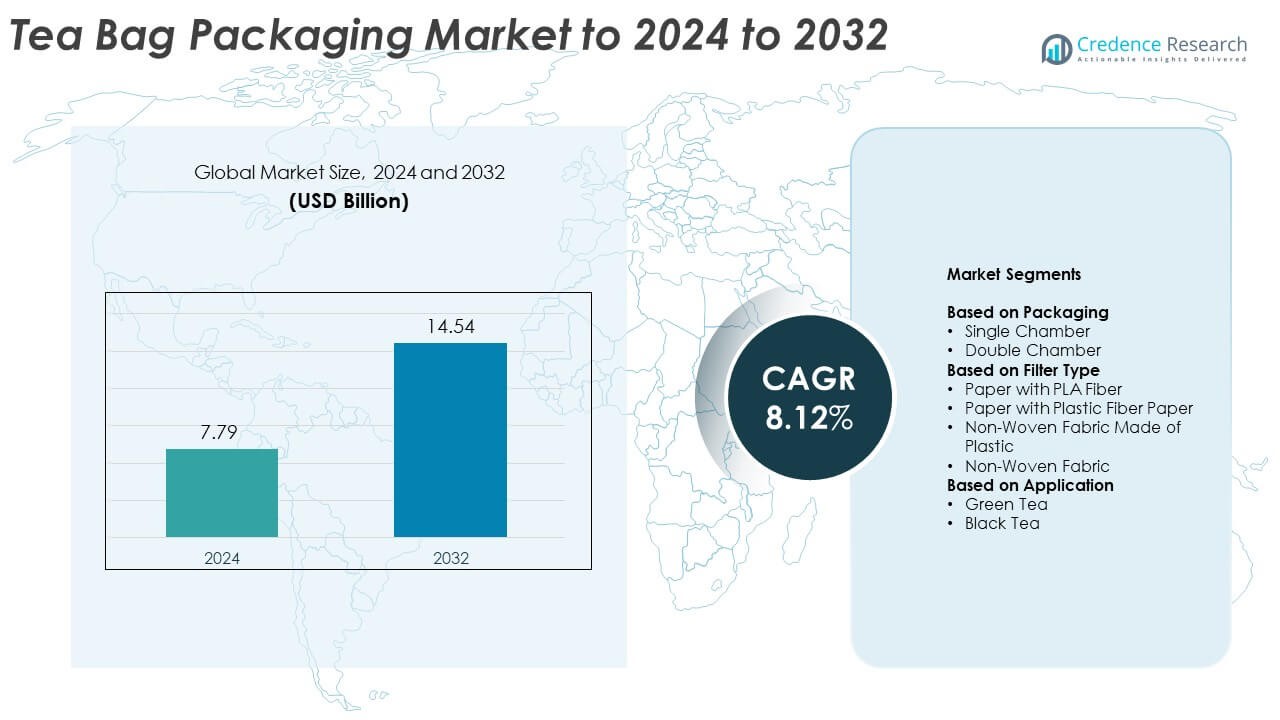
The Tea Bag Packaging Market size was valued at USD 7.79 billion in 2024 and is anticipated to reach USD 14.54 billion by 2032, at a CAGR of 8.12% during the forecast period.
| REPORT ATTRIBUTE | DETAILS |
|---|---|
| Historical Period | 2020-2023 |
| Base Year | 2024 |
| Forecast Period | 2025-2032 |
| Tea Bag Packaging Market Size 2024 | USD 7.79 Billion |
| Tea Bag Packaging Market, CAGR | 8.12% |
| Tea Bag Packaging Market Size 2032 | USD 14.54 Billion |
The tea bag packaging market is led by major players such as Huhtamaki, Smurfit Kappa Group, ProAmpac, DS Smith, WestRock Company, Mondi Group, Sealed Air Corporation, Global Packaging Solutions, Syntegon Technology, Tetra Pak, and Amcor. These companies focus on sustainable materials, advanced sealing technology, and innovative design solutions to enhance product quality and brand appeal. Europe dominated the global market in 2024, holding approximately 30.6% share, driven by high tea consumption and strong environmental regulations promoting biodegradable packaging. Asia-Pacific followed closely, supported by rising demand for premium and health-focused tea varieties.
Market Insights
- The tea bag packaging market was valued at USD 7.79 billion in 2024 and is expected to reach USD 14.54 billion by 2032, growing at a CAGR of 8.12%.
- Rising tea consumption and preference for convenient brewing formats are driving demand for advanced and sustainable packaging solutions.
- Key trends include the adoption of biodegradable materials such as PLA fiber and paper blends, along with smart and premium packaging designs.
- The market is competitive, with leading players focusing on eco-friendly innovations, automation, and strategic partnerships with tea producers to strengthen brand presence.
- Europe led the market with 30.6% share, followed by Asia-Pacific with 33.2%, while the double chamber segment dominated with 64.7% share in 2024, supported by high infusion efficiency and global consumer preference for quality and convenience.
Market Segmentation Analysis:
By Packaging
The double chamber segment dominated the tea bag packaging market in 2024, accounting for around 64.7% of the total share. This dominance is due to its superior infusion capability, which allows water to circulate freely, enhancing flavor and aroma extraction. Double chamber bags are preferred by premium tea brands as they maintain consistency and quality in every brew. The growing popularity of convenience-focused packaging and automated filling systems further strengthens this segment’s leadership, particularly in Europe and North America, where high-end tea consumption continues to expand.
- For instance, Teepack offers the Perfecta line, a series of packaging machines for double-chamber bags. Certain models, such as the PERFECTA TAG, are capable of reaching production speeds of up to 420 double-chamber bags per minute.
By Filter Type
The paper with PLA fiber segment held the largest share of approximately 41.2% in 2024, driven by the rising demand for biodegradable and compostable materials. PLA fibers derived from renewable corn starch offer excellent strength, heat sealability, and filtration efficiency. Manufacturers increasingly adopt this filter type to comply with sustainability goals and plastic reduction regulations. Growing consumer preference for eco-friendly packaging, combined with the global shift toward circular economy practices, supports steady expansion of this segment across major tea-producing regions such as Asia-Pacific and Africa.
- For instance, Tetley GB released over 1 billion plant-based teabags as of the end of fiscal year 2023. This was part of a larger company initiative that aimed to convert 9 billion Tetley teabags in the UK to renewable packaging.
By Application
The green tea segment emerged as the leading application category in 2024, capturing about 53.6% of the global tea bag packaging market. Rising health awareness and preference for antioxidant-rich beverages have boosted green tea consumption worldwide. Tea brands are introducing innovative packaging formats that preserve freshness and aroma while offering convenient brewing options. The segment’s growth is further driven by expanding retail availability, premium organic product lines, and rising adoption of eco-conscious packaging solutions among consumers in Japan, China, and Western markets.
Key Growth Drivers
Rising Global Tea Consumption
The increasing global demand for tea, especially specialty and herbal blends, is driving the need for advanced packaging solutions. Consumers are shifting toward convenient, ready-to-use tea formats that preserve freshness and flavor. This shift encourages manufacturers to adopt innovative materials and designs that extend shelf life and enhance brewing experience. Rapid urbanization and the growing café culture further accelerate packaged tea adoption, particularly in Asia-Pacific and Europe, where single-serve packaging formats are becoming a preferred choice among younger consumers.
- For instance, Twinings sources tea from a restricted list of 160 carefully selected tea gardens and smallholder farms globally, based on ethical and quality standards.
Shift Toward Sustainable Packaging Solutions
Growing environmental awareness has led to rising adoption of eco-friendly and biodegradable packaging materials. Brands are replacing conventional plastic-based filters with compostable fibers such as polylactic acid (PLA) and paper blends. Governments and regulatory bodies are enforcing stricter plastic usage limits, prompting companies to invest in sustainable alternatives. This transition not only meets regulatory requirements but also improves brand perception and aligns with consumer preferences for environmentally responsible products, strengthening long-term market growth prospects.
- For instance, In 2019, Unilever's CEO Alan Jope announced that the company used approximately 700,000 tonnes of virgin plastic annually and pledged to halve its use by 2025. However, this target was subsequently revised. As of 2024, the company's new goal is to reduce its virgin plastic footprint by 30% by 2026 and 40% by 2028, citing challenges in scaling new packaging solutions
Expansion of Premium and Functional Tea Segments
The growth of premium tea varieties, including organic, detox, and wellness-infused blends, fuels demand for high-quality packaging that maintains flavor integrity. Packaging innovations such as double-chamber bags and aroma-lock pouches support the premiumization trend. Consumers associate refined packaging with better taste and purity, increasing brand loyalty. Manufacturers leverage this trend by offering visually appealing, resealable, and eco-safe packaging designs that cater to the rising global preference for healthier and luxury tea products across retail and online channels.
Key Trends & Opportunities
Adoption of Smart and Innovative Packaging
Technological advancements in packaging design are reshaping the tea industry. Smart packaging solutions integrate freshness indicators, aroma-seal mechanisms, and QR codes that enhance transparency and traceability. These innovations allow brands to communicate product origin, sustainability, and brewing instructions directly to consumers. The rise of digital engagement tools and interactive packaging also supports brand differentiation, creating new opportunities for premium players to attract health-conscious and tech-savvy consumers across competitive markets.
- For instance, Zhejiang Kan Special Paper Co., Ltd. (a Zhejiang Kain entity) manufactures heat-sealable tea bag filter papers that can contain PLA fibers, with PLA content typically ranging from 15–40% when used with natural fibers like wood pulp or abaca.
Growth in E-commerce Distribution Channels
The increasing shift toward online retailing offers significant opportunities for tea bag packaging manufacturers. E-commerce platforms favor lightweight, durable, and visually appealing packaging that ensures safe delivery and strong shelf presentation. Global tea brands and niche startups alike are leveraging digital platforms to expand their reach and product visibility. This trend accelerates the demand for flexible, protective, and custom-designed packaging that enhances consumer experience and reinforces brand identity in the online retail space.
- For instance, Based on statements made in 2025, Tata Consumer Products' e-commerce revenue has grown significantly and now accounts for approximately 15% of its total turnover. Within this channel, quick commerce is a major driver, contributing a substantial portion of e-commerce revenue-around 7.5% of total turnover, or half of the total e-commerce share.
Key Challenges
High Cost of Sustainable Materials
The use of biodegradable and compostable materials, though environmentally beneficial, significantly increases production costs. Sustainable fibers such as PLA and non-woven organic fabrics are more expensive compared to synthetic alternatives. Small and medium-sized producers often struggle to absorb these costs, limiting large-scale adoption. The challenge lies in balancing eco-friendly packaging goals with affordability and performance, compelling companies to invest in material innovation and supply chain efficiency to remain competitive.
Limited Recycling and Disposal Infrastructure
Despite growing demand for sustainable packaging, many regions lack adequate recycling and composting facilities. Improper disposal practices reduce the effectiveness of biodegradable solutions, undermining environmental benefits. This challenge is more prominent in developing countries where waste management systems are underdeveloped. Manufacturers face difficulties ensuring end-of-life sustainability, which hinders full circular economy implementation. Addressing this issue requires collaboration among governments, packaging firms, and consumers to establish efficient collection and recycling frameworks.
Regional Analysis
North America North America accounted for around 27.4% of the global tea bag packaging market in 2024, driven by strong demand for premium and organic tea products. The U.S. leads regional growth due to rising consumer preference for convenient, on-the-go beverage solutions. Sustainable packaging adoption is accelerating as brands transition toward compostable and recyclable materials. Major players focus on product differentiation through advanced barrier coatings and user-friendly designs. The region’s robust retail infrastructure and growing online tea sales further strengthen packaging innovation, with eco-conscious consumers influencing material and design trends across the market.
Europe
Europe held a significant market share of approximately 30.6% in 2024, emerging as the largest regional market. The region’s dominance is attributed to the high consumption of black and herbal teas and strong sustainability regulations. Countries such as the United Kingdom, Germany, and France lead in adopting biodegradable and plastic-free tea bags. Packaging manufacturers are investing in paper-based and non-woven filter materials that comply with EU environmental standards. Growing demand for premium and functional teas also fuels packaging innovation, with a focus on preserving freshness, aroma, and brand aesthetics across retail and specialty stores.
Asia-Pacific
Asia-Pacific captured nearly 33.2% of the global market in 2024, making it the fastest-growing region. The region’s expansion is driven by the large tea-producing economies of China, India, and Japan. Rising middle-class populations, urbanization, and health-conscious consumers are increasing packaged tea consumption. Local manufacturers are investing in modern packaging technologies to cater to both export and domestic markets. The growing popularity of green and herbal teas, coupled with sustainable packaging adoption, supports long-term growth. Increasing e-commerce penetration and rising export demand for value-added tea products further enhance regional market development.
Latin America
Latin America represented about 5.2% of the tea bag packaging market share in 2024, supported by growing awareness of health and wellness beverages. Countries like Brazil, Argentina, and Chile are experiencing gradual increases in tea consumption, particularly green and herbal blends. Manufacturers are focusing on cost-effective yet sustainable packaging formats to meet shifting consumer preferences. Expanding retail networks and the entry of international tea brands enhance market accessibility. The regional market is also witnessing a rise in locally produced organic teas, stimulating demand for paper-based and biodegradable packaging options.
Middle East & Africa
The Middle East & Africa accounted for approximately 3.6% of the global market in 2024, with steady growth driven by evolving beverage consumption habits. Countries such as Saudi Arabia, the United Arab Emirates, and South Africa are leading adopters of packaged tea products. Demand is growing for convenient, single-serve tea bags that suit fast-paced lifestyles. International brands are expanding their presence through modern retail channels and online platforms. The increasing preference for flavored and wellness teas, along with gradual shifts toward sustainable packaging materials, is expected to drive regional market expansion.
Market Segmentations:
By Packaging
- Single Chamber
- Double Chamber
By Filter Type
- Paper with PLA Fiber
- Paper with Plastic Fiber Paper
- Non-Woven Fabric Made of Plastic
- Non-Woven Fabric
By Application
- Green Tea
- Black Tea
By Geography
- North America
- U.S.
- Canada
- Mexico
- Europe
- Germany
- France
- U.K.
- Italy
- Spain
- Rest of Europe
- Asia Pacific
- China
- Japan
- India
- South Korea
- South-east Asia
- Rest of Asia Pacific
- Latin America
- Brazil
- Argentina
- Rest of Latin America
- Middle East & Africa
- GCC Countries
- South Africa
- Rest of the Middle East and Africa
Competitive Landscape
Key players in the tea bag packaging market include Huhtamaki, Smurfit Kappa Group, ProAmpac, DS Smith, WestRock Company, Mondi Group, Sealed Air Corporation, Global Packaging Solutions, Syntegon Technology, Tetra Pak, and Amcor. The market is highly competitive, characterized by strong emphasis on sustainable materials, automation, and design innovation. Companies focus on developing biodegradable and compostable solutions to meet global sustainability goals and evolving consumer preferences. Technological advancements in heat sealing, aroma preservation, and lightweight structures enhance product performance and brand differentiation. Strategic partnerships with tea producers and retailers support tailored packaging development and wider distribution. Additionally, rising investments in recyclable paper filters and PLA-based materials drive production efficiency while maintaining compliance with regional regulations. Increasing competition also encourages diversification in packaging formats such as pyramid, double chamber, and sachet styles, aligning with the demand for convenience and premiumization across major tea-consuming regions.
Key Player Analysis
- Huhtamaki
- Smurfit Kappa Group
- ProAmpac
- DS Smith
- WestRock Company
- Mondi Group
- Sealed Air Corporation
- Global Packaging Solutions
- Syntegon Technology
- Tetra Pak
- Amcor
Recent Developments
- In 2024, ProAmpac introduced ProActive Intelligent Moisture Protect MP-1000, a patent-pending technology to control moisture without desiccant sachets.
- In 2024, Smurfit Kappa acquired a Bag-in-Box plant in Bulgaria, expanding its production capacity for a format that can be used for liquid teas.
- In 2023, Mondi invested in FunctionalBarrier Paper Ultimate, an ultra-high barrier paper-based packaging solution suitable for tea and coffee packaging.
Report Coverage
The research report offers an in-depth analysis based on Packaging, Filter Type, Application and Geography. It details leading market players, providing an overview of their business, product offerings, investments, revenue streams, and key applications. Additionally, the report includes insights into the competitive environment, SWOT analysis, current market trends, as well as the primary drivers and constraints. Furthermore, it discusses various factors that have driven market expansion in recent years. The report also explores market dynamics, regulatory scenarios, and technological advancements that are shaping the industry. It assesses the impact of external factors and global economic changes on market growth. Lastly, it provides strategic recommendations for new entrants and established companies to navigate the complexities of the market.
Future Outlook
- The market will witness steady growth driven by increasing global tea consumption.
- Sustainable and biodegradable materials will dominate future packaging developments.
- Premiumization in tea products will boost demand for high-quality and aesthetic packaging.
- Asia-Pacific will remain the fastest-growing region due to rising urbanization and exports.
- Technological innovations such as smart packaging will enhance consumer engagement.
- E-commerce expansion will create strong opportunities for customized tea bag packaging.
- Strategic collaborations between tea producers and packaging firms will rise.
- Manufacturers will focus on cost optimization to offset sustainability expenses.
- Flexible and lightweight materials will gain preference for better transport efficiency.
- Brand differentiation through eco-labeling and recyclable designs will shape market competitiveness.

Request a Free Sample
Fill in your details and we'll send you a free sample report.
- Sample data tables & charts
- Research methodology
Need a Custom Version of This Report?
Tailor the scope, geography, or segments to your exact requirements.
- Custom geography or segment scope
- Direct access to our analyst team
Frequently Asked Questions
What is the current market size for Tea Bag Packaging Market, and what is its projected size in 2032?
At what Compound Annual Growth Rate is the Tea Bag Packaging Market projected to grow between 2025 and 2032?
Which Tea Bag Packaging Market segment held the largest share in 2024?
What are the primary factors fueling the growth of the Tea Bag Packaging Market?
Who are the leading companies in the Tea Bag Packaging Market?
Which region commanded the largest share of the Tea Bag Packaging Market in 2024?
Table of Content
Chapter 1 Market Segmentation
- 1.1 Segmentation Framework
- 1.1.1 Product and Service Classification
- 1.1.2 Application and End-Use Classification
- 1.1.3 Technology and Solution Classification
- 1.1.4 Customer and Distribution Channel Classification
- 1.1.5 Geographic Segmentation
- 1.1.6 Market Segment Definitions and Boundaries
Chapter 2 Introduction
- 2.1 Report Objectives and Scope
- 2.2 Product Definition and Industry Terminology
- 2.3 Market Inclusions and Exclusions
- 2.4 Research Process
- 2.4.1 Primary Research and Expert Interviews
- 2.4.2 Secondary Research and Source Review
- 2.4.3 Top-Down and Bottom-Up Estimation
- 2.4.4 Data Triangulation and Verification
- 2.5 Market Size Measurement Basis
- 2.5.1 2024: USD 7.79 billion → 2032: USD 14.54 billion
- 2.6 Historical and Forecast Reference Periods
- 2.6.1 Base Year: 2024
- 2.6.2 Forecast Period: 2024-2032
- 2.7 Research Assumptions and Limitations
Chapter 3 Executive Summary
- 3.1 Market Snapshot and Key Findings
- 3.2 Base-Year Market Size, 2024
- 3.3 Forecast Market Size, 2032
- 3.4 Revenue and Volume Growth Outlook
- 3.5 Key Demand and Supply Indicators
- 3.6 Leading Market Segments
- 3.7 Fastest-Growing Market Opportunities
- 3.8 Regional Performance Highlights
- 3.9 Technology and Industry Transformation
- 3.10 Competitive Landscape Summary
- 3.11 Analyst View and Strategic Implications
Chapter 4 Global Tea Bag Packaging Market Trends and Developments
- 4.1 Historical Industry Development
- 4.2 Recent Market Trends and Developments
- 4.3 Demand and Customer Behavior Trends
- 4.4 Technology and Product Innovation
- 4.5 Artificial Intelligence, Automation and Digitalization
- 4.6 Local Manufacturing and Supply Chain Realignment
- 4.7 Industry Partnerships, Mergers and Acquisitions
- 4.8 Sustainability and Circular Economy Developments
- 4.9 Government and Private Sector Investment Trends
- 4.10 Emerging Business Models and Commercialization
- 4.11 Industry Developments and Announcements
Chapter 5 Global Tea Bag Packaging Market Production, Supply and Demand Analysis
- 5.1 Demand Trend and Consumption Analysis
- 5.2 Demand Forecast, 2024-2032
- 5.3 Production and Output Trend
- 5.4 Production and Output Forecast, 2024-2032
- 5.5 Installed Capacity and Capacity Utilization
- 5.6 Company-Wise Production Plants and Statistics
- 5.6.1 Installed Production Capacity
- 5.6.2 Actual Production
- 5.6.3 Planned Capacity and Expansion Targets
- 5.7 Supply Chain Structure and Procurement Trends
- 5.8 Supply-Demand Gap and Bottlenecks
- 5.9 Import Dependence and Sourcing Structure
- 5.10 Contract Manufacturing and Outsourcing
- 5.11 Regional Supply and Demand Concentration
Chapter 6 Global Tea Bag Packaging Market Pricing Analysis
- 6.1 Pricing Structure and Measurement
- 6.2 Historical Pricing Trends
- 6.3 Pricing Outlook, 2024-2032
- 6.4 Average Selling Price and Unit Economics
- 6.5 Pricing by Product and Market Segment
- 6.6 Geographic Pricing Differences
- 6.7 Key Input, Energy, Labor and Logistics Costs
- 6.8 Contract Pricing and Purchasing Models
- 6.9 Pricing Sensitivity and Competitive Positioning
- 6.10 Price, Margin and Profitability Implications
Chapter 7 Global Tea Bag Packaging Market Dynamics
- 7.1 Market Growth Drivers
- 7.1.1 Demand-Side Drivers
- 7.1.2 Technology and Innovation Drivers
- 7.1.3 Infrastructure and Investment Drivers
- 7.1.4 Regulatory and Policy Drivers
- 7.2 Market Restraints
- 7.2.1 Cost and Affordability Constraints
- 7.2.2 Technology and Adoption Barriers
- 7.2.3 Supply Chain and Operational Constraints
- 7.3 Market Challenges
- 7.3.1 Competitive Pressure and Margin Erosion
- 7.3.2 Skills, Infrastructure and Implementation Gaps
- 7.4 Emerging Market Opportunities
- 7.5 Market Dynamics Impact and Time-Horizon Assessment
Chapter 8 Global Tea Bag Packaging Value Chain Analysis
- 8.1 Industry Value Chain Overview
- 8.2 Upstream Suppliers and Critical Inputs
- 8.3 Technology and Component Providers
- 8.4 Manufacturing or Service Delivery
- 8.5 Distribution, Channel Partners and Integrators
- 8.6 Downstream Applications and End Users
- 8.7 Value Addition and Profit Pools
- 8.8 Vertical Integration and Outsourcing
- 8.9 Supplier Concentration and Risk
- 8.10 Supply Chain Localization and Resilience
Chapter 9 Global Tea Bag Packaging Market Regulations and Policies
- 9.1 Relevant Laws, Standards and Compliance Frameworks
- 9.2 Product, Service, Safety and Quality Requirements
- 9.3 Government Policies, Incentives and Subsidies
- 9.4 Imports, Exports and Trade Barriers
- 9.5 Public Procurement and Local Content Requirements
- 9.6 Environmental and Sustainability Compliance
- 9.7 Upcoming Policy Changes and Market Implications
Chapter 10 Global Tea Bag Packaging Market Hotspots and Opportunities
- 10.1 Market Opportunity Mapping and Growth Hotspots
- 10.2 High-Growth Applications and Customer Groups
- 10.3 Underserved Markets and White-Space Opportunities
- 10.4 Emerging Technology and Product Opportunities
- 10.5 New Capacity and Investment Hotspots
- 10.6 Market Entry and Expansion Opportunities
- 10.7 Distribution and Partnership Opportunities
- 10.8 Near-Term and Long-Term Commercial Potential
- 10.9 Opportunity Attractiveness and Execution Risks
Chapter 11 Global Tea Bag Packaging Market Outlook, 2024-2032
- 11.1 Market Size and Analysis
- 11.1.1 Revenue (Market Measurement: 2024: USD 7.79 billion → 2032: USD 14.54 billion)
- 11.1.2 Market Volume and Quantity Sold
- 11.1.3 Historical Market Size
- 11.1.4 Base-Year Market Size, 2024
- 11.2 Market Forecast, 2024-2032
- 11.2.1 Revenue Forecast to 2032
- 11.2.2 Volume Forecast to 2032
- 11.2.3 CAGR and Year-on-Year Growth
- 11.2.4 Incremental Revenue Opportunity
- 11.3 Forecast Assumptions and Scenario Analysis
- 11.3.1 Base-Case Forecast
- 11.3.2 Optimistic and Conservative Scenarios
- 11.3.3 Technology, Pricing and Policy Sensitivities
- 11.4 Market Attractiveness and Growth Outlook
Chapter 12 Global Tea Bag Packaging Market Segmentation and Outlook
- 12.1 Segmentation Summary and Market Shares, 2024
- 12.2 Largest and Fastest-Growing Segments
- 12.3 Segment Growth Comparison
- 12.4 Segment Attractiveness and Priority Matrix
Chapter 13 Global Tea Bag Packaging Geographic Market Outlook, 2024-2032
- 13.1 Regional Market Size and Share, 2024
- 13.2 Regional Market Forecast, 2024-2032
- 13.3 Regional Pricing, Production and Demand Differences
- 13.4 North America
- 13.4.1 United States
- 13.4.2 Canada
- 13.4.3 Mexico
- 13.5 Europe
- 13.5.1 Germany
- 13.5.2 France
- 13.5.3 Italy
- 13.5.4 United Kingdom
- 13.5.5 Spain
- 13.5.6 Poland
- 13.5.7 Russia
- 13.5.8 Netherlands
- 13.5.9 Belgium
- 13.5.10 Sweden
- 13.5.11 Denmark
- 13.5.12 Norway
- 13.5.13 Rest of Europe
- 13.6 Asia Pacific
- 13.6.1 China
- 13.6.2 India
- 13.6.3 Japan
- 13.6.4 South Korea
- 13.6.5 Thailand
- 13.6.6 Indonesia
- 13.6.7 Vietnam
- 13.6.8 Malaysia
- 13.6.9 Australia
- 13.6.10 Rest of Asia Pacific
- 13.7 Latin America
- 13.7.1 Brazil
- 13.7.2 Argentina
- 13.7.3 Colombia
- 13.7.4 Chile
- 13.7.5 Rest of Latin America
- 13.8 Middle East
- 13.8.1 Saudi Arabia
- 13.8.2 United Arab Emirates
- 13.8.3 Turkey
- 13.8.4 Israel
- 13.8.5 Iran
- 13.8.6 Rest of the Middle East
- 13.9 Africa
- 13.9.1 South Africa
- 13.9.2 Egypt
- 13.9.3 Nigeria
- 13.9.4 Morocco
- 13.9.5 Rest of Africa
- 13.10 Regional Investment, Policy and Supply Chain Differences
- 13.11 Regional Competitive Landscape
- 13.12 Geographic Growth Hotspots
Chapter 14 Global Tea Bag Packaging Technology, Innovation and Sustainability Outlook
- 14.1 Technology Landscape and Maturity
- 14.2 Product, Process and Service Innovation
- 14.3 AI, Automation and Digital Tools in the Industry
- 14.4 Technology Adoption and Performance Benchmarking
- 14.5 Innovation Pipeline and R&D Investment
- 14.6 Patent and Intellectual Property Trends
- 14.7 Energy Efficiency and Resource Management
- 14.8 Sustainability, Recycling and Circularity
- 14.9 Technology Roadmap, 2024-2032
- 14.10 Risks of Obsolescence and Technology Substitution
Chapter 15 Global Tea Bag Packaging Market Key Strategic Imperatives
- 15.1 Growth and Market Entry Priorities
- 15.2 High-Return Products and Segments
- 15.3 Pricing, Profitability and Cost Optimization
- 15.4 Technology Investment and Product Differentiation
- 15.5 Supply Chain Localization and Resilience
- 15.6 Distribution and Customer Acquisition
- 15.7 Partnership, Acquisition and Capacity Strategy
- 15.8 Regional Expansion Priorities
- 15.9 Short-, Medium- and Long-Term Actions
Chapter 16 Competition Outlook
- 16.1 Industry Competition Characteristics
- 16.2 Market Structure and Concentration
- 16.3 Market Share and Competitive Positioning, 2024
- 16.4 Company-Wise Revenue and Product Benchmarking
- 16.5 Production and Service Capacity Benchmarking
- 16.6 Technology, Pricing and Differentiation
- 16.7 Regional Footprint and Distribution Strength
- 16.8 Mergers, Acquisitions and Strategic Alliances
- 16.9 New Entrants and Competitive Threats
- 16.10 Porter's Five Forces and Industry Attractiveness
- 16.11 Competitive Outlook, 2024-2032
Chapter 17 Company Profiles
- 17.1 Company Coverage and Selection Criteria
- 17.2 Leading Market Participants – Standard Profile Structure
- 17.2.1 Business Description
- 17.2.2 Company Ownership and Geographic Presence
- 17.2.3 Product and Service Portfolio
- 17.2.4 Manufacturing and Operating Footprint
- 17.2.5 Production Capacity and Expansion Plans
- 17.2.6 Financial Performance and Investment
- 17.2.7 Market Share and Competitive Position
- 17.2.8 Technology and Innovation Capabilities
- 17.2.9 Strategic Alliances or Partnerships
- 17.2.10 Recent Developments
- 17.2.11 Growth Strategy and Outlook
- 17.3 Other Relevant Market Participants
Note: Every listed company is profiled on the structure shown under the first company. The company list is preliminary and may change based on research findings, market developments, data availability and client requirements.
Chapter 18 Disclaimer
- 18.1 Research and Forecast Disclaimer
- 18.2 Data Source and Estimation Limitations
Note: The depth of individual sections depends on data availability for this market. Volume, capacity, trade and other unit-based metrics are included where applicable.

