
Market Overview:
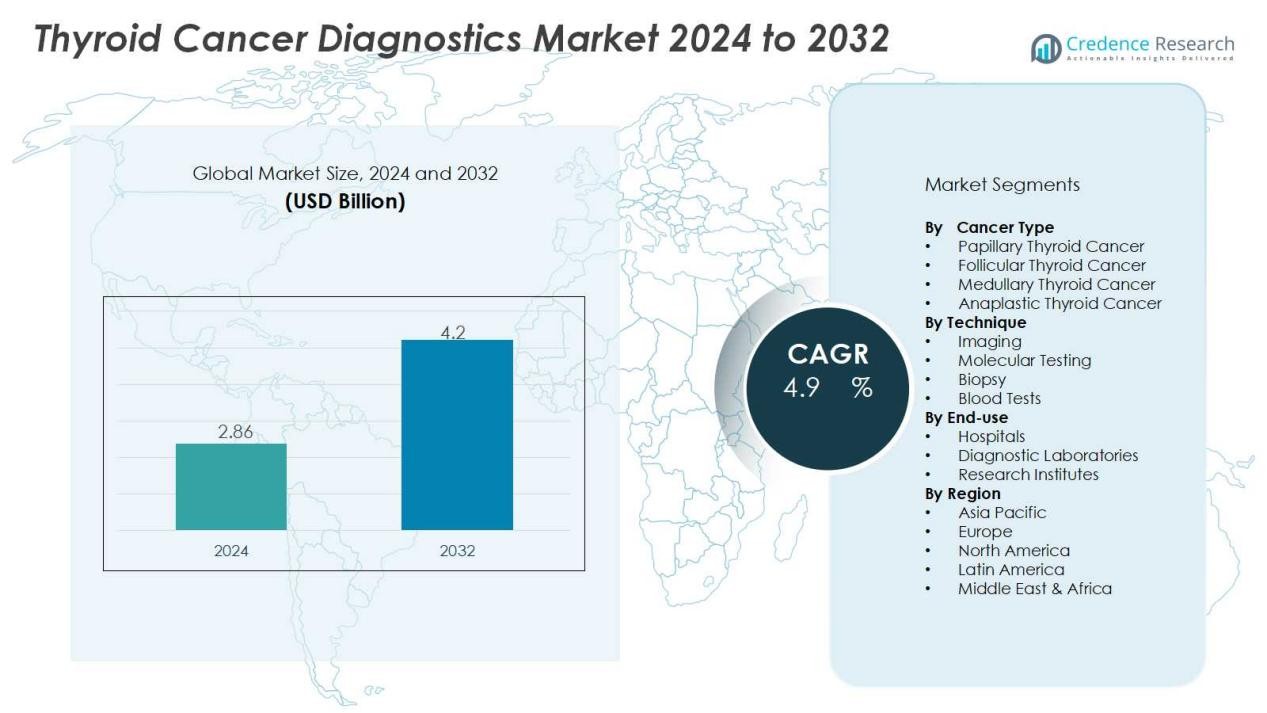
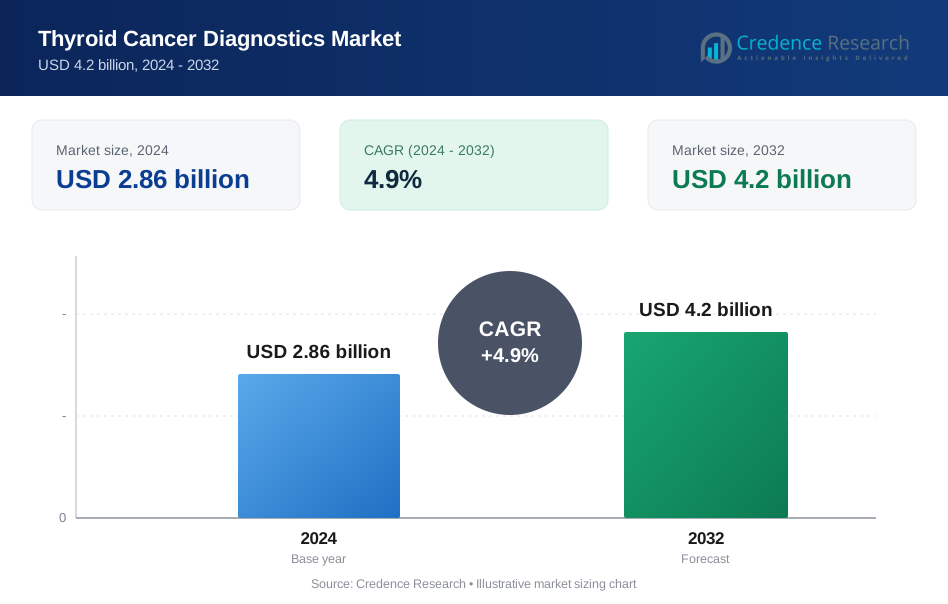
The Thyroid Cancer Diagnostics Market size was valued at USD 2.86 billion in 2024 and is anticipated to reach USD 4.2 billion by 2032, at a CAGR of 4.9 % during the forecast period.
| REPORT ATTRIBUTE | DETAILS |
|---|---|
| Historical Period | 2020-2023 |
| Base Year | 2024 |
| Forecast Period | 2025-2032 |
| Thyroid Cancer Diagnostics Market Size 2024 | USD 2.86 Billion |
| Thyroid Cancer Diagnostics Market, CAGR | 4.9 % |
| Thyroid Cancer Diagnostics Market Size 2032 | USD 4.2 Billion |
Key market drivers include the increasing incidence of thyroid cancer globally, supported by lifestyle factors and improved screening practices. The growing preference for minimally invasive diagnostic procedures, along with continuous innovation in genomic testing and personalized medicine, also plays a pivotal role. Furthermore, supportive government initiatives, rising healthcare expenditure, and the integration of artificial intelligence into diagnostic imaging strengthen market opportunities.
Regionally, North America dominates the thyroid cancer diagnostics market, supported by advanced healthcare infrastructure, robust R&D, and high awareness levels. Europe follows with strong adoption due to early diagnosis programs and widespread use of advanced diagnostic technologies. Asia-Pacific is projected to witness the fastest growth, fueled by expanding healthcare access, increasing patient pool, and rising investments in diagnostic innovations in countries such as China, India, and Japan. Meanwhile, Latin America and the Middle East & Africa show promising potential with improving healthcare infrastructure and growing awareness campaigns.
Market Insights:
- The thyroid cancer diagnostics market was valued at USD 2.86 billion in 2024 and is expected to reach USD 4.2 billion by 2032, growing at a CAGR of 4.9%.
- Rising incidence of thyroid cancer and growing awareness are fueling demand for early detection solutions worldwide.
- Advancements in molecular diagnostics, such as next-generation sequencing and biomarker discovery, are improving accuracy and enabling personalized medicine.
- Expansion of imaging modalities, including ultrasound, CT scans, and PET scans, supported by AI integration, enhances diagnostic outcomes.
- Government initiatives and rising healthcare expenditure are expanding access to advanced diagnostics in both developed and emerging economies.
- High costs, unequal access to advanced tools, and overdiagnosis risks present significant challenges to market growth.
- North America led with 41% share in 2024, followed by Europe at 29%, while Asia-Pacific captured 22% and is projected to grow fastest due to expanding healthcare infrastructure and rising cancer awareness.
Market Drivers:
Rising Incidence of Thyroid Cancer and Growing Awareness:
The thyroid cancer diagnostics market is strongly driven by the rising global incidence of thyroid disorders. Increasing awareness campaigns by healthcare organizations encourage early detection, leading to higher testing rates. It strengthens the role of diagnostics in identifying cases at an early stage. Expanding patient pools, particularly in Asia-Pacific and North America, underline the importance of improved diagnostic access. Governments and NGOs actively promote awareness to reduce late-stage detection.
- For Instance, FDA and Roche Diagnostics, the Roche Elecsys Tg II immunoassay received FDA clearance in the United States in May 2023, not June 2025. The test, which runs on instruments like the cobas e 801 analytical unit at up to 300 tests per hour, is intended for detecting and monitoring thyroid cancer in patients who have undergone thyroid surgery
Advancements in Molecular and Genetic Testing Technologies:
Advancements in molecular diagnostics, including next-generation sequencing and biomarker discovery, are transforming thyroid cancer diagnosis. These technologies improve accuracy by identifying genetic mutations linked to tumor development. It enables clinicians to personalize treatment strategies and reduce unnecessary interventions. Widespread adoption of genetic profiling enhances the effectiveness of targeted therapies. Growing investments in precision medicine further accelerate the role of advanced testing in the market.
- For instance, the ThyroSeq v3 Genomic Classifier by the University of Pittsburgh interrogates 112 thyroid cancer–related genes and has demonstrated an overall accuracy of 94% in distinguishing benign from malignant thyroid nodules in clinical validation studies as of 2023.
Expansion of Imaging Modalities and AI Integration:
The thyroid cancer diagnostics market benefits from significant improvements in imaging modalities such as ultrasound, CT scans, and PET scans. High-resolution imaging supports accurate detection and monitoring of tumors. It is further enhanced by the integration of artificial intelligence, which streamlines interpretation and reduces errors. Hospitals and diagnostic centers are rapidly adopting AI-powered tools to improve efficiency. Ongoing development of imaging platforms ensures stronger diagnostic outcomes.
Government Initiatives and Rising Healthcare Expenditure:
Government-backed initiatives for cancer screening are providing strong momentum to the thyroid cancer diagnostics market. National cancer programs across Europe, North America, and Asia-Pacific are expanding access to advanced diagnostic services. It drives higher adoption in both urban and rural healthcare settings. Rising healthcare expenditure in emerging economies also supports infrastructure development for advanced testing. Public and private collaborations continue to strengthen diagnostic capacity and patient outcomes.
Market Trends:
Growing Adoption of Advanced Molecular and Imaging Diagnostics:
The thyroid cancer diagnostics market is witnessing rapid adoption of advanced molecular assays and imaging modalities that improve early detection and accuracy. Molecular diagnostics, including next-generation sequencing and gene expression profiling, help identify genetic mutations linked to thyroid cancer. These innovations support more precise risk stratification and guide targeted treatment decisions. Imaging technologies such as high-resolution ultrasound, CT scans, and PET scans also play a crucial role in confirming disease presence and monitoring recurrence. Integration of artificial intelligence into imaging further enhances diagnostic accuracy by reducing errors and improving interpretation speed. The expansion of biomarker-based testing is strengthening personalized medicine approaches, creating new opportunities for diagnostic companies. Growing clinical acceptance of these technologies is expected to transform the competitive landscape of the market.
- For Instance, Thermo Fisher Scientific's Oncomine panels, utilizing Ion AmpliSeq technology, allow assessment of numerous gene variants relevant to thyroid cancer. The Ion Torrent Genexus System can deliver comprehensive results in as little as 24 hours, automating the workflow from sample to report.
Rising Emphasis on Early Detection, Personalized Medicine, and Digital Integration:
The thyroid cancer diagnostics market is also shaped by an increasing focus on early diagnosis and preventive healthcare strategies. Healthcare providers are promoting awareness campaigns to encourage routine screening, especially among high-risk populations. Personalized medicine is gaining traction, supported by advances in molecular and genetic testing that align treatments with individual patient profiles. Digital health solutions, including cloud-based diagnostic platforms and telepathology, are streamlining access to test results and consultations. It supports better collaboration among clinicians and ensures faster decision-making in treatment planning. Investment in AI-driven diagnostic tools and data analytics is expected to expand further, aligning with the global shift toward precision oncology. These developments highlight a market trend toward integrated, patient-centric diagnostic ecosystems that improve both outcomes and efficiency.
- For instance, in March 2024, Roche Diagnostics launched the Elecsys Thyroglobulin II assay in Europe, enabling laboratories to process up to 300 patient samples per hour to support early thyroid cancer recurrence detection with high throughput.
Market Challenges Analysis:
High Diagnostic Costs, Unequal Access, and Resource Constraints:
The thyroid cancer diagnostics market encounters significant hurdles due to high testing costs and unequal access to advanced tools. Molecular assays and imaging procedures remain expensive, limiting adoption in price-sensitive markets. Many healthcare systems in developing regions lack the infrastructure needed for specialized diagnostic equipment. It restricts timely detection and creates disparities in patient outcomes. Shortages of skilled professionals in radiology and pathology further add to delays in diagnosis. Limited reimbursement policies in several countries reduce affordability and discourage the uptake of advanced tests. These barriers slow down the pace of global market expansion.
Overdiagnosis Risks, Regulatory Complexity, and Data Management Issues:
The thyroid cancer diagnostics market also struggles with the growing concern of overdiagnosis from frequent imaging and screenings. Detection of small nodules often leads to unnecessary procedures, adding both cost and patient anxiety. Regulatory pathways for molecular and AI-driven diagnostics remain complex, delaying innovation and commercial rollout. It increases the burden on manufacturers and slows market entry for novel solutions. Data management is another challenge, as healthcare systems face pressure to integrate large volumes of diagnostic information securely. Variability in clinical guidelines across regions complicates uniform adoption of best practices. These issues underscore the need for balanced innovation and efficient regulatory frameworks.
Market Opportunities:
Advancements in Precision Medicine and Diagnostic Innovation:
The thyroid cancer diagnostics market offers strong opportunities through rapid advancements in precision medicine and molecular testing. Growth in next-generation sequencing, biomarker discovery, and liquid biopsy techniques enables early detection and tailored treatment plans. It supports the expansion of personalized medicine by identifying genetic mutations that guide targeted therapies. Integration of artificial intelligence in imaging and pathology improves accuracy and speeds up clinical decisions. The rising demand for non-invasive diagnostic tools creates new product development prospects for manufacturers. Investment in research focused on predictive diagnostics further strengthens long-term opportunities. These innovations position the market for continued expansion in both developed and emerging healthcare systems.
Expanding Healthcare Infrastructure and Growing Preventive Care Initiatives:
The thyroid cancer diagnostics market also benefits from expanding healthcare infrastructure and rising focus on preventive care. Emerging economies such as India, China, and Brazil are investing heavily in diagnostic facilities, increasing accessibility for larger patient populations. It drives greater adoption of advanced molecular and imaging technologies across hospitals and clinics. Government programs promoting cancer awareness and early screening are boosting demand for reliable diagnostic tools. The growing importance of telemedicine and digital diagnostic platforms creates opportunities for wider reach and efficiency. Private sector investments in diagnostic centers further support availability of modern testing solutions. These factors collectively open avenues for growth across both established and emerging markets.
Market Segmentation Analysis:
By Cancer Type:
The thyroid cancer diagnostics market is segmented into papillary, follicular, medullary, and anaplastic thyroid cancer. Papillary thyroid cancer dominates due to its higher prevalence and favorable prognosis, leading to strong demand for accurate diagnostics. Follicular thyroid cancer holds a notable share, supported by the need for early and reliable detection methods. It shows growing use of molecular and imaging technologies to improve differentiation. Medullary thyroid cancer requires specialized genetic testing due to its hereditary nature. Anaplastic thyroid cancer, though rare, drives the need for rapid and advanced diagnostics because of its aggressive progression.
- In November 2021, Roche launched the Cobas 5800 System, a compact and fully automated molecular testing system designed for low- to mid-volume laboratories.
By Technique:
The market is categorized into imaging, molecular testing, biopsy, and blood tests. Imaging techniques such as ultrasound and PET-CT remain central to diagnosis and disease monitoring. Molecular testing is expanding rapidly with the adoption of next-generation sequencing and biomarker analysis. It enhances precision by identifying genetic mutations and guiding treatment choices. Biopsy remains a gold standard for confirmation of malignancy. Blood tests, including thyroid function panels and tumor marker assays, support early detection and ongoing monitoring.
- For Instance, Siemens Healthineers launched the Biograph Vision Quadra PET/CT system, which features a 106-cm axial field of view and uses 3.2 mm lutetium oxyorthosilicate crystals to deliver high spatial resolution, significantly improving lesion detectability in clinical applications
By End-use:
The thyroid cancer diagnostics market is divided into hospitals, diagnostic laboratories, and research institutes. Hospitals lead due to advanced infrastructure and integration of multiple diagnostic modalities under one system. Diagnostic laboratories are gaining traction with the rising demand for specialized molecular tests. It is supported by collaborations with healthcare providers to expand access. Research institutes contribute through innovation in genomic and biomarker-based diagnostics. Growing investment in advanced diagnostic facilities continues to drive expansion across all end-use segments.
Segmentations:
By Cancer Type:
- Papillary Thyroid Cancer
- Follicular Thyroid Cancer
- Medullary Thyroid Cancer
- Anaplastic Thyroid Cancer
By Technique:
- Imaging
- Molecular Testing
- Biopsy
- Blood Tests
By End-use:
- Hospitals
- Diagnostic Laboratories
- Research Institutes
By Region:
- North America
- U.S.
- Canada
- Mexico
- Europe
- Germany
- France
- U.K.
- Italy
- Spain
- Rest of Europe
- Asia Pacific
- China
- Japan
- India
- South Korea
- South-east Asia
- Rest of Asia Pacific
- Latin America
- Brazil
- Argentina
- Rest of Latin America
- Middle East & Africa
- GCC Countries
- South Africa
- Rest of the Middle East and Africa
Regional Analysis:
North America:
North America held 41% market share in 2024, supported by advanced healthcare infrastructure and strong reimbursement systems. The thyroid cancer diagnostics market in this region benefits from high awareness levels and early adoption of innovative technologies. It is further strengthened by extensive R&D investments and the presence of key industry players. The United States dominates the regional landscape, with widespread use of molecular diagnostics and imaging tools. Canada supports growth through national cancer screening initiatives and expanding access to advanced diagnostics. Integration of artificial intelligence in diagnostic imaging is accelerating clinical adoption. Continuous innovation and supportive policies ensure sustained regional leadership.
Europe:
Europe accounted for 29% market share in 2024, driven by well-established healthcare systems and government-backed screening programs. The thyroid cancer diagnostics market in this region benefits from strong clinical adoption of imaging and molecular technologies. It is supported by harmonized cancer registries and robust collaboration between research institutions and healthcare providers. Germany, France, and the UK lead adoption due to extensive hospital networks and favorable reimbursement frameworks. Eastern European countries are gradually increasing investment in diagnostic infrastructure, boosting accessibility. Focus on early detection and integration of digital health platforms supports long-term market expansion. Strategic partnerships with diagnostic companies are also enhancing patient care delivery.
Asia-Pacific:
Asia-Pacific captured 22% market share in 2024, with rapid growth expected throughout the forecast period. The thyroid cancer diagnostics market in this region is supported by rising healthcare investments and growing cancer awareness. It is experiencing strong demand in China, India, and Japan due to increasing patient pools and expanding diagnostic facilities. Government initiatives promoting preventive healthcare are accelerating adoption of molecular and imaging diagnostics. Private sector investments are enhancing availability of modern diagnostic equipment across urban and semi-urban centers. Rising use of telemedicine platforms is improving access to specialized care in remote regions. These factors position Asia-Pacific as the fastest-growing regional market for thyroid cancer diagnostics.
Key Player Analysis:
- Abbott
- Thermo Fisher Scientific, Inc.
- Siemens Healthcare GmbH
- F. Hoffmann-La Roche Ltd.
- Bio-Rad Laboratories, Inc
- Hologic, Inc.
- Koninklijke Philips N.V.
- GE HealthCare
- Toshiba Corporation
- Agilent Technologies, Inc.
Competitive Analysis:
The thyroid cancer diagnostics market is highly competitive, shaped by global leaders with diversified portfolios and strong research capabilities. Key players include Abbott, Thermo Fisher Scientific, Inc., Siemens Healthcare GmbH, F. Hoffmann-La Roche Ltd., Bio-Rad Laboratories, Inc., and Hologic, Inc. These companies focus on advancing molecular diagnostics, imaging systems, and biomarker-based solutions to strengthen clinical outcomes. It emphasizes innovation in genetic testing, AI-driven imaging, and non-invasive diagnostic tools to address rising demand for accuracy and speed. Strategic collaborations with hospitals, laboratories, and research institutions are enhancing global reach and service integration. Companies are also investing in automation and digital platforms to expand accessibility and efficiency in diagnostic services. Competitive intensity is further driven by continuous product launches, regulatory approvals, and expansion into emerging markets where rising healthcare investments create new opportunities.
Recent Developments:
- In July 2025, Abbott launched the FreeStyle Libre 3 Plus glucose sensor technology in Canada, featuring the world’s smallest and most advanced glucose sensor for diabetes management.
- In September 2025, Thermo Fisher Scientific acquired Sanofi’s fill-finish facility in Ridgefield, New Jersey, strengthening its pharmaceutical manufacturing capabilities in the United States.
Report Coverage:
The research report offers an in-depth analysis based on Cancer Type, Technique, End-use and Region. It details leading Market players, providing an overview of their business, product offerings, investments, revenue streams, and key applications. Additionally, the report includes insights into the competitive environment, SWOT analysis, current Market trends, as well as the primary drivers and constraints. Furthermore, it discusses various factors that have driven Market expansion in recent years. The report also explores Market dynamics, regulatory scenarios, and technological advancements that are shaping the industry. It assesses the impact of external factors and global economic changes on Market growth. Lastly, it provides strategic recommendations for new entrants and established companies to navigate the complexities of the Market.
Future Outlook:
- The thyroid cancer diagnostics market will see rising adoption of molecular testing to improve accuracy in early detection.
- Integration of artificial intelligence in imaging and pathology will enhance speed and reduce diagnostic errors.
- Genomic profiling and biomarker-based diagnostics will strengthen personalized medicine and guide treatment strategies.
- Non-invasive liquid biopsy techniques will gain importance for monitoring disease progression and recurrence.
- Digital health platforms and telepathology will expand access to diagnostics across remote and underserved regions.
- Growing government support for cancer screening programs will increase patient participation in early detection initiatives.
- Private sector investments in diagnostic infrastructure will enhance the availability of advanced technologies.
- Collaborations between healthcare providers and technology companies will accelerate product development and clinical integration.
- Standardization of diagnostic guidelines across regions will improve consistency in patient outcomes.
- Expansion in emerging markets with rising healthcare spending will create new opportunities for diagnostic providers.
Request a Free Sample
Fill in your details and we'll send you a free sample report.
- Sample data tables & charts
- Research methodology
Need a Custom Version of This Report?
Tailor the scope, geography, or segments to your exact requirements.
- Custom geography or segment scope
- Direct access to our analyst team
Frequently Asked Questions
What is the current market size for the thyroid cancer diagnostics market, and what is its projected size in 2032?
At what Compound Annual Growth Rate is the thyroid cancer diagnostics market projected to grow between 2024 and 2032?
Which thyroid cancer diagnostics market segment held the largest share in 2024?
What are the primary factors fueling the growth of the thyroid cancer diagnostics market?
Who are the leading companies in the thyroid cancer diagnostics market?
Which region commanded the largest share of the thyroid cancer diagnostics market in 2024?
Table of Content
Chapter 1. Report Introduction
- 1.1 Report Description & Purpose
- 1.1.1 Report Title & Market Definition
- 1.1.2 Unique Selling Propositions (USP) & Key Differentiators
- 1.1.3 Value Proposition for Stakeholders
- 1.2 Research Objectives
- 1.2.1 Market Sizing Objectives (Volume & Revenue)
- 1.2.2 Segmentation Objectives
- 1.2.3 Competitive Intelligence Objectives
- 1.2.4 Forecast & Scenario Objectives
- 1.3 Report Scope
- 1.3.1 Thyroid Cancer Diagnostics Scope – Types & Subtypes Covered
- 1.3.2 Geographic Scope – Regions & Countries Covered
- 1.3.3 Historical Period, Base Year & Forecast Period (2024; forecast to 2032)
- 1.3.4 Inclusions & Exclusions
- 1.4 HS Code & Classification Framework
- 1.5 Currency, Units & Pricing Basis
- 1.6 Target Stakeholders
- 1.7 Limitations & Assumptions
Chapter 2. Executive Summary
- 2.1 Global Thyroid Cancer Diagnostics Market Snapshot
- 2.1.1 Market Size – Historical (2024) & Forecast (2024-2032) (2024: USD 2.86 billion → 2032: USD 4.2 billion)
- 2.1.2 Volume & Revenue – Global Totals
- 2.1.3 Key Market Highlights – Top Five Facts
- 2.2 Thyroid Cancer Diagnostics Market Segmentation Snapshot
- 2.2.1 Market Split by Region – 2024 vs. 2032
- 2.3 Competitive Snapshot
- 2.3.1 Top 10 Players by Revenue Share – 2024
- 2.3.2 Top 10 Players by Volume Share – 2024
- 2.3.3 Recent Strategic Developments (18-Month Summary)
- 2.4 Key Investment Highlights & Strategic Conclusions
Chapter 3. Thyroid Cancer Diagnostics Market Dynamics & Industry Analysis
- 3.1 Market Overview & Context
- 3.1.1 Thyroid Cancer Diagnostics Market Position in the Broader Automotive Value Chain
- 3.1.2 OEM vs. Replacement Market Dynamics
- 3.1.3 Market Maturity & Development Stage by Region
- 3.2 Thyroid Cancer Diagnostics Market Drivers
- 3.3 Thyroid Cancer Diagnostics Market Restraints & Challenges
- 3.4 Thyroid Cancer Diagnostics Market Opportunities
- 3.5 Porter's Five Forces Analysis
- 3.5.1 Threat of New Entrants
- 3.5.2 Bargaining Power of Suppliers
- 3.5.3 Bargaining Power of Buyers
- 3.5.4 Threat of Substitutes
- 3.5.5 Competitive Rivalry – Intensity Assessment
- 3.6 Thyroid Cancer Diagnostics Value Chain Analysis
- 3.6.1 Upstream – Raw Material/Input Suppliers
- 3.6.1.1 Raw Material/Input 1
- 3.6.1.2 Raw Material/Input 2
- 3.6.1.3 Raw Material/Input 3
- 3.6.2 Midstream – Production/Manufacturing/Service Delivery
- 3.6.2.1 Production/Process Overview
- 3.6.2.2 Key Facility Locations & Capacity by Manufacturer
- 3.6.3 Downstream – Distribution & End Consumer
- 3.6.3.1 Primary Channel – B2B/OEM
- 3.6.3.2 Secondary Channels – Dealer, Retail, Online, Direct
- 3.6.4 Value Chain Profitability Analysis
- 3.6.1 Upstream – Raw Material/Input Suppliers
- 3.7 PESTEL Analysis
- 3.7.1 Political Factors
- 3.7.2 Economic Factors
- 3.7.3 Social Factors
- 3.7.4 Technological Factors
- 3.7.5 Environmental Factors
- 3.7.6 Legal Factors
- 3.8 Thyroid Cancer Diagnostics Supply Chain Analysis
- 3.8.1 Raw Material/Input Supply Risk Assessment
- 3.8.2 Manufacturing Concentration Risk (Geographic Exposure)
- 3.8.3 Trade Disruption Impact Analysis
- 3.9 Regulatory & Policy Landscape
Note: The regulatory and policy landscape section covers regulations based on their applicability to the market, Thyroid Cancer Diagnostics category, geography, and scope of the study. Only regulatory frameworks with a material impact on operations, compliance, trade, sustainability, or market access are analyzed in detail.
Chapter 4. Key Investment Pockets & Opportunity Analysis
- 4.1 Thyroid Cancer Diagnostics Market Attractiveness Analysis
- 4.1.1 By Region – Investment Attractiveness Matrix (Volume × CAGR)
- 4.2 Absolute Revenue Growth Opportunity
- 4.2.1 By Region – Absolute USD Growth Through 2032
- 4.3 Incremental Volume Opportunity
- 4.3.1 By Region – Incremental Volume Through 2032
- 4.3.2 Segment – Incremental Volume
- 4.4 Emerging Submarket Opportunity Deep Dive (Subject to Applicability)
- 4.5 Emerging Market Opportunity Scorecards
- 4.5.1 United States
- 4.5.2 Europe
- 4.5.3 Asia
- 4.5.4 Middle East & Africa
Note: Emerging Market Opportunity Scorecards will be included based on relevance and strategic importance. Regions listed are indicative and may vary depending on data availability and market dynamics.
Chapter 5. Thyroid Cancer Diagnostics Import-Export Analysis & Trade Flows
- 5.1 Global Trade Overview
- 5.1.1 Global Export Value by Country (2024)
- 5.1.2 Global Export Volume by Country (2024)
- 5.1.3 Global Import Value by Country (2024)
- 5.1.4 Global Import Volume by Country (2024)
- 5.1.5 Net Trade Balance by Country (2024)
- 5.2 Export Analysis – Segment
- 5.2.1 Type 1 (HS Code)
- 5.2.2 Type 2 (HS Code)
- 5.2.3 Type 3 (HS Code)
- 5.2.4 Type 4 (HS Code)
- 5.2.5 Type 5 (HS Code)
- 5.3 Import Analysis – Segment
- 5.3.1 Type 1 (HS Code)
- 5.3.2 Type 2 (HS Code)
- 5.3.3 Type 3 (HS Code)
- 5.3.4 Type 4 (HS Code)
- 5.3.5 Type 5 (HS Code)
- 5.4 Average Unit Trade Prices
- 5.4.1 Average Export Price – Segment & Country
- 5.4.2 Average Import Price – Segment & Source Country
- 5.4.3 Price Trends (2024)
- 5.5 Key Trade Route Analysis
- 5.5.1 Trade Route 1
- 5.5.2 Trade Route 2
- 5.5.3 Trade Route 3
- 5.5.4 Trade Route 4
- 5.5.5 Trade Route 5
- 5.6 Trade Policy Impact Assessment
- 5.6.1 US Anti-Dumping & Section 301 Tariffs
- 5.6.2 EU Customs Union Impact
- 5.6.3 Major Free Trade Agreements
- 5.6.4 USMCA Rules of Origin
Note: Trade policy analysis will be included only where relevant to the Thyroid Cancer Diagnostics market.
Chapter 6. Competitive Landscape & Company Benchmarking
- 6.1 Thyroid Cancer Diagnostics Market Concentration & Structure
- 6.1.1 Herfindahl-Hirschman Index (HHI) – vs. 2024
- 6.1.2 Tier 1, Tier 2 & Tier 3 Market Structure
- 6.1.3 Global, Regional & Local Player Dynamics
- 6.2 Thyroid Cancer Diagnostics Market Share Analysis – 2024
- 6.2.1 Global Revenue Share by Company
- 6.2.2 Global Volume Share by Company
- 6.2.3 Regional Revenue Share
- 6.2.4 Market Share Evolution ( vs. 2024)
- 6.2.5 OEM Segment Share by Company
- 6.2.6 Replacement Segment Share by Company
- 6.3 Production/Delivery Capacity & Facility Analysis
- 6.3.1 Global Installed Capacity
- 6.3.2 Capacity Utilization Rates
- 6.3.3 Production/Output Volume
- 6.3.4 Facility Locations & Capacity Map
- 6.3.5 Planned Capacity Additions
- 6.4 Thyroid Cancer Diagnostics Competitive Benchmarking Matrix
- 6.4.1 Revenue, Volume, CAGR & Profitability Comparison
- 6.4.2 Channel Revenue Mix
- 6.4.3 Geographic Revenue Exposure
- 6.4.4 R&D Intensity
- 6.4.5 Sustainability Maturity
- 6.5 Strategic Developments in Thyroid Cancer Diagnostics (Last 24 Months)
- 6.5.1 Mergers, Acquisitions & Divestments
- 6.5.2 New Thyroid Cancer Diagnostics Launches
- 6.5.3 Facility Expansions
- 6.5.4 Strategic Alliances, Joint Ventures & Partnerships
- 6.5.5 Distribution Expansion & Market Entry
- 6.5.6 Sustainability & ESG Initiatives
- 6.6 Competitive Strategy Mapping
- 6.6.1 Leader, Challenger, Follower & Niche Classification
- 6.6.2 Pricing Strategy Comparison
- 6.6.3 Channel Strategy Matrix
Note: Strategic developments are included based on their materiality and the availability of reliable information.
Chapter 7. Global Thyroid Cancer Diagnostics Market – By Distribution Channel
- 7.1 Segment Overview
- 7.1.1 Volume & Revenue Split by Channel (2024 & 2032)
- 7.1.2 Channel Mix Evolution (2024-2032)
Chapter 8. Regional Market Analysis – Global Overview
- 8.1 Global Regional Overview
- 8.1.1 Regional Volume Share
- 8.1.2 Regional Revenue Share
- 8.1.3 Regional Volume by Region
- 8.1.4 Regional Revenue by Region
- 8.1.5 Regional Forecast Through 2032
- 8.2 Cross-Regional Segment Analysis
- 8.2.1 By Distribution Channel
- 8.2.2 By Brand/Price Tier
Chapter 9. North America Thyroid Cancer Diagnostics Market
- 9.1 United States
- 9.2 Canada
- 9.3 Mexico
Chapter 10. Europe Thyroid Cancer Diagnostics Market
- 10.1 Germany
- 10.2 France
- 10.3 Italy
- 10.4 United Kingdom
- 10.5 Spain
- 10.6 Poland
- 10.7 Russia
- 10.8 Netherlands
- 10.9 Belgium
- 10.10 Sweden
- 10.11 Denmark
- 10.12 Norway
- 10.13 Rest of Europe
Chapter 11. Asia Pacific Thyroid Cancer Diagnostics Market
- 11.1 China
- 11.2 India
- 11.3 Japan
- 11.4 South Korea
- 11.5 Thailand
- 11.6 Indonesia
- 11.7 Vietnam
- 11.8 Malaysia
- 11.9 Australia
- 11.10 Rest of Asia Pacific
Chapter 12. Latin America Thyroid Cancer Diagnostics Market
- 12.1 Brazil
- 12.2 Argentina
- 12.3 Colombia
- 12.4 Chile
- 12.5 Rest of Latin America
Chapter 13. Middle East Thyroid Cancer Diagnostics Market
- 13.1 Saudi Arabia
- 13.2 United Arab Emirates
- 13.3 Turkey
- 13.4 Israel
- 13.5 Iran
- 13.6 Rest of the Middle East
Chapter 14. Africa Thyroid Cancer Diagnostics Market
- 14.1 South Africa
- 14.2 Egypt
- 14.3 Nigeria
- 14.4 Morocco
- 14.5 Rest of Africa
Chapter 15. Thyroid Cancer Diagnostics Company Profiles
- 15.1 [Company 01]
- 15.1.1 Company Overview
- 15.1.2 Key Management Personnel
- 15.1.3 Products & Services Portfolio
- 15.1.4 Financial Performance
- 15.1.5 Key Market Focus & Geographic Presence
- 15.1.6 Recent Developments & Strategic Initiatives
Note: The company profile list is preliminary and may change based on research findings, market developments, data availability, and client requirements.
Chapter 16. Appendices
- Appendix A – List of Abbreviations & Acronyms
- Appendix B – Industry Classification Code Reference – Full Series
- Appendix C – Production & Capacity Data Tables
- Appendix D – End-Use & Demand Base Tables
- Appendix E – Consumption & Replacement Rate Assumptions
- Appendix F – ASP Reference Tables
- Appendix G – Manufacturing & Facility Database
- Appendix H – Import-Export Data Tables
- Appendix I – Regulatory Summary Tables
- Appendix J – Primary Research Participant List (Anonymized)
- Appendix K – Primary Research Questionnaire Framework
- Appendix L – Data Sources & Bibliography
- Appendix M – Market Size Divergence & Source Comparison
Chapter 17. Research Methodology
- 17.1 Research Framework & Philosophy
- 17.2 Secondary Research – Sources, Hierarchy & Data Extraction
- 17.3 Data Modeling – Bottom-Up & Top-Down Market Sizing
- 17.4 Primary Research – Stakeholder Framework, LOI & Sample Sizes
- 17.5 Forecast Methodology – Regression, Scenario & Sensitivity Analysis
- 17.6 Quality Control – Four-Layer Validation Framework
- 17.7 Limitations & Standard Assumptions
- 17.8 Disclaimer
