
Market Overview
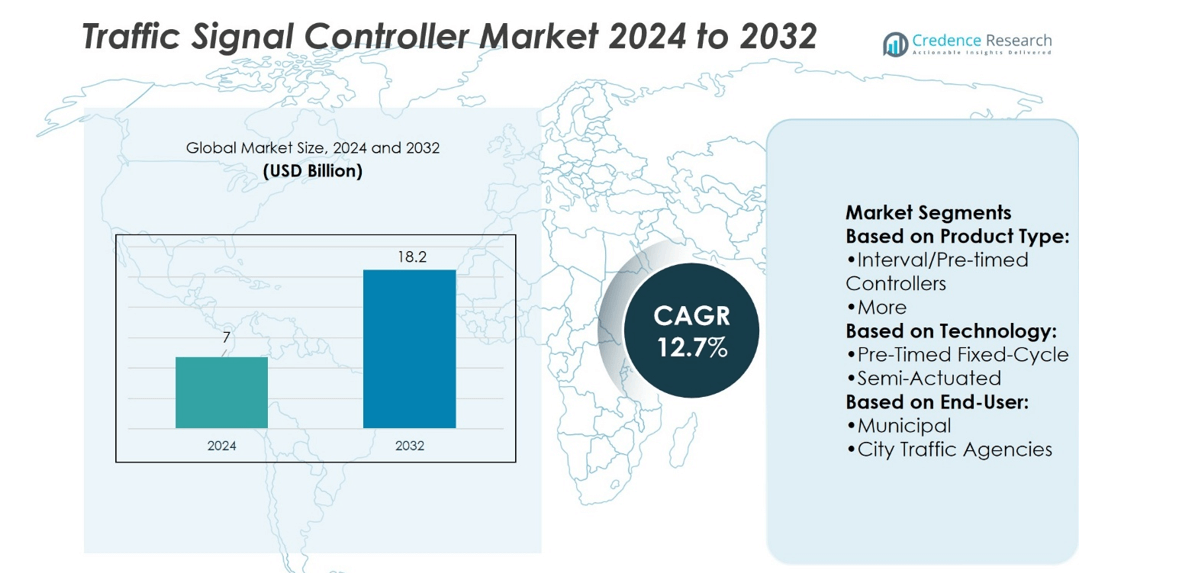
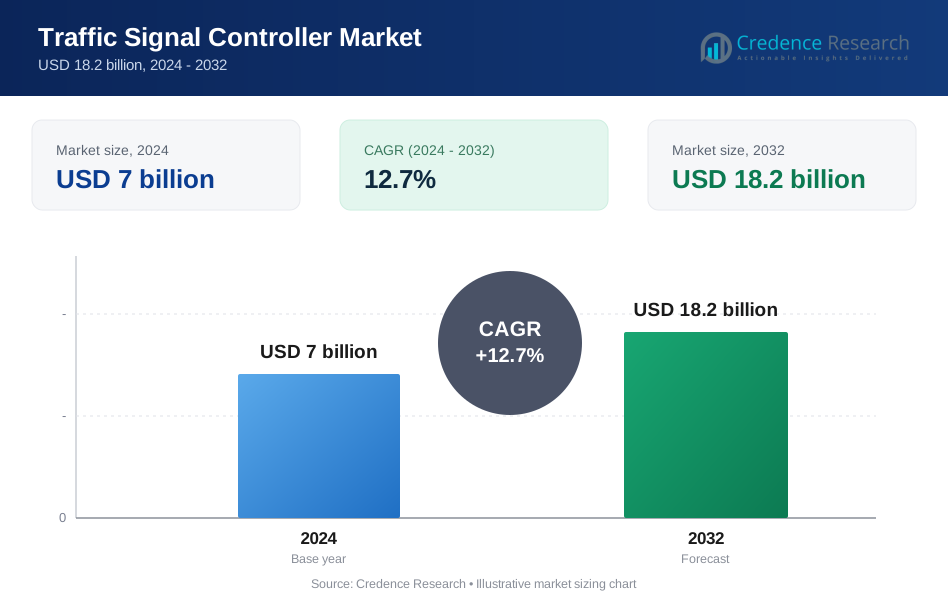
Traffic Signal Controller Market size was valued at USD 7 billion in 2024 and is anticipated to reach USD 18.2 billion by 2032, at a CAGR of 12.7% during the forecast period.
| REPORT ATTRIBUTE | DETAILS |
|---|---|
| Historical Period | 2020-2023 |
| Base Year | 2024 |
| Forecast Period | 2025-2032 |
| Traffic Signal Controller Market Size 2024 | USD 7 billion |
| Traffic Signal Controller Market, CAGR | 12.7% |
| Traffic Signal Controller Market Size 2032 | USD 18.2 billion |
The Traffic Signal Controller Market grows with rising urbanization, increasing vehicle ownership, and the urgent need for efficient mobility solutions. Governments invest in smart city projects and prioritize adaptive traffic systems to reduce congestion and improve road safety. Integration of AI, IoT, and cloud platforms strengthens real-time monitoring and predictive traffic management. Sustainability initiatives drive demand for energy-efficient, solar-powered controllers and LED-based signaling. It also benefits from growing adoption of vehicle-to-infrastructure communication that supports connected and autonomous mobility. Strong regulatory frameworks and funding commitments ensure continuous deployment of advanced traffic technologies across both developed and emerging regions.
North America holds the largest share of the Traffic Signal Controller Market, driven by strong funding and advanced infrastructure, while Europe follows with sustainability-focused deployments and regulatory support. Asia-Pacific shows the fastest growth, supported by urbanization and large-scale smart city initiatives. Latin America and the Middle East & Africa record smaller shares but expand through modernization projects. Key players driving competition include Siemens AG, Econolite, Johnson Controls, Indra Sistemas S.A., Traffic Technologies Pty Ltd, and Kyosan Electric Mfg Co Ltd.
Market Insights
- Traffic Signal Controller Market size was valued at USD 7 billion in 2024 and is expected to reach USD 18.2 billion by 2032, at a CAGR of 12.7%.
- Rising urbanization, increasing vehicle ownership, and demand for efficient mobility drive market growth.
- Adoption of AI, IoT, and cloud-based systems strengthens real-time traffic monitoring and predictive control.
- Competition intensifies as global and regional players focus on adaptive and connected traffic solutions.
- High implementation costs and integration challenges with legacy infrastructure act as restraints.
- North America leads with strong funding and advanced infrastructure, while Europe advances through sustainability-focused projects.
- Asia-Pacific records the fastest growth, while Latin America and the Middle East & Africa expand through modernization initiatives.
Market Drivers
Rising Urbanization and Vehicle Growth Increase Demand for Advanced Controllers
Rapid urbanization and the surge in vehicle ownership drive the need for efficient traffic management. Cities struggle with congestion, delays, and pollution, creating pressure to modernize signaling systems. The Traffic Signal Controller Market benefits from investments in smart infrastructure and digital mobility solutions. Governments prioritize adaptive control systems to reduce waiting times and improve road efficiency. It supports smoother traffic flow, lowers emissions, and strengthens commuter safety. Growing smart city projects further strengthen adoption across both developed and emerging regions.
- For instance, Johnson Controls, which acquired Tyco International in 2016, offers intelligent transport systems (ITS) that include SCATS and Meridian. According to information on Johnson Controls' websites, these systems control road traffic at more than 35,000 intersections, motorways, and tunnels in over 250 cities.
Government Regulations and Road Safety Policies Accelerate Adoption
Strict road safety standards and enforcement of traffic laws push the use of advanced controllers. Authorities deploy these systems to reduce accidents, improve compliance, and streamline mobility. The Traffic Signal Controller Market gains from integration with surveillance and incident detection technologies. Governments invest heavily in connected infrastructure to ensure real-time monitoring and adaptive signaling. It enables improved response to emergencies and dynamic adjustments for changing traffic conditions. Policy support and funding continue to make these systems a priority for urban development.
- For instance, Siemens Mobility’s 230-volt LED traffic signals, the 1-watt technology can save approximately 1,600 kilowatt-hours (kWh) per year at a typical intersection with about 55 signal heads. This translates to significant energy cost savings for cities.
Integration of IoT, AI, and Smart Connectivity Expands Capabilities
Advancements in IoT, AI, and communication networks transform the scope of traffic management. Controllers now support adaptive algorithms, predictive analytics, and cloud-based monitoring. The Traffic Signal Controller Market grows with the shift toward data-driven decision-making. It provides cities with insights on traffic density, peak hours, and pedestrian flow. AI-based systems optimize signal cycles, reducing congestion and fuel consumption. Adoption of 5G further enhances real-time communication between vehicles, infrastructure, and controllers.
Sustainability and Energy Efficiency Shape Market Development
Sustainability goals lead to wider use of eco-friendly and energy-efficient traffic systems. Solar-powered controllers, LED-based signals, and low-maintenance components see strong demand. The Traffic Signal Controller Market aligns with global efforts to cut emissions and energy costs. It also supports environmental goals by minimizing vehicle idling time at intersections. Urban planners adopt sustainable traffic management as part of broader green infrastructure strategies. Public acceptance of eco-friendly mobility solutions further fuels the shift toward smarter controllers.
Market Trends
Growing Shift Toward Adaptive and Intelligent Traffic Control Systems
Cities move from fixed-time controllers to adaptive systems that respond to real-time conditions. Sensors, cameras, and AI platforms guide dynamic signal adjustments for smoother flow. The Traffic Signal Controller Market experiences growth from rising adoption of intelligent traffic solutions. It enables reduced congestion, shorter waiting periods, and better safety outcomes. Adaptive systems also support integration with connected vehicles for coordinated movement. Urban areas prioritize these solutions to manage rising traffic complexities effectively.
- For instance, Econolite’s Centracs® system now controls over 57,000 signalized intersections across North America, serving more than 340 customers through its advanced ATMS software suite.
Expansion of Connected Infrastructure and Vehicle-to-Infrastructure Communication
Integration of controllers with vehicle-to-infrastructure (V2I) technology is becoming standard. These systems exchange data with vehicles to enhance safety and mobility. The Traffic Signal Controller Market benefits from widespread deployment of V2I-ready solutions. It supports collision prevention, smoother lane merging, and better pedestrian safety. Connectivity also allows for remote monitoring and predictive maintenance of traffic assets. This trend aligns with the broader vision of fully connected, smart transportation networks.
- For instance, SWARCO’s Traffic Light Assistance pilot showed that 95 % of vehicles with speed advisories encountered no delay at intersections. Additionally, SWARCO’s V2X Standalone Road Side Unit acts as a modular “communication modem” using the ETSI ITS G5 5.9 GHz standard.
Rising Adoption of Cloud Platforms and Data-Driven Traffic Management
Cloud integration is transforming how cities monitor and optimize traffic networks. Real-time data collection and analytics enable proactive decision-making for traffic authorities. The Traffic Signal Controller Market expands with demand for centralized platforms and digital dashboards. It improves coordination across intersections and reduces operational inefficiencies. Cloud systems also enhance resilience by offering quick updates and scalable operations. Growing reliance on analytics makes traffic management more predictive and adaptive.
Focus on Sustainable, Energy-Efficient, and Low-Maintenance Solutions
Energy efficiency drives strong demand for solar-powered controllers and LED-based signaling systems. Cities prefer sustainable designs that reduce long-term maintenance and operating costs. The Traffic Signal Controller Market grows with wider adoption of eco-friendly solutions. It lowers carbon footprints and supports broader green infrastructure policies. Energy-saving controllers also extend equipment lifespan and reduce downtime. Global sustainability targets encourage governments to prioritize investments in such traffic solutions.
Market Challenges Analysis
High Implementation Costs and Complex Integration with Existing Infrastructure
The deployment of advanced traffic controllers requires large investments in hardware, software, and skilled labor. Cities with legacy infrastructure face difficulties aligning new systems with outdated signal networks. The Traffic Signal Controller Market encounters challenges where budget limitations restrict modernization efforts. It often demands long project timelines and extensive planning to ensure compatibility. Maintenance costs for advanced systems also remain a concern for smaller municipalities. Integration with surveillance, IoT, and communication platforms further raises both technical and financial barriers.
Cybersecurity Risks and Operational Reliability Concerns in Smart Networks
Growing reliance on connected systems exposes traffic controllers to cybersecurity threats. Unauthorized access or system disruptions could compromise traffic safety and efficiency. The Traffic Signal Controller Market must address data security to maintain trust and reliability. It requires investment in encryption, monitoring, and secure communication frameworks. Operational failures during power outages or network breakdowns present another critical issue. It highlights the need for robust backup systems and standardized protocols to sustain uninterrupted traffic control.
Market Opportunities
Expansion of Smart City Projects and Investments in Intelligent Mobility
Smart city initiatives worldwide create strong opportunities for advanced traffic management solutions. Governments invest heavily in digital infrastructure to reduce congestion and improve mobility. The Traffic Signal Controller Market benefits from rising demand for adaptive and interconnected control systems. It enables cities to optimize traffic flow, integrate multimodal transport, and strengthen public safety. Growing urbanization ensures steady project pipelines across both developed and developing regions. Large-scale funding commitments further support the deployment of next-generation signaling technologies.
Advancements in AI, IoT, and Sustainable Traffic Solutions
Rapid progress in AI and IoT technologies opens opportunities for predictive and data-driven traffic control. Cloud-based platforms enhance real-time decision-making and support integration with autonomous vehicle ecosystems. The Traffic Signal Controller Market expands with eco-friendly solutions such as solar-powered controllers and low-energy LEDs. It aligns with global sustainability goals while reducing long-term operational costs for cities. Demand for smart mobility also drives interest in energy-efficient and low-maintenance systems. These advancements create pathways for vendors to deliver scalable, innovative solutions worldwide.
Market Segmentation Analysis:
By Product Type
The Traffic Signal Controller Market is segmented by product type into interval/pre-timed controllers, actuated controllers, adaptive controllers, and others. Interval and pre-timed controllers hold steady demand due to their simplicity and cost-effectiveness in smaller towns and low-traffic zones. Actuated controllers gain traction in urban areas where sensors and detectors adjust timing to real-time conditions. Adaptive controllers show strong growth, supported by smart city projects and the need for optimized traffic flow. It ensures flexibility in response to varying traffic volumes across different times of day. Growing emphasis on digital transformation continues to favor advanced product types with higher automation levels.
- For instance, Q-Free deployed 240 ATC controllers using the 2070LDX model, combined with its MAXTIME® intersection control software, across Plano, Texas, enhancing signal timing at numerous key intersections.
By Technology
Segmentation by technology includes pre-timed fixed-cycle, semi-actuated, fully actuated, and adaptive traffic control. Pre-timed fixed-cycle controllers remain relevant in structured networks with predictable traffic flows. Semi-actuated systems offer balance by combining sensors with fixed cycles, making them effective in medium-density urban roads. Fully actuated systems witness demand in metropolitan areas where high variability in traffic requires dynamic adjustments. The Traffic Signal Controller Market benefits from adaptive traffic control, which integrates AI, IoT, and cloud platforms. It enables real-time coordination and predictive analytics to minimize congestion. Smart technologies are gradually replacing traditional systems, creating opportunities for long-term upgrades.
- For instance, Sumitomo’s Intelligent Traffic Signal Management system controls approximately 8,000 intersections using central algorithms that coordinate both macro and micro traffic flows.
By End User
End-user segmentation covers municipal and city traffic agencies, highway authorities, and private infrastructure operators. Municipal and city agencies dominate demand due to their responsibility for urban mobility management. Highway authorities adopt advanced controllers to improve safety and streamline long-distance travel routes. Private operators, often involved in toll roads and large-scale infrastructure projects, integrate advanced solutions to enhance efficiency. The Traffic Signal Controller Market aligns closely with urban planning objectives and government-led projects. It underscores the critical role of public sector investments in driving adoption. Demand across end users continues to grow, supported by policies for smart mobility and sustainable infrastructure.
Segments:
Based on Product Type:
- Interval/Pre-timed Controllers
- More
Based on Technology:
- Pre-Timed Fixed-Cycle
- Semi-Actuated
Based on End-User:
- Municipal
- City Traffic Agencies
Based on the Geography:
- North America
- U.S.
- Canada
- Mexico
- Europe
- UK
- France
- Germany
- Italy
- Spain
- Russia
- Belgium
- Netherlands
- Austria
- Sweden
- Poland
- Denmark
- Switzerland
- Rest of Europe
- Asia Pacific
- China
- Japan
- South Korea
- India
- Australia
- Thailand
- Indonesia
- Vietnam
- Malaysia
- Philippines
- Taiwan
- Rest of Asia Pacific
- Latin America
- Brazil
- Argentina
- Peru
- Chile
- Colombia
- Rest of Latin America
- Middle East
- UAE
- KSA
- Israel
- Turkey
- Iran
- Rest of Middle East
- Africa
- Egypt
- Nigeria
- Algeria
- Morocco
- Rest of Africa
Regional Analysis
North America
North America holds around 37.5% of the Traffic Signal Controller Market. The United States accounts for the largest portion within this region, supported by strong federal programs that promote smart mobility. Government funding drives widespread deployment of adaptive and connected traffic control systems. Canada contributes steadily, with cities investing in AI-driven vehicle-to-infrastructure communication and smart intersection projects. Mexico is advancing through urban modernization plans that incorporate sensor-based traffic solutions. It reflects a mature market environment where innovation, regulation, and adoption move in alignment. North America remains the global leader, supported by high demand for safe and efficient urban mobility.
Europe
Europe represents approximately 25% of the global market. Germany leads adoption, supported by sustainability mandates and smart transport policies. The United Kingdom expands rapidly, with projects focused on congestion relief and emission reduction. France, Italy, and Spain also integrate adaptive controllers into national smart city initiatives. The region benefits from collaboration between public agencies and private technology developers. It emphasizes reducing carbon emissions through the use of eco-friendly traffic solutions. The Traffic Signal Controller Market in Europe shows steady momentum, driven by regulatory frameworks and advanced infrastructure upgrades.
Asia-Pacific
Asia-Pacific contributes about 30% of global revenue, making it the second-largest regional market. China dominates through rapid deployment of intelligent traffic networks in major urban centers. India shows strong growth with rising investment in smart city projects and urban modernization schemes. Japan and South Korea lead in technology adoption, focusing on AI-enabled traffic management and IoT integration. Southeast Asia adds growth through infrastructure expansion in emerging economies. It highlights the importance of scalable solutions to handle large urban populations. Asia-Pacific stands out as the fastest-growing region, supported by high congestion levels and smart infrastructure funding.
Latin America
Latin America holds about 5% of the Traffic Signal Controller Market. Brazil leads adoption, supported by major metropolitan projects in São Paulo and Rio de Janeiro. Mexico and Chile invest in modernization projects to improve safety and reduce congestion. Regional growth is driven by government support and partnerships with international technology providers. It faces challenges from limited budgets, but gradual adoption of adaptive controllers is underway. The region highlights opportunities for vendors offering cost-effective and durable systems. Latin America continues to expand its role in the global market, albeit at a slower pace compared to larger regions.
Middle East & Africa
The Middle East & Africa account for roughly 5% of global demand. Gulf countries, led by the United Arab Emirates and Saudi Arabia, invest heavily in smart mobility as part of national diversification plans. South Africa and Nigeria show gradual growth, focusing on urban modernization and safety projects. It faces barriers such as infrastructure gaps and high integration costs, but pilot deployments strengthen adoption trends. International collaborations help governments introduce AI-based traffic solutions in key cities. The region presents long-term opportunities as urbanization accelerates and transport systems modernize. Middle East & Africa continue to emerge as promising, though relatively smaller, markets.
Key Player Analysis
- Econolite (U.S.)
- Kyosan Electric Mfg Co Ltd (Japan)
- Indra Sistemas, S.A. (Spain)
- Johnson Controllers (Ireland)
- Traffic Technologies Pty Ltd (Australia)
- Sena Traffic Systems (Malaysia)
- Siemens AG (Germany)
- PPK Technology Sdn. Bhd (Malaysia)
- Sumitomo Electric Mfg Co (Japan)
- Dynamic Traffic Systems (Malaysia)
Competitive Analysis
The Traffic Signal Controller Market include Econolite, Kyosan Electric Mfg Co Ltd, Indra Sistemas S.A., Johnson Controls, Traffic Technologies Pty Ltd, Sena Traffic Systems, Siemens AG, PPK Technology Sdn. Bhd, Sumitomo Electric Mfg Co, and Dynamic Traffic Systems. The Traffic Signal Controller Market is defined by rapid technological evolution and rising urban mobility needs. Governments focus on smart city initiatives that integrate adaptive traffic systems, cloud-based monitoring, and vehicle-to-infrastructure communication. The market grows as cities seek solutions that reduce congestion, improve safety, and align with sustainability goals. It benefits from the integration of AI and IoT, enabling predictive analytics and real-time decision-making across intersections. Demand for energy-efficient, solar-powered controllers and LED signaling is increasing, driven by environmental policies. Strong emphasis on interoperability ensures controllers can support future mobility ecosystems, including connected and autonomous vehicles.
Recent Developments
- In August 2025, Kapsch TrafficCom and Intellectual Holding, a subsidiary of Schneider Electric, announced a joint venture to develop and market integrated intelligent transportation systems. The partnership would combine Kapsch traffic management expertise with Intellectus' advanced traffic signal control technologies.
- In October 2024, the Gurugram Metropolitan Development Authority (GMDA) developed smart traffic signal systems by including 32 junctions in the city. This second phase of the project will help meet the vehicle traffic management and pedestrian safety challenges across the city.
- In July 2024, LEOTEK closed its acquisition of Dialight’s traffic business, a well-known global supplier of LED commercial and industrial luminaires. The acquisition provides LEOTEK with a much-needed leg up as a supplier/provider/manufacturer of traffic signals in the Americas.
- In April 2024, PTV Group, Umovity, and Econolite partnered to an integrated prediction traffic monitoring and alarm solution leveraging an Advanced Transportation Management System (ATMS). This new predictive platform also accepted inputs from Econolite Centris Mobility software to optimize traffic flows, mitigate congestion, and improve safety using real-time data to respond to dynamic changes.
Report Coverage
The research report offers an in-depth analysis based on Product Type, Technology, End-User and Geography. It details leading market players, providing an overview of their business, product offerings, investments, revenue streams, and key applications. Additionally, the report includes insights into the competitive environment, SWOT analysis, current market trends, as well as the primary drivers and constraints. Furthermore, it discusses various factors that have driven market expansion in recent years. The report also explores market dynamics, regulatory scenarios, and technological advancements that are shaping the industry. It assesses the impact of external factors and global economic changes on market growth. Lastly, it provides strategic recommendations for new entrants and established companies to navigate the complexities of the market.
Future Outlook
- The market will expand with rising adoption of adaptive and intelligent traffic systems.
- Governments will continue to fund smart city projects that integrate advanced traffic control.
- Demand for AI and IoT-enabled controllers will increase across developed and emerging regions.
- Cloud-based platforms will play a greater role in real-time monitoring and traffic optimization.
- Energy-efficient and solar-powered traffic controllers will see stronger adoption worldwide.
- Vehicle-to-infrastructure communication will strengthen integration with connected and autonomous mobility.
- Regions with rapid urbanization will drive large-scale deployments of advanced controllers.
- Cybersecurity will become a priority to safeguard connected traffic management systems.
- Predictive analytics will improve congestion management and enhance urban traffic efficiency.
- Global sustainability goals will push demand for low-emission, eco-friendly traffic control solutions.
Request a Free Sample
Fill in your details and we'll send you a free sample report.
- Sample data tables & charts
- Research methodology
Need a Custom Version of This Report?
Tailor the scope, geography, or segments to your exact requirements.
- Custom geography or segment scope
- Direct access to our analyst team
Frequently Asked Questions
What is the current market size for Traffic Signal Controller Market, and what is its projected size in 2032?
At what Compound Annual Growth Rate is the Traffic Signal Controller Market projected to grow between 2025 and 2032?
What are the primary factors fueling the growth of the Traffic Signal Controller Market?
Who are the leading companies in the Traffic Signal Controller Market?
Table of Content
Chapter 1. Report Introduction
- 1.1 Report Description & Purpose
- 1.1.1 Report Title & Market Definition
- 1.1.2 Unique Selling Propositions (USP) & Key Differentiators
- 1.1.3 Value Proposition for Stakeholders
- 1.2 Research Objectives
- 1.2.1 Market Sizing Objectives (Volume & Revenue)
- 1.2.2 Segmentation Objectives
- 1.2.3 Competitive Intelligence Objectives
- 1.2.4 Forecast & Scenario Objectives
- 1.3 Report Scope
- 1.3.1 Traffic Signal Controller Scope – Types & Subtypes Covered
- 1.3.2 Geographic Scope – Regions & Countries Covered
- 1.3.3 Historical Period, Base Year & Forecast Period (2024; forecast to 2032)
- 1.3.4 Inclusions & Exclusions
- 1.4 HS Code & Classification Framework
- 1.5 Currency, Units & Pricing Basis
- 1.6 Target Stakeholders
- 1.7 Limitations & Assumptions
Chapter 2. Executive Summary
- 2.1 Global Traffic Signal Controller Market Snapshot
- 2.1.1 Market Size – Historical (2024) & Forecast (2024-2032) (2024: USD 7 billion → 2032: USD 18.2 billion)
- 2.1.2 Volume & Revenue – Global Totals
- 2.1.3 Key Market Highlights – Top Five Facts
- 2.2 Traffic Signal Controller Market Segmentation Snapshot
- 2.2.1 Market Split by Region – 2024 vs. 2032
- 2.3 Competitive Snapshot
- 2.3.1 Top 10 Players by Revenue Share – 2024
- 2.3.2 Top 10 Players by Volume Share – 2024
- 2.3.3 Recent Strategic Developments (18-Month Summary)
- 2.4 Key Investment Highlights & Strategic Conclusions
Chapter 3. Traffic Signal Controller Market Dynamics & Industry Analysis
- 3.1 Market Overview & Context
- 3.1.1 Traffic Signal Controller Market Position in the Broader Automotive Value Chain
- 3.1.2 OEM vs. Replacement Market Dynamics
- 3.1.3 Market Maturity & Development Stage by Region
- 3.2 Traffic Signal Controller Market Drivers
- 3.3 Traffic Signal Controller Market Restraints & Challenges
- 3.4 Traffic Signal Controller Market Opportunities
- 3.5 Porter's Five Forces Analysis
- 3.5.1 Threat of New Entrants
- 3.5.2 Bargaining Power of Suppliers
- 3.5.3 Bargaining Power of Buyers
- 3.5.4 Threat of Substitutes
- 3.5.5 Competitive Rivalry – Intensity Assessment
- 3.6 Traffic Signal Controller Value Chain Analysis
- 3.6.1 Upstream – Raw Material/Input Suppliers
- 3.6.1.1 Raw Material/Input 1
- 3.6.1.2 Raw Material/Input 2
- 3.6.1.3 Raw Material/Input 3
- 3.6.2 Midstream – Production/Manufacturing/Service Delivery
- 3.6.2.1 Production/Process Overview
- 3.6.2.2 Key Facility Locations & Capacity by Manufacturer
- 3.6.3 Downstream – Distribution & End Consumer
- 3.6.3.1 Primary Channel – B2B/OEM
- 3.6.3.2 Secondary Channels – Dealer, Retail, Online, Direct
- 3.6.4 Value Chain Profitability Analysis
- 3.6.1 Upstream – Raw Material/Input Suppliers
- 3.7 PESTEL Analysis
- 3.7.1 Political Factors
- 3.7.2 Economic Factors
- 3.7.3 Social Factors
- 3.7.4 Technological Factors
- 3.7.5 Environmental Factors
- 3.7.6 Legal Factors
- 3.8 Traffic Signal Controller Supply Chain Analysis
- 3.8.1 Raw Material/Input Supply Risk Assessment
- 3.8.2 Manufacturing Concentration Risk (Geographic Exposure)
- 3.8.3 Trade Disruption Impact Analysis
- 3.9 Regulatory & Policy Landscape
Note: The regulatory and policy landscape section covers regulations based on their applicability to the market, Traffic Signal Controller category, geography, and scope of the study. Only regulatory frameworks with a material impact on operations, compliance, trade, sustainability, or market access are analyzed in detail.
Chapter 4. Key Investment Pockets & Opportunity Analysis
- 4.1 Traffic Signal Controller Market Attractiveness Analysis
- 4.1.1 By Region – Investment Attractiveness Matrix (Volume × CAGR)
- 4.2 Absolute Revenue Growth Opportunity
- 4.2.1 By Region – Absolute USD Growth Through 2032
- 4.3 Incremental Volume Opportunity
- 4.3.1 By Region – Incremental Volume Through 2032
- 4.3.2 Segment – Incremental Volume
- 4.4 Emerging Submarket Opportunity Deep Dive (Subject to Applicability)
- 4.5 Emerging Market Opportunity Scorecards
- 4.5.1 United States
- 4.5.2 Europe
- 4.5.3 Asia
- 4.5.4 Middle East & Africa
Note: Emerging Market Opportunity Scorecards will be included based on relevance and strategic importance. Regions listed are indicative and may vary depending on data availability and market dynamics.
Chapter 5. Traffic Signal Controller Import-Export Analysis & Trade Flows
- 5.1 Global Trade Overview
- 5.1.1 Global Export Value by Country (2024)
- 5.1.2 Global Export Volume by Country (2024)
- 5.1.3 Global Import Value by Country (2024)
- 5.1.4 Global Import Volume by Country (2024)
- 5.1.5 Net Trade Balance by Country (2024)
- 5.2 Export Analysis – Segment
- 5.2.1 Type 1 (HS Code)
- 5.2.2 Type 2 (HS Code)
- 5.2.3 Type 3 (HS Code)
- 5.2.4 Type 4 (HS Code)
- 5.2.5 Type 5 (HS Code)
- 5.3 Import Analysis – Segment
- 5.3.1 Type 1 (HS Code)
- 5.3.2 Type 2 (HS Code)
- 5.3.3 Type 3 (HS Code)
- 5.3.4 Type 4 (HS Code)
- 5.3.5 Type 5 (HS Code)
- 5.4 Average Unit Trade Prices
- 5.4.1 Average Export Price – Segment & Country
- 5.4.2 Average Import Price – Segment & Source Country
- 5.4.3 Price Trends (2024)
- 5.5 Key Trade Route Analysis
- 5.5.1 Trade Route 1
- 5.5.2 Trade Route 2
- 5.5.3 Trade Route 3
- 5.5.4 Trade Route 4
- 5.5.5 Trade Route 5
- 5.6 Trade Policy Impact Assessment
- 5.6.1 US Anti-Dumping & Section 301 Tariffs
- 5.6.2 EU Customs Union Impact
- 5.6.3 Major Free Trade Agreements
- 5.6.4 USMCA Rules of Origin
Note: Trade policy analysis will be included only where relevant to the Traffic Signal Controller market.
Chapter 6. Competitive Landscape & Company Benchmarking
- 6.1 Traffic Signal Controller Market Concentration & Structure
- 6.1.1 Herfindahl-Hirschman Index (HHI) – vs. 2024
- 6.1.2 Tier 1, Tier 2 & Tier 3 Market Structure
- 6.1.3 Global, Regional & Local Player Dynamics
- 6.2 Traffic Signal Controller Market Share Analysis – 2024
- 6.2.1 Global Revenue Share by Company
- 6.2.2 Global Volume Share by Company
- 6.2.3 Regional Revenue Share
- 6.2.4 Market Share Evolution ( vs. 2024)
- 6.2.5 OEM Segment Share by Company
- 6.2.6 Replacement Segment Share by Company
- 6.3 Production/Delivery Capacity & Facility Analysis
- 6.3.1 Global Installed Capacity
- 6.3.2 Capacity Utilization Rates
- 6.3.3 Production/Output Volume
- 6.3.4 Facility Locations & Capacity Map
- 6.3.5 Planned Capacity Additions
- 6.4 Traffic Signal Controller Competitive Benchmarking Matrix
- 6.4.1 Revenue, Volume, CAGR & Profitability Comparison
- 6.4.2 Channel Revenue Mix
- 6.4.3 Geographic Revenue Exposure
- 6.4.4 R&D Intensity
- 6.4.5 Sustainability Maturity
- 6.5 Strategic Developments in Traffic Signal Controller (Last 24 Months)
- 6.5.1 Mergers, Acquisitions & Divestments
- 6.5.2 New Traffic Signal Controller Launches
- 6.5.3 Facility Expansions
- 6.5.4 Strategic Alliances, Joint Ventures & Partnerships
- 6.5.5 Distribution Expansion & Market Entry
- 6.5.6 Sustainability & ESG Initiatives
- 6.6 Competitive Strategy Mapping
- 6.6.1 Leader, Challenger, Follower & Niche Classification
- 6.6.2 Pricing Strategy Comparison
- 6.6.3 Channel Strategy Matrix
Note: Strategic developments are included based on their materiality and the availability of reliable information.
Chapter 7. Global Traffic Signal Controller Market – By Distribution Channel
- 7.1 Segment Overview
- 7.1.1 Volume & Revenue Split by Channel (2024 & 2032)
- 7.1.2 Channel Mix Evolution (2024-2032)
Chapter 8. Regional Market Analysis – Global Overview
- 8.1 Global Regional Overview
- 8.1.1 Regional Volume Share
- 8.1.2 Regional Revenue Share
- 8.1.3 Regional Volume by Region
- 8.1.4 Regional Revenue by Region
- 8.1.5 Regional Forecast Through 2032
- 8.2 Cross-Regional Segment Analysis
- 8.2.1 By Distribution Channel
- 8.2.2 By Brand/Price Tier
Chapter 9. North America Traffic Signal Controller Market
- 9.1 United States
- 9.2 Canada
- 9.3 Mexico
Chapter 10. Europe Traffic Signal Controller Market
- 10.1 Germany
- 10.2 France
- 10.3 Italy
- 10.4 United Kingdom
- 10.5 Spain
- 10.6 Poland
- 10.7 Russia
- 10.8 Netherlands
- 10.9 Belgium
- 10.10 Sweden
- 10.11 Denmark
- 10.12 Norway
- 10.13 Rest of Europe
Chapter 11. Asia Pacific Traffic Signal Controller Market
- 11.1 China
- 11.2 India
- 11.3 Japan
- 11.4 South Korea
- 11.5 Thailand
- 11.6 Indonesia
- 11.7 Vietnam
- 11.8 Malaysia
- 11.9 Australia
- 11.10 Rest of Asia Pacific
Chapter 12. Latin America Traffic Signal Controller Market
- 12.1 Brazil
- 12.2 Argentina
- 12.3 Colombia
- 12.4 Chile
- 12.5 Rest of Latin America
Chapter 13. Middle East Traffic Signal Controller Market
- 13.1 Saudi Arabia
- 13.2 United Arab Emirates
- 13.3 Turkey
- 13.4 Israel
- 13.5 Iran
- 13.6 Rest of the Middle East
Chapter 14. Africa Traffic Signal Controller Market
- 14.1 South Africa
- 14.2 Egypt
- 14.3 Nigeria
- 14.4 Morocco
- 14.5 Rest of Africa
Chapter 15. Traffic Signal Controller Company Profiles
- 15.1 [Company 01]
- 15.1.1 Company Overview
- 15.1.2 Key Management Personnel
- 15.1.3 Products & Services Portfolio
- 15.1.4 Financial Performance
- 15.1.5 Key Market Focus & Geographic Presence
- 15.1.6 Recent Developments & Strategic Initiatives
Note: The company profile list is preliminary and may change based on research findings, market developments, data availability, and client requirements.
Chapter 16. Appendices
- Appendix A – List of Abbreviations & Acronyms
- Appendix B – Industry Classification Code Reference – Full Series
- Appendix C – Production & Capacity Data Tables
- Appendix D – End-Use & Demand Base Tables
- Appendix E – Consumption & Replacement Rate Assumptions
- Appendix F – ASP Reference Tables
- Appendix G – Manufacturing & Facility Database
- Appendix H – Import-Export Data Tables
- Appendix I – Regulatory Summary Tables
- Appendix J – Primary Research Participant List (Anonymized)
- Appendix K – Primary Research Questionnaire Framework
- Appendix L – Data Sources & Bibliography
- Appendix M – Market Size Divergence & Source Comparison
Chapter 17. Research Methodology
- 17.1 Research Framework & Philosophy
- 17.2 Secondary Research – Sources, Hierarchy & Data Extraction
- 17.3 Data Modeling – Bottom-Up & Top-Down Market Sizing
- 17.4 Primary Research – Stakeholder Framework, LOI & Sample Sizes
- 17.5 Forecast Methodology – Regression, Scenario & Sensitivity Analysis
- 17.6 Quality Control – Four-Layer Validation Framework
- 17.7 Limitations & Standard Assumptions
- 17.8 Disclaimer
