
Market Overview:
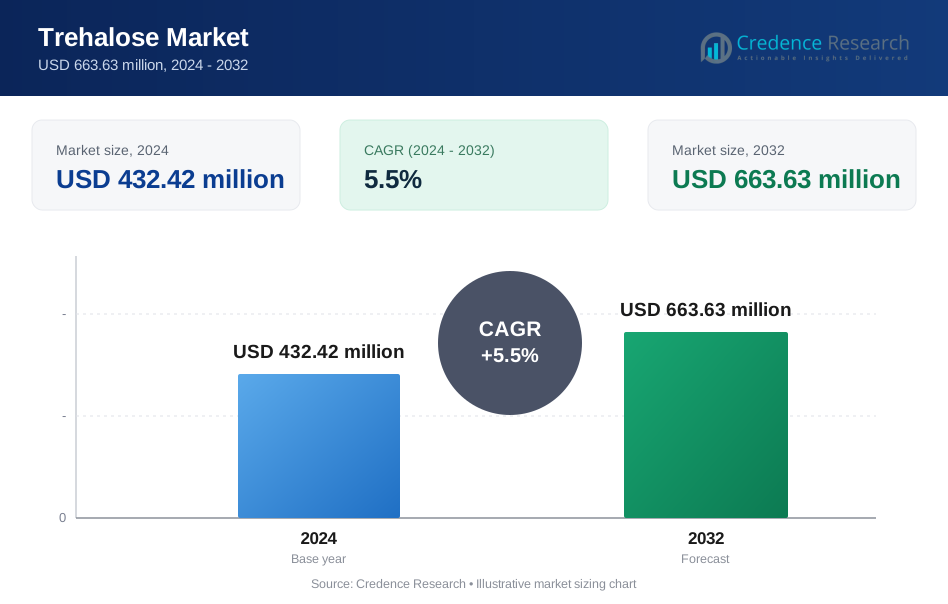
The Trehalose Market size was valued at USD 432.42 million in 2024 and is anticipated to reach USD 663.63 million by 2032, at a CAGR of 5.5% during the forecast period (2024-2032).
| REPORT ATTRIBUTE | DETAILS |
|---|---|
| Historical Period | 2020-2023 |
| Base Year | 2024 |
| Forecast Period | 2025-2032 |
| Trehalose Market By Product Size 2024 | USD 432.42 million |
| Trehalose Market By Product, CAGR | 5.5% |
| Trehalose Market By Product Size 2032 | USD 663.63 million |
Key drivers of market growth include rising consumer demand for natural sweeteners and preservative agents, as trehalose offers enhanced shelf-life stability and a low glycemic index. Additionally, the growing trend toward clean-label and plant-based products is contributing to the market's expansion. The pharmaceutical sector's focus on trehalose's potential therapeutic applications, particularly in treating neurodegenerative diseases, is also fueling demand. Moreover, increasing research into the benefits of trehalose in medical and biotechnology applications is expected to drive further market adoption.
Regionally, North America holds the largest share of the trehalose market, driven by high demand in the food and beverage industry, as well as significant investments in research and development. The Asia Pacific region is expected to witness the highest growth rate, supported by increasing industrialization, consumer awareness, and the expanding food and beverage sector in countries like China and India. Europe also contributes significantly to the market due to the growing trend of healthy eating and functional foods. Additionally, the rising popularity of sports nutrition and energy drinks in these regions is further boosting the demand for trehalose.
Market Insights:
- The Trehalose market was valued at USD 432.42 million in 2024 and is expected to reach USD 663.63 million by 2032, growing at a CAGR of 5.5% during the forecast period.
- Rising consumer demand for natural sweeteners and preservatives is a key driver for market growth. Trehalose’s ability to offer a low glycemic index and extend shelf life makes it highly sought after in food and beverage applications.
- Increasing demand for clean-label and plant-based products is boosting the adoption of trehalose. Its natural origins and versatility make it a preferred ingredient in vegan and plant-based alternatives.
- The pharmaceutical industry’s growing interest in trehalose’s therapeutic applications, particularly in treating neurodegenerative diseases, is accelerating market expansion. Research indicates its potential to protect cells from damage and stress.
- High production costs remain a challenge for the Trehalose market. The complex extraction process from natural starch sources increases production costs, limiting its widespread use in price-sensitive markets.
- Regulatory challenges are hindering market entry, as various regions have different safety and efficacy regulations for trehalose. Companies must invest in compliance efforts, raising the cost of bringing new products to market.
- North America holds the largest market share (38%) in the Trehalose market, driven by strong demand in the food and beverage sector. Significant R&D investments continue to drive innovations and applications in this region.

Market Drivers:
Increasing Consumer Demand for Natural Sweeteners
The growing consumer preference for natural ingredients drives the demand for trehalose in the food and beverage industry. It is increasingly seen as a healthy alternative to artificial sweeteners due to its low glycemic index, making it suitable for consumers seeking to manage blood sugar levels. This trend toward cleaner, more natural food products is a significant factor contributing to the expansion of the trehalose market. Its ability to enhance flavor profiles without compromising health benefits makes it an appealing choice for manufacturers.
Trehalose’s Shelf-Life Extension Benefits
Trehalose’s natural preservative properties make it highly valuable in extending the shelf life of food and beverages. It helps maintain product freshness, texture, and flavor stability, even under challenging storage conditions. With increasing consumer demand for long-lasting, preservative-free foods, trehalose is becoming an essential ingredient in the food processing industry. Its potential to preserve the quality of various products, from baked goods to dairy items, strengthens its position in the market.
Growing Adoption in Plant-Based Products
The rise of plant-based diets and clean-label foods has positively impacted the market for trehalose. It serves as a key ingredient in plant-based alternatives due to its natural origin and versatile functionality. Trehalose’s ability to improve texture, flavor, and mouthfeel while being free from animal-based components aligns with consumer preferences for sustainable and ethical food choices. Its role in enhancing the appeal of plant-based products contributes to its increasing demand.
- For instance, Nagase’s TREHA® trehalose, produced with over 180 years of expertise, is used extensively in plant-based bakery and beverage formulations to improve moisture retention and texture quality.
Expanding Applications in the Pharmaceutical Industry
In the pharmaceutical sector, trehalose’s potential therapeutic applications are gaining attention, especially in treating neurodegenerative diseases. Research indicates that it may help protect cells from stress and damage, positioning it as a candidate for disease management. With advancements in biotechnology and medicine, trehalose’s growing use in drug formulations, especially for rare and chronic conditions, is further propelling market growth.
- For instance, DFE Pharma’s BioHale® Trehalose Dihydrate launched in 2021 meets multiple pharmacopeia standards worldwide and is utilized by pharmaceutical companies globally to enhance stability in biologics and inhalation drugs, supporting over 100 pharma customers.
Market Trends:
Rising Demand for Functional Foods and Beverages in the Trehalose Market
The growing trend of functional foods and beverages is a significant driver for the Trehalose market. Consumers are increasingly seeking products that offer health benefits beyond basic nutrition, such as immune support, energy enhancement, and gut health. Trehalose, with its ability to improve the texture, stability, and shelf life of products, aligns well with this trend. Its application in energy drinks, sports nutrition, and functional snacks is expanding, as these sectors seek ingredients that provide both health benefits and sensory appeal. Trehalose’s adaptability in various product formulations, such as smoothies, meal replacements, and dietary supplements, further contributes to its growing demand in functional food products.
- For instance, Nagase uses TREHA® trehalose to enhance the freshness and texture of energy drinks, with application levels up to 5 grams per serving to improve flavor stability.
Innovation and Research Advancements Boosting Trehalose Market Growth
Ongoing research and development in the Trehalose market are driving innovation in its applications, particularly in pharmaceuticals and biotechnology. Studies are uncovering new uses for trehalose in disease prevention, including neurodegenerative disorders and cell preservation techniques. With its ability to protect cells from damage and support cellular functions, it is being explored for use in treatments for Alzheimer’s and other conditions. These innovations are positioning trehalose as a crucial ingredient in the development of advanced therapeutics. As research continues to evolve, the potential for trehalose in new medical applications increases, further expanding its market reach. The growing body of scientific evidence supporting its benefits ensures its continued relevance across diverse industries.
- For instance, Jiangsu OGO Biotechnology Co., Ltd. operates production facilities with an annual capacity of 100,000 tons of trehalose, supporting pharmaceutical and industrial grade requirements, demonstrating significant scale in trehalose manufacturing for therapeutic applications.
Market Challenges Analysis:
High Production Costs Limiting Trehalose Market Growth
The high production cost of trehalose remains a significant challenge for the market. It is primarily derived from natural sources like starch, requiring complex and energy-intensive processes for extraction and purification. This increases the cost of production, making it less competitive compared to other sweeteners and preservatives. Despite its numerous benefits, the high cost of production limits its widespread adoption, especially in price-sensitive markets. Manufacturers face challenges in balancing quality and affordability, which may deter small and medium-sized companies from incorporating trehalose into their products.
Regulatory Challenges and Market Entry Barriers
Regulatory hurdles also pose challenges for the trehalose market. As a food ingredient and potential pharmaceutical product, it faces stringent regulations concerning its safety, efficacy, and labeling. Different regions have varying guidelines and approval processes for trehalose, which can slow its market entry and limit its growth potential. Companies must invest in complying with these regulations, which can increase the time and cost of bringing new trehalose-based products to market. This complexity in global regulatory frameworks can hinder the market’s expansion, particularly in emerging economies.
Market Opportunities:
Expanding Applications in the Growing Plant-Based Food Sector
The rise of plant-based foods presents significant growth opportunities for the Trehalose market. With the increasing adoption of vegan and vegetarian diets, manufacturers are seeking natural, functional ingredients to enhance the texture, flavor, and nutritional profile of plant-based products. Trehalose fits seamlessly into this trend, offering a clean-label, plant-derived solution that appeals to health-conscious consumers. It can be used in plant-based meat substitutes, dairy alternatives, and snacks, making it a valuable ingredient in the expanding plant-based sector. The increasing demand for sustainable and ethical food choices further drives the market potential for trehalose.
Advancements in Biotechnology and Pharmaceutical Applications
Trehalose holds considerable promise in the biotechnology and pharmaceutical industries, providing opportunities for further market expansion. Its unique properties in protecting cells from stress and damage make it a candidate for use in treatments for neurodegenerative diseases, such as Alzheimer’s. Ongoing research into its potential as a therapeutic agent in drug formulations is paving the way for its integration into new medical applications. The growing focus on personalized medicine and cell-based therapies presents opportunities for trehalose to play a key role in novel medical treatments, further boosting its market adoption.
Market Segmentation Analysis:
By Product Type
The Trehalose market is segmented into two primary product types: crystalline and amorphous. Crystalline trehalose dominates the market, known for its superior stability and purity. It is commonly used in the food and beverage industry for its preservative properties and low glycemic index. Amorphous trehalose, though less common, is gaining traction due to its versatile applications in biotechnology and pharmaceuticals, where its properties are suitable for protecting sensitive proteins and enzymes. Both product types are integral to the market, with crystalline trehalose leading in demand due to its widespread use in consumer goods.
- For instance, Cargill produces crystalline trehalose used in meat products at 3 grams per serving to enhance moisture retention and improve texture, providing a clean label solution in processed foods.
By Application
The key applications of trehalose span across food and beverages, pharmaceuticals, cosmetics, and biotechnology. In the food and beverage sector, trehalose is used for its preservative properties, enhancing shelf life and maintaining product texture. Its demand is growing as consumers seek healthier, natural alternatives to synthetic preservatives. In pharmaceuticals, trehalose’s role in cell preservation and potential therapeutic applications, especially in neurodegenerative disease treatments, is expanding its market presence. The cosmetic industry also benefits from trehalose's hydrating properties, adding to its appeal in skincare products. In biotechnology, it is used in the stabilization of enzymes and proteins, further driving market growth. Trehalose’s adaptability across these diverse sectors ensures its continued market relevance.
- For instance, Seelos Therapeutics is conducting a 24-week clinical trial involving 160 ALS patients testing SLS-005, a trehalose-based therapy, with outcomes measured on motor function via the ALS Functional Rating Scale.
Segmentations:
By Product Type
- Crystalline Trehalose
- Amorphous Trehalose
By Application
- Food and Beverages
- Pharmaceuticals
- Cosmetics
- Biotechnology
By Region
- North America
- U.S.
- Canada
- Mexico
- Europe
- UK
- France
- Germany
- Italy
- Spain
- Russia
- Rest of Europe
- Asia Pacific
- China
- Japan
- South Korea
- India
- Australia
- Southeast Asia
- Rest of Asia Pacific
- Latin America
- Brazil
- Argentina
- Rest of Latin America
- Middle East
- GCC Countries
- Israel
- Turkey
- Rest of Middle East
- Africa
- South Africa
- Egypt
- Rest of Africa
Regional Analysis:
North America Trehalose Market
North America holds 38% of the global Trehalose market share, driven by strong demand in the food and beverage industry. The region’s focus on health-conscious products has propelled the adoption of natural sweeteners and preservatives like trehalose. Consumer awareness of the benefits of low glycemic index ingredients is high, fostering the growth of products featuring trehalose. The region also sees significant investments in research and development, accelerating the use of trehalose in new applications, including functional foods, beverages, and pharmaceuticals. With its established infrastructure and regulatory environment, North America remains a key player in shaping the global market dynamics.
Asia Pacific Trehalose Market
Asia Pacific holds 30% of the Trehalose market share, expected to grow at the highest rate during the forecast period. Countries like China, Japan, and India are witnessing a rise in consumer demand for health-conscious food and beverages, driving the need for ingredients like trehalose. The rapid industrialization and expansion of the food processing sector in these nations are also contributing to market growth. Moreover, the increasing popularity of plant-based diets and functional foods in the region is pushing the demand for trehalose. Manufacturers are increasing their presence in Asia Pacific to meet the growing demand for this versatile ingredient.
Europe Trehalose Market
Europe accounts for 22% of the global Trehalose market share, driven by a strong focus on healthy eating and clean-label products. The increasing consumer preference for functional foods, which offer health benefits beyond basic nutrition, is propelling the demand for trehalose. European regulations around food safety and ingredient transparency have spurred innovation in the market, with trehalose gaining attention as a natural alternative to artificial preservatives. The growing adoption of plant-based and vegan diets in countries like Germany, the UK, and France further supports its integration into various food products. As the demand for sustainable and functional ingredients rises, trehalose is expected to see continued growth in Europe.
Key Player Analysis:
- DuPont de Nemours, Inc.
- Tereos Syral
- Archer Daniels Midland Company
- Cargill, Incorporated
- Mitsubishi Corporation RtM Japan Ltd.
- Hayashibara Co., Ltd.
- Roquette Frères
- Tokyo Chemical Industry Co., Ltd.
- Ingredion Incorporated
- Cosun Beet Company
- CJ CheilJedang Corporation
- The Ajinomoto Co., Inc.
Competitive Analysis:
The Trehalose market is competitive, with both global and regional players shaping its dynamics. Leading companies dominate by leveraging large-scale production capabilities and established distribution channels. These firms focus on innovation and quality to meet rising demand for natural sweeteners and preservatives across multiple industries. Regional players cater to niche applications such as pharmaceuticals and cosmetics, offering specialized products tailored to specific market needs. Competitive pressures arise from factors like production costs, regulatory requirements, and technological advancements. Companies invest heavily in research and development to improve product offerings and stay ahead in a fast-evolving market. Strategic partnerships and collaborations are also common, allowing companies to expand their market presence and capabilities.
Recent Developments:
- In July 2025, Tereos announced plans to expand its power contract sales client base in the Brazilian market by tenfold over two years, utilizing power generation from sugarcane biomass at its plants in Sao Paulo state to target over 1,000 corporate customers through acquisitions and partnerships.
- In August 2025, Archer Daniels Midland announced a production partnership with OCOchem to build a demonstration plant in Decatur, Illinois for converting biogenic CO2 from ethanol production into high-value formate molecules.
- In June 2025, Cargill acquired full ownership of Teys Australia and Teys USA, strengthening its presence in beef production after a 14-year partnership.
Report Coverage:
The research report offers an in-depth analysis based on Product Type, Application and Region. It details leading market players, providing an overview of their business, product offerings, investments, revenue streams, and key applications. Additionally, the report includes insights into the competitive environment, SWOT analysis, current market trends, as well as the primary drivers and constraints. Furthermore, it discusses various factors that have driven market expansion in recent years. The report also explores market dynamics, regulatory scenarios, and technological advancements that are shaping the industry. It assesses the impact of external factors and global economic changes on market growth. Lastly, it provides strategic recommendations for new entrants and established companies to navigate the complexities of the market.
Future Outlook:
- The Trehalose market is expected to continue growing as demand for natural and clean-label ingredients increases.
- Increased consumer awareness of health and wellness will drive the adoption of low-glycemic products like trehalose in the food and beverage industry.
- Trehalose’s versatility in food preservation, especially for plant-based and vegan products, will lead to its broader application in these growing sectors.
- The pharmaceutical industry will explore further therapeutic uses for trehalose, particularly in treating neurodegenerative diseases, expanding its role beyond food products.
- Advancements in biotechnology will open new avenues for trehalose, including its use in enzyme and protein stabilization.
- As plant-based diets gain popularity, trehalose will become a key ingredient in plant-based foods, enhancing flavor and texture.
- Increased research into trehalose’s medical benefits will likely expand its role in treatments for various conditions, boosting demand.
- Regulatory approval for trehalose in more regions will help increase its market penetration, particularly in emerging economies.
- The Asia Pacific region will experience the highest growth due to industrialization, increasing food demand, and a rising middle-class population.
- Companies will continue to focus on innovation and sustainable production practices to meet evolving consumer preferences and regulatory requirements.
Request a Free Sample
Fill in your details and we'll send you a free sample report.
- Sample data tables & charts
- Research methodology
Market Dynamics
Rising Consumer Demand for Natural Sweeteners
Consumers are increasingly seeking natural alternatives to artificial sweeteners, and trehalose’s low glycemic index and clean-label appeal make it a preferred choice in food and beverage applications.
Shelf-Life Extension and Preservative Benefits
Trehalose’s ability to enhance product stability, maintain texture, and extend shelf life is driving its adoption in processed foods and beverages, meeting the demand for longer-lasting, preservative-free products.
Growth in Plant-Based and Clean-Label Products
The surge in plant-based diets and clean-label trends is boosting trehalose usage, as it is a naturally derived ingredient that improves texture and flavor in vegan and vegetarian products.
Expanding Pharmaceutical and Biotechnology Applications
Trehalose is gaining traction in pharmaceuticals for its cell-protective properties and potential therapeutic uses, especially in neurodegenerative disease treatments and biologic drug formulations.
Innovation and Research Advancements
Ongoing R&D is uncovering new uses for trehalose in functional foods, sports nutrition, and medical applications, supporting market growth through product innovation and expanded applications.
Need a Custom Version of This Report?
Tailor the scope, geography, or segments to your exact requirements.
- Custom geography or segment scope
- Direct access to our analyst team
Frequently Asked Questions
What is the current market size for Trehalose, and what is its projected size in 2032?
At what Compound Annual Growth Rate is the Trehalose market projected to grow between 2024 and 2032?
Which Trehalose market segment held the largest share in 2024?
What are the primary factors fueling the growth of the Trehalose market?
Who are the leading companies in the Trehalose market?
Table of Content
Chapter 1 Market Segmentation
- 1.1 Segmentation Framework
- 1.1.1 Product and Service Classification
- 1.1.2 Application and End-Use Classification
- 1.1.3 Technology and Solution Classification
- 1.1.4 Customer and Distribution Channel Classification
- 1.1.5 Geographic Segmentation
- 1.1.6 Market Segment Definitions and Boundaries
- 1.2 By Application
- 1.2.1 Food and Beverages
- 1.2.2 Pharmaceuticals
- 1.2.3 Cosmetics
- 1.2.4 Biotechnology
- 1.3 By Product Type
- 1.3.1 Crystalline Trehalose
- 1.3.2 Amorphous Trehalose
Chapter 2 Introduction
- 2.1 Report Objectives and Scope
- 2.2 Product Definition and Industry Terminology
- 2.3 Market Inclusions and Exclusions
- 2.4 Research Process
- 2.4.1 Primary Research and Expert Interviews
- 2.4.2 Secondary Research and Source Review
- 2.4.3 Top-Down and Bottom-Up Estimation
- 2.4.4 Data Triangulation and Verification
- 2.5 Market Size Measurement Basis
- 2.5.1 2024: USD 432.42 million → 2032: USD 663.63 million
- 2.6 Historical and Forecast Reference Periods
- 2.6.1 Base Year: 2024
- 2.6.2 Forecast Period: 2024-2032
- 2.7 Research Assumptions and Limitations
Chapter 3 Executive Summary
- 3.1 Market Snapshot and Key Findings
- 3.2 Base-Year Market Size, 2024
- 3.3 Forecast Market Size, 2032
- 3.4 Revenue and Volume Growth Outlook
- 3.5 Key Demand and Supply Indicators
- 3.6 Leading Market Segments
- 3.7 Fastest-Growing Market Opportunities
- 3.8 Regional Performance Highlights
- 3.9 Technology and Industry Transformation
- 3.10 Competitive Landscape Summary
- 3.11 Analyst View and Strategic Implications
Chapter 4 Global Trehalose Market Trends and Developments
- 4.1 Historical Industry Development
- 4.2 Recent Market Trends and Developments
- 4.3 Demand and Customer Behavior Trends
- 4.4 Technology and Product Innovation
- 4.5 Artificial Intelligence, Automation and Digitalization
- 4.6 Local Manufacturing and Supply Chain Realignment
- 4.7 Industry Partnerships, Mergers and Acquisitions
- 4.8 Sustainability and Circular Economy Developments
- 4.9 Government and Private Sector Investment Trends
- 4.10 Emerging Business Models and Commercialization
- 4.11 Industry Developments and Announcements
Chapter 5 Global Trehalose Market Production, Supply and Demand Analysis
- 5.1 Demand Trend and Consumption Analysis
- 5.2 Demand Forecast, 2024-2032
- 5.3 Production and Output Trend
- 5.4 Production and Output Forecast, 2024-2032
- 5.5 Installed Capacity and Capacity Utilization
- 5.6 Company-Wise Production Plants and Statistics
- 5.6.1 Installed Production Capacity
- 5.6.2 Actual Production
- 5.6.3 Planned Capacity and Expansion Targets
- 5.7 Supply Chain Structure and Procurement Trends
- 5.8 Supply-Demand Gap and Bottlenecks
- 5.9 Import Dependence and Sourcing Structure
- 5.10 Contract Manufacturing and Outsourcing
- 5.11 Regional Supply and Demand Concentration
Chapter 6 Global Trehalose Market Pricing Analysis
- 6.1 Pricing Structure and Measurement
- 6.2 Historical Pricing Trends
- 6.3 Pricing Outlook, 2024-2032
- 6.4 Average Selling Price and Unit Economics
- 6.5 Pricing by Product and Market Segment
- 6.6 Geographic Pricing Differences
- 6.7 Key Input, Energy, Labor and Logistics Costs
- 6.8 Contract Pricing and Purchasing Models
- 6.9 Pricing Sensitivity and Competitive Positioning
- 6.10 Price, Margin and Profitability Implications
Chapter 7 Global Trehalose Market Dynamics
- 7.1 Market Growth Drivers
- 7.1.1 Demand-Side Drivers
- 7.1.2 Technology and Innovation Drivers
- 7.1.3 Infrastructure and Investment Drivers
- 7.1.4 Regulatory and Policy Drivers
- 7.2 Market Restraints
- 7.2.1 Cost and Affordability Constraints
- 7.2.2 Technology and Adoption Barriers
- 7.2.3 Supply Chain and Operational Constraints
- 7.3 Market Challenges
- 7.3.1 Competitive Pressure and Margin Erosion
- 7.3.2 Skills, Infrastructure and Implementation Gaps
- 7.4 Emerging Market Opportunities
- 7.5 Market Dynamics Impact and Time-Horizon Assessment
Chapter 8 Global Trehalose Value Chain Analysis
- 8.1 Industry Value Chain Overview
- 8.2 Upstream Suppliers and Critical Inputs
- 8.3 Technology and Component Providers
- 8.4 Manufacturing or Service Delivery
- 8.5 Distribution, Channel Partners and Integrators
- 8.6 Downstream Applications and End Users
- 8.7 Value Addition and Profit Pools
- 8.8 Vertical Integration and Outsourcing
- 8.9 Supplier Concentration and Risk
- 8.10 Supply Chain Localization and Resilience
Chapter 9 Global Trehalose Market Regulations and Policies
- 9.1 Relevant Laws, Standards and Compliance Frameworks
- 9.2 Product, Service, Safety and Quality Requirements
- 9.3 Government Policies, Incentives and Subsidies
- 9.4 Imports, Exports and Trade Barriers
- 9.5 Public Procurement and Local Content Requirements
- 9.6 Environmental and Sustainability Compliance
- 9.7 Upcoming Policy Changes and Market Implications
Chapter 10 Global Trehalose Market Hotspots and Opportunities
- 10.1 Market Opportunity Mapping and Growth Hotspots
- 10.2 High-Growth Applications and Customer Groups
- 10.3 Underserved Markets and White-Space Opportunities
- 10.4 Emerging Technology and Product Opportunities
- 10.5 New Capacity and Investment Hotspots
- 10.6 Market Entry and Expansion Opportunities
- 10.7 Distribution and Partnership Opportunities
- 10.8 Near-Term and Long-Term Commercial Potential
- 10.9 Opportunity Attractiveness and Execution Risks
Chapter 11 Global Trehalose Market Outlook, 2024-2032
- 11.1 Market Size and Analysis
- 11.1.1 Revenue (Market Measurement: 2024: USD 432.42 million → 2032: USD 663.63 million)
- 11.1.2 Market Volume and Quantity Sold
- 11.1.3 Historical Market Size
- 11.1.4 Base-Year Market Size, 2024
- 11.2 Market Forecast, 2024-2032
- 11.2.1 Revenue Forecast to 2032
- 11.2.2 Volume Forecast to 2032
- 11.2.3 CAGR and Year-on-Year Growth
- 11.2.4 Incremental Revenue Opportunity
- 11.3 Forecast Assumptions and Scenario Analysis
- 11.3.1 Base-Case Forecast
- 11.3.2 Optimistic and Conservative Scenarios
- 11.3.3 Technology, Pricing and Policy Sensitivities
- 11.4 Market Attractiveness and Growth Outlook
Chapter 12 Global Trehalose Market Segmentation and Outlook
- 12.1 Segmentation Summary and Market Shares, 2024
- 12.2 Largest and Fastest-Growing Segments
- 12.3 By Application - Market Size and Forecast, 2024-2032
- 12.3.1 Segment Definition and Scope
- 12.3.2 Historical Market Size
- 12.3.3 Revenue Forecast, 2024-2032
- 12.3.4 Volume Forecast, 2024-2032
- 12.3.5 Base-Year Market Share, 2024
- 12.3.6 Segment CAGR and Growth Drivers
- 12.3.7 Subsegment Market Size and Forecast
- 12.3.7.1 Food and Beverages
- 12.3.7.2 Pharmaceuticals
- 12.3.7.3 Cosmetics
- 12.3.7.4 Biotechnology
- 12.3.8 Subsegment Pricing and Adoption Trends
- 12.3.9 Leading Suppliers and Competition
- 12.3.10 Regional Demand and Opportunities
- 12.4 By Product Type - Market Size and Forecast, 2024-2032
- 12.4.1 Segment Definition and Scope
- 12.4.2 Historical Market Size
- 12.4.3 Revenue Forecast, 2024-2032
- 12.4.4 Volume Forecast, 2024-2032
- 12.4.5 Base-Year Market Share, 2024
- 12.4.6 Segment CAGR and Growth Drivers
- 12.4.7 Subsegment Market Size and Forecast
- 12.4.7.1 Crystalline Trehalose
- 12.4.7.2 Amorphous Trehalose
- 12.4.8 Subsegment Pricing and Adoption Trends
- 12.4.9 Leading Suppliers and Competition
- 12.4.10 Regional Demand and Opportunities
- 12.5 Segment Growth Comparison
- 12.6 Segment Attractiveness and Priority Matrix
Chapter 13 Global Trehalose End-Use and Application Market Outlook
- 13.1 End-Use Industry and Customer Demand Structure
- 13.2 Leading Applications and Customer Groups
- 13.3 End-Use Market Size, Share and Forecast
- 13.4 Major End-Use Industry Deep Dives
- 13.4.1 Customer Requirements and Use Cases
- 13.4.2 Demand and Replacement Cycles
- 13.4.3 Technical and Regulatory Considerations
- 13.4.4 Purchasing and Procurement Models
- 13.4.5 Leading Vendors and Distribution Channels
- 13.4.6 Forecast and Commercial Opportunities
- 13.5 Emerging Applications and Cross-Segment Demand
- 13.6 End-Use Industry Investment Priorities
Chapter 14 Global Trehalose Geographic Market Outlook, 2024-2032
- 14.1 Regional Market Size and Share, 2024
- 14.2 Regional Market Forecast, 2024-2032
- 14.3 Regional Pricing, Production and Demand Differences
- 14.4 North America
- 14.4.1 United States
- 14.4.2 Canada
- 14.4.3 Mexico
- 14.5 Europe
- 14.5.1 Germany
- 14.5.2 France
- 14.5.3 Italy
- 14.5.4 United Kingdom
- 14.5.5 Spain
- 14.5.6 Poland
- 14.5.7 Russia
- 14.5.8 Netherlands
- 14.5.9 Belgium
- 14.5.10 Sweden
- 14.5.11 Denmark
- 14.5.12 Norway
- 14.5.13 Rest of Europe
- 14.6 Asia Pacific
- 14.6.1 China
- 14.6.2 India
- 14.6.3 Japan
- 14.6.4 South Korea
- 14.6.5 Thailand
- 14.6.6 Indonesia
- 14.6.7 Vietnam
- 14.6.8 Malaysia
- 14.6.9 Australia
- 14.6.10 Rest of Asia Pacific
- 14.7 Latin America
- 14.7.1 Brazil
- 14.7.2 Argentina
- 14.7.3 Colombia
- 14.7.4 Chile
- 14.7.5 Rest of Latin America
- 14.8 Middle East
- 14.8.1 Saudi Arabia
- 14.8.2 United Arab Emirates
- 14.8.3 Turkey
- 14.8.4 Israel
- 14.8.5 Iran
- 14.8.6 Rest of the Middle East
- 14.9 Africa
- 14.9.1 South Africa
- 14.9.2 Egypt
- 14.9.3 Nigeria
- 14.9.4 Morocco
- 14.9.5 Rest of Africa
- 14.10 Regional Investment, Policy and Supply Chain Differences
- 14.11 Regional Competitive Landscape
- 14.12 Geographic Growth Hotspots
Chapter 15 Global Trehalose Technology, Innovation and Sustainability Outlook
- 15.1 Technology Landscape and Maturity
- 15.2 Product, Process and Service Innovation
- 15.3 AI, Automation and Digital Tools in the Industry
- 15.4 Technology Adoption and Performance Benchmarking
- 15.5 Innovation Pipeline and R&D Investment
- 15.6 Patent and Intellectual Property Trends
- 15.7 Energy Efficiency and Resource Management
- 15.8 Sustainability, Recycling and Circularity
- 15.9 Technology Roadmap, 2024-2032
- 15.10 Risks of Obsolescence and Technology Substitution
Chapter 16 Global Trehalose Market Key Strategic Imperatives
- 16.1 Growth and Market Entry Priorities
- 16.2 High-Return Products and Segments
- 16.3 Pricing, Profitability and Cost Optimization
- 16.4 Technology Investment and Product Differentiation
- 16.5 Supply Chain Localization and Resilience
- 16.6 Distribution and Customer Acquisition
- 16.7 Partnership, Acquisition and Capacity Strategy
- 16.8 Regional Expansion Priorities
- 16.9 Short-, Medium- and Long-Term Actions
Chapter 17 Competition Outlook
- 17.1 Industry Competition Characteristics
- 17.2 Market Structure and Concentration
- 17.3 Market Share and Competitive Positioning, 2024
- 17.4 Company-Wise Revenue and Product Benchmarking
- 17.5 Production and Service Capacity Benchmarking
- 17.6 Technology, Pricing and Differentiation
- 17.7 Regional Footprint and Distribution Strength
- 17.8 Mergers, Acquisitions and Strategic Alliances
- 17.9 New Entrants and Competitive Threats
- 17.10 Porter's Five Forces and Industry Attractiveness
- 17.11 Competitive Outlook, 2024-2032
Chapter 18 Company Profiles
- 18.1 Company Coverage and Selection Criteria
- 18.2 DuPont de Nemours, Inc.
- 18.2.1 Business Description
- 18.2.2 Company Ownership and Geographic Presence
- 18.2.3 Product and Service Portfolio
- 18.2.4 Manufacturing and Operating Footprint
- 18.2.5 Production Capacity and Expansion Plans
- 18.2.6 Financial Performance and Investment
- 18.2.7 Market Share and Competitive Position
- 18.2.8 Technology and Innovation Capabilities
- 18.2.9 Strategic Alliances or Partnerships
- 18.2.10 Recent Developments
- 18.2.11 Growth Strategy and Outlook
- 18.3 Tereos Syral
- 18.4 Archer Daniels Midland Company
- 18.5 Cargill, Incorporated
- 18.6 Mitsubishi Corporation RtM Japan Ltd.
- 18.7 Hayashibara Co., Ltd.
- 18.8 Roquette Frères
- 18.9 Ingredion Incorporated
- 18.10 CJ CheilJedang Corporation
- 18.11 The Ajinomoto Co., Inc.
- 18.12 Other Relevant Market Participants
Note: Every listed company is profiled on the structure shown under the first company. The company list is preliminary and may change based on research findings, market developments, data availability and client requirements.
Chapter 19 Disclaimer
- 19.1 Research and Forecast Disclaimer
- 19.2 Data Source and Estimation Limitations
Note: The depth of individual sections depends on data availability for this market. Volume, capacity, trade and other unit-based metrics are included where applicable.

