
Market Overview
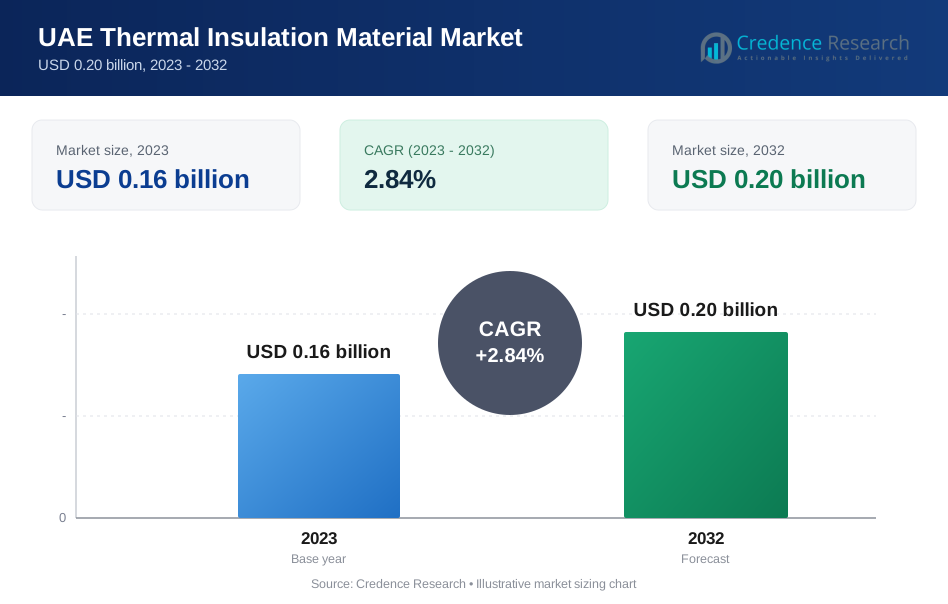
UAE Thermal Insulation Material market size was valued at USD 0.16 billion in 2023 and is anticipated to reach USD 0.20 billion by 2032, at a CAGR of 2.84% during the forecast period (2023-2032).
| REPORT ATTRIBUTE | DETAILS |
|---|---|
| Historical Period | 2020-2023 |
| Base Year | 2024 |
| Forecast Period | 2025-2032 |
| UAE Thermal Insulation Material Market Size 2023 | USD 0.16 billion |
| UAE Thermal Insulation Material Market, CAGR | 2.84% |
| UAE Thermal Insulation Material Market Size 2032 | USD 0.20 billion |
The UAE thermal insulation material market is driven by increasing construction activities, stringent energy efficiency regulations, and growing demand for sustainable building solutions. Rising urbanization and government initiatives promoting green buildings further fuel market growth. The adoption of advanced insulation materials in residential, commercial, and industrial applications enhances energy savings and reduces carbon emissions, aligning with the UAE’s sustainability goals. Additionally, the integration of smart insulation technologies and lightweight, high-performance materials is shaping market trends. The shift toward eco-friendly and fire-resistant insulation products, driven by regulatory compliance and consumer awareness, also contributes to market expansion. Moreover, the increasing adoption of prefabricated construction methods boosts demand for efficient insulation solutions. Innovations in aerogel and vacuum insulation panels are gaining traction due to their superior thermal performance. Overall, the market is poised for steady growth, supported by technological advancements, regulatory frameworks, and the rising emphasis on energy conservation in the UAE’s construction sector.
The UAE thermal insulation material market is driven by rapid urbanization and stringent energy efficiency regulations across key regions, including Abu Dhabi, Dubai, Sharjah, and Ras Al Khaimah. These regions are experiencing significant growth in residential, commercial, and industrial construction, increasing the demand for high-performance insulation materials. Government initiatives promoting sustainability and green building standards further support market expansion. Leading players in the UAE thermal insulation material market include BASF SE, Asahi Kasei Corporation, Saint Gobain SA, Recticel, Kingspan Group, Rockwool International A/S, Owens Corning, Knauf Insulation, Evonik, E. I. du Pont de Nemours and Company, Berkshire Hathaway (Johns Manville), Bayer AG, and Dow Chemicals Company. These companies focus on product innovation, sustainability, and strategic partnerships to meet growing insulation demands. With rising investments in infrastructure and industrial projects, the market is expected to witness continued growth, driven by advancements in insulation technology and increasing environmental concerns.
Market Insights
- The UAE thermal insulation material market was valued at USD 0.16 billion in 2023 and is expected to reach USD 0.20 billion by 2032, growing at a CAGR of 2.84% during the forecast period (2023-2032).
- Rising construction and industrial activities, along with stringent energy efficiency regulations, are driving the demand for advanced insulation materials.
- The growing focus on sustainability and eco-friendly building practices is encouraging the adoption of high-performance insulation solutions.
- Increasing adoption of green building certifications like Estidama and LEED is boosting the use of energy-efficient insulation materials.
- Key players in the market include BASF SE, Owens Corning, and Kingspan Group, which are focusing on innovation and strategic partnerships to expand their market share.
- High initial costs and installation complexities remain major barriers to market growth.
- Abu Dhabi and Dubai are the leading regions driving market expansion due to high construction and infrastructure investments.
Market Drivers
Rising Construction Activities and Urbanization
The UAE's thermal insulation material market is primarily driven by rapid urbanization and large-scale construction projects. The government's focus on infrastructure development, including residential, commercial, and industrial buildings, fuels the demand for high-performance insulation materials. For instance, the Dubai Urban Master Plan 2040 aims to make Dubai "the best city to live in" by optimizing space utilization and enhancing environmental spatial quality. Additionally, increasing investments in real estate, tourism, and industrial expansion contribute to market growth. As developers seek energy-efficient solutions to meet modern building standards, the demand for advanced insulation materials continues to rise, ensuring improved thermal efficiency and reduced energy consumption.
Growing Demand for Sustainable and High-Performance Materials
The rising awareness of environmental sustainability and energy conservation has led to a shift toward eco-friendly and high-performance insulation materials in the UAE. Consumers and businesses are prioritizing materials with low thermal conductivity, enhanced fire resistance, and minimal environmental impact. For instance, the National Green Certificates Program launched by the Ministry of Energy and Infrastructure sets specific standards for building classification regarding energy efficiency, water management, indoor air quality, and the use of sustainable building materials. Additionally, increasing adoption of green building certifications such as LEED (Leadership in Energy and Environmental Design) encourages the use of advanced insulation materials that contribute to energy savings and environmental sustainability. This trend is expected to further drive the market’s expansion.
Advancements in Smart Insulation Technologies
Technological advancements in smart insulation materials are transforming the UAE’s thermal insulation market. The development of phase-change materials (PCMs), reflective insulation, and nanotechnology-based insulation solutions enhances thermal efficiency and adaptability to extreme climatic conditions. The integration of IoT-enabled smart insulation systems allows real-time monitoring and optimization of thermal performance in buildings, improving energy efficiency. Additionally, prefabricated construction methods, which incorporate high-quality insulation materials, are gaining popularity due to their cost-effectiveness and sustainability benefits. These innovations are expected to propel market growth, offering enhanced insulation solutions that meet the UAE’s evolving construction and environmental requirements.
Stringent Energy Efficiency Regulations
The UAE government has implemented stringent building codes and energy efficiency regulations to reduce carbon emissions and promote sustainability. Initiatives such as the Estidama Pearl Rating System and Dubai’s Green Building Regulations mandate the use of high-quality insulation materials in construction projects. These regulations encourage the adoption of eco-friendly, fire-resistant, and high-performance insulation solutions, driving market growth. Additionally, the UAE’s commitment to the Paris Agreement and its ambition to achieve net-zero emissions by 2050 reinforce the need for energy-efficient buildings. With a strong regulatory push toward sustainability, businesses and developers are increasingly investing in advanced insulation materials to comply with these evolving standards.
Market Trends
Increasing Adoption of Eco-Friendly and Fire-Resistant Insulation Materials
Sustainability is a key trend shaping the UAE thermal insulation material market, with growing preference for eco-friendly and fire-resistant insulation solutions. As the country advances its green building initiatives, developers and construction firms are increasingly using insulation materials with low environmental impact. For instance, the National Green Certificates Program launched by the Ministry of Energy and Infrastructure sets specific standards for building classification regarding energy efficiency, water management, indoor air quality, and the use of sustainable building materials. Products such as recycled fiberglass, mineral wool, and bio-based foams are gaining traction due to their superior thermal efficiency and compliance with stringent environmental regulations. Additionally, fire-resistant insulation materials are becoming a priority, especially in high-rise buildings and industrial facilities, ensuring safety while improving energy efficiency. This trend aligns with the UAE’s long-term sustainability and safety goals, driving demand for innovative insulation solutions.
Rising Demand for High-Performance and Smart Insulation Technologies
Advancements in insulation technology are influencing market growth, with increasing adoption of high-performance materials such as aerogels, vacuum insulation panels (VIPs), and phase-change materials (PCMs). These advanced materials offer superior thermal insulation, enabling buildings to maintain optimal indoor temperatures with minimal energy consumption. Additionally, smart insulation technologies integrated with IoT and AI-driven energy management systems are gaining popularity. These solutions allow real-time monitoring and control of thermal performance, optimizing energy usage in residential, commercial, and industrial applications. The shift toward intelligent insulation systems reflects the UAE’s growing emphasis on smart and energy-efficient infrastructure.
Expansion of Prefabricated and Modular Construction Methods
The rise of prefabricated and modular construction in the UAE is driving demand for advanced thermal insulation materials. Prefabricated building components, including insulated panels and pre-assembled wall systems, offer enhanced energy efficiency and faster construction timelines. With government initiatives promoting sustainable urban development and cost-effective construction methods, builders are increasingly incorporating high-quality insulation materials into modular designs. The integration of insulation solutions into prefabricated structures not only improves thermal performance but also aligns with the UAE’s vision for sustainable and resilient infrastructure. This trend is expected to accelerate market growth in the coming years.
Growing Influence of Green Building Certifications and Regulations
The UAE’s commitment to green building standards, including the Estidama Pearl Rating System, LEED certification, and Dubai’s Green Building Regulations, is significantly influencing insulation material selection. For instance, the UAE currently has 1,354 programmes under LEED (Leadership in Energy and Environmental Design) which includes certifications and registrations. Developers and construction firms are prioritizing materials that meet these certification requirements, driving demand for energy-efficient and environmentally friendly insulation solutions. With the government’s push toward net-zero emissions and sustainable urban development, compliance with these standards has become a critical factor for construction projects. As a result, the market is witnessing increased investment in research and development of insulation materials that align with evolving regulatory frameworks, ensuring long-term growth and innovation in the sector.
Market Challenges Analysis
High Initial Costs and Installation Complexities
One of the primary challenges in the UAE thermal insulation material market is the high initial cost associated with premium insulation materials and advanced technologies. For instance, the GCC Thermal Insulation Market faces cost constraints and return on investment issues, with the initial expenses involved in procuring and installing insulation materials and systems being relatively high. High-performance insulation solutions, such as aerogels and vacuum insulation panels, offer superior energy efficiency but come at a significantly higher price than traditional materials. Additionally, the cost of skilled labor and specialized installation processes adds to the overall expenditure, making it a financial burden for small and mid-sized construction firms. Many developers and property owners hesitate to invest in expensive insulation solutions despite long-term energy savings, limiting market penetration. Furthermore, improper installation can compromise insulation effectiveness, leading to reduced energy efficiency and increased maintenance costs, further discouraging widespread adoption.
Stringent Regulatory Compliance and Material Availability Issues
The UAE’s strict building regulations and sustainability standards present another challenge for the thermal insulation material market. While these policies drive demand for high-quality insulation, compliance with evolving regulatory frameworks requires manufacturers to continuously adapt and invest in R&D. Ensuring that insulation products meet fire safety, energy efficiency, and environmental standards can be costly and time-consuming, posing a hurdle for smaller market players. Additionally, the limited availability of raw materials for advanced insulation products leads to supply chain disruptions and fluctuating material costs. Dependence on imports for specialized insulation materials further exacerbates pricing instability and delays in project completion. As a result, developers often struggle to source cost-effective, high-performance insulation materials, impacting the overall market growth.
Market Opportunities
The UAE thermal insulation material market presents significant growth opportunities driven by the rising demand for energy-efficient and sustainable building solutions. With the government’s commitment to achieving net-zero emissions by 2050, there is a strong push for eco-friendly insulation materials that enhance energy conservation and reduce carbon footprints. The increasing adoption of green building certifications, such as Estidama and LEED, further supports the integration of high-performance insulation solutions in residential, commercial, and industrial projects. This shift creates opportunities for manufacturers to develop and market innovative insulation materials, such as aerogels, vacuum insulation panels, and bio-based insulation, that align with evolving regulatory standards and sustainability goals. Additionally, advancements in smart insulation technologies, including IoT-enabled thermal management systems, offer a lucrative market segment, enabling improved energy efficiency and cost savings for building owners and developers.
Moreover, the rapid expansion of the UAE’s construction sector, particularly in smart cities, infrastructure projects, and modular construction, presents a growing demand for high-quality insulation solutions. The increasing focus on prefabricated and modular construction methods provides an opportunity for insulation manufacturers to develop pre-installed, high-performance insulation systems that enhance building efficiency while reducing construction time. Additionally, the UAE’s extreme climatic conditions necessitate advanced thermal insulation materials that provide superior heat resistance and durability. This creates a strong market potential for international and local players to introduce region-specific insulation solutions tailored to the harsh environmental conditions. Furthermore, the rising awareness among consumers and businesses regarding the long-term cost benefits of thermal insulation is expected to drive greater adoption, making it a promising market for innovation and investment in energy-efficient insulation technologies.
Market Segmentation Analysis:
By Material Type:
The UAE thermal insulation material market is segmented by material type into fiberglass, stone wool, foam, and wood fiber. Fiberglass dominates the market due to its excellent thermal resistance, lightweight properties, and cost-effectiveness. It is widely used in residential, commercial, and industrial applications to enhance energy efficiency and reduce heat transfer. Stone wool is gaining traction, particularly in high-rise buildings and industrial facilities, due to its superior fire resistance and soundproofing capabilities. Its ability to withstand high temperatures makes it a preferred choice for projects requiring enhanced safety and durability. Foam insulation, including polyurethane and polystyrene, is also witnessing increased demand due to its high insulating efficiency, moisture resistance, and ease of application. These materials are commonly used in HVAC systems, refrigeration units, and structural insulation. Wood fiber, though less prevalent, is emerging as an eco-friendly alternative in green buildings, offering excellent thermal and acoustic insulation while aligning with the UAE’s sustainability initiatives. The increasing demand for high-performance insulation materials is expected to drive further innovation and market growth across all material segments.
By Temperature:
Based on temperature range, the UAE thermal insulation material market is segmented into 0-100°C, 100-500°C, and 500°C and above. The 0-100°C segment accounts for a significant share due to its extensive use in residential and commercial buildings, HVAC systems, and refrigeration applications. These insulation materials help maintain optimal indoor temperatures, reduce energy consumption, and enhance occupant comfort. The 100-500°C segment is witnessing growing demand in industrial applications, including power plants, oil and gas facilities, and manufacturing units, where higher thermal resistance is required to ensure energy efficiency and safety. Insulation solutions in this range include stone wool and high-performance foam materials that prevent heat loss and enhance process efficiency. The 500°C and above segment is crucial for heavy industrial applications such as petrochemical plants and metal processing units, where extreme heat insulation is necessary to protect equipment and personnel. Advanced materials like ceramic fibers and high-temperature stone wool dominate this category, ensuring durability and thermal stability in extreme conditions.
Segments:
Based on Material Type:
- Fiberglass
- Stone Wool
- Foam
- Wood Fiber
Based on Temperature:
- 0-100 °C
- 100-500°C
- 500°C and above
Based on End-use:
- Construction
- Automotive
- HVAC
- Industrial
- Others
Based on the Geography:
- Abu Dhabi
- Dubai
- Sharjah
- Ajman
- Fujairah
- Ras Al Khaimah
- Umm Al Quwain
Regional Analysis
Abu Dhabi and Dubai
Abu Dhabi and Dubai dominate the UAE thermal insulation material market, collectively accounting for 65% of the total market share due to large-scale construction activities, stringent energy efficiency regulations, and rapid urbanization. Abu Dhabi holds approximately 35% of the market share, driven by its Vision 2030 sustainability initiatives, which emphasize energy-efficient building practices. The government’s focus on green buildings and sustainable urban development has led to widespread adoption of high-performance insulation materials in residential, commercial, and industrial sectors. Dubai follows closely with 30% of the market share, benefiting from its status as a global business hub with extensive real estate developments, smart city initiatives, and strict environmental regulations. The implementation of the Dubai Green Building Regulations has accelerated demand for fire-resistant and energy-efficient insulation solutions in high-rise buildings, commercial complexes, and hospitality projects, further strengthening the market’s growth in these regions.
Sharjah
Sharjah holds around 15% of the market share, supported by its growing industrial sector and increasing demand for energy-efficient residential projects. The Emirate is experiencing a rise in construction activities, particularly in affordable housing and commercial real estate, where insulation materials are critical for maintaining energy efficiency. Government initiatives promoting sustainable urban development and green building certifications have further encouraged the use of advanced insulation solutions. Additionally, the industrial sector, including manufacturing, logistics, and warehousing, is a significant consumer of insulation materials, especially for temperature-sensitive storage and production facilities. The rising focus on eco-friendly insulation solutions, such as recycled fiberglass and stone wool, aligns with Sharjah’s environmental sustainability goals, enhancing market growth.
Ras Al Khaimah
Ras Al Khaimah holds approximately 10% of the UAE thermal insulation material market, with increasing demand from its expanding industrial and infrastructure sectors. The Emirate’s cement, ceramics, and mining industries require high-temperature insulation solutions to improve energy efficiency and operational safety. The government’s efforts toward economic diversification and smart city development have also boosted the use of insulation materials in residential and commercial construction. Furthermore, the adoption of sustainable construction practices and energy conservation policies aligns with global efficiency standards, further driving market expansion. As Ras Al Khaimah continues to attract investment in industrial and tourism projects, the demand for high-performance insulation materials is expected to grow.
Fujairah and Ajman
Fujairah and Ajman collectively contribute 10% to the market share, with increasing urbanization and infrastructure projects fueling demand for thermal insulation materials. Fujairah, known for its strategic industrial and port activities, requires effective insulation solutions for storage facilities, logistics hubs, and energy-intensive industries. Meanwhile, Ajman is experiencing growth in residential and commercial construction, leading to greater demand for cost-effective and efficient insulation materials. Both regions are benefiting from government initiatives focused on energy efficiency and sustainability, creating opportunities for market players to introduce innovative insulation solutions. As urban development continues in these regions, the adoption of advanced insulation technologies is expected to rise, further supporting market expansion.
Key Player Analysis
- BASF SE
- Asahi Kasei Corporation
- Saint Gobain SA
- Recticel
- Kingspan Group
- Rockwool International A/S
- Owens Corning
- Knauf Insulation
- Evonik
- E. I. du Pont de Nemours and Company
- Berkshire Hathaway (Johns Manville)
- Bayer AG
- Dow Chemicals Company
- Kingspan Group PLC
- Others
Competitive Analysis
The UAE thermal insulation material market is highly competitive, with several global players leading the market. BASF SE, Asahi Kasei Corporation, Saint Gobain SA, Recticel, Kingspan Group, Rockwool International A/S, Owens Corning, Knauf Insulation, Evonik, E. I. du Pont de Nemours and Company, Berkshire Hathaway (Johns Manville), Bayer AG, Dow Chemicals Company, and Kingspan Group PLC dominate the market by offering a wide range of high-performance insulation materials. These companies are focusing on innovation, product diversification, and sustainability to maintain a competitive edge. Key companies focus on innovation and the development of energy-efficient, sustainable insulation solutions to meet the growing demand driven by government regulations and eco-friendly construction practices. Market players are adopting advanced technologies, such as enhanced fire resistance and superior thermal insulation properties, to cater to the diverse needs of residential, commercial, and industrial sectors. Competitive strategies include strategic partnerships, acquisitions, and the expansion of product portfolios to cater to the region’s diverse climate conditions and energy efficiency standards. In addition, pricing strategies play a significant role in the market, as cost-effective solutions remain crucial for many developers and contractors. For instance, in Dubai, various roof insulation systems are available at different price points, such as the Polydex System at 35 dirhams per square meter and the Epoxy System at 85 dirhams per square meter. Companies are increasingly targeting emerging markets within the UAE, where infrastructure development and industrial projects are on the rise. As the demand for high-quality insulation materials continues to grow, companies are also focusing on sustainable practices, ensuring their products align with green building certifications and environmental regulations. Despite the competition, the market's potential remains strong due to continuous infrastructure growth and the need for energy-efficient building materials.
Recent Developments
- In February 2025,BASF introduced Basotect® EcoBalanced, a melamine resin foam with a reduced Product Carbon Footprint (PCF).
- In February 2025,Asahi Kasei is set to present SunForce™, an easy-to-process particle foam for composite foam core applications, at JEC World 2025 in Paris.
- In September 2024, Kingspan announced Kyle McEnroe as the Managing Director at Kingspan Insulation North America.
- In May 2023, Knauf Insulation GmbH introduced Ominifit slab 32, designed for use in external wall systems of residential buildings and rain-screen facades.
Market Concentration & Characteristics
The UAE thermal insulation material market exhibits moderate to high market concentration, with several key players dominating the industry. The presence of both global leaders and local players creates a competitive environment, where established companies focus on product innovation and technological advancements to maintain a competitive edge. Major players typically offer a broad range of high-performance insulation materials, such as fiberglass, stone wool, and foam, catering to the residential, commercial, and industrial sectors. The market is characterized by a growing demand for sustainable and energy-efficient materials, driven by government regulations promoting green building standards. Additionally, regional players are increasingly focusing on cost-effective solutions to meet the needs of the local market, where infrastructure projects and industrial growth continue to surge. The competitive landscape is further shaped by companies forming strategic partnerships and expanding their product offerings to meet the diverse requirements of the UAE’s diverse climate conditions and energy efficiency goals.
Report Coverage
The research report offers an in-depth analysis based on Material Type, Temperature, End-use and Geography. It details leading market players, providing an overview of their business, product offerings, investments, revenue streams, and key applications. Additionally, the report includes insights into the competitive environment, SWOT analysis, current market trends, as well as the primary drivers and constraints. Furthermore, it discusses various factors that have driven market expansion in recent years. The report also explores market dynamics, regulatory scenarios, and technological advancements that are shaping the industry. It assesses the impact of external factors and global economic changes on market growth. Lastly, it provides strategic recommendations for new entrants and established companies to navigate the complexities of the market.
Future Outlook
- The UAE thermal insulation material market is expected to grow steadily, driven by increasing infrastructure and construction activities.
- Government regulations and sustainability initiatives will continue to fuel demand for energy-efficient and eco-friendly insulation solutions.
- The rise in smart city developments and green building certifications will further enhance the adoption of advanced insulation materials.
- The demand for fire-resistant and high-performance insulation materials will increase due to stringent safety and environmental standards.
- Technological advancements in insulation materials, such as improved thermal efficiency and lightweight products, will drive market innovation.
- Expansion in the industrial sector, including logistics and manufacturing, will create new opportunities for insulation material suppliers.
- The residential sector will continue to be a major consumer, as energy-efficient insulation solutions become a priority for homeowners.
- Cost-effective insulation solutions will remain important for developers working on large-scale projects.
- Companies will invest in strategic partnerships and acquisitions to enhance their regional presence and expand product offerings.
- The market will see increased competition from regional players offering affordable and localized insulation materials.
Request a Free Sample
Fill in your details and we'll send you a free sample report.
- Sample data tables & charts
- Research methodology
Need a Custom Version of This Report?
Tailor the scope, geography, or segments to your exact requirements.
- Custom geography or segment scope
- Direct access to our analyst team
Frequently Asked Questions
What is the current size of the UAE Thermal Insulation Material market?
What factors are driving the growth of the UAE Thermal Insulation Material market?
What are the key segments within the UAE Thermal Insulation Material market?
What are some challenges faced by the UAE Thermal Insulation Material market?
Who are the major players in the UAE Thermal Insulation Material market?
Table of Content
Chapter 1. Report Introduction
- 1.1 Report Description & Purpose
- 1.1.1 Report Title & Market Definition
- 1.1.2 Unique Selling Propositions (USP) & Key Differentiators
- 1.1.3 Value Proposition for Stakeholders
- 1.2 Research Objectives
- 1.2.1 Market Sizing Objectives (Volume & Revenue)
- 1.2.2 Segmentation Objectives
- 1.2.3 Competitive Intelligence Objectives
- 1.2.4 Forecast & Scenario Objectives
- 1.3 Report Scope
- 1.3.1 UAE Thermal Insulation Material Scope – Types & Subtypes Covered
- 1.3.2 Geographic Scope – Regions & Countries Covered
- 1.3.3 Historical Period, Base Year & Forecast Period (2023; forecast to 2032)
- 1.3.4 Inclusions & Exclusions
- 1.4 HS Code & Classification Framework
- 1.5 Currency, Units & Pricing Basis
- 1.6 Target Stakeholders
- 1.7 Limitations & Assumptions
Chapter 2. Executive Summary
- 2.1 Global UAE Thermal Insulation Material Market Snapshot
- 2.1.1 Market Size – Historical (2023) & Forecast (2023-2032) (2023: USD 0.16 billion → 2032: USD 0.20 billion)
- 2.1.2 Volume & Revenue – Global Totals
- 2.1.3 Key Market Highlights – Top Five Facts
- 2.2 UAE Thermal Insulation Material Market Segmentation Snapshot
- 2.2.1 Market Split by Region – 2023 vs. 2032
- 2.3 Competitive Snapshot
- 2.3.1 Top 10 Players by Revenue Share – 2023
- 2.3.2 Top 10 Players by Volume Share – 2023
- 2.3.3 Recent Strategic Developments (18-Month Summary)
- 2.4 Key Investment Highlights & Strategic Conclusions
Chapter 3. UAE Thermal Insulation Material Market Dynamics & Industry Analysis
- 3.1 Market Overview & Context
- 3.1.1 UAE Thermal Insulation Material Market Position in the Broader Automotive Value Chain
- 3.1.2 OEM vs. Replacement Market Dynamics
- 3.1.3 Market Maturity & Development Stage by Region
- 3.2 UAE Thermal Insulation Material Market Drivers
- 3.3 UAE Thermal Insulation Material Market Restraints & Challenges
- 3.4 UAE Thermal Insulation Material Market Opportunities
- 3.5 Porter's Five Forces Analysis
- 3.5.1 Threat of New Entrants
- 3.5.2 Bargaining Power of Suppliers
- 3.5.3 Bargaining Power of Buyers
- 3.5.4 Threat of Substitutes
- 3.5.5 Competitive Rivalry – Intensity Assessment
- 3.6 UAE Thermal Insulation Material Value Chain Analysis
- 3.6.1 Upstream – Raw Material/Input Suppliers
- 3.6.1.1 Raw Material/Input 1
- 3.6.1.2 Raw Material/Input 2
- 3.6.1.3 Raw Material/Input 3
- 3.6.2 Midstream – Production/Manufacturing/Service Delivery
- 3.6.2.1 Production/Process Overview
- 3.6.2.2 Key Facility Locations & Capacity by Manufacturer
- 3.6.3 Downstream – Distribution & End Consumer
- 3.6.3.1 Primary Channel – B2B/OEM
- 3.6.3.2 Secondary Channels – Dealer, Retail, Online, Direct
- 3.6.4 Value Chain Profitability Analysis
- 3.6.1 Upstream – Raw Material/Input Suppliers
- 3.7 PESTEL Analysis
- 3.7.1 Political Factors
- 3.7.2 Economic Factors
- 3.7.3 Social Factors
- 3.7.4 Technological Factors
- 3.7.5 Environmental Factors
- 3.7.6 Legal Factors
- 3.8 UAE Thermal Insulation Material Supply Chain Analysis
- 3.8.1 Raw Material/Input Supply Risk Assessment
- 3.8.2 Manufacturing Concentration Risk (Geographic Exposure)
- 3.8.3 Trade Disruption Impact Analysis
- 3.9 Regulatory & Policy Landscape
Note: The regulatory and policy landscape section covers regulations based on their applicability to the market, UAE Thermal Insulation Material category, geography, and scope of the study. Only regulatory frameworks with a material impact on operations, compliance, trade, sustainability, or market access are analyzed in detail.
Chapter 4. Key Investment Pockets & Opportunity Analysis
- 4.1 UAE Thermal Insulation Material Market Attractiveness Analysis
- 4.1.1 By Region – Investment Attractiveness Matrix (Volume × CAGR)
- 4.2 Absolute Revenue Growth Opportunity
- 4.2.1 By Region – Absolute USD Growth Through 2032
- 4.3 Incremental Volume Opportunity
- 4.3.1 By Region – Incremental Volume Through 2032
- 4.3.2 Segment – Incremental Volume
- 4.4 Emerging Submarket Opportunity Deep Dive (Subject to Applicability)
- 4.5 Emerging Market Opportunity Scorecards
- 4.5.1 United States
- 4.5.2 Europe
- 4.5.3 Asia
- 4.5.4 Middle East & Africa
Note: Emerging Market Opportunity Scorecards will be included based on relevance and strategic importance. Regions listed are indicative and may vary depending on data availability and market dynamics.
Chapter 5. UAE Thermal Insulation Material Import-Export Analysis & Trade Flows
- 5.1 Global Trade Overview
- 5.1.1 Global Export Value by Country (2023)
- 5.1.2 Global Export Volume by Country (2023)
- 5.1.3 Global Import Value by Country (2023)
- 5.1.4 Global Import Volume by Country (2023)
- 5.1.5 Net Trade Balance by Country (2023)
- 5.2 Export Analysis – Segment
- 5.2.1 Type 1 (HS Code)
- 5.2.2 Type 2 (HS Code)
- 5.2.3 Type 3 (HS Code)
- 5.2.4 Type 4 (HS Code)
- 5.2.5 Type 5 (HS Code)
- 5.3 Import Analysis – Segment
- 5.3.1 Type 1 (HS Code)
- 5.3.2 Type 2 (HS Code)
- 5.3.3 Type 3 (HS Code)
- 5.3.4 Type 4 (HS Code)
- 5.3.5 Type 5 (HS Code)
- 5.4 Average Unit Trade Prices
- 5.4.1 Average Export Price – Segment & Country
- 5.4.2 Average Import Price – Segment & Source Country
- 5.4.3 Price Trends (2023)
- 5.5 Key Trade Route Analysis
- 5.5.1 Trade Route 1
- 5.5.2 Trade Route 2
- 5.5.3 Trade Route 3
- 5.5.4 Trade Route 4
- 5.5.5 Trade Route 5
- 5.6 Trade Policy Impact Assessment
- 5.6.1 US Anti-Dumping & Section 301 Tariffs
- 5.6.2 EU Customs Union Impact
- 5.6.3 Major Free Trade Agreements
- 5.6.4 USMCA Rules of Origin
Note: Trade policy analysis will be included only where relevant to the UAE Thermal Insulation Material market.
Chapter 6. Competitive Landscape & Company Benchmarking
- 6.1 UAE Thermal Insulation Material Market Concentration & Structure
- 6.1.1 Herfindahl-Hirschman Index (HHI) – vs. 2023
- 6.1.2 Tier 1, Tier 2 & Tier 3 Market Structure
- 6.1.3 Global, Regional & Local Player Dynamics
- 6.2 UAE Thermal Insulation Material Market Share Analysis – 2023
- 6.2.1 Global Revenue Share by Company
- 6.2.2 Global Volume Share by Company
- 6.2.3 Regional Revenue Share
- 6.2.4 Market Share Evolution ( vs. 2023)
- 6.2.5 OEM Segment Share by Company
- 6.2.6 Replacement Segment Share by Company
- 6.3 Production/Delivery Capacity & Facility Analysis
- 6.3.1 Global Installed Capacity
- 6.3.2 Capacity Utilization Rates
- 6.3.3 Production/Output Volume
- 6.3.4 Facility Locations & Capacity Map
- 6.3.5 Planned Capacity Additions
- 6.4 UAE Thermal Insulation Material Competitive Benchmarking Matrix
- 6.4.1 Revenue, Volume, CAGR & Profitability Comparison
- 6.4.2 Channel Revenue Mix
- 6.4.3 Geographic Revenue Exposure
- 6.4.4 R&D Intensity
- 6.4.5 Sustainability Maturity
- 6.5 Strategic Developments in UAE Thermal Insulation Material (Last 24 Months)
- 6.5.1 Mergers, Acquisitions & Divestments
- 6.5.2 New UAE Thermal Insulation Material Launches
- 6.5.3 Facility Expansions
- 6.5.4 Strategic Alliances, Joint Ventures & Partnerships
- 6.5.5 Distribution Expansion & Market Entry
- 6.5.6 Sustainability & ESG Initiatives
- 6.6 Competitive Strategy Mapping
- 6.6.1 Leader, Challenger, Follower & Niche Classification
- 6.6.2 Pricing Strategy Comparison
- 6.6.3 Channel Strategy Matrix
Note: Strategic developments are included based on their materiality and the availability of reliable information.
Chapter 7. Global UAE Thermal Insulation Material Market – By Distribution Channel
- 7.1 Segment Overview
- 7.1.1 Volume & Revenue Split by Channel (2023 & 2032)
- 7.1.2 Channel Mix Evolution (2023-2032)
Chapter 8. Regional Market Analysis – Global Overview
- 8.1 Global Regional Overview
- 8.1.1 Regional Volume Share
- 8.1.2 Regional Revenue Share
- 8.1.3 Regional Volume by Region
- 8.1.4 Regional Revenue by Region
- 8.1.5 Regional Forecast Through 2032
- 8.2 Cross-Regional Segment Analysis
- 8.2.1 By Distribution Channel
- 8.2.2 By Brand/Price Tier
Chapter 9. North America UAE Thermal Insulation Material Market
- 9.1 United States
- 9.2 Canada
- 9.3 Mexico
Chapter 10. Europe UAE Thermal Insulation Material Market
- 10.1 Germany
- 10.2 France
- 10.3 Italy
- 10.4 United Kingdom
- 10.5 Spain
- 10.6 Poland
- 10.7 Russia
- 10.8 Netherlands
- 10.9 Belgium
- 10.10 Sweden
- 10.11 Denmark
- 10.12 Norway
- 10.13 Rest of Europe
Chapter 11. Asia Pacific UAE Thermal Insulation Material Market
- 11.1 China
- 11.2 India
- 11.3 Japan
- 11.4 South Korea
- 11.5 Thailand
- 11.6 Indonesia
- 11.7 Vietnam
- 11.8 Malaysia
- 11.9 Australia
- 11.10 Rest of Asia Pacific
Chapter 12. Latin America UAE Thermal Insulation Material Market
- 12.1 Brazil
- 12.2 Argentina
- 12.3 Colombia
- 12.4 Chile
- 12.5 Rest of Latin America
Chapter 13. Middle East UAE Thermal Insulation Material Market
- 13.1 Saudi Arabia
- 13.2 United Arab Emirates
- 13.3 Turkey
- 13.4 Israel
- 13.5 Iran
- 13.6 Rest of the Middle East
Chapter 14. Africa UAE Thermal Insulation Material Market
- 14.1 South Africa
- 14.2 Egypt
- 14.3 Nigeria
- 14.4 Morocco
- 14.5 Rest of Africa
Chapter 15. UAE Thermal Insulation Material Company Profiles
- 15.1 [Company 01]
- 15.1.1 Company Overview
- 15.1.2 Key Management Personnel
- 15.1.3 Products & Services Portfolio
- 15.1.4 Financial Performance
- 15.1.5 Key Market Focus & Geographic Presence
- 15.1.6 Recent Developments & Strategic Initiatives
Note: The company profile list is preliminary and may change based on research findings, market developments, data availability, and client requirements.
Chapter 16. Appendices
- Appendix A – List of Abbreviations & Acronyms
- Appendix B – Industry Classification Code Reference – Full Series
- Appendix C – Production & Capacity Data Tables
- Appendix D – End-Use & Demand Base Tables
- Appendix E – Consumption & Replacement Rate Assumptions
- Appendix F – ASP Reference Tables
- Appendix G – Manufacturing & Facility Database
- Appendix H – Import-Export Data Tables
- Appendix I – Regulatory Summary Tables
- Appendix J – Primary Research Participant List (Anonymized)
- Appendix K – Primary Research Questionnaire Framework
- Appendix L – Data Sources & Bibliography
- Appendix M – Market Size Divergence & Source Comparison
Chapter 17. Research Methodology
- 17.1 Research Framework & Philosophy
- 17.2 Secondary Research – Sources, Hierarchy & Data Extraction
- 17.3 Data Modeling – Bottom-Up & Top-Down Market Sizing
- 17.4 Primary Research – Stakeholder Framework, LOI & Sample Sizes
- 17.5 Forecast Methodology – Regression, Scenario & Sensitivity Analysis
- 17.6 Quality Control – Four-Layer Validation Framework
- 17.7 Limitations & Standard Assumptions
- 17.8 Disclaimer
