
| REPORT ATTRIBUTE | DETAILS |
|---|---|
| Historical Period | 2020-2023 |
| Base Year | 2024 |
| Forecast Period | 2025-2032 |
| UAE Industrial Solvents Market Size 2023 | USD 76.02 million |
| UAE Industrial Solvents Market, CAGR | 4.80% |
| UAE Industrial Solvents Market Size 2032 | USD 110.64 million |
Market Overview
The UAE Industrial Solvents market was valued at USD 76.02 million in 2024 and is anticipated to reach USD 110.64 million by 2032, at a CAGR of 4.80% during the forecast period (2024-2032).
The UAE Industrial Solvents market is driven by several key factors, including rapid industrialization, growth in the manufacturing and construction sectors, and increasing demand from industries such as automotive, pharmaceuticals, and coatings. The rise in chemical production, coupled with the growing need for efficient and specialized solvents, supports market expansion. Additionally, the UAE's strategic location as a trading hub and the government's investment in infrastructure development contribute to heightened demand for industrial solvents. Technological advancements in solvent manufacturing, along with the shift towards more sustainable and eco-friendly solvents, are also emerging trends. The growing focus on minimizing environmental impact and adhering to regulatory standards is further shaping the market landscape.
The UAE industrial solvents market is primarily driven by the economic activities concentrated in key regions like Abu Dhabi, Dubai, and Sharjah, which are hubs for industries such as construction, chemicals, and manufacturing. These areas host a wide array of solvent-consuming sectors, including paints and coatings, pharmaceuticals, and automotive. The market is characterized by the presence of both local and global key players, including Dow Inc., ExxonMobil Corporation, Eastman Chemical Company, and Ashland UAE Holdings Inc., among others. These companies play a significant role in shaping the market landscape by providing a diverse range of solvents to meet the growing demand from various industries. With the UAE’s ongoing focus on industrial diversification and infrastructure development, major players are continuously innovating to meet the evolving needs for sustainable and eco-friendly solvent solutions, contributing to the market's expansion.
Market Insights
- The UAE industrial solvents market was valued at USD 76.02 million in 2024 and is expected to reach USD 110.64 million by 2032, growing at a CAGR of 4.80% during the forecast period.
- The global industrial solvents market was valued at USD 34,660.50 million in 2024 and is expected to reach USD 60,647.79 million by 2032, growing at a CAGR of 7.24% during the forecast period (2024-2032).
- The market is primarily driven by industrial growth, especially in construction, automotive, and chemical sectors, boosting the demand for solvents.
- Increasing focus on eco-friendly and sustainable solvent solutions is one of the key trends in the market, as industries shift toward greener alternatives.
- Competitive dynamics are shaped by major players like Dow Inc., ExxonMobil, and Eastman Chemical Company, driving innovation and product diversification.
- Regulatory pressures on environmental impact and VOC emissions are key restraints affecting market growth.
- The UAE’s regional demand is led by Abu Dhabi, Dubai, and Sharjah, which house key industries consuming industrial solvents.
- Rising investments in new technologies and automation in solvent production are expected to open new market opportunities.
Report Scope
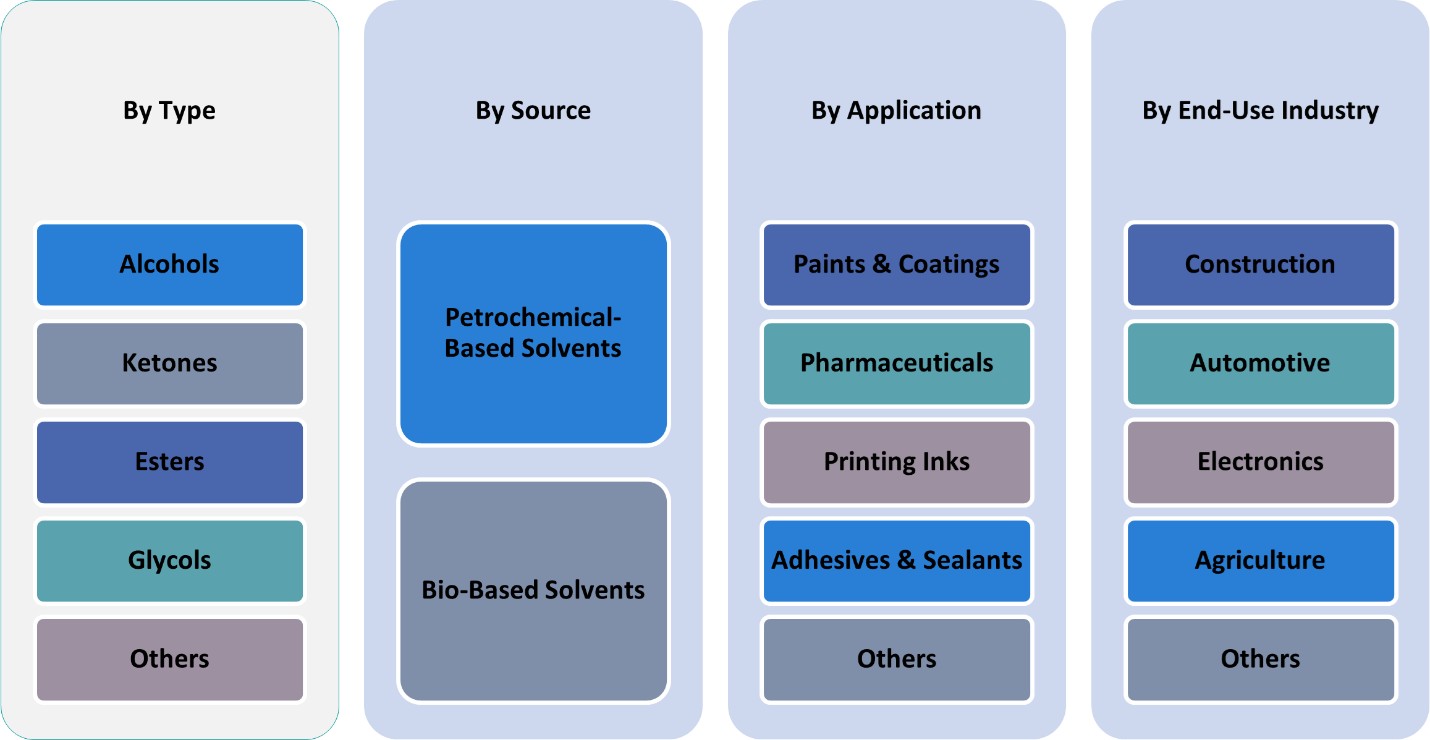
This report segments the UAE Industrial Solvents market as follows:
Market Drivers
Industrial Growth and Infrastructure Development
The rapid industrial growth in the UAE plays a pivotal role in driving the demand for industrial solvents. The UAE’s strategic investments in sectors such as construction, automotive, manufacturing, and chemical processing have created a solid foundation for solvent demand. With ongoing infrastructural projects like Expo 2020 and large-scale construction initiatives, the need for paints, coatings, adhesives, and sealants all of which require solvents has surged. For instance, the UAE government has prioritized industrial expansion through initiatives that support infrastructure development and manufacturing growth. These developments not only contribute to a direct rise in the consumption of industrial solvents but also enhance the overall economic position of the country, further stimulating demand across multiple industries. The growth in these sectors is expected to continue, providing a long-term boost to the industrial solvents market.
Expanding Chemical and Pharmaceutical Industries
The growth of the chemical and pharmaceutical industries in the UAE is another key driver for the industrial solvents market. Solvents are essential components in the chemical production process, used in everything from formulation to product manufacturing. As the UAE strives to position itself as a leading hub for the chemical and pharmaceutical industries, increased production and export activities create a higher demand for specialized solvents. Additionally, the pharmaceutical industry’s growth, driven by a rising population and increased healthcare needs, further emphasizes the reliance on solvents in drug formulation, coatings, and packaging processes. For instance, the UAE’s chemical sector has seen steady expansion, supported by government-backed industrial policies. The continued expansion of these industries will undoubtedly fuel further growth in the industrial solvents market.
Technological Advancements and Eco-friendly Solutions
Technological innovation is transforming the industrial solvents landscape in the UAE. With the rising demand for more sustainable and eco-friendly products, the development of advanced solvent formulations that are less harmful to the environment is gaining traction. The shift toward green chemistry, along with the implementation of stricter environmental regulations, is driving the need for solvents with reduced volatility, toxicity, and environmental impact. Manufacturers in the UAE are increasingly investing in research and development (R&D) to produce solvents that meet the growing demand for safer, more efficient solutions. The increased focus on sustainability is not only addressing environmental concerns but also meeting regulatory compliance standards, making eco-friendly solvents a crucial driver for the market.
Government Initiatives and Regulatory Support
The UAE government’s ongoing initiatives to diversify its economy and attract foreign investment in various sectors significantly impact the industrial solvents market. Policies designed to foster industrialization and attract global players in sectors like manufacturing and chemicals create a favorable environment for solvent manufacturers. The government’s push towards creating a regulatory framework for cleaner and safer industrial practices also influences the demand for specific types of solvents. With growing attention on health, safety, and environmental compliance, industries in the UAE are increasingly adopting low-emission, non-toxic solvents. Furthermore, the government's commitment to sustainable practices and green technologies provides both challenges and opportunities for solvent manufacturers to innovate and stay competitive in a rapidly changing market.
Market Trends
Shift Towards Eco-friendly and Sustainable Solvents
One of the most notable trends in the UAE industrial solvents market is the growing demand for eco-friendly and sustainable solvents. With increasing awareness of environmental issues and stricter regulations regarding chemical emissions, industries are moving towards greener alternatives. Solvent manufacturers are focusing on developing bio-based, non-toxic, and low-VOC (volatile organic compound) solvents to align with global sustainability trends. For instance, UAE industries are adopting eco-friendly solvent technologies to comply with environmental regulations and sustainability goals. This shift is driven by both environmental regulations and the desire for safer working conditions within industrial environments. As a result, there is a rising preference for solvents that are biodegradable and have minimal environmental impact, positioning eco-friendly solvents as a key trend in the market.
Technological Advancements in Solvent Formulations
Technological advancements are significantly shaping the UAE industrial solvents market, particularly in the development of new solvent formulations that improve efficiency and performance. As industries seek to enhance production processes, manufacturers are investing in R&D to produce solvents with superior performance characteristics, such as higher solubility, faster drying times, and increased chemical stability. These innovations are being driven by demands from the automotive, coatings, and chemical industries for solvents that improve productivity while maintaining quality and compliance with regulations. For instance, UAE industries are integrating advanced solvent recovery systems to enhance efficiency and reduce waste. The continuous evolution of solvent formulations allows businesses to meet the changing demands of end users, further contributing to market growth.
Integration of Automation in Solvent Manufacturing
The integration of automation into the manufacturing processes of industrial solvents is another emerging trend in the UAE. Automation technology enhances production efficiency by streamlining operations, reducing human error, and improving consistency in solvent formulations. This trend is particularly evident in large-scale manufacturing plants where automation ensures that solvents are produced more quickly, at lower costs, and with greater precision. Additionally, automation allows for better monitoring of environmental impacts during production, ensuring that emissions and waste are minimized. As industries continue to embrace Industry 4.0, the use of automated systems in solvent production will become increasingly prevalent, shaping the future of the market.
Growth in Demand from Emerging Industries
An important trend in the UAE industrial solvents market is the increasing demand for solvents from emerging industries such as renewable energy, electronics, and advanced materials. As the UAE diversifies its economy, there is a growing need for solvents in sectors like solar energy production, electronics manufacturing, and the production of high-tech materials. These industries require highly specialized solvents for tasks such as cleaning, surface preparation, and coating applications. The emergence of these sectors is driving the need for more tailored solvent solutions that meet specific technical and regulatory requirements. This shift represents a promising opportunity for solvent manufacturers to diversify their product offerings and cater to new, high-growth markets.
Market Challenges Analysis
Stringent Environmental Regulations and Compliance Costs
One of the key challenges facing the UAE industrial solvents market is the increasingly stringent environmental regulations surrounding solvent usage. With growing concerns over air pollution and the adverse environmental effects of chemical emissions, the UAE government has implemented tighter controls on solvent production and usage. Manufacturers must comply with regulations related to volatile organic compounds (VOCs) and emissions, which can require substantial investment in cleaner technologies and processes. Adhering to these standards may lead to higher production costs for companies, particularly for those transitioning to eco-friendly solvents. As the regulatory landscape becomes more complex, companies must invest in continuous monitoring, reporting, and compliance measures to avoid penalties and maintain operations, further adding to operational costs.
Raw Material Supply Chain Disruptions and Price Volatility
The UAE industrial solvents market also faces challenges related to the volatility in the prices and supply of raw materials. Many solvents are derived from petrochemical products, and fluctuations in crude oil prices significantly impact production costs. Additionally, global supply chain disruptions, such as those caused by geopolitical tensions, trade restrictions, or pandemics, can lead to shortages or delays in obtaining key materials for solvent production. For instance, UAE’s petrochemical sector has experienced fluctuations in feedstock availability due to global trade uncertainties and energy price shifts. These supply chain disruptions can create uncertainties, forcing manufacturers to absorb higher costs or face challenges in meeting demand. The inability to stabilize raw material procurement can hinder the growth prospects of solvent manufacturers and may require companies to explore alternative sourcing strategies, further complicating market dynamics.
Market Opportunities
The UAE industrial solvents market presents several significant opportunities driven by the country’s ongoing industrial expansion and the diversification of its economy. As sectors such as construction, automotive, and chemical manufacturing continue to grow, there is an increasing demand for specialized solvents in applications such as coatings, adhesives, and cleaning agents. The rapid pace of infrastructure development and government-led initiatives, such as the UAE Vision 2021 and various mega projects, provide a promising market for solvents in both traditional and emerging industries. Moreover, the demand for environmentally friendly and sustainable solvents opens up new avenues for manufacturers to innovate, particularly as industries seek to meet stricter environmental regulations and sustainability goals. Companies that invest in research and development to produce low-emission, bio-based, and safer solvents are likely to capture a growing share of this environmentally conscious market.
Additionally, the rise of emerging industries such as renewable energy, electronics, and advanced materials presents significant opportunities for the UAE industrial solvents market. These sectors, which require specialized solvents for applications like cleaning, surface preparation, and coating, are seeing rapid growth and are projected to continue expanding in the coming years. The UAE’s ambition to become a global hub for green energy and high-tech manufacturing aligns well with the increased demand for advanced solvent solutions. As the demand for electronic products, renewable energy components, and high-performance materials rises, manufacturers have the opportunity to tailor solvent products to meet the specific needs of these industries. This shift provides both new market segments and high-growth opportunities for solvent producers to diversify their offerings and strengthen their market presence.
Market Segmentation Analysis:
By Type:
The UAE industrial solvents market is segmented by type into alcohols, ketones, esters, glycols, and others. Among these, alcohols hold a significant share due to their versatility and widespread use in various industrial applications. Alcohols, such as ethanol and isopropyl alcohol, are commonly used in paints, coatings, cleaning agents, and personal care products. Ketones, particularly acetone, are widely used in the production of adhesives, paints, and coatings because of their strong solvency properties. Esters, including ethyl acetate and butyl acetate, are favored in the automotive and coatings industries for their ability to dissolve resins and improve drying time. Glycols, such as ethylene glycol and propylene glycol, are primarily used in antifreeze solutions, hydraulic fluids, and cosmetics. The “others” segment consists of less commonly used solvents such as hydrocarbons, which are employed in niche applications. The growing preference for eco-friendly solvents is prompting manufacturers to innovate and develop low-VOC and biodegradable variants across all solvent types, which is expected to shape the future market dynamics.
By Application:
The application segment of the UAE industrial solvents market is diverse, with significant demand across paints & coatings, pharmaceuticals, printing inks, adhesives & sealants, and others. The paints and coatings industry is the largest consumer of industrial solvents, driven by the booming construction and automotive sectors. Solvents are essential in thinning paints and ensuring proper application and drying. In the pharmaceutical industry, solvents are crucial in drug formulation, extraction processes, and as carriers in ointments and creams. With the growing healthcare needs in the UAE, the demand for high-quality solvents in pharmaceuticals is expanding. Printing inks also contribute to solvent consumption, as solvents are used to adjust ink viscosity and improve print quality. The adhesives and sealants market is another key sector, with industrial solvents used to dissolve resins and ensure optimal bonding properties in various applications. Other industries, including textiles, cleaning products, and chemicals, also rely on solvents, creating further market opportunities. As industries continue to evolve, the need for specialized solvents tailored to each application is expected to increase, driving innovation and market growth.
Segments:
Based on Type:
- Alcohols
- Ketones
- Esters
- Glycols
- Others
Based on Application:
- Paints & Coatings
- Pharmaceuticals
- Printing Inks
- Adhesives & Sealants
- Others
Based on End- Use:
- Construction
- Automotive
- Electronics
- Agriculture
- Others
Based on Source:
- Petrochemical-Based Solvents
- Bio-Based Solvents
Based on the Geography:
- Abu Dhabi
- Dubai
- Sharjah
- Ajman
- Fujairah
- Ras Al Khaimah
- Umm Al Quwain
Regional Analysis
Abu Dhabi
Abu Dhabi holds approximately 35% of the market share, driven by its focus on petrochemical industries, oil and gas, and industrial expansion. The emirate is home to numerous chemical production plants that rely heavily on industrial solvents, contributing to its leading position in the market. Additionally, the city’s initiatives in sustainable development and diversification of its economy further fuel demand for industrial solvents, particularly eco-friendly and low-emission products.
Dubai
Dubai follows closely with a market share of about 30%. As the UAE’s economic hub, Dubai's industrial sector is expansive, including automotive, construction, and manufacturing industries that demand substantial volumes of solvents for paints, coatings, adhesives, and cleaning products. The city’s strategic location as a global trading and logistics center also increases its market share, with solvents being essential in import and export activities. Dubai’s dynamic infrastructure projects and growing focus on green technologies have led to an increased preference for sustainable solvent solutions, fostering growth in the market for environmentally friendly alternatives.
Sharjah and Ajman
Sharjah and Ajman each hold around 15% of the market share, driven by their strong manufacturing sectors and proximity to Dubai. Sharjah, known for its industrial zones, has a significant presence of small to medium-sized enterprises in manufacturing, textiles, and packaging, all of which utilize solvents. The region’s well-established industrial base, along with efforts to enhance infrastructure, supports ongoing solvent demand. Ajman, while smaller in comparison, benefits from its low operating costs, attracting small-scale solvent-consuming industries, such as plastics and packaging, contributing to its steady market share.
Key Player Analysis
- Dow Inc.
- ExxonMobil Corporation
- Eastman Chemical Company
- Ashland UAE Holdings Inc.
- Huntsman Corporation
- LyondellBasell Industries
- Celanese Corporation
- PPG Industries, Inc.
- Chevron Phillips Chemical Company
- DuPont de Nemours, Inc.
Competitive Analysis
The UAE industrial solvents market is highly competitive, with several global and regional players dominating the landscape. Leading companies such as Dow Inc., ExxonMobil Corporation, Eastman Chemical Company, Ashland UAE Holdings Inc., Huntsman Corporation, LyondellBasell Industries, Celanese Corporation, PPG Industries, Inc., Chevron Phillips Chemical Company, and DuPont de Nemours, Inc. are significant contributors to the market. These players have extensive product portfolios, offering a wide range of solvents catering to industries like construction, automotive, chemicals, and pharmaceuticals. The competitive advantage of these companies lies in their ability to innovate and meet the growing demand for eco-friendly and low-emission solvents, aligning with global sustainability trends. Many of these companies invest heavily in research and development to create advanced formulations that improve performance and meet regulatory standards. Additionally, their global supply chains and robust distribution networks give them a strong market presence in the UAE. Strategically, these key players focus on mergers, acquisitions, and collaborations to expand their market share and improve production capabilities. Their ability to adapt to regional market needs, such as the demand for specialized solvents in emerging industries like renewable energy and electronics, further strengthens their competitive position in the UAE industrial solvents market.
Recent Developments
- In April 2025, Eastman announced off-list price increases for several EOD (Ethylene Oxide Derivatives) solvents, including Eastman™ DB Solvent, effective April 7, 2025, reflecting ongoing cost and market pressures.
- In March 2025, BASF reported generating approximately €11 billion in 2024 sales from products launched in the past five years, driven by R&D focused on sustainability, biodegradable materials, and digital transformation. The company filed 1,159 new patents in 2024, with 45% targeting sustainability. R&D investment in 2024 was €2.1 billion, with a similar budget planned for 2025.
- In March and April 2025, Shell is restructuring its global chemicals business to boost profitability and reduce capital spending by 2030. This includes exploring strategic partnerships in the U.S., potentially closing some European assets, and selling existing assets like the Singapore refinery and chemical complex. The company aims to streamline operations, focus on core businesses, and improve returns for shareholders.
- In March 2025, BASF is expanding its production capacity for aminic antioxidants at its Puebla, Mexico site, targeting the growing demand for long-life lubricants. The project is set for completion in 2026.
- In March 2025, ExxonMobil announced a $100 million upgrade to its Baton Rouge, Louisiana plant to produce ultra-high-purity (99.999%) isopropyl alcohol (IPA) for the semiconductor industry by 2027.
- In March 2024, Dow announced plans to invest in new ethylene derivatives capacity-including carbonate solvents-on the U.S. Gulf Coast. This investment, supported by the U.S. Department of Energy, aims to supply carbonate solvents for lithium-ion batteries, supporting the domestic EV and energy storage market. The facility will capture over 90% of CO₂ from ethylene oxide production, aligning with sustainability goals.
Market Concentration & Characteristics
The UAE industrial solvents market is characterized by moderate to high concentration, with a few large multinational companies holding a dominant share. These key players, such as Dow Inc., ExxonMobil, and Eastman Chemical, benefit from their strong global presence, extensive product portfolios, and advanced technological capabilities. The market is highly competitive, with companies focusing on innovation and sustainable solutions to meet the growing demand for eco-friendly solvents. While multinational corporations lead the market, regional players also contribute significantly, especially in specific industries like construction and manufacturing. The market features a diverse range of solvents, from alcohols and ketones to more specialized esters and glycols, catering to various sectors such as paints, coatings, pharmaceuticals, and automotive. Despite its concentration, the market offers opportunities for both large and small manufacturers, driven by the ongoing industrial expansion and increasing demand for tailored solvent solutions in the UAE.
Report Coverage
The research report offers an in-depth analysis based on Type, Application, End-Use, Source and Geography. It details leading market players, providing an overview of their business, product offerings, investments, revenue streams, and key applications. Additionally, the report includes insights into the competitive environment, SWOT analysis, current market trends, as well as the primary drivers and constraints. Furthermore, it discusses various factors that have driven market expansion in recent years. The report also explores market dynamics, regulatory scenarios, and technological advancements that are shaping the industry. It assesses the impact of external factors and global economic changes on market growth. Lastly, it provides strategic recommendations for new entrants and established companies to navigate the complexities of the market.
Future Outlook
- The UAE industrial solvents market is projected to experience steady growth, driven by increasing demand across sectors like construction, automotive, and chemicals.
- There is a significant shift towards eco-friendly and low-VOC solvents, aligning with global sustainability trends and stricter environmental regulations.
- Advancements in solvent formulation technologies are enabling the development of high-performance solvents that meet evolving industry needs.
- The expansion of end-use industries, particularly in paints and coatings, pharmaceuticals, and electronics, is fueling the demand for specialized solvent solutions.
- Investment in research and development is crucial for innovation and to stay competitive in the market.
- Strategic collaborations and partnerships are becoming more prevalent, allowing companies to offer comprehensive solutions and access new market segments.
- The adoption of automation and digitalization in manufacturing processes is improving efficiency and reducing operational costs.
- Regulatory pressures are pushing manufacturers to develop solvents that comply with stringent environmental standards.
- The market is witnessing a rise in demand for bio-based and biodegradable solvents, driven by consumer preference for sustainable products.
- Despite challenges like raw material volatility and environmental concerns, the market outlook remains positive, with opportunities for growth and innovation.

Request a Free Sample
Fill in your details and we'll send you a free sample report.
- Sample data tables & charts
- Research methodology
Market Dynamics
Industrial Growth and Infrastructure Development
The UAE's rapid industrialization and large-scale infrastructure projects, particularly in construction and manufacturing, are significantly increasing the demand for industrial solvents used in paints, coatings, adhesives, and sealants.
Expanding Chemical and Pharmaceutical Industries
Growth in the UAE's chemical and pharmaceutical sectors is driving higher consumption of specialized solvents for formulation, production, and packaging, supported by government-backed industrial policies and rising healthcare needs.
Technological Advancements and Eco-friendly Solutions
Innovation in solvent manufacturing, including the development of low-VOC, biodegradable, and high-performance formulations, is meeting both regulatory requirements and industry demand for sustainable, efficient solutions.
Government Initiatives and Regulatory Support
Proactive government policies to diversify the economy, attract foreign investment, and enforce stricter environmental standards are fostering a favorable environment for solvent manufacturers and encouraging the adoption of safer, greener products.
Growth in Emerging Industries
The rise of sectors such as renewable energy, electronics, and advanced materials in the UAE is creating new demand for highly specialized solvents, offering manufacturers opportunities to diversify and expand into high-growth market segments.
Need a Custom Version of This Report?
Tailor the scope, geography, or segments to your exact requirements.
- Custom geography or segment scope
- Direct access to our analyst team
Frequently Asked Questions
What is the current size of the UAE Industrial Solvents?
What factors are driving the growth of the UAE Industrial Solvents?
What are some challenges faced by the UAE Industrial Solvents?
Who are the major players in the UAE Industrial Solvents?
Table of Content
Chapter 1 Market Segmentation
- 1.1 Segmentation Framework
- 1.1.1 Product and Service Classification
- 1.1.2 Application and End-Use Classification
- 1.1.3 Technology and Solution Classification
- 1.1.4 Customer and Distribution Channel Classification
- 1.1.5 Geographic Segmentation
- 1.1.6 Market Segment Definitions and Boundaries
- 1.2 By Type
- 1.2.1 Alcohols
- 1.2.2 Ketones
- 1.2.3 Esters
- 1.2.4 Glycols
- 1.2.5 Others
- 1.3 By Source
- 1.3.1 Petrochemical-Based Solvents
- 1.3.2 Bio-Based Solvents
- 1.4 By End-Use
- 1.4.1 Construction
- 1.4.2 Automotive
- 1.4.3 Electronics
- 1.4.4 Agriculture
- 1.4.5 Others
- 1.5 By Application
- 1.5.1 Paints & Coatings
- 1.5.2 Pharmaceuticals
- 1.5.3 Printing Inks
- 1.5.4 Adhesives & Sealants
- 1.5.5 Others
Chapter 2 Introduction
- 2.1 Report Objectives and Scope
- 2.2 Product Definition and Industry Terminology
- 2.3 Market Inclusions and Exclusions
- 2.4 Research Process
- 2.4.1 Primary Research and Expert Interviews
- 2.4.2 Secondary Research and Source Review
- 2.4.3 Top-Down and Bottom-Up Estimation
- 2.4.4 Data Triangulation and Verification
- 2.5 Market Size Measurement Basis
- 2.5.1 2024: USD 76.02 million → 2032: USD 110.64 million
- 2.6 Historical and Forecast Reference Periods
- 2.6.1 Base Year: 2024
- 2.6.2 Forecast Period: 2024-2032
- 2.7 Research Assumptions and Limitations
Chapter 3 Executive Summary
- 3.1 Market Snapshot and Key Findings
- 3.2 Base-Year Market Size, 2024
- 3.3 Forecast Market Size, 2032
- 3.4 Revenue and Volume Growth Outlook
- 3.5 Key Demand and Supply Indicators
- 3.6 Leading Market Segments
- 3.7 Fastest-Growing Market Opportunities
- 3.8 Regional Performance Highlights
- 3.9 Technology and Industry Transformation
- 3.10 Competitive Landscape Summary
- 3.11 Analyst View and Strategic Implications
Chapter 4 UAE Industrial Solvents Market Trends and Developments
- 4.1 Historical Industry Development
- 4.2 Recent Market Trends and Developments
- 4.3 Demand and Customer Behavior Trends
- 4.4 Technology and Product Innovation
- 4.5 Artificial Intelligence, Automation and Digitalization
- 4.6 Local Manufacturing and Supply Chain Realignment
- 4.7 Industry Partnerships, Mergers and Acquisitions
- 4.8 Sustainability and Circular Economy Developments
- 4.9 Government and Private Sector Investment Trends
- 4.10 Emerging Business Models and Commercialization
- 4.11 Industry Developments and Announcements
Chapter 5 UAE Industrial Solvents Market Production, Supply and Demand Analysis
- 5.1 Demand Trend and Consumption Analysis
- 5.2 Demand Forecast, 2024-2032
- 5.3 Production and Output Trend
- 5.4 Production and Output Forecast, 2024-2032
- 5.5 Installed Capacity and Capacity Utilization
- 5.6 Company-Wise Production Plants and Statistics
- 5.6.1 Installed Production Capacity
- 5.6.2 Actual Production
- 5.6.3 Planned Capacity and Expansion Targets
- 5.7 Supply Chain Structure and Procurement Trends
- 5.8 Supply-Demand Gap and Bottlenecks
- 5.9 Import Dependence and Sourcing Structure
- 5.10 Contract Manufacturing and Outsourcing
- 5.11 Regional Supply and Demand Concentration
Chapter 6 UAE Industrial Solvents Market Pricing Analysis
- 6.1 Pricing Structure and Measurement
- 6.2 Historical Pricing Trends
- 6.3 Pricing Outlook, 2024-2032
- 6.4 Average Selling Price and Unit Economics
- 6.5 Pricing by Product and Market Segment
- 6.6 Geographic Pricing Differences
- 6.7 Key Input, Energy, Labor and Logistics Costs
- 6.8 Contract Pricing and Purchasing Models
- 6.9 Pricing Sensitivity and Competitive Positioning
- 6.10 Price, Margin and Profitability Implications
Chapter 7 UAE Industrial Solvents Market Dynamics
- 7.1 Market Growth Drivers
- 7.1.1 Demand-Side Drivers
- 7.1.2 Technology and Innovation Drivers
- 7.1.3 Infrastructure and Investment Drivers
- 7.1.4 Regulatory and Policy Drivers
- 7.2 Market Restraints
- 7.2.1 Cost and Affordability Constraints
- 7.2.2 Technology and Adoption Barriers
- 7.2.3 Supply Chain and Operational Constraints
- 7.3 Market Challenges
- 7.3.1 Competitive Pressure and Margin Erosion
- 7.3.2 Skills, Infrastructure and Implementation Gaps
- 7.4 Emerging Market Opportunities
- 7.5 Market Dynamics Impact and Time-Horizon Assessment
Chapter 8 UAE Industrial Solvents Value Chain Analysis
- 8.1 Industry Value Chain Overview
- 8.2 Upstream Suppliers and Critical Inputs
- 8.3 Technology and Component Providers
- 8.4 Manufacturing or Service Delivery
- 8.5 Distribution, Channel Partners and Integrators
- 8.6 Downstream Applications and End Users
- 8.7 Value Addition and Profit Pools
- 8.8 Vertical Integration and Outsourcing
- 8.9 Supplier Concentration and Risk
- 8.10 Supply Chain Localization and Resilience
Chapter 9 UAE Industrial Solvents Market Regulations and Policies
- 9.1 Relevant Laws, Standards and Compliance Frameworks
- 9.2 Product, Service, Safety and Quality Requirements
- 9.3 Government Policies, Incentives and Subsidies
- 9.4 Imports, Exports and Trade Barriers
- 9.5 Public Procurement and Local Content Requirements
- 9.6 Environmental and Sustainability Compliance
- 9.7 Upcoming Policy Changes and Market Implications
Chapter 10 UAE Industrial Solvents Market Hotspots and Opportunities
- 10.1 Market Opportunity Mapping and Growth Hotspots
- 10.2 High-Growth Applications and Customer Groups
- 10.3 Underserved Markets and White-Space Opportunities
- 10.4 Emerging Technology and Product Opportunities
- 10.5 New Capacity and Investment Hotspots
- 10.6 Market Entry and Expansion Opportunities
- 10.7 Distribution and Partnership Opportunities
- 10.8 Near-Term and Long-Term Commercial Potential
- 10.9 Opportunity Attractiveness and Execution Risks
Chapter 11 UAE Industrial Solvents Market Outlook, 2024-2032
- 11.1 Market Size and Analysis
- 11.1.1 Revenue (Market Measurement: 2024: USD 76.02 million → 2032: USD 110.64 million)
- 11.1.2 Market Volume and Quantity Sold
- 11.1.3 Historical Market Size
- 11.1.4 Base-Year Market Size, 2024
- 11.2 Market Forecast, 2024-2032
- 11.2.1 Revenue Forecast to 2032
- 11.2.2 Volume Forecast to 2032
- 11.2.3 CAGR and Year-on-Year Growth
- 11.2.4 Incremental Revenue Opportunity
- 11.3 Forecast Assumptions and Scenario Analysis
- 11.3.1 Base-Case Forecast
- 11.3.2 Optimistic and Conservative Scenarios
- 11.3.3 Technology, Pricing and Policy Sensitivities
- 11.4 Market Attractiveness and Growth Outlook
Chapter 12 UAE Industrial Solvents Market Segmentation and Outlook
- 12.1 Segmentation Summary and Market Shares, 2024
- 12.2 Largest and Fastest-Growing Segments
- 12.3 By Type - Market Size and Forecast, 2024-2032
- 12.3.1 Segment Definition and Scope
- 12.3.2 Historical Market Size
- 12.3.3 Revenue Forecast, 2024-2032
- 12.3.4 Volume Forecast, 2024-2032
- 12.3.5 Base-Year Market Share, 2024
- 12.3.6 Segment CAGR and Growth Drivers
- 12.3.7 Subsegment Market Size and Forecast
- 12.3.7.1 Alcohols
- 12.3.7.2 Ketones
- 12.3.7.3 Esters
- 12.3.7.4 Glycols
- 12.3.7.5 Others
- 12.3.8 Subsegment Pricing and Adoption Trends
- 12.3.9 Leading Suppliers and Competition
- 12.3.10 Regional Demand and Opportunities
- 12.4 By Source - Market Size and Forecast, 2024-2032
- 12.4.1 Segment Definition and Scope
- 12.4.2 Historical Market Size
- 12.4.3 Revenue Forecast, 2024-2032
- 12.4.4 Volume Forecast, 2024-2032
- 12.4.5 Base-Year Market Share, 2024
- 12.4.6 Segment CAGR and Growth Drivers
- 12.4.7 Subsegment Market Size and Forecast
- 12.4.7.1 Petrochemical-Based Solvents
- 12.4.7.2 Bio-Based Solvents
- 12.4.8 Subsegment Pricing and Adoption Trends
- 12.4.9 Leading Suppliers and Competition
- 12.4.10 Regional Demand and Opportunities
- 12.5 By End-Use - Market Size and Forecast, 2024-2032
- 12.5.1 Segment Definition and Scope
- 12.5.2 Historical Market Size
- 12.5.3 Revenue Forecast, 2024-2032
- 12.5.4 Volume Forecast, 2024-2032
- 12.5.5 Base-Year Market Share, 2024
- 12.5.6 Segment CAGR and Growth Drivers
- 12.5.7 Subsegment Market Size and Forecast
- 12.5.7.1 Construction
- 12.5.7.2 Automotive
- 12.5.7.3 Electronics
- 12.5.7.4 Agriculture
- 12.5.7.5 Others
- 12.5.8 Subsegment Pricing and Adoption Trends
- 12.5.9 Leading Suppliers and Competition
- 12.5.10 Regional Demand and Opportunities
- 12.6 By Application - Market Size and Forecast, 2024-2032
- 12.6.1 Segment Definition and Scope
- 12.6.2 Historical Market Size
- 12.6.3 Revenue Forecast, 2024-2032
- 12.6.4 Volume Forecast, 2024-2032
- 12.6.5 Base-Year Market Share, 2024
- 12.6.6 Segment CAGR and Growth Drivers
- 12.6.7 Subsegment Market Size and Forecast
- 12.6.7.1 Paints & Coatings
- 12.6.7.2 Pharmaceuticals
- 12.6.7.3 Printing Inks
- 12.6.7.4 Adhesives & Sealants
- 12.6.7.5 Others
- 12.6.8 Subsegment Pricing and Adoption Trends
- 12.6.9 Leading Suppliers and Competition
- 12.6.10 Regional Demand and Opportunities
- 12.7 Segment Growth Comparison
- 12.8 Segment Attractiveness and Priority Matrix
Chapter 13 UAE Industrial Solvents End-Use and Application Market Outlook
- 13.1 End-Use Industry and Customer Demand Structure
- 13.2 Leading Applications and Customer Groups
- 13.3 End-Use Market Size, Share and Forecast
- 13.4 Major End-Use Industry Deep Dives
- 13.4.1 Customer Requirements and Use Cases
- 13.4.2 Demand and Replacement Cycles
- 13.4.3 Technical and Regulatory Considerations
- 13.4.4 Purchasing and Procurement Models
- 13.4.5 Leading Vendors and Distribution Channels
- 13.4.6 Forecast and Commercial Opportunities
- 13.5 Emerging Applications and Cross-Segment Demand
- 13.6 End-Use Industry Investment Priorities
Chapter 14 UAE Industrial Solvents Geographic Market Outlook, 2024-2032
- 14.1 Domestic Market Distribution and Demand Clusters
- 14.2 State- or Province-Wise Market Size and Forecast, 2024-2032
- 14.3 City and Metropolitan Market Outlook
- 14.4 Industrial, Manufacturing and Commercial Clusters
- 14.5 Geographic Concentration of Key End Users
- 14.6 Local Pricing and Purchasing Differences
- 14.7 Domestic Production Facilities and Capacity Map
- 14.8 Local Infrastructure and Project Pipeline
- 14.9 State-Level Policy and Incentive Differences
- 14.10 Subnational Investment Hotspots and Opportunities
- 14.11 Distribution and Logistics Networks
- 14.12 Domestic Competitive Footprint
Chapter 15 UAE Industrial Solvents Technology, Innovation and Sustainability Outlook
- 15.1 Technology Landscape and Maturity
- 15.2 Product, Process and Service Innovation
- 15.3 AI, Automation and Digital Tools in the Industry
- 15.4 Technology Adoption and Performance Benchmarking
- 15.5 Innovation Pipeline and R&D Investment
- 15.6 Patent and Intellectual Property Trends
- 15.7 Energy Efficiency and Resource Management
- 15.8 Sustainability, Recycling and Circularity
- 15.9 Technology Roadmap, 2024-2032
- 15.10 Risks of Obsolescence and Technology Substitution
Chapter 16 UAE Industrial Solvents Market Key Strategic Imperatives
- 16.1 Growth and Market Entry Priorities
- 16.2 High-Return Products and Segments
- 16.3 Pricing, Profitability and Cost Optimization
- 16.4 Technology Investment and Product Differentiation
- 16.5 Supply Chain Localization and Resilience
- 16.6 Distribution and Customer Acquisition
- 16.7 Partnership, Acquisition and Capacity Strategy
- 16.8 Regional Expansion Priorities
- 16.9 Short-, Medium- and Long-Term Actions
Chapter 17 Competition Outlook
- 17.1 Industry Competition Characteristics
- 17.2 Market Structure and Concentration
- 17.3 Market Share and Competitive Positioning, 2024
- 17.4 Company-Wise Revenue and Product Benchmarking
- 17.5 Production and Service Capacity Benchmarking
- 17.6 Technology, Pricing and Differentiation
- 17.7 Regional Footprint and Distribution Strength
- 17.8 Mergers, Acquisitions and Strategic Alliances
- 17.9 New Entrants and Competitive Threats
- 17.10 Porter's Five Forces and Industry Attractiveness
- 17.11 Competitive Outlook, 2024-2032
Chapter 18 Company Profiles
- 18.1 Company Coverage and Selection Criteria
- 18.2 Dow Inc.
- 18.2.1 Business Description
- 18.2.2 Company Ownership and Geographic Presence
- 18.2.3 Product and Service Portfolio
- 18.2.4 Manufacturing and Operating Footprint
- 18.2.5 Production Capacity and Expansion Plans
- 18.2.6 Financial Performance and Investment
- 18.2.7 Market Share and Competitive Position
- 18.2.8 Technology and Innovation Capabilities
- 18.2.9 Strategic Alliances or Partnerships
- 18.2.10 Recent Developments
- 18.2.11 Growth Strategy and Outlook
- 18.3 ExxonMobil Corporation
- 18.4 Eastman Chemical Company
- 18.5 Ashland UAE Holdings Inc.
- 18.6 Huntsman Corporation
- 18.7 LyondellBasell Industries
- 18.8 Celanese Corporation
- 18.9 PPG Industries, Inc.
- 18.10 Chevron Phillips Chemical Company
- 18.11 DuPont de Nemours, Inc.
- 18.12 Other Relevant Market Participants
Note: Every listed company is profiled on the structure shown under the first company. The company list is preliminary and may change based on research findings, market developments, data availability and client requirements.
Chapter 19 Disclaimer
- 19.1 Research and Forecast Disclaimer
- 19.2 Data Source and Estimation Limitations
Note: The depth of individual sections depends on data availability for this market. Volume, capacity, trade and other unit-based metrics are included where applicable.

