
Market Overview:
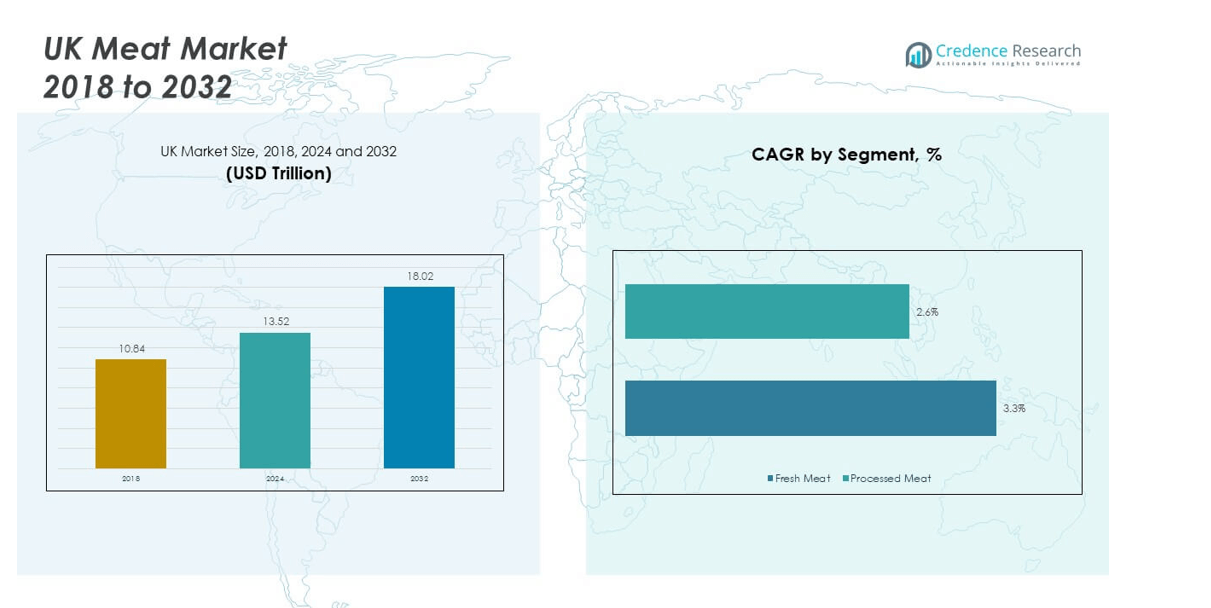
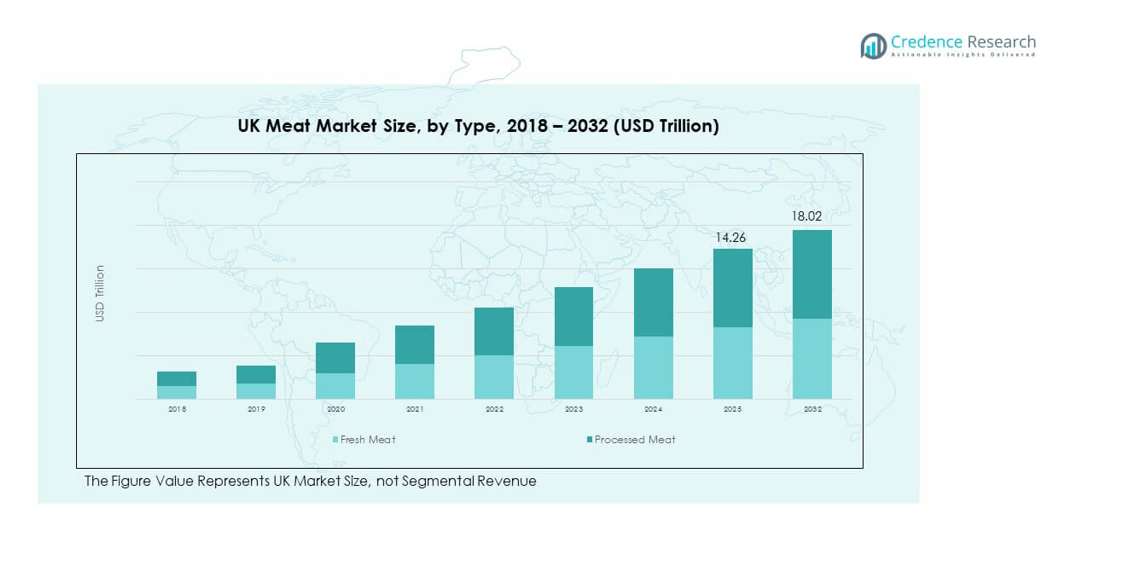
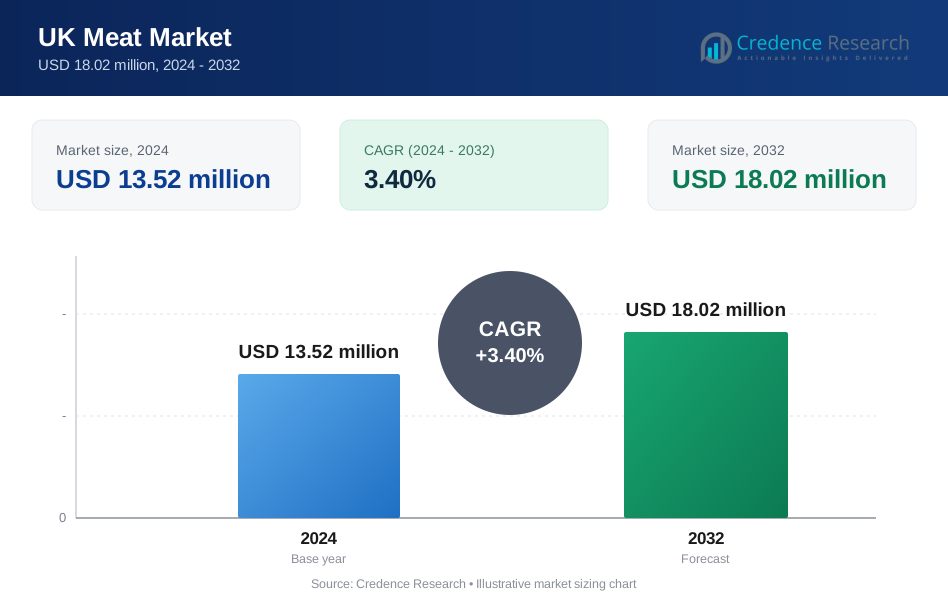
The UK Meat Market size was valued at USD 10.84 million in 2018 to USD 13.52 million in 2024 and is anticipated to reach USD 18.02 million by 2032, at a CAGR of 3.40% during the forecast period.
| REPORT ATTRIBUTE | DETAILS |
|---|---|
| Historical Period | 2020-2023 |
| Base Year | 2024 |
| Forecast Period | 2025-2032 |
| UK Meat Market Size 2024 | USD 13.52 million |
| UK Meat Market, CAGR | 3.40% |
| UK Meat Market Size 2032 | USD 18.02 million |
The UK Meat Market is driven by rising consumer demand for protein-rich diets and evolving food habits. Growing popularity of fresh and processed meat products supports expansion across retail and foodservice channels. Premiumization trends highlight demand for high-quality cuts, while convenience-driven lifestyles increase sales of ready-to-cook and marinated products. Sustainability and animal welfare standards influence purchasing decisions, encouraging producers to adopt traceable and eco-friendly practices. Innovation in packaging and product diversification strengthens consumer trust and broadens market appeal.
Regionally, England leads the UK Meat Market with strong retail infrastructure, high household consumption, and large-scale foodservice demand. Scotland holds a strong position with premium beef and lamb production supported by strict quality standards and branding. Wales and Northern Ireland contribute through lamb, beef, and pork categories, benefiting from cultural preferences and export activities. Emerging growth is visible in rural and semi-urban areas where convenience formats and online retail are gaining traction. Regional diversity ensures balanced growth across domestic and international demand.
Market Insights
- The UK Meat Market size was valued at USD 10.84 million in 2018, increased to USD 13.52 million in 2024, and is anticipated to reach USD 18.02 million by 2032, at a CAGR of 3.40%.
- England held the largest share at 58% due to strong retail infrastructure and household consumption, followed by Scotland at 22% with premium beef and lamb, and Wales/Northern Ireland together at 20% supported by pork and lamb production.
- The fastest-growing region is Scotland with its 22% share, driven by premium branding of beef and lamb and strong global demand for high-quality exports.
- By type, fresh meat accounted for 64% of the UK Meat Market in 2024, while processed meat held 36%, reflecting growing demand for convenience and marinated formats.
- By distribution, supermarkets and hypermarkets commanded 46% of the market, convenience stores held 22%, independent retailers captured 15%, online retail reached 12%, and others accounted for 5%.
Market Drivers
Growing Consumer Preference for High Protein and Nutrient-Dense Food Products
The UK Meat Market is driven by the rising importance of protein-rich diets among consumers. People are becoming more aware of the nutritional benefits of meat in supporting muscle growth and overall health. Demand for poultry, beef, and pork has increased across both retail and foodservice channels. Producers are focusing on meeting this requirement by improving product quality and safety standards. Shifts in consumer purchasing habits also reflect preference for premium cuts and convenient options. Marketing campaigns highlight the value of natural protein sources compared to plant alternatives. The widespread appeal of meat in daily meals sustains its relevance. It continues to strengthen its role as a vital part of modern diets.
- For instance, The Compleat Food Group launched Meateors, a ready-to-eat pork meatball snack in October 2024, each 50g bag naturally containing 9g of protein, distributed in Morrisons Daily and SPAR stores to address demand for portable, protein-rich meat snack options.
Expansion of Convenience and Ready-to-Cook Meat Products in Urban Areas
Urbanization and busier work schedules have pushed demand for ready-to-cook and processed meat. Consumers prefer quick-preparation items that fit into fast-paced lifestyles without compromising quality. The UK Meat Market benefits from investments in packaging that ensures extended shelf life. Retailers expand their portfolios with marinated and pre-seasoned cuts to meet growing demand. Supermarkets highlight grab-and-go meat offerings to attract time-conscious buyers. E-commerce platforms also distribute fresh meat through cold-chain logistics. The popularity of ready meals supports steady growth for packaged meat formats. It ensures producers adapt to evolving consumer needs across urban and semi-urban areas.
Focus on Sustainability and Responsible Meat Production Practices
Sustainability has become a key driver shaping consumption behavior in the UK. The UK Meat Market experiences rising pressure from consumers seeking traceability and ethical sourcing. Producers introduce carbon footprint labeling and animal welfare certifications to build trust. Companies adopt greener packaging solutions that reduce environmental impact. Government regulations also encourage sustainable farming practices and responsible meat production. Retailers highlight products with clear environmental credentials to capture attention. These factors align with the preference for transparency in food systems. It positions meat producers as responsible contributors to long-term ecological balance.
Rising Role of Innovation and Value-Added Meat Products in Retail Markets
Innovation supports market growth by bringing diverse, value-added meat products to consumers. Producers invest in developing new flavors, cuts, and cooking formats. The UK Meat Market benefits from high demand for gourmet and premium options. Ready-to-eat and portion-controlled packs attract younger demographics and single households. Foodservice outlets rely on innovative cuts to provide menu variety. Technological advancements in preservation and cold storage enhance product longevity. Investments in automation improve efficiency and reduce labor dependency in processing. It ensures consistent supply while aligning with rising consumer expectations.
- For example, in 2025, OAL Group deployed its AI-powered APRIL™ Eye system at Ilchester Cheese, boosting line capacity by 50% and reducing traceability checks from hours to just 15 minutes. The automation eliminated labeling errors and improved both efficiency and food safety standards.
Market Trends
Adoption of Digital Platforms for Fresh Meat Retail Distribution
The retail landscape is shifting toward digital channels for meat sales. Online platforms expand accessibility for consumers seeking fresh meat delivered at home. The UK Meat Market leverages digital platforms to enhance direct-to-consumer engagement. Subscription-based services for meat boxes gain popularity among households. Mobile apps provide tracking for product sourcing and delivery times. Retailers use technology to showcase transparency in quality and freshness. E-commerce ensures convenience while reaching regions beyond urban areas. It demonstrates how technology adoption shapes modern consumer purchasing patterns.
Premiumization and Growing Appeal of Specialty Meat Varieties
Consumers are showing preference for gourmet and specialty meats with unique qualities. Premiumization is influencing both retail and restaurant offerings. The UK Meat Market reflects demand for organic, grass-fed, and free-range meats. Specialty imports like Wagyu beef and Iberico pork gain attention in urban centers. Chefs and restaurants highlight premium cuts to attract affluent customers. Rising disposable income drives adoption of higher-value meat products. Retailers expand luxury meat sections in supermarkets to cater to niche buyers. It emphasizes the role of premiumization in shaping growth trajectories.
- For example, Waitrose sells a premium No.1 range of British wagyu beef products, sourced from pedigree Wagyu bulls. All products in this range are graded a minimum of 6 on the Beef Marbling Scale (BMS), with the score transparently displayed on the packaging for customers. The retailer offers a variety of wagyu cuts and products within this line.
Integration of Health and Wellness Positioning into Meat Marketing
Health-conscious consumers are seeking meat products with added functional benefits. Producers market lean cuts and low-fat options to appeal to wellness-focused buyers. The UK Meat Market highlights health-driven messaging in promotions and branding. Products enriched with omega-3 and fortified nutrients are expanding on shelves. Clear labeling about calories and fat content attracts informed shoppers. Restaurants include healthy meat choices to align with fitness trends. Brands position meat as part of balanced diets instead of indulgence. It strengthens consumer confidence in meat as a health-supporting choice.
- For example, in 2025, Marks & Spencer expanded its “High Protein” and “Count on Us (COU)” ranges with new prepared meals, including the Naked Green Goddess Chicken Salad offering 39g of protein and under 375 kcals per portion. The launch emphasized omega-3 DHA and low sugar options to appeal to health-conscious consumers.
Influence of Global Culinary Trends on Domestic Meat Consumption
Global cuisines are impacting household and restaurant-level consumption patterns. The UK Meat Market experiences demand for meat suited to international recipes. Dishes inspired by Asian, Mediterranean, and Latin American cuisine drive variety. Retailers introduce spice blends and marinades to cater to diverse tastes. Street food trends increase consumption of smaller, flavorful meat portions. Migration influences cultural meat preferences across communities. Foodservice outlets adapt menus to match global consumer expectations. It illustrates how culinary diversity plays a pivotal role in driving meat innovation.
Market Challenges Analysis
High Pressure from Sustainability Demands and Regulatory Compliance in Meat Processing
The UK Meat Market faces significant pressure due to strict environmental and welfare regulations. Producers must align with sustainability standards that require costly investments in equipment. Maintaining compliance with carbon reduction goals adds financial strain to processing firms. Consumer expectations for traceability demand technological upgrades in supply chains. Adopting eco-friendly packaging also raises costs for mid-sized producers. International trade disruptions further complicate sourcing of raw materials. Meeting these demands without raising consumer prices remains difficult. It reflects how sustainability creates both challenges and opportunities for the sector.
Rising Competition from Alternative Proteins and Shifting Dietary Preferences
The increasing availability of plant-based and lab-grown alternatives poses a major challenge. The UK Meat Market competes with brands promoting ethical and eco-friendly substitutes. Younger consumers are more open to experimenting with meat-free diets. Marketing campaigns by alternative protein companies influence perceptions of sustainability. Traditional producers struggle to balance retaining loyal customers and appealing to new ones. Restaurants adapt menus to include plant-based offerings, affecting meat demand. Economic pressures also push some buyers toward cheaper alternatives. It highlights how evolving diets threaten traditional consumption patterns.
Market Opportunities
Expansion of Export Opportunities in Emerging Global Markets for Meat Products
Producers in the UK can explore export channels to capture international demand. Emerging markets show rising appetite for high-quality imported meat products. The UK Meat Market can strengthen its reach through trade partnerships and certifications. Export strategies focusing on premium and specialty meats gain momentum. Government support for trade expansion provides avenues for industry players. Logistics advancements help ensure freshness across long distances. International branding enhances visibility in overseas markets. It positions UK producers to capitalize on growing global demand.
Innovation in Alternative Cuts and Specialty Processed Meat for Domestic Growth
Innovation remains a strong opportunity for producers targeting evolving consumer needs. The UK Meat Market can focus on alternative cuts, premium processing, and gourmet options. Ready-to-eat meat snacks align with demand from younger demographics. Advances in cold storage help scale nationwide distribution. Processed options like marinated cuts and portion packs address convenience needs. Collaboration with chefs creates unique retail experiences. Adoption of smart packaging ensures freshness and traceability. It strengthens domestic growth potential while addressing changing consumption preferences.
Market Segmentation Analysis
By Type
The UK Meat Market is divided into fresh meat and processed meat. Fresh meat holds a dominant position, supported by strong demand in households and foodservice outlets. Consumers value freshness, traceability, and quality standards, making it a consistent driver of sales. Processed meat shows steady growth due to rising demand for convenience, ready-to-eat, and marinated formats. It appeals to urban consumers with busy schedules, making it a fast-growing category across retail channels.
By Product
Poultry leads the market due to affordability, versatility, and preference for lean protein sources. Pork maintains a strong share, particularly in processed products and exports. Beef holds demand in both premium and mass-market categories, supported by foodservice adoption. Lamb and goat retain importance in regional and cultural consumption patterns, especially in Wales and Scotland. Seafood gains traction with health-conscious buyers seeking alternatives to red meat. Others, including specialty meats, contribute to niche and gourmet segments. The UK Meat Market benefits from this diversity, ensuring broad consumer appeal.
- For example, Moy Park, in partnership with Klöckner Pentaplast, introduced fully recycled (rPET) trays for its chicken lines, including products processed at its Anwick site. The move reduces the company’s plastic use and enhances the recyclability of its packaging, aligning with broader sustainability goals.
By Distribution Channel
Supermarkets and hypermarkets dominate distribution with extensive product availability and established supply chains. Convenience stores capture impulse and ready-to-eat purchases, particularly in urban locations. Independent retailers play an important role in offering locally sourced products and specialty cuts. Online retail expands rapidly, supported by e-commerce platforms and cold chain logistics. Others, including butchers and specialty stores, remain relevant for personalized service and regional loyalty. It ensures multiple touchpoints for consumers across diverse buying preferences.
- For example, major supermarkets, like Tesco, have an extensive and complex supply chain network that includes distribution centers for chilled products. These networks leverage technology and logistics to meet high customer demands for online and in-store fresh and chilled goods.
Segmentation
By Type
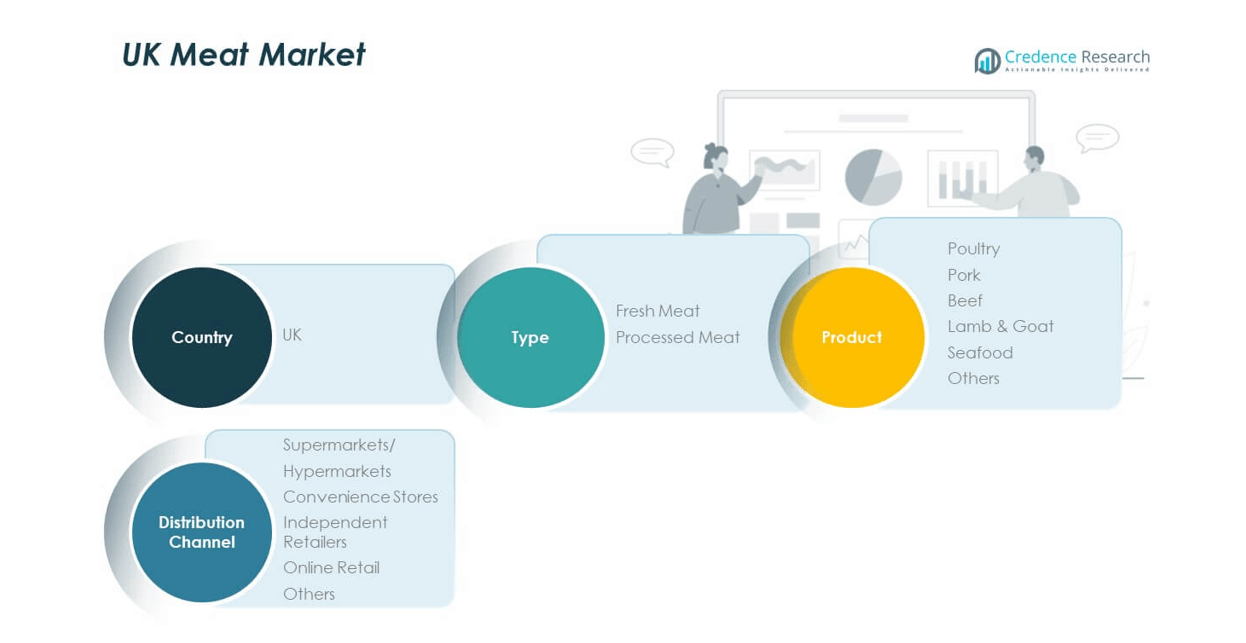
- Fresh Meat
- Processed Meat
By Product
- Poultry
- Pork
- Beef
- Lamb & Goat
- Seafood
- Others
By Distribution Channel
- Supermarkets/Hypermarkets
- Convenience Stores
- Independent Retailers
- Online Retail
- Others
By Country
- UK
Regional Analysis
England
England dominates the UK Meat Market with a market share of 58%. The region benefits from strong domestic consumption, advanced processing facilities, and a dense retail network. Major supermarkets and hypermarkets in London, Manchester, and Birmingham drive steady sales of both fresh and processed meats. Foodservice demand remains high, supported by restaurants and catering sectors with diverse meat offerings. Consumers in England display preference for poultry and beef due to affordability and versatility. Innovation in ready-to-cook formats also strengthens retail penetration. It continues to be the leading subregion by value and volume contribution.
Scotland
Scotland holds a 22% share of the UK Meat Market, driven by beef and lamb production. The region has a strong reputation for quality meat products supported by strict welfare and farming standards. Exports play an important role, with Scottish beef and lamb gaining premium recognition in global markets. Domestic demand is supported by tourism and hospitality, particularly in cities like Edinburgh and Glasgow. Supermarkets highlight Scottish meat products as premium categories with regional branding. Local producers emphasize sustainability and traceability to maintain consumer trust. It benefits from both domestic consumption and export opportunities.
Wales and Northern Ireland
Wales and Northern Ireland together account for 20% of the UK Meat Market. Wales is recognized for lamb production, supported by pasture-based farming methods. Northern Ireland contributes through pork and beef exports, benefiting from proximity to European markets. Retailers emphasize locally branded products to build strong regional loyalty. Foodservice outlets promote regional specialties, driving sales in hospitality and restaurants. Demand is supported by both rural household consumption and urban centers. It strengthens the overall diversity of the UK market by contributing specialized product categories.
Key Player Analysis
- Banham Poultry
- Bernard Matthews Foods
- Faccenda Foods
- Universal Meat Company
- Best Meat UK
- Bowyers Ltd
- Grampian Country Foods
- Ginsters
- Vestey Foods UK Ltd
- Weddel Swift Ltd
Competitive Analysis
The UK Meat Market is highly competitive with the presence of regional and national players. Banham Poultry, Bernard Matthews Foods, and Faccenda Foods maintain dominance in poultry production through integrated supply chains and large-scale processing. Universal Meat Company and Best Meat UK focus on processed and value-added categories that cater to growing urban demand. Grampian Country Foods and Bowyers Ltd emphasize innovation in ready-to-eat and pre-packaged meats. Ginsters leverages strong retail partnerships with convenience stores through its processed meat-based products. Vestey Foods UK Ltd and Weddel Swift Ltd strengthen their market position through international trade channels and diversified portfolios. Competition is defined by scale, product innovation, distribution strength, and brand reputation. It remains dynamic as companies expand product lines and adopt sustainability-focused strategies to align with evolving consumer expectations.
Recent Developments
- In January 2025, Cranswick plc, a major UK-based pig and poultry producer, announced the acquisition of JSR Genetics, a leading pig genetics company. This acquisition included JSR's pig genetics and pig farming operations, significantly increasing Cranswick’s scale in indoor pig production. Cranswick stated that this move would help secure high-quality pork supplies for its customers and further advance its production efficiency and meat quality for the UK market.
- In February 2025, Meatly launched “Chick Bites”, the world’s first lab-grown meat dog treats, in collaboration with The Pack and Pets at Home. The product mixes cultivated chicken with plant-based ingredients and it began limited release in one Pets at Home location in London.
- In August 2025, Meatable, a cultivated meat technology company, completed an acquisition of the Meat Technology platform. The move aims to enhance research, development and scale-up capacity in cultivated meat technologies. The acquisition supports Meatable’s goal of accelerating production of lab-grown meat products.
Report Coverage
The research report offers an in-depth analysis based on Type, Product and Distribution Channel. It details leading market players, providing an overview of their business, product offerings, investments, revenue streams, and key applications. Additionally, the report includes insights into the competitive environment, SWOT analysis, current market trends, as well as the primary drivers and constraints. Furthermore, it discusses various factors that have driven market expansion in recent years. The report also explores market dynamics, regulatory scenarios, and technological advancements that are shaping the industry. It assesses the impact of external factors and global economic changes on market growth. Lastly, it provides strategic recommendations for new entrants and established companies to navigate the complexities of the market.
Future Outlook
- The UK Meat Market will see steady demand as protein-rich diets continue to support consumption of poultry, beef, and pork, keeping meat central in daily meals.
- Processed and ready-to-cook meat products will expand urban retail sales, meeting consumer needs for quick preparation and convenience-driven lifestyles.
- Online retail platforms will enhance distribution efficiency, providing greater accessibility across urban and rural regions with reliable delivery and quality assurance.
- Sustainability and animal welfare standards will drive innovation in production practices, with producers adopting greener methods and certifications.
- Premiumization trends will encourage rising demand for gourmet and specialty meats, creating opportunities for value-added categories in retail and foodservice.
- International exports will strengthen revenue streams, with high-quality UK meat gaining traction in global markets for its reputation and standards.
- Automation in processing plants will improve efficiency, optimize output, and reduce operational costs for leading producers.
- Cold chain logistics investments will ensure freshness, extend shelf life, and support wider regional distribution networks.
- Regional branding will build consumer loyalty, enhancing premium positioning for meats associated with strong origin identity.
- Shifting lifestyles will drive innovation in portion-controlled, healthy, and wellness-focused meat formats tailored to new dietary needs.
Request a Free Sample
Fill in your details and we'll send you a free sample report.
- Sample data tables & charts
- Research methodology
Need a Custom Version of This Report?
Tailor the scope, geography, or segments to your exact requirements.
- Custom geography or segment scope
- Direct access to our analyst team
Frequently Asked Questions
What is the current market size for UK Meat Market, and what is its projected size in 2032?
Which UK Meat Market segment held the largest share in 2024?
What are the primary factors fueling the growth of the UK Meat Market?
Who are the leading companies in the UK Meat Market?
Which region commanded the largest share of the UK Meat Market in 2024?
Table of Content
Chapter 1. Report Introduction
- 1.1 Report Description & Purpose
- 1.1.1 Report Title & Market Definition
- 1.1.2 Unique Selling Propositions (USP) & Key Differentiators
- 1.1.3 Value Proposition for Stakeholders
- 1.2 Research Objectives
- 1.2.1 Market Sizing Objectives (Volume & Revenue)
- 1.2.2 Segmentation Objectives
- 1.2.3 Competitive Intelligence Objectives
- 1.2.4 Forecast & Scenario Objectives
- 1.3 Report Scope
- 1.3.1 UK Meat Scope – Types & Subtypes Covered
- 1.3.2 Geographic Scope – Regions & Countries Covered
- 1.3.3 Historical Period, Base Year & Forecast Period (2024; forecast to 2032)
- 1.3.4 Inclusions & Exclusions
- 1.4 HS Code & Classification Framework
- 1.5 Currency, Units & Pricing Basis
- 1.6 Target Stakeholders
- 1.7 Limitations & Assumptions
Chapter 2. Executive Summary
- 2.1 Global UK Meat Market Snapshot
- 2.1.1 Market Size – Historical (2024) & Forecast (2024-2032) (2024: USD 13.52 million → 2032: USD 18.02 million)
- 2.1.2 Volume & Revenue – Global Totals
- 2.1.3 Key Market Highlights – Top Five Facts
- 2.2 UK Meat Market Segmentation Snapshot
- 2.2.1 Market Split by Region – 2024 vs. 2032
- 2.3 Competitive Snapshot
- 2.3.1 Top 10 Players by Revenue Share – 2024
- 2.3.2 Top 10 Players by Volume Share – 2024
- 2.3.3 Recent Strategic Developments (18-Month Summary)
- 2.4 Key Investment Highlights & Strategic Conclusions
Chapter 3. UK Meat Market Dynamics & Industry Analysis
- 3.1 Market Overview & Context
- 3.1.1 UK Meat Market Position in the Broader Automotive Value Chain
- 3.1.2 OEM vs. Replacement Market Dynamics
- 3.1.3 Market Maturity & Development Stage by Region
- 3.2 UK Meat Market Drivers
- 3.3 UK Meat Market Restraints & Challenges
- 3.4 UK Meat Market Opportunities
- 3.5 Porter's Five Forces Analysis
- 3.5.1 Threat of New Entrants
- 3.5.2 Bargaining Power of Suppliers
- 3.5.3 Bargaining Power of Buyers
- 3.5.4 Threat of Substitutes
- 3.5.5 Competitive Rivalry – Intensity Assessment
- 3.6 UK Meat Value Chain Analysis
- 3.6.1 Upstream – Raw Material/Input Suppliers
- 3.6.1.1 Raw Material/Input 1
- 3.6.1.2 Raw Material/Input 2
- 3.6.1.3 Raw Material/Input 3
- 3.6.2 Midstream – Production/Manufacturing/Service Delivery
- 3.6.2.1 Production/Process Overview
- 3.6.2.2 Key Facility Locations & Capacity by Manufacturer
- 3.6.3 Downstream – Distribution & End Consumer
- 3.6.3.1 Primary Channel – B2B/OEM
- 3.6.3.2 Secondary Channels – Dealer, Retail, Online, Direct
- 3.6.4 Value Chain Profitability Analysis
- 3.6.1 Upstream – Raw Material/Input Suppliers
- 3.7 PESTEL Analysis
- 3.7.1 Political Factors
- 3.7.2 Economic Factors
- 3.7.3 Social Factors
- 3.7.4 Technological Factors
- 3.7.5 Environmental Factors
- 3.7.6 Legal Factors
- 3.8 UK Meat Supply Chain Analysis
- 3.8.1 Raw Material/Input Supply Risk Assessment
- 3.8.2 Manufacturing Concentration Risk (Geographic Exposure)
- 3.8.3 Trade Disruption Impact Analysis
- 3.9 Regulatory & Policy Landscape
Note: The regulatory and policy landscape section covers regulations based on their applicability to the market, UK Meat category, geography, and scope of the study. Only regulatory frameworks with a material impact on operations, compliance, trade, sustainability, or market access are analyzed in detail.
Chapter 4. Key Investment Pockets & Opportunity Analysis
- 4.1 UK Meat Market Attractiveness Analysis
- 4.1.1 By Region – Investment Attractiveness Matrix (Volume × CAGR)
- 4.2 Absolute Revenue Growth Opportunity
- 4.2.1 By Region – Absolute USD Growth Through 2032
- 4.3 Incremental Volume Opportunity
- 4.3.1 By Region – Incremental Volume Through 2032
- 4.3.2 Segment – Incremental Volume
- 4.4 Emerging Submarket Opportunity Deep Dive (Subject to Applicability)
- 4.5 Emerging Market Opportunity Scorecards
- 4.5.1 United States
- 4.5.2 Europe
- 4.5.3 Asia
- 4.5.4 Middle East & Africa
Note: Emerging Market Opportunity Scorecards will be included based on relevance and strategic importance. Regions listed are indicative and may vary depending on data availability and market dynamics.
Chapter 5. UK Meat Import-Export Analysis & Trade Flows
- 5.1 Global Trade Overview
- 5.1.1 Global Export Value by Country (2024)
- 5.1.2 Global Export Volume by Country (2024)
- 5.1.3 Global Import Value by Country (2024)
- 5.1.4 Global Import Volume by Country (2024)
- 5.1.5 Net Trade Balance by Country (2024)
- 5.2 Export Analysis – Segment
- 5.2.1 Type 1 (HS Code)
- 5.2.2 Type 2 (HS Code)
- 5.2.3 Type 3 (HS Code)
- 5.2.4 Type 4 (HS Code)
- 5.2.5 Type 5 (HS Code)
- 5.3 Import Analysis – Segment
- 5.3.1 Type 1 (HS Code)
- 5.3.2 Type 2 (HS Code)
- 5.3.3 Type 3 (HS Code)
- 5.3.4 Type 4 (HS Code)
- 5.3.5 Type 5 (HS Code)
- 5.4 Average Unit Trade Prices
- 5.4.1 Average Export Price – Segment & Country
- 5.4.2 Average Import Price – Segment & Source Country
- 5.4.3 Price Trends (2024)
- 5.5 Key Trade Route Analysis
- 5.5.1 Trade Route 1
- 5.5.2 Trade Route 2
- 5.5.3 Trade Route 3
- 5.5.4 Trade Route 4
- 5.5.5 Trade Route 5
- 5.6 Trade Policy Impact Assessment
- 5.6.1 US Anti-Dumping & Section 301 Tariffs
- 5.6.2 EU Customs Union Impact
- 5.6.3 Major Free Trade Agreements
- 5.6.4 USMCA Rules of Origin
Note: Trade policy analysis will be included only where relevant to the UK Meat market.
Chapter 6. Competitive Landscape & Company Benchmarking
- 6.1 UK Meat Market Concentration & Structure
- 6.1.1 Herfindahl-Hirschman Index (HHI) – vs. 2024
- 6.1.2 Tier 1, Tier 2 & Tier 3 Market Structure
- 6.1.3 Global, Regional & Local Player Dynamics
- 6.2 UK Meat Market Share Analysis – 2024
- 6.2.1 Global Revenue Share by Company
- 6.2.2 Global Volume Share by Company
- 6.2.3 Regional Revenue Share
- 6.2.4 Market Share Evolution ( vs. 2024)
- 6.2.5 OEM Segment Share by Company
- 6.2.6 Replacement Segment Share by Company
- 6.3 Production/Delivery Capacity & Facility Analysis
- 6.3.1 Global Installed Capacity
- 6.3.2 Capacity Utilization Rates
- 6.3.3 Production/Output Volume
- 6.3.4 Facility Locations & Capacity Map
- 6.3.5 Planned Capacity Additions
- 6.4 UK Meat Competitive Benchmarking Matrix
- 6.4.1 Revenue, Volume, CAGR & Profitability Comparison
- 6.4.2 Channel Revenue Mix
- 6.4.3 Geographic Revenue Exposure
- 6.4.4 R&D Intensity
- 6.4.5 Sustainability Maturity
- 6.5 Strategic Developments in UK Meat (Last 24 Months)
- 6.5.1 Mergers, Acquisitions & Divestments
- 6.5.2 New UK Meat Launches
- 6.5.3 Facility Expansions
- 6.5.4 Strategic Alliances, Joint Ventures & Partnerships
- 6.5.5 Distribution Expansion & Market Entry
- 6.5.6 Sustainability & ESG Initiatives
- 6.6 Competitive Strategy Mapping
- 6.6.1 Leader, Challenger, Follower & Niche Classification
- 6.6.2 Pricing Strategy Comparison
- 6.6.3 Channel Strategy Matrix
Note: Strategic developments are included based on their materiality and the availability of reliable information.
Chapter 7. Global UK Meat Market – By Distribution Channel
- 7.1 Segment Overview
- 7.1.1 Volume & Revenue Split by Channel (2024 & 2032)
- 7.1.2 Channel Mix Evolution (2024-2032)
Chapter 8. Regional Market Analysis – Global Overview
- 8.1 Global Regional Overview
- 8.1.1 Regional Volume Share
- 8.1.2 Regional Revenue Share
- 8.1.3 Regional Volume by Region
- 8.1.4 Regional Revenue by Region
- 8.1.5 Regional Forecast Through 2032
- 8.2 Cross-Regional Segment Analysis
- 8.2.1 By Distribution Channel
- 8.2.2 By Brand/Price Tier
Chapter 9. North America UK Meat Market
- 9.1 United States
- 9.2 Canada
- 9.3 Mexico
Chapter 10. Europe UK Meat Market
- 10.1 Germany
- 10.2 France
- 10.3 Italy
- 10.4 United Kingdom
- 10.5 Spain
- 10.6 Poland
- 10.7 Russia
- 10.8 Netherlands
- 10.9 Belgium
- 10.10 Sweden
- 10.11 Denmark
- 10.12 Norway
- 10.13 Rest of Europe
Chapter 11. Asia Pacific UK Meat Market
- 11.1 China
- 11.2 India
- 11.3 Japan
- 11.4 South Korea
- 11.5 Thailand
- 11.6 Indonesia
- 11.7 Vietnam
- 11.8 Malaysia
- 11.9 Australia
- 11.10 Rest of Asia Pacific
Chapter 12. Latin America UK Meat Market
- 12.1 Brazil
- 12.2 Argentina
- 12.3 Colombia
- 12.4 Chile
- 12.5 Rest of Latin America
Chapter 13. Middle East UK Meat Market
- 13.1 Saudi Arabia
- 13.2 United Arab Emirates
- 13.3 Turkey
- 13.4 Israel
- 13.5 Iran
- 13.6 Rest of the Middle East
Chapter 14. Africa UK Meat Market
- 14.1 South Africa
- 14.2 Egypt
- 14.3 Nigeria
- 14.4 Morocco
- 14.5 Rest of Africa
Chapter 15. UK Meat Company Profiles
- 15.1 [Company 01]
- 15.1.1 Company Overview
- 15.1.2 Key Management Personnel
- 15.1.3 Products & Services Portfolio
- 15.1.4 Financial Performance
- 15.1.5 Key Market Focus & Geographic Presence
- 15.1.6 Recent Developments & Strategic Initiatives
Note: The company profile list is preliminary and may change based on research findings, market developments, data availability, and client requirements.
Chapter 16. Appendices
- Appendix A – List of Abbreviations & Acronyms
- Appendix B – Industry Classification Code Reference – Full Series
- Appendix C – Production & Capacity Data Tables
- Appendix D – End-Use & Demand Base Tables
- Appendix E – Consumption & Replacement Rate Assumptions
- Appendix F – ASP Reference Tables
- Appendix G – Manufacturing & Facility Database
- Appendix H – Import-Export Data Tables
- Appendix I – Regulatory Summary Tables
- Appendix J – Primary Research Participant List (Anonymized)
- Appendix K – Primary Research Questionnaire Framework
- Appendix L – Data Sources & Bibliography
- Appendix M – Market Size Divergence & Source Comparison
Chapter 17. Research Methodology
- 17.1 Research Framework & Philosophy
- 17.2 Secondary Research – Sources, Hierarchy & Data Extraction
- 17.3 Data Modeling – Bottom-Up & Top-Down Market Sizing
- 17.4 Primary Research – Stakeholder Framework, LOI & Sample Sizes
- 17.5 Forecast Methodology – Regression, Scenario & Sensitivity Analysis
- 17.6 Quality Control – Four-Layer Validation Framework
- 17.7 Limitations & Standard Assumptions
- 17.8 Disclaimer
