
Veterinary Regenerative Medicine Market Overview:
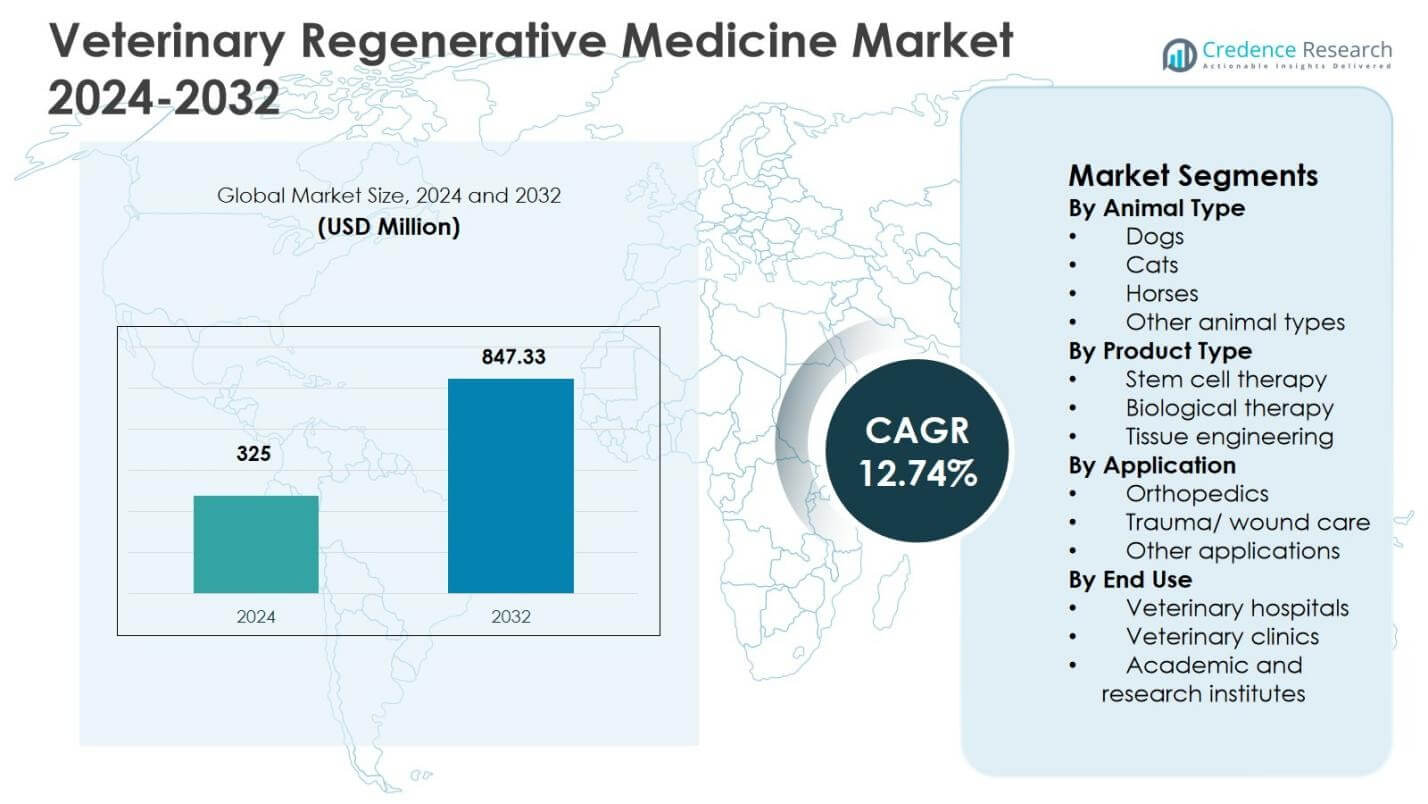
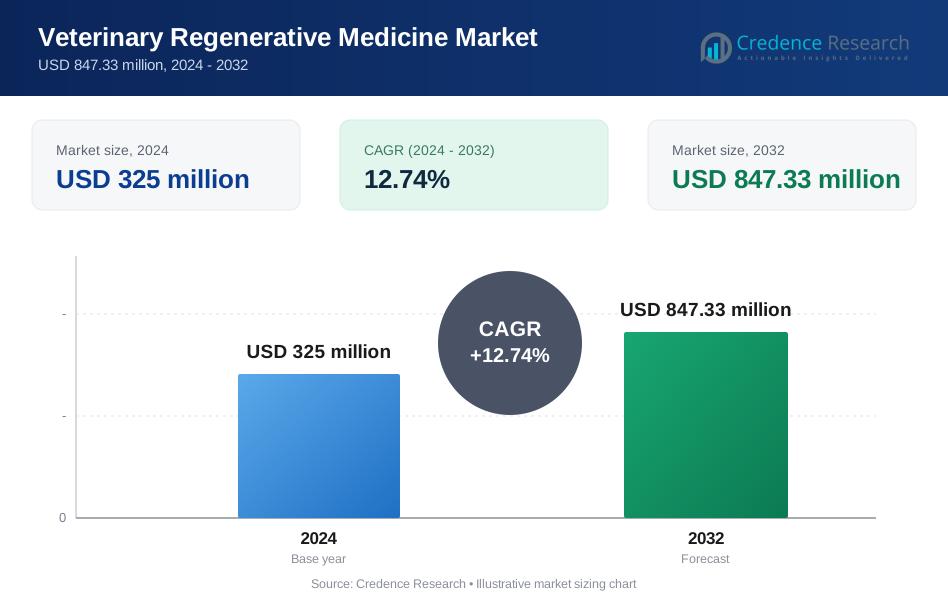
The Veterinary Regenerative Medicine Market size was valued at USD 325 million in 2024 and is anticipated to reach USD 847.33 million by 2032, growing at a CAGR of 12.74% during the forecast period.
| REPORT ATTRIBUTE | DETAILS |
|---|---|
| Historical Period | 2020-2023 |
| Base Year | 2024 |
| Forecast Period | 2025-2032 |
| Veterinary Regenerative Medicine Market Size 2024 | USD 325 million |
| Veterinary Regenerative Medicine Market, CAGR | 12.74% |
| Veterinary Regenerative Medicine Market Size 2032 | USD 847.33 million |
Veterinary Regenerative Medicine Market Insights
- Market growth is supported by increasing companion animal ownership, higher spending on pet healthcare, and growing prevalence of musculoskeletal and degenerative disorders, with the dogs segment holding 52.6% share in 2024 due to high treatment demand.
- Technological advancements in stem cell processing and biologics shape market trends, with stem cell therapy leading the product segment at 47.9% share, supported by strong clinical outcomes and wider veterinarian acceptance.
- Market positioning is influenced by key players expanding therapy portfolios, investing in clinical validation, and strengthening partnerships with veterinary hospitals and clinics to enhance adoption and service reach.
- North America dominated the market with a 41.8% regional share in 2024, supported by advanced veterinary infrastructure, strong pet insurance penetration, and early adoption of regenerative medicine, followed by Europe and Asia Pacific.
Veterinary Regenerative Medicine Market Segmentation Analysis:
By Animal Type:
In the Veterinary Regenerative Medicine Market, dogs represented the dominant animal type segment, accounting for 52.6% of the market share in 2024. High pet ownership rates, increasing expenditure on companion animal healthcare, and rising incidence of osteoarthritis, ligament injuries, and degenerative joint diseases in dogs continue to drive demand. Veterinary clinics increasingly adopt stem cell and biologic therapies for canine orthopedic and soft-tissue conditions due to faster recovery times and reduced surgical intervention. Growing awareness among pet owners and expanding availability of specialized veterinary regenerative centers further strengthen the segment’s leadership.
- For instance, Stem Cell Vet in the UK treated dogs like Benson, a patient receiving stem cell injections for mobility issues, resulting in substantial health improvements within 3-6 months post-treatment.
By Product Type:
The stem cell therapy segment led the Veterinary Regenerative Medicine Market by product type, capturing 47.9% market share in 2024. This dominance is driven by its proven effectiveness in treating musculoskeletal disorders, tendon injuries, and inflammatory conditions across companion and equine animals. Autologous stem cell treatments offer reduced rejection risk and improved healing outcomes, making them widely preferred by veterinarians. Continuous advancements in cell processing technologies, increasing clinical evidence supporting efficacy, and regulatory support for veterinary biologics have accelerated adoption, positioning stem cell therapy as the core revenue-generating product segment.
- For instance, The Royal Veterinary College (RVC) applied bone marrow-derived stem cells to an equine superficial digital flexor tendon core lesion, resulting in full lesion fill-in and reduced inflammation after six months
By Application:
By application, orthopedics emerged as the leading segment, holding 44.3% of the Veterinary Regenerative Medicine Market share in 2024. The segment benefits from the high prevalence of joint disorders, ligament tears, hip dysplasia, and sports-related injuries, particularly in dogs and horses. Regenerative therapies offer effective alternatives to surgery by reducing pain, restoring mobility, and shortening recovery periods. Rising demand for minimally invasive treatment options, growing referral rates to veterinary orthopedic specialists, and expanding use of regenerative protocols in clinical practice continue to support strong growth in this application segment.
Key Growth Drivers
Rising Companion Animal Ownership and Increased Healthcare Spending
The Veterinary Regenerative Medicine Market benefits significantly from the growing population of companion animals and rising expenditure on advanced veterinary care. Pet owners increasingly prioritize long-term health outcomes and quality of life, driving demand for regenerative therapies over conventional pain management. Higher spending on diagnostics, specialty treatments, and chronic disease management supports the adoption of stem cell and biologic therapies. Expansion of pet insurance coverage further improves affordability, enabling veterinary clinics to incorporate regenerative medicine into routine orthopedic and chronic care treatment pathways.
- For instance, VetStem Biopharma pioneered adipose-derived stem cell therapy for canine osteoarthritis, with over 16,000 patient samples processed by 2024 leading to more than 38,000 treatments.
Increasing Prevalence of Musculoskeletal and Degenerative Conditions
The rising incidence of musculoskeletal disorders such as osteoarthritis, ligament injuries, and tendon damage is a key growth driver for the Veterinary Regenerative Medicine Market. Aging companion animals and performance-related injuries in horses create sustained demand for therapies that promote tissue repair and functional recovery. Regenerative treatments reduce inflammation, enhance mobility, and shorten recovery periods, making them preferred options among veterinarians. Growing clinical confidence in regenerative outcomes continues to support wider adoption across orthopedic and sports medicine applications.
- For instance, TVM's DogStem, a licensed stem cell therapy for canine hip and elbow osteoarthritis, showed 63% of treated dogs achieving clinically relevant improvement in force-plate gait analysis eight weeks post-injection, alongside 77% exhibiting better orthopedic exam results.
Advancements in Veterinary Regenerative Technologies
Technological advancements in cell processing, biologic formulations, and treatment delivery methods are strengthening the Veterinary Regenerative Medicine Market. Improved stem cell isolation techniques and standardized platelet-rich plasma preparation enhance treatment consistency and clinical reliability. These innovations reduce procedural complexity and expand accessibility beyond specialty centers. As technologies become more efficient and cost-effective, general veterinary practices increasingly adopt regenerative solutions, supporting broader market penetration and long-term growth.
Key Trends & Opportunities
Expansion of Equine Sports and Performance Medicine
The expansion of equine sports and performance medicine represents a major trend and opportunity within the Veterinary Regenerative Medicine Market. Competitive racing and performance disciplines require advanced treatments that accelerate healing and extend athletic longevity. Regenerative therapies are increasingly used for tendon injuries, joint degeneration, and trauma recovery in horses. Investments in specialized equine hospitals and training facilities support the adoption of regenerative protocols, creating growth opportunities for therapy providers and technology developers.
- For instance, Vet-Stem, Inc. applied adipose-derived regenerative cells to 66 cases of equine superficial or deep digital flexor tendonitis since 2003, demonstrating statistically significant improvements (p<0.05) in tendon healing indicators compared to controls.
Integration of Regenerative Therapies into General Veterinary Practice
The integration of regenerative medicine into general veterinary practice presents a significant opportunity for market expansion. Simplified treatment protocols, increasing practitioner training, and improved access to ready-to-use therapy kits encourage adoption by small and mid-sized clinics. This trend supports geographic expansion into emerging markets where veterinary infrastructure is developing. Companies offering standardized solutions and clinical support services are well positioned to capture growing demand from general veterinary practitioners.
- For instance, Two Rivers Veterinary Hospital partners with Ardent Animal Health to deliver Platelet-Rich Plasma (PRP) and Stem Cell Therapy using the clinic's own cells, providing less invasive alternatives for pets with chronic joint pain and soft tissue injuries in a single visit.
Key Challenges
High Treatment Costs and Affordability Constraints
High treatment costs remain a critical challenge in the Veterinary Regenerative Medicine Market. Specialized equipment, skilled labor, and multiple treatment sessions increase overall expenses, limiting accessibility for many pet owners. Limited reimbursement coverage from pet insurance providers further constrains adoption, particularly in cost-sensitive regions. Addressing affordability through scalable production, cost-efficient technologies, and broader insurance inclusion is essential to support sustained market growth.
Regulatory Variability and Lack of Standardized Guidelines
Regulatory variability across regions poses a challenge to the Veterinary Regenerative Medicine Market. Inconsistent approval processes for cell-based and biologic therapies create uncertainty for manufacturers and clinicians. The absence of standardized clinical guidelines can impact treatment consistency and practitioner confidence. Establishing harmonized regulatory frameworks, validated protocols, and long-term clinical evidence is essential to ensure safety, reliability, and widespread acceptance of regenerative veterinary therapies.
Regional Analysis
North America
North America led the Veterinary Regenerative Medicine Market, accounting for 41.8% of the market share in 2024. The region benefits from high companion animal ownership, advanced veterinary infrastructure, and strong adoption of innovative treatment technologies. Widespread availability of specialty veterinary clinics and growing use of regenerative therapies for orthopedic and chronic conditions support market leadership. Favorable regulatory pathways for veterinary biologics and increasing pet healthcare expenditure further strengthen adoption. The presence of established market players and ongoing clinical research activities continue to reinforce North America’s dominant regional position.
Europe
Europe represented 27.4% of the Veterinary Regenerative Medicine Market share in 2024, supported by strong animal welfare standards and expanding access to advanced veterinary services. Increasing demand for regenerative treatments in companion animals and equine sports medicine drives growth across major European countries. Rising awareness among veterinarians and pet owners regarding non-invasive treatment options contributes to market expansion. Government support for veterinary research and structured regulatory frameworks encourage clinical adoption, while growing pet insurance penetration further supports demand for regenerative therapies.
Asia Pacific
Asia Pacific accounted for 18.6% of the Veterinary Regenerative Medicine Market share in 2024, reflecting rapid growth in veterinary healthcare infrastructure and rising companion animal adoption. Increasing disposable income and urbanization have driven demand for advanced animal care solutions in key markets. Veterinary clinics are expanding service offerings to include regenerative therapies, particularly for orthopedic and trauma-related conditions. Growing investments in veterinary education and specialty care centers support market development, positioning Asia Pacific as the fastest-growing regional contributor during the forecast period.
Latin America
Latin America captured 7.3% of the Veterinary Regenerative Medicine Market share in 2024, driven by gradual improvements in veterinary healthcare services and increasing awareness of regenerative treatment options. Expanding pet ownership and rising expenditure on companion animal health support adoption in urban areas. Veterinary professionals increasingly incorporate regenerative therapies for musculoskeletal and soft tissue injuries. Growth in private veterinary clinics and partnerships with international therapy providers enhances accessibility, supporting steady market expansion across key countries in the region.
Middle East & Africa
The Middle East & Africa held 4.9% of the Veterinary Regenerative Medicine Market share in 2024, supported by growing investments in veterinary infrastructure and increasing focus on animal health. Rising demand for advanced treatments in companion animals and equine care drives market development. Expanding private veterinary clinics and specialty centers improve access to regenerative therapies. Government initiatives promoting animal welfare and gradual adoption of advanced veterinary technologies support market growth, while increasing awareness among veterinarians continues to strengthen regional participation.
Veterinary Regenerative Medicine Market Segmentations:
By Animal Type
- Dogs
- Cats
- Horses
- Other animal types
By Product Type
- Stem cell therapy
- Biological therapy
- Tissue engineering
By Application
- Orthopedics
- Trauma/ wound care
- Other applications
By End Use
- Veterinary hospitals
- Veterinary clinics
- Academic and research institutes
By Geography
- North America
- U.S.
- Canada
- Mexico
- Europe
- Germany
- France
- U.K.
- Italy
- Spain
- Rest of Europe
- Asia Pacific
- China
- Japan
- India
- South Korea
- South-east Asia
- Rest of Asia Pacific
- Latin America
- Brazil
- Argentina
- Rest of Latin America
- Middle East & Africa
- GCC Countries
- South Africa
- Rest of the Middle East and Africa
Competitive Landscape
Competitive landscape analysis of the Veterinary Regenerative Medicine Market highlights the presence of key players including Animal Cell Therapies, Ardent, Boehringer Ingelheim International, Cell Therapy Sciences, Dechra Pharmaceuticals, Enso Discoveries, EquiCord, Lynch Biologics, Magellan Stem Cells, and Medrego. These companies focus on expanding regenerative therapy portfolios through stem cell technologies, biologics, and tissue-engineering solutions tailored for companion and equine animals. Strategic priorities include product innovation, clinical validation, and partnerships with veterinary hospitals and research institutes. Companies are investing in scalable cell-processing platforms and standardized treatment kits to improve clinical adoption. Geographic expansion, particularly into emerging veterinary markets, and increasing emphasis on training and education programs for veterinarians further shape market positioning. Continuous efforts to strengthen regulatory compliance and demonstrate long-term efficacy remain central to sustaining competitive differentiation.
Key Player Analysis
- Magellan Stem Cells
- Dechra Pharmaceuticals
- Enso Discoveries
- Lynch Biologics
- Boehringer Ingelheim International
- Medrego
- EquiCord
- Cell Therapy Sciences
- Ardent
- Animal Cell Therapies
Recent Developments
- In November 2025, RION launched RION Vet, a veterinary biotechnology arm advancing a first-in-class platelet-derived biologic therapeutic (ePEP-01) for equine musculoskeletal indications and appointed Mark Herthel as CEO.
- In April 2025, Vetirus Pharmaceuticals acquired Enso Discoveries, enhancing its regenerative medicine portfolio with patented products like Rebound PRP and Rebound PRF for veterinary applications.
- In April 2025, Transcend Biologics launched TropoVet PRP, an advanced one-step platelet therapy system to improve pet healing and recovery in veterinary practices.
Report Coverage
The research report offers an in-depth analysis based on Animal Type, Product Type, Application, End Use and Geography. It details leading market players, providing an overview of their business, product offerings, investments, revenue streams, and key applications. Additionally, the report includes insights into the competitive environment, SWOT analysis, current market trends, as well as the primary drivers and constraints. Furthermore, it discusses various factors that have driven market expansion in recent years. The report also explores market dynamics, regulatory scenarios, and technological advancements that are shaping the industry. It assesses the impact of external factors and global economic changes on market growth. Lastly, it provides strategic recommendations for new entrants and established companies to navigate the complexities of the market.
Future Outlook
- The Veterinary Regenerative Medicine Market will continue to expand due to increasing demand for advanced, non-invasive treatment options for companion and performance animals.
- Wider adoption of stem cell and biologic therapies will strengthen as clinical evidence and standardized protocols increase veterinarian confidence.
- Integration of regenerative treatments into general veterinary practice will broaden market reach beyond specialty clinics.
- Technological advancements in cell processing and biologic formulations will improve treatment consistency and clinical outcomes.
- Growing awareness among pet owners will drive earlier intervention and preventive use of regenerative therapies.
- Expansion of equine sports and performance medicine will support sustained demand for regenerative solutions.
- Increased training and education programs will enhance practitioner expertise and treatment adoption rates.
- Emerging markets will contribute to growth as veterinary healthcare infrastructure continues to develop.
- Collaboration between therapy providers and veterinary hospitals will accelerate innovation and service availability.
- Regulatory harmonization and clearer clinical guidelines will support long-term market stability and acceptance.
Request a Free Sample
Fill in your details and we'll send you a free sample report.
- Sample data tables & charts
- Research methodology
Need a Custom Version of This Report?
Tailor the scope, geography, or segments to your exact requirements.
- Custom geography or segment scope
- Direct access to our analyst team
Frequently Asked Questions
What is the current market size for the Veterinary Regenerative Medicine Market, and what is its projected size in 2032?
At what Compound Annual Growth Rate is the Veterinary Regenerative Medicine Market projected to grow between 2024 and 2032?
Which Veterinary Regenerative Medicine Market segment held the largest share in 2024?
What are the primary factors fueling the growth of the Veterinary Regenerative Medicine Market?
Who are the leading companies in the Veterinary Regenerative Medicine Market?
Which region commanded the largest share of the Veterinary Regenerative Medicine Market in 2024?
Table of Content
Chapter 1. Report Introduction
- 1.1 Report Description & Purpose
- 1.1.1 Report Title & Market Definition
- 1.1.2 Unique Selling Propositions (USP) & Key Differentiators
- 1.1.3 Value Proposition for Stakeholders
- 1.2 Research Objectives
- 1.2.1 Market Sizing Objectives (Volume & Revenue)
- 1.2.2 Segmentation Objectives
- 1.2.3 Competitive Intelligence Objectives
- 1.2.4 Forecast & Scenario Objectives
- 1.3 Report Scope
- 1.3.1 Veterinary Regenerative Medicine Scope – Types & Subtypes Covered
- 1.3.2 Geographic Scope – Regions & Countries Covered
- 1.3.3 Historical Period, Base Year & Forecast Period (2024; forecast to 2032)
- 1.3.4 Inclusions & Exclusions
- 1.4 HS Code & Classification Framework
- 1.5 Currency, Units & Pricing Basis
- 1.6 Target Stakeholders
- 1.7 Limitations & Assumptions
Chapter 2. Executive Summary
- 2.1 Global Veterinary Regenerative Medicine Market Snapshot
- 2.1.1 Market Size – Historical (2024) & Forecast (2024-2032) (2024: USD 325 million → 2032: USD 847.33 million)
- 2.1.2 Volume & Revenue – Global Totals
- 2.1.3 Key Market Highlights – Top Five Facts
- 2.2 Veterinary Regenerative Medicine Market Segmentation Snapshot
- 2.2.1 Market Split by Region – 2024 vs. 2032
- 2.3 Competitive Snapshot
- 2.3.1 Top 10 Players by Revenue Share – 2024
- 2.3.2 Top 10 Players by Volume Share – 2024
- 2.3.3 Recent Strategic Developments (18-Month Summary)
- 2.4 Key Investment Highlights & Strategic Conclusions
Chapter 3. Veterinary Regenerative Medicine Market Dynamics & Industry Analysis
- 3.1 Market Overview & Context
- 3.1.1 Veterinary Regenerative Medicine Market Position in the Broader Automotive Value Chain
- 3.1.2 OEM vs. Replacement Market Dynamics
- 3.1.3 Market Maturity & Development Stage by Region
- 3.2 Veterinary Regenerative Medicine Market Drivers
- 3.3 Veterinary Regenerative Medicine Market Restraints & Challenges
- 3.4 Veterinary Regenerative Medicine Market Opportunities
- 3.5 Porter's Five Forces Analysis
- 3.5.1 Threat of New Entrants
- 3.5.2 Bargaining Power of Suppliers
- 3.5.3 Bargaining Power of Buyers
- 3.5.4 Threat of Substitutes
- 3.5.5 Competitive Rivalry – Intensity Assessment
- 3.6 Veterinary Regenerative Medicine Value Chain Analysis
- 3.6.1 Upstream – Raw Material/Input Suppliers
- 3.6.1.1 Raw Material/Input 1
- 3.6.1.2 Raw Material/Input 2
- 3.6.1.3 Raw Material/Input 3
- 3.6.2 Midstream – Production/Manufacturing/Service Delivery
- 3.6.2.1 Production/Process Overview
- 3.6.2.2 Key Facility Locations & Capacity by Manufacturer
- 3.6.3 Downstream – Distribution & End Consumer
- 3.6.3.1 Primary Channel – B2B/OEM
- 3.6.3.2 Secondary Channels – Dealer, Retail, Online, Direct
- 3.6.4 Value Chain Profitability Analysis
- 3.6.1 Upstream – Raw Material/Input Suppliers
- 3.7 PESTEL Analysis
- 3.7.1 Political Factors
- 3.7.2 Economic Factors
- 3.7.3 Social Factors
- 3.7.4 Technological Factors
- 3.7.5 Environmental Factors
- 3.7.6 Legal Factors
- 3.8 Veterinary Regenerative Medicine Supply Chain Analysis
- 3.8.1 Raw Material/Input Supply Risk Assessment
- 3.8.2 Manufacturing Concentration Risk (Geographic Exposure)
- 3.8.3 Trade Disruption Impact Analysis
- 3.9 Regulatory & Policy Landscape
Note: The regulatory and policy landscape section covers regulations based on their applicability to the market, Veterinary Regenerative Medicine category, geography, and scope of the study. Only regulatory frameworks with a material impact on operations, compliance, trade, sustainability, or market access are analyzed in detail.
Chapter 4. Key Investment Pockets & Opportunity Analysis
- 4.1 Veterinary Regenerative Medicine Market Attractiveness Analysis
- 4.1.1 By Region – Investment Attractiveness Matrix (Volume × CAGR)
- 4.2 Absolute Revenue Growth Opportunity
- 4.2.1 By Region – Absolute USD Growth Through 2032
- 4.3 Incremental Volume Opportunity
- 4.3.1 By Region – Incremental Volume Through 2032
- 4.3.2 Segment – Incremental Volume
- 4.4 Emerging Submarket Opportunity Deep Dive (Subject to Applicability)
- 4.5 Emerging Market Opportunity Scorecards
- 4.5.1 United States
- 4.5.2 Europe
- 4.5.3 Asia
- 4.5.4 Middle East & Africa
Note: Emerging Market Opportunity Scorecards will be included based on relevance and strategic importance. Regions listed are indicative and may vary depending on data availability and market dynamics.
Chapter 5. Veterinary Regenerative Medicine Import-Export Analysis & Trade Flows
- 5.1 Global Trade Overview
- 5.1.1 Global Export Value by Country (2024)
- 5.1.2 Global Export Volume by Country (2024)
- 5.1.3 Global Import Value by Country (2024)
- 5.1.4 Global Import Volume by Country (2024)
- 5.1.5 Net Trade Balance by Country (2024)
- 5.2 Export Analysis – Segment
- 5.2.1 Type 1 (HS Code)
- 5.2.2 Type 2 (HS Code)
- 5.2.3 Type 3 (HS Code)
- 5.2.4 Type 4 (HS Code)
- 5.2.5 Type 5 (HS Code)
- 5.3 Import Analysis – Segment
- 5.3.1 Type 1 (HS Code)
- 5.3.2 Type 2 (HS Code)
- 5.3.3 Type 3 (HS Code)
- 5.3.4 Type 4 (HS Code)
- 5.3.5 Type 5 (HS Code)
- 5.4 Average Unit Trade Prices
- 5.4.1 Average Export Price – Segment & Country
- 5.4.2 Average Import Price – Segment & Source Country
- 5.4.3 Price Trends (2024)
- 5.5 Key Trade Route Analysis
- 5.5.1 Trade Route 1
- 5.5.2 Trade Route 2
- 5.5.3 Trade Route 3
- 5.5.4 Trade Route 4
- 5.5.5 Trade Route 5
- 5.6 Trade Policy Impact Assessment
- 5.6.1 US Anti-Dumping & Section 301 Tariffs
- 5.6.2 EU Customs Union Impact
- 5.6.3 Major Free Trade Agreements
- 5.6.4 USMCA Rules of Origin
Note: Trade policy analysis will be included only where relevant to the Veterinary Regenerative Medicine market.
Chapter 6. Competitive Landscape & Company Benchmarking
- 6.1 Veterinary Regenerative Medicine Market Concentration & Structure
- 6.1.1 Herfindahl-Hirschman Index (HHI) – vs. 2024
- 6.1.2 Tier 1, Tier 2 & Tier 3 Market Structure
- 6.1.3 Global, Regional & Local Player Dynamics
- 6.2 Veterinary Regenerative Medicine Market Share Analysis – 2024
- 6.2.1 Global Revenue Share by Company
- 6.2.2 Global Volume Share by Company
- 6.2.3 Regional Revenue Share
- 6.2.4 Market Share Evolution ( vs. 2024)
- 6.2.5 OEM Segment Share by Company
- 6.2.6 Replacement Segment Share by Company
- 6.3 Production/Delivery Capacity & Facility Analysis
- 6.3.1 Global Installed Capacity
- 6.3.2 Capacity Utilization Rates
- 6.3.3 Production/Output Volume
- 6.3.4 Facility Locations & Capacity Map
- 6.3.5 Planned Capacity Additions
- 6.4 Veterinary Regenerative Medicine Competitive Benchmarking Matrix
- 6.4.1 Revenue, Volume, CAGR & Profitability Comparison
- 6.4.2 Channel Revenue Mix
- 6.4.3 Geographic Revenue Exposure
- 6.4.4 R&D Intensity
- 6.4.5 Sustainability Maturity
- 6.5 Strategic Developments in Veterinary Regenerative Medicine (Last 24 Months)
- 6.5.1 Mergers, Acquisitions & Divestments
- 6.5.2 New Veterinary Regenerative Medicine Launches
- 6.5.3 Facility Expansions
- 6.5.4 Strategic Alliances, Joint Ventures & Partnerships
- 6.5.5 Distribution Expansion & Market Entry
- 6.5.6 Sustainability & ESG Initiatives
- 6.6 Competitive Strategy Mapping
- 6.6.1 Leader, Challenger, Follower & Niche Classification
- 6.6.2 Pricing Strategy Comparison
- 6.6.3 Channel Strategy Matrix
Note: Strategic developments are included based on their materiality and the availability of reliable information.
Chapter 7. Global Veterinary Regenerative Medicine Market – By Distribution Channel
- 7.1 Segment Overview
- 7.1.1 Volume & Revenue Split by Channel (2024 & 2032)
- 7.1.2 Channel Mix Evolution (2024-2032)
Chapter 8. Regional Market Analysis – Global Overview
- 8.1 Global Regional Overview
- 8.1.1 Regional Volume Share
- 8.1.2 Regional Revenue Share
- 8.1.3 Regional Volume by Region
- 8.1.4 Regional Revenue by Region
- 8.1.5 Regional Forecast Through 2032
- 8.2 Cross-Regional Segment Analysis
- 8.2.1 By Distribution Channel
- 8.2.2 By Brand/Price Tier
Chapter 9. North America Veterinary Regenerative Medicine Market
- 9.1 United States
- 9.2 Canada
- 9.3 Mexico
Chapter 10. Europe Veterinary Regenerative Medicine Market
- 10.1 Germany
- 10.2 France
- 10.3 Italy
- 10.4 United Kingdom
- 10.5 Spain
- 10.6 Poland
- 10.7 Russia
- 10.8 Netherlands
- 10.9 Belgium
- 10.10 Sweden
- 10.11 Denmark
- 10.12 Norway
- 10.13 Rest of Europe
Chapter 11. Asia Pacific Veterinary Regenerative Medicine Market
- 11.1 China
- 11.2 India
- 11.3 Japan
- 11.4 South Korea
- 11.5 Thailand
- 11.6 Indonesia
- 11.7 Vietnam
- 11.8 Malaysia
- 11.9 Australia
- 11.10 Rest of Asia Pacific
Chapter 12. Latin America Veterinary Regenerative Medicine Market
- 12.1 Brazil
- 12.2 Argentina
- 12.3 Colombia
- 12.4 Chile
- 12.5 Rest of Latin America
Chapter 13. Middle East Veterinary Regenerative Medicine Market
- 13.1 Saudi Arabia
- 13.2 United Arab Emirates
- 13.3 Turkey
- 13.4 Israel
- 13.5 Iran
- 13.6 Rest of the Middle East
Chapter 14. Africa Veterinary Regenerative Medicine Market
- 14.1 South Africa
- 14.2 Egypt
- 14.3 Nigeria
- 14.4 Morocco
- 14.5 Rest of Africa
Chapter 15. Veterinary Regenerative Medicine Company Profiles
- 15.1 [Company 01]
- 15.1.1 Company Overview
- 15.1.2 Key Management Personnel
- 15.1.3 Products & Services Portfolio
- 15.1.4 Financial Performance
- 15.1.5 Key Market Focus & Geographic Presence
- 15.1.6 Recent Developments & Strategic Initiatives
Note: The company profile list is preliminary and may change based on research findings, market developments, data availability, and client requirements.
Chapter 16. Appendices
- Appendix A – List of Abbreviations & Acronyms
- Appendix B – Industry Classification Code Reference – Full Series
- Appendix C – Production & Capacity Data Tables
- Appendix D – End-Use & Demand Base Tables
- Appendix E – Consumption & Replacement Rate Assumptions
- Appendix F – ASP Reference Tables
- Appendix G – Manufacturing & Facility Database
- Appendix H – Import-Export Data Tables
- Appendix I – Regulatory Summary Tables
- Appendix J – Primary Research Participant List (Anonymized)
- Appendix K – Primary Research Questionnaire Framework
- Appendix L – Data Sources & Bibliography
- Appendix M – Market Size Divergence & Source Comparison
Chapter 17. Research Methodology
- 17.1 Research Framework & Philosophy
- 17.2 Secondary Research – Sources, Hierarchy & Data Extraction
- 17.3 Data Modeling – Bottom-Up & Top-Down Market Sizing
- 17.4 Primary Research – Stakeholder Framework, LOI & Sample Sizes
- 17.5 Forecast Methodology – Regression, Scenario & Sensitivity Analysis
- 17.6 Quality Control – Four-Layer Validation Framework
- 17.7 Limitations & Standard Assumptions
- 17.8 Disclaimer
