Market Overview
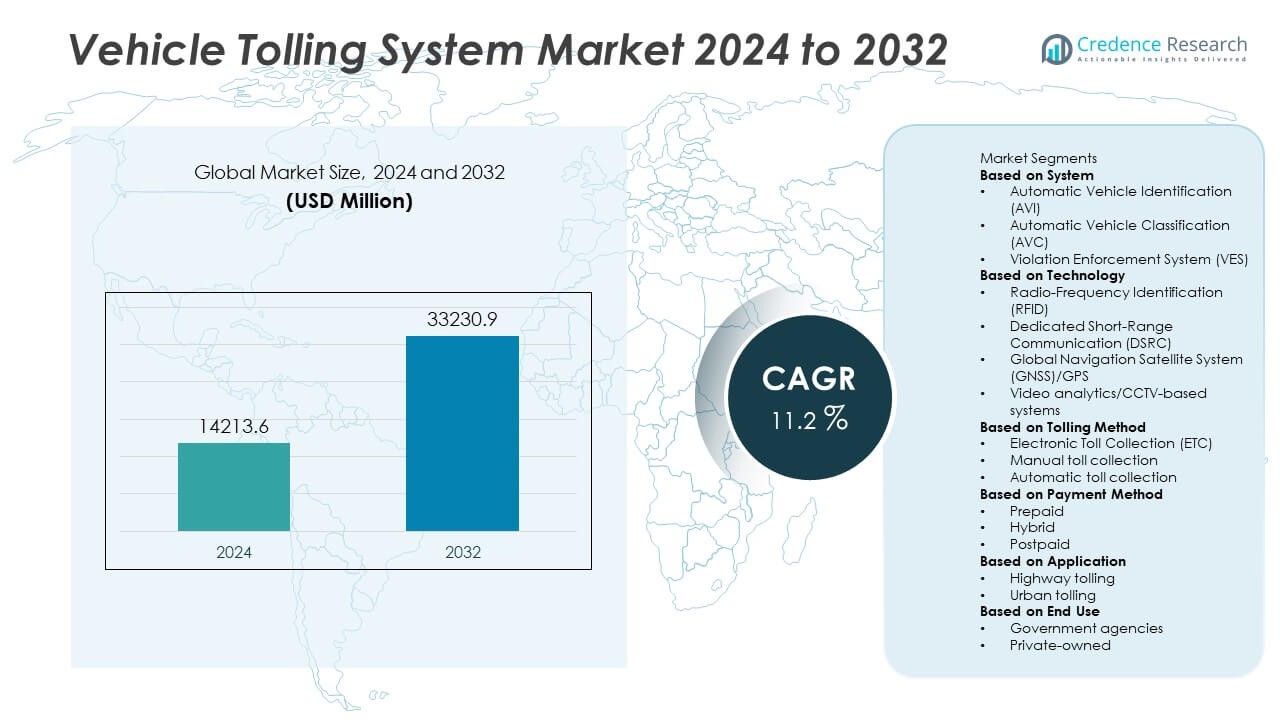
The Vehicle Tolling System Market was valued at USD 14,213.6 million in 2024 and is projected to reach USD 33,230.9 million by 2032, expanding at a CAGR of 11.2% during the forecast period.
| REPORT ATTRIBUTE | DETAILS |
|---|---|
| Historical Period | 2020-2024 |
| Base Year | 2024 |
| Forecast Period | 2025-2032 |
| Vehicle Tolling System Market Size 2024 | USD 14,213.6 Million |
| Vehicle Tolling System Market, CAGR | 11.2% |
| Vehicle Tolling System Market Size 2032 | USD 33,230.9 Million |
The Vehicle Tolling System Market advances with rising demand for congestion reduction, smart mobility, and efficient road infrastructure funding. Governments invest in electronic toll collection, RFID, and GNSS technologies to improve traffic flow and revenue accuracy.
The Vehicle Tolling System Market demonstrates wide geographical adoption, with North America focusing on electronic toll collection networks such as transponder-based systems that reduce congestion on highways, while Europe emphasizes GNSS-based distance tolling and congestion pricing to align with sustainable transport policies. Asia-Pacific expands rapidly with large-scale programs in China and India, where governments deploy nationwide RFID and digital tolling initiatives to handle increasing vehicle volumes. Latin America modernizes its road infrastructure with public-private partnerships supporting RFID and ANPR-based tolling, whereas the Middle East & Africa gradually invest in cashless tolling linked to smart city development. Key players shaping the competitive landscape include Thales Group, known for advanced traffic management solutions; Siemens AG, a leader in integrated tolling and smart mobility systems; Kapsch TrafficCom AG, specializing in multi-lane free-flow and GNSS-based tolling; and TransCore, recognized for electronic toll collection and intelligent transportation networks in North America.
Market Insights
- The Vehicle Tolling System Market was valued at USD 14,213.6 million in 2024 and is projected to reach USD 33,230.9 million by 2032, growing at a CAGR of 11.2% during the forecast period.
- The market grows with rising demand for congestion reduction, sustainable road funding, and improved traffic efficiency supported by government-led tolling modernization programs.
- Key trends include expansion of electronic toll collection networks, adoption of multi-lane free-flow systems, and integration of AI and data analytics for traffic monitoring and predictive maintenance.
- Leading companies such as Siemens AG, Kapsch TrafficCom AG, Thales Group, TransCore, and Honeywell International Inc. compete by focusing on advanced technologies, cross-border interoperability, and smart city integration.
- High infrastructure costs, lengthy implementation timelines, and data privacy concerns act as restraints that limit large-scale adoption in certain regions.
- North America emphasizes electronic toll collection networks, Europe advances distance-based and congestion tolling, Asia-Pacific grows rapidly through large-scale RFID and GNSS deployment, Latin America expands tolling through public-private partnerships, while the Middle East & Africa invest gradually in cashless and smart tolling systems.
- Long-term opportunities are driven by integration with smart mobility platforms, expansion of electric vehicle corridors, and increasing government focus on digitalized and environmentally sustainable transport systems.
Market Drivers
Rising Focus on Traffic Congestion Reduction and Road Efficiency
The Vehicle Tolling System Market grows strongly with increasing emphasis on reducing traffic congestion in urban areas and highways. Governments and transport authorities implement electronic tolling to minimize delays at toll plazas and improve road efficiency. Automated systems ensure faster vehicle movement, which reduces fuel consumption and lowers emissions. It allows transportation authorities to manage traffic flow more effectively by integrating real-time data into planning and operations. Tolling also provides a sustainable revenue stream for maintaining and upgrading road infrastructure. The push for smoother mobility continues to accelerate adoption worldwide.
- For instance, TransCore deployed its Infinity Digital Lane System across the Delaware River Joint Toll Bridge Commission network, significantly reducing average wait times during peak hours. Specifically, the system has led to a reduction of over 20 minutes in average wait times during peak hours according to TransCore.
Increasing Government Investments in Smart Infrastructure
National and regional governments prioritize investments in smart infrastructure to meet rising mobility demands. Large-scale funding programs encourage the deployment of advanced toll collection technologies across highways and expressways. The Vehicle Tolling System Market benefits from such initiatives, as electronic tolling aligns with smart city development and digital transformation strategies. It reduces manual intervention, improves revenue collection accuracy, and supports transparent operations. Countries in Asia-Pacific and Europe lead with extensive toll road networks supported by modernized tolling technologies. Public-private partnerships further strengthen implementation across both developed and emerging economies.
- For instance, The National Highways Authority of India (NHAI) FASTag program, which facilitates electronic toll collection, has seen a significant increase in daily electronic transactions. The Indian government recently reported that the program recorded 1.16 crore transactions in a single day, with a total of ₹193.15 crore collected.
Growing Adoption of Cashless and Contactless Payment Solutions
The rapid shift toward digital payment solutions enhances tolling efficiency and user convenience. Electronic toll collection systems allow cashless transactions through RFID tags, ANPR cameras, and mobile applications. The Vehicle Tolling System Market adapts quickly to this demand, offering integrated solutions that support multiple payment platforms. It ensures faster processing, reduces cash-handling risks, and lowers administrative costs. Widespread adoption of mobile wallets and banking applications further accelerates this transition. Consumers increasingly prefer seamless, contactless toll payments that align with global digital finance trends.
Rising Demand for Sustainable Transportation Solutions
Sustainability goals drive governments and operators to adopt tolling systems that encourage efficient vehicle use and reduce environmental impact. The Vehicle Tolling System Market plays a crucial role in promoting eco-friendly transportation by discouraging excessive fuel consumption through congestion pricing and distance-based tolling. It enables authorities to incentivize carpooling and the use of low-emission vehicles. Smart tolling contributes to reducing traffic-related carbon footprints, aligning with climate targets set by many countries. The integration of tolling with electric vehicle infrastructure enhances its relevance in the evolving mobility landscape. Sustainable policies ensure long-term adoption of advanced tolling systems across global road networks.
Market Trends
Expansion of Electronic Toll Collection (ETC) Networks
The Vehicle Tolling System Market shows strong alignment with the expansion of electronic toll collection networks across highways and urban corridors. Governments invest in RFID, Dedicated Short-Range Communication (DSRC), and satellite-based tolling to eliminate delays at toll booths. It improves operational efficiency by reducing human error and manual cash handling. Toll operators deploy multi-lane free-flow systems that allow uninterrupted traffic movement. The expansion of ETC networks not only enhances driver convenience but also improves revenue assurance for infrastructure projects. This trend continues to define large-scale modernization programs in both developed and emerging markets.
- For instance, Kapsch TrafficCom implemented its multi-lane free-flow (MLFF) system on Austria’s A9 Pyhrn Autobahn in 2024, where the system processed more than 1.1 million vehicles monthly, ensuring 99.95% transaction accuracy across all lanes.
Integration of Advanced Data Analytics and AI Technologies
The adoption of artificial intelligence and advanced analytics is reshaping toll management. Operators use predictive models to analyze traffic flows, forecast toll revenues, and optimize lane allocation. The Vehicle Tolling System Market benefits from AI-enabled license plate recognition and anomaly detection that reduce fraud and improve compliance. It provides authorities with real-time insights to manage congestion more effectively. Predictive analytics also enhances system maintenance by identifying faults before disruptions occur. AI-driven tolling solutions create smarter, safer, and more reliable networks.
- For instance, Kapsch TrafficCom launched a barrier-free tolling system on Norway’s National Road 4 in July 2025-deploying charging point equipment that integrates OBE communication and license plate recognition, in operation across multiple counties and ensuring reliable detection in all weather conditions.
Growing Role of Mobility-as-a-Service (MaaS) Platforms
The tolling industry adapts to new mobility patterns shaped by shared mobility and subscription-based transport models. Integration of tolling systems with MaaS platforms allows seamless travel experiences across multiple transport modes. The Vehicle Tolling System Market leverages this trend by enabling interoperability between road tolls, parking, and public transport payments. It ensures drivers and commuters access unified accounts for simplified transactions. This integration supports broader mobility ecosystems where tolling is no longer an isolated service. The trend strengthens the role of tolling systems in future mobility infrastructure.
Increasing Implementation of Distance-Based and Dynamic Pricing Models
Dynamic tolling and distance-based fee models gain traction to optimize traffic management and revenue generation. Authorities implement congestion pricing in cities to discourage excessive vehicle use during peak hours. The Vehicle Tolling System Market adapts to this demand by integrating software capable of real-time fare adjustments. It enables flexible pricing strategies that promote carpooling, public transport use, and reduced emissions. Distance-based tolling ensures fair cost distribution, reflecting actual road usage rather than fixed rates. The rise of smart pricing models highlights the market’s transition toward intelligent, adaptive tolling solutions.
Market Challenges Analysis
High Infrastructure Costs and Implementation Barriers
The Vehicle Tolling System Market faces challenges from the high capital investment required for toll infrastructure development. Building electronic toll collection systems involves deployment of RFID readers, sensors, cameras, and communication networks across large corridors. It raises costs for governments and operators, particularly in emerging economies with limited budgets. Integration of advanced tolling technologies also demands strong IT systems and cybersecurity measures, which further increase expenditure. Lengthy approval processes and land acquisition delays slow down large-scale projects. These factors limit the pace of adoption, keeping toll modernization uneven across regions.
Technical Complexities and Data Privacy Concerns
Operational challenges arise from the technical complexity of integrating toll systems with existing transportation infrastructure. The Vehicle Tolling System Market requires advanced interoperability between multiple payment platforms, traffic monitoring systems, and national transport databases. It increases the risk of technical glitches, system downtime, and revenue leakages. Data privacy concerns also emerge, as tolling systems rely heavily on vehicle tracking, license plate recognition, and user payment records. Weak security frameworks expose operators to cyberattacks and data misuse. The shortage of skilled workforce capable of managing large-scale digital toll operations compounds these challenges, restricting seamless implementation across networks.
Market Opportunities
Expansion of Smart Mobility and Connected Infrastructure
The Vehicle Tolling System Market benefits from the rapid expansion of smart mobility initiatives and connected transport infrastructure. Governments and private operators are integrating tolling with intelligent transportation systems that support real-time traffic monitoring and automated fare collection. It creates opportunities to link tolling platforms with parking, urban transit, and mobility-as-a-service applications, enabling unified payment ecosystems. Growing investments in 5G connectivity further enhance tolling performance by ensuring low-latency communication between vehicles and tolling infrastructure. Countries with large urban populations are prioritizing smart corridors where tolling plays a central role in traffic management. These developments open new revenue models and improve user convenience.
Growing Demand for Electric Vehicle Integration and Green Corridors
Rising adoption of electric vehicles creates opportunities to design tolling systems aligned with sustainable mobility goals. The Vehicle Tolling System Market adapts to this trend by integrating tolling with EV charging stations and offering incentives for low-emission vehicles. It allows authorities to implement differential pricing that promotes eco-friendly transportation choices. Governments worldwide are investing in green highway projects where tolling revenue supports EV infrastructure development. Tolling operators can also leverage carbon credit mechanisms linked to reduced traffic emissions. This alignment with clean energy policies positions modern tolling systems as critical enablers of the global sustainability agenda.
Market Segmentation Analysis:
By System
The Vehicle Tolling System Market segments by system into transponder-based, video analytics-based, and global navigation satellite system (GNSS)-based solutions. Transponder-based systems dominate long-standing tolling networks, offering reliable identification of vehicles through RFID tags and dedicated short-range communication. It remains a preferred choice for highways with high traffic density, where speed and accuracy are essential. Video analytics-based tolling grows steadily due to advancements in automatic number plate recognition (ANPR) cameras, enabling cashless tolling without physical devices. GNSS-based systems emerge as a flexible alternative, allowing distance-based charging and satellite-enabled monitoring across large road networks. The expansion of GNSS projects in Europe and Asia strengthens this segment as authorities explore scalable solutions for national corridors.
- For instance, Toll Collect launched the world’s first national GNSS road‑pricing system in Germany, covering over 12,000 kilometers of motorways and tracking trucks with onboard GNSS units and DSRC for enforcement.
By Technology
Technological segmentation includes RFID, DSRC, ANPR, and GPS/GNSS. RFID-based tolling leads adoption, driven by its low operational cost and high transaction accuracy. The Vehicle Tolling System Market also reflects strong adoption of DSRC, widely deployed in North America and Europe for real-time, short-range communication. ANPR technology gains ground in urban regions where license plate detection eliminates the need for physical tags. It supports seamless tolling across mixed vehicle classes, improving compliance and reducing manual enforcement. GPS/GNSS tolling, though newer, expands rapidly in regions experimenting with satellite-enabled distance-based charging models. Each technology contributes uniquely, creating a diverse landscape of tolling innovations.
- For instance, In the UK, approximately 11,000 Automatic Number Plate Recognition (ANPR) cameras capture around 50 million reads daily. These cameras are used by law enforcement to track vehicle movements, detect crime, and monitor for uninsured vehicles.
By Tolling Method
The market divides by tolling method into open road tolling, distance-based tolling, and congestion pricing. Open road tolling, also called multi-lane free flow, dominates due to its ability to eliminate physical toll plazas and enable uninterrupted traffic flow. It enhances user experience by reducing waiting times and fuel wastage. Distance-based tolling expands steadily in regions prioritizing fair cost distribution by charging vehicles based on actual kilometers traveled. The Vehicle Tolling System Market also sees rapid growth in congestion pricing models, particularly in metropolitan areas where traffic management and environmental concerns are critical. It empowers authorities to regulate peak-hour demand while incentivizing sustainable travel. The balance of these tolling methods reflects a shift toward intelligent, adaptive, and environmentally conscious mobility solutions.
Segments:
Based on System
- Automatic Vehicle Identification (AVI)
- Automatic Vehicle Classification (AVC)
- Violation Enforcement System (VES)
Based on Technology
- Radio-Frequency Identification (RFID)
- Dedicated Short-Range Communication (DSRC)
- Global Navigation Satellite System (GNSS)/GPS
- Video analytics/CCTV-based systems
Based on Tolling Method
- Electronic Toll Collection (ETC)
- Manual toll collection
- Automatic toll collection
Based on Payment Method
- Prepaid
- Hybrid
- Postpaid
Based on Application
- Highway tolling
- Urban tolling
Based on End Use
- Government agencies
- Private-owned
Based on the Geography:
- North America
- U.S.
- Canada
- Mexico
- Europe
- UK
- France
- Germany
- Italy
- Spain
- Russia
- Belgium
- Netherlands
- Austria
- Sweden
- Poland
- Denmark
- Switzerland
- Rest of Europe
- Asia Pacific
- China
- Japan
- South Korea
- India
- Australia
- Thailand
- Indonesia
- Vietnam
- Malaysia
- Philippines
- Taiwan
- Rest of Asia Pacific
- Latin America
- Brazil
- Argentina
- Peru
- Chile
- Colombia
- Rest of Latin America
- Middle East
- UAE
- KSA
- Israel
- Turkey
- Iran
- Rest of Middle East
- Africa
- Egypt
- Nigeria
- Algeria
- Morocco
- Rest of Africa
Regional Analysis
North America
North America accounts for 29% of the Vehicle Tolling System Market, supported by strong adoption of electronic toll collection and cashless payment solutions. The United States leads the region with widespread deployment of transponder-based tolling networks such as E-ZPass, which serves over 35 million active accounts across multiple states. Canada invests in modernized toll roads and bridges, while Mexico expands electronic tolling to improve efficiency on busy highways. It benefits from well-established infrastructure, advanced digital payment penetration, and regulatory support for congestion pricing initiatives in urban areas. Ongoing integration of RFID, ANPR, and GPS technologies enhances system reliability and user convenience. The growing focus on smart city development further accelerates regional adoption.
Europe
Europe represents 31% of the Vehicle Tolling System Market, making it the largest regional share. Countries such as Germany, France, and the United Kingdom invest in advanced distance-based tolling systems supported by GNSS technology. It reflects Europe’s emphasis on sustainable transportation policies and cross-border interoperability. The European Union promotes unified tolling systems under the European Electronic Toll Service (EETS), enabling seamless travel across member states with a single on-board unit. Investments in congestion pricing projects in cities like London, Stockholm, and Milan highlight the region’s leadership in environmentally driven tolling. Europe’s integration of tolling with smart mobility and low-emission zones secures its strong position in the market.
Asia-Pacific
Asia-Pacific holds 27% of the Vehicle Tolling System Market, driven by rapid infrastructure development and increasing traffic volumes. China leads with nationwide implementation of electronic tolling that connects more than 30 provinces, supporting efficient long-distance transport. India expands toll plazas under the FASTag program, which surpassed 60 million active users in 2024 and processes over 7 million transactions daily. Japan and South Korea deploy DSRC and GNSS-based tolling across expressways, ensuring accuracy and efficiency in dense urban traffic. It benefits from strong government support for digitalization and smart mobility solutions. The region’s fast-growing population and rising vehicle ownership sustain high demand for tolling modernization.
Latin America
Latin America contributes 7% of the Vehicle Tolling System Market, supported by highway concessions and public-private partnerships. Brazil dominates with extensive toll road networks that incorporate RFID and ANPR-based solutions. Chile and Argentina invest in electronic tolling projects to improve efficiency in urban corridors and intercity highways. It reflects a growing emphasis on reducing congestion and generating stable revenue for road maintenance. International partnerships with European and U.S. tolling technology providers strengthen system deployment in the region. Latin America continues to expand its tolling footprint, although adoption varies by country based on regulatory and economic factors.
Middle East & Africa
The Middle East & Africa accounts for 6% of the Vehicle Tolling System Market, with emerging interest in tolling modernization and smart transport systems. The United Arab Emirates leads with advanced electronic tolling, including the Salik system in Dubai, which operates entirely cashless and processes millions of transactions daily. Saudi Arabia invests in toll road projects as part of Vision 2030, emphasizing efficiency and private sector participation. In Africa, South Africa introduces electronic tolling on national highways to improve revenue collection and reduce congestion. It gains momentum from urbanization and rising vehicle density, though adoption remains gradual compared to other regions. The long-term potential is significant, supported by government-backed infrastructure programs and regional integration initiatives.
Key Player Analysis
- Siemens AG
- Sensys Gatso Group
- Honeywell International Inc.
- Transcore
- Continental AG
- Jenoptik AG
- Indra Sistemas
- Cubic Corporation
- Thales Group
- Kapsch TrafficCom AG
Competitive Analysis
The competitive landscape of the Vehicle Tolling System Market is shaped by global players that focus on technology leadership, large-scale project execution, and integration with smart mobility platforms. Siemens AG, Thales Group, Kapsch TrafficCom AG, TransCore, Cubic Corporation, Honeywell International Inc., Indra Sistemas, Continental AG, Sensys Gatso Group, and Jenoptik AG dominate the market with diverse portfolios covering electronic toll collection, GNSS-based tolling, ANPR solutions, and multi-lane free-flow systems. Siemens AG leverages its expertise in intelligent transportation and integrated digital platforms, while Thales Group emphasizes security-driven tolling solutions and advanced traffic management. Kapsch TrafficCom AG stands out with leadership in free-flow tolling and GNSS deployments across Europe and Asia. TransCore plays a critical role in North America with strong deployment of RFID and ETC technologies, while Cubic Corporation focuses on urban tolling integrated with public transport systems. Honeywell International Inc. and Continental AG strengthen their presence with hardware, sensors, and software-driven toll management platforms. Indra Sistemas contributes to large government-backed tolling projects, and Sensys Gatso Group specializes in enforcement technologies linked to toll compliance. Jenoptik AG enhances its position with advanced ANPR and traffic enforcement cameras. Collectively, these players compete through innovation, partnerships, and global expansion to capture rising demand for seamless tolling and smart road infrastructure.
Recent Developments
- In June 2025, TransCore deployed its next-generation Infinity Digital Lane System-including AI-powered VCATS™ and SmartPass® readers.
- In September 2024, SkyToll, in collaboration with its sister company TollNet, secured a major contract to develop and implement a state-of-the-art Electronic Toll System (ETS) across Croatia’s highways. This initiative aims to significantly improve tolling efficiency, reduce manual interventions, and provide a faster, more seamless experience for highway users. The ETS will also contribute to enhanced traffic management and reduced congestion on Croatian roadways.
- In April 2024, Ohio Turnpike implemented a toll collection system. The new system incorporates Open Road Tolling (ORT)which allows vehicles to pass through tolling points without stopping, promoting seamless traffic flow. The project includes the removal of all toll gates in E-ZPass lanes at both entry and exit points, drastically reducing congestion and enhancing overall driver convenience.
- In May 2024, Cubic Transportation Systems showcased its next-gen tolling solutions-including Umo Pass and Road User Charging platforms-at the ITE Joint International Conference, enhancing smart mobility frameworks.
Market Concentration & Characteristics
The Vehicle Tolling System Market demonstrates a moderately concentrated structure, with global leaders and specialized regional players driving adoption through advanced technologies and strategic partnerships. Leading companies such as Siemens AG, Kapsch TrafficCom AG, Thales Group, TransCore, and Honeywell International Inc. dominate large-scale projects by leveraging expertise in electronic toll collection, multi-lane free-flow solutions, and GNSS-based systems. It is characterized by high infrastructure costs, long implementation cycles, and strong reliance on government policies and concessions, which create entry barriers for smaller firms. The market reflects a mix of standardized transponder-based solutions in mature economies and innovative ANPR or satellite-enabled systems in emerging regions. Integration with digital payments, smart mobility platforms, and connected vehicle technologies shapes its evolution, while data privacy and interoperability remain defining challenges. Intense competition pushes players to focus on seamless user experience, operational efficiency, and sustainable tolling models that align with global smart city and green transport initiatives.
Report Coverage
The research report offers an in-depth analysis based on System, Technology, Tolling Method, Payment Method, Application, End Use and Geography. It details leading market players, providing an overview of their business, product offerings, investments, revenue streams, and key applications. Additionally, the report includes insights into the competitive environment, SWOT analysis, current market trends, as well as the primary drivers and constraints. Furthermore, it discusses various factors that have driven market expansion in recent years. The report also explores market dynamics, regulatory scenarios, and technological advancements that are shaping the industry. It assesses the impact of external factors and global economic changes on market growth. Lastly, it provides strategic recommendations for new entrants and established companies to navigate the complexities of the market.
Future Outlook
- Demand for electronic toll collection will accelerate with wider adoption of RFID, DSRC, and GNSS systems.
- Multi-lane free-flow tolling will expand to eliminate traditional toll plazas and improve traffic efficiency.
- Artificial intelligence and data analytics will play a stronger role in revenue assurance and traffic management.
- Integration with smart mobility platforms will create unified payment ecosystems across transport modes.
- Governments will prioritize congestion pricing and dynamic tolling to regulate peak-hour traffic in cities.
- Adoption of cashless and contactless payment methods will enhance user convenience and system transparency.
- Asia-Pacific will emerge as a key growth hub with large-scale nationwide digital tolling programs.
- Europe will lead in sustainable tolling policies through distance-based and emission-linked pricing models.
- Collaboration between public agencies and private operators will drive investment in advanced tolling networks.
- Electric vehicle growth will encourage tolling systems integrated with charging infrastructure and green corridors.

Request a Free Sample
Fill in your details and we'll send you a free sample report.
- Sample data tables & charts
- Research methodology
Market Dynamics
Focus on Traffic Congestion Reduction and Road Efficiency
Governments and transport authorities are implementing electronic tolling systems to minimize delays at toll plazas, improve road efficiency, and reduce fuel consumption and emissions. Automated tolling enables faster vehicle movement and better traffic flow management, which is critical as urbanization and vehicle ownership rise.
Increasing Government Investments in Smart Infrastructure
National and regional governments are prioritizing large-scale funding for advanced toll collection technologies as part of smart city and digital transformation strategies. These investments support the deployment of modern tolling systems across highways and expressways, improving revenue collection and operational transparency.
Adoption of Cashless and Contactless Payment Solutions
The shift toward digital payment methods, such as RFID tags, ANPR cameras, and mobile applications, is enhancing tolling efficiency and user convenience. Cashless and contactless tolling reduces processing times, lowers administrative costs, and aligns with global trends in digital finance.
Demand for Sustainable Transportation Solutions
Sustainability goals are driving the adoption of tolling systems that encourage efficient vehicle use and reduce environmental impact. Distance-based and congestion pricing models help authorities manage traffic, incentivize carpooling, and promote low-emission vehicles, supporting national climate targets.
Integration with Smart Mobility and Connected Infrastructure
The expansion of smart mobility initiatives and connected transport infrastructure is creating opportunities for tolling systems to integrate with real-time traffic monitoring, parking, and MaaS platforms. This integration enables unified payment ecosystems and supports the evolution of intelligent, adaptive mobility solutions.
Need a Custom Version of This Report?
Tailor the scope, geography, or segments to your exact requirements.
- Custom geography or segment scope
- Direct access to our analyst team
Frequently Asked Questions
What is the current market size for Vehicle Tolling System, and what is its projected size in 2032?
At what Compound Annual Growth Rate is the Vehicle Tolling System market projected to grow between 2025 and 2032?
Which Vehicle Tolling System market segment held the largest share in 2024?
What are the primary factors fueling the growth of the Vehicle Tolling System market?
Who are the leading companies in the Vehicle Tolling System market?
Which region commanded the largest share of the Vehicle Tolling System market in 2024?
Table of Content
Chapter 1 Market Segmentation
- 1.1 Segmentation Framework
- 1.1.1 Product and Service Classification
- 1.1.2 Application and End-Use Classification
- 1.1.3 Technology and Solution Classification
- 1.1.4 Customer and Distribution Channel Classification
- 1.1.5 Geographic Segmentation
- 1.1.6 Market Segment Definitions and Boundaries
- 1.2 By System
- 1.2.1 Automatic Vehicle Identification (AVI)
- 1.2.2 Automatic Vehicle Classification (AVC)
- 1.2.3 Violation Enforcement System (VES)
- 1.3 By Technology
- 1.3.1 Radio-Frequency Identification (RFID)
- 1.3.2 Dedicated Short-Range Communication (DSRC)
- 1.3.3 Global Navigation Satellite System (GNSS)/GPS
- 1.3.4 Video analytics/CCTV-based systems
- 1.4 By Application
- 1.4.1 Highway tolling
- 1.4.2 Urban tolling
- 1.5 By Tolling Method
- 1.5.1 Electronic Toll Collection (ETC)
- 1.5.2 Manual toll collection
- 1.5.3 Automatic toll collection
Chapter 2 Introduction
- 2.1 Report Objectives and Scope
- 2.2 Product Definition and Industry Terminology
- 2.3 Market Inclusions and Exclusions
- 2.4 Research Process
- 2.4.1 Primary Research and Expert Interviews
- 2.4.2 Secondary Research and Source Review
- 2.4.3 Top-Down and Bottom-Up Estimation
- 2.4.4 Data Triangulation and Verification
- 2.5 Market Size Measurement Basis
- 2.5.1 2024: USD 14,213.6 million → 2032: USD 33,230.9 million
- 2.6 Historical and Forecast Reference Periods
- 2.6.1 Base Year: 2024
- 2.6.2 Forecast Period: 2024-2032
- 2.7 Research Assumptions and Limitations
Chapter 3 Executive Summary
- 3.1 Market Snapshot and Key Findings
- 3.2 Base-Year Market Size, 2024
- 3.3 Forecast Market Size, 2032
- 3.4 Revenue and Volume Growth Outlook
- 3.5 Key Demand and Supply Indicators
- 3.6 Leading Market Segments
- 3.7 Fastest-Growing Market Opportunities
- 3.8 Regional Performance Highlights
- 3.9 Technology and Industry Transformation
- 3.10 Competitive Landscape Summary
- 3.11 Analyst View and Strategic Implications
Chapter 4 Global Vehicle Tolling System Market Trends and Developments
- 4.1 Historical Industry Development
- 4.2 Recent Market Trends and Developments
- 4.3 Demand and Customer Behavior Trends
- 4.4 Technology and Product Innovation
- 4.5 Artificial Intelligence, Automation and Digitalization
- 4.6 Local Manufacturing and Supply Chain Realignment
- 4.7 Industry Partnerships, Mergers and Acquisitions
- 4.8 Sustainability and Circular Economy Developments
- 4.9 Government and Private Sector Investment Trends
- 4.10 Emerging Business Models and Commercialization
- 4.11 Industry Developments and Announcements
Chapter 5 Global Vehicle Tolling System Market Production, Supply and Demand Analysis
- 5.1 Demand Trend and Consumption Analysis
- 5.2 Demand Forecast, 2024-2032
- 5.3 Production and Output Trend
- 5.4 Production and Output Forecast, 2024-2032
- 5.5 Installed Capacity and Capacity Utilization
- 5.6 Company-Wise Production Plants and Statistics
- 5.6.1 Installed Production Capacity
- 5.6.2 Actual Production
- 5.6.3 Planned Capacity and Expansion Targets
- 5.7 Supply Chain Structure and Procurement Trends
- 5.8 Supply-Demand Gap and Bottlenecks
- 5.9 Import Dependence and Sourcing Structure
- 5.10 Contract Manufacturing and Outsourcing
- 5.11 Regional Supply and Demand Concentration
Chapter 6 Global Vehicle Tolling System Market Pricing Analysis
- 6.1 Pricing Structure and Measurement
- 6.2 Historical Pricing Trends
- 6.3 Pricing Outlook, 2024-2032
- 6.4 Average Selling Price and Unit Economics
- 6.5 Pricing by Product and Market Segment
- 6.6 Geographic Pricing Differences
- 6.7 Key Input, Energy, Labor and Logistics Costs
- 6.8 Contract Pricing and Purchasing Models
- 6.9 Pricing Sensitivity and Competitive Positioning
- 6.10 Price, Margin and Profitability Implications
Chapter 7 Global Vehicle Tolling System Market Dynamics
- 7.1 Market Growth Drivers
- 7.1.1 Demand-Side Drivers
- 7.1.2 Technology and Innovation Drivers
- 7.1.3 Infrastructure and Investment Drivers
- 7.1.4 Regulatory and Policy Drivers
- 7.2 Market Restraints
- 7.2.1 Cost and Affordability Constraints
- 7.2.2 Technology and Adoption Barriers
- 7.2.3 Supply Chain and Operational Constraints
- 7.3 Market Challenges
- 7.3.1 Competitive Pressure and Margin Erosion
- 7.3.2 Skills, Infrastructure and Implementation Gaps
- 7.4 Emerging Market Opportunities
- 7.5 Market Dynamics Impact and Time-Horizon Assessment
Chapter 8 Global Vehicle Tolling System Value Chain Analysis
- 8.1 Industry Value Chain Overview
- 8.2 Upstream Suppliers and Critical Inputs
- 8.3 Technology and Component Providers
- 8.4 Manufacturing or Service Delivery
- 8.5 Distribution, Channel Partners and Integrators
- 8.6 Downstream Applications and End Users
- 8.7 Value Addition and Profit Pools
- 8.8 Vertical Integration and Outsourcing
- 8.9 Supplier Concentration and Risk
- 8.10 Supply Chain Localization and Resilience
Chapter 9 Global Vehicle Tolling System Market Regulations and Policies
- 9.1 Relevant Laws, Standards and Compliance Frameworks
- 9.2 Product, Service, Safety and Quality Requirements
- 9.3 Government Policies, Incentives and Subsidies
- 9.4 Imports, Exports and Trade Barriers
- 9.5 Public Procurement and Local Content Requirements
- 9.6 Environmental and Sustainability Compliance
- 9.7 Upcoming Policy Changes and Market Implications
Chapter 10 Global Vehicle Tolling System Market Hotspots and Opportunities
- 10.1 Market Opportunity Mapping and Growth Hotspots
- 10.2 High-Growth Applications and Customer Groups
- 10.3 Underserved Markets and White-Space Opportunities
- 10.4 Emerging Technology and Product Opportunities
- 10.5 New Capacity and Investment Hotspots
- 10.6 Market Entry and Expansion Opportunities
- 10.7 Distribution and Partnership Opportunities
- 10.8 Near-Term and Long-Term Commercial Potential
- 10.9 Opportunity Attractiveness and Execution Risks
Chapter 11 Global Vehicle Tolling System Market Outlook, 2024-2032
- 11.1 Market Size and Analysis
- 11.1.1 Revenue (Market Measurement: 2024: USD 14,213.6 million → 2032: USD 33,230.9 million)
- 11.1.2 Market Volume and Quantity Sold
- 11.1.3 Historical Market Size
- 11.1.4 Base-Year Market Size, 2024
- 11.2 Market Forecast, 2024-2032
- 11.2.1 Revenue Forecast to 2032
- 11.2.2 Volume Forecast to 2032
- 11.2.3 CAGR and Year-on-Year Growth
- 11.2.4 Incremental Revenue Opportunity
- 11.3 Forecast Assumptions and Scenario Analysis
- 11.3.1 Base-Case Forecast
- 11.3.2 Optimistic and Conservative Scenarios
- 11.3.3 Technology, Pricing and Policy Sensitivities
- 11.4 Market Attractiveness and Growth Outlook
Chapter 12 Global Vehicle Tolling System Market Segmentation and Outlook
- 12.1 Segmentation Summary and Market Shares, 2024
- 12.2 Largest and Fastest-Growing Segments
- 12.3 By System - Market Size and Forecast, 2024-2032
- 12.3.1 Segment Definition and Scope
- 12.3.2 Historical Market Size
- 12.3.3 Revenue Forecast, 2024-2032
- 12.3.4 Volume Forecast, 2024-2032
- 12.3.5 Base-Year Market Share, 2024
- 12.3.6 Segment CAGR and Growth Drivers
- 12.3.7 Subsegment Market Size and Forecast
- 12.3.7.1 Automatic Vehicle Identification (AVI)
- 12.3.7.2 Automatic Vehicle Classification (AVC)
- 12.3.7.3 Violation Enforcement System (VES)
- 12.3.8 Subsegment Pricing and Adoption Trends
- 12.3.9 Leading Suppliers and Competition
- 12.3.10 Regional Demand and Opportunities
- 12.4 By Technology - Market Size and Forecast, 2024-2032
- 12.4.1 Segment Definition and Scope
- 12.4.2 Historical Market Size
- 12.4.3 Revenue Forecast, 2024-2032
- 12.4.4 Volume Forecast, 2024-2032
- 12.4.5 Base-Year Market Share, 2024
- 12.4.6 Segment CAGR and Growth Drivers
- 12.4.7 Subsegment Market Size and Forecast
- 12.4.7.1 Radio-Frequency Identification (RFID)
- 12.4.7.2 Dedicated Short-Range Communication (DSRC)
- 12.4.7.3 Global Navigation Satellite System (GNSS)/GPS
- 12.4.7.4 Video analytics/CCTV-based systems
- 12.4.8 Subsegment Pricing and Adoption Trends
- 12.4.9 Leading Suppliers and Competition
- 12.4.10 Regional Demand and Opportunities
- 12.5 By Application - Market Size and Forecast, 2024-2032
- 12.5.1 Segment Definition and Scope
- 12.5.2 Historical Market Size
- 12.5.3 Revenue Forecast, 2024-2032
- 12.5.4 Volume Forecast, 2024-2032
- 12.5.5 Base-Year Market Share, 2024
- 12.5.6 Segment CAGR and Growth Drivers
- 12.5.7 Subsegment Market Size and Forecast
- 12.5.7.1 Highway tolling
- 12.5.7.2 Urban tolling
- 12.5.8 Subsegment Pricing and Adoption Trends
- 12.5.9 Leading Suppliers and Competition
- 12.5.10 Regional Demand and Opportunities
- 12.6 By Tolling Method - Market Size and Forecast, 2024-2032
- 12.6.1 Segment Definition and Scope
- 12.6.2 Historical Market Size
- 12.6.3 Revenue Forecast, 2024-2032
- 12.6.4 Volume Forecast, 2024-2032
- 12.6.5 Base-Year Market Share, 2024
- 12.6.6 Segment CAGR and Growth Drivers
- 12.6.7 Subsegment Market Size and Forecast
- 12.6.7.1 Electronic Toll Collection (ETC)
- 12.6.7.2 Manual toll collection
- 12.6.7.3 Automatic toll collection
- 12.6.8 Subsegment Pricing and Adoption Trends
- 12.6.9 Leading Suppliers and Competition
- 12.6.10 Regional Demand and Opportunities
- 12.7 Segment Growth Comparison
- 12.8 Segment Attractiveness and Priority Matrix
Chapter 13 Global Vehicle Tolling System End-Use and Application Market Outlook
- 13.1 End-Use Industry and Customer Demand Structure
- 13.2 Leading Applications and Customer Groups
- 13.3 End-Use Market Size, Share and Forecast
- 13.4 Major End-Use Industry Deep Dives
- 13.4.1 Customer Requirements and Use Cases
- 13.4.2 Demand and Replacement Cycles
- 13.4.3 Technical and Regulatory Considerations
- 13.4.4 Purchasing and Procurement Models
- 13.4.5 Leading Vendors and Distribution Channels
- 13.4.6 Forecast and Commercial Opportunities
- 13.5 Emerging Applications and Cross-Segment Demand
- 13.6 End-Use Industry Investment Priorities
Chapter 14 Global Vehicle Tolling System Geographic Market Outlook, 2024-2032
- 14.1 Regional Market Size and Share, 2024
- 14.2 Regional Market Forecast, 2024-2032
- 14.3 Regional Pricing, Production and Demand Differences
- 14.4 North America
- 14.4.1 United States
- 14.4.2 Canada
- 14.4.3 Mexico
- 14.5 Europe
- 14.5.1 Germany
- 14.5.2 France
- 14.5.3 Italy
- 14.5.4 United Kingdom
- 14.5.5 Spain
- 14.5.6 Poland
- 14.5.7 Russia
- 14.5.8 Netherlands
- 14.5.9 Belgium
- 14.5.10 Sweden
- 14.5.11 Denmark
- 14.5.12 Norway
- 14.5.13 Rest of Europe
- 14.6 Asia Pacific
- 14.6.1 China
- 14.6.2 India
- 14.6.3 Japan
- 14.6.4 South Korea
- 14.6.5 Thailand
- 14.6.6 Indonesia
- 14.6.7 Vietnam
- 14.6.8 Malaysia
- 14.6.9 Australia
- 14.6.10 Rest of Asia Pacific
- 14.7 Latin America
- 14.7.1 Brazil
- 14.7.2 Argentina
- 14.7.3 Colombia
- 14.7.4 Chile
- 14.7.5 Rest of Latin America
- 14.8 Middle East
- 14.8.1 Saudi Arabia
- 14.8.2 United Arab Emirates
- 14.8.3 Turkey
- 14.8.4 Israel
- 14.8.5 Iran
- 14.8.6 Rest of the Middle East
- 14.9 Africa
- 14.9.1 South Africa
- 14.9.2 Egypt
- 14.9.3 Nigeria
- 14.9.4 Morocco
- 14.9.5 Rest of Africa
- 14.10 Regional Investment, Policy and Supply Chain Differences
- 14.11 Regional Competitive Landscape
- 14.12 Geographic Growth Hotspots
Chapter 15 Global Vehicle Tolling System Technology, Innovation and Sustainability Outlook
- 15.1 Technology Landscape and Maturity
- 15.2 Product, Process and Service Innovation
- 15.3 AI, Automation and Digital Tools in the Industry
- 15.4 Technology Adoption and Performance Benchmarking
- 15.5 Innovation Pipeline and R&D Investment
- 15.6 Patent and Intellectual Property Trends
- 15.7 Energy Efficiency and Resource Management
- 15.8 Sustainability, Recycling and Circularity
- 15.9 Technology Roadmap, 2024-2032
- 15.10 Risks of Obsolescence and Technology Substitution
Chapter 16 Global Vehicle Tolling System Market Key Strategic Imperatives
- 16.1 Growth and Market Entry Priorities
- 16.2 High-Return Products and Segments
- 16.3 Pricing, Profitability and Cost Optimization
- 16.4 Technology Investment and Product Differentiation
- 16.5 Supply Chain Localization and Resilience
- 16.6 Distribution and Customer Acquisition
- 16.7 Partnership, Acquisition and Capacity Strategy
- 16.8 Regional Expansion Priorities
- 16.9 Short-, Medium- and Long-Term Actions
Chapter 17 Competition Outlook
- 17.1 Industry Competition Characteristics
- 17.2 Market Structure and Concentration
- 17.3 Market Share and Competitive Positioning, 2024
- 17.4 Company-Wise Revenue and Product Benchmarking
- 17.5 Production and Service Capacity Benchmarking
- 17.6 Technology, Pricing and Differentiation
- 17.7 Regional Footprint and Distribution Strength
- 17.8 Mergers, Acquisitions and Strategic Alliances
- 17.9 New Entrants and Competitive Threats
- 17.10 Porter's Five Forces and Industry Attractiveness
- 17.11 Competitive Outlook, 2024-2032
Chapter 18 Company Profiles
- 18.1 Company Coverage and Selection Criteria
- 18.2 Siemens AG
- 18.2.1 Business Description
- 18.2.2 Company Ownership and Geographic Presence
- 18.2.3 Product and Service Portfolio
- 18.2.4 Manufacturing and Operating Footprint
- 18.2.5 Production Capacity and Expansion Plans
- 18.2.6 Financial Performance and Investment
- 18.2.7 Market Share and Competitive Position
- 18.2.8 Technology and Innovation Capabilities
- 18.2.9 Strategic Alliances or Partnerships
- 18.2.10 Recent Developments
- 18.2.11 Growth Strategy and Outlook
- 18.3 Kapsch TrafficCom AG
- 18.4 Thales Group
- 18.5 TransCore
- 18.6 Honeywell International Inc.
- 18.7 Cubic Corporation
- 18.8 Indra Sistemas
- 18.9 Continental AG
- 18.10 Sensys Gatso Group
- 18.11 Jenoptik AG
- 18.12 Other Relevant Market Participants
Note: Every listed company is profiled on the structure shown under the first company. The company list is preliminary and may change based on research findings, market developments, data availability and client requirements.
Chapter 19 Disclaimer
- 19.1 Research and Forecast Disclaimer
- 19.2 Data Source and Estimation Limitations
Note: The depth of individual sections depends on data availability for this market. Volume, capacity, trade and other unit-based metrics are included where applicable.