
India Approves Rs 2,814 Crore Subsidy Scheme for Four Lithium and Nickel Processing Plants
India is prepared to pay for up to 30% of four new refineries in an effort to close one of the largest gaps in its battery supply chain. The Union Cabinet on Nov. 4 approved a Rs 2,814 crore capital support scheme for two lithium and two nickel processing plants, and the Ministry of Mines published detailed terms in New Delhi on Nov. 5. The program runs from fiscal 2026-27 through fiscal 2030-31.
Key developments
- The scheme offers a 30% capital subsidy on eligible investment, with total outlay of Rs 2,814 crore, or Rs 28.14 billion, over five fiscal years.
- Each lithium plant must have at least 30 kilotons of capacity and each nickel plant at least 50 kilotons. Cobalt is expected to be recovered as a by-product of nickel processing.
- Support is capped at Rs 500 crore per lithium beneficiary and Rs 900 crore per nickel beneficiary.
- Applicants must first clear technical qualification. Two winners per mineral will then be chosen on a least-cost basis, favoring the lowest capital support sought.
- The Ministry of Mines expects the scheme to attract about Rs 10,000 crore in processing investment.
Why India is funding the refining step
The Cabinet framed the decision as a supply security measure. Its announcement said critical mineral processing remains concentrated in a few global locations, exposing supply chains to geopolitical disruption, price volatility and supply restrictions. India meets its needs for refined intermediates and high-purity materials largely through imports, and the government attributes the limited domestic capacity to high capital requirements, restricted access to technology and constrained raw material supply.
The scheme sits within a growing set of mineral policies. The National Critical Mineral Mission, launched in January 2025, carries a proposed Rs 16,300 crore in government spending and an expected Rs 18,000 crore from public sector companies and other stakeholders. In September 2025, the Cabinet approved a separate Rs 1,500 crore incentive for recycling e-waste, lithium-ion battery scrap and other scrap. The new program addresses the stage that turns ores and intermediates into usable chemicals.
The product definitions show where the government wants capacity. The Ministry of Mines refers to battery-grade lithium products along with Class 1 nickel or battery-grade nickel sulfate. It did not publish a numeric purity threshold in the release, and it did not define what counts as eligible investment.
Industry implications
The caps reveal the intended scale of each project. By Credence Research's calculation, the Rs 500 crore lithium ceiling is reached at about Rs 1,667 crore of eligible investment, and the Rs 900 crore nickel ceiling at Rs 3,000 crore. Four projects built to those points would total about Rs 9,333 crore, close to the government's Rs 10,000 crore estimate. The four caps together add up to Rs 2,800 crore of the Rs 2,814 crore outlay.
Payment terms tie public money to construction progress. The first tranche, 25% of the quoted bid amount, follows 25% of committed capital spending and at least 15% of minimum required equity. The second brings the total to 50% once half of committed capital is spent and half of required equity is in. The remainder comes at commissioning, with all required equity contributed. Plants have three years from the letter of award to commission, and undisbursed support tapers if work slips, up to an outer limit of five years.
That structure leaves sponsors financing most of the construction risk. Because the subsidy is paid against spending already made, developers will need equity and lenders willing to fund a process that has few commercial precedents in India. The least-cost criterion adds a second discipline: a bidder asking for less than the cap improves its odds but gives up support it may later need.
Competitive and supply chain implications
The 30-kiloton lithium threshold lines up with projects already in discussion. Business Standard reported in September that Altmin plans a refinery of about $200 million at Kakinada in Andhra Pradesh, with output of 30,000 metric tons a year of lithium carbonate from spodumene. It also reported that Lohum, which runs a 1,000-ton refinery in Greater Noida, is mining lithium in Zimbabwe and scouting a site for a larger Indian plant. Neither company has been named a beneficiary, and the announcement identifies no bidders.
Feedstock remains the harder problem. Swarajya reported on Nov. 5 that India does not yet mine lithium, that the Reasi deposit has not been auctioned and that Khanij Bidesh India's five blocks in Argentina are not expected to produce until around 2029. Domestic refiners would therefore depend on imported concentrate or overseas mines in their early years. The same report said about 93% of India's nickel ore lies in Odisha, which gives nickel a clearer domestic resource link.
Technology access may also shape the field. Swarajya reported that China restricted exports of certain battery and lithium processing technologies in July 2025, and that Chinese firms built most of the world's lithium and nickel refineries. It also noted that Albemarle shut the last working unit at its Kemerton lithium hydroxide plant in Australia in February 2026, citing S&P Global. A subsidy can lower the entry cost, but it cannot by itself deliver operating know-how.
Regional implications
The announcement names no sites, so location will depend on bids. Coastal locations have an evident logic for lithium, since plants would likely rely on imported concentrate in their early years. Altmin's choice of the port city of Kakinada reflects that approach. Nickel projects may look toward Odisha for ore access, although the scheme also covers intermediates, which could allow coastal or import-based designs.
Beyond India, the program could make the country a buyer of spodumene and nickel intermediates. It also gives overseas supply agreements a domestic destination.
Credence Research analysis
The scheme is small in rupee terms, but its design is notable. India is backing a limited number of plants with hard caps and competitive bids rather than spreading support across many applicants. That approach limits fiscal exposure and should concentrate volume at a scale where processing costs can be tested. It also means the outcome rests on four projects, so a single failed sponsor would remove a meaningful share of the planned capacity.
The earlier cell manufacturing program offers a caution. Swarajya reported that the Rs 18,100 crore scheme launched in 2021 had built 2.8% of its target capacity and paid no incentives by January 2026. A processing plant faces a related risk, because its output needs domestic cell and cathode customers that have been slow to arrive. Bidders will need to show offtake as well as chemistry. The stronger near-term case may be lithium carbonate for iron phosphate cathodes, where Indian projects are already advancing, while nickel sulfate will depend more on demand for nickel-based batteries.
What comes next
- Publication of operational guidelines, including the definition of eligible investment and technical qualification criteria.
- A call for applications and the first technical screening by the Ministry of Mines.
- Financial bids showing how far winners discount from the 30% subsidy and the per-plant caps.
- Letters of award, which start the three-year commissioning clock.
- Feedstock and offtake agreements from selected sponsors, the clearest early test of whether the plants can run at scale.
Sources
- Prime Minister's Office: Cabinet approves Capex Support Scheme for lithium and nickel processing
- Press Information Bureau, Ministry of Mines: CAPEX Support Scheme to Promote Critical Mineral Processing
- Business Standard: New-age private firms build critical minerals supply chain in India
- Swarajya: India funds the missing middle of its battery chain
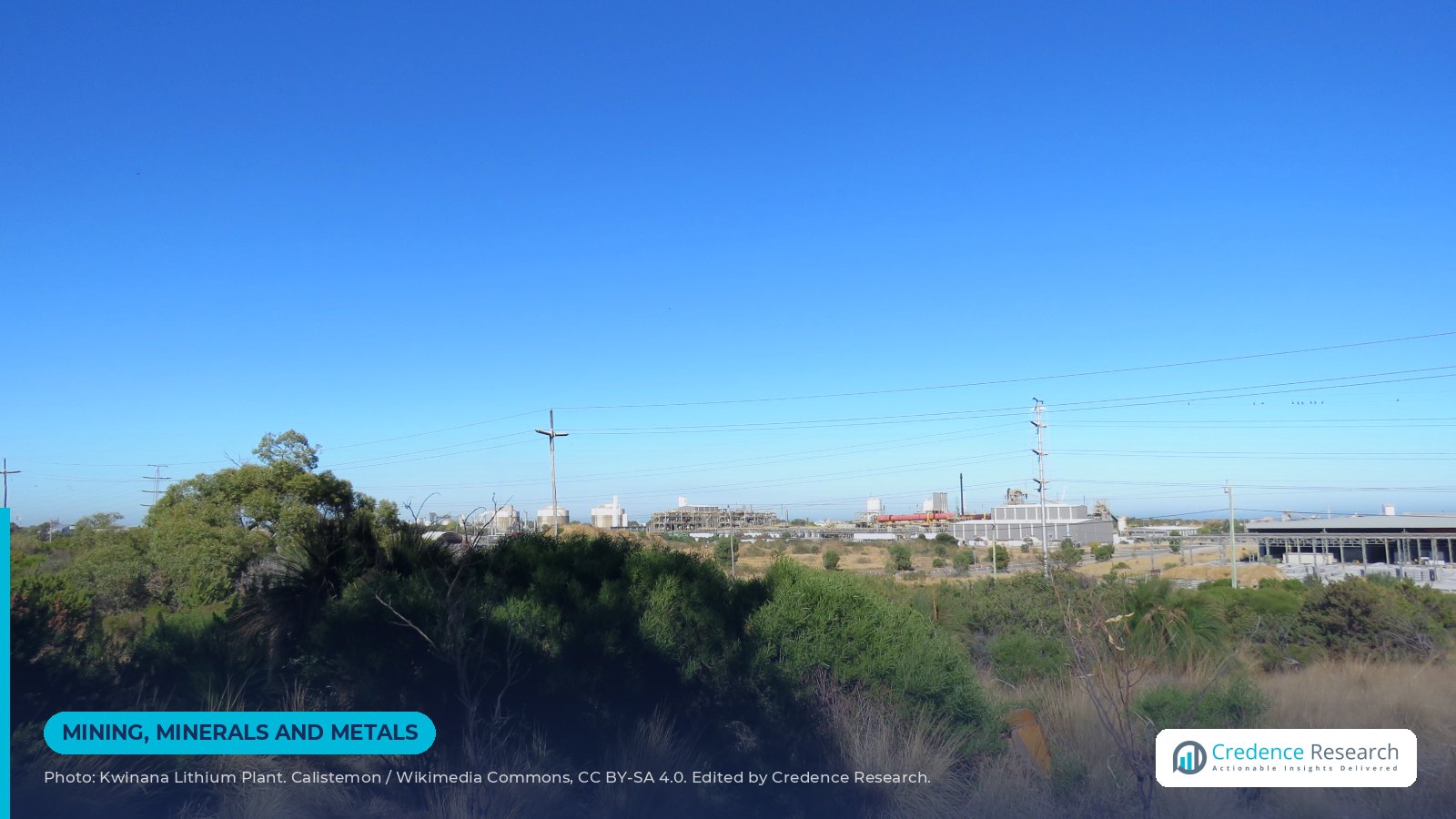
Image: Kwinana Lithium Plant in Western Australia, shown for illustration, by Calistemon via Wikimedia Commons, CC BY-SA 4.0. Cropped and edited by Credence Research.

About the Author

Senior News Editor at Credence Research Inc