
Google Plans $17 Billion Wyoming Data Center, Backed by 702 MW of Fuel Cells and Carbon Storage
Google said on Nov. 5 that it will build its first data center in Wyoming, a long-term, $17 billion commitment in Laramie County, around Cheyenne, developed with Tallgrass Energy, Black Hills Energy, American Electric Power and Related Digital. Power will come from a 702-megawatt fuel cell development with planned carbon capture and storage, new natural gas generation and a privately managed microgrid.
Key developments
- Google described the project as a long-term, $17 billion investment and its first data center in Wyoming. It has not published a breakdown of that sum, a site acreage, a data center capacity figure or an opening date.
- AEP will own about 92% of Cheyenne Fuel Cell, LLC, which will sell power from the 702 MW Bloom Energy fuel cell project to Google under a 20-year power purchase agreement. AEP put the project at about $4 billion and expects it to be fully operational by the end of 2028.
- Black Hills plans to invest $1.8 billion from 2027 to 2029 in 564 MW of company-owned natural gas generation at the Cheyenne Prairie Generating Station site, under agreements with Google that run through 2048.
- Google expects construction to support more than 8,800 jobs statewide, including about 2,500 onsite skilled jobs at peak, and operations to support more than 3,700 jobs a year, including 250 direct roles.
- The facility will be air-cooled, and Google said it will pay for 100% of the power it uses and cover the infrastructure needs directly driven by its growth.
How the power plan fits together
The announcement ties together pieces that surfaced separately over the past six weeks. Black Hills disclosed on Oct. 6 that it had signed definitive agreements with Google, effective Sept. 30, covering a planned Cheyenne data center. Those contracts provide up to 590 MW of grid-connected service, with energy deliveries due to begin in late 2027 and ramp to peak load in 2030. Black Hills will also manage about 2.1 GW of third-party Wyoming resources through a privately managed microgrid, giving a total resource mix of about 2.7 GW including reserve margins. That total is a supply figure and should not be read as the data center's computing load, which Google has not disclosed.
AEP followed on Oct. 14 with the fuel cell project near Cheyenne. Funds advised by Basalt Infrastructure Partners hold the remaining stake of nearly 8%. Bloom Energy's fuel cells convert natural gas to electricity through an electrochemical reaction rather than combustion.
The carbon piece runs through Tallgrass. Google said carbon capture and storage will allow the permanent geologic storage of "a large majority" of the fuel cell project's emissions at Tallgrass's Eastern Wyoming Sequestration Hub, though it gave no percentage. Google will also source power from gas generators operated by Tallgrass and Black Hills, and it is running a front-end engineering study on adding capture to Tallgrass's combined-cycle turbines. Google said the Wyoming contract brings its total contracted carbon capture and storage capacity to nearly 1 GW.
Industry implications
The project shows how far large technology buyers will now go to secure firm power outside the normal utility queue. Instead of relying on one supplier, Google has contracted a fuel cell owner, a utility's non-regulated generation affiliate, third-party resources and a pipeline and storage operator for one location.
The cost language matters as much as the megawatts. Google's pledge to pay for its own power reflects the question now facing developers in statehouses and at utility commissions: who pays when a single customer reshapes a regional grid? Black Hills told investors that Google bears all costs of serving the project, citing cost pass-through mechanisms, early-termination protections and collateral requirements. Google has also provided $399 million in refundable advances for long-lead equipment, which Black Hills expects to reimburse by June 30, 2027.
Competitive and supply chain implications
For Bloom Energy, the Cheyenne order joins a growing set of data center commitments. NTT DATA said on Nov. 5 it would use Bloom fuel cells for 900 MW of onsite primary power across multiple global projects. Those deals put heavy demands on a single fuel cell supply chain. AEP, for its part, is moving beyond its traditional wires and generation role by taking majority ownership of a customer-dedicated fuel cell plant.
The announcement also landed in a tense week for the sector. Reuters reported that Bloom shares fell more than 14% on Thursday amid fears of new restrictions on data centers, and that Microsoft declined to expand a Texas agreement with AI cloud provider Nscale. Google, meanwhile, added Wyoming one day after announcing a $15 billion Malaysia investment.
Regional implications
Google expects hundreds of millions of dollars in local property taxes for Laramie County and School District 1, along with about $610 million in average annual labor income during construction. It also pledged investments in K-12 education, workforce development, and STEM and skilled trades grants, plus unspecified local water replenishment efforts. Air cooling is intended to limit strain on local water resources.
The politics are shifting quickly elsewhere. Reuters, citing Ballotpedia, reported that 40 of 41 data center-related ballot measures decided this week went against data centers. Google and its partners said they met with more than 200 Laramie County residents at a meeting in downtown Cheyenne, and they are forming a Community Council with AEP, Black Hills, Bloom, Related Digital and Tallgrass to address data center growth in the area.
Credence Research analysis
The most useful reading of this announcement is as a template for procurement, not a single site story. Google has spread its exposure across technologies with different lead times: grid service from late 2027 and fuel cells by the end of 2028. It has also placed capture commitments on the newest asset while treating the turbine retrofit only as a study. That sequencing lets the company secure capacity first and decide on the costliest emissions measures later. Buyers in states with gas supply and geologic storage near available land will likely study it.
The gaps deserve equal attention. Google's $17 billion is a long-term commitment with no published allocation, and the AEP and Black Hills figures come from separate disclosures not reconciled with it, so they should not be added together. "A large majority" of emissions is not a measured capture rate, and the fuel cells will still run on natural gas. Until the companies publish capture performance and storage volumes, the climate case remains a stated intention. The commercial case, by contrast, is already backed by signed contracts running as long as 2048.
What comes next
- AEP plans to begin fuel cell construction in 2026, with full operation targeted by the end of 2028.
- Black Hills has an industrial siting permit filed for the Cheyenne Prairie expansion, and it has filed for a certificate covering the South Cheyenne transmission expansion. A further Wyoming transmission filing is planned for the fourth quarter of 2026.
- Black Hills expects energy service to begin in late 2027 and reach peak load in 2030.
- Google has yet to announce a construction schedule or opening date for the data center itself.
- The front-end engineering study on Tallgrass's turbines will determine whether capture extends beyond the fuel cell project.
Sources
- Google: Google's data center investment in Wyoming (Nov. 5, 2026)
- American Electric Power release on the 702 MW Cheyenne fuel cell project (Oct. 14, 2026), via PR Newswire copy
- Black Hills Corp.: Google agreements disclosure (Oct. 6, 2026)
- Reuters via Yahoo Finance: Google plans $17 billion Wyoming data center (Nov. 5, 2026)
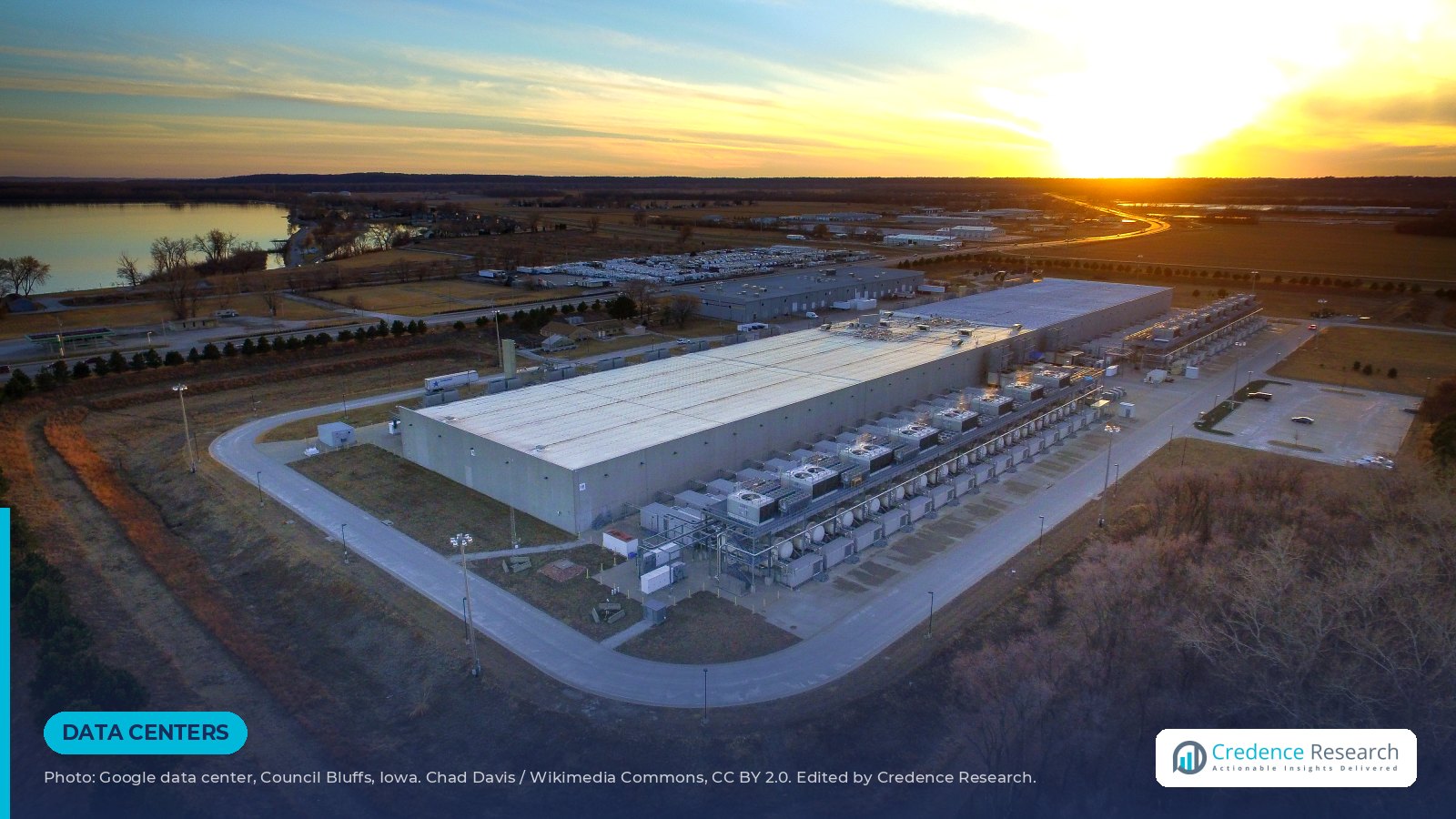
Image: Google data center in Council Bluffs, Iowa, shown for illustration and not the Wyoming site, by Chad Davis via Wikimedia Commons, CC BY 2.0. Cropped and edited by Credence Research.

About the Author

Senior News Editor at Credence Research Inc