
Boehringer Ingelheim, SBP Group sign option deal on six preclinical cancer programs
Boehringer Ingelheim and Sino Biopharmaceutical Limited, known as SBP Group, signed an option and license agreement on Nov. 4, 2026, covering six preclinical cancer programs. The German drugmaker will back antibody-drug conjugates and T-cell engagers developed by SBP subsidiaries in China, with $358 million in upfront and near-term payments and up to $7 billion in potential milestones. The deal is the second oncology partnership between the two companies and arrives weeks after Boehringer opened a China research center built partly to find such assets.
Key developments
- The agreement covers six preclinical biologic programs. Five are associated with LaNova Medicines in Shanghai and one comes from Beijing Tide Pharmaceutical, both SBP subsidiaries.
- SBP Group will receive $358 million in upfront and near-term payments and is eligible for up to $7 billion in option-exercise, development, regulatory and commercial milestones, plus tiered royalties of up to double-digit percentages.
- SBP Group leads early development. After agreed clinical milestones, Boehringer may exercise options for exclusive development, manufacturing and commercialization rights.
- For four programs, those rights would apply outside mainland China, Hong Kong and Macau. For the other two, they would be worldwide.
- The companies did not disclose targets or indications. Reuters reported that Boehringer did not respond to a request for comment on which diseases the programs address.
How the modalities work
Antibody-drug conjugates link a cytotoxic payload to an antibody that seeks out a protein on tumor cells, so the drug is delivered more selectively than conventional chemotherapy. T-cell engagers take a different route. They bind a tumor target and a T cell at the same time, drawing the patient's own immune cells toward the cancer. Both classes demand specialized engineering and manufacturing.
The companies' existing relationship dates to April 2024, when they announced a partnership to bring Boehringer cancer medicines to China, including three drugs then in clinical trials and several earlier-stage programs. That first agreement moved Western assets into China through SBP's commercial network. The new one runs in the opposite direction, sending Chinese-originated candidates toward global development.
LaNova is central to that reversal. BioPharm International reported that SBP agreed in July 2025 to buy the 95.09% of LaNova it did not already own, for up to about $951 million. The Boehringer agreement draws five of its six programs from that unit, little more than a year later. The same outlet reported that Boehringer licensed an antibody-drug conjugate from South Korea's AimedBio in October 2025 for up to $991 million.
Industry implications
The structure shows how large drugmakers are managing early-stage risk when they source from China. Boehringer is not buying finished clinical assets. It is paying near-term money for the right to decide later, once human data exist, while SBP carries the early development work. According to Reuters, that work runs through global Phase 1 trials. Most of the headline value depends on options, clinical results, approvals and sales that may never occur, so the $358 million is the firmest indication of what the buyer is committing today.
The deal also follows a pattern set just weeks earlier. On Oct. 19, Hansoh Pharma and Roche announced an antibody-drug conjugate collaboration with a $400 million upfront payment, a $110 million first-anniversary payment and potentially more than $15 billion in milestones, Pharmaceutical Executive reported. Hansoh leads early work through global Phase 1a trials before Roche takes over worldwide development. Two large European groups have now adopted similar models in the same month, with the Chinese partner advancing preclinical candidates and the Western partner holding the later-stage path.
Pharmaceutical Technology reported that Sanofi, GSK and AstraZeneca also signed licensing deals with Sino Biopharm in 2026, none above $2 billion, making the Boehringer agreement the largest of that group by potential value.
Competitive and supply chain implications
For SBP Group, the agreement offers external validation and non-dilutive funding for an early pipeline. Chairwoman Theresa Tse said the partnership further validates the group's scientific capabilities in next-generation oncology and said the company will keep expanding its global partner network. Boehringer board member Paola Casarosa, head of the company's Innovation Unit, said the deal brings together complementary science and puts the company's China strategy into action.
The rights language carries a supply chain question that the companies have not yet answered. If Boehringer exercises its options, it would hold exclusive manufacturing rights in the relevant territories, but the release does not say where clinical or commercial material would be produced. Antibody-drug conjugates in particular rely on a specialized chain of antibody production, payload synthesis and conjugation, often split across several sites. Any eventual transfer from China-based development to a global supply network would be a significant technical step.
Regional implications
China sits at the center of the agreement on both sides. Boehringer opened its China Research and Development Center in Zhangjiang Science City, Shanghai, in October, according to Yicai Global. The outlet reported that the center includes an External Innovation team charged with finding and evaluating partnerships and in-licensing deals with Chinese innovators, under the company's China Strategy 2035. The release does not say the center originated this transaction.
The split in territorial rights is worth watching. Four programs would leave mainland China, Hong Kong and Macau outside Boehringer's option, while two would give it worldwide rights. The companies have not said which programs fall in each group or why they differ.
Pharmaceutical Technology reported that China's five-year biomedical plan seeks to have Chinese companies develop 25% of global first-in-class drugs by 2030, a policy goal that gives the country's developers further reason to pursue foreign partners.
Credence Research analysis
The most instructive number in this deal is the smallest one. Headline biobucks draw attention, but $358 million for six programs with no disclosed targets is a concrete bet on a platform and a development engine, not on any single molecule. Paying in stages lets SBP generate the first human data and lets Boehringer decide with that evidence in hand. SBP's purchase of LaNova is now producing a measurable return in partnering terms, although the milestone money remains contingent.
The strategic risk for Western buyers is concentration. As more companies adopt the same model, their early oncology pipelines come to depend on a smaller set of Chinese discovery groups and on policy conditions outside their control. The test for this agreement will be whether first-in-human results justify the options and whether Boehringer can transfer these complex biologics into its own development and manufacturing network without losing the time advantage that made the structure attractive.
What comes next
- SBP Group advances the six preclinical programs, with no public timeline yet for first clinical trials.
- The companies may disclose targets, indications or formats as candidates approach human testing.
- Agreed clinical milestones will trigger Boehringer's decisions on option exercise, program by program.
- Any exercised option would move development, manufacturing and commercialization rights to Boehringer in the agreed territories.
- The new agreement builds on the 2024 collaboration, and any update on those programs would add context.
Sources
- Boehringer Ingelheim: New oncology partnership with SBP Group
- Boehringer Ingelheim and Sino Biopharmaceutical joint release via EuropaWire
- Yicai Global: Boehringer Ingelheim opens China R&D center in Shanghai
- Pharmaceutical Executive: Hansoh Pharma and Roche collaboration and license agreement
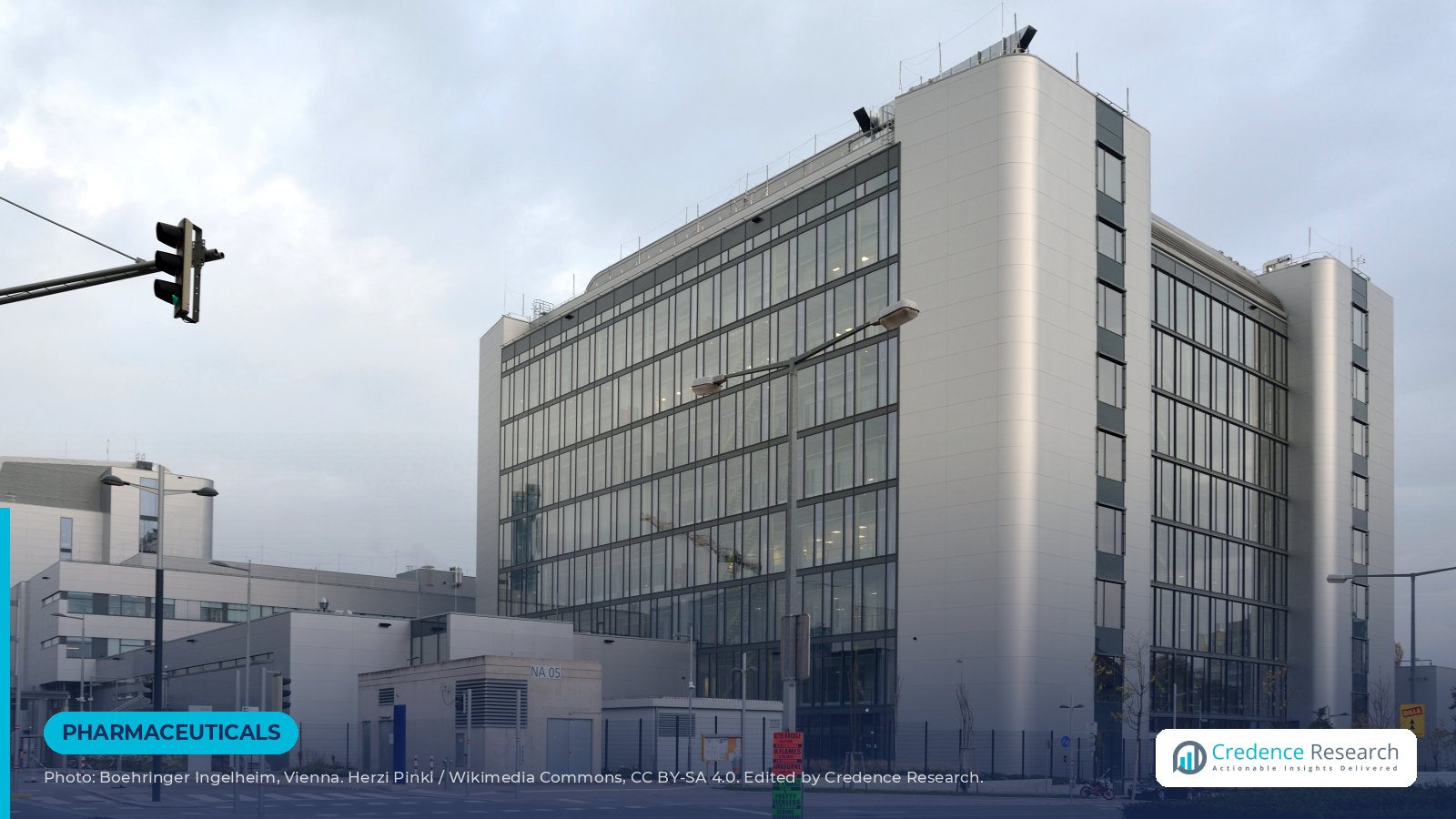
Image: Boehringer Ingelheim building in Vienna, by Herzi Pinki via Wikimedia Commons, CC BY-SA 4.0. Cropped and edited by Credence Research.

About the Author

Senior News Editor at Credence Research Inc