
Toyota Raises Operating Income Forecast to 3.9 Trillion Yen as North America Returns to Profit
Toyota Motor Corp. on Nov. 5 raised its operating income forecast for the fiscal year ending March 31, 2027, to 3.9 trillion yen from 3.4 trillion yen, after first-half results showed its North American business back in profit. The automaker, based in Toyota City, Japan, reported the figures at a Tokyo press briefing and also disclosed plans for a companywide robotics organization that will start work in January.
Key developments
- First-half operating income rose by 185.4 billion yen to 2.19 trillion yen, on sales revenues of 26.96 trillion yen, for the six months ended Sept. 30.
- North America swung to operating income of 132 billion yen from a loss of 134.1 billion yen a year earlier, which Toyota attributed largely to price revisions and a reduced U.S. tariff impact.
- Toyota and Lexus vehicle sales fell to 5.06 million units from 5.27 million, while China retail sales dropped to 685,000 from 914,000.
- Electrified vehicles reached 2.81 million units, or 55.6% of Toyota and Lexus sales, up from 46.7%.
- Toyota Robotics launches Jan. 1, 2027, and the share repurchase ceiling for the fiscal year rises by 300 billion yen to as much as 1.3 trillion yen.
Industry background
Toyota's report arrives during a difficult earnings season for global vehicle makers, whose costs have been pushed up by U.S. tariffs, raw material prices and the conflict in the Middle East. The company said it faces approximately 1 trillion yen in rising materials prices this fiscal year. It also said earthquakes and floods disrupted production, and that recovery work at plants and adjustments to its global supply limited the damage to earnings.
The first-half result also leaned on currency. The yen averaged 159 to the dollar, compared with 146 a year earlier. Accounting Group Chief Officer Takanori Azuma cited cost reductions with suppliers, price revisions and growth in value chain businesses as further offsets. Net income attributable to Toyota climbed by 463 billion yen to 2.24 trillion yen, helped by a 290.8 billion yen increase in other income.
The new forecast assumes a stronger yen than the previous one, at 157 to the dollar rather than 160, so the upgrade does not rest on currency. Toyota instead pointed to lower tariff-related costs and accumulated improvement efforts. Its net income forecast rose to 3.57 trillion yen from 3.25 trillion yen, and the dividend forecast stayed at 100 yen a share, up 5 yen from last year.
Industry implications
The clearest signal in the results is the shift in sales mix. Hybrids reached 2.45 million units in the half, up 8.3%, and battery electric vehicles more than doubled to 231,000 from a far smaller base. Toyota's full-year plan calls for 5.74 million electrified vehicles, including 5.01 million hybrids and 463,000 battery electric models, and its stated strategy keeps hybrids at the center of a 10 million vehicle electrified base by 2030.
Other parts of the industry are retrenching. BMW said this week it would phase out some current-generation electric models early, and supplier Schaeffler announced 3,460 job cuts in Europe. Toyota's figures show a company still absorbing heavy costs, yet with a product mix that is holding up where demand has been steady.
The robotics move extends the story beyond vehicles. Toyota sees internal demand for about 400,000 robots, with 150,000 units for itself and group companies and 250,000 for suppliers, across a sales period running from 2028 to 2040. It also cited an annual requirement of 1 trillion yen to replace aging equipment.
Competitive and supply chain implications
Toyota's revised plan keeps consolidated vehicle sales at 9.7 million units, while cutting the Toyota and Lexus retail target to 10.3 million from 10.5 million, mainly because of slower conditions in China. Planned production stands at 9.8 million vehicles, with 3.4 million in Japan and 6.4 million overseas. Consolidated sales of 4.76 million units in the half were nearly level with last year, and Azuma said the decline of 25,000 units came mainly from excluding Hino, the truck maker. Without Hino, sales rose by 26,000.
Suppliers should read the results as a sign that pressure on costs will continue. Toyota credited joint cost reduction work with suppliers for part of its first-half performance, and it plans to bring automation and robots deeper into its own supply base. A group of 250,000 supplier robots would represent a substantial capital program for parts makers, many of which already face tariff and material cost burdens.
The value chain is another competitive lever. Toyota said value chain profit grew from 1 trillion yen in fiscal 2021 to 2.1 trillion yen in fiscal 2026, drawing on 150 million vehicles in use, and that it targets a further 1 trillion yen by 2030.
Regional implications
Japan remained the largest profit center, with operating income of 1.26 trillion yen, up 138.7 billion yen. Europe rose to 207.7 billion yen on price revisions and value chain profits, while Asia slipped to 434 billion yen from 445.1 billion yen. Toyota raised its Japan sales plan to 1.64 million units and lowered North America to 1.74 million from 1.78 million.
China is the weak point. Retail sales fell by about a quarter, and operating income from consolidated subsidiaries there dropped to 65 billion yen from 122.2 billion yen. Toyota also cut its Asia sales plan to 3 million units from 3.02 million, citing China and flooding in Thailand. Its response includes Lexus Electrified Shanghai, due to begin operations in September 2027 with a goal of cutting 18 months from development time. In emerging markets, Toyota is preparing a multipathway platform spanning A, B and C segments.
Credence Research analysis
The upgrade is less a demand story than a cost and tariff story. Unit sales forecasts barely moved, and the Toyota and Lexus target fell, yet operating income guidance rose by 500 billion yen. Toyota's materials show gains from accessories, spare parts and expenses as well as model mix, which suggests management is finding profit through pricing, parts and service rather than extra volume. North America's recovery is real but thin: 132 billion yen on a large base leaves Toyota exposed to any further change in U.S. trade policy.
The capital allocation plan may matter more over time than the quarterly numbers. For fiscal 2027 through 2031, Toyota set aside 22 trillion yen for capital spending, research and growth investment, 11 trillion to 14 trillion yen for shareholder returns and 7 trillion yen as a contingency reserve. Pairing that with a new robotics unit indicates Toyota regards factory automation as a way to protect margins, and perhaps as a future business, as its China sales fall.
What comes next
- Jan. 1, 2027: Toyota Robotics begins operations as a companywide organization.
- January 2027: A new Kanri Group combines the General Administration and Human Resources Group with the Accounting Group, and Chairman Akio Toyoda leads the Toyota Philosophy and Education Group.
- March 31, 2027: The fiscal year closes, testing the 3.9 trillion yen operating income forecast and the 157 yen dollar assumption.
- September 2027: Lexus Electrified Shanghai is scheduled to begin operations.
Sources
- Toyota Motor Corp.: FY2027 second quarter financial results, with transcripts
- Toyota Motor Corp.: Financial results materials
- Toyota Motor Corp.: FY2027 2Q financial results press briefing
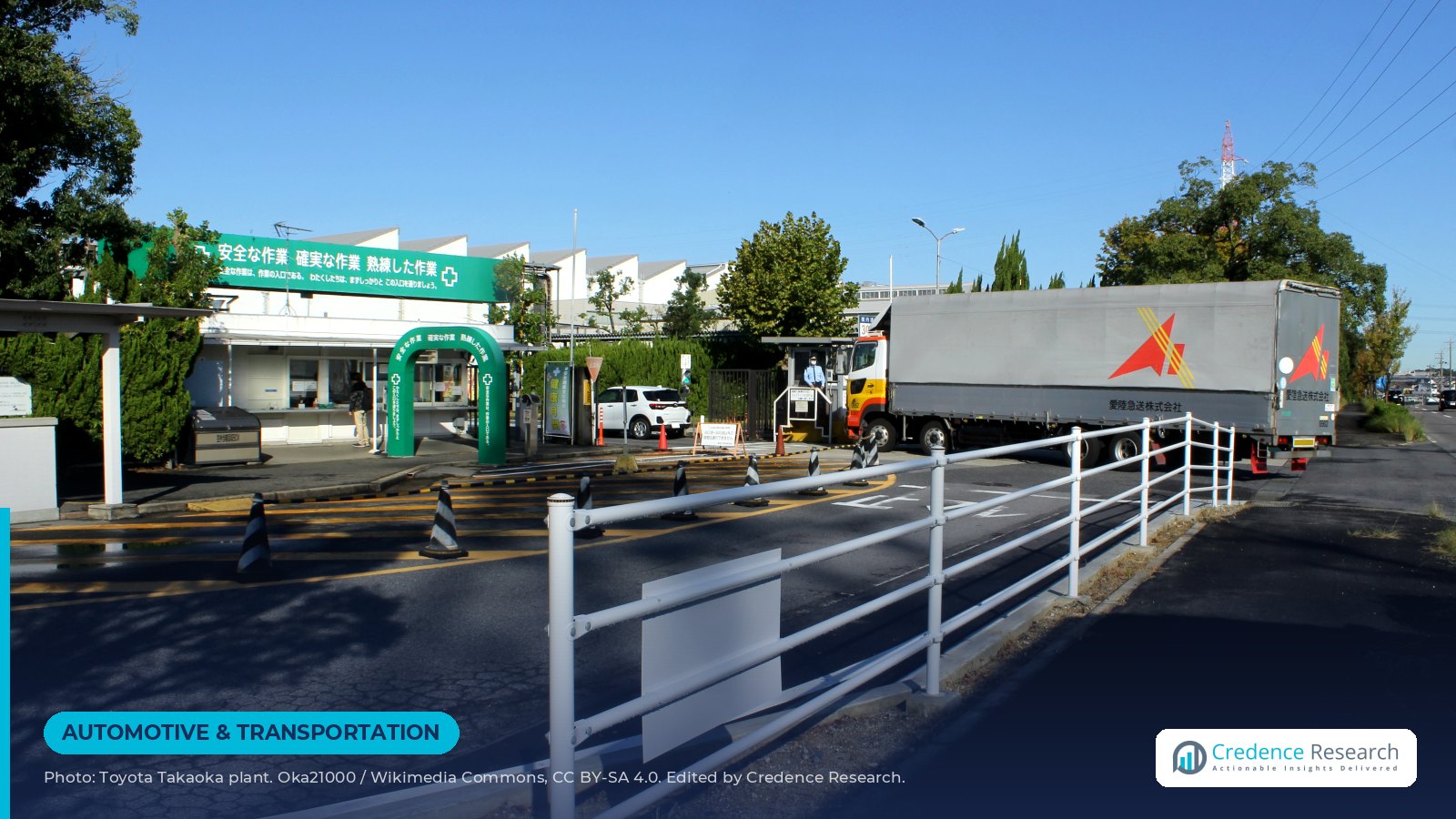
Image: Toyota Motor Takaoka plant in Toyota City, Japan, by Oka21000 via Wikimedia Commons, CC BY-SA 4.0. Cropped and edited by Credence Research.

About the Author

Senior News Editor at Credence Research Inc