
India Approves Rs 14,500 Crore Funding Scheme for 92 GWh of Grid-Scale Energy Storage
India's Union Cabinet on Nov. 4 approved a Rs 14,500 crore viability gap funding scheme to support 92 GWh of new grid-scale energy storage. The program runs from fiscal 2026-27 through fiscal 2030-31 and covers pumped hydro, batteries and alternative technologies. It also requires battery projects to meet a minimum 40% domestic content threshold, adding an industrial policy goal to its grid objectives.
Key developments
- The Cabinet, chaired by Prime Minister Narendra Modi, approved total support of Rs 14,500 crore, about Rs 145 billion. Mercom India put the amount at roughly $1.53 billion.
- The 92 GWh target splits into 60 GWh of pumped storage, 30 GWh of battery energy storage and 2 GWh of alternative technologies.
- The government estimates total investment at Rs 97,600 crore across the three categories.
- Capacity will be allocated through tariff-based competitive bidding. Public and private distribution companies are eligible for battery and pumped storage support.
- Battery projects must meet a minimum 40% domestic content requirement.
Why storage has become a grid priority
Viability gap funding is a capital subsidy that covers part of a project's cost so that it can compete at tariffs buyers will accept. The government said the new capacity must not yet be commissioned, so the money is aimed at additional assets rather than plants already running. It said the 92 GWh equals 170% of present-day grid-scale storage capacity and supports a requirement of 411 GWh by 2031-32, the planning figure attributed to the Central Electricity Authority.
The scheme builds on an earlier and smaller program. The Cabinet approved battery funding in September 2023, and the Ministry of Power later said capacity under that scheme had grown from 4,000 MWh to 13,200 MWh within a Rs 3,760 crore budget. In April 2025, the ministry said no project had reached financial closure, so no money had been spent in 2024-25. Energy-Storage.news reported that the power minister announced a further Rs 5,400 crore for 30 GWh in June 2025, and that a 20% domestic content rule for funded battery projects followed in December 2025.
Project delivery remains the central gap. Down To Earth reported in April 2026 that India had less than 1 GWh of commissioned battery storage, while 28,739 MWh was under construction and 69,837 MWh was at the tendering stage as of Jan. 31, 2026.
Industry implications
Pumped storage accounts for about 65% of the targeted capacity. That weighting matters because pumped hydro projects offer long asset lives but carry long construction periods and site-specific geological and environmental risk. Public funding may help developers and distribution companies accept those risks, although the approval does not publish a per-unit subsidy rate or a commissioning schedule for individual projects.
The tariff-based bidding model will shape how support reaches the sector. Distribution companies are eligible for funding on battery and pumped storage capacity, placing utilities close to the center of procurement. Bidders will then compete on delivered tariffs, which should reveal how much of the subsidy passes through to power buyers. Alternative technologies, limited to 2 GWh, follow a different route, with both public and private entities able to implement projects.
By Credence Research's calculation, public support equals about 15% of the estimated Rs 97,600 crore investment. Private and utility balance sheets, along with lenders, would need to carry the remainder, so financing terms are likely to be as important as the subsidy. High capital costs and expensive financing were among the obstacles identified in the Down To Earth report.
Competitive and supply chain implications
The 40% threshold is the provision most likely to reshape battery sourcing. It doubles the 20% rule introduced for funded projects in December 2025, and the government says it is meant to promote indigenous manufacturing. The Cabinet announcement does not say how content will be measured, so implementation guidelines will determine whether local pack assembly and software can satisfy much of the rule or whether suppliers must localize more of the cell value chain.
Large developers already hold positions in both technologies. AlCircle reported in June 2025, citing the Central Electricity Authority, that Greenko had about 13.2 GW of planned pumped storage, Adani Green Energy 11.4 GW and JSW Energy 7.7 GW. Down To Earth reported in April 2026 that Adani Green planned to deploy more than 10 GWh of batteries in 2026 and about 15 GWh or more a year from 2027. Eligibility rules for distribution companies may also create openings for utility-led procurement.
Pumped storage also draws on a different supply base from batteries: civil contractors, tunneling specialists, and makers of reversible turbines and generators. A sustained tender program would test that capacity alongside a battery chain that the Down To Earth report said remains exposed to imported lithium and cobalt.
Regional implications
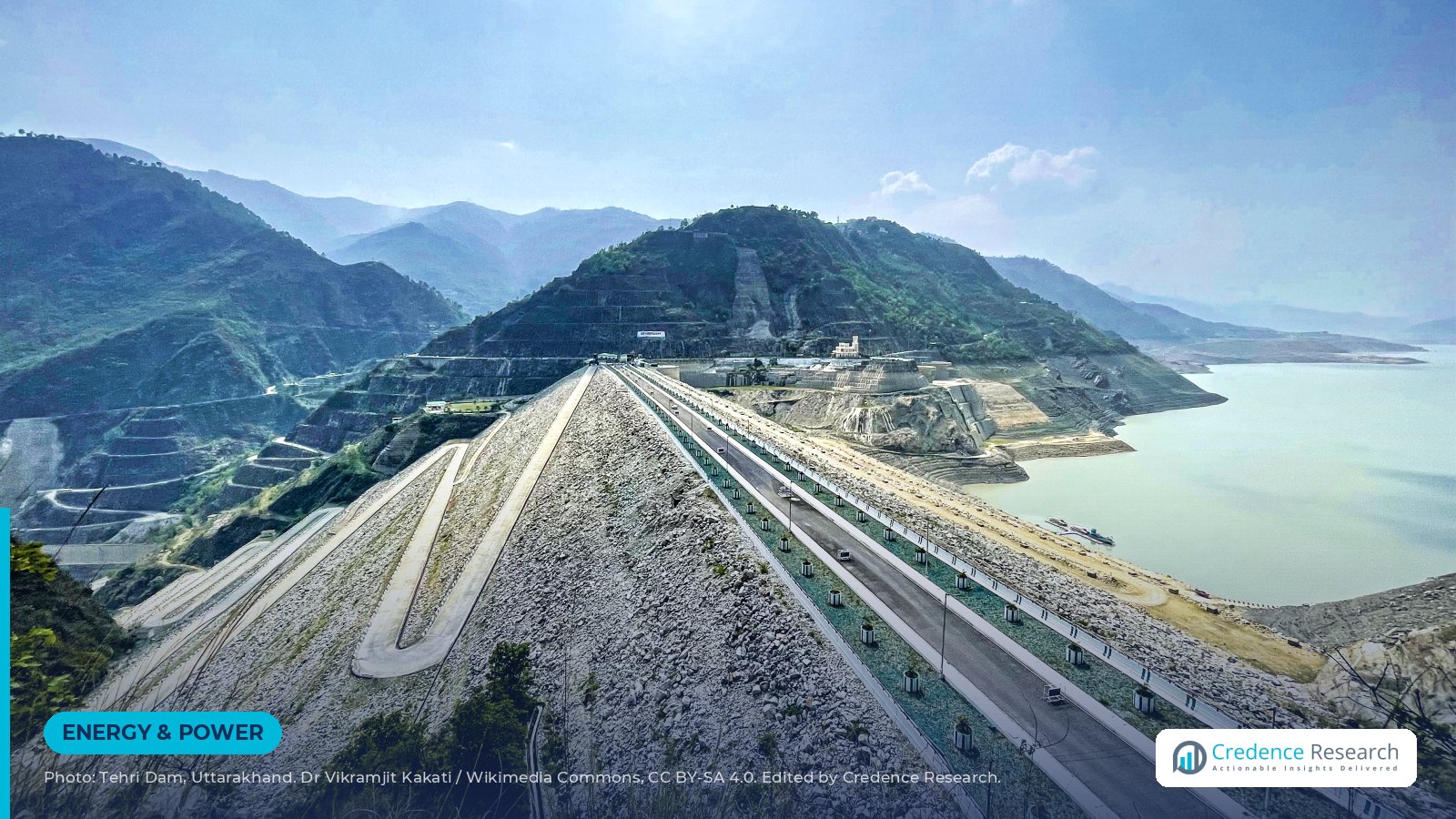
The Cabinet announcement names no states, so the geographic spread will depend on bidding and on the availability of sites and transmission. Existing plans point to some early centers. AlCircle reported that Andhra Pradesh and Maharashtra were expected to host nearly 57% of planned pumped storage capacity. THDC India's 1,000 MW Tehri project in Uttarakhand, built around the existing Tehri and Koteshwar reservoirs, offers a domestic reference for adding pumped storage at established hydro complexes.
Battery deployment may follow renewable zones and constrained transmission corridors. Adani Green has said it is co-locating batteries with solar and wind assets, mainly at Khavda in Gujarat and at sites in Rajasthan, according to Down To Earth. Distribution company participation could also widen demand beyond those resource-rich states, because utilities in consuming states need peak supply and balancing capacity of their own.
Credence Research analysis
The decision marks a shift in India's storage policy from a battery-only subsidy toward a portfolio approach that gives long-duration pumped hydro the largest capacity allocation. That choice suggests policymakers view the storage need as more than a short-duration balancing problem. It also spreads technology risk: batteries can be built quickly, while pumped storage offers scale and longevity but takes far longer to reach operation. The five-year window may prove tight for projects that have not already cleared early development stages.
The higher domestic content floor creates the main tension in the scheme. A stricter local sourcing rule can support manufacturing investment, but it may also raise costs or narrow the supplier pool if domestic capacity does not expand in time. Because the program depends on competitive tariffs, bidders will need to price that risk directly. The earlier scheme's slow move toward financial closure shows that an approved budget does not guarantee delivery. Tender design, payment security from distribution companies and clear content rules will likely determine how quickly this funding turns into operating capacity.
What comes next
- Publication of operational guidelines covering subsidy rates, disbursement and the method for calculating domestic content.
- First tariff-based tenders for battery and pumped storage capacity under the new scheme.
- Bidding results that show how much of the support is reflected in delivered storage tariffs.
- Domestic battery manufacturing commitments from suppliers seeking to qualify under the 40% threshold.
- Progress against the 411 GWh requirement set for 2031-32, with the funding window closing at the end of fiscal 2030-31.
Sources
- Prime Minister's Office: Cabinet approves Rs 14,500 crore Viability Gap Funding Scheme for 92 GWh of grid-scale storage
- Energy-Storage.news: India introduces 20% domestic content rule for battery storage funding
- Down To Earth: Adani Green storage targets and India's storage pipeline
- AlCircle: India's planned pumped storage capacity and developers
Image: Tehri Dam in Uttarakhand, India, by Dr Vikramjit Kakati via Wikimedia Commons, CC BY-SA 4.0. Cropped and edited by Credence Research.

About the Author

Senior News Editor at Credence Research Inc