
X-energy, Alleima and Doosan Place First Steam Generator Tubing Order for Xe-100 Reactor
X-energy, Alleima and Doosan Enerbility on Nov. 4 announced the first procurement of steam generator tubing for the Xe-100 small modular reactor, moving a key component for the first planned U.S. deployment from framework to purchase order. Sweden-based Alleima will make the specialized stainless steel tubing and supply it to South Korea's Doosan, which will bend it into helical coils for a proposed four-unit plant with Dow in Texas. The companies did not disclose the value, volume or delivery schedule of the order.
Key developments
- Alleima said the order from Doosan is its first for steam generator tubing for a next-generation, helium-cooled small modular reactor.
- Doosan will form the tubing into helical coils using its own fabrication processes. The coils remove heat from the reactor to produce steam at up to 565 degrees Celsius.
- The material is destined for the first Xe-100 deployment, a proposed four-unit plant at a Dow industrial site in Texas supported by the U.S. Department of Energy's Advanced Reactor Demonstration Program.
- The order follows a strategic framework the three companies signed earlier in 2026 and a binding reservation agreement between X-energy and Doosan announced in December 2025.
- It arrives days after X-energy said on Oct. 30 that the Nuclear Regulatory Commission had completed its safety review of the Texas project.
How the Xe-100 steam system works
The Xe-100 is an 80-megawatt-electric, high-temperature gas-cooled reactor that uses helium as its coolant and TRISO coated particle fuel in a pebble-bed core. That design separates it from the light-water reactors that make up most of the world's operating nuclear fleet, and the steam generator coils must withstand high temperatures.
Steam temperature is central to the commercial case. X-energy says the 565-degree output allows a single Xe-100 to supply both electricity and high-temperature process heat for industrial use. That dual role helps explain why a chemical producer is the first customer. Dow's proposed site, known as the Long Mott Generating Station, would be the first grid-scale advanced nuclear reactor at an industrial facility in U.S. history, according to X-energy.
Technical work between X-energy and Doosan dates to 2021. Doosan says it has supplied 34 reactor vessels and 124 steam generators to nuclear facilities worldwide. Alleima, based in Sandviken, Sweden, employs about 6,800 people and makes advanced stainless steels and special alloys.
Industry implications
For new reactor designs, procurement milestones can be as telling as licensing ones. A design review shows that a plant can be built safely. A purchase order shows that a developer is committing money and factory time to specific hardware before a construction permit is in hand. X-energy's reservation with Doosan was described as a way to gain cost and schedule certainty on long-lead components, and the tubing order extends that approach further down the supply chain.
The timing also matters because the regulatory path has narrowed. X-energy said the NRC's Final Safety Evaluation Report concludes the proposed plant and site provide a safety basis to begin construction under 10 CFR Part 50, and that the Advisory Committee on Reactor Safeguards supports issuing the permit. The NRC completed its environmental review in May with a Finding of No Significant Impact.
The order is not a construction start, and the companies still describe the Texas plant as proposed.
Competitive and supply chain implications
Qualified nuclear suppliers are few, and new reactor designs compete for their attention with conventional plant projects and life extensions. Locking in tube supply early gives X-energy a place in that queue. It also gives Alleima, by its own account, a first order of this kind for a helium-cooled small modular reactor.
The structure of the deal is worth noting. Alleima sells to Doosan, not directly to X-energy, which places Doosan as the integrator of materials and fabrication for the coils. X-energy said it looks forward to learning from its suppliers, a sign that a first-of-a-kind developer relies on established manufacturers for know-how as well as capacity.
The December 2025 agreement covers 16 sets of reactor pressure vessels, steam generator pressure vessels and other steel components, reserving capacity for X-energy's first two commercial projects. Doosan also committed to a new small modular reactor fabrication facility in Changwon, expected to support about 20 Xe-100 units a year at full production. Fuel is a parallel constraint: X-energy's TRISO-X unit said in September that it had completed vertical construction of its TX-1 fuel fabrication facility.
Regional implications
The order links three industrial bases. In Sweden, it supports Alleima's push into nuclear applications. Alleima inaugurated a production facility called Tube Mill 2026 in Sandviken in June to serve demand from conventional nuclear power and small modular reactors, although its release does not say the Xe-100 tubing will be made there. In South Korea, the order adds work to Doosan's nuclear manufacturing base and supports the case for the planned Changwon facility.
In the United States, the Texas project sits on the Gulf Coast's chemical corridor, where large industrial users need both power and heat. A second U.S. prospect emerged Oct. 19, when X-energy, American Electric Power and Amazon outlined a proposed 12-unit, 960-megawatt plant near the retired Breed Generating Station in Sullivan County, Indiana. That project remains at the feasibility stage and could still not proceed. In the United Kingdom, where X-energy is working with Centrica, the Xe-100 has been accepted into the Generic Design Assessment.
Credence Research analysis
The significance of this order lies less in its size, which is undisclosed, than in its sequence. X-energy is placing supply commitments while its first construction permit is still pending, which suggests the company sees schedule risk in the supply chain as at least as pressing as licensing risk once the safety review is complete. If the permit is issued as the safety findings point toward, the projects with reserved fabrication slots should be better placed than those still negotiating for them. If it slips, the developer carries the exposure of having committed early.
The heavier test is repetition. X-energy cites a pipeline of more than 11 gigawatts, which Doosan's planned 20-unit annual rate is meant to serve, yet this order is tied to the Dow plant alone. The Indiana and U.K. projects still depend on further agreements and reviews. A first order can prove coil fabrication, but the industrial payoff for Alleima and Doosan depends on follow-on orders. Those will show whether the Xe-100 supply chain converts from a demonstration to a production line.
What comes next
- The NRC moves into the final stages of its construction permit review for Long Mott. No decision date has been given.
- X-energy is scheduled to report third-quarter 2026 results on Nov. 12, which may offer further detail on supply chain spending.
- Schedules for tube manufacture, coil fabrication and delivery have not been disclosed and are worth watching.
- Doosan's Changwon fabrication facility remains a milestone to track against its target of about 20 reactors a year.
- X-energy and AEP will carry out feasibility work on the Indiana project under their joint development agreement.
Sources
- X-energy: first order for steam generator components (Nov. 4, 2026)
- Alleima: first order for next-generation nuclear reactor tubing (Nov. 4, 2026)
- X-energy: NRC completes safety review of Xe-100 (Oct. 30, 2026)
- X-energy and Doosan Enerbility: 16-unit reservation agreement (December 2025)
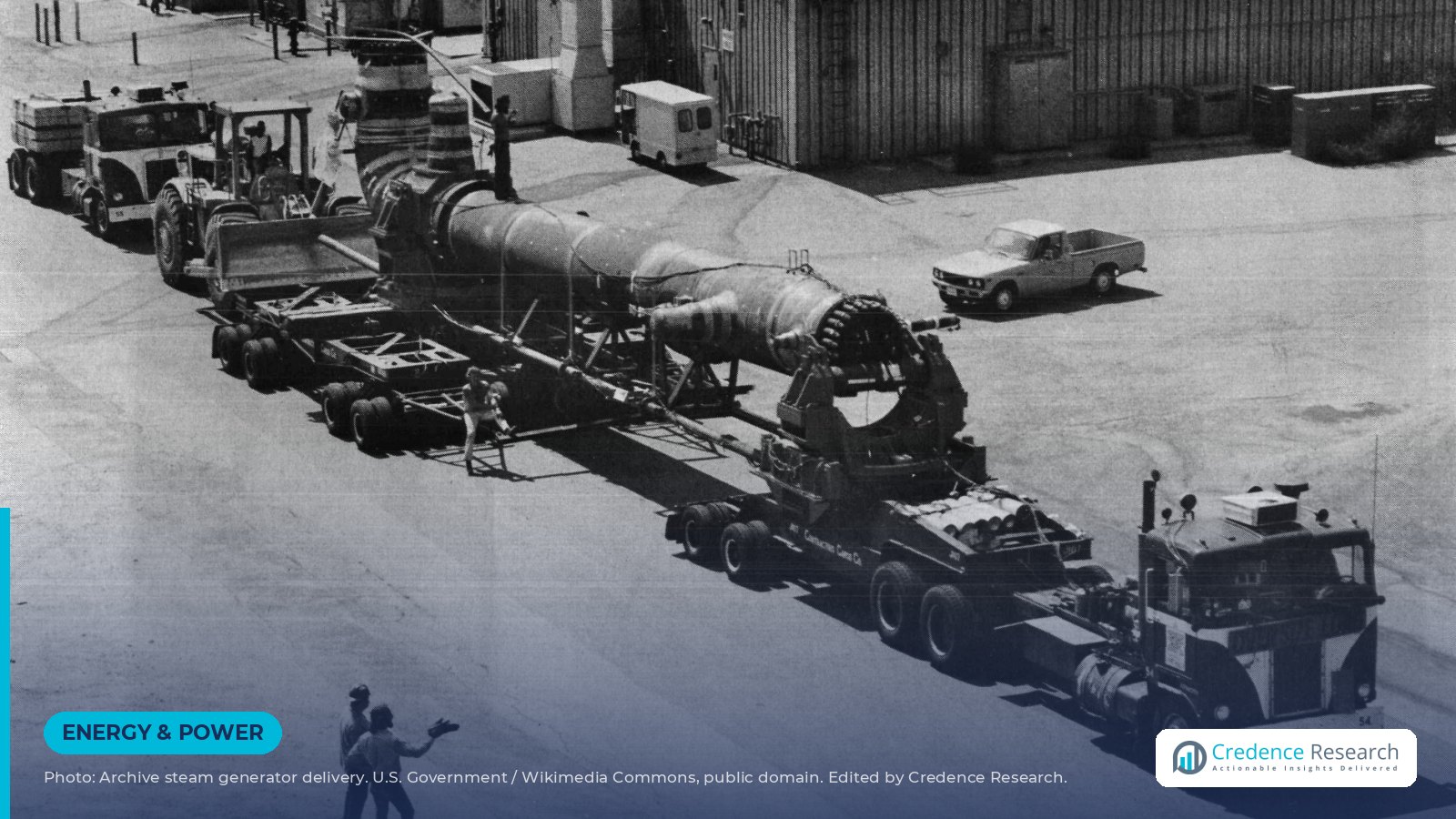
Image: Prototype steam generator being delivered to the Energy Technology Engineering Center for testing, 1981, by the U.S. Government via Wikimedia Commons, public domain. Shown for illustration; not an Xe-100 component. Cropped and edited by Credence Research.

About the Author

Senior News Editor at Credence Research Inc