
Bull and Schwarz Digits Sign MoU on European AI Infrastructure, Pairing Angers Servers With STACKIT
French computing group Bull and Schwarz Digits, the IT and digital division of Germany's Schwarz Group, signed a memorandum of understanding to build a European AI and cloud infrastructure ecosystem, the companies said Nov. 3 from Paris and Berlin. The plan pairs servers from Bull's factory in Angers, France, with Schwarz Digits' STACKIT cloud, and it is aimed at regulated and strategic organizations that want sensitive data and operations kept under European jurisdiction.
Key developments
- Bull and Schwarz Digits signed a memorandum of understanding covering servers, software platforms and appliance environments. The announcement gives no deal value, financial terms or delivery dates and does not describe the memorandum as binding.
- Bull would contribute AI and high-performance computing expertise and rack-scale server production at Angers. Schwarz Digits would contribute secure cloud infrastructure through STACKIT.
- The partners plan to bring the BullSequana AI platform to the STACKIT Marketplace, giving enterprise and public-sector customers a route to AI software under European jurisdiction.
- Stated future work includes co-designing servers on Open Compute Project standards, SAP RISE integration, large high-performance computing projects and exploring quantum computing integration.
Two companies with new European ambitions
Bull changed hands this year. Atos Group completed the sale of its advanced computing activities to the French State on March 31 at an enterprise value of up to 404 million euros, including 104 million euros in contingent earn-outs, leaving the state as sole shareholder. In the new announcement, Bull reports revenue of about 720 million euros, 3,000 employees, operations in 32 countries and 1,600 patents.
On Oct. 2, Bull opened a new production building in Angers as part of an 80 million euro redevelopment due for completion in 2028. The company says the building doubles production capacity and raises productivity by 30%. On Oct. 21, it signed a separate memorandum with Czech operator České Radiokomunikace tied to a Czech AI Gigafactory bid.
Schwarz Digits comes from a different direction. Its parent, Schwarz Group, owns the Lidl retail chain, and the unit provides IT to group companies alongside its cloud, cybersecurity, data and AI, communication and workspace services. In November 2025, it broke ground on a data center at a former power plant site in Lübbenau, Germany, calling the 11 billion euro commitment the largest single investment in the company's history. The site has an initial connected load of about 200 megawatts, could eventually hold up to 100,000 GPUs and is scheduled to finish its first construction phase by the end of 2027. The memorandum does not say whether Bull equipment would be installed there.
Industry implications
The agreement reflects a shift in how sovereign computing is being packaged for buyers. European providers have often addressed the issue at a single layer, whether a national cloud, a domestic supercomputer or a local AI model. Bull and Schwarz Digits describe a stack that runs from manufactured hardware through cloud services to a software marketplace. For a bank or public agency, that could reduce the number of vendors and legal regimes involved in an AI deployment.
Emmanuel Le Roux, CEO of Bull, said the aim is to give organizations capabilities they "can deploy and control." Bernie Wagner, chief revenue officer of Schwarz Digits, said European organizations "cannot afford to choose between cutting-edge computing performance and data sovereignty." That framing targets the main commercial objection to sovereign offerings, which is that customers give up performance or breadth of service to gain legal control.
The technical details point to high-density AI deployments. The partners cite Bull's direct liquid cooling experience and intend to design servers around Open Compute Project standards, which large cloud operators use to simplify rack and server procurement. Planned SAP RISE integration would also extend the relationship beyond AI and into enterprise software workloads.
Competitive and supply chain implications
For STACKIT, Bull offers a European hardware partner with its own factory and a recognized HPC brand. For Bull, STACKIT offers a commercial cloud channel beyond individual supercomputer tenders.
The partnership also gives both companies a sharper answer to U.S. cloud providers such as Amazon Web Services, which launched its European Sovereign Cloud in January. The contest will likely turn on price, service breadth and access to current accelerators, in addition to legal structure.
That last factor remains the clearest gap in the announcement. The companies do not name a GPU or accelerator supplier, and European assembly does not by itself remove dependence on non-European chips. Bull's production capacity is another point to watch. Its Angers release lists the Alice Recoque exascale supercomputer and the LUMI-AI system for delivery in 2027, so any large STACKIT volume would have to fit alongside those public programs.
Regional implications
The alliance carries political weight because it links a French state-owned computing company with the digital arm of a large German retailer. A supplier-and-channel arrangement between two operating companies would be a practical test of Franco-German digital cooperation if it moves past the memorandum stage.
For France, the deal offers a German route to market for Angers production. For Germany, it gives Schwarz Digits an industrial partner within the European Union as it builds out Lübbenau, where the company says STACKIT will run its fifth data center. Both partners also sit within a wider European policy push. The European Commission's InvestAI initiative is designed to support up to five AI Gigafactories, and Bull has already aligned itself with one Czech bid through its October memorandum. The announcement does not connect STACKIT to that project.
Credence Research analysis
This is a statement of intent rather than an order, and it should be read that way. The announcement relies on words such as plan, intend and explore, and it contains no capacity commitment, purchase volume or schedule. Its significance lies in the pairing. The deal connects a European server maker to a commercial cloud with its own large data center program. If the marketplace listing and co-designed servers arrive on a defined timeline, buyers would have a concrete European alternative to evaluate, rather than a policy goal.
The most useful evidence will be operational. A first server order for a STACKIT site, published GPU sourcing and a named regulated customer would each show the partnership has moved beyond positioning. Bull's new status as a state-owned company also adds a question for German buyers and regulators, who may welcome a European supplier while still weighing how French state ownership fits with their own definition of sovereignty. Bull's memoranda in October and November suggest it is building a partner network quickly, and their conversion into contracts will be the better measure of progress.
What comes next
- Any definitive agreement, including commercial terms, volumes or a schedule, which the memorandum does not provide.
- The listing of the BullSequana AI platform on the STACKIT Marketplace.
- Details of co-designed Open Compute Project servers and SAP RISE integration.
- Bull's further industrial partnerships under its Open Factory program, which the company expects to announce in early 2027.
- Completion of the first Lübbenau construction phase, scheduled by the end of 2027, and of the Angers redevelopment in 2028.
Sources
- Bull and Schwarz Digits: A Franco-German alliance for Europe's digital sovereignty (Nov. 3, 2026)
- Atos Group: Completion of the sale of Bull to the French State
- Schwarz Digits: Ground-breaking ceremony in Lübbenau (Nov. 17, 2025)
- Bull: New production building in Angers (Oct. 2, 2026)
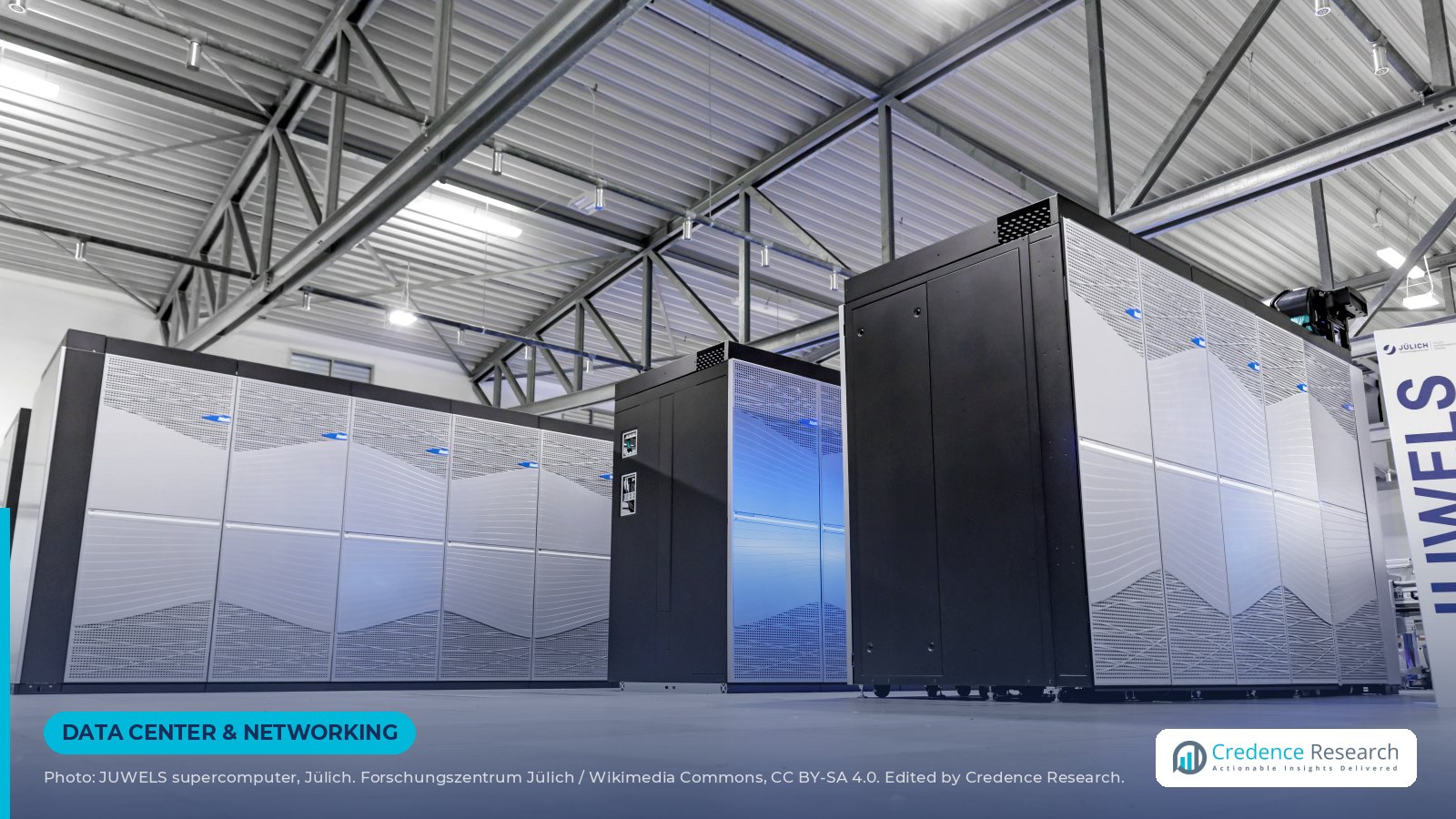
Image: JUWELS supercomputer at Forschungszentrum Jülich, Germany, by Forschungszentrum Jülich via Wikimedia Commons, CC BY-SA 4.0. Cropped and edited by Credence Research.

About the Author

Senior News Editor at Credence Research Inc